
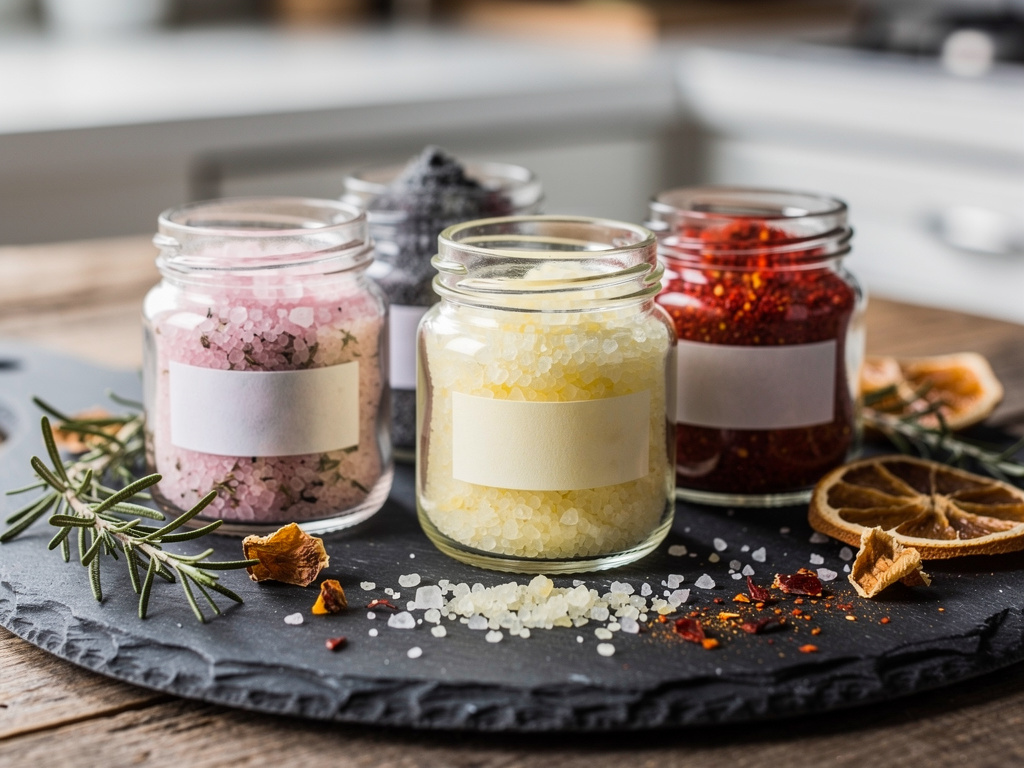


Infused salts, rosemary salt, citrus salt, smoked salt, chili-lime, garlic-herb, are one of those small-batch products that feel gourmet and sell like a gift, yet cost very little to make. They're also a clean fit for cottage food law in most states, because a flavored salt is just a seasoning, and seasoning salts and dried herb blends are standard approved categories. There's one rule that governs everything: whatever you infuse has to be dry. This guide walks through how to sell infused salt from home, why it's cottage-eligible, and how to keep every batch safe, shelf-stable, and gift-worthy.
The short version: Infused and flavored salts, herb salts, citrus salts, smoked salt, chili and garlic blends, are cottage-food eligible in most states, because seasoning salts and dried herb-and-seasoning mixes are standard approved categories. The single rule that matters: everything you blend into the salt must be dry. Dried herbs, dried citrus zest, dried chili, and granulated garlic are fine; fresh herbs, fresh zest, or fresh garlic are not, because moisture invites clumping and spoilage. Dry your botanicals fully and a flavored salt is one of the safest, longest-lasting home food products you can make. Homegrown gives you the storefront to sell your salts as finishing salts, gift sets, and holiday orders. This is general information, not legal advice.
This guide covers why infused salt is cottage-eligible, the dry-infusion rule, what flavors work, labeling, making and storing, the gift market, pricing, and mistakes. This is general information, not legal or food-safety advice.
Yes, in most states you can sell infused salt as a cottage food, because seasoning salts and dried herb-and-seasoning mixes are standard approved cottage food categories. A flavored salt is a seasoning, which puts it squarely in the eligible zone.
Why infused salt is eligible:
The takeaway: seasoning salts and dried herb mixes are standard approved cottage foods, so a flavored salt is clearly eligible in most states. The rule is to register under your state's cottage food program and confirm its seasoning rules, since eligibility is strong but the process still applies, the same first step as starting a cottage food business.
The infusion has to be dry because dry botanicals keep the salt shelf-stable and non-hazardous, while fresh herbs, zest, or garlic add moisture that causes clumping, mold, or spoilage. The whole safety of a flavored salt rests on keeping it dry.
Why the dry rule matters:
The takeaway: the infusion must be dry because moisture is what turns a safe salt into a spoilage or safety risk. The rule is to fully dry every botanical before it touches the salt, since dryness is what keeps the product safe, a core principle of home food safety.
You can make a wide range of infused salts, herb, citrus, smoked, spicy, and savory, as long as every flavoring is dried and shelf-stable. The variety is what makes flavored salts feel gourmet and gift-worthy.
Popular infused-salt flavors:
The takeaway: herb, citrus, smoked, spicy, and savory salts all work as long as the flavorings are dried, giving you a broad, gourmet lineup. The rule is to build a varied all-dry flavor range, since variety and quality sell finishing salts, a cousin of packaging up dry spice blends.
You should label infused salt with its ingredients, an allergen note where relevant, your cottage food disclosure, net weight, and business information, exactly like any cottage food seasoning. Flavored salts are simple to label, but the basics still apply.
Here's what the label needs to cover:
| Label element | Why it matters |
|---|---|
| Ingredient list | Salt plus every dried flavoring, by weight |
| Allergen note | Usually none, but check added ingredients |
| Cottage food disclosure | Your state's "made in a home kitchen" line |
| Net weight and business info | Standard cottage food requirements |
| Suggested uses | Helps the customer use a finishing salt well |
What to get right:
The takeaway: infused salt needs a standard cottage food label plus a helpful suggested-use note, since the basics of ingredients, disclosure, and weight all apply. The rule is to label every flavoring fully and add usage guidance, alongside the rest of your cottage food labeling.
You make and store infused salt by fully drying your botanicals, blending them evenly into quality salt, curing the mix so flavors meld, and sealing it dry in a cool spot. The drying and the salt quality are what set a gourmet salt apart.
Making and storing well:
The takeaway: fully dried botanicals, quality salt, even blending, a short cure, and airtight cool storage give you a gourmet, long-lasting product. The rule is to dry everything completely and start with good salt, since those two choices define the quality.
The market for infused salt is gourmet home cooks, gift buyers, and specialty retailers: finishing salts, gift sets, wedding favors, and boutique wholesale all pull strongly. It's a small-luxury product that punches above its cost.
Where infused salt sells:
The takeaway: infused salt sells to gourmet cooks and gift buyers, where quality and presentation command a premium. The rule is to build your salt business around gift sets and the gourmet-finishing market, the same demand that powers holiday gift boxes.
You price infused salt to cover quality salt and dried botanicals, the jar and packaging, the labor of drying and blending, and a gourmet-market margin, then use gift sets to lift order value. Ingredients are cheap, so the value is in quality, presentation, and the finishing-salt positioning.
Pricing guidance:
The takeaway: price infused salt as a gourmet gift product, covering quality ingredients, packaging, and labor, well above the cost of plain salt. The rule is to price the quality and presentation, then use gift sets to lift order value.
The biggest mistakes selling infused salt are blending in fresh, moist botanicals, using cheap fine salt, weak labeling, and pricing like a commodity. The moisture mistake is the one with safety and quality consequences.
Mistakes to avoid:
The takeaway: the mistakes that matter most are moist botanicals, cheap salt, and weak labeling, all avoidable with a dry, quality-first approach. The rule is to dry everything, use good salt, and label fully before your first jar ships.
Infused salt is a gourmet gift product with strong holiday and gift-set demand, so you need a clean way to take orders, offer sampler sets and bulk favors, and get paid, without losing a cut of every sale. That's what Homegrown is for.
Homegrown gives you an online storefront to sell your salts as single jars, gift sets, and bulk favors, take scheduled holiday and event orders, and collect payment, all for a flat $10 a month with no percentage fees beyond standard payment processing. For a small-luxury product where much of the revenue comes in seasonal gift spikes, a per-order commission quietly skims your best weeks. A marketplace-style platform takes a percentage of every jar, and a generic website builder wasn't made for taking gift and favor orders. Homegrown bundles the storefront, order scheduling, and set options into one flat rate, so your salt margin stays yours. It won't suit everyone, if you sell a few jars to friends for cash, you may not need a storefront yet, but the moment you're taking gift and favor orders online, a flat monthly rate beats handing a percentage to a marketplace.
Ready to sell your infused salts online? Set up your Homegrown storefront and start taking orders.
In most states, yes. Seasoning salts and dried herb-and-seasoning mixes are standard approved cottage food categories, so a flavored salt is clearly eligible. Salt is also inherently shelf-stable, which keeps the product non-hazardous. Register under your state's cottage food program and follow its seasoning and labeling rules, keeping every infusion dry.
No, use dried. Fresh herbs, fresh zest, or fresh garlic add moisture that causes clumping and mold, and fresh garlic specifically carries a botulism risk in low-oxygen conditions. Always fully dry herbs and zest before blending, and use dried or granulated garlic rather than fresh. Keeping everything dry is what makes the product safe and shelf-stable.
Herb salts (rosemary, thyme, Italian herb), citrus salts (lemon, lime), smoked salt, and spicy blends (chili-lime, cayenne) are all popular finishing salts. Building a varied lineup that spans savory, citrus, smoky, and spicy gives customers reasons to buy a set, which is where the gift market shines.
Because salt is a preservative and the infusions are dried, a sealed flavored salt stays good for a year or more, with the flavor gradually mellowing over time. Store it in an airtight jar away from humidity and heat, and date each batch so customers use it while the flavor is at its brightest.
Not really. You need a reliable way to fully dry botanicals (air-drying, an oven on low, or a dehydrator), a means to blend and grind to your target texture, and airtight jars for packaging. The most important thing is ensuring everything is completely dry before it goes into the salt.
It can be, since ingredient costs are low and finishing salts command a gourmet premium. Profitability comes from quality salt and presentation, pricing for the gourmet position rather than as a commodity, and offering gift sets and bulk favors that raise order value. Holiday and gift demand can make flavored salts a strong seasonal earner.



