
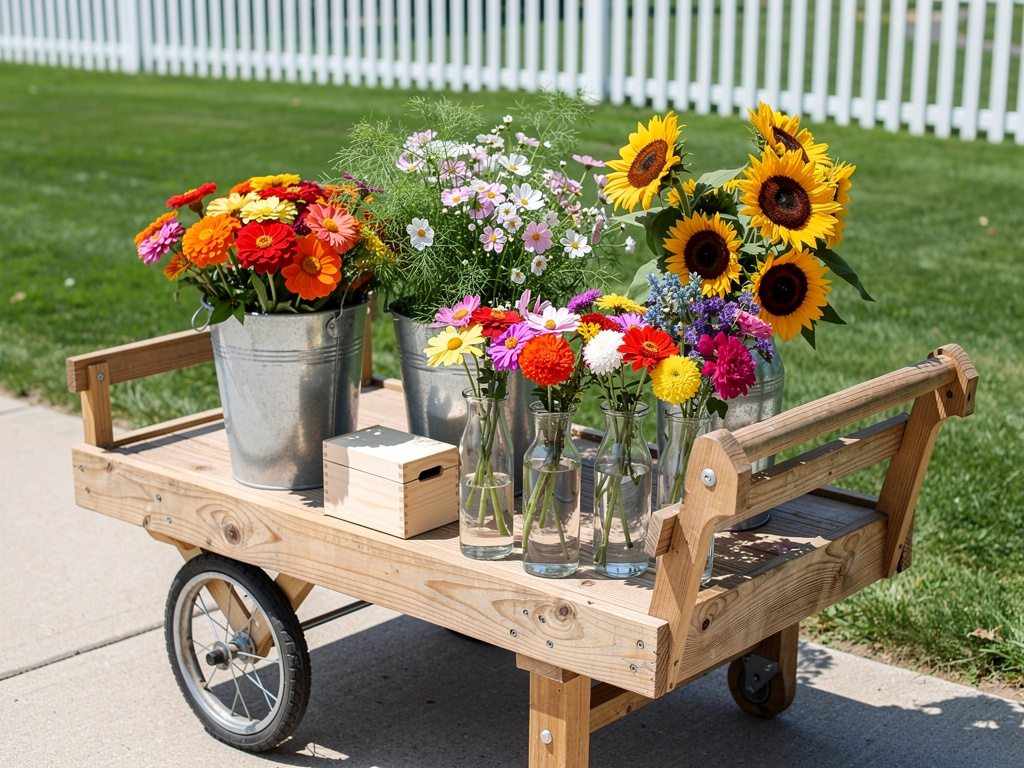


The short version: You can sell cut flowers from home in every state checked for this guide, and because flowers are not food, you will never deal with cottage food rules or a kitchen inspection. The rule that catches people is the state one: Texas requires a yearly registration for every place that grows cut flowers for sale ($110 for a grower on 10 acres or less), and Louisiana requires a $120 Cut Flower Dealer Permit, while Maine, Florida and Nevada leave cut-flower-only growers out of their plant licenses. Washington and Connecticut both tax flowers you grew yourself, and your town decides whether a stand at the end of your driveway is allowed. The simplest setup is a self-serve stand for walk-up sales plus a pre-order page for porch pickup, so you cut to order instead of guessing. On Homegrown, 7 of 16 single bouquet listings were priced at $15 in the September 27, 2026 catalog pull.
Checked September 24, 2026 on each state's own pages: the Texas Department of Agriculture's Nursery Floral program and Agriculture Code sections 71.041 and 71.043, the Louisiana Department of Agriculture and Forestry florist page, Maine's nursery licensing page, the Florida nursery inspection summary sheet (revised May 2016), the Nevada nursery FAQ, and the Washington Department of Revenue and Connecticut Department of Agriculture sales tax pages, plus the Homegrown, Square and Venmo pricing pages. The six states in the license table (five state agency pages plus the Michigan Farmers Market Association) and the two sales tax states are examples, not the whole country, so verify your state's current rules before you sell. Homegrown customers create an account to place a first order, and there is no drop or countdown release feature.
Your zinnias did what zinnias do. You planted one packet in May, and by August you are cutting two buckets a week and running out of vases and friends to give them to. A neighbor asks if she can buy a jar for her table. That is how most home flower businesses start, and it is a good way to start, because cut flowers are one of the few things you can grow in a backyard and sell the same day.
This guide covers the from-home side: the state rules, sales tax, zoning, a driveway stand, porch pickup pre-orders, subscriptions and florists. If you want to sell at a Saturday market instead, our guide to selling flowers at the farmers market covers booths, displays and market day.
Yes: in every state checked for this guide you can sell cut flowers from home with no food permit at all, but you still need to check three things before you put out a price sign: your state agriculture rule, sales tax and your town's zoning. Cut flowers are a plant product, not a food, so the rules that shape a home bakery never touch a bucket of zinnias.
Here is what you will not deal with as a home flower vendor:
Here is what you will deal with:
The work itself is the same as any small flower farm: grow, cut early, keep stems cool, and get them to customers within a day or two. Across the 6 states checked for this guide, none asked a cut flower vendor for a food permit. What changes when you sell from home is where the customer meets you. That can be a stand at the curb, your front porch, a doorstep delivery or a florist's back door, and each one has its own rules and its own math.
In 2 of the 6 states checked for this guide, yes: Texas and Louisiana license people who sell cut flowers, at $110 and $120 a year, while Maine, Florida and Nevada leave cut-flower-only growers out of their plant licenses, and the Michigan Farmers Market Association says Michigan requires none. StandScout's guide says that in most states you can start selling today with no permits or licenses required. Texas and Louisiana are two states where the state's own page, loaded September 24, 2026, says you do need one.
Texas is the clearest case. The Texas Department of Agriculture's Nursery Floral program says every location where nursery products or floral products are sold, offered for sale or grown for sale must be registered. State law defines a "florist item" as "a cut flower, potted plant, blooming plant, inside foliage plant, bedding plant, corsage flower, cut foliage, floral decoration, or live decorative material." A backyard cutting garden that sells bouquets is a place growing florist products for sale. If your bouquets also hold candy, cupcakes or rolled bills, each filling brings its own rule, and our guide to selling homemade bouquets legally covers money, candy, fruit and liquor bouquets, plus Louisiana's $120 cut flower permit.
Louisiana is just as direct. The Louisiana Department of Agriculture and Forestry requires a Cut Flower Dealer Permit to sell cut flowers "singly or arranged," at $120 per location per year, and you need a Louisiana sales tax number before you can apply.
Scroll sideways to see every column.
| State | Do you need a state license to sell only cut flowers? | Yearly cost | What the state's page says |
|---|---|---|---|
| Texas | Yes, a Nursery Floral registration for each location | $110 for a grower on 10 acres or less; $180 for a temporary-market vendor who does not grow; optional extra 15% | Every place that grows or offers florist products for sale registers; selling without one can bring a stop-sale order and fines |
| Louisiana | Yes, a Cut Flower Dealer Permit | $120 per location, expires January 31 | Needed to sell cut flowers singly or arranged; not needed for dried plant material |
| Maine | No, if you sell only cut flowers | $0 for cut flowers; $25 per location if you also sell plants ($5 for the smallest plant vendors) | "Businesses selling only cutflowers or cut Christmas trees do not require a license" |
| Florida | No, cut flowers are exempt from nursery registration | $0 for cut flowers | Cut flowers, cut ferns and cut foliage are exempt when apparently free of injurious pests |
| Nevada | No, if you sell only cut flowers or indoor decorative plants | $0 for cut flowers | Listed as an exception to the nursery license |
| Michigan | No, per the Michigan Farmers Market Association | $0 for cut flowers | No license to sell cut flowers from perennial or annual plants |
We checked each state's page on September 24, 2026: texasagriculture.gov and Texas Agriculture Code sections 71.041 and 71.043, ldaf.la.gov, maine.gov/dacf, the FDACS nursery inspection summary sheet (revised May 2016), agri.nv.gov and mifma.org (a farmers market association, not a state agency). Fees change, so confirm the current amount with the agency before you pay.
The rule usually changes the moment you add potted plants. Maine exempts a vendor who sells only cut flowers, but a single tray of seedlings or a potted mum on the same table puts you back under its plant license: $25 per location, or $5 for a very small vendor selling under $500 of plants a year from under 150 square feet. Texas covers both with the same registration. In Louisiana, a $100 Floral Dealer Permit per location covers cut flowers and potted plants together. If you plan to sell plants too, check the plant rule as well as the flower rule, and verify your state's current rules with its department of agriculture.
If your state is not in this table, search your state department of agriculture's site for "florist," "cut flower" and "nursery license," and read what the page says about cut flowers specifically. A plant license that covers "nursery stock" often leaves cut flowers out, but you only know by reading it.
Usually yes: in Washington and Connecticut, the two state tax pages checked for this guide, flowers are taxable even when you grew them yourself, so plan on registering with your state revenue department before your first sale. Washington exempts farm products sold as food, but flowers are not food, so that exemption does not reach them. Expect the same in your state unless its revenue department says otherwise.
Three state pages say it plainly, as of September 24, 2026:
What this means in practice for a home vendor:
Homegrown's signup page, checked September 24, 2026, says it calculates and remits sales tax on orders placed through your storefront. Cash from your driveway stand is still yours to report. For how filing works when you sell in person, our guide to sales tax at farmers markets walks through registering, collecting and filing.
Whether you can sell from your house is a local question, decided by your city or county zoning code and, in a planned neighborhood, by your homeowners association, not by the state. A home occupation rule in a residential zone often limits customer visits, signs and parking, and a flower stand can trip all three.
Before you set a bucket at the curb, check these five things:
One phone call to the zoning office gives you an answer you can point to if a neighbor complains. That answer covers your own lot, not the grass strip beside the road, which is usually public right-of-way, and the rules for selling flowers on the side of the road come from the road owner instead: Florida makes selling on a state road's right-of-way outside city limits a misdemeanor. Our guide to farm stand zoning laws covers the questions to ask and how rural and residential zones differ.
None of the five state agency pages or the Michigan association page checked for this guide says anything about zoning, so that answer only comes from your town. If your zoning does not allow a stand, you are not out of business. Porch pickup of prepaid orders, local delivery and florist sales do not bring a line of cars to your curb. Ask the zoning office about prepaid pickup specifically, since the answer can differ from the one for a roadside stand.
The easiest flowers to sell from home are fast, heat-tolerant annuals you can cut again and again, such as zinnias, cosmos, sunflowers and celosia, plus dahlias for late summer. They grow from seed in one season, bloom for weeks and look good in a jar on a kitchen table, which is what most home customers buy.
These are the flowers that show up by name in the Homegrown listings pulled on September 27, 2026, across 24 cut-flower listings from 7 vendors:
Penn State Extension's cut flower production guide names sunflowers, zinnia, lisianthus, dahlia, ageratum and peonies as "specialty cut flowers," the ones local growers sell because they do not ship well or have a shorter vase life. That is your advantage over the grocery store. A zinnia cut this morning beats one that flew in last week.
Three tips for picking what to grow:
A home flower business can start in one bed; for scale, Penn State's sample budget for a small commercial sunflower planting used 1,000 square feet, $1,200 to $1,400 of labor and $2,500 to $2,800 of capital. That budget is dated December 17, 2012 and assumes a rototiller or small tractor, so a backyard grower with hand tools will spend far less on equipment.
Most backyard flower vendors start smaller than that budget and grow into it. A realistic first-year list looks like this:
Track what you spend from day one. Seeds, jars and paper are business costs, and the only way to know whether a $15 bouquet makes money is to know what went into it. Our pricing guide breaks down cost per stem in detail.
There are six common ways to sell cut flowers from home, and the two that fit most beginners are a self-serve driveway stand and prepaid porch pickup. The others, subscriptions, event buckets, florists and U-pick, work better once you know how many stems your garden gives you each week.
Swipe the table sideways to compare all six ways to sell.
| Way to sell | How it works | Best for | Main risk | Real example or source |
|---|---|---|---|---|
| Driveway or roadside stand | Buckets or jars at the curb, customers pay cash or scan a code | Busy streets, rural roads | Theft, heat, zoning | Farm-stand example: Country Apple Orchard Farm Stand sells a $15 market bouquet, in-store purchase only |
| Porch pickup pre-orders | Customers order and pay online, pick up at a set time | Neighborhoods, repeat buyers | Customers who forget to pick up | The Meadow Barn Flower Farm: "message us for a special order and pick-up" |
| Subscriptions | Customers prepay for a set number of weekly or monthly bouquets | Steady weekly harvests | Bad weather weeks | Spring Street Farm, $139 for a four-week season |
| DIY buckets and events | Bulk stems for weddings, showers and parties | Weekend events | Color requests you cannot grow | Spring Street Farm, $120 for about 80 stems |
| Florists and shops | Wholesale bunches to a florist, cafe or grocer | Growers with extra volume | Lower prices, strict quality | Utah State University Extension florist survey |
| U-pick | Customers cut their own in your garden | Larger gardens with parking | Liability and trampled beds | Utah State University Extension |
Homegrown examples come from the catalog pull of September 27, 2026 and the live storefront pages loaded September 24, 2026.
You can mix two or three of these. A common pattern is a stand on Saturday for walk-up sales, pre-orders during the week for regulars, and a subscription for the 10 or 20 customers who want flowers every week. If you have a big garden and parking, our guide to running a U-pick farm stand covers setup and liability.
A self-serve flower stand needs five things: shade, water, clear prices, a way to pay and a plan for theft, and it can start with one table and three buckets. Unattended stands work because customers like the trust, but flowers wilt fast in the sun, so the setup matters more than it does for a jar of jam.
Set it up like this:
The honor system works for plenty of stands, but not every week. Bolt the cash box down, empty it more than once a day, and count what you put out so you know your loss rate. Our guide to preventing farm stand theft covers locked boxes, cameras and what vendors do when a box goes missing.
Put your storefront QR code on the stand sign, too. A customer who finds the stand empty on a Tuesday can order for Saturday instead of driving on.
Pre-orders let you cut only what is already sold: customers order and pay by a cutoff, you harvest that morning, and they pick up from your porch in a set window, often on a Friday or Saturday. It is the single best way to stop throwing away wilted bouquets at the end of the day.
Spring Street Farm in Clinton, Tennessee runs its subscriptions this way: customers prepay, and the farm emails the exact pickup and delivery schedule a few weeks ahead, with pickup at its mobile farmstand or free delivery within one zip code.
If you are tired of tracking flower orders across texts and Facebook comments, a Homegrown storefront gives your neighbors one link to reserve and prepay a bouquet before you cut it. You can set up your flower pre-order page on Homegrown and put the link on your stand sign this week.
Price a home bouquet from what it costs you plus your time, and expect a small mixed jar or bunch to land around $15: 7 of the 16 single bouquet listings on Homegrown were priced at exactly $15 when we pulled the catalog on September 27, 2026. The median of those 16 listings, not counting one farm's special occasion jars made for events, was $15, and they ran from $10 for a small vase to $95 for a large wrapped bouquet.
How 16 Homegrown bouquets, jars and bunches were priced
Source: Homegrown catalog pull, September 27, 2026; base price of each of the 16 listings for one bouquet, jar or bunch, from 7 vendors, not counting Spring Street Farm's Special Occasion Florals jars ($40 to $60), which are made for events.
In a pull of the Homegrown catalog on September 27, 2026, 24 of the 2,721 products listed by 307 vendors were fresh cut flowers, from 7 vendors. Her Hands Flower Farm in Attleboro, Massachusetts sells a wrapped farm-style bouquet from $25, a mason jar from $25 and a small vase from $10. McBride Family Farm sells a small flower arrangement with a vase for $15 and a large one for $20. The Meadow Barn Flower Farm sells single-variety bunches of zinnias, cosmos and sunflowers at $15, and its market bouquets are sold weekly through the Country Apple Orchard Farm Stand.
A few pricing habits that hold up when you sell from home:
For stem counts, cost per stem and what to charge florists, our full guide to cut flower pricing goes much deeper.
Cut in the early morning, which Penn State Extension says means cooler flowers with less heat stress and better quality, then get the stems into water and keep them cool and out of the sun until the customer takes them. Freshness is your whole advantage over a grocery bouquet, so this step decides whether customers come back.
Penn State's cut flower guide gives the basics:
Spring Street Farm's DIY bucket holds about 80 stems, which it says makes about 6 small bouquets or mason jar arrangements. That works out to roughly 13 stems a small bouquet, a useful number for planning how many stems to cut for each pre-order.
For porch pickup, a shaded cooler with an inch or two of water in each jar keeps bouquets fresh for a few hours. Put a care card in each bouquet: fresh water every 2 days and a fresh cut on the stems. Customers who get a week out of your flowers become regulars.
For a home flower vendor, the cheapest way to get paid is cash or a Venmo business profile, and the easiest way to take prepaid orders is an ordering page, which costs more per month but saves the order tracking. Here is the full cost of each option on a $20 bouquet order and a month of 50 orders, from each company's own pricing page.
Scroll sideways to see every column.
| Way to get paid | Monthly plan | Trial period | Platform fee | Card processing | Customer pays on a $20 order | Vendor pays on a $20 order | Vendor pays in a month of 50 orders |
|---|---|---|---|---|---|---|---|
| Homegrown | $10 billed annually ($12.50 monthly) | 7 days, no charge until day 8 | 0% commission | 2.9% + $0.30, paid by the vendor | $20.00 | $0.88 plus the plan | $54.00 ($56.50 on monthly billing) |
| Square Free, online link | $0 | None on the Free plan | None | 3.3% + 30¢ online | $20.00 | $0.96 | $48.00 |
| Square Free, tap or card at the stand | $0 | None on the Free plan | None | 2.6% + 15¢ in person | $20.00 | $0.67 | $33.50, with no pre-orders |
| Venmo business profile | $0 | Not applicable | None | 1.9% + $0.10 per payment | $20.00 | $0.48 | $24.00, with no order page or pickup times |
| Cash in an honor box | $0 | Not applicable | None | None | $20.00 | $0.00 | $0.00, plus whatever goes missing |
We checked every price on each company's own pricing page on September 24, 2026: findhomegrown.com/signup, squareup.com/us/en/pricing and venmo.com/resources/our-fees. Card processing is figured on the $20 price. Venmo charges 2.29% + $0.09 instead when a payment comes through Tap to Pay. The customer column is the bouquet price before sales tax: where your state taxes flowers, the customer also pays sales tax on every row, and on Homegrown that tax is calculated at checkout.
The cheapest line is not always the best one. Cash and Venmo cost nothing or almost nothing, but neither gives you an order list, a cutoff or a pickup time, so you track every bouquet by hand. The Homegrown line costs about $30 more a month than Venmo at 50 orders, and what that buys is knowing your stem count before you cut. A common setup is two: cash or a card reader at the stand, and an ordering page for everything that is not a walk-up.
The problem with selling flowers from home is timing: you cut in the morning, and every bouquet nobody buys by evening is a loss, so the fix is getting orders in before the stems come out of the ground. That is what a pre-order page does, and it is where Homegrown fits a home flower vendor.
Homegrown is $10 per month billed annually ($12.50 billed monthly) with no percentage fees beyond standard payment processing of 2.9% + $0.30, per its signup page on September 24, 2026. For a home flower vendor, the parts that matter are:
Compare that with the tools you may be using now, none of which charge a monthly fee. A neighborhood Facebook group finds customers, but orders come in as comments and messages you track by hand. Venmo costs 1.9% + $0.10 per payment with no monthly plan, but it has no order page, so you still keep the list on paper. Square's Free plan also costs $0 a month, but charges 3.3% + 30¢ on each online order.
What Homegrown does not do for a flower vendor: it does not register you with your state or file your Texas or Louisiana paperwork, and it handles pickup and local delivery, not shipping. Customers create a Homegrown account to place their first order. Your storefront is listed on the Homegrown marketplace, but plan on most orders coming from people you send to your own link. There is no drop or countdown release feature; you list what you will have and set pickup times. Homegrown also holds 20% of each order as a reserve for 30 days, then releases it automatically, per the signup page.
Yes, and florists do want local flowers, but they pay wholesale prices and expect steady quality: in a 2022 survey of Utah florists reported by Utah State University Extension, 25% wanted to source most of their flowers locally and another 54% wanted at least some, so about 8 in 10 wanted at least some local flowers, yet most would not pay more than 10% extra for local. Wholesale is a volume business, which is why it usually comes after direct sales, not before. Once your garden gives more stems than your stand can sell, florists, cafés and flower co-ops can take whole buckets, and a co-op that keeps 30% to 40% of a wholesale sale leaves you $2.25 to $5.25 from 12 stems that bring $15 in a bouquet.
What the Utah State University Extension fact sheet on cut flower markets found, as loaded September 24, 2026:
Beyond florists, look at cafes, restaurants, salons and offices that want a weekly arrangement. The same extension sheet suggests reaching out to restaurants, hospitals, offices and country clubs for weekly flowers. One standing order of 5 jars a week is steadier than a stand that depends on the weather.
For event work, Spring Street Farm offers pint, quart and half-gallon jar arrangements at $40, $50 and $60 and takes special occasion orders up to 2 weeks before the event. If you also dry what you do not sell, our guide to selling dried flowers for weddings covers that market.
A flower subscription is a prepaid set of bouquets, for example 4 weekly bouquets for one season or one bouquet a month for 6 months, and it is steady money for a home flower vendor because customers pay before you cut. On Homegrown, two flower farms listed subscriptions in the September 27, 2026 catalog pull.
The two real examples:
Spring Street's $139 season works out to $34.75 a bouquet, more than a single market bouquet, for about two dozen stems of the best of the week. Subscribers are paying for first pick and a sure thing.
To start small, cap your first season at 10 subscribers, sell it as one prepaid product, and pick one pickup day. Our guide to running a flower subscription from your garden covers garden planning and bouquet building for a subscription.
Most mistakes new home flower vendors make come from treating flowers like a hobby instead of a perishable product, and the costliest one is cutting 30 bouquets for a stand that sells 12. Every one of these is avoidable in your first season.
In 4 of the 6 states checked for this guide you do not need a license to sell only cut flowers, but Texas and Louisiana do. Texas requires a Nursery Floral registration for any place that grows cut flowers for sale, $110 a year if you grow on 10 acres or less, and Louisiana requires a $120 Cut Flower Dealer Permit, both checked September 24, 2026. Maine, Florida and Nevada exempt cut-flower-only growers from their plant licenses. Check your own state's department of agriculture before you sell.
Selling flowers you grow in your garden is legal in every state checked for this guide, as long as you follow your state's flower rule, collect any sales tax, and your local zoning allows sales from your home. Flowers are not food, so cottage food laws and kitchen inspections do not apply. The local zoning question is often the one that decides whether you can run a driveway stand.
Usually yes. In the two state tax pages checked for this guide, flowers are taxable even when you grew them yourself, because the farm food exemption does not cover them. Washington's Department of Revenue says growers must collect retail sales tax on all retail sales of flowers, and Connecticut lists flowers as a taxable farm product. Register with your state revenue department before your first sale.
Zinnias, sunflowers, cosmos and celosia sell well from a home stand because they are bright, cheap to grow from seed and bloom for weeks. Dahlias sell well in late summer and fall. On Homegrown, small mixed bouquets and single-variety bunches of zinnias, cosmos and sunflowers were commonly priced at $15 in our late-September 2026 catalog pull.
It depends on how many stems your garden produces and how many you sell before they wilt. As a simple example, 20 bouquets a week at $15 is $300 a week before costs, sales tax and payment fees. Pre-orders and subscriptions raise what you keep because you cut less that goes unsold. Track seeds, jars, paper and your hours from day one to know your real profit.
Yes. Meta's commerce policy for Facebook Marketplace, loaded September 24, 2026, lists 24 kinds of prohibited products, and cut flowers are not one of them; its plant and animal rule covers only animals, animal parts and land in conservation areas. Neighborhood Facebook groups work too, and selling in either place does not change your state's flower license or sales tax rules. The challenge is tracking orders that arrive as comments and messages. A pre-order link with pickup times turns those posts into orders you can count before you cut.
More on growing, pricing and selling flowers:
A cutting garden, a shady spot at the curb and a way to take orders before you cut is all most home flower vendors need to start. When your state paperwork and zoning are sorted, start your Homegrown storefront and let your neighbors reserve this week's bouquets.



