
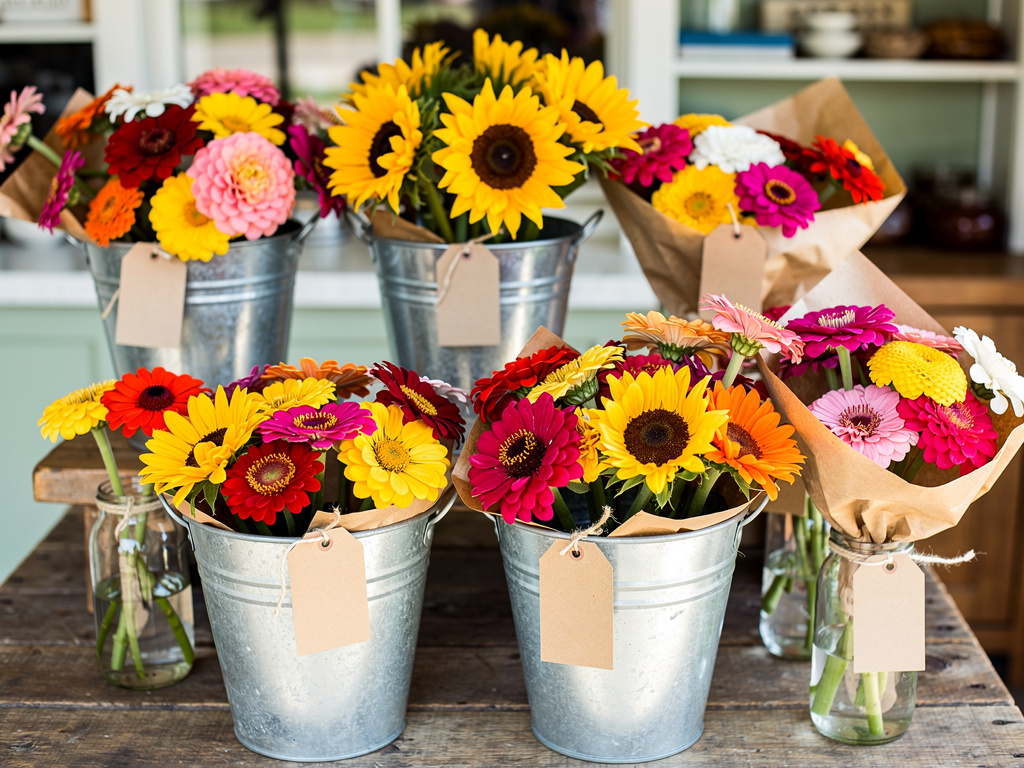


The short version: Sell a standard mixed bouquet of about 12 stems for $15, and keep your bouquet prices between $10 and $25 unless it is a large showpiece. That works out to about $1.25 a stem. Utah State's trial zinnias sold for $1 a stem, and a Virginia farm pictured in a 2019 Virginia Tech guide sold most of its stems at $2. The seed, sleeve and flower food in that bouquet cost you about 69 cents, so the price is paying for your time, the stems you throw away and your market costs, not for seed. Sell zinnias to a florist and expect 25 to 50 cents a stem, a quarter to half of the market price, and price a subscription by the bouquet, usually $20 to $35 each.
Checked September 22, 2026: seed, sleeve and sachet prices on Johnny's Selected Seeds product pages, the 16 bouquet listings on Homegrown's live product list (rechecked September 27, 2026), and plan and card processing fees on findhomegrown.com/signup, squareup.com/us/en/pricing, localline.co/pricing and venmo.com/about/fees. Honest bounds: these are costs, fees and real listing prices, not a promise about your market, and only your own sell-through tells you whether $15 is right where you sell. Customers create a Homegrown account to order, and there is no timed release feature.
Growing the flowers is the fun part. Putting a number on the bucket is where most new flower vendors stall. You cut a gorgeous bunch of zinnias and sunflowers, wrap it in kraft paper, and then wonder whether $8 is fair or $20 is greedy.
Cut flowers are one of the easiest local products to price, because the material cost is tiny and knowable, and there are real prices to check yours against. This guide builds a bouquet from supplier prices checked the day it was written, lines it up against what 16 real bouquet listings on Homegrown charge, and then subtracts what each way of selling takes back out.
It covers market bouquets, single-variety bunches, subscriptions, florist and wholesale prices, and DIY buckets for events, at the stem counts a part-time grower actually sells.
Sell a standard mixed bouquet of about 12 stems for $15, and keep most of your bouquet prices between $10 and $25. It is the most common starting price flower vendors list on Homegrown. At 12 stems, our suggested count, that is about $1.25 a stem, which sits between the $1 a stem Utah State's trial zinnias sold for and the $2 a stem a Virginia farm charged for most of its stems in a 2019 Virginia Tech guide.
Here is where the edges of that range come from:
Above $25 you are in showpiece territory, and real growers do go there. One Massachusetts flower farm on Homegrown lists a lush bouquet from $55 and a statement bouquet from $95 next to its $10 and $25 options. They are the top of a ladder, not the price of your everyday bucket.
If you are still working out how to get a market spot, which flowers to grow and how to keep them fresh all day, the companion guide on how to sell cut flowers at a farmers market covers all of that. This page is the arithmetic underneath the price sign.
Flower vendors on Homegrown list a middle starting price of $15 for a bouquet or bunch, and 14 of their 16 listings start between $10 and $25. That comes from a live pull of the whole Homegrown catalog on September 27, 2026, and it is the closest thing to a real price survey a part-time grower can get.
In a pull of the Homegrown catalog on September 27, 2026, 24 of the 2,721 products listed by 307 vendors were fresh cut flowers, from 7 flower vendors. We read every listing's name and description. Sixteen were bouquets, bunches, jars or vases priced one at a time, and their starting prices were: two at $10, seven at $15, two at $20, one at $22, two at $25, one at $55 and one at $95. The middle starting price of those 16 is $15. Eight of the 16 also come in larger sizes at higher prices, up to $115 for the biggest size of the $95 bouquet. The other eight were six flower subscriptions, one DIY bucket of about 80 stems and one special occasion jar arrangement made for events. These are listing prices, not sales figures.
How 16 bouquet listings on Homegrown are priced
Source: Homegrown's product list as it stood on September 27, 2026, 2,721 products from 307 vendors. Counted: the starting price of each of the 16 fresh-cut bouquet, bunch, jar and vase listings from 7 flower vendors; eight of them also offer larger sizes, up to $115. Left out: six subscriptions, one DIY bucket, one special occasion jar arrangement made for events, dried flowers, potted plants, flower-shaped baked products and one florist's $35 Halloween arrangement of fall flowers and dried material listed under crafts.
A few patterns stand out in those 16 listings:
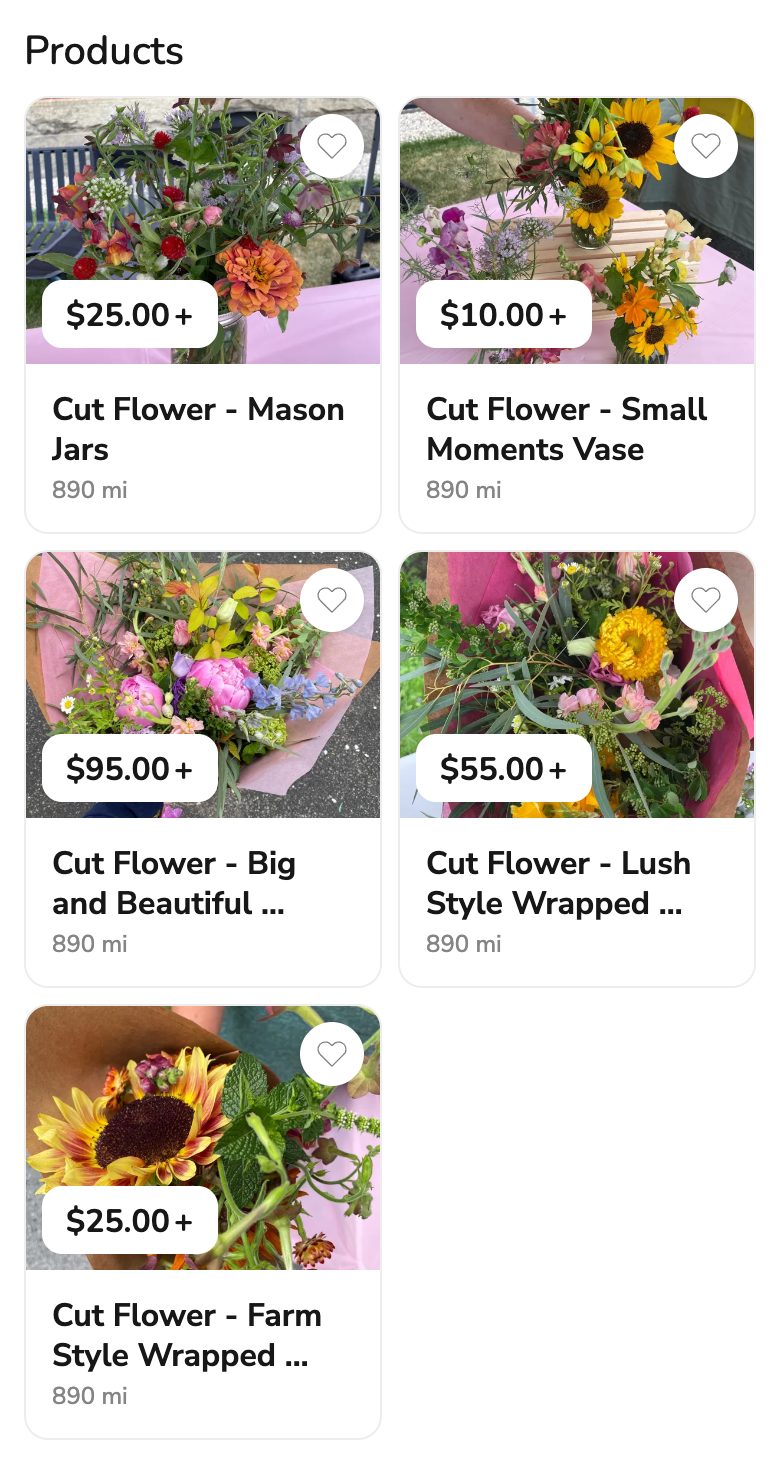
That storefront is a price ladder from a $10 vase of short stems to a $95 statement bouquet, with bigger sizes of each product costing more, up to $115. The top step does a quiet job: next to a $95 bouquet, $25 looks easy.
The seed, kraft sleeve and flower food in a 12-stem bouquet cost about 69 cents at Johnny's Selected Seeds prices checked September 22, 2026. That is 3 sunflowers and 9 zinnias grown from bulk seed, wrapped and sent home with a sachet of flower food.
Scroll sideways to see every column.
| Line | What you buy | Price checked | Per unit | In one 12-stem bouquet |
|---|---|---|---|---|
| Sunflower seed | ProCut Orange, a single-stem sunflower, 1,000 seeds | $36.80 | 3.7 cents a seed, and one seed is one stem | 3 stems, $0.11 |
| Zinnia seed | Benary's Giant Mix, 1,000 seeds | $36.90 | 3.7 cents a seed, about 0.6 cents a sellable stem | 9 stems, $0.06 |
| Kraft sleeve | Cut-flower sleeves, medium, about 14 by 14 by 4 inches, 100 count | $32.95 | 33 cents | 1 sleeve, $0.33 |
| Flower food | Chrysal universal paper sachets, 100 count, each treats a quart | $18.95 | 19 cents | 1 sachet, $0.19 |
| Total | $0.69 |
Every price read off the product pages at johnnyseeds.com on September 22, 2026, at the pack size shown. The zinnia line uses a 2019 Utah State University Extension field trial, published in August 2020, of Benary's Giant zinnias that harvested 5.8 sellable stems per plant, so one 3.7 cent seed spreads across about six stems. Both seed lines assume every seed comes up; any that do not raise the cost slightly. Rubber bands, twine, water, fertilizer and your time are not in the table.
Notice how small that number is. Your stems, sleeve and flower food cost less than a dollar on a $15 bouquet. That is why flower pricing is not a cost-plus-markup problem the way tea or jam is.
Do not multiply 69 cents by four and call $2.76 a price. Seed is the smallest cost in a bouquet. The real costs are your hours cutting, stripping and tying, the stems that never make it into a bouquet, and the booth fee, gas and buckets that sit behind every market day. Price flowers by the stem and by what a buyer will pay, then check that the number covers those.
A few things move the cost up or down:
Charge $1 to $2 a stem for most market flowers, and more for premium stems. The two ends of that range come from two extension publications. A photo in Virginia Tech's 2019 guide to marketing specialty cut flowers shows a Virginia farm selling most of its stems at $2, with a discount when someone buys several. A Utah State University Extension trial, written up in its August 2020 zinnia guide, sold its zinnias for $1 a stem at markets along the Wasatch Front.
Per-stem pricing is the easiest way to build any bouquet price:
The gap between $6 for three sunflowers and $18 for three sunflowers is the whole lesson. Both are real prices. The difference is presentation, market and confidence, not the flower.
A useful habit is to price your bouquets by counting stems before you set the sign. A 12-stem bouquet at $1.25 a stem is $15. A 20-stem bouquet at the same rate is $25. If a bouquet looks like it deserves more than its stem count says, you have probably added a premium flower, and that is fine: count it at its own rate.
Price a bouquet by counting its stems at their per-stem rate, then checking that about a fifth of the price is left for your design time. Here is the whole thing on the 12-stem bouquet costed above: 3 sunflowers and 9 zinnias.
The design rule comes from the Kentucky fact sheet on cut flowers for CSA subscriptions, which uses a $20 bouquet as its example: $4 of design and $16 of flowers, wrapping and other inputs. It is a check, not a formula. If your stem count says $15 but the bouquet leaves no room for arranging time, add stems or raise the price.
Two notes that save arguments with yourself later. First, do not add your hourly wage to the cost and then multiply it, because you will land at $40 for a bouquet nobody buys at a Saturday market. Your time is paid out of the gap between the 69 cents and the $15. Second, price the bouquet you actually bring, not the best one you have ever made. If your stems are shorter this week, sell a smaller bouquet at a smaller price rather than a thin bouquet at the usual one.
Time yourself making ten bouquets before you set prices for the season. If ten 12-stem bouquets take you an hour from cutting to tying, each one carries 6 minutes of work, and $15 pays you well. If they take two hours, you are at 12 minutes a bouquet, and that is when a $15 price starts to feel thin. The fix is often a simpler bouquet, not a higher price.
Sell a small bouquet or jar for $10, a standard 12-stem bouquet for $15, and a large 20-stem bouquet for $25. Each size is the same stems at the same per-stem rate, so the price steps make sense to a customer standing at your table.
Scroll sideways for the rest of the row.
| Size | Stems | Stems at $1 (Utah State's zinnia price) to $1.25 (our suggested rate) | Seed, sleeve and sachet cost | Put this on the sign |
|---|---|---|---|---|
| Small jar or mini bunch | 8 | $8 to $10 | about $0.30 in a jar you own, $0.61 in a small sleeve | $10 |
| Standard market bouquet | 12 | $12 to $15 | $0.69 | $15 |
| Large bouquet | 20 | $20 to $25 | about $0.80 | $25 |
| Showpiece bouquet | 30 or more, premium flowers | Set by the listings, not the stem rate | depends on the flowers | $55 and up |
Stem counts are suggestions for a zinnia and sunflower mix; costs use the Johnny's Selected Seeds prices checked September 22, 2026. The small row is 2 sunflowers and 6 zinnias; the large row is 5 sunflowers and 15 zinnias in a medium sleeve. Showpiece prices come from real Homegrown listings that start at $55 and $95 in the September 27, 2026 catalog pull, with larger sizes of those bouquets running up to $115; no listing gives a stem count, so the 30-stem figure is a suggestion too.
Three price points are enough for most tables. A customer who wants something small has a $10 option, most people buy the $15, and the $25 bouquet catches the gift buyer. A fourth size is worth adding only if you have the premium flowers to fill it.
Keep the stem count consistent within a size. Virginia Tech's 2019 guide recommends limiting pre-made bouquets to one or two price points with a consistent number of stems in each, for example a small at $8 and a large at $16 in 2019 prices. Your regulars will notice if the $15 bouquet is 15 stems one week and 9 the next.
Price a single-variety bunch at $10 to $15, and use small jars at $10 to sell your short and imperfect stems. An all-zinnia or all-sunflower bunch takes less design time than a mixed bouquet, so it can sit a little lower, and it is the easiest way to sell a flower that is producing heavily.
One Homegrown farm in South Dakota lists single-variety bunches of cosmos, zinnias and sunflowers at $15 each, the same price as the smaller Garden size of its mixed market bouquet; the Deluxe size is $26. The listings do not give stem counts, so a shopper cannot tell from the page how many flowers the $15 buys.
Jars and mini vases solve a real problem: stems that are too short for a bouquet. Utah State University Extension's zinnia trial counted 5.8 sellable stems per plant in the field, and 8.1 cull stems per plant on top of that, meaning stems too short, deformed or insect-damaged for florist grade. Some of those culls are fine for a pint jar on a kitchen table. One Massachusetts farm lists its "Small Moments Vase" from $10 and says plainly that you get "a couple shorties" in it.
Good uses for single bunches and jars:
If you use jars, count the jar in your cost. The 30 cents in the size table assumes a jar you already own; a jar you buy new adds its own price to that line, and on a $10 product that can be the biggest cost you have.
Price a flower subscription by the bouquet, usually $20 to $35 a bouquet, paid for the whole run up front. Most real listings on Homegrown and most published Kentucky share prices land in that range; one monthly Homegrown listing works out to $55 a bouquet, and one Kentucky farm charged $17.50.
Scroll sideways to see every column.
| Subscription | Price | Bouquets | Per bouquet | Source |
|---|---|---|---|---|
| Spring Street Farm, 4 weekly bouquets of about two dozen stems | $139 | 4 | $34.75, about $1.45 a stem | Homegrown listing, September 27, 2026 |
| The Meadow Barn Flower Farm, every two weeks for 6 months | $390 | about 13 | about $30 | Homegrown listing, September 27, 2026 |
| The Meadow Barn Flower Farm, monthly for 6 months | $330 | 6 | $55 | Homegrown listing, September 27, 2026 |
| Kentucky farm A, 2 weeks | $40 | 2 | $20 | Kentucky CCD fact sheet, 2021 prices |
| Kentucky farm B, 4 weeks | $70 | 4 | $17.50 | Kentucky CCD fact sheet, 2021 prices |
| Kentucky farm C, 4 weeks | $80 | 4 | $20 | Kentucky CCD fact sheet, 2021 prices |
| Kentucky farm D, 4 weeks, delivery included | $120 | 4 | $30 | Kentucky CCD fact sheet, 2021 prices |
Homegrown prices and descriptions read from the live catalog on September 27, 2026. The Meadow Barn's bi-weekly count is our estimate from "every two weeks for 6 months"; the listing does not state an exact number. Both Meadow Barn listings say travel fees may apply. Kentucky prices are the 2021 figures published in the University of Kentucky Center for Crop Diversification fact sheet CCD-FS-40, several with an optional season delivery fee of $5 to $15. The fact sheet gives season length and share price only; the Kentucky bouquet counts assume one bouquet a week.
Notice what the Spring Street subscription does. Its single hand-tied bouquet is $20 for a small and $35 for a large, with no stem count given, and its subscription bouquet works out to $34.75 for about 24 stems. The listing says the best flowers are reserved for its subscription members. It also includes free delivery to homes and businesses in Clinton, Tennessee, and it states its own pricing plainly: its flowers are priced below florist retail, but above wholesale and above what a farmers market typically charges. That is what the subscription price is paying for.
Subscriptions are worth pricing a little above your market bouquet for three reasons:
For the practical side of running one, like pickup and delivery, how many subscribers to take and what goes in each bouquet, see the guide to starting a flower subscription from your garden.
For a common flower like zinnias, expect a florist to pay 25 to 50 cents a stem, a quarter to half of the $1 it brings at market. That range comes from Utah State University Extension's August 2020 zinnia guide, which also notes that florists usually buy zinnias in bunches of ten, or fives for the larger blooms. The same guide's trial zinnias sold for $1 a stem at markets along the Wasatch Front.
So ten zinnias that would bring $10 at your table bring $2.50 to $5.00 from a florist. That is not a bad deal if it is the right buyer. A florist takes a whole bucket at once, pays for stems you did not have to arrange or wrap, and can come back every week in season if your quality and quantities stay consistent.
Premium flowers follow their own numbers, so check a florist's price on dahlias or peonies before assuming the same split. Here is how wholesale compares to selling at your table:
The Virginia Tech guide notes that the highest wholesale prices go to flowers that do not ship well and are best bought locally. So the practical rule is to sell florists those flowers, in the quantities they ask for, and not to expect a local premium to carry the price. Keep a written price list by the bunch of ten, and keep it separate from your market sign. A $4 florist bunch next to a $10 market bunch is the normal gap between wholesale and retail. A $4 market bunch because you set it off the florist price gives away $6 on every retail sale. Which of those two prices a stem earns depends on where it goes, and the guide to where to sell flowers you grow runs the same 12 stems through seven places, from $15.00 in cash at a stand to about $17 inside a prepaid subscription.
Price a DIY bucket at about $1.50 a stem, and price event flowers by the piece, never by the bucket at market rates. One Tennessee farm on Homegrown lists a DIY Bloom Bucket at $120 for about 80 stems of focal flowers, fillers and foliage, enough for about six small bouquets or mason jars. That is $1.50 a stem, or $20 per finished arrangement the customer makes themselves.
A DIY bucket pays more per stem than a market bouquet, $1.50 against about $1.25:
Event work like bridal showers, dinners and small weddings is a different product. The same Tennessee farm lists "Special Occasion Florals" starting at $40 for a pint-jar arrangement, with quart and half-gallon sizes at $50 and $60. It accepts orders up to two weeks before the date, and asks larger events to book a consultation. The Virginia Tech guide warns that wedding customers often carry a "perception that local = bargain" and tells growers to build their time and effort into the price.
The mistake to avoid is pricing an event arrangement like a market bouquet. A market bouquet is made in a few minutes from whatever is blooming. An event piece has a color list, a delivery time and a customer who will remember it. Price each piece at your per-stem rate plus a design share that covers your time and effort, as the Virginia Tech guide advises, and put a minimum order on anything you have to deliver.
On a $15 bouquet, card processing takes between $0.39 and $0.80 depending on how you get paid, and none of the setups below add a percentage platform fee on top. The monthly plan is where they differ most, from $0 to $87 a month.
Scroll right for all eight columns.
| Way of selling | Monthly plan | Trial | Platform fee | Card processing | Customer pays on a $15 bouquet | Vendor pays on a $15 bouquet | Vendor pays in a month of 50 bouquets, plan included |
|---|---|---|---|---|---|---|---|
| Homegrown storefront, pre-orders for pickup | $10 billed annually ($12.50 monthly) | 7 days, no charge until day 8 | None, 0% commission | 2.9% + $0.30, paid by the vendor | $15.00 | $0.74 | $46.75 |
| Square Free, card reader at your table | $0 per location | No plan to try | None | 2.6% + 15¢ tap, dip or swipe | $15.00 | $0.54 | $27.00, plus the reader you buy |
| Square Free, online ordering | $0 per location | No plan to try | None | 3.3% + 30¢ online | $15.00 | $0.80 | $39.75 |
| Local Line Core | $87 billed annually ($109 monthly) | 7 days, no credit card | None, 0% commission | 2.9% + $0.30 cards, 1.0% ACH | $15.00 | $0.74 | $123.75 |
| Venmo business profile, orders by message | $0 | No plan to try | None | 1.9% + $0.10 per payment received | $15.00 | $0.39 | $19.25 |
We checked every plan price and card processing rate on the company's own page on September 22, 2026: findhomegrown.com/signup, squareup.com/us/en/pricing, localline.co/pricing and venmo.com/about/fees. Monthly totals use annual billing where a plan has it and assume every bouquet is paid by card. Square's Plus plan is $49 a month per location with a 30-day trial and cuts the online rate to 2.9% + 30¢. The Venmo row has no order page: you track who ordered what in your messages.
Read the table by how you actually sell:
Etsy and Shopify are left out of this table because both are built around shipping or a full website, and a fresh bouquet is handed over in person. The comparison of platforms for selling cut flowers online prices both for a flower grower, if you want to see those fee stacks too.
List your bouquet sizes on an order page, let customers pay ahead for pickup, and cut to the number of orders instead of guessing. Cut flowers are one of the most perishable products at a farmers market, so an unsold bouquet on Saturday is a loss by midweek. Pre-orders turn that guess into a count.
A Homegrown storefront is $10 a month billed annually with no percentage fees beyond standard payment processing (2.9% + $0.30, paid by you and never added to the customer's total). Compare that to Local Line at $87 a month billed annually, which comes with separate retail and wholesale price lists, or taking cut flower orders through Instagram and Venmo messages, which is cheap per payment but leaves you matching payments to bouquets by hand on Friday night. Square's free plan is a good card reader at the table, and its online orders cost 3.3% plus 30 cents on that plan.
What a storefront does for a flower table:
Honest bounds: Homegrown does not grow, arrange or ship flowers, and it does not set your prices. Customers create a Homegrown account to place their first order. There is no timed release or countdown feature for opening a week's bouquets. Your storefront is listed on the Homegrown marketplace, but plan on most orders coming from people you send to your own link, from the sign on your bucket or the photo you post.
A grower selling 30 bouquets a week at $15 keeps about $413 before the booth fee and their own time, once seed, wrap and card fees are paid. Here is the same math at three weekly volumes, using the $0.69 bouquet cost and the fees checked above.
Scroll sideways for the rest of the row.
| Week | Bouquets at $15 | Brought in | Seed, sleeve and sachet | Card fees | Left before booth fee, plan and time | Cutting and tying at 6 minutes each |
|---|---|---|---|---|---|---|
| Farm stand pickup only | 10, all ordered online | $150 | $6.90 | $7.35 | $135.75 | 1 hour |
| One market | 30, all paid by card at the table | $450 | $20.70 | $16.20 | $413.10 | 3 hours |
| Market plus pre-orders | 60: 40 at the table, 20 ordered online | $900 | $41.40 | $36.30 | $822.30 | 6 hours |
Fees use Homegrown's 2.9% + $0.30 for online orders ($0.735 a bouquet) and Square Free's 2.6% + 15¢ at the table ($0.54), checked September 22, 2026. Materials use the $0.69 Johnny's Selected Seeds cost build. The 6 minutes a bouquet is the example from the vendor tip above, not a measurement; time your own. Growing time, harvest, booth fees, gas and unsold bouquets are not included.
What the table shows:
Keep your everyday bouquet price steady all season, and charge more only for flowers that are scarce or in demand for a holiday. Changing the $15 price every week confuses regulars. Changing what goes in the premium bouquet does not.
Utah State's peony budget notes that stems can command higher early-market prices, and that early-blooming peonies grown in a high tunnel peak in early May, in time for Mother's Day and Memorial Day. The same logic applies to other early flowers. The first tulips, ranunculus and peonies of spring, and anything around Mother's Day, can carry a premium while few growers have them.
Ways to handle the season without rewriting your price sign:
The one time to move the everyday price is the start of a season, when your seed, sleeve and booth costs are new. Change it once, on the sign and on your order page together, and keep it there.
The biggest costs in a bouquet are the stems you cannot sell and the hours you spend, not the seed. In Utah State University Extension's zinnia field trial, 58% of the stems harvested were culls, too short, deformed or insect-damaged for florist sale. You still watered, weeded and cut every one of them.
The costs that hide behind a 69 cent bouquet:
This is why a $15 bouquet is not greedy. The customer is paying for the stems that made it, the ones that did not, and the Saturday you spent at the table.
A common mistake is pricing a standard 12-stem bouquet at $8 or $10 because the flowers "only cost pennies," when flower vendors on Homegrown list a middle starting price of $15. Cheap seed makes cheap bouquets feel fair. They are not, once you count the hours and the stems that never sell.
The mistakes that cost new flower vendors the most:
Watch how fast your bouquets go. If your 30 standard bouquets are gone in the first hour every week, your $15 price is too low. Try $18 next week and see if you still sell most of them. If they sit until noon, fix the display and the stem count before you touch the price.
The sell-through test is the only price research that really counts. Extension ranges and catalog medians tell you where to start. Your own buckets at 1 p.m. tell you whether to move.
Charge $15 for a standard mixed bouquet of about 12 stems, with a $10 small size and a $25 large size beside it. That works out to about $1.25 a stem. Across the 16 bouquets and bunches that 7 flower vendors listed on Homegrown on September 27, 2026, the middle starting price and the most common starting price were both $15.
Most market cut flowers sell for $1 to $2 a stem. A Virginia farm pictured in Virginia Tech's 2019 cut flower marketing guide sold most of its stems at $2, and a Utah State University Extension trial sold zinnias at $1 a stem at markets along the Wasatch Front. Premium stems deserve more: a 2021 Utah State Extension budget for high tunnel peonies priced sellable stems at $5.00, and $3 is our suggested starting point for dahlias and lisianthus.
The seed, kraft sleeve and flower food for a 12-stem bouquet of sunflowers and zinnias cost about 69 cents at Johnny's Selected Seeds prices checked September 22, 2026. That leaves out your time, water, buckets, booth fees and the stems you cannot sell. Those costs, not the seed, are why cut flowers sell for $15 and not $3.
For common flowers, charge a florist about a quarter to half of your market price per stem. Utah State University Extension's August 2020 zinnia guide puts wholesale zinnias at 25 to 50 cents each, usually sold in bunches of ten. Premium stems can bring more: Utah State's January 2021 peony budget priced sellable peony stems at $5.00 each, but the co-op that handled the sale kept 30%, so the grower saw about $3.50.
A flower subscription usually costs $20 to $35 a bouquet, paid up front for the whole run. Spring Street Farm lists four weekly bouquets of about two dozen stems for $139 on Homegrown, which is $34.75 a bouquet. Kentucky farms in a University of Kentucky fact sheet charged $17.50 to $30 a bouquet in 2021, assuming weekly bouquets.
It can be, because the materials in a $15 bouquet cost well under a dollar. A grower selling 30 bouquets at $15 keeps about $413 after seed, wrap and card fees, before the booth fee and their time. Whether that pays depends on how many hours those 30 bouquets take you, so time your first market day.
More on selling and pricing flowers and other farm products:
Count your stems, set three prices, and put them where customers can order before Saturday. That is one evening of work with your seed receipts and a bucket of flowers.
Do those five things and you walk into market knowing your price per stem, your floor price, and how many of this week's bouquets are already paid for.



