
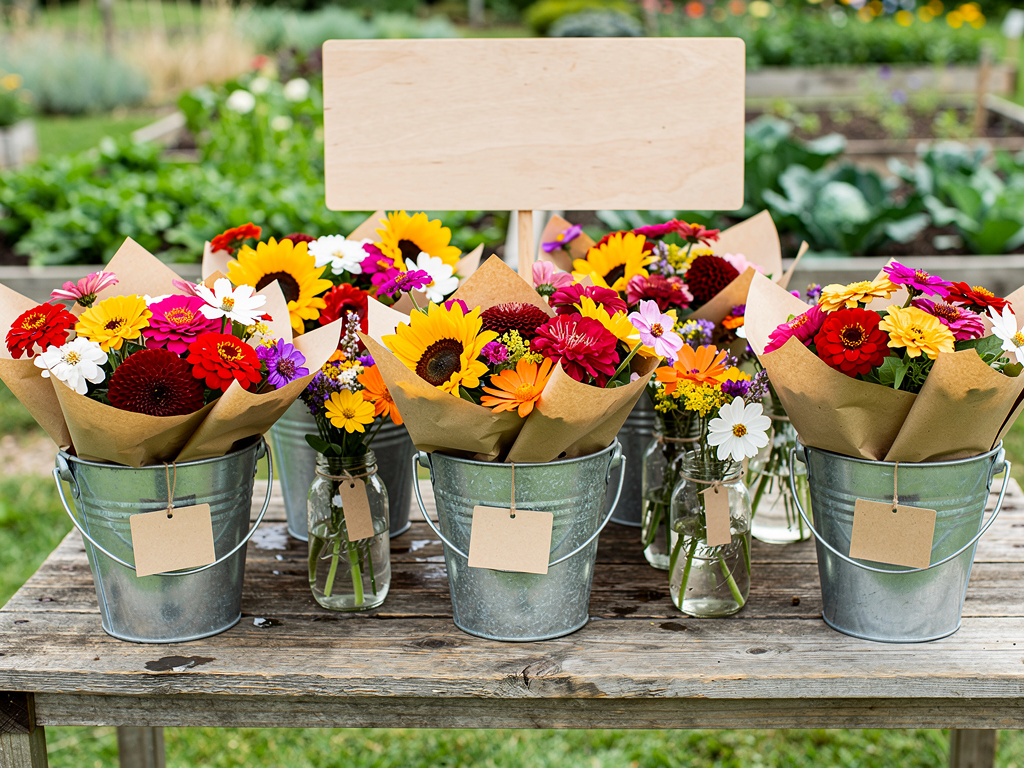


The short version: You can sell flowers in seven places: a stand at the end of your driveway, a farmers market, pre-orders and subscriptions on your own link, florists, cafés and farm stores, weddings and events, and flower co-ops that sell to florists for you. The first three sell at your full price to the person who takes the flowers home, florists pay about a quarter to half of that price and co-ops less, and weddings pay more per stem but cost you hours of design work. On Homegrown, the middle starting price of the 16 single bouquets listed on September 25, 2026 was $15, and that bouquet reaches you as $15.00 in cash at your stand, $14.26 as a pre-order on a Homegrown storefront and $3.75 to $7.50 from a florist. Fresh flowers do not travel well in a box, so every place on this list is local, and online marketplaces like Etsy suit dried flowers instead.
Checked September 25, 2026: Homegrown is $10 a month billed annually or $12.50 billed monthly, with 0% commission and 2.9% + $0.30 card processing paid by the vendor, and the Square, Venmo and Etsy fees, the florist and co-op research and the catalog prices in this guide were all loaded that day. The limits: your customer creates a Homegrown account to place a first order, Homegrown does not charge subscriptions automatically or run timed releases, and you should plan on most orders coming from people you send to your own link.
You cut 60 stems on Friday evening, sold 40 of them at the Saturday market, and put the last 20 on the compost pile on Monday. The zinnias were fine. The problem was that you only had one place to sell them.
Plenty of small flower growers start that way, with one market table or one bucket at the end of the driveway. To sell every stem, plan on two or three places at once, each one matched to a different kind of buyer. If you want the booth itself (what to grow, how to price at the table, how to keep bouquets fresh until noon), our guide to selling flowers at a farmers market covers it in full. This guide is about where else your stems can go: seven places, what the same 12-stem, $15 bouquet pays you in each one, and how many stems a week each place needs before it is worth your time.
You can sell flowers you grow in seven places, and it pays to use two or three at once: one spot for walk-up buyers, one way to sell ahead of cutting day, and one business account for the extra stems. Three of the seven sell straight to the person who puts the bouquet in a vase. Four sell to a business or an event.
Two ideas are left off on purpose. Grocery chains buy in large volumes and can be hard to open an account with, which suits a farm with acres in production, not a cutting garden. And shipping fresh bouquets across the country is its own business, with coolers, overnight freight and flowers cut days before they arrive. Every fresh-flower place below is local, because that is where a small grower's flowers have the edge: they are fresher than anything shipped in.
Match the place to the number of stems you cut in a normal week, then add one place at a time. A grower cutting 50 stems a week from a backyard bed needs very different buyers than one cutting 400 from a quarter acre, and the table below is the quick way to choose.
Scroll sideways to see every column.
| Stems you cut in a normal week | Start here | Add next | Why |
|---|---|---|---|
| Under 50 (about 4 bouquets) | Pre-orders from friends and neighbors | A small driveway stand on your busiest day | Four bouquets sell out to people who already know you, with no booth fee to cover |
| 50 to 150 (4 to 12 bouquets) | A driveway stand or one café bucket | Pre-orders for regulars | Enough for steady walk-up sales without a weekly booth fee |
| 150 to 300 (12 to 25 bouquets) | A farmers market | A subscription for your best 10 to 20 customers | A market moves real volume, and subscribers pay before the season starts |
| 300 or more | A market plus subscriptions | One or two florists, or a co-op | Florists and co-ops take whole buckets of top-grade stems cut tight, the ones market shoppers pass over because they are not open yet |
| Any amount, if you love design | Weddings and events | DIY buckets for hosts who arrange their own | Event work pays the most per stem but eats your Fridays |
Bouquet counts assume the 12-stem, $15 standard bouquet in our farmers market flower guide. Rows are planning guides built from the fee pages, catalog data and extension research in this article, all checked September 25, 2026. Your own garden, town and schedule decide the final mix.
You may never need the bottom two rows. A stand or a market plus a pre-order link keeps every stem at your full retail price, and that pair can carry a part-time flower business through a whole season.
A stand on your own property is the cheapest place to sell flowers, because there is no booth fee and a $15 bouquet paid in cash reaches you as the full $15.00. It works best on a road with steady traffic and a spot where drivers can pull over safely. On a quiet country lane, the same stand may sell only a handful of bouquets.
The legal line to know is where your land ends. The strip of grass beside the pavement usually belongs to the road, not to you, and our guide to whether you can sell flowers on the side of the road walks through the state laws and county permits. A stand set back on your own lawn is the simple, legal version in most places, but check with your city or county before you set it up, since some towns limit signs and stands in residential zones.
A flower stand needs five things to work:
You do not have to own the stand to sell this way. On Homegrown, The Meadow Barn Flower Farm in Harrisburg, South Dakota lists $15 market bouquets that it stocks weekly in the Country Apple Orchard Farm Stand, and that farm stand lists its own $15 market bouquet as an in-store purchase only. A farm stand that already sells eggs and honey is a ready-made roadside stand for your flowers. Our guide to selling cut flowers from home covers the full driveway setup, from theft to hot days.
A farmers market is the best first place for a grower cutting 150 stems or more a week, because it puts a steady stream of shoppers past your table in one morning and flowers are an impulse buy. The USDA Local Food Directories listed 7,148 farmers markets on September 25, 2026, and you can search them by distance from your ZIP code to build a short list.
A market also does something a stand cannot: it lets you meet the buyers who will become your pre-order customers and subscribers. The shopper who buys a $15 bouquet three Saturdays in a row is the one you hand a card with your ordering link. Ask each market manager these questions before you apply:
Take cards as well as cash. On Square's free plan, checked September 25, 2026, an in-person card payment costs 2.6% + 15 cents, so a $15 bouquet costs $0.54 to take by card and $14.46 reaches you, less your share of the booth fee. Our farmers market flower guide covers the rest: varieties, display, pricing at the table and keeping stems fresh until close.
You sell bouquets before you cut them by listing this week's sizes and prices on one ordering link, sharing it with the people who already buy from you, and letting them pay and pick a pickup day before cutting morning. You cut to the order count instead of guessing, so fewer stems end up on the compost pile, and the regular who missed Saturday can still get her bouquet on Wednesday.
That is the job a Homegrown storefront does for a flower grower whose buyers keep texting "are you doing dahlias this week?" It is $10 per month billed annually with no percentage fees beyond standard payment processing, which is 2.9% + $0.30 per order, so a $15 bouquet costs you $0.74 to sell. One listing can hold small, standard and large bouquets at their own prices, the count goes down as orders come in, so if you list 20 bouquets, the 20th is the last one sold, and you can set pickup at your porch, your farm stand and your market booth on their own days. If you deliver, you set a radius of 1 to 25 miles, a flat fee and a minimum order, and you keep the whole delivery fee minus card processing.
Here is how it compares with what flower growers usually try first:
Homegrown has limits a flower grower should know before signing up. Your customer creates a Homegrown account to place a first order. It does not charge a subscriber's card again each week or month, so a season is sold as one prepaid listing, the way Spring Street Farm sells its four-week bouquets. It has no timed release feature, and it does not ship. Your storefront is also listed on Homegrown's local marketplace, but plan on most orders coming from people you send to your own link. And 20% of each order is held for 30 days before it pays out, which matters if you sell a season of subscriptions in March and buy bulbs with the money.
A flower subscription is a season of bouquets that a customer pays for up front, and it is the steadiest money on this list, because the customer pays for the whole season before the first stem is cut. A subscription can pay more per stem than a market table, since subscribers are buying a promise of the best flowers every week.
Two flower farms on Homegrown showed how it works on September 25, 2026:
Run the Spring Street numbers and the subscription beats the market. At $139 for four bouquets of about 24 stems, each bouquet is $34.75, or about $1.45 a stem, against about $1.25 a stem for a 12-stem, $15 market bouquet. On a Homegrown storefront, card processing on the $139 season is $4.33, so $134.67 reaches the farm, and 20% of the order is held for 30 days before it pays out, as noted above.
You can find subscribers in three places beyond your regulars:
Start with 10 subscribers, not 50, until you know how many stems your garden gives in a bad week. Our flower subscription guide covers garden planning and bouquet design for a season of members.
Yes, florists buy from small growers, but they pay wholesale, somewhere between one fourth and one half of what the same stems bring at your table, and they want the same quality every week. In a 2022 survey of Utah florists reported by Utah State University Extension, 25% wanted to source most of their flowers from local growers and another 54% wanted at least some, but most would not pay more than 10% extra for local.
The per-stem gap is real. Our cut flower pricing guide cites a Utah State zinnia guide where florists pay 25 to 50 cents for a zinnia that brings $1 at market. A Hawaii grower in the Association of Specialty Cut Flower Growers' Cut Flower Quarterly (Summer 2023) keeps her math simple: one stem is $1 wholesale and $2 retail. So the 12 stems in a $15 bouquet bring $3.75 to $7.50 from a florist.
That can still be a good trade, because a florist takes a whole bucket at once and you skip the arranging, the wrapping and the booth. One grower quoted on Harris Seeds' blog found that delivering to two or three florists in a day paid more than four hours at a market. What florists usually want, from the grower tips collected in the National Center for Appropriate Technology's cut flower guide:
Fragile flowers are where a small grower beats the wholesale truck. University of Kentucky's greenhouse cut flower profile notes that dahlias are highly perishable in shipping and that most florists will only buy dahlias grown locally.
Start with the florists whose style matches your garden. Utah State's research notes that florists with artistic styles are more interested in working with different flower varieties than florists at larger companies with set design offerings.
Yes, a café, gift shop or farm store with steady foot traffic can sell your bouquets from a bucket near the register, and it is a good fit for a grower cutting 50 to 150 stems a week who cannot staff a stand. Flowers are an impulse buy, so the spot next to the cash register matters more than the size of the store.
Homegrown's catalog showed two versions of this on September 25, 2026. Harvest House Foods, which sells beef, milk, eggs and vegetables on its storefront, lists a $22 farmstand bouquet and a $15 flower jar with flowers from Full Bushel Farm. And the Meadow Barn bouquets are stocked weekly at the Country Apple Orchard Farm Stand. In both cases a grower's flowers ride along with a business that already has regular customers.
Before you drop off a bucket, agree on which of two deals you have, then settle three more terms in writing:
Consignment works for soap and jam because they keep. A bouquet lasts days in a vase, not months, and fewer days on a warm counter, so a consignment deal hands the store your stems and leaves you holding every one that wilts. Virginia Cooperative Extension's cut flower guide, loaded September 25, 2026, advises against consignment sales in its section on selling to wholesalers, and the same risk applies at a café counter. If a store wants consignment, ask for a short restock cycle and a written split first. As an example of the math, if the store keeps a third, a $15 bouquet pays you $10 after it sells.
One café account can also be a pickup point. A flower farm writing on Team Flower's education site sells bouquets at a local espresso bar, which also serves as one of its subscription pickup spots.
Wedding and event arrangements pay the most per stem of any place on this list, $3 to $5 a stem against $2 retail on one grower's price list, but they cost you design time, color requests you may not be able to grow, and a Saturday you cannot move. The same Hawaii grower in the Cut Flower Quarterly said she makes "$5 from a snapdragon, instead of $1 wholesale" on wedding work, and that "with one wedding I can pay my team for months."
There are two ways in, and the easier one needs no design skill at all:
Take a deposit for any event order, write down that colors and varieties depend on what is blooming that week, and keep a list of stems you can promise. If you also dry flowers, our guide to selling dried flowers for weddings covers the booking season that runs after your garden is done.
A flower co-op is a group of local growers who pool their stems and sell them to florists, keeping a share of each sale. Utah State University Extension reports that Utah has at least three cut flower co-ops that typically run from April to October, sell directly to florists and charge growers a fee between 30% and 40% of sales.
A co-op solves the hardest part of selling to florists for a small grower: you no longer need enough of one variety every week to fill a florist's order by yourself. You bring what you have, and the co-op combines it with other growers' stems. The trade is price. On a $7.50 wholesale sale of 12 stems, a 30% to 40% fee leaves you $4.50 to $5.25.
Here is how to find one near you:
Ask how and when the co-op pays. Virginia Cooperative Extension notes that wholesalers usually pay 30 to 45 days after delivery, so a wholesaler will not put cash in your hand at the door the way a stand does. Get a co-op's payment terms in writing before you join.
You can sell fresh flowers online for local pickup or delivery, which is how 6 of the 7 flower vendors on Homegrown sold them on September 25, 2026 (the seventh, a farm stand, sells its bouquet in the store only), but shipping fresh bouquets to strangers is a different business. A bouquet cut on Friday that spends two days in a box arrives tired, which is why national flower delivery runs on coolers, overnight freight and flowers bred to ship.
What online does well for a small grower is take the order before the flowers are cut. The link is online and the flowers stay local. Four online places, and what each one is for:
Before you promise delivery, set a radius you can drive before the flowers warm up. Spring Street Farm delivers free inside one zip code, and Meadow Barn notes that travel fees may apply to its Bloom Club. A 20-minute drive in an air-conditioned car is fine. A three-hour delivery loop in July is not.
Our guide to the best platforms to sell flowers online puts Homegrown, Etsy, Shopify and Square Online side by side, with what each one is best for.
Taking payment for a $15 bouquet costs you anywhere from $0 in cash to $1.88 on Etsy, and the card and app options at a stand or market sit between $0.39 and $0.54, and an online order link costs $0.74 on Homegrown or $0.80 on Square. The table shows every part of the fee stack for each option on the same bouquet, so you can compare them side by side.
Scroll right for all eight columns of the fee stack.
| Way to get paid | Subscription | Trial | Platform fee | Card processing | Customer pays on a $15 bouquet | You pay on a $15 bouquet | A month of 50 bouquets (you) |
|---|---|---|---|---|---|---|---|
| Homegrown storefront | $10/mo billed annually, or $12.50/mo billed monthly | 7 days, no charge until day 8 | $0, 0% commission, no shopper fee | 2.9% + $0.30 | $15.00 | $0.74 | $46.75 billed annually, $49.25 billed monthly |
| Square Free, card at your stand or market | $0 | None needed | $0 | 2.6% + $0.15 in person | $15.00 | $0.54 | $27.00 |
| Square Free, online link | $0 | None needed | $0 | 3.3% + $0.30 online | $15.00 | $0.80 | $39.75 |
| Venmo business profile | $0 | None needed | $0 | 1.9% + $0.10, or 2.29% + $0.09 with Tap to Pay | $15.00 | $0.39 ($0.43 with Tap to Pay) | $19.25 ($21.68 with Tap to Pay) |
| Cash, or Facebook Marketplace local pickup paid in cash | $0 | None needed | $0 on local pickup (10%, $0.80 minimum, on orders shipped through Facebook checkout) | $0 | $15.00 | $0 | $0 |
| Etsy, dried flowers only | $0 (a one-time shop set-up fee may apply) | None needed | $0.20 listing fee, plus 6.5% transaction fee on the sale price and shipping; a separate fee on Offsite Ads sales | 3% + $0.25 | $15.00 plus shipping | $1.88 before shipping and ads | $93.75 |
We checked every fee on each company's own page on September 25, 2026: findhomegrown.com/signup, squareup.com/us/en/pricing, venmo.com/about/fees and etsy.com/sell. Facebook's local pickup and shipped selling fees come from two 2026 fee guides (Underpriced, updated July 29, 2026, and LitCommerce), because Meta's help page would not load for our check. Each fee is figured on one $15 bouquet and rounded to the cent; the monthly column multiplies the exact per-bouquet fee, before rounding, by 50 and adds one month of any plan (on Homegrown, $0.735 times 50 plus $10 is $46.75). The Etsy row assumes one listing, no shipping charge and no Offsite Ads sale. Sales tax, booth fees and shipping are left out.
The table leaves out the cost that matters most for a flower grower: stems that do not sell. A pre-order or a subscription is cut to a count, so the fee buys you a bouquet that was never at risk of wilting on a table. A cash sale at a stand costs nothing to take, but the 10 bouquets still in the buckets at dusk cost you $150 of flowers at your retail price.
Twelve stems that sell as a $15 bouquet pay you as little as $2.25 through a flower co-op and as much as $36 to $60 as wedding arrangements, with $15.00 in cash at your own stand and about $16.84 inside a subscription in between. This is the table to check before you say yes to a new place.
Scroll across for the rest of each row.
| Place | What the buyer pays | What comes off | What reaches you from 12 stems | What it takes to get in |
|---|---|---|---|---|
| Driveway stand, cash | $15.00 | Nothing at the sale | $15.00 | A table, shade, water and a cash box |
| Driveway stand, Venmo business QR | $15.00 | 1.9% + $0.10 = $0.39 | $14.61 | A Venmo business profile |
| Farmers market, card on Square Free | $15.00 | 2.6% + $0.15 = $0.54 | $14.46, less your booth fee | An application and a weekly or season fee |
| Pre-order on a Homegrown storefront | $15.00 | 2.9% + $0.30 = $0.74 | $14.26, and you pay the $10 a month plan billed annually ($12.50 billed monthly) | Photos, prices and a pickup day |
| Subscription season at Spring Street's rate ($139 for 4 bouquets of about 24 stems) | About $17.38 per 12 stems | About $0.54 per 12 stems ($4.33 on the $139 season on Homegrown) | About $16.84, and you pay the same monthly plan | Customers willing to pay for a season up front |
| DIY event bucket at Spring Street's rate ($120 for about 80 stems) | About $18.00 per 12 stems | Card processing if paid by card | About $18.00, before processing | A host who arranges their own flowers |
| Wedding or event arrangements | $36 to $60 at $3 to $5 a stem | Your design and delivery time, plus card processing if paid by card | $36 to $60, before processing | Design skill, a deposit and a fixed date |
| Café or farm store on consignment (example split) | $15.00 | The store keeps a third, $5.00 | $10.00, after it sells | A written split and a restock plan |
| Florist | $3.75 to $7.50 | Nothing if paid on delivery | $3.75 to $7.50 | Bunches of ten and a weekly delivery day |
| Flower co-op | $3.75 to $7.50 at wholesale | A 30% to 40% fee | $2.25 to $5.25 | Membership and the co-op's delivery days |
Fees from each company's own page, checked September 25, 2026. Subscription and DIY bucket prices from Spring Street Farm's Homegrown listings the same day. Florist prices use 25% to 50% of retail (Utah State University Extension's zinnia figures and a $1 wholesale, $2 retail stem in the ASCFG Cut Flower Quarterly); event prices use the same Quarterly's wedding and event rate; the co-op fee follows Utah State University Extension. The consignment split is an example, not a standard. Booth fees and sales tax are left out.
Read the table from the top when you have more time than flowers, and from the bottom when you have more flowers than time. The top rows keep your full retail price but need you, or your stand, in front of buyers, and the subscription and event rows in the middle bring in more per stem while tying you to a season or a date. The bottom rows pay less but take whole buckets while you are back in the garden.
On September 25, 2026, Homegrown listed 24 fresh cut flower products from 7 vendors, and the starting prices of the 16 single bouquets, bunches and jars among them ran from $10 to $95, with a middle starting price of $15. Eight of the 16 also came in larger sizes, and the biggest topped out at $115. That $15 middle starting price is why this guide runs its numbers on a $15 bouquet.
In a pull of the Homegrown catalog on September 25, 2026 (2,697 products from 304 vendors), 24 listings were fresh cut flowers, from 7 vendors. We counted a listing only if it sat in the plants and flowers category and its name or description described cut flowers, then searched every other category by description and found no fresh cut flowers there. Seedlings, houseplants, wreaths, flower-scented soaps and candles, and a $1 dried flower craft box were left out. Of the 24, 16 were single bouquets, bunches or jars, 6 were subscriptions, 1 was a DIY event bucket and 1 was a special occasion jar arrangement.
Single bouquets, bunches and jars on Homegrown, by starting price
Source: Homegrown catalog pull, September 25, 2026. 16 single bouquet, bunch and jar listings from 7 vendors, each counted at its smallest size's price; 8 of the 16 offer larger sizes, up to $115. Subscriptions and event listings left out.
Three things stand out in those listings:
Size tiers give a buyer more than one way to say yes. Her Hands Flower Farm lists a small vase in three sizes from $10 to $20 and mason jars from $25 to $45. Its wrapped bouquets run $25 to $45, $55 to $75 and $95 to $115 across standard, deluxe and premium sizes, and all are marked "farmers choice," so the colors depend on what is blooming.
Add one new place at a time, starting with the one that fits your weekly stem count, and give it four weeks before you judge it. Six steps take you from a single market table to a second or third place:
The fourth step takes the most nerve, and the fifth is where a link does the most work. Every bouquet that leaves your stand with a way to reorder is a customer who can order again before your next cutting morning, instead of hoping they drive past again. If you want that link ready before your next market, you can set up a Homegrown storefront for flower pre-orders and list this week's bouquet sizes in about 15 minutes.
To sell every stem, plan for the flowers that will not make a perfect bouquet, and give each kind of stem its own buyer. A market bouquet, a florist bunch and a $10 jar can all come from the same row of zinnias on the same morning.
What that looks like in practice:
Short stems still earn money. Her Hands Flower Farm sells a $10 Small Moments Vase on Homegrown, described as "a couple shorties" in a little vase, next to its $25 wrapped bouquets. Stems too short for a bouquet become a $10 sale instead of compost, and a $10 vase is an easy first purchase for a buyer who has never bought from you.
The unsold stems that still look good on Sunday have one more place to go: hang them upside down in a dark, dry room and they become next month's dried bundles.
You can sell flowers from your garden at a stand on your own property, at a farmers market, through an ordering link for pre-orders and subscriptions, to florists, through cafés and farm stores, for weddings and events, or through a flower co-op. For a backyard grower cutting under 50 stems a week, pre-orders from friends and neighbors plus a small driveway stand is the easiest place to start. Where to sell flowers changes as your garden grows, so add places as your stem count rises.
Flowers are not food, so cottage food laws and kitchen inspections do not apply to a bouquet. Some states still register or permit flower vendors: our guide to selling cut flowers from home found that Texas requires a yearly registration for flower growers and Louisiana requires a $120 cut flower dealer permit, checked September 24, 2026. Your town may also limit roadside stands and signs, so verify your state's and town's current rules before you sell.
You can sell fresh flowers online through an ordering link for local pickup or delivery, and announce them on Facebook Marketplace, neighborhood groups and Instagram. Fresh bouquets do not hold up well in a shipping box, so marketplaces built around shipping, like Etsy, are a better fit for dried flowers. On Etsy, a $15 dried bundle costs $1.88 in fees before shipping, checked September 25, 2026.
Some independent grocers, food co-ops and farm stores buy local bouquets by the bucket at a wholesale price, and some ask for consignment, which the watch-out above covers. Large supermarket chains buy in large volumes and can be hard to open an account with, as the National Center for Appropriate Technology's cut flower guide notes, which suits a farm with acres of flowers rather than a cutting garden. Start with a store that already sells produce from local farms, since its buyer is used to working with small growers.
Florists usually pay a quarter to half of what a stem brings at a farmers market. Utah State University Extension figures put a zinnia at 25 to 50 cents from a florist against $1 at market, and one grower in the ASCFG Cut Flower Quarterly prices stems at $1 wholesale and $2 retail. So 12 stems that sell for $15 in a bouquet bring about $3.75 to $7.50 when a florist buys them.
Per stem, finished wedding and event arrangements pay the most, at $3 or more a stem on one grower's price list. Next to a 12-stem, $15 market bouquet (about $1.25 a stem), DIY event buckets pay more at about $1.50 a stem, and subscriptions about $1.45 a stem in Spring Street Farm's $139 four-week season. Per hour, florists and co-ops can win, because they take whole buckets with no arranging or booth time. For most small growers, the best answer to where to sell flowers is a stand or market for walk-up buyers plus pre-orders and a subscription for regulars.
This page maps the seven places to sell flowers and what 12 stems pay in each. These six guides go deep on the parts it only touches, from the booth and the permit to the $15 price tag, and each one is written for a small, part-time grower rather than a 20-acre farm:
The simplest flower business is a place where walk-up buyers find you and a link where regulars order ahead. Every other place on this list is worth adding once those two are working. Florists, co-ops and cafés each pay you less per stem than a regular who reserves a bouquet before you cut it, and weddings and events pay more per stem but tie you to one fixed date.
That is the real answer to where to sell flowers: sell them where you can hand the bouquet to the person who puts it in a vase, as often as you can, and let florists, co-ops and cafés take the stems you cannot sell that way. A $15 bouquet at your stand or on your link pays you two to four times what the same 12 stems pay through a florist, and a subscriber who pays for a four-week season in April has paid for the whole season before the first stem is cut.
If you are tired of cutting 60 stems and guessing how many will sell, start your Homegrown storefront and list next week's bouquets tonight. It is $10 a month billed annually with 0% commission and 2.9% + $0.30 card processing that you pay, not your customer. Your regulars reserve bouquets and pick them up on your schedule, and your stand stays full for the drivers who stop on impulse.



