
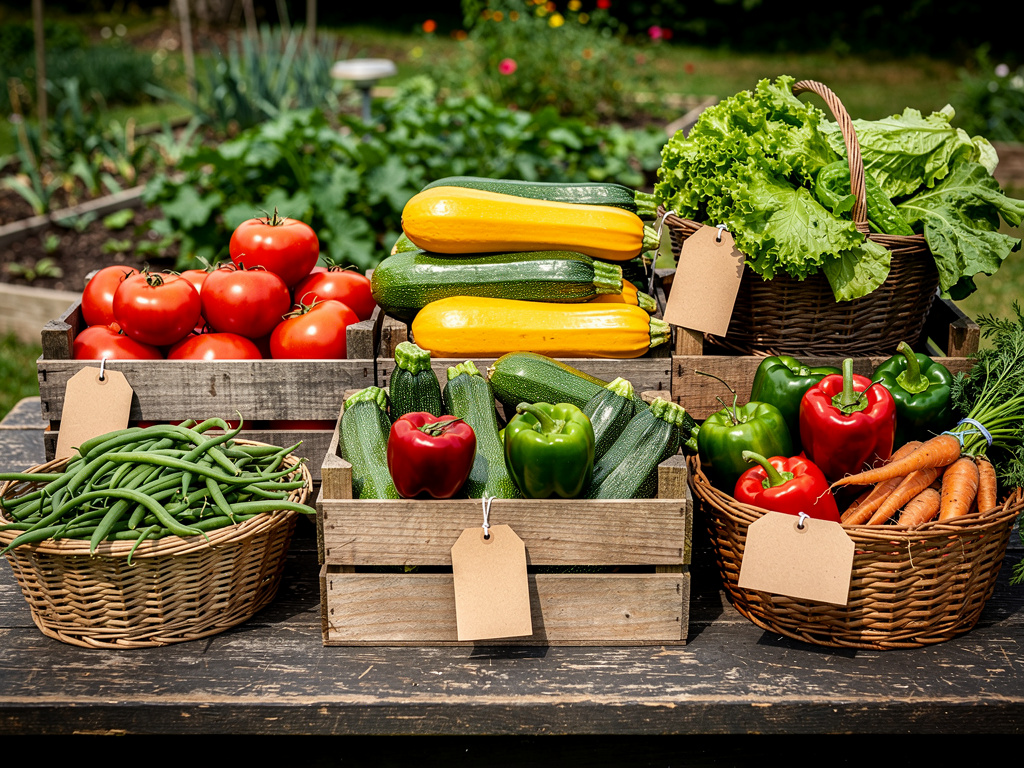


The short version: Vegetables sell in seven places: neighbors and coworkers, a roadside or porch stand, your own storefront link with pickup, a farmers market, a weekly veggie bag, restaurants, and grocery stores, co-ops or food hubs. Start with the people who already know you and a stand, because whole, uncut vegetables you grew yourself sit under lighter rules than cooked or canned food, and the FDA's produce safety rule does not cover a farm averaging about $34,000 or less a year in produce sales (the $25,000 threshold adjusted for inflation). On a $35 vegetable box, a Homegrown storefront link costs you $1.32 in card processing, but a single $2 cucumber paid by card loses 17.9% to the same fee, so bundle before you sell.
Checked September 24, 2026: Homegrown is $10 a month billed annually or $12.50 billed monthly, with 0% commission and card processing of 2.9% + $0.30 paid by the vendor, per findhomegrown.com/signup; Square, Venmo, Local Line and Barn2Door fees come from their own pricing pages loaded that day, and the produce rule from the FDA's Produce Safety Rule page and its inflation-adjusted cut-off page, so verify your own state and county before you sell. The limits: your customer creates a Homegrown account to place a first order, there is no timed release feature, and most orders will come from people you send to your own link.
It is late July. The zucchini doubled overnight, the tomatoes all ripened the same week, and the green beans need picking every other day whether anyone wants them or not. You gave a bag to the neighbors last week. They asked if you sell.
That question has seven good answers, and they are not equal. Some places pay retail for a $3 bunch of chard, some take 40 pounds at a time at a lower price, and some want an invoice and an insurance certificate before the first delivery. If you want the step-by-step of taking orders online, start with how to sell produce online as a small grower, and for what to charge per pound, how to price vegetables at a farm stand. This guide is about where: seven places part-time growers actually sell, priced against a real $35 box and checked against real listings.
You can sell vegetables in seven places, and a grower with a few raised beds to a half acre can run two or three of them at once. Each one trades price for time differently, and each takes a different cut of the same $35 box.
Two ideas are left off on purpose. Shipping fresh vegetables by mail is not a real channel for a backyard grower, because greens and soft crops wilt in transit, and overnight postage on a box often costs more than the vegetables inside it. And a terminal market (the wholesale yards that supply grocery chains) pays commodity prices that rarely cover a small grower's time. One more outlet sits outside the seven: a regional produce auction, where buyers bid on growers' lots on sale days. Some small growers use one, but its prices are set by that day's bidding and can swing below what a stand earns.
Start with neighbors and coworkers, then add one place at a time as your harvest outgrows it. The right next step depends on how much you pick each week and how many hours you want to spend selling, not on how big your garden looks in June.
Scroll sideways to see every column.
| Your situation | Start here | Add next | Why |
|---|---|---|---|
| A few raised beds, $20 to $60 of extra produce a week | Neighbors and coworkers | A porch stand | Enough to cover seed and water, small enough to sell by text |
| A big garden and a house on a busy road | A roadside stand | A storefront link for regulars | Drive-by buyers find you; regulars reserve the good stuff before the table empties |
| You already sell baked goods or eggs at a market | Vegetables at your market table | Pre-orders picked up at the booth | The booth fee is already paid by your other products |
| A quarter acre or more, steady weekly harvest | A weekly veggie bag | One restaurant | A prepaid list sells the steady middle of your harvest every week |
| Consistent volume, insurance and a food safety plan | A co-op or food hub | A grocery store | Volume buyers want the same crop, same pack, same day every week |
The dollar and acreage ranges are rough planning numbers, not rules. The legal line for produce is set by your state and county and by the federal sales thresholds covered in the license section below.
Most backyard growers never need the last two rows. At $3 to $5 a bunch or a pound, the first three places can move a big garden's surplus for years. They also keep you selling whole, uncut vegetables straight to the people who eat them, which is the simplest place to be under almost every state's rules.
Neighbors and coworkers are the easiest first buyers because they already trust you, they already buy vegetables every week, and a garden that is ten houses away is fresher than anything at the store. Most first sales start exactly the way yours probably did: someone got a free bag of tomatoes and asked what they owe you next time.
What makes this channel work:
The limit is reach and timing. Your circle fills up fast, and your garden does not care about their schedule: in August you have three times what they want, and in May you have nothing. That is when a stand, or a link your regulars can pass to their friends, earns its place.
A roadside stand works well for vegetables, because fresh produce is the reason most people pull over, and a stand sells while you are at work. It works best on a road with steady local traffic, with shade over the table, and with prices written on everything. The full build, from placement to signs, is in how to set up a roadside farm stand.
What sells best at a small vegetable stand:
Heat is what ruins a vegetable stand, not theft. Leafy greens, beans and cut herbs wilt within hours in direct sun, so keep them in a shaded cooler and put only the sturdy crops on the open table. And whole, uncut produce is one thing; a stand that also sells cut melon, salad mix, salsa or pickles can pull in your state's cottage food or food processing rules, which vary by state and county. Check yours before you add them.
For an unattended stand, keep prices in whole dollars and use a locked cash box plus a payment code, which the honor system farm stand setup walks through. Cash at a stand costs you nothing in fees, so keep the cash box even after you add a card reader or payment code.
The best way to take vegetable orders is to sell the harvest before you pick it: post what is ready on Monday, close orders Wednesday night, pick Thursday morning, and hand out paid orders Friday afternoon. For vegetables, a pre-order is worth more than a walk-up sale, because every unsold bunch of chard is a loss by Saturday.
That is the job a Homegrown storefront does for a grower with too much zucchini and not enough buyers. It is $10 per month billed annually with no percentage fees beyond standard payment processing, which is 2.9% + $0.30 per order. Your regulars see this week's list, order and pay, and pick up from your porch, your stand or your market booth; if you drive orders around, you set a delivery fee and keep all of it, minus card processing. Sales tax is calculated and filed for you, and payouts land the next business day.
Here is how it compares with what most vegetable growers try first:
What Homegrown does not do: your customer creates a Homegrown account to place a first order, there is no timed release feature, and recurring subscription billing is not on the feature list, so regulars either order the bag each week or buy a prepaid run of weeks as one product, the way Breadstreet sells a month of weekly loaves, 4 for $40, on Homegrown (catalog pull, September 24, 2026). Your storefront is listed on the Homegrown marketplace, but plan on most orders coming from people you send to your own link. It also does not accept SNAP (the federal food benefit once called food stamps) or WIC (the program for mothers and young kids) market benefits, run a GAP audit, or handle your county's permits.
In a pull of the Homegrown catalog on September 24, 2026, 61 of 2,638 products were fresh vegetables, listed by 13 of 300 vendors. The middle starting price was $3.50, and 51 of the 61 started at $5 or less: South Fork Farm lists green beans, okra, onions and peppers at $2 a pound and romaine at $3 a head, and Kaufman Family Farms in Dahlonega, Georgia sells zucchini at $3.99 for a 1 pound bag or $5.99 for 2 pounds. Microgreens, mushrooms, herbs, pickles and a few non-vegetable listings were left out.
If you are tired of guessing how much to pick, set up a Homegrown storefront and post this week's harvest before you pull a single carrot. Your regulars order and pay first, you pick exactly what sold, and the extra goes to the stand.
A farmers market is worth it for a small grower when you have enough volume to fill a table for four hours and something the other vegetable vendors do not. It puts the most shoppers in front of you in one morning, but the booth fee, the drive and the setup come out before you earn anything, and at a busy market you may share the aisle with other tables selling the same zucchini.
Run the math before you apply. Say your market charges $30 a day (booth fees vary widely; this is only an example). That is 10 bunches at $3 before you have covered the fee, plus gas and a Saturday morning. The real cost of selling at a farmers market lays out every line.
What helps a small vegetable vendor at a market:
Markets also bring shoppers with WIC market benefits. Under USDA's WIC Farmers Market Nutrition Program, which runs in 49 states, many families on WIC get extra benefits for fresh, unprepared, locally grown fruits and vegetables. They can spend them only with farmers, markets and roadside stands their state agency has approved, so ask your state's program office how a grower signs up before the season opens.
A weekly veggie bag is a prepaid mixed bag of whatever is ready, sold to a short list of households for the same price every week. It turns an unpredictable garden into a known number of orders, and it lets you pack what is at its peak instead of promising a customer three pounds of tomatoes in a week of cold rain.
Two real listings show the range on Homegrown. Harvest House Foods sells a $15 Small Veggie Share of "3-4 seasonal veggies and herbs" from Blue Coyote Farm in Montana. Albritton Produce Co. sells a $35 Harvest Box of fruits and vegetables with Saturday doorstep delivery. For how to set the price of a bag, how to price a produce box subscription does the math, and a micro CSA with 10 members shows the smallest version that works.
Sell the bag, not the vegetables one by one. At 2.9% + $0.30, a $15 bag loses $0.74 to card processing (4.9%) and a $35 box loses $1.32 (3.8%), but seven separate $2 purchases, $14 in all, lose about $0.36 each, $2.51 together, or 17.9% of what they bring in. Growers who switch regulars from single vegetables to one weekly bag keep more of every dollar and pick to a known count.
You can post vegetables on Facebook Marketplace, in local Facebook groups and on Nextdoor, and for a gardener with a one-time glut of 20 or 30 pounds they are a fine way to find buyers nearby. Most local pickup sales there are paid in person, in cash or through a payment app, so the cost is whatever that payment method charges you.
What works on these sites:
The weak spot is repeat business. A marketplace post gets buried under newer listings, and the buyer who liked your tomatoes has no easy way to find you again next week. Use these sites to find the first customers, then give every repeat buyer one place to order.
You sell vegetables to a restaurant by bringing a chef samples of two or three crops the grocery store does not carry, then delivering the same order on the same day every week at a price below what you get at your stand. Restaurants will not pay retail, but they buy in pounds instead of bunches, they reorder every week, and they will take the odd crops your neighbors ignore.
SARE's guide to wholesale marketing for vegetable growers lists what wholesale buyers may require: liability insurance, a food safety plan and other documentation, plus an up-to-date availability and price list. A restaurant or store may ask for the same. It also says to confirm each order, send a pending invoice, pack a packing slip with the delivery and follow with a final invoice. And it is plain about the trade: wholesale prices "will not be near direct market prices," so you make it up in volume.
How to sell food to local restaurants and cafes covers the pitch in more depth, and a wholesale price sheet for restaurants shows how to lay out the list. Watch the distance: a restaurant that orders two pounds of salad mix across town is rarely worth the drive. Set a minimum order, like $40 or 10 pounds, before you add a stop.
A grocery store, co-op or food hub will buy your vegetables if you can deliver the same crop, in the same pack, on the same day every week, and if you have the paperwork their buyers ask for. Food co-ops and independent grocers are the realistic start; a regional chain usually buys through a distributor.
What these buyers commonly ask for:
Selling through someone else's storefront is a middle path. On Homegrown, Harvest House Foods lists vegetables "Grown by Blue Coyote Farm in Stevensville + Victor, Montana": beans at $4 a pint or $25 for a 4 pound bag, cherry tomatoes at $5 a pint and summer squash at $4. That is the food hub idea at its smallest: one business sells, another grows. Selling through a food co-op explains how co-op buyers pick new local suppliers.
You can sell vegetables in bulk to home canners, restaurants, food hubs and other farm stands, and to households who buy by the bushel for freezing, pickling and sauce. Bulk is where a glut of one crop goes: 40 pounds of tomatoes in the same week, or more sweet corn than any stand can move. For tomatoes, that bulk buyer is usually a home canner, and a standard half-bushel basket (about 26.5 pounds) lets you sell tomatoes by the basket instead of by the pound, with no scale needed.
Real bulk listings on Homegrown show the shape of it. Produce with Purpose Marketplace lists sweet corn at $30 for four dozen ears, and Harvest House Foods sells beans by the 4 pound bag for $25 to people who want to "process" them. Good places to sell in bulk:
Price bulk below your per-pound stand price, since the buyer does the sorting and takes it all at once. And watch what you make from it: once you cut, cook or can the vegetables yourself, you are selling a processed food, not produce. Salsa, for example, falls under the rules in can you sell homemade salsa.
On a $35 vegetable box, card processing costs you between $0.77 and $1.46 depending on how you take the payment, and cash costs nothing; the bigger difference over a month is the subscription. A month of 50 boxes ($1,750 in sales) costs $75.75 through a Homegrown storefront on the annual plan, $72.75 through Square's free online checkout and $152.75 on Local Line's Core plan.
Swipe the table left to see all eight columns.
| Place | Subscription | Free trial | Platform fee | Card processing | Customer pays on $35 | You pay on $35 | 50 boxes a month ($1,750) |
|---|---|---|---|---|---|---|---|
| Homegrown storefront | $10/mo billed annually, or $12.50/mo billed monthly | 7 days, no charge until day 8 | $0, 0% commission | 2.9% + $0.30 | $35.00 | $1.32 | $75.75 annual plan ($78.25 monthly billing) |
| Square free plan, online link | $0/mo | None listed (free plan) | $0 | 3.3% + $0.30 online | $35.00 | $1.46 | $72.75 |
| Square free plan, card reader at the stand | $0/mo, plus a reader from $59 once, or Tap to Pay on your phone for $0 | None listed (free plan) | $0 | 2.6% + $0.15 in person | $35.00 | $1.06 | $53.00 |
| Venmo business profile | $0/mo | None listed | $0 | 1.9% + $0.10 per payment | $35.00 | $0.77 | $38.25 |
| Local Line Core | $87/mo billed annually, or $109/mo billed monthly | 7 days, no card required | $0, no commissions | 2.9% + $0.30 | $35.00 | $1.32 | $152.75 annual plan ($174.75 monthly billing) |
| Barn2Door Entrepreneur | $99/mo billed yearly, or $119/mo billed monthly, plus a one-time $399 set-up fee | None listed | $0 | 2.9% + $0.30 | $35.00 | $1.32 | $164.75 yearly plan ($184.75 monthly), plus $399 once |
| Cash at your stand | $0 | n/a | $0 | None | $35.00 | $0.00 | $0 |
We checked every fee on the company's own pricing page on September 24, 2026: findhomegrown.com/signup, squareup.com/us/en/pricing, venmo.com/resources/our-fees, localline.co/pricing and barn2door.com/pricing. Card processing is figured on the $35 price; the 50-box column adds one month of the subscription at the annual rate, with monthly billing in brackets. Square Plus ($49 a month per location) lowers online processing to 2.9% + 30 cents.
Three things stand out for a vegetable grower:
Real vegetable listings on Homegrown mostly start between $2 and $5: in the September 24, 2026 catalog pull, 51 of 61 fresh vegetable listings started at $5 or less, and the middle starting price was $3.50. Greens and squash are the most common listings, and boxes, shares and mixed listings the least, though that group holds the biggest single price, a $35 box.
On a phone, slide left for the vendor, price and unit.
| Vegetable | Vendor | Listed price | Unit |
|---|---|---|---|
| Green beans, okra, onions, bell or jalapeño peppers | South Fork Farm | $2.00 | 1 pound |
| Romaine or buttercrunch lettuce | South Fork Farm | $3.00 | 1 head |
| Kale, chard, arugula, mizuna or tatsoi | Eco Sun Farms | $3.50 (kale and chard: $6 for 2) | 1 bunch |
| Zucchini | Kaufman Family Farms | $3.99 ($5.99 for 2 lb) | 1 pound bag |
| Cherry tomatoes | Harvest House Foods | $5.00 | 1 pint |
| Spicy peppers (jalapeño or cayenne) | Mortensen Farm | $6.00 | 1 pint basket |
| Lemon Boy, cherry or purple tomatoes | Mountain Artisan LLC dba ZachsGarden | $8.00 | 1 pint |
| Small Veggie Share | Harvest House Foods | $15.00 | 3 to 4 seasonal vegetables and herbs |
| Sweet corn | Produce with Purpose Marketplace | $30.00 | 4 dozen ears |
| Harvest Box (fruits and vegetables) | Albritton Produce Co. | $35.00 | 1 box, Saturday doorstep delivery |
Listed prices as they appeared on Homegrown when we pulled the catalog live that day, starting price shown first with a larger size in brackets. These are what vendors ask, not what they sold for, and they span several states and growing seasons.
Fresh vegetable listings on Homegrown, by type
Source: live pull of the Homegrown catalog, September 24, 2026. 61 fresh vegetable listings from 13 vendors, grouped by crop; microgreens, mushrooms, herbs, pickles and a few non-vegetable listings excluded.
Use these as a sanity check, not a price list. What sells in Dahlonega, Georgia at $3.99 a pound may sell for more or less on your road, and the farm stand vegetable pricing guide shows how to set yours against your local grocery store.
Whole, uncut vegetables you grew yourself and sell straight to the people who eat them sit under lighter rules than almost any other food, but your state, county or city decides whether you need a business license, a sales tax permit or a zoning permit for a stand. The federal rule that matters most is the FDA's rule on growing and handling produce, and small growers sit below it. That federal line sat at $34,324 a year in produce sales for 2023 to 2025, so the rules that decide your answer are your state's, and the guide to whether it is legal to sell vegetables from your garden quotes six state agencies on whole versus cut produce, scales and selling to restaurants.
Here is what the FDA's page on that rule says, checked September 24, 2026:
The easy rules cover whole, uncut produce. Washing and bagging salad mix, cutting squash into noodles, making salsa or pickles, or selling someone else's vegetables can each move you into food processing or dealer rules, and those vary a lot by state. Local rules also change: a county may require a permit for a roadside stand even when the state does not. Verify your state's current rules with your state department of agriculture and your county before you sell.
Sales tax is the other one people miss. Whether fresh vegetables are taxed depends on your state, so check with your state's revenue department before your first sale. If you sell through a Homegrown storefront, sales tax is calculated and filed for you on those orders; at your stand and market table, it is on you.
Vegetables that do not sell should go, in this order, into a marked-down grab bag, to a canner or another stand in bulk, into your own freezer or pantry, and then to a food pantry, before anything goes on the compost. Every grower has a week when the table is still full at closing time.
The better fix is upstream. When regulars order before you pick, the harvest follows the orders, and a slow Saturday leaves you with a few pounds of extra zucchini instead of a truckload.
You can add a new place to sell this week with five steps and about two hours of work. Pick one place from the list, not three, and run it for a month before adding the next.
After a month, look at what sold out first and what came home, then add a second place that fits the gap: a stand for the volume the neighbors cannot take, or a restaurant for the crop nobody at the stand buys.
Experienced vegetable growers plant for their buyers, not for their garden, and they decide where each crop will sell before the seed goes in. The difference shows up in August, when a beginner has 60 zucchini and an experienced grower has a waiting list.
You can sell garden vegetables to neighbors and coworkers, at a roadside or porch stand, through your own storefront link with pickup, at a farmers market, as a weekly veggie bag, to restaurants, and to grocery stores, co-ops and food hubs. A good order for a backyard grower is neighbors and a stand first, then pre-orders once you have regulars.
Usually not a food license, if you sell whole vegetables from your own garden straight to customers. The FDA's Produce Safety Rule does not cover farms averaging about $34,000 or less a year in produce sales ($25,000 adjusted for inflation), but your state or county may still require a business license, a sales tax permit or a stand permit. Verify your state's current rules before you sell.
The best place to sell vegetables online for a small grower is a simple storefront where local customers order and pay before you harvest, then pick up or get a local delivery. A Homegrown storefront is $10 a month billed annually with 2.9% + $0.30 card processing; farm platforms like Local Line start at $87 a month billed annually, and Barn2Door's plan for part-time farmers is $99 a month billed yearly plus $399 once, each with the same 2.9% + $0.30 card processing.
It depends on your state. Federal produce rules skip the smallest farms, but your state can set its own rules, and the restaurant may ask for liability insurance, a food safety plan and an invoice with every delivery. Check your state department of agriculture and ask the chef what their buyer requires before the first delivery.
It depends on how many regulars buy from you each week: 10 households buying a $15 veggie bag is $150 a week in sales, before seed, water and card fees. Vegetable listings on Homegrown mostly ask a few dollars: the middle starting price of 61 listings was $3.50 on September 24, 2026. Selling vegetables in bundles, like a $15 bag or a $35 box, is how small growers raise each order and keep card fees under 5%.
A farm stand is usually better for a small grower because it has no booth fee and sells every day, while a farmers market puts more shoppers in front of you once a week. Many growers run a stand for surplus and add a market only when they have enough volume and something the other vegetable vendors do not.
Five guides that answer the next question once you know where to sell vegetables. Start with the online guide if you want regulars ordering before Thursday's harvest, or the pricing guide if your $3 bunches are selling out by 10 a.m. and you suspect they are too cheap. The stand guide covers the table at the end of the driveway, the platform comparison lays out what each ordering tool costs a produce grower, and the herb guide maps where the basil next to your tomatoes sells.
The best place to sell vegetables is the one where the order comes before the harvest. A neighbor list, a stand and a weekly bag can carry a big garden all season, and every one of them works better when regulars can see what is ready and pay ahead. Picking to orders is how a grower turns a $3.50 bunch into part of a $15 bag or a $35 box, and how the Thursday harvest matches Friday's pickups instead of the compost pile.
You do not need a farm, a website or a wholesale account to start. You need a list of what will be ready in the next week, a price in whole dollars, a pickup time, and one place to send people. Keep the stand for drive-by buyers and the market for new faces, and give every regular a link they can order from on Monday. Start your Homegrown storefront, post this week's picking list, and send the link to the people who keep asking if you sell.



