
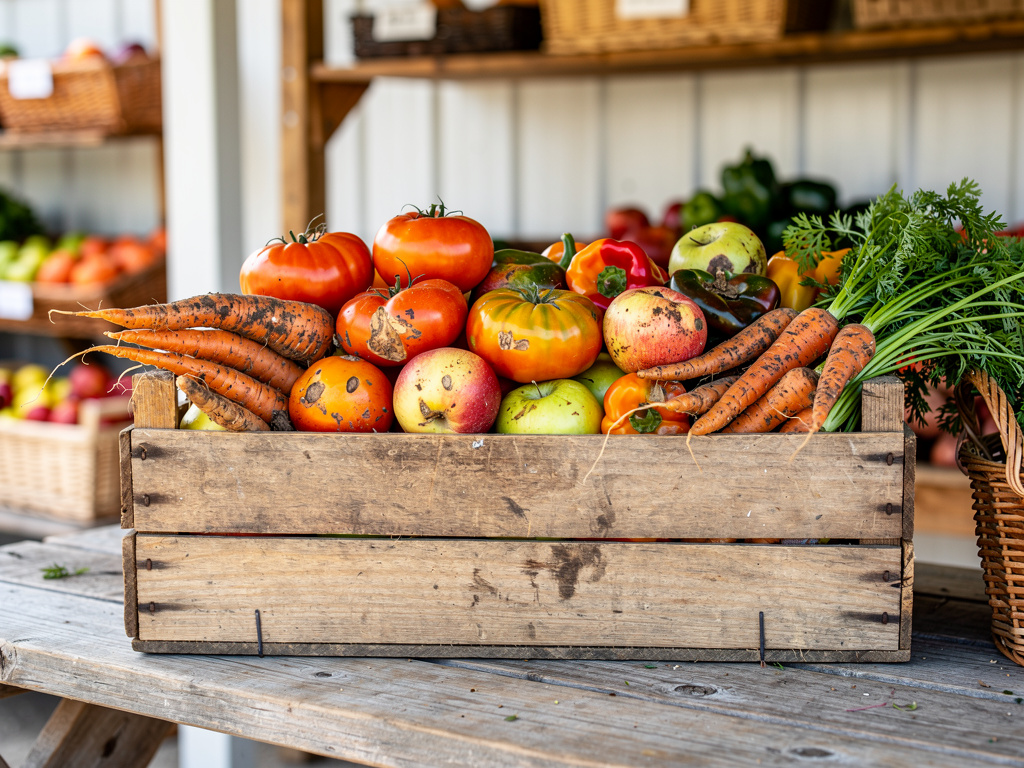


Perfectly good fruit and vegetables get left in the field or tossed at the packhouse for one reason: they're the wrong shape, size, or color for a grocery shelf. That's food a small local vendor can turn into a product, either by selling the "seconds" as a discounted box or by cooking the surplus into jam, sauce, or dried goods worth more than the raw produce. This guide walks through the ugly produce business model, the ways to run it, how to price it, and how to move perishable seconds before they go bad.
The short version: An ugly produce business sells cosmetically imperfect but perfectly edible fruit and vegetables, either as a lower-priced "seconds" or "value" box, or as the raw material for value-added products like jam and sauce. You source it from farms, orchards, and wholesalers who'd otherwise leave it unsold. The value-added route usually makes the most money, since a jar of jam is worth far more than the bruised fruit that went into it. The hard part is that seconds are perishable and unpredictable in supply, so a pre-order model that sells the box before you buy the produce is the safest way to run it. Homegrown gives you the storefront and pre-orders to sell it, but you source the produce and set the price yourself.
This guide covers what the model is, where to source, whether it's profitable, the three main models, pricing, moving perishables, and the legal picture. This is general information, not legal advice.
The ugly produce business model is selling fruit and vegetables that are safe and tasty to eat but rejected by conventional retail for looking imperfect, either as-is at a lower price or as an ingredient in something you make. The whole model rests on a gap: cosmetic standards pull a large amount of edible produce out of the supply chain, and that produce is available cheap to someone willing to sell it a different way.
The core idea in three parts:
According to the nonprofit ReFED, which researches food waste, surplus and unharvested produce on farms is one of the single largest sources of wasted food in the country, which is the raw supply this whole model runs on. The takeaway: ugly produce is a business because cosmetic rejection creates a steady stream of cheap, good food, and your job is to route it to people who'll eat it. The rule is that you're selling edibility, not appearance, so lead with taste and value, never apology.
You source ugly produce from the people who grow and handle it in bulk: farms, orchards, packhouses, and produce wholesalers who have cosmetically rejected or surplus stock they can't sell through normal channels. The supply is real, but it's inconsistent, so you build relationships rather than expecting a catalog.
The main sourcing channels:
The catch is that this supply is seasonal and unpredictable: you can't promise customers "10 pounds of tomatoes every week" when your source depends on what didn't sell that day. The takeaway: line up more than one source and treat supply as variable, not guaranteed. The rule is to build direct relationships with growers, since a farmer who knows you'll reliably take their seconds becomes a dependable, cheap supply.
It can be, but the margin depends heavily on which model you run: reselling raw seconds is a thin-margin, high-volume game, while turning them into value-added products is where the real money is. The cheap input is only half the equation, since what you do with it determines whether there's a business.
Here's the profit reality by approach:
The takeaway: ugly produce is most profitable when you use it as a cheap raw material for a made product, and least profitable when you just move boxes of it. The rule is to run the numbers on your real labor with a proper cost-per-item breakdown before assuming cheap produce means easy profit.
There are three common ways to build an ugly produce business: the seconds box, the value-added maker, and upcycled specialty products, and they differ in how much you process the produce and how much margin you capture. Pick the one that fits your skills and your kitchen.
Here's how they compare:
| Model | What you sell | Margin | Best for |
|---|---|---|---|
| Seconds box | Raw imperfect produce, boxed at a lower price | Thin, volume-based | Growers, resellers with cheap supply |
| Value-added maker | Jam, sauce, salsa, dried goods made from seconds | High | Cooks with a cottage food setup |
| Upcycled products | Specialty items using parts usually discarded | High, niche | Makers with a distinct product idea |
A few notes on each:
The takeaway: the more you transform the produce, the more margin you capture and the less its imperfection matters. The rule is to match the model to your setup, since a grower with a field of seconds and a cook with a cottage kitchen should run very different versions of this. It pairs naturally with a broader low-waste brand story.
You price a seconds box at a clear, meaningful discount to perfect produce, and you price a value-added product on your true cost plus a margin, not on the near-zero cost of the ugly input. The two models price on completely different logic, and mixing them up is where vendors lose money.
For raw seconds boxes:
For value-added products:
The takeaway: discount raw seconds honestly, but price made products on their real value, not their cheap input. The rule is that cheap produce should widen your margin, not drag your price down to match it.
You sell perishable seconds with a pre-order model: list the box, take orders and payment, and only then buy or pick the produce, so you never hold inventory that rots. This is the single most important operational move in the raw-produce version of the business, because seconds are perishable and your supply is unpredictable.
Why pre-orders fit this model so well:
A weekly rhythm works well: open pre-orders for a few days, close them, then source and pack against the confirmed list. The takeaway: pre-orders turn a perishable, unpredictable product into a made-to-order one with almost no spoilage risk. The rule is to sell first and source second, which a pre-order system is built to do. For value-added products, shelf life buys you room, but pre-orders still smooth out how much you make.
Selling produce and selling made products live under different rules: raw produce has its own handling and, in some places, labeling requirements, while value-added foods fall under your state's cottage food or food-processing law. You have to know which bucket you're in, because they're regulated very differently.
The key distinctions:
The takeaway: match your compliance to what you actually sell, and confirm the specifics with your state and local health department before you start. The rule is that imperfect is about looks, never about safety, so hold the safety line hard. This is a real "check your local rules" situation, not boilerplate.
The hard parts of an ugly produce business are perishability and unpredictable supply, and both get much easier when you can list a box, take orders and payment up front, and pack only what's sold. Homegrown is a $10-per-month online storefront, with no percentage fees beyond standard payment processing, built for exactly this kind of made-to-order, pre-order selling.
You list this week's seconds box or your jam and sauces, open a pre-order window, and take payment at order time, so you source produce against confirmed sales instead of buying on a gamble. A lower-priced seconds box is simply its own listing at its own price, a "value box" customers choose on purpose, which fits the model cleanly without any discount-code machinery. And because your storefront keeps clean records of what sold, you learn which boxes and products move, so you source smarter each week.
To be clear about what Homegrown does not do: it does not source your produce, find your growers, set your prices, or handle the sorting, cooking, or delivery. Those are your business. What it gives you is the storefront, the pre-order flow, and the payment handling so the selling side runs cleanly while you focus on sourcing and making. If you're ready to turn imperfect produce into a real product line, set up your Homegrown storefront and open your first pre-order box.
Yes. "Ugly" or "imperfect" produce refers only to cosmetic flaws, an odd shape, a small size, a blemish, or discoloration, that keep it off grocery shelves. It's the same fruit and vegetables nutritionally and tastes the same. What you must never do is sell produce that's actually rotten, moldy, or unsafe under the label of "ugly." Cosmetic imperfection is fine to sell; spoilage is not. Sort strictly and reject anything past a surface flaw.
From farms and orchards directly, from produce packhouses and wholesalers who grade out cosmetically rejected lots, from other vendors at your farmers market with end-of-day surplus, and through local gleaning networks that harvest what would be left in fields. Build direct relationships with growers, since a farmer who knows you'll reliably take their seconds becomes a dependable, cheap source. Expect the supply to be seasonal and variable rather than a fixed catalog.
It can be, but it depends on the model. Reselling raw seconds is a thin-margin, high-volume game, because the produce is cheap but still perishable and labor-intensive to handle. Turning surplus produce into value-added products like jam or sauce is far more profitable, since you're selling your recipe and labor and a jar is worth much more than the bruised fruit inside it. In every version, your own labor is the real cost, so price it in.
Price it at a clear, meaningful discount to perfect produce, enough that the value is obvious to someone who's going to cook or preserve it anyway. Frame it positively as a "value box" or "chef's box," not as damaged goods. For value-added products made from seconds, price differently: on your true cost of ingredients, packaging, and labor plus a margin, not on the near-zero cost of the ugly input. The cheap produce should widen your margin, not lower your price.
Use a pre-order model. List the box, take orders and payment first, then buy or pick the produce against your confirmed sales, so you never hold inventory that rots. This matches the unpredictable supply of seconds and means you're sourcing with the customer's money instead of floating the cost. A weekly rhythm, open orders for a few days, close, then source and pack, works well. For value-added products, shelf life gives you more room, but pre-orders still help.
It depends on what you sell and where. Selling whole, uncut raw produce is usually the lightest-regulated category, though local rules vary. The moment you cut, cook, dry, or jar it, you're likely into your state's cottage food law or a licensed-kitchen requirement, with labeling and allowed-product limits. Value-added goods like jam and salsa follow cottage food rules on acidity, labeling, and permitted products. Always confirm the specifics with your state and local health department before you start.
Ugly produce is one of the rare business ideas where the raw material is cheap, the supply is real, and the story sells itself. Whether you box the seconds or cook them into something better, the model works when you sell before you source and price on real value. Start your Homegrown storefront and open a pre-order box for your first batch.



