
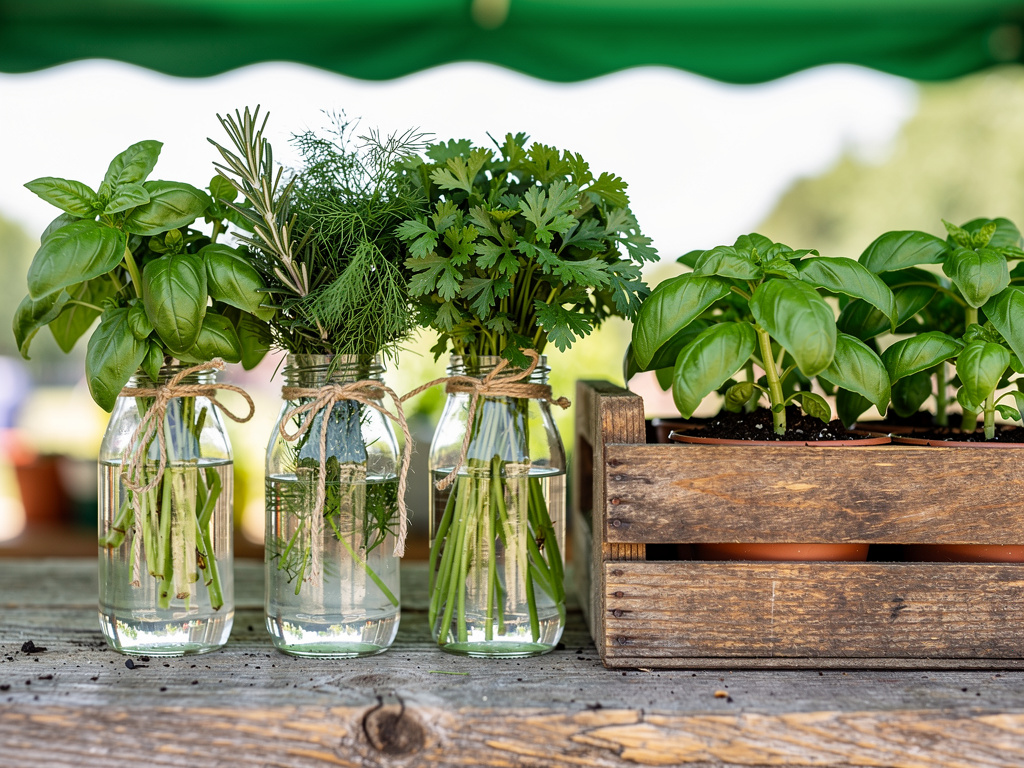


The short version: Herbs sell in seven places: a farmers market booth, your own storefront link with pickup, a farm stand or porch stand, restaurants, grocery stores and co-ops, another farm's CSA, and online shipping for dried herbs and seasonings, with potted herb plants selling best at spring plant sales. A $20 herb order costs you $0.88 in card processing through a Homegrown storefront link, but a single $3 bunch paid by card on its own loses 12.9% of its price to the same 2.9% + $0.30 fee, so herbs sell best in bundles and pre-orders. Cut basil and cilantro start to fade within a day, which means the best channel is the one where the order exists before you pick up the shears.
Checked September 22, 2026: Homegrown is $10 a month billed annually or $12.50 billed monthly, with 0% commission and card processing of 2.9% + $0.30 paid by the vendor, per findhomegrown.com/signup. Honest bounds: your customer creates a Homegrown account to place a first order, there is no timed release feature, and most orders will come from people you send to your own link.
You cut two dozen bunches of basil, parsley and dill this morning, and by tomorrow afternoon the basil will be starting to droop. Herbs are cheap to grow and quick to sell to the right buyer, but they are one of the worst products at waiting for one to show up.
So the real question is not only where people buy herbs. It is which of those places buys a $3 product without eating the profit in fees and gas, which ones take fresh bunches versus dried jars versus potted plants, and which ones let you cut to an order instead of cutting on hope. This guide covers seven places part-time growers actually sell, priced against a real $20 herb order.
Fresh herbs sell in seven places, and a grower cutting 20 to 60 bunches a week can run two or three of them from a backyard without hiring help. Each place trades price for time differently, and each one suits a different form of herb.
Potted herb plants are a separate product, and they mostly sell through the first three places plus spring plant sales, covered in their own section below.
To find the nearest farmers markets, CSA farms and on-farm markets, search USDA's Local Food Directories by zip code. Restaurants, independent grocers and co-ops you find the old way: walk your own town, read the menus and look at who already stocks a local shelf.
The University of Kentucky's crop profile on culinary herbs names the same spread: fresh, dried and live plants through farmers markets, on-farm stands and CSA memberships, plus small-scale wholesale straight to local restaurants and grocers. It also warns that herb growers may spend more time marketing than growing. Picking the right two channels is how you keep that time down.
If you are still working out which herbs to grow, how to harvest them and what a bunch should cost, the companion guide on how to sell fresh herbs from home covers that ground. This article starts where that one stops: the herbs are growing, and you need buyers lined up before they are cut.
Start with the channel that matches what you grow and how steady your harvest is, not the one with the highest price per bunch. A grower with 30 basil plants in succession is ready for a chef. A grower with six patio pots and $30 a week in sales is not, and should sell to neighbors first.
Scroll sideways to see every column.
| What you have right now | Start here | Add second | Why that order |
|---|---|---|---|
| A few containers, under 15 bunches a week | Your own storefront link with porch pickup | A porch stand | Pre-orders let you cut only what is sold, and neighbors pick up on their schedule |
| A market booth you already pay for | Your own storefront link | One restaurant | The booth built the customers; the link lets them order before market day so you cut to the order |
| Raised beds with a steady 40+ bunches a week | One or two restaurants | A farmers market | Chefs take volume on a fixed day at a lower price, with no hours behind a table |
| A friend who runs a vegetable farm | Their CSA as an add-on | Your own storefront link | Their members already pick up weekly; your herbs ride on a pickup that exists |
| More herbs than you can move fresh | Dried herbs or herb salt, shipped | A co-op with a bulk or local shelf | Dried product buys you months, as long as your state allows it |
| Spring seedlings and extra transplants | A plant sale or your market booth | Your own storefront link | Potted herbs sell hardest in April and May, when people plant gardens |
The situations and the order are our own advice. The market, stand, CSA, restaurant and grocer channels come from the University of Kentucky's Culinary Herbs crop profile (CCD-CP-51, March 2020), loaded September 22, 2026.
The trap is opening three channels in the same month. A chef, a grocer and a market all expect you on a fixed day with a fixed amount, and a grower who promises all three from one bed of basil ends up shorting the chef, which is the one buyer who will not give you a second chance.
A farmers market pays full retail, about $2 to $4 a bunch for basil, cilantro, mint and parsley, and costs you the most hours to earn it. Booth space commonly runs $20 to $75 a week, as broken down in the guide to the real cost of selling at farmers markets, and an herb table has to move 5 to 25 bunches at $3 and $4 just to cover it.
Run the arithmetic on a $40 booth. At $4 a bunch, you need 10 bunches sold just to pay for the table, before gas, rubber bands and clamshells. Bring 40 bunches, sell 30, and you clear $80 before other costs. The 10 bunches that go home unsold are worth $40 at your own prices, and most of them will not look good enough to sell next week.
What the booth gives you that no other channel does:
Cut herbs lose their look fast on a hot table. Stand bunches in jars of water, keep backstock in a cooler under a damp towel, and bring out a few at a time. Basil hates the cold, so keep it out of the ice and out of direct sun. A table of limp cilantro at 11 a.m. costs you the whole afternoon of sales.
The booth is the best place to find customers and the worst place to guess quantities. Most herb growers who stay at markets for a second season do it because the booth feeds the channels below.
Sell between market days by taking orders before you harvest, so every bunch you cut already has a name on it. Herbs are the clearest case for pre-orders of anything a small grower sells: a head of lettuce holds for days, but a cut basil bunch starts to fade the same afternoon.
Homegrown is $10 per month billed annually, or $12.50 billed monthly, with no percentage fees beyond standard payment processing (2.9% + $0.30 per order, paid by you, not added to the customer's total). You list your weekly herbs with bunch sizes and prices, set an order prep time, for example two days before a Friday pickup so orders close Wednesday, and share one link. Customers order and pay in one step, and you walk into the garden Thursday morning with an exact cut list: 12 basil, 8 parsley, 5 dill, 3 rosemary. If you set a quantity on the Thai basil, the listing stops taking orders when it runs out, instead of you apologizing by text.
How that compares to what herb growers usually use instead:
What fits an herb harvest: an order prep time, pickup at your porch or market booth, local delivery if you want it, a customer list (names and emails) that stays yours, so you can email your regulars when the first basil is ready, and payment before you cut.
Honest bounds, so you decide with the whole picture. Your customer creates a Homegrown account to place a first order. There is no countdown or timed release feature. Your storefront appears on the Homegrown marketplace, but plan on most orders coming from the link you text, print and hand out yourself. Homegrown does not send wholesale invoices or run net-30 terms for a restaurant, it is built around pickup and local delivery, and it does not grow or cut a single stem for you.
In a live pull of the Homegrown catalog on September 22, 2026, 7 of the 2,604 listings were fresh-cut culinary herbs, from 5 vendors, priced from $1.49 to $17. Aliken Beach Farm lists a basil bunch at $5, rosemary at $5 and a mixed bunch of basil, dill, parsley, chives and fennel at $10. Fields & Firelight Farms lists a $17 "Kitchen Herb Harvest" cut the day of pickup. Another 4 listings were potted herb plants and 4 were herb seasonings.
If your herbs keep wilting on the table while regulars ask "do you have basil this week?" by text, a storefront link turns those texts into paid orders before harvest. You can set up your Homegrown storefront and list this week's herbs in about 15 minutes.
A porch or roadside stand works well for herbs if you have steady foot or car traffic, because a $3 bunch is exactly what a neighbor buys on impulse with cash. It works badly for herbs on a hot afternoon, because an unattended stand has no one to swap wilted bunches for fresh ones.
The setup that works for most herb growers:
A porch stand is also the easiest pickup spot for pre-orders. The neighbor who ordered two bunches on your link grabs a bag with their name on it from the same cooler, and your stand turns into a pickup shelf on the days you do not want to sit outside.
The weak spot is volume. If a stand on a quiet street sells 10 bunches on a good day at $3, that is a nice extra $30, not a reason to plant more beds.
Sell herbs to restaurants by starting with one chef, bringing samples of the herbs kitchens use most, and promising only the weekly quantity you can cut every single week. The University of Kentucky crop profile says chef interest is greatest for high-volume herbs: basil, chives, cilantro, parsley and rosemary. Kentucky chefs surveyed also named horseradish, oregano, sage, tarragon and thyme.
The price is lower than retail. A kitchen buys by the pound or the case to put on 40 plates, so it will not pay $4 a bunch for 20 bunches. What it pays you back in is volume on one fixed day and no hours spent behind a market table.
Know when to stop adding kitchens. NC State Extension's guide to fresh herb production and marketing warns that when the restaurants are few and far between, more and more time goes into deliveries as production grows, until it no longer pays to drive "a pound or two at a time" to many locations. A good rule of thumb for a backyard grower is two or three kitchens on one route.
Yes, a locally owned grocery store or food co-op will often buy local herbs, but it expects consistent bunch sizes, a steady weekly supply and sometimes a food safety certification. Chain supermarkets mostly buy through distributors, so start with the independent store, the co-op and the specialty or international grocer.
Kentucky's herb crop profile points out why a local grower can win this shelf: supermarket cilantro trucked in from California loses quality over a three-day shipment. Your cilantro, cut that morning, is visibly better on the same shelf.
What a produce buyer usually asks before saying yes:
How the four wholesale-style buyers usually differ, for a grower cutting about 20 bunches a week:
Scroll sideways to see every column.
| Buyer | How they order | Price per bunch | What they ask for | When you get paid |
|---|---|---|---|---|
| Restaurant | Standing weekly order by text or email | Below your $2 to $4 market price | Same herbs, same day, cold | Usually on an invoice, net 15 or net 30; on delivery only if you agree to it up front |
| Independent grocer | Weekly order from the produce manager | Below your market price, so the store can mark it up | Standard bunches, a label, sometimes a GAP audit | Usually on an invoice |
| Food co-op | Local shelf, bought at your wholesale price | Your wholesale price, which the co-op marks up 30 to 50% for the shelf | Labels and a delivery day | On the co-op's payment terms |
| Another farm's CSA | Fixed count per box or add-on | A set price per bunch | An exact count on pickup day | On the farm's schedule |
The restaurant pay terms come from Homegrown's guide to selling food to local restaurants, and the co-op markup from its guide to selling through a food co-op, both checked September 22, 2026. The other rows describe how these buyers usually work, not a fixed rule.
Co-ops are the friendliest door. Many carry a local shelf, and they typically buy at your wholesale price and mark it up 30 to 50% for the retail shelf. The guide to selling through a food co-op covers how to set that wholesale price and what a co-op buyer asks for first. For a grower with 20 bunches a week, one co-op and one restaurant is a full wholesale book.
Yes, and for a small herb grower it is often the easiest wholesale channel, because a CSA already has a fixed list of members picking up a box on the same day every week. A CSA, short for community supported agriculture, is a farm subscription where members pay up front for a weekly share of the harvest.
Three ways herb growers plug into a CSA:
The math is simple and predictable. If a 40-member CSA takes one $3 bunch per box, that is $120 a week you know about on Monday, cut to an exact count.
Your own weekly herb share is the do-it-yourself version: customers prepay for 8 or 10 weeks of a mixed bunch, and you cut whatever is best that week. It works best once you have a list of regulars, since an herb share is a harder first sale than a single bunch.
Dried herbs, herb salts and seasoning blends sell in the places fresh herbs cannot reach: online and shipped, gift shops, specialty food stores and holiday markets. They keep for months, which turns the herbs you could not sell fresh in July into December gift sales.
Where dried herb products do well:
Dried herbs come with more rules than fresh ones. Drying herbs is considered food processing, as the Kentucky crop profile puts it, so dried and blended herbs usually fall under your state's cottage food law or a processing license rather than the looser produce rules. The guide on how to sell dried herbs from home covers drying, jars and labels. On Homegrown's marketplace, herb seasonings on September 22, 2026 ranged from a $5 rosemary oregano blend and a $5 five-herb salt to $9 frozen herb cubes. Frozen herb cubes are a processed product with their own rules: Washington, for one, requires a food processor license for frozen herb products, so check before you freeze a batch to sell.
Potted herb plants sell best in spring, in the weeks around your area's last frost date, at plant sales, farmers markets and garden club events, when people are filling their own gardens. After June, a potted basil competes with the basil your customers already planted.
The University of Kentucky crop profile says container herbs are usually grown in 4- to 6-inch pots and sold as garden transplants or as kitchen herbs at farmers markets and groceries. It also names a buyer most growers forget: homeowners and landscape contractors who want herbs for edible landscaping.
Where potted herbs move:
On Homegrown's marketplace on September 22, 2026, Red Shed Market listed four potted herbs, three basils and a Mammoth dill, in 3.5-inch pots at $4 each. The guide on selling potted herbs at the farmers market covers growing starts cheaply and pricing them.
Potted plants often fall under your state's nursery rules rather than its food rules. Washington's herb fact sheet sends potted herbs and plant starts to a separate fact sheet on nursery products, which is a good sign to check your own state's plant-sale rules before a big spring sale.
On a $20 herb order, what you pay runs from $0.67 through a Square card reader at your booth to $2.35 in Etsy fees, and at a few dozen orders a month, both the subscription and the per-order fee move your total. The last column shows both together. The table uses a real basket: two $5 basil bunches and one $10 mixed bunch, the prices on Aliken Beach Farm's Homegrown listings.
Scroll sideways to see every column.
| Where you sell | Subscription | Trial | Platform fee | Card processing | Customer pays on a $20 order | You pay on a $20 order | A month of 50 orders ($1,000) |
|---|---|---|---|---|---|---|---|
| Homegrown storefront link | $10/mo billed annually, or $12.50 billed monthly | 7 days, not charged until day 8 | $0, 0% commission | 2.9% + $0.30 | $20.00 | $0.88 | $54.00 ($44 processing + $10 plan) |
| Square free plan, online orders | $0 | Free plan | $0 | 3.3% + $0.30 | $20.00 | $0.96 | $48.00 processing |
| Square free plan, card reader at the booth | $0 | Free plan | $0 | 2.6% + $0.15 | $20.00 | $0.67 | $33.50 processing |
| Shopify Basic | $29/mo paid yearly, or $39 paid monthly | 3 days, then $1/month for 3 months | $0 on Shopify Payments; 2% with a third-party processor | 2.9% + $0.30 | $20.00 | $0.88 | $73.00 ($44 processing + $29 plan) |
| Local Line Core | $87/mo billed annually ($1,044/yr), or $109 billed monthly | 7 days, no credit card required | $0, no commission or setup fee | 2.9% + $0.30 | $20.00 | $0.88 | $131.00 ($44 processing + $87 plan) |
| Etsy (dried herbs, shipped) | $0 a month; a one-time shop set-up fee may apply | None | 6.5% transaction fee + $0.20 listing fee; 15% if the sale came from an Offsite Ad | 3% + $0.25 | $20.00 plus shipping | $2.35 | $117.50 before shipping |
We checked every price on each company's own pricing page on September 22, 2026: findhomegrown.com/signup, squareup.com/us/en/pricing, shopify.com/pricing, localline.co/pricing and etsy.com/sell. Annual plans are compared on the annual price. Etsy's 6.5% also applies to any shipping you charge.
What the table means for an herb grower:
At $1,000 a month in herbs, the gap is $97.50 between the lowest fee on this list, the booth card reader at $33.50 in processing, and the most expensive, Local Line at $131. That booth figure leaves out the booth itself, which runs $20 to $75 a week. Among the options that take orders online, the gap is $83, from Square online at $48 to Local Line. Pick the channel that fits how your customers buy first, then compare the fee.
Small herb orders lose more to card fees because most processors charge a percentage plus a fixed fee on every payment, often 30 cents online, and 30 cents is a big slice of a $3 bunch. At 2.9% + $0.30, a $3 bunch loses $0.39, or 12.9% of its price, while a $20 order loses $0.88, or 4.4%.
What card processing at 2.9% + $0.30 takes from each sale
Source: 2.9% + $0.30 per card payment, the rate on Homegrown, Shopify Basic and Local Line Core pricing pages checked September 22, 2026. Calculated per single payment.
Square's online rate on the free plan is a little worse at the small end: 3.3% + 30 cents on a $3 bunch is $0.40, or 13.3%. Cash at a porch stand costs nothing to process, which is one reason honor boxes still make sense for single bunches.
Ways herb growers push the average order up:
Price your pre-order bunches as a weekly "kitchen box" instead of single stems. Fields & Firelight Farms lists a $17 herb harvest, cut the day of pickup, on Homegrown. At that size the 2.9% + $0.30 fee is $0.79, about 4.7% of the sale, against 12.9% on a $3 bunch.
Fresh, whole herbs sold as-is usually fall under the same light rules as other fresh produce, and the rules tighten the moment you dry, chop, freeze or wash them into a ready-to-eat product. Where you sell changes what you have to show, too.
The rules that most often apply, by channel:
Herb rules are set state by state, and dried herbs are where states differ most. Verify your state's current rules with your state department of agriculture before you sell dried, chopped or frozen herbs, or before a store asks for a food safety audit. Search for "produce sales" or "farm direct sales" as well as "cottage food," since fresh herbs usually sit under the produce rules.
One more rule applies in every channel: keep health claims off your sign. The Kentucky crop profile points out that the FDA regulates how products may be marketed with claims of health benefits. "Great in pesto" is fine. "Cures headaches" is not.
You can open one new herb channel within a week if you pick one channel and one date instead of three, and give it 4 weeks before judging it. Here is the order that works for most backyard growers.
The fourth step is the easiest one to put off. The fix is a date on the calendar: "I will visit two kitchens on Tuesday at 3 p.m." gets done, while "I should try restaurants" does not.
Experienced herb growers sell before they plant, sell when nobody else has herbs, and count the hours, not just the bunches. NC State's herb guide says markets should be set before herbs are harvested or even planted, because the product is too perishable to find buyers after the fact.
What that looks like in practice:
The pattern under all of it: an herb grower's real product is freshness on a schedule. Every channel that rewards a reliable weekly supply pays better than one that rewards a big pile on one Saturday.
The best place to sell herbs from a small patio or a few raised beds is your own neighborhood, through pre-orders with porch pickup or a small porch stand. Both let you sell 5 to 15 bunches a week without a booth fee, and pre-orders mean you cut only what is already paid for. A farmers market booth at $20 to $75 a week makes more sense once you can fill a table.
Usually, yes. Fresh, whole herbs are generally treated as raw produce, and Washington's agriculture department says directly that fresh culinary herbs sold to restaurants need no specific license, beyond any federal produce safety rules that apply to the farm. Chefs care most about the herbs they use by the handful, like basil, cilantro and parsley, and they need the same amount on the same day every week. Start with one kitchen and verify your state's current rules before your first delivery.
Locally owned grocery stores, food co-ops and specialty markets often buy herbs from local growers, while big chains usually buy through distributors. Expect the buyer to ask for standard bunch sizes, a fixed delivery day and sometimes a GAP food safety audit. A co-op with a local shelf is often the easiest first yes.
You can sell herbs online, but where to sell herbs online depends on the form. Fresh bunches sell best online as local pre-orders with pickup or nearby delivery, because a cut herb will not survive days in the mail. Jars of dried basil, herb salt and spice blends ship well through marketplaces like Etsy, where each sale pays a 6.5% transaction fee, a $0.20 listing fee and 3% + $0.25 for card processing.
A backyard herb grower selling 40 bunches a week at $3 to $4 grosses $120 to $160 a week before costs. The University of Kentucky estimates well-managed small-scale direct-market herb production can return $5,000 to $10,000 per acre to land, labor and management. Most part-time growers earn far less than an acre's worth, and the biggest cost is hours spent harvesting and packing.
Basil and cilantro sell best almost everywhere, followed by mint, rosemary, dill and parsley, going by the demand table in Homegrown's guide to selling fresh herbs from home. Chefs in the University of Kentucky's crop profile also named horseradish, oregano, sage, tarragon and thyme. Specialty herbs such as Thai basil or shiso sell at higher prices at markets where shoppers cannot find them in the grocery store.
These guides pick up where this one leaves off, from growing and pricing the herbs themselves to the paperwork behind a wholesale account. Each one answers a question this article only touches.
Herbs are the product where timing matters most: a bunch cut to an order is sold, and a bunch cut on hope is compost by Sunday. The growers who sell out every week are the ones who know the count before they walk into the garden.
Here is what that looks like on a Homegrown storefront. You list this week's herbs on Monday, with single bunches at $3 to $5 and a mixed bunch at $10. You set a two-day order prep time, so orders for Friday close Wednesday, and text the link to your market regulars and neighbors. Thursday morning you cut exactly what was ordered, and Friday they pick up at your porch or your booth. On a $20 order you pay $0.88 in card processing, and the plan is $10 a month billed annually with 0% commission.
Your customers create a Homegrown account the first time they order, and most orders will come from the link you share yourself. Start your herb storefront and take your first pre-orders before this week's harvest.



