
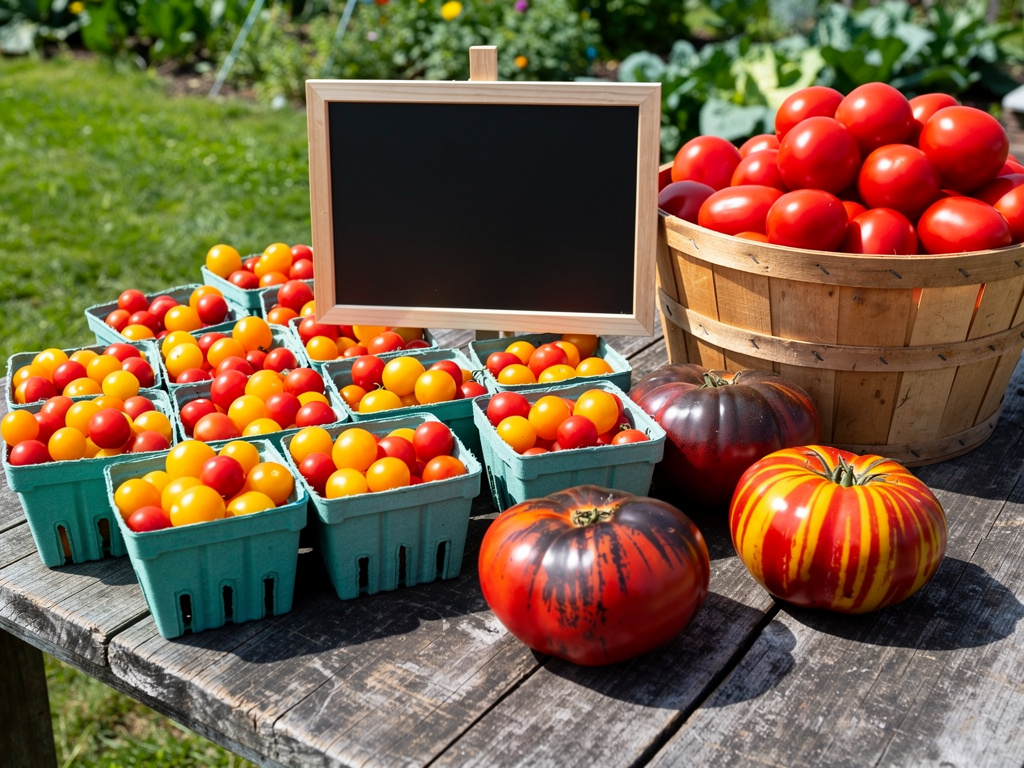


The short version: Tomatoes sell in seven places: neighbors and regulars who order before you pick, a porch or roadside stand, a farmers market, home canners who buy by the box, restaurants that want heirlooms, co-ops and food hubs, and, in spring, as tomato plants. Sell cherry tomatoes by the pint, and slicers by the piece or the quart, unless you own a legal-for-trade scale, because selling by the pound on a kitchen scale breaks weights and measures rules in states like Iowa. Whole, uncut tomatoes you grew yourself sit under some of the lightest food rules there are, and the FDA's produce safety rule does not cover a farm averaging under $34,324 a year in produce sales. Cut tomatoes, salsa and tomato sauce are a different story: Michigan's cottage food list, for one, bans all three.
Checked September 26, 2026: Homegrown is $10 a month billed annually or $12.50 billed monthly, 0% commission, with card processing of 2.9% + $0.30 paid by the vendor, per findhomegrown.com/signup. Square and Venmo fees come from their own pricing pages, the rules from the FDA, USDA, the Michigan, Iowa and Washington agriculture departments and the University of Maryland Extension, and the grocery price from the Bureau of Labor Statistics, all loaded that day. The limits: Homegrown cannot price by the pound yet (selling by weight is on its roadmap), your customer creates a Homegrown account to place a first order, there is no timed release feature, and most orders will come from people you send to your own link.
It is the second week of August. Every tomato plant you own ripened at once, the counter is covered, and the neighbors have stopped answering the door when you walk over with a bag. Meanwhile three people at work asked if you would sell them some.
Where you sell tomatoes depends on which tomatoes you have. A pint of Sungolds, a 2 pound heirloom, and 25 pounds of odd-shaped Romas each have a different best buyer. If you want the price per pound or per pint first, how to price vegetables at a farm stand has a tomato row and the grocery-store method behind it. If you grow a little of everything, where to sell vegetables covers the mixed box. This guide is only about tomatoes: which buyer takes which kind, how to sell without a scale, and the rules that change the moment you cut one open.
You can sell tomatoes in seven places, and most backyard growers use two or three at once: a pre-order list for the best fruit, a stand or market for the rest, and a canner for the glut. Each place wants a different tomato, so sorting your harvest by type is the first job, not the last.
One more outlet sits outside the seven: a food pantry, for tomatoes that are still good but will not sell in time. It pays nothing, but it beats the compost pile and keeps your stand stocked with only the best fruit.
Match the tomato to the buyer: cherry tomatoes and pints go to regulars and markets, big slicers go to a stand, heirlooms go to chefs and markets, and paste tomatoes and seconds go to canners by the box. Seconds are tomatoes with cosmetic flaws, like a healed crack at the shoulder or an odd shape, that taste fine but will not win a display.
Scroll sideways to see every column.
| Tomato type | Best first buyer | Sell it by | Why it fits |
|---|---|---|---|
| Cherry and grape (Sungold, Super Sweet 100) | Regulars who order ahead, farmers market | The pint | A pint is an impulse buy at $5, needs no scale, and travels without bruising |
| Red slicers (Early Girl, Beefmaster) | Porch stand, neighbors | The piece, the quart, or a bag of a set count | Everyone knows what a slicer is for; count or measure keeps the honor box simple |
| Heirlooms (Black Krim, Mr Stripey, Cherokee Purple) | Restaurants, farmers market | The piece, or the pound on a legal scale | Color and flavor are the selling point; chefs pay for what the grocery store does not stock |
| Paste (Roma, San Marzano, Amish Paste) | Home canners | The half-bushel or bushel basket | Grown for sauce; canners buy them by the basket |
| Seconds (sound fruit with cosmetic flaws) | Home canners, a "sauce box" at your stand | A peck or half-bushel basket | Shape does not matter in a pot; rot and mold still do |
| Green tomatoes at the end of the season | Restaurants, regulars | The quart or the piece | Fried green tomatoes and relish use them, and frost is coming anyway |
| Tomato plants | Neighbors, spring plant sales, farmers market | The pot | Sells in April and May, when you have no fruit at all |
Variety names are examples from the Homegrown catalog and common garden catalogs, not a ranking. "Sell it by" follows the weights and measures options in the section on pounds, pints and pieces below; your state's rules decide which apply to you.
Stop selling every tomato the same way. A grower who puts cherry tomatoes, heirlooms and cracked Romas on one table at one price is underpricing the first two and overpricing the third.
Tomatoes sell best when the buyer has already paid, because your whole crop ripens in the same few weeks and a picked tomato cannot go back on the vine. A pre-order list turns "I hope someone stops by" into "I am picking 14 pints for Thursday."
A real Homegrown vendor shows how it works. Mountain Artisan LLC dba ZachsGarden lists its "Hanover Tomatoes" at $8 a pint in three choices (Lemon Boy, cherry and purple), and the listing says it brings "a limited quantity to the market or we can pick freshly when you pre-order online." The same listing says unsold tomatoes become ingredients for the vendor's salsas. That is the whole model in two lines: sell ahead, pick to order, and have a plan for the rest.
Here is how a backyard grower can run the same thing with a weekly pint list:
Run it this way and the pre-order list sells your best fruit first, while the stand or market clears the rest. After one season, your order history also tells you whether to plant more cherry tomatoes or more paste types next year.
The fix for the tomato glut is a list of buyers who ordered before the tomatoes ripened, and that is the job a Homegrown storefront does. Homegrown is $10 a month billed annually ($12.50 billed monthly) with no percentage fees beyond standard payment processing of 2.9% + $0.30, which the vendor pays. You list a cherry tomato pint, a quart of slicers and a half-bushel canning box as one product with choices, set how many of each you can pick, and let regulars pay before Thursday's harvest.
Compare that to the three ways most tomato growers take orders now:
Three things in a Homegrown storefront fit tomatoes: pickup at more than one place (your porch and your market table under one storefront), inventory counts so you do not sell 12 canning boxes when you can pick 8, and choices on one listing so a pint and a half-bushel share a page. The honest bounds: Homegrown cannot price by the pound yet (selling by weight is on its roadmap, not live), so you list pints of cherry tomatoes, and sell slicers and canning tomatoes by the piece, the quart or the basket. Your customer creates a Homegrown account to place a first order. There is no timed release feature. Your storefront is listed on the Homegrown marketplace, but plan on most orders coming from people you send to your own link.
In a live pull of the Homegrown catalog on September 26, 2026 (2,730 products from 308 vendors), 4 listings from 4 vendors were fresh tomatoes, 14 were tomato plants, and 13 from 5 vendors were cooked or cut tomato products such as canned tomatoes, tomato sauce, marinara, salsa and bruschetta. We counted by category and description, not by the word "tomato" in the name, and opened each vendor's other listings to check. Salsas whose listing does not say what is in them were left out, except one ZachsGarden listing, because the same vendor's tomato listing says its unsold tomatoes go into its salsas, so the count may run low. Fresh tomatoes are the rare listing in the catalog.
If your tomatoes are already ripening faster than you can hand them out, set up a pre-order page for this week's pints and send the link to the three people who asked. Orders close before you pick, so you pick what sold.
A porch or roadside stand works well for tomatoes if you live on a road with traffic, price in whole dollars (slicers by the piece or quart, cherry tomatoes by the pint), and keep the table out of direct afternoon sun. It is the lowest-cost place to sell: no booth fee, no drive, and cash or a payment code taped to the cash box.
What makes a tomato stand sell:
For building the table itself, how to set up a roadside farm stand covers placement and signs, and the honor system farm stand guide covers cash boxes and theft.
A "$3 a pound" sign on an honor stand with a kitchen scale beside it is the setup weights and measures rules are written to stop. Iowa's agriculture department says it is illegal to sell by weight on a non-commercial scale and names kitchen, bathroom and postage scales as not legal for trade (checked September 26, 2026). If you do not own a certified scale, count out slicers or sell them by the quart, and sell cherry tomatoes in pint measures.
Sell cherry tomatoes by the pint, slicers by the piece or quart, and paste tomatoes by the basket unless you own a legal-for-trade scale, because selling by weight requires one in Iowa and Maryland, the two states whose rules we checked, and your own state's weights and measures rules decide it where you live. The pound is the fairest unit for big heirlooms, but it is also the only unit that brings a scale inspector into your life.
The University of Maryland Extension's guide to weighing or not weighing produce lays out the three legal ways to sell: by weight, by count, or by measure (a quart, a peck, a basket). It also shows what the pound can earn you. Its example: a quart of tomatoes sold for $4.00, against the same tomatoes at $1.49 a pound in a container weighing 3.00 pounds, which comes to $4.47. That 47 cents is the pound's reward for owning the right scale.
What a scale that counts looks like, per that Maryland guide and Iowa's agriculture department:
What to charge per unit is a pricing question, and the grocery store sets the ceiling most customers carry in their heads. The Bureau of Labor Statistics average price for field-grown tomatoes at U.S. stores was $1.98 a pound in August 2026, down from $2.69 in April. The farm stand pricing guide shows how to price your homegrown tomatoes against that shelf. Its slicing tomato prices are per pound, which assumes you own a legal scale, and they run above that August 2026 store average.
A farmers market is worth it for tomatoes when you bring something the other tables do not have: cherry tomato mixes, heirlooms, a color nobody else grows, or a canning box on pre-order. Plain red slicers are a hard sell at a July market when three other growers have a table of them at the same price.
Ways a tomato grower stands out at the market:
The booth fee is the other half of the math. If a booth costs $30 for the day (an illustrative number; yours may be more or less), you need six $5 pints just to cover it before your time counts. The real cost of selling at farmers markets breaks down booth fees, insurance and the rest. For most backyard growers, the market pays off when tomatoes share a table with something else you already sell there, like eggs, bread or herbs.
Home canners buy tomatoes by the box, and they are the best buyer for paste tomatoes and sound seconds, because shape does not matter in a pot. A 53 pound bushel of tomatoes makes 17 to 20 quarts of crushed tomatoes, according to the National Center for Home Food Preservation's recipe for crushed tomatoes, an average of 2¾ pounds per quart. For thin tomato sauce, the same center's standard sauce recipe puts it at 10 to 12 quarts a bushel, about 5 pounds per quart.
That math is why canners think in baskets, not pints. A half bushel (about 26.5 pounds by that 53 pound figure) makes roughly 8½ to 10 quarts of crushed tomatoes, or 5 to 6 quarts of thin sauce. Price it against the grocery store and a canning box is a deal for the buyer: 26.5 pounds at the August 2026 store average of $1.98 comes to about $52, so a $30 half-bushel (our working example, about $1.13 a pound) is a real reason to buy from you.
What canners ask for, and what the canning guides tell them to use:
Put the canning math in the listing. "A half bushel makes about 8½ to 10 quarts of crushed tomatoes" answers the first question a canner asks, and it turns a $30 box into a clear price of about $3 to $3.50 per quart jar before lids and time.
Canners also come back. The person who bought one box for sauce this year is the easiest sale for two boxes next August, so keep their name and number, or let the storefront keep it for you. Where to find them: church and community groups, local canning or homesteading groups online, the "free and for sale" boards in your town, and the regulars who already buy your pints. The ugly produce business model goes deeper on pricing seconds.
Yes, restaurants buy heirloom and cherry tomatoes from small growers, especially independent places that put the grower's name or the variety on the menu, and they pay less than retail but can order every week. Most chains buy through a distributor; a chef-owned bistro can buy from you on a Tuesday.
What a chef usually wants from a tomato grower:
Start with one restaurant within a short drive, bring a mixed pint to the back door on a slow afternoon, and ask what they would use. How to sell food to local restaurants and cafes covers the pitch. Price below your stand price, because a chef buying 10 pints every Tuesday saves you ten stand sales' worth of time. At an illustrative $4 a pint, that standing order is $40 a week from one stop.
A co-op, grocery store or food hub may buy your tomatoes, but it can ask for more than any other buyer on this list: steady volume, consistent packing, and in some cases liability insurance or a food safety audit. For most backyard growers, this is the last place to add, not the first.
If you do sell here, one federal rule matters. The FDA's produce safety rule gives smaller farms a "qualified exemption" when all their food sales average under $500,000 a year, adjusted for inflation ($686,476 for the 2023 to 2025 average), and more than half go to consumers or to restaurants and stores in the same state or within 275 miles. A farm with that exemption must show the name and complete business address of the farm where the produce was grown, either on the label or at the point of purchase. So if your sales put you in that exempt group, a case of tomatoes going to a co-op carries your farm name and full address. A farm under the smaller $34,324 line covered in the license section is outside the rule entirely.
What these buyers commonly look for:
A small local co-op is the friendliest version of this channel. Ask the produce buyer what they are short on in August. If every local grower brings red slicers, the gap may be yellow cherry tomatoes or paste tomatoes for their deli.
Yes, and tomato plants fill the one gap in a tomato grower's year, because they sell in April and May, when nobody has ripe tomatoes to pick. On Homegrown, Red Shed Market lists 14 tomato varieties as 3.5 inch starts at $4 each (checked September 26, 2026), from Early Girl and Beefmaster to Sungold, Black Krim and a paste type called Super Sauce.
Why plants work for a tomato grower:
Plants are their own business, with their own rules about licenses, pots, timing and pests. Some states license plant sellers: Washington requires a nursery license once you sell more than $100 of plants in a calendar year, so check your state's agriculture department before your first plant sale. Where to sell seedlings covers the seven places plants sell and what each one costs.
On a $30 half-bushel of canning tomatoes, card processing costs you between $0.67 and $1.29 depending on how you take the payment, and cash costs nothing. Over a month of 50 boxes ($1,500 in sales), that is $68.50 through a Homegrown storefront ($58.50 in processing plus the $10 plan at the annual rate), $64.50 through Square's free online checkout, $46.50 on a Square card reader and $33.50 on a Venmo business profile.
Scroll sideways to see every column.
| Way to get paid | Subscription | Trial | Platform fee | Card processing | Customer pays on a $30 box | You pay on a $30 box | You pay on a $5 pint | You pay on 50 boxes a month ($1,500) |
|---|---|---|---|---|---|---|---|---|
| Homegrown storefront | $10/mo billed annually, or $12.50/mo billed monthly | 7 days, no charge until day 8 | $0, 0% commission | 2.9% + $0.30, paid by you | $30.00 | $1.17 | $0.45 | $68.50 on the annual plan ($71.00 billed monthly) |
| Square free plan, online checkout link | $0/mo | n/a (free plan) | $0 | 3.3% + $0.30 online, paid by you | $30.00 | $1.29 | $0.47 | $64.50 |
| Square free plan, card reader or Tap to Pay at the stand | $0/mo, hardware from $59 or Tap to Pay on your phone | n/a (free plan) | $0 | 2.6% + $0.15 in person, paid by you | $30.00 | $0.93 | $0.28 | $46.50 |
| Venmo business profile | $0/mo | n/a | $0 | 1.9% + $0.10 per payment, paid by you | $30.00 | $0.67 | $0.20 | $33.50 |
| Cash at your stand or porch | $0 | n/a | $0 | None | $30.00 | $0.00 | $0.00 | $0.00 |
We checked every fee on the company's own pricing page on September 26, 2026: findhomegrown.com/signup, squareup.com/us/en/pricing and venmo.com/resources/our-fees. Processing is figured on the listed price. The 50-box column adds one month of the subscription at the annual rate, with monthly billing in brackets. Square Plus ($49 a month per location) lowers online processing to 2.9% + 30 cents. Venmo charges 2.29% + $0.09 on Tap to Pay payments to a business profile. A payment marked goods and services to a personal Venmo account costs 2.99%.
What the table means for a tomato grower:
For a wider look at ordering tools built for growers, the best platforms to sell produce online compares farm software as well.
Fresh tomato listings on Homegrown ran from $2.29 for a pound of Romas to $8 for a pint of Lemon Boy, cherry or purple tomatoes in the September 26, 2026 catalog pull, with two listings that give no size, one of them at $22. Tomato plants were steady at $4 a pot, and tomato sauces, canned tomatoes and salsas ran $7.49 to $18, with ZachsGarden's salsas, which the vendor says use its unsold tomatoes, at $10 a half pint and $15 to $18 a pint.
On a phone, slide left for the vendor, price and unit.
| Listing | Vendor | Listed price | Unit |
|---|---|---|---|
| Roma tomatoes | KairosGO | $2.29 | 1 pound |
| Cherry tomatoes | KairosGO | $3.49 | No size given on the listing |
| Assorted cherry tomatoes, grown by Blue Coyote Farm | Harvest House Foods | $5.00 | 1 pint |
| Lemon Boy, cherry or purple tomatoes | Mountain Artisan LLC dba ZachsGarden | $8.00 | 1 pint |
| Tomatoes, rounds or Romas | Heavenly Fresh Fruits | $22.00 | No size given (the same vendor sells plums by the 25 pound box) |
| Tomato plants, 14 varieties | Red Shed Market | $4.00 | 3.5 inch pot |
| Canned tomatoes or tomato sauce | Homegrown Gardens | $8.00 pint, $15.00 quart | Jar |
| Salsa, bruschetta or pico de gallo | Sunset Salsa | $7.49 | Container (size not listed) |
Listed prices as they appeared on Homegrown in a live catalog pull on September 26, 2026. These are asking prices, not sale prices, from vendors in different states and seasons. The cooked and cut products are shown for what they cost, not as proof that they are legal to make at home in your state; see the section on salsa and sauce below.
Tomato listings on Homegrown, by kind
Source: live pull of the Homegrown catalog, September 26, 2026, 2,730 products from 308 vendors. Counted by category and description: fresh tomatoes are whole tomatoes in the vegetable or fruit categories; cooked or cut products are canned tomatoes, tomato sauce, marinara, salsa, bruschetta and pico made with tomatoes; meals, breads and spice blends that include tomato are left out, and so are salsas whose listing does not say what is in them, except one ZachsGarden listing, because the same vendor's tomato listing says its unsold tomatoes go into its salsas.
Only 4 of 2,730 listings were fresh tomatoes. The pint is also the common unit: two of the four fresh listings are pints, at $5 and $8, and neither needs a scale, though a pint of slicers like Lemon Boy is not an allowed unit in every state (Iowa allows slicers by count, by weight or by a dry measure of a quart or larger).
In Michigan, for example, you do not need a food license to sell whole, uncut tomatoes you grew yourself at a farmers market, but your city or county may still want a business license, a sales tax permit or a permit for a roadside stand. Verify your state's current rules and your local ones before your first sale; they differ from state to state and change.
The Michigan Department of Agriculture and Rural Development says "there are no licensing requirements for farmers selling fresh, whole, uncut fruits and vegetables at a farmers market in Michigan." Once cut, the department says, "vegetables fall into the category of processed food," and that processing is permitted only at an approved, licensed location. Checked on MDARD's farmers market FAQ, September 26, 2026.
The federal rule that matters is the FDA's produce safety rule, which sets standards for growing, harvesting and handling produce. Here is where tomatoes sit in it, checked on the FDA's produce safety and inflation-adjusted cut-off pages on September 26, 2026:
For a backyard or part-time grower, $34,324 of produce sold in a year is far more than a garden produces. At $5 a pint, it is 6,865 pints. Most home growers never come close, which is why the FDA produce rule is not what stands between a home grower and a tomato stand. Your state and local rules are. The picture changes the moment you cut, cook or can them.
Often not from a home kitchen: Michigan's cottage food list, for example, rules out salsa, tomato sauce, canned vegetables and dried tomatoes by name, and of the 5 other states in our salsa guide, only Texas and Wisconsin allow home-canned salsa. Cottage food laws let you sell certain low-risk foods made at home, and each state writes its own list, so the only answer that counts is your state's.
Michigan's cottage food page, checked September 26, 2026, lists these as not allowed:
Cut tomatoes carry their own federal food safety line too. The FDA's retail guidance on tomatoes says cut tomatoes are a time and temperature controlled food, one that can grow Salmonella if left warm, and must be kept at 41°F or colder. Salsa with cut tomatoes stays a temperature-controlled food unless it is acidified, for example with vinegar, lemon or lime juice, to a pH below 4.2. Whole tomatoes, with their waxy skin intact, do not support pathogen growth on the surface, which is why the whole ones are the easy sale.
Some Homegrown vendors sell tomato sauce, canned tomatoes and salsa, and that is legal for a vendor with the right license or a state that allows it. The $7.49 to $15 prices in the listing table above are not proof your state allows it from a home kitchen. Check your state's cottage food list for salsa, sauce and dried tomatoes by name before you make a batch to sell. Our guide to whether you can sell homemade salsa walks through the state differences.
The tomato-grower version of the answer: sell the tomatoes fresh and whole, and sell the canning box to the person who wants to make the sauce. The canner takes on the kitchen, and you stay in the simplest legal category there is.
Keep tomatoes sellable by picking close to the pickup day, handling them whole and dry, and never soaking them, because the FDA's guidance on tomatoes warns against storing produce in standing water. A tomato that is cut, crushed or split open has left the easy category, so gentle handling is both a quality step and a safety step.
Handling habits drawn from the FDA's retail guidance on tomatoes (checked September 26, 2026) and from how pre-order growers work:
Growers who sell out every week plan their sales before they plant: they know how many pints they can pick in peak weeks, they have a buyer for each kind of tomato, and they sell ahead so the counter never fills up. None of it takes a big farm; it takes a list and a few fixed units.
The habits that separate them from growers who give tomatoes away in August:
Keeping the customer list is the habit that compounds: a list of 30 people who already bought your tomatoes is worth more in July than any stand sign, because it sells your first pint before the first tomato turns red.
In Michigan, yes, as long as the tomatoes are whole and uncut and you sell them yourself at a farmers market: the state says there are no licensing requirements for farmers selling fresh, whole, uncut fruits and vegetables at a farmers market. Other states write their own rules. Your city or county may still require a business license or sales tax permit, so verify your state's current rules and your local ones first.
Home canners are the best place to sell a big batch of tomatoes at once, because they buy by the basket, and a single 53 pound bushel turns into as many as 20 quarts of crushed tomatoes. Offer half-bushel boxes for a set pickup Saturday, take payment when they order, and sell firm paste tomatoes and sound seconds this way. Restaurants are the next best, with smaller weekly orders.
Start from the grocery store: the Bureau of Labor Statistics average for field-grown tomatoes was $1.98 a pound in August 2026, and that is the number your customers carry in their heads. Real Homegrown listings on September 26, 2026 ran $5 and $8 for a pint. When you decide where to sell tomatoes, set the price per unit that place uses: pints at a market, baskets for canners, pieces at a stand.
You need a legal-for-trade scale only if you sell by weight. Iowa's agriculture department says it is illegal to sell by weight on a non-commercial scale such as a kitchen or bathroom scale. A pint of cherry tomatoes, or slicers sold by the piece, the quart or the basket, avoids the scale entirely. Check your state's method-of-sale rules before you pick a unit: Iowa, for one, allows whole slicing tomatoes by count or by a dry measure of a quart or larger, and cherry or grape tomatoes by dry measure of any size, but not a pint of slicers or cherry tomatoes by the piece.
You can sell tomatoes with cosmetic flaws, like healed cracks or odd shapes, as seconds at a lower price, usually to home canners or in a sauce box at your stand. Leave out anything soft, moldy or leaking. The National Center for Home Food Preservation tells canners to use only disease-free, firm fruit and never tomatoes from dead or frost-killed vines.
Often not from a home kitchen. Michigan's cottage food rules, for example, do not allow salsas, tomato sauces, spaghetti sauces, canned vegetables or dried tomatoes, and of 5 other states Homegrown checked for its salsa guide, only Texas and Wisconsin allow home-canned salsa. Check your own state's cottage food list by name, and if sauce is not allowed, sell the fresh tomatoes and let the buyer do the canning. Knowing where to sell tomatoes fresh keeps you in the simplest legal category.
These 5 guides answer the questions most tomato growers ask next, from what to charge per pint to what else to sell from the same garden:
A tomato glut is a timing problem, and the fix is buyers who ordered before the fruit turned red. Every place in this guide gets easier when the order comes first: the pint list tells you how many cherry tomatoes to pick on Thursday, the canner who paid for a half-bushel plans the weekend around your box, and the stand only has to sell what is left.
A Homegrown storefront puts all of that on one link. Your regulars reserve a $5 pint, a quart of slicers or a $30 half-bushel canning box before you pick, and choose pickup at your porch or your market table. It costs $10 a month on the annual plan, with no commission beyond standard payment processing of 2.9% + $0.30 per order. It will not sell by the pound yet, so list pints, quarts and baskets, and it will not replace the neighbors who stop at your stand; it keeps them coming back next week.
Start your tomato pre-order page, send the link to everyone who asked this summer, and pick only what sold.



