
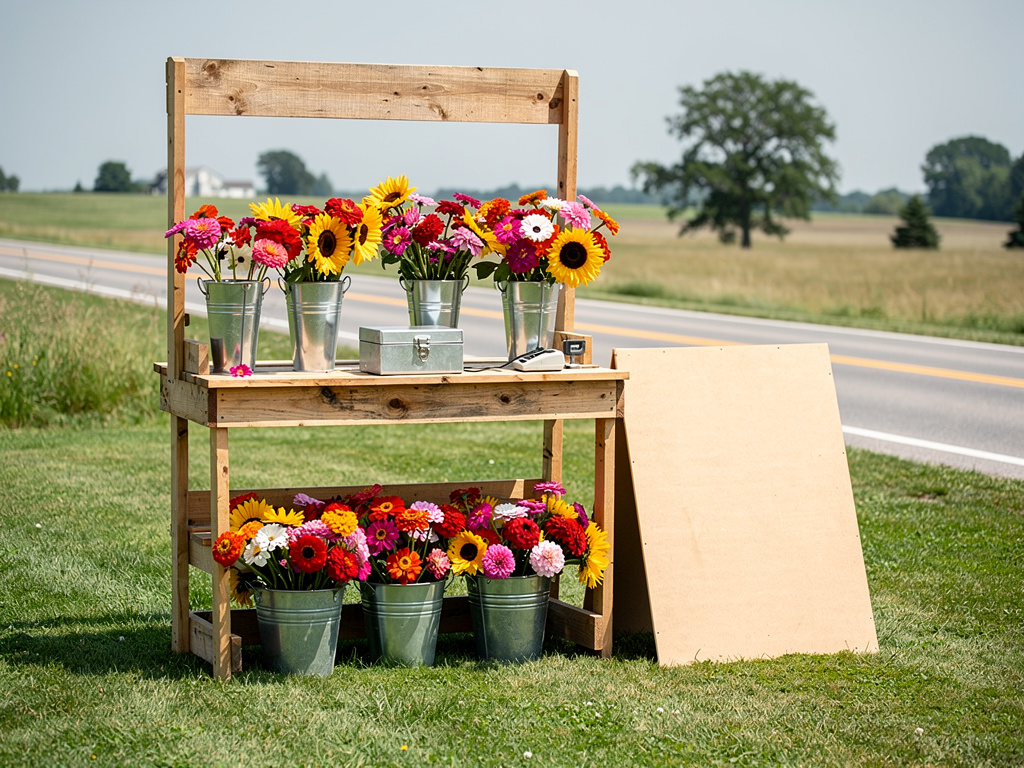


The short version: Selling flowers on the side of the road is usually legal on your own land and usually not legal on the public strip beside the pavement, unless a county or city gives you a permit for that exact spot. That strip, called the right-of-way, belongs to the road, and Florida law makes it a second-degree misdemeanor to sell products on the right-of-way of a state road beyond city limits if the selling gets in the way of traffic, while California bans selling on any road or shoulder within 500 feet of a freeway ramp. Some counties do license roadside flower vendors: Palm Beach County, Florida, permits flower, plant and produce vendors at approved spots on county roads, at least 1,500 feet apart. Wherever you stand, your state may still want a flower license (Texas registers "street vendors" at $75 a year, and Louisiana charges $120 per location), and some states, Washington among them, tax flowers even when they skip tax on vegetables. The simplest legal setup is a stand on your own property, or bouquets that customers order ahead and pick up at your place.
Checked September 25, 2026 on each source's own page: Florida Statutes section 337.406, California Vehicle Code section 22520.5 and Government Code section 51038, 23 CFR 1.23, Palm Beach County's Roadside Vendor Program page, the Texas Department of Agriculture's Nursery Floral page and FAQ, the Louisiana Department of Agriculture and Forestry flower dealer page, the Washington Department of Revenue farmer tax page, and the Homegrown, Square and Venmo pricing pages. These states are examples, not the whole country, so check your own state's current rules and call your city or county before you sell. Homegrown customers create an account to place a first order, and there is no drop or countdown release feature.
You have a bucket of zinnias, a folding table and a busy road a few steps away. The question is not really whether flowers are allowed. Cut flowers are not food, so cottage food rules and kitchen inspections do not apply to them. The question is whose ground the table sits on, and whether your state wants a flower license from you no matter where you stand.
This guide is about the road itself: the grass strip along the pavement, a county roadside permit, a street corner, a gas station lot and a holiday pop-up. If you plan to sell from your house with a driveway stand or porch pickup, our guide to selling cut flowers from home covers that side, including a six-state license table.
It is legal in most places when the flowers sit on land you own or have permission to use, and it is usually illegal on the public strip along the road unless the road owner or local government issues a permit. "The side of the road" means three different things, and each one has a different answer.
In the 2 states whose road laws are quoted below, Florida bans selling on a state road's right-of-way outside city limits when it interferes with traffic, and California bans selling on freeways and on roads up to 500 feet from a freeway ramp. Both laws allow exceptions by permit. Two more rules follow you to all three spots. Your state may license anyone who sells flowers, and your state may tax flowers. Those are covered further down.
The grass strip along most roads is public right-of-way, which means it belongs to the road even when you mow it, and selling from it is treated as using a public road for a private business. The right-of-way is the full width of land set aside for the road. It usually includes the shoulder, the ditch, and often a stretch of lawn that looks like part of your yard.
Federal rules show how seriously road owners treat it. For highways built with federal money, 23 CFR 1.23 says all land inside the right-of-way "shall be devoted exclusively to public highway purposes," and any other use needs approval. The same rule makes the state highway department responsible for keeping that land clear. Roads built without federal money follow their own state, county or city rules, but the idea is the same.
To find where your land ends and the road begins:
The edge of the pavement is not your property line. On many streets the right-of-way runs past the curb or road edge and into what looks like your front lawn, so a table at the end of your driveway can sit on public land without you knowing it. Check the map before you pick the spot, and verify your local rules with the road owner.
Some states ban selling products of any kind on parts of the state road right-of-way, and a bucket of flowers counts. The two clearest examples are Florida, where the ban covers state roads outside city limits when the selling interferes with traffic, and California, where it covers freeways and roads near freeway ramps.
Florida Statutes section 337.406 makes it unlawful to use the right-of-way of a state road outside city limits in a way that interferes with traffic, and it names "the free distribution or sale, or display or solicitation for free distribution or sale, of any merchandise, goods, property or services" as a banned use. A violation is a second-degree misdemeanor, and each day counts as a separate offense, so a stand left up for 30 days is 30 offenses. The same law lets local governments issue short-term permits when the use will not endanger traffic, but never on a limited access highway.
California Vehicle Code section 22520.5 bans selling any merchandise inside a freeway right-of-way. It also covers any road or its shoulder within 500 feet of a freeway on-ramp or off-ramp, plus a sidewalk that close to a ramp when you are selling to drivers. A first violation is an infraction, and a second is a misdemeanor.
Swipe sideways to see all five columns.
| Rule | Where it applies | What it bans | The way in | Penalty |
|---|---|---|---|---|
| Florida Statutes 337.406 | State road right-of-way outside city limits | Selling or displaying any products for sale in a way that interferes with traffic | A short-term local permit, never on limited access highways | Second-degree misdemeanor, each day a separate offense |
| California Vehicle Code 22520.5 | Freeway right-of-way, plus nearby roads, shoulders and some sidewalks up to 500 feet from a ramp | Selling or offering any merchandise | A state freeway vending permit, or a rest area covered by a separate rule | Infraction, then misdemeanor |
| 23 CFR 1.23 | Right-of-way of federal-aid highway projects | Any use that is not a highway purpose, unless approved | Federal approval, only if traffic is not affected | Enforced through the state highway department |
We read each rule on its official page on September 25, 2026: leg.state.fl.us for Florida, leginfo.legislature.ca.gov for California, and ecfr.gov for the federal rule. These are three examples, not a full list, so ask your state transportation department what applies to your road.
Yes, some counties run permit programs for roadside flower vendors, and some cities may, but each program covers only the roads and spots it names. Palm Beach County's permit, for example, covers only county roads, and its ordinance rules out state roads, so ask whoever issues a permit which roads it covers.
Palm Beach County's roadside vendor program in Florida is a good model of what these programs ask for. It issues permits to flower, plant and produce vendors on county roads in unincorporated parts of the county, and a spot has to meet rules like these:
Approval takes a few steps: an application, a review, an intent to permit, and then 20 business days, about 4 weeks, to bring in the remaining paperwork. The county's page, checked September 25, 2026, lists a $100 non-refundable application fee and a $250 permit fee ($150 after July 1), and every permit expires January 31. Vendors must also carry general liability insurance and a performance bond, and depending on what they sell, bring a Florida annual resale certificate and a local business tax receipt. The county sends state road questions to the Florida Department of Transportation and city road questions to the city. So the first call is "who owns this road?"
California took a different route for sidewalks. Government Code section 51038 lets cities and counties require a sidewalk vending permit or a business license, and it lets them ban stationary sidewalk vendors in areas zoned only for homes, but not vendors who keep moving. The same law also limits cities: they cannot confine sidewalk vendors to set parts of the public right-of-way or to set neighborhoods, or cap the number of sidewalk vendors, except for objective health, safety or welfare reasons. They also cannot make you get permission from a nearby business or any other private party first. A flower vendor with a cart on a city sidewalk in California is a sidewalk vendor under that law, and the 500-foot freeway ramp rule in Vehicle Code 22520.5 still applies if you sell to drivers from a sidewalk near a ramp.
Usually yes: a stand that sits fully on your own land is a zoning question for your city or county, not a road question. Agricultural zones often allow a roadside stand for things grown on the property. Residential zones often allow it with limits on signs, parking and customer traffic, and some homeowners associations ban it.
Keep three things inside your lot line:
A state flower license can still apply at home: in Texas, a grower on 10 acres or less registers each selling location for $110 a year. Our guide to farm stand zoning laws walks through looking up your zoning and what to ask the zoning office. For the table, shade, signs and cash box, see how to set up a roadside farm stand.
You can sell on private land that is not yours only with the owner's permission, and many cities also want a temporary use permit or a business license for that spot. Holiday flower vendors on gas station corners and empty lots are the classic case, and a busy holiday weekend is when you are most visible.
Before a weekend pop-up, line up:
In Texas, a vendor who does not grow the flowers and sells at temporary markets registers as Class M for $180 a year, which includes 30 event permits. Stay on the lot itself. The sidewalk and the strip beside the street in front of the lot are usually public right-of-way, even when the lot owner said yes.
In some states, yes, and the license follows you to every spot where you sell. Several states leave cut flowers out of their plant licenses, but a few license flower vendors directly.
The Texas Department of Agriculture's Nursery Floral program says each location where floral products are sold must be registered, and it lists "street vendors" among Class 1 vendors who do not grow what they sell, at $75 a year. A grower on 10 acres or less pays $110 (Class 2). Vendors who do not grow what they sell and sell at flea markets, craft shows, flower shows or other temporary markets register as Class M for $180, which includes 30 event permits, and each permit covers one day at one location. Classes 1 to 4 each include 10 event permits too, but the department says Class 1 to 4 licensees may use them only at trade shows, garden shows or other horticultural exhibits. The department's FAQ says selling without the right license can bring a stop-sale order and fines.
Louisiana's agriculture department requires a Cut Flower Dealer Permit to sell cut flowers, singly or arranged, at $120 per location per year. A Floral Dealer Permit at $100 per location covers cut flowers and potted ornamental plants together. All permits expire January 31, and you need a Louisiana sales tax number before you apply.
Texas names street vendors in Class 1 ($75) and temporary markets in Class M ($180). Class 1 is for a permanent location and Class M is for temporary markets run by vendors who do not grow, so a roadside pop-up, especially one selling flowers you grew, may not fit either cleanly. If you plan to sell from different spots a day at a time in Texas, ask the program which class fits before you pay. For states that leave cut flowers out of their plant licenses, see the six-state table in our cut flowers from home guide. If your state is not covered anywhere, search your state department of agriculture's site for "florist," "cut flower" and "nursery license."
For whether you need a state license, not in the two states checked here: Texas licenses growers too, and Louisiana's flower dealer page lists no exception for growers. It can change which license you buy and what it costs, though. In Texas a grower pays $110 a year and a street vendor who buys flowers pays $75, and the temporary-market class (Class M) is only for vendors who do not grow. Where it does matter is zoning and sales tax, since reselling runs into rules that a grower selling from home may never touch.
If you want to fill a Valentine's Day or Mother's Day corner with wholesale roses, plan for the full stack: land owner permission, a city permit, a state flower license where one exists, and a sales tax account.
In states like Washington you do, because the sales tax break for food does not cover flowers. That surprises growers who sell vegetables tax free from the same table.
The Washington Department of Revenue spells it out. Sales to customers at public markets or roadside stands are retail sales. Farm products sold as food are exempt from sales tax, but farm products that are not food need retail sales tax, and growers must collect it "on all retail sales of flowers, trees, shrubs, and vines." So a basket of tomatoes and a bucket of zinnias on the same Washington stand are taxed differently.
Before your first sale, find out three things from your state revenue department:
For how registering, collecting and filing work when you sell in person, see our guide to sales tax at farmers markets. Homegrown's signup page, checked September 25, 2026, says it calculates and files sales tax on orders placed through your storefront. Cash from a roadside table is still yours to report.
The rule changes with the product: cut flowers follow flower rules, potted plants usually follow nursery rules, and anything eaten follows food rules. Mixing products on one table can put you under all three.
Swipe sideways for the example column.
| What you sell | Which rules usually apply | Example |
|---|---|---|
| Cut flowers and bouquets | State flower license where one exists, sales tax, local permits | Louisiana Cut Flower Dealer Permit, $120 per location |
| Potted plants and seedlings | State nursery or plant dealer license, and trees or shrubs can need a separate nursery license | Louisiana Floral Dealer Permit, $100, covers potted plants and cut flowers; trees and shrubs also need a Nursery Stock Dealer Permit |
| Wreaths and dried arrangements | Your state's flower and nursery definitions, which can reach decorative plant material | Louisiana: no flower permit needed for artificial or dried plant materials; ask your own state agriculture department before you add them to the table |
| Edible flowers | Food rules, not flower rules | Sold as produce or food, under your state's food rules |
| Flowers picked on land you do not own | Not yours to sell without the owner's permission | Public land and the strip along the road belong to someone else |
The Louisiana permit details come from the state agriculture department's flower dealer page, checked September 25, 2026. Other states draw these lines differently, so confirm with your own state before you add a new product.
If seedlings are part of your table, our guide on selling seedlings you grew covers the plant license side, and edible flowers at the farmers market covers the food side.
Plan on about seven checks, most of them one phone call or one web page each, before the first bucket goes out. Most of these checks cost $0; the money goes to license and permit fees, like Texas's $75 to $180 or Louisiana's $120. A county roadside permit can cost more: Palm Beach County charges a $100 application fee plus a $250 permit fee, and requires liability insurance and a performance bond. Write down who you talked to and the date, so you have an answer to point to if someone complains.
Cash costs nothing to take but can go missing, and card or app payments cost between about 48 cents and 96 cents on a $20 bouquet. At an unattended stand, the cheapest method can be the one you lose the most on. Our guide to farm stand theft and honor systems covers the lockbox side.
Scroll sideways to see every column.
| Way to get paid | Monthly plan | Trial | Platform fee | Card or app processing | Customer pays on a $20 bouquet | Vendor pays on a $20 bouquet | Vendor pays in a month of 50 bouquets |
|---|---|---|---|---|---|---|---|
| Homegrown, billed annually | $10 a month | 7 days, no charge until day 8 | $0, no commission | 2.9% + $0.30, paid by the vendor | $20.00 | $0.88 plus the plan | $54.00 |
| Homegrown, billed monthly | $12.50 a month | 7 days, no charge until day 8 | $0, no commission | 2.9% + $0.30, paid by the vendor | $20.00 | $0.88 plus the plan | $56.50 |
| Square Free plan, card in person | $0 | None; the plan is $0 | $0 | 2.6% + 15¢, paid by the vendor | $20.00 | $0.67 | $33.50 |
| Square Free plan, online | $0 | None; the plan is $0 | $0 | 3.3% + 30¢, paid by the vendor | $20.00 | $0.96 | $48.00 |
| Venmo business profile | $0 | None; no plan | $0 | 1.9% + $0.10, paid by the vendor | $20.00 | $0.48 | $24.00 |
| Venmo personal account, goods and services | $0 | None; no plan | $0 | 2.99%, paid by the vendor | $20.00 | $0.60 | $29.90 |
| Cash in an honor box | $0 | None; no plan | $0 | $0 | $20.00 | $0.00, plus whatever goes missing | $0.00, plus whatever goes missing |
We checked every price on each company's own pricing page on September 25, 2026: findhomegrown.com/signup, squareup.com/us/en/pricing and venmo.com/resources/our-fees. Processing is figured on the $20 price before sales tax. Venmo charges 2.29% + $0.09 instead when a business payment comes through Tap to Pay. The month column is 50 bouquets at $20, plus the monthly plan where there is one. Where your state taxes flowers, the customer also pays sales tax on every row.
The legal trouble in this guide mostly comes from standing on land that is not yours, and pre-orders take you off the roadside altogether. Homegrown is $10 a month billed annually ($12.50 month to month) with no percentage fees beyond standard payment processing, and it gives you a storefront where neighbors order and pay for Saturday's bouquets on Thursday, then pick them up at your porch or farm during the window you set. You cut to the order count instead of guessing, and nobody parks on a road shoulder.
Compare that to the usual roadside tools. A cash honor box costs nothing until the box walks off. Venmo is cheap per payment, but a payment is not an order, so you are still matching names to bouquets by hand. Square's Free plan takes cards at 2.6% + 15¢ in person, which suits a staffed table, and 3.3% + 30¢ online. On a Homegrown storefront you get pickup windows for each bouquet day, card payment at 2.9% + $0.30 paid by you, and sales tax calculated and filed on storefront orders.
Homegrown does not issue permits, make a right-of-way spot legal, or run your cash box. Customers create a Homegrown account to place a first order, and your storefront is listed on the Homegrown marketplace, but plan on most orders coming from the people you send to your own link.
Most single bouquets on Homegrown start at $15 to $25, and $15 is the most common starting price, with a middle starting price of $17.50. That is useful when you decide what to put on a roadside price sign or an order page.
In a pull of the Homegrown catalog on September 25, 2026, 2,699 products were listed by 304 vendors. 18 of them were fresh cut flowers sold one at a time (bouquets, bunches, jars, arrangements and a bloom bucket) from 7 vendors. 9 of the 18 come in more than one size, so we counted each listing at its starting price, the price of its smallest size. 7 of the 18 started at $15, the middle starting price was $17.50, and prices ran from $10 to $120. We left out seasonal decor such as wreaths and a Halloween arrangement listed under crafts that mixes fall flowers with dried material. Another 6 listings from 2 vendors were flower subscriptions, from $139 for a season of bouquets to $390 for six months.
Homegrown cut-flower listings by starting price
Source: Homegrown catalog pull, September 25, 2026, 18 cut-flower listings from 7 vendors, each at the price of its smallest size.
The two $10 listings are a seasonal bouquet and a small vase, and both start at $10 for the smallest size. The top two start at $95 for a big wrapped bouquet and $120 for a bucket of loose stems for arranging yourself. For how to set your own price from stem costs and bouquet size, see how much to sell cut flowers for. A subscription, where customers pay for a season up front, is the other way to sell without a roadside table, and our guide to starting a flower subscription from your garden covers it.
The quickest way to get shut down is to set up where the rules clearly say no: on the public strip, near a freeway ramp, or on a lot without the owner's permission. These are the mistakes to avoid:
Sell part of the harvest before it is cut. If 10 of your 25 bouquets for Saturday are ordered and paid by Thursday, that is $150 at $15 each that never has to sit in the heat by the road, and you only cut the other 15 for walk-up buyers. The fewer stems you leave by the road, the less you lose to wilting, theft or a complaint.
Every one of these is fixable with one call before you start. When you have the answer for your spot, write it down with the date and the name of the person who gave it.
Usually yes, if the table sits on your own property and your zoning allows it. The strip between the street and your lot line is often public right-of-way, so keep the table, sign and parking inside your lot line. Call your zoning office to confirm what your zone allows before you set up.
On your own land, often yes, as long as you hold any flower license your state requires and your zoning allows a stand. On the public road shoulder, usually no: Florida makes it a misdemeanor to sell on state road right-of-way outside city limits where the selling disrupts traffic, and California bans it on freeways and near freeway ramps. Check the road owner's rules and your state's before you sell.
In some states you do. Texas registers street vendors who buy their flowers for $75 a year and growers from $110 a year, and Louisiana requires a $120 Cut Flower Dealer Permit per location. Many cities also want a vendor permit or business license for street sales.
Only with the property owner's written permission, and usually with a city temporary use or vendor permit as well. The sidewalk and the strip along the street are normally public land, not part of the lot. In states that license flower dealers, you also need that license.
In some states, yes. Washington, for example, treats roadside stand sales as retail sales and taxes flowers, even though farm food sold at the same stand is exempt. Check with your state revenue department and register before you sell.
Not unless you have the landowner's permission. The strip along the road and other public land belong to the road owner or the government, and the flowers on them are not yours to sell. Grow your own, or buy from a grower and follow your state's dealer rules.
More on the rules and the selling side of a flower stand:
The safest roadside flower business is one where the flowers never touch the public strip. Put the stand on your own land, behind your lot line, with the sign and the parking there too. Check your state's flower license before your first sale, since Texas and Louisiana both charge for one, and register for sales tax if your state taxes flowers.
If a busy road nearby tempts you, call the road owner first and ask whether it runs a vendor program like Palm Beach County's. If the answer is no, the road is not your store. Your regulars can still find you.
The easiest way to keep them coming without a roadside table is to let them order ahead. When your paperwork is sorted, set up your Homegrown storefront for $10 a month billed annually, post this week's bouquets with a pickup time, and send your neighbors one link. You cut what is already sold, and the flowers stay on your side of the line.



