

The short version: In most of the 11 states we checked you can sell homemade dried pasta, but fresh pasta usually needs a licensed kitchen. Nine of the 11 give dried pasta a home kitchen route, though New Jersey allows it only without eggs and Idaho only under its 2026 Direct-to-Consumer Commerce Act, not its cottage food list. Of the 11, only Texas, Utah, Wyoming and Idaho let a home kitchen sell fresh pasta, and Texas makes you register first. Meat-filled ravioli is out in 10 of the 11. Idaho's 2026 act bars meat except a few cases, such as selling meat inspected by the USDA, so ask before you fill ravioli with meat there. Verify your own state's current rules with its health or agriculture department before your first sale.
Checked September 25, 2026 on each state's own pages: the cottage food pages of Michigan, New Jersey, California, Colorado, Georgia, Texas and Washington, Virginia's home kitchen exemption FAQ, Idaho's Food Protection Program list and its Direct-to-Consumer Commerce Act (Idaho Code 37-203, 37-205 and 37-208, added in 2026), the Utah Home Consumption and Homemade Food Act, the Wyoming Food Freedom Act, and the federal pasta standards at 21 CFR part 139. Eleven states are examples, not the whole country. Homegrown customers create an account to place a first order, Homegrown handles pickup and local delivery, not shipping, and there is no drop or countdown release feature.
Your cavatelli came out better than anything in the grocery store aisle, and now friends keep asking if they can buy a bag. Pasta feels like bread, and bread is the easiest homemade food to sell legally. The law sees it differently. Whether you can sell homemade pasta depends on three things: whether it is dried or fresh, whether it has eggs, and whether it has a filling.
This guide covers the rules only, using what 11 state pages and the federal pasta standards said on September 25, 2026. If you already know you are allowed and want the business side, our guide to selling pasta from home covers shapes, packaging, sales channels and pricing. When you get to setting a price, the fresh pasta pricing guide works a pound out to a $12 starting price.
Yes for dried pasta in 9 of the 11 states checked, but fresh pasta has a home kitchen route in only 4 of them. A cottage food law is the set of state rules that lets you make certain low-risk foods at home and sell them without a commercial kitchen. Dried pasta is usually on the low-risk side. Fresh pasta usually is not.
Here is how the 11 states split:
For fresh pasta the list gets short. Texas allows it with a state registration, and Utah, Wyoming and Idaho allow it under their food freedom laws. Michigan says "No fresh pastas" in plain words, and the other states either leave fresh pasta out or bar foods that need a refrigerator.
It matters because fresh pasta keeps for days in a refrigerator while dried pasta keeps for months in a pantry, and cottage food laws are written around that line. Regulators call foods that need cold storage "time and temperature control for safety" foods, often shortened to TCS. A TCS food can grow harmful bacteria if it sits at room temperature.
Fresh pasta is TCS for a few reasons:
Dried pasta has had most of its water taken out. Federal standards set commercial dried pasta at 87% solids or more, and that low moisture is why a bag of spaghetti sits in a pantry for a year. That is the whole reason Michigan can allow "Dried pasta made with or without eggs" and, in the same list, say "No fresh pastas." Same dough, different water content, different law.
Scroll sideways to see every column.
| Type of pasta | Examples | Needs refrigeration? | Usual cottage food answer | Where it can still work |
|---|---|---|---|---|
| Dried, no egg | Semolina cavatelli, orecchiette, dried spaghetti | No | Allowed in most states checked, including New Jersey | Idaho under its 2026 Direct-to-Consumer Commerce Act, not its cottage food list |
| Dried, with egg | Dried egg noodles, dried egg fettuccine | No, once fully dried | Allowed in Michigan; not in New Jersey | Check whether your state separates egg pasta |
| Fresh, unfilled | Fresh fettuccine, tagliatelle, lasagna sheets | Yes | Not allowed in most states checked | Texas with registration, Utah, Wyoming, Idaho |
| Filled | Ravioli, tortellini, manicotti with filling | Yes | Not allowed in most states checked | Texas, Utah and Wyoming with no meat; Idaho for vegetable fillings, ask about cheese or meat |
| Cooked pasta dishes | Mac and cheese, pasta dinners | Yes | Not a cottage food in most states | Texas after registering, Utah and Wyoming, all with no meat; otherwise a home kitchen operation permit or licensed kitchen |
We read each rule on the state or federal page on September 25, 2026. "Most states checked" means the 11 in the next section. Rules change and some counties add their own, so check what your state requires right now before you sell.
Of the 11 states checked on September 25, 2026, 9 allow dried pasta from a home kitchen, 2 do not name it, and only 4 allow fresh pasta, counting Idaho's 2026 Direct-to-Consumer Commerce Act rather than its cottage food list, which still bars pasta. The table puts them side by side.
Swipe left for the other columns.
| State | Dried pasta | Fresh pasta | Filled pasta | What the page says | Where the rule lives |
|---|---|---|---|---|---|
| California | Yes | No | No | "Pasta" listed under dried, dehydrated and freeze-dried foods | CDPH Approved Cottage Foods list, last reviewed April 2026 |
| Colorado | Not named; ask | No, needs refrigeration | No | Eligible foods are those that "do not require refrigeration for safety" | CDPHE Cottage Foods page |
| Georgia | Yes | No, only dry pasta is named | No | "dry pasta" named as a non-potentially hazardous food | HB 398 text and the GDA cottage food FAQ |
| Idaho | Yes, under the 2026 act | Yes, under the 2026 act | Vegetable filling yes; ask about cheese or meat | The 2026 act lists "Fresh and dehydrated pastas"; the older cottage food list never allows "Fresh or refrigerated pasta" or "Dehydrated pasta" | Idaho Code 37-203, 37-205 and 37-208 (Direct-to-Consumer Commerce Act, 2026); Idaho Food Protection Program list, July 2025 |
| Michigan | Yes, with or without eggs | No | No | "No fresh pastas" | MDARD cottage food page |
| New Jersey | Eggless only | No | No | "Dried wheat pasta (no egg)"; not "Dried egg noodles" | NJ Department of Health approved products list |
| Texas | Yes | Yes, after registering with DSHS | Yes without meat, after registering | "any foods, except" meat, poultry, seafood and a few others | DSHS cottage food page (SB 541) |
| Utah | Yes | Yes | Yes without meat | Sold in Utah, directly to an informed final consumer | Utah Code 4-5a-104 and 4-5a-105 |
| Virginia | Yes | No | No | "Dried pasta" on the low-risk list | VDACS home kitchen exemption FAQ, revised July 2024 |
| Washington | Not named; ask | No, "requiring refrigeration are not allowed" | No | Allowable list does not mention pasta | WSDA Cottage Food page and WAC 16-149-120 |
| Wyoming | Yes | Yes | Yes without meat | Foods requiring refrigeration allowed, sold only in Wyoming | Wyoming Food Freedom Act, W.S. 11-49-101 to 104 |
Every row was read on the state's own page, PDF or statute on September 25, 2026. These 11 states are examples. Your county can add rules, so check what your own state and county require right now before you sell.
Michigan gives the clearest answer of the 11 states checked. The Department of Agriculture and Rural Development's cottage food list puts "Dried pasta made with or without eggs" under allowed dried products, and puts "No fresh pastas" under not allowed, right next to cheese and yogurt. If you are in Michigan, dry it and you can sell it.
It depends on the state: Michigan allows dried pasta with eggs, but New Jersey allows only dried wheat pasta with no egg. This detail decides whether your grandmother's egg noodle recipe is legal where you live.
New Jersey's Department of Health approved products list has a "Dried Pasta" category. It says the category includes "Dried wheat pasta (no egg)." It then says it does NOT include "Raw pizza dough," "Dried egg noodles," or "Dried pasta with egg ingredient." So in New Jersey, semolina and water cavatelli is a cottage food and dried egg fettuccine is not.
What to take from the two states:
There is also a naming rule if you ever grow past cottage food. The federal standard for noodle products at 21 CFR 139.150 says at least 5.5% of the solids in egg noodles, by weight, must be egg solids. A licensed pasta company that calls a product "egg noodles" has to meet that line.
No state checked says a flat no: Idaho's cottage food list bars both fresh and dried pasta but its 2026 Direct-to-Consumer Commerce Act allows both, and Colorado and Washington do not name pasta at all, so you have to ask. At least one guide that ranks for this question says dried pasta is allowed in every state. New Jersey, which bars dried egg noodles, shows why you still read your own state's list word for word.
Idaho's Food Protection Program list of foods a cottage food business may never make, dated July 2025 and published by Eastern Idaho Public Health, has a "Pasta" heading with two entries: "Fresh or refrigerated pasta" and "Dehydrated pasta." We read it on September 25, 2026. That list covers only the cottage food route. Idaho's Direct-to-Consumer Commerce Act, added to Idaho Code in 2026, lists "Fresh and dehydrated pastas" at section 37-203 and, under section 37-205, lets you sell them directly to an informed end consumer, inside Idaho only. If you sell under that act, a sign, label or card has to say "This product is not subject to government food safety inspection or licensing requirements. It may contain allergens.", with your name, your contact information and the ingredients. Because the act counts fresh and dehydrated pasta as perishable food, section 37-205 also requires handling instructions that tell the buyer how to store and prepare it safely. Section 37-208 also requires you to keep a record of every sale (what and how much, the sale date, the date you made it, where you made it and where each ingredient came from) for at least two years.
The two states that do not name pasta:
When a list is silent, do not read the silence as a yes. Email the agency, describe your recipe and drying method, and keep the answer.
Only in a few states: of the 11 checked, Texas, Utah, Wyoming and Idaho let a home kitchen sell fresh pasta, and everywhere else you need a licensed kitchen, or a home kitchen operation permit if your county says it covers uncooked pasta. Fresh pasta needs a refrigerator, and most cottage food laws bar every food that does.
Your options if your state says no:
The Home Consumption and Homemade Food Act, Utah Code 4-5a-104, exempts homemade food that is "produced and sold within the state" and "sold directly to an informed final consumer" from state and local licensing. The limits sit in section 105, which leaves out raw dairy and meat products. Fresh pasta with no meat fits. You still need a local business license, and you cannot sell to a restaurant.
Wyoming's Food Freedom Act works much the same way, with its own limits. It names "foods requiring refrigeration" as potentially hazardous and still allows them, but the person selling it has to be you or an agent you name in writing, which can be a consignment market or food freedom store but not a store that buys it to resell. Every sale has to happen in Wyoming, and you are capped at $250,000 in gross revenue a year. Idaho's 2026 Direct-to-Consumer Commerce Act works the same way for "Fresh and dehydrated pastas": sold inside Idaho, by you or by an agent you have designated in writing, to a buyer who knows it was not inspected, with no meat products apart from narrow exceptions such as selling meat that was inspected by the USDA or another approved inspector. Our list of food freedom states covers the others.
Texas now allows fresh pasta from a home kitchen, as long as you register with the Department of State Health Services, keep it at 41°F or below and label it with a date and a safe handling statement. This changed with Senate Bill 541, which rewrote the Texas cottage food law in 2025.
The Texas cottage food page says allowable foods "now include any foods, except" meat and poultry, seafood, ice products, low-acid canned goods, CBD or THC products, and raw milk products. Fresh pasta is not on that list, so it is allowed. Because it is a TCS food, it comes with extra rules.
To sell fresh pasta, register on the DSHS Online Licensing Registry, keep the pasta at an internal temperature of 41°F or below, put the date you made it on the label, print the Texas cottage food disclosure, "THIS PRODUCT WAS PRODUCED IN A PRIVATE RESIDENCE THAT IS NOT SUBJECT TO GOVERNMENTAL LICENSING OR INSPECTION.", and print this statement in at least 12-point type on the label or receipt: "SAFE HANDLING INSTRUCTIONS: To prevent illness from bacteria, keep this food refrigerated or frozen until the food is prepared for consumption." Read it yourself on the Texas cottage food guide and the DSHS page before you start.
What else the Texas page says about TCS foods like fresh pasta:
Dried pasta in Texas skips the registration because it does not need refrigeration. If you are unsure whether your pasta counts as dry, email DSHS at foodestablishments@dshs.texas.gov and ask whether it is a TCS food.
Filled pasta is out in 7 of the 11 states checked, and a meat filling is out in 10 of them; Idaho's 2026 act bars meat apart from narrow exceptions such as selling USDA-inspected meat itself, so ask there first. Ravioli, tortellini and filled manicotti need refrigeration, and the filling usually adds a second food with its own rules.
How the fillings break down:
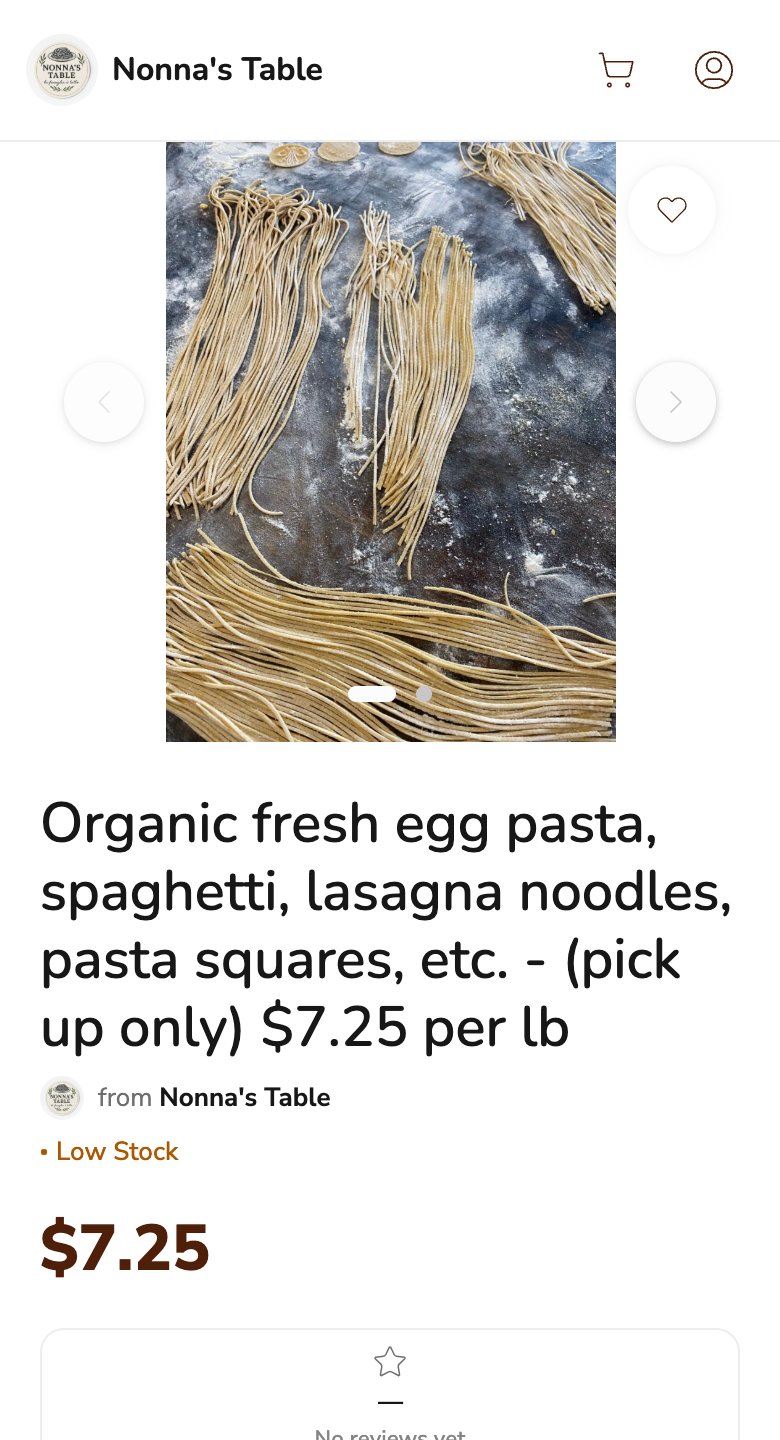
Keep fresh and filled pasta batches small enough to sell before they spoil. On September 25, 2026, Nonna's Table listed its fresh egg pasta at $7.25 a pound, pick up only, with 4 left of each of its three cuts. Her pickup spot is on West Elkton Road in Somerville, Ohio, which is outside the 11 states in this guide, and we did not check Ohio's rules, so her listing shows how to size a batch, not what your state allows. Small, pre-ordered batches with a pickup time mean nothing sits in your fridge past its few good days.
No state page checked gives a number, but the federal standard for commercial dried pasta requires at least 87% solids, which means no more than about 13% water. That standard, at 21 CFR 139.110 for macaroni products and 139.150 for noodle products, is written for licensed pasta plants. It is still the best yardstick for what "dried" means.
Why it matters for a home vendor:
A simple home check is the snap: fully dried pasta breaks cleanly instead of bending. If you want proof, a food lab can test water activity, a measure of how much free water a food has, and in Texas you can email DSHS to ask whether your pasta is a TCS food.
A homemade pasta label usually needs the product name, the ingredients, the allergens and your name and address, and several of the 11 states checked add a line saying the food was made without inspection. Pasta is heavy on allergens: wheat in almost every recipe, eggs in most fresh pasta, and milk in cheese fillings.
Our cottage food labeling guide walks through the common state requirements with examples.
Most of the 11 states checked let you sell cottage food pasta at farmers markets, from your home and by pre-order with in-person delivery, but shipping and wholesale are often limited. The details decide how you take orders.
Virginia's home kitchen exemption allows dried pasta, but the Virginia Department of Agriculture and Consumer Services FAQ (revised July 2024) says you can sell only from your home, at a farmers market, or at a temporary event of 14 consecutive days or less. Under the exemption, your online presence cannot contain an order form, accept payment electronically, or offer shipping. You can still take card or app payments, such as PayPal, Venmo or Square, in person at the handoff. Online ordering does not fit that exemption at all.
Where the other states land:
Take orders ahead of your making day and hand them off in person, which fits fresh pasta's short life and most states' delivery rules. Fresh pasta lasts days, so making to order beats guessing. Dried pasta keeps, but pre-orders still tell you which shapes to dry.
Homegrown is $10 per month billed annually, with no commission, plus 2.9% + $0.30 card processing that the vendor pays. It gives you one link where customers see this week's shapes, order by the pound and pick a pickup time or local delivery, so every order ends with a handoff instead of a box in the mail. Compare that to Hotplate, which adds a 5% + $0.55 fee to each order that the customer pays unless you cover it, plus 2.9% + $0.30 processing that you pay, or Square Online's free plan, where online card processing runs 3.3% + 30¢. Etsy's fee policies, checked September 25, 2026, charge a 6.5% transaction fee plus $0.20 a listing and 3% + $0.25 payment processing on US sales, and a one-time set-up fee may apply when you open the shop. Etsy is also built around shipping, which many cottage food rules limit.
Homegrown does not tell you whether your pasta is legal in your state, it does not ship, and it has no countdown release for weekly drops. Customers create a Homegrown account to place a first order. If you sell in Virginia under the home kitchen exemption, online ordering is not allowed at all.
Scroll sideways to see every column.
| Platform | Monthly plan | Trial period | Platform or service fee | Card processing | Customer pays on a $12 pound | Vendor pays on a $12 pound | Vendor pays in a month of 50 orders at $12 |
|---|---|---|---|---|---|---|---|
| Homegrown | $10 billed annually ($12.50 monthly) | 7 days, no charge until day 8 | None, 0% commission | 2.9% + $0.30, paid by the vendor | $12.00 | $0.65 plus the plan | $42.40 ($44.90 on the monthly plan) |
| Hotplate, default | $0 | None, no plan to trial | 5% + $0.55, paid by the customer | 2.9% + $0.30, vendor-paid | $13.15 | $0.68 | $34.07 |
| Hotplate, vendor covers the fee | $0 | None, no plan to trial | 5% + $0.55, paid by the vendor | 2.9% + $0.30, also vendor-paid | $12.00 | $1.80 | $89.90 |
| Square Online, Free plan | $0 (paid plans offer a 30-day trial) | None needed on Free | None | 3.3% + 30¢ online, paid by the vendor | $12.00 | $0.70 | $34.80 |
We checked Homegrown's signup page, Hotplate's pricing page and Square's fees page on September 25, 2026. Card processing is figured on what the customer pays: $12 on most rows, and $13.15 on Hotplate's default row. Hotplate does not publish what its processing is charged on, so we figured it on the full customer total as the high case; figured on the $12 subtotal it would be $0.65 an order and $32.40 a month. Tips or tax would add a few cents more. The $12 pound is the starting price from our fresh pasta pricing guide, not a quote from any vendor.
If your state allows your pasta, start your Homegrown storefront and put this week's shapes on one pre-order link, so you roll exactly what was ordered.
In Homegrown's September 25, 2026 catalog pull, 3 of 306 vendors listed uncooked pasta, 10 products in all, and 4 more vendors sold cooked pasta dishes. Pasta is a small, open category on the marketplace.
In a pull of the Homegrown catalog on September 25, 2026, 2,708 products were listed by 306 vendors. We searched product names and descriptions for pasta words, then opened every matching vendor's full list. Ten products are uncooked pasta sold to cook at home, from 3 vendors: 3 are described as slow dried, 2 as fresh and pick up only, and 5 do not say. Two of the 10 include ravioli. Another 23 products from 4 vendors are cooked pasta dishes, 17 of them mac and cheese. We left out cookies made with a "pasta madre" sourdough starter, an egg noodle cake, and a rice or ramen bowl.
Pasta products in Homegrown's catalog by type
Source: Homegrown catalog pull, September 25, 2026, 2,708 products from 306 vendors; 33 pasta products counted by name and description, each vendor's full list opened.
Nonna's Table has the widest range: slow dried semolina pasta at $5 a pound, slow dried cavatelli at $7 a pound, personalized stamped corzetti at $10, and fresh egg pasta at $7.25 a pound marked pick up only. Seriously Sourdough lists pasta noodles and gnocchi at $15 each and ravioli at $20, and we did not check where it sells or which state's rules it follows. D's Dough sells noodles at $13 a package that feeds four.
The easiest way to get in trouble is selling the wrong form of pasta for your state: of the 11 states checked, 9 allow dried pasta but only 4 allow fresh. A clean kitchen does not help if the product is not on your state's list.
The mistakes the rules above point to:
Find your state's cottage food list, search it for "pasta" and "noodle," then email the agency in writing if the answer is not on the page. Six steps, one sitting, and a written answer to keep. Of the 11 states checked, 2 did not name pasta at all, so the email step matters.
Verify your state's current rules before your first sale. The pages in this guide were current on September 25, 2026, and Texas health departments began applying its rewritten law on September 1, 2025.
In some states, yes, for dried pasta, though many still ask for a registration or permit. Michigan lists dried pasta as a cottage food, and Georgia's cottage food FAQ says operators under HB 398 do not need a license from the Georgia Department of Agriculture. New Jersey requires a cottage food permit and allows only eggless dried pasta, and Idaho's cottage food list bars pasta, though its 2026 Direct-to-Consumer Commerce Act allows fresh and dehydrated pasta sold directly to an informed end consumer in Idaho.
Only if your state has a route for refrigerated foods or you make it in a licensed kitchen. Of 11 states checked on September 25, 2026, Texas, Utah, Wyoming and Idaho allowed fresh pasta from a home kitchen. Bring a cooler that holds 41°F or below if you sell in Texas.
In Michigan, dried egg noodles are allowed under the cottage food law. In New Jersey, they are not, because its list allows only dried wheat pasta with no egg. Fresh egg noodles need refrigeration and follow the fresh pasta rules in your state.
You can sell homemade ravioli with a cheese or vegetable filling in Texas after registering with DSHS, and in Utah and Wyoming under their food freedom laws. Ravioli with a meat filling is excluded in all three. Idaho's 2026 Direct-to-Consumer Commerce Act allows fresh pasta too, but it keeps out most meat and sends dairy through Idaho's dairy laws, so ask before you fill ravioli with cheese there. In most other states, ravioli needs a licensed kitchen, and a home kitchen operation permit covers a cooked ravioli dinner eaten the same day, so ask your county whether it covers uncooked ravioli.
Usually not across state lines. Of the 11 states checked, Colorado, Washington and Virginia keep cottage food sales inside the state, Idaho's 2026 act does too, and Wyoming's Food Freedom Act bars interstate commerce outright. Georgia's HB 398 does allow mail order sales, so check whether your own state allows shipping inside its borders.
Not for dried pasta in states that list it, since cottage food laws let you use your home kitchen. Fresh pasta usually needs a licensed or rented commercial kitchen unless you live in Texas, Utah, Wyoming or Idaho, the 4 of the 11 states we checked that allow it, or in another food freedom state whose law covers it, or your county confirms its home kitchen operation permit covers uncooked pasta. A pasta roller and a drying rack are enough equipment to start.
The pasta business and the legal steps that come before it:
Once your state's list says yes, the fastest start is one pre-order link and one weekly making day. Dried pasta and fresh pasta start differently, so pick the path that matches your state's answer.
A $12 pound of fresh pasta costs you about $0.65 in card processing on Homegrown, with no commission on top. Set up your Homegrown storefront for $10 a month billed annually, put this week's shapes on one link, and roll only what has already been ordered.