
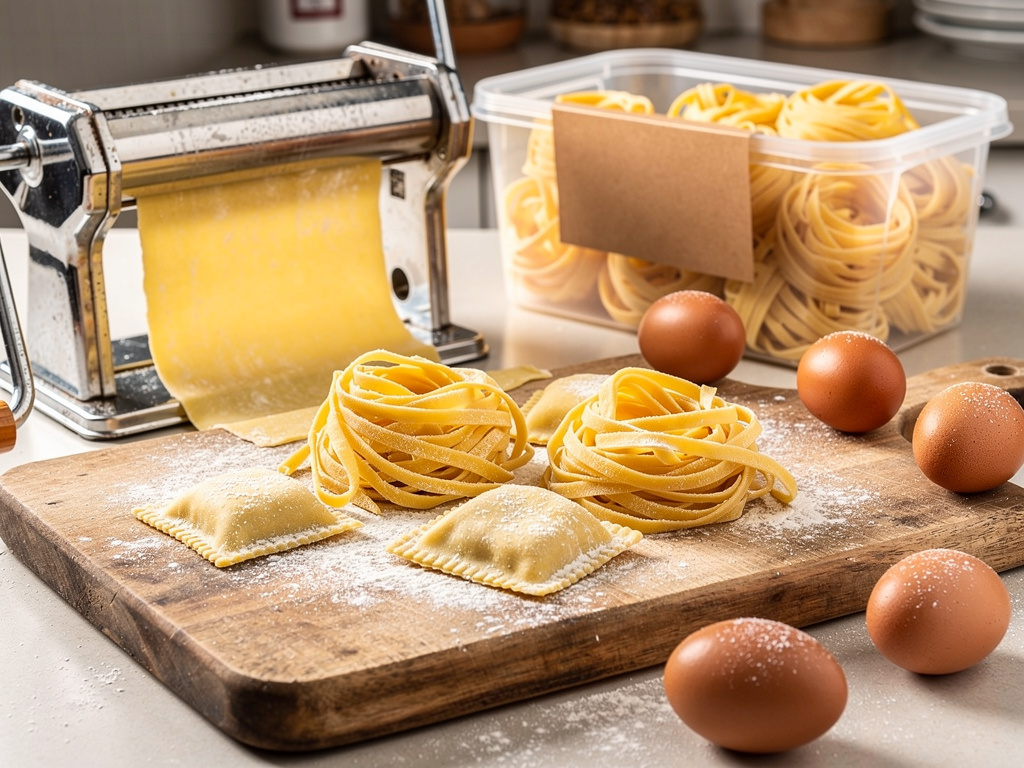


The short version: Sell plain fresh egg pasta for $10 to $14 a pound, and start at $12. Two small pasta makers priced their pasta at $10.99 and $13.98 per pound in our September 22, 2026 check, one of them sold frozen, and a dozen cheese ravioli ran $11 to $11.50. A pound of fresh egg pasta costs about $1.96 in flour, eggs, bag, and label, but your time is the real cost: about $5.40 a pound in a 10-pound session at $18 an hour, for a full cost of $7.36. In a rented kitchen at $25 an hour, a 20-pound session costs about $12.71 a pound, so rented-kitchen pasta needs about $16.50 a pound to keep a 30 percent markup on cost, counted before card fees, and $14 barely covers cost once card fees come out.
Checked on September 22, 2026: shop prices come from each listing's own product page, egg and flour prices from the Bureau of Labor Statistics August 2026 averages, the recipe yield from a Utah State University Extension booklet that Purdue Extension shares, and the platform fees from the Homegrown, Etsy, Hotplate, Shopify, and Square pricing pages. Homegrown customers create an account to place a first order, there is no countdown-timer release feature, and most of your orders will come from people you send to your own link.
You rolled ten pounds of fettuccine last night, nested it into bags, and it is sitting in the fridge with a day or so of good life left. Now you need a number for the sign. Charge $6 a pound, the 3x ingredient number, and you pay yourself about $13 an hour before card fees, with nothing left for the business. Charge $18 and the bags ride home with you in the cooler.
This guide gives you the number and the math behind it, so you can move it for your own market and your own kitchen. It is the pricing companion to how to sell pasta from home, which covers the fresh vs dried legal paths, permits, packaging, and where to sell. Read that one to get set up. Read this one for the price tag.
Charge $10 to $14 for a pound of plain fresh egg pasta, and start at $12 if you are not sure. Two small makers charged $10.99 a pound (sold frozen, direct from the maker) and $13.98 a pound (through a grocery delivery service) on September 22, 2026. Grocery brands and long-running regional makers sat at $7.99 to $10.65 a pound.
Here is what real pasta businesses were charging that day, read from their own product pages:
Scroll sideways to see every maker.
| Business | Product | Size | Price | Per pound | Kind of business |
|---|---|---|---|---|---|
| Bayview Pasta | Bucatini | 12 oz | $10.49 | $13.98 | Small maker, mills its own flour |
| Nicola's Marketplace | Hand-cut fresh fettuccine | 1 lb | $10.99 | $10.99 | Chef-run shop, made to order and frozen |
| La Pasta | Egg fettuccine | 9 oz | $5.99 | $10.65 | Regional brand on a grocery shelf |
| Pasta Mami | Spinach penne | 1 lb | $7.99 | $7.99 | Regional maker in business since 1987 |
Prices read from each business's product page on September 22, 2026. Bayview Pasta sells through the Good Eggs delivery service, which lists this bucatini under Pantry but records its product type as "Bucatini, Fresh" and says it cooks in under a minute. Fresh Harvest files Pasta Mami's penne under Pantry too, and Pasta Mami's own site, last updated September 10, 2026, says its penne is extruded fresh and its pasta is made from scratch every morning. La Pasta's price is its listing at Fresh Thyme Market, and Pasta Mami's is its listing at the Fresh Harvest grocery delivery service. Per-pound figures are the price divided by the weight, except Bayview's, which is Good Eggs' own unit price. Online prices do not include shipping or tax.
The two small makers we found charged about $11 and $14 a pound. A regional brand sold through grocery stores charges about $8 to $10.65. At a farmers market you are the first kind of business, and your customer is comparing you to the Italian deli, not the box of dried spaghetti.
A pound of fresh egg pasta costs about $1.96 in materials when you buy grocery eggs, and about $2.89 with $6-a-dozen farm eggs. Flour and eggs are cheap. The bag, the label, and the ice cost more than the flour does.
Start with a tested recipe. A Utah State University Extension recipe, shared by Purdue Extension, uses 2 cups of sifted all-purpose flour and 3 large eggs and yields about 1 pound of noodles, enough for 4 to 6 people. Two cups of flour weigh a bit over half a pound. The Bureau of Labor Statistics put the average price of a dozen grade A large eggs at $2.27 in August 2026, and all-purpose flour at about 55 cents a pound.
Swipe to see the whole cost sheet.
| Input for one pound | Amount | Cost | Where the number comes from |
|---|---|---|---|
| All-purpose flour | About 0.53 lb (2 cups) | $0.29 | BLS average, $0.548 a pound, August 2026 |
| Semolina or flour for dusting | A handful | $0.15 | Assumption. Swap in your receipt. |
| Large eggs | 3 | $0.57 | BLS average, $2.272 a dozen, August 2026. At $6 a dozen for farm eggs this line is $1.50. |
| Salt and olive oil | A pinch and a splash | $0.05 | Assumption |
| Container or zip pouch | 1 | $0.45 | Assumption. Swap in your receipt. |
| Label | 1 | $0.25 | Assumption |
| Ice packs and cooler share | Per pound | $0.20 | Assumption. Fresh pasta has to stay cold at the table. |
| Materials total | 1 lb | $1.96 | $2.89 with farm eggs |
The recipe yield, egg price, and flour price were all loaded on September 22, 2026. The dusting, packaging, label, and cold lines are stated assumptions so the math is visible; put your own numbers in and the sheet still works.
Semolina and "00" flour cost more than all-purpose, and $6-a-dozen farm eggs cost more than twice the $2.27 grocery average. Swap in farm eggs and this sheet rises to $2.89 a pound. The full method for turning a recipe into a per-item cost is in how to calculate the real cost per item, and it matters here because the ingredients are the small part.
The 3x rule underprices fresh pasta because it multiplies the cheapest part of the product. Three times $1.96 is $5.88 a pound, and four times is $7.84. Both land under what small makers actually charge, and neither reaches your full cost plus a 30 percent markup, which runs $8.40 to $11.91 a pound at home.
The rule works for jam and cookies, where a jar or a dozen takes minutes of hands-on time and the ingredients carry most of the cost. Fresh pasta flips that. You mix, rest, roll, cut, dust, and nest every pound by hand, and that time is worth more than the flour and eggs combined.
Use the rule as a floor check, not a price:
The farmers market pricing formula walks through cost-plus pricing for any product. For pasta, the labor line decides the answer.
Your time adds $4.50 to $7.20 a pound at $18 an hour, depending on how many pounds you make in one session. The fixed hour of setup and cleanup gets spread over more bags as the batch grows, so bigger sessions cost less per pound.
Here are the assumptions, so you can swap in your own. Once you are practiced, figure about 12 minutes of hands-on time per pound with a hand-crank or stand-mixer roller: mixing, resting, rolling, cutting, and bagging. Add one hour per session for setup, cleaning the machine, and wiping down flour. Pay yourself $18 an hour. Time your next batch with a phone timer and replace the 12 minutes with your real number.
Slide the table to see every session size.
| Session size | Hours | Your time per pound | Materials per pound | Full cost per pound | Full cost plus 30% |
|---|---|---|---|---|---|
| 5 pounds | 2 | $7.20 | $1.96 | $9.16 | $11.91 |
| 10 pounds | 3 | $5.40 | $1.96 | $7.36 | $9.57 |
| 20 pounds | 5 | $4.50 | $1.96 | $6.46 | $8.40 |
Home kitchen, no rent, if your permit allows fresh pasta at home. Hours are 1 hour of setup and cleanup plus 12 minutes a pound. Labor at $18 an hour. All three are worked examples built on stated assumptions, not survey data.
At $12 a pound in a 10-pound session, you keep $4.64 a pound after paying yourself $18 an hour, and about $3.99 once 65 cents of card processing comes out. That is about $40 of profit on top of $54 in wages for a three-hour evening. In a 5-pound session, $12 clears the $11.91 target only before card fees, and falls about 56 cents short after them. That is why tiny test batches can make pasta look like it does not pay.
A rented kitchen adds a second hourly cost, and at $25 an hour it roughly doubles your cost per pound. That matters because fresh pasta usually cannot be made under a basic cottage food permit, so the rent line is the one that decides your price if you cannot get a home kitchen permit.
Fresh pasta needs refrigeration, and most state cottage food laws only cover foods that are safe at room temperature. Michigan's cottage food list is typical: it allows dried pasta made with or without eggs, but lists "No fresh pastas" among the foods you cannot make at home. New Jersey goes further and allows only dried pasta made without eggs.
Your legal path sets your cost sheet. A microenterprise home kitchen permit, called a MEHKO, usually covers same-day meals sold for home pickup or delivery, not bagged pasta at a farmers market table. Ask your state or county health department whether any home permit covers fresh pasta, because that is the only way to skip the rent line. Texas, Utah and Wyoming already let a home kitchen sell fresh pasta, and our guide to whether you can sell homemade pasta shows the rule in each of 11 states. If not, you are usually looking at a licensed commercial kitchen. We read Michigan's list on September 22, 2026; check your own state's current rules before you price a single bag. The MEHKO guide covers which places offer one.
Shared kitchens charge by the hour. On September 22, 2026, the Incubator Kitchen Collective in Newport, Kentucky listed $225 a month for 9 hours and $25 an hour after that, plus a one-time $75 application fee. 110 North Kitchen in Anderson, South Carolina listed $20 an hour for the first 35 hours plus a $100 booking fee. 6888 Kitchen in Dayton, Ohio listed $22 an hour at peak times and $18 off-peak, with an 8-hour minimum, a $150 membership fee every six months, a $300 refundable deposit, and a $50 application fee. Our commissary kitchen guide covers what those memberships include.
Here is the same session table with $25 an hour of kitchen rent on top:
Drag sideways for the rented-kitchen numbers.
| Session size | Kitchen hours | Rent per pound | Your time per pound | Full cost per pound | Full cost plus 30% |
|---|---|---|---|---|---|
| 5 pounds | 2 | $10.00 | $7.20 | $19.16 | $24.91 |
| 10 pounds | 3 | $7.50 | $5.40 | $14.86 | $19.32 |
| 20 pounds | 5 | $6.25 | $4.50 | $12.71 | $16.52 |
Materials at $1.96 a pound in every row. Rent at $25 an hour, the rate one Kentucky shared kitchen listed on September 22, 2026 for hours past a member's included 9. The three kitchens we checked ran $18 to $25 an hour; swap in yours.
In a rented kitchen, plain fettuccine at $12 loses money unless you make 20 pounds or more per session and work faster than 12 minutes a pound. Rented-kitchen pasta makers get there three ways:
Price fresh pasta in seven steps: cost the recipe, time the batch, put a wage on your time, add rent, add margin, check the market, and round and hold for four weeks. Here is the order that keeps you from guessing.
Charge $11 to $14 for a dozen ravioli with a cheese filling, and $14 to $15 for premium fillings like lobster or braised meat. Three small makers priced a dozen cheese ravioli at $11 to $11.50 on September 22, 2026, and Nicola's Marketplace sold 24 smaller cheese ravioli for $15.99, about $8 a dozen.
Scroll sideways to compare every ravioli.
| Business | Product | Count or size | Price | Kind of business |
|---|---|---|---|---|
| Melina's Fresh Pasta | Ravioli, current menu | 12 | $11.00 | North Carolina pasta shop |
| Dalla Terra Pasta, sold at Avrom Farm | Five cheese ravioli | 12 | $11.50 | Wisconsin pasta maker sold through a farm store, local stone-ground flour |
| Pappardelle's Pasta | Homestyle cheese ravioli | 12, about 12 oz | $11.00 | Colorado pasta maker, fresh-frozen |
| Pappardelle's Pasta | Lobster ravioli | 12, about 12 oz | $15.00 | Same maker, premium filling |
| Naked Pasta | Five cheese ravioli | 9 oz, serves 2 | $11.50 | South Carolina maker, sold through a farm box |
| Nicola's Marketplace | Cheese ravioli | 24 pieces | $15.99 | Chef-run shop, smaller pieces, frozen |
Prices read from each business's product page on September 22, 2026. Naked Pasta's price is its listing at Farmbox Carolina. The Dalla Terra ravioli was listed as sold out that day.
Ravioli cost more to make than cut pasta, mostly in time. A dozen takes about 5 ounces of dough, around 33 cents of flour, eggs, dusting flour, salt, and oil. Say the ricotta and parmesan filling runs $2.00 and the container, label, and ice run $0.90, for about $3.23 in materials. At 20 minutes of hand filling and sealing per dozen, your time adds $6.00. That is a full cost of $9.23, which leaves $2.77 at $12 a dozen and $4.77 at $14, before card fees. These figures leave out your share of the setup and cleanup hour, which adds about $1.50 a dozen in a 12-dozen session. Those are assumptions; weigh your own filling and time your own tray.
Charge $1 to $3 more a pound for flavored and specialty doughs, because they cost more, take longer, and sell to people who came looking for them. Here is a reasonable way to step it up:
A $12 pound of fresh pasta works out to about $3 a serving for four people, and that is the number to put on the sign. The Utah State recipe above says a pound of noodles serves 4 to 6, so one pound feeds a family of four. A $3 plate is an easier number to say yes to than $12 a pound.
Ways to use serving math at the table:
The bundle pricing guide shows how far under the separate prices a kit should sit.
Price wholesale fresh pasta at 50 to 60 percent of your retail price, so a $12 pound wholesales for $6.00 to $7.20. The bottom of that range, $6.00, is under your full cost even in a 20-pound session, so do not quote below $6.46 a pound. That only works at volume. In a 10-pound home session your full cost is $7.36, so a $7.20 wholesale price falls 16 cents short of paying for your time. In a 20-pound session at $6.46, the same price leaves 74 cents a pound.
Restaurants that buy fresh pasta care about three things more than price:
Ask for a standing weekly order before you quote, and put it in writing on a restaurant wholesale price sheet. A 15-pound standing order every Thursday is worth more than a higher price on a one-off.
If a restaurant pushes below 50 percent of retail, answer with a volume tier instead of a lower price. For example: $7.20 a pound under 10 pounds a week, $7.00 at 10 to 20 pounds, and $6.75 above 20 pounds. If you opened at $7.20, the top tier matches your quote, so pushing back never earns a restaurant a higher price. On this guide's worked numbers ($18 an hour and 12 minutes a pound), all three tiers clear the $6.46 full cost of a 20-pound session and none clears the $7.36 cost of a 10-pound one. Quote them for pounds you make in a 20-pound session, whether the restaurant's order fills it alone or shares it with your market bags. Made on their own in a 10-pound session at $7.36 a pound, the $7.00 tier loses 36 cents a pound, and delivery is not counted in any of these numbers. The bigger order lets you run the bigger session, and the bigger session is what brings your cost down to $6.46 a pound. A shop that takes 20 pounds every week also takes the guesswork out of your production day.
Selling fees take $0.41 to $1.80 off a $12 pound of pasta depending on where the order is placed, and some platforms add a monthly plan on top. Here is the full stack for each option, all read on September 22, 2026, on one $12 pound and on 50 pounds sold in one month.
Swipe sideways for the full fee stack.
| Platform | Monthly plan | Trial | Platform fee | Card processing | Customer pays on a $12 pound | Vendor pays on a $12 pound | Vendor pays in a month of 50 pounds at $12 |
|---|---|---|---|---|---|---|---|
| Homegrown | $10 billed annually ($12.50 billed monthly) | 7 days, no charge until day 8 | $0, no commission, no shopper service fee | 2.9% + $0.30, paid by the vendor | $12.00 | $0.65 plus the plan | $42.40 on the annual plan |
| Etsy | $0 (a one-time shop set-up fee may apply when you open) | None | 6.5% of price plus shipping, plus a $0.20 listing fee that renews after each sale, paid by the vendor | 3% + $0.25 on the total including shipping and tax, paid by the vendor | $12.00 plus shipping | $1.59 before shipping | $79.50 before shipping |
| Hotplate, default | $0 | None | 5% + $0.55 on the subtotal, paid by the customer at checkout | 2.9% + $0.30, vendor-paid | $13.15 | $0.65 | $32.40 |
| Hotplate, vendor covers the fee | $0 | None | 5% + $0.55, paid by the vendor | 2.9% + $0.30, also vendor-paid | $12.00 | $1.80 | $89.90 |
| Shopify Basic | $29 billed yearly ($39 billed monthly) | 3 days, then $1 a month for 3 months | $0 with Shopify Payments (2% with another processor) | 2.9% + 30 cents online on standard cards, 3.5% + 30 cents on premium cards, 2.6% + 10 cents in person, paid by the vendor | $12.00 | $0.65 plus the plan | $61.40 on the yearly plan |
| Square, Square Free plan | $0 | None needed on the $0 plan | $0 | 3.3% + 30 cents online, 2.6% + 15 cents in person, paid by the vendor | $12.00 | $0.70 online | $34.80 online |
Card processing is figured on the $12 price. Hotplate charges it on the subtotal plus any tip. Etsy charges its 6.5 percent and its 3% + $0.25 on shipping too, and fresh pasta has to ship cold, so a real Etsy order costs more than this row shows. Etsy's Offsite Ads fee of 15 percent on orders placed within 30 days of an ad click is not in the table. Homegrown's numbers come from findhomegrown.com/signup, Etsy's from its Fees and Payments Policy and its payment processing help page, Hotplate's from hotplate.com/pricing, Shopify's from shopify.com/pricing, and Square's from its processing fees page, all loaded September 22, 2026.
What you pay on 50 pounds at $12 in one month, plan included
Source: each platform's pricing page, read September 22, 2026. Worked on 50 orders of one $12 pound each. Hotplate's default row is low because its 5% + $0.55 fee is added to your customer's total instead.
Online card processing near 3 percent is the floor almost everywhere, and in person Square and Shopify charge a little less, 2.6 percent plus 10 to 15 cents. Either rate bundles the fee the card-issuing bank keeps, the card network's fee, and the processor's markup. The Federal Reserve's interchange fee data shows only the bank's slice on debit cards, which federal rules cap for large banks, so on a debit card from a large bank, most of the fee is network and processor markup. What varies between platforms is everything stacked on top of processing: a monthly plan, a percentage, or a fee added to your customer's receipt.
Two of these numbers are easy to miss. Hotplate's default puts its 5% + $0.55 fee on your customer's receipt, so your $12 pound reads as $13.15 at checkout. You pay the 2.9% + $0.30 card processing either way, and if you choose to cover the fee too, your total is $1.80 a pound. Etsy is built for shipping, and fresh pasta has to ship cold and fast, so the fees and the postage both grow with the box. We checked both on September 22, 2026; check them again before you build a price on them.
It costs $0.65 in card processing on a $12 pound to take pasta pre-orders through your own Homegrown storefront, plus $10 a month, with no commission and no fee added to your customer's total. For fresh pasta that matters more than for most foods, because a bag you made and did not sell is gone in a day or two. Pre-orders let you roll exactly what was paid for.
The plan is $10 per month billed annually or $12.50 billed monthly, with no percentage fees beyond standard payment processing at 2.9% + $0.30. Compare three other places pasta vendors sell. Hotplate charges $0 a month, but its fee shows up on your customer's receipt by default, so the $12 pound becomes $13.15, or you cover it at $1.80 a pound. Etsy takes $1.59 a pound before shipping and is built around mailing a box, which is the wrong shape for a cold, perishable product. Shopify Basic is $29 a month billed yearly for a full online store, which is more than a vendor with four pasta shapes and one ravioli needs.
What the storefront does for a pasta business:
What it does not do: it will not roll your dough, keep your bags cold, or get you a permit. Customers create a Homegrown account to place a first order. There is no countdown-timer release feature. Your storefront is listed on the Homegrown marketplace, but plan on most orders coming from the people you hand the link to at the market. Card processing at 2.9% + $0.30 is paid by you with no pass-through to the customer.
Add about a quarter to your cost per pound if one bag in five goes home unsold, because the cost of the bags you toss has to ride on the bags you sell. Fresh pasta keeps only 1 to 2 days in the refrigerator, according to the USDA's FoodKeeper storage data, and Utah State University Extension's pasta booklet says to use frozen fresh egg pasta within 1 to 2 months. A bag that comes home on Saturday goes in the freezer that night or it is a loss.
Here is the math. Make 10 pounds at a full cost of $7.36 a pound and sell 8. The 2 unsold pounds cost $14.72, spread over 8 sold pounds, which adds $1.84 to each. Your real full cost is now $9.20. At $12 you keep $2.80 a pound before card fees and about $2.15 after, but $10 leaves only 80 cents before fees.
Three ways to shrink that line:
Split your market batch 70 and 30: make 70 percent of it for pre-orders already paid for, and 30 percent for walk-ups. If you sell 14 pre-ordered pounds, roll about 6 more for the table, for 20 pounds total. Walk-ups who miss out become next week's pre-orders when the sign says "order by Thursday."
If you are tired of guessing how many bags to roll, a Homegrown storefront takes pasta pre-orders at your price and gives you the exact pound count before you crack the first egg. It costs $10 a month plus card processing, with no commission on your sales.
Sell dried pasta if your state's cottage food law allows it and fresh pasta would force you into a rented kitchen. Dried pasta is a shelf-stable product, so states like Michigan let you make it at home, and it keeps for months instead of a day or two. At the $6 to $10 for an 8 to 12 ounce bag that our pasta-from-home guide estimates, dried pasta works out to $8 to $20 a pound, about the same as fresh, and you lose the rent line and most of the waste.
How dried and fresh compare for a small vendor:
You can sell both: dried pasta year-round from home, and fresh pasta as a weekly pre-order once you have the permit or kitchen for it.
Pasta is nearly empty on Homegrown: 5 of 1,804 products in the August 2026 catalog pull, from 2 vendors. Homegrown has no separate pasta category. All 5 pasta listings sit inside Bakery, which was 49 percent of the catalog, so a pasta vendor is filed next to hundreds of bakers but has only one other pasta maker to compete with.
In a pull of the Homegrown catalog on August 14, 2026, 5 of the 1,804 products were pasta you cook at home, from 2 of the 219 vendors. One vendor, Nonna's Table, listed organic fresh egg pasta by the pound for pickup only, slow-dried organic semolina pasta by the pound, specialty pasta, and stamped corzetti. The other listed noodles and ravioli of any type. Three more listings were ready-to-eat pasta meals from a prepared-food vendor. We also left out one listing named only "Mac and Cheese" on a homestead's pantry shelf, because it does not say whether it is a mix you cook at home. We counted them on September 22, 2026.
One of the two pasta vendors sells by the pound and limits fresh pasta to pickup. That matches everything above: price by weight, keep it cold, and hand it over in person.
An empty category cuts both ways. You will not be undercut by the vendor next to you in the listings, but you also cannot count on shoppers browsing a pasta section to find you. Plan on your first 20 regulars coming from your own market table, your neighborhood group, and the QR code on your cooler, then let word of mouth do the rest.
The biggest mistake is pricing fresh pasta from the ingredient cost and forgetting the three hours of rolling. The rest follow from that:
Sell homemade fresh egg pasta for $10 to $14 a pound, and start at $12. The two small makers in our listings table listed plain pasta at $10.99 and $13.98 per pound in September 2026. Dried pasta usually sells by the bag, and our pasta-from-home guide estimates around $6 to $10 for 8 to 12 ounces.
About $1.96 in materials with grocery eggs and $2.89 with $6-a-dozen farm eggs, counting flour, eggs, dusting semolina, a bag, a label, and ice. Your time adds $4.50 to $7.20 a pound at $18 an hour, so the full cost at home runs about $6.46 to $9.16 a pound.
Charge $11 to $14 for a dozen cheese ravioli and $14 to $15 for premium fillings. Small makers priced a dozen at $11 to $11.50 on September 22, 2026, and one sold lobster ravioli at $15. Ravioli take more hands-on time than cut pasta, so do not price them below cut pasta per pound.
It can be, at $12 a pound in sessions of 10 pounds or more in a home kitchen, if your permit allows fresh pasta there. That leaves about $4.64 a pound after paying yourself $18 an hour, or about $3.99 after card processing. In a rented kitchen at $25 an hour, plain pasta needs 20-pound sessions and about $16.50 a pound for a 30 percent markup on cost, not counting card fees.
Usually not under a basic cottage food permit, because fresh pasta needs refrigeration. Michigan, for example, allows dried pasta at home but not fresh. Where a MEHKO home kitchen permit exists, it usually covers same-day meals sold from your home, not bagged pasta at a market, so ask your state or county health department whether any home permit covers fresh pasta before you set a price.
No. Charge the same $12 a pound on your pickup link and at the table so regulars never wonder where the better deal is. The only exception is shipping, which fresh pasta rarely does well because it has to stay cold.
Pages that pick up where this one stops.
Your pasta prices should live on one link you own, so the customer who bought a pound on Saturday can order two for Thursday without texting you to ask. Fresh pasta is a planned purchase: people pick a dinner night, then buy the noodles. A price list they can open on Tuesday catches that plan.
A Homegrown storefront puts your shapes, bag sizes, and prices on one page, takes the card payment at the price on your sign, and hands you the pound count before you start the dough. It costs $10 a month plus 2.9% + $0.30 card processing on each order, with no commission, and you can open your storefront tonight and post this week's shapes before you buy the eggs.
Start with the numbers on this page: $12 a pound for plain egg pasta, $7 for a half pound, $13 for spinach, and $12 a dozen for cheese ravioli. Put them on the bag, the sign, and the link, all the same. Then track four markets of sell-through before you touch them.



