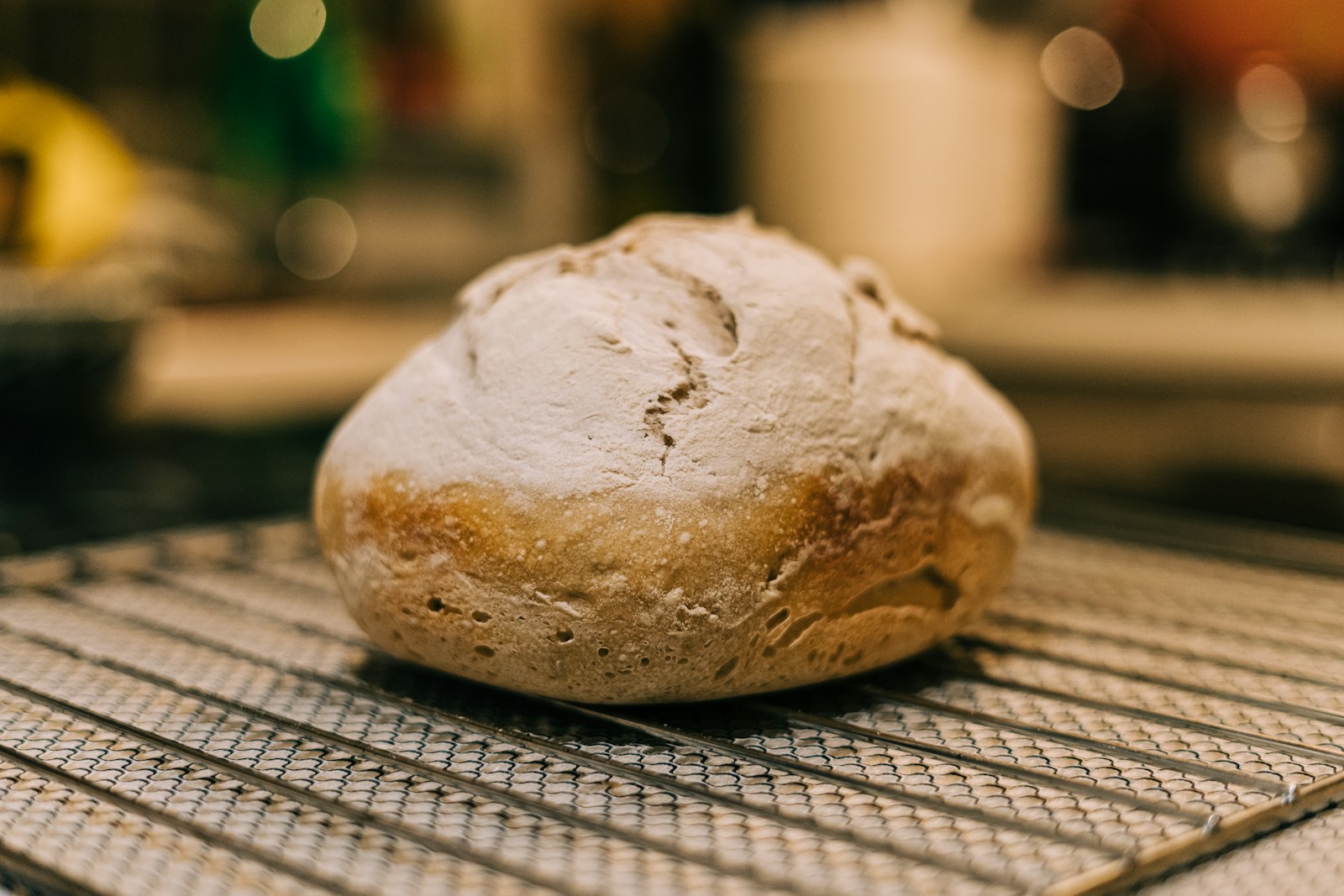


The short version: Charge $8 to $12 for a plain sourdough or sandwich loaf, $10 to $15 for a flavored loaf, and $8 to $12 for quick breads like banana bread. Those ranges come from 206 loaves listed on Homegrown, where quick breads actually list from $6 to $12, but the bottom of that range is too low for what a quick bread costs to make. Figure your own floor with ingredients plus packaging plus your time plus overhead, then price for a 15 to 20 percent margin by dividing that cost by 0.85 or 0.80. Batch size moves your price more than anything else, so a baker who bakes 12 loaves at a time can charge $10 and earn about $23 an hour, where a six-loaf baker at the same price earns about $15. Raise your price by $1 when a batch is gone within an hour three weeks running.
Checked on September 18, 2026: listing prices from a pull of the Homegrown catalog, ingredient and grocery bread prices from the U.S. Bureau of Labor Statistics, and payment fees on each company's own pricing page. Homegrown customers create an account to place their first order, and Homegrown has no timed "drop" release feature.
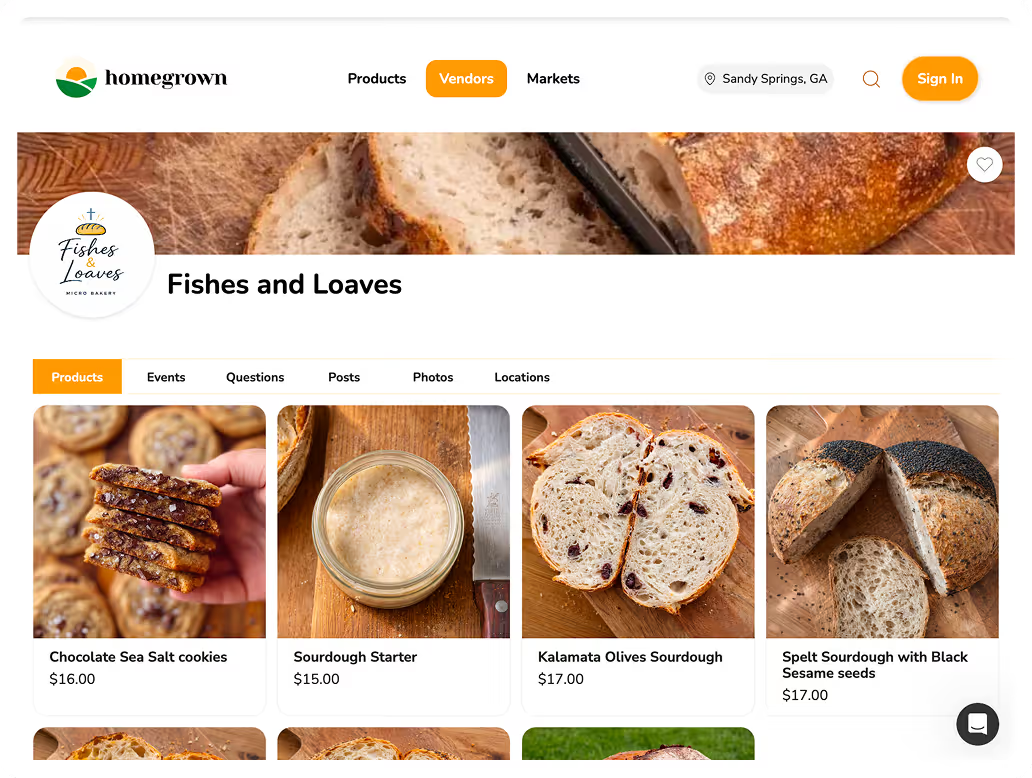
On Homegrown, most home bakers list a plain loaf of bread at $8 to $12, and $10 is the most common price. That is what 206 bread listings from 76 home bakeries on Homegrown showed on September 18, 2026. The harder question is what your own loaf should cost, because a price that pays well at 24 loaves a bake day can leave you earning $15 an hour at six.
Start with the ranges below, then check them against your own costs.
On Homegrown, a plain homemade loaf lists for $8 to $12, with $10 as the most common price for sourdough and sandwich bread alike. Flavored sourdough (jalapeño cheddar, cranberry walnut, cinnamon swirl) runs higher, with a $14 median. Quick breads sell for the widest spread, from $6 to $12. If you already know you want to sell and you are working out the legal side and where to find buyers, the guide to selling sourdough bread from home covers the permits, labels and bake schedule. This page is only about the number on the tag.
Here is the full range by type, pulled from every purchasable bread listing on Homegrown the day this was written. "Middle half" means half of all listings fall inside that range, which cuts out the odd $4 or $21 outlier. Where a range starts with "about," the edge is calculated from the listings and rounded to the nearest dollar.
Scroll sideways to see every column.
| Bread type | Middle half of listed prices | Median | Listings (vendors) |
|---|---|---|---|
| Plain sourdough loaf | $8 to $12 | $10 | 35 (33) |
| Flavored sourdough loaf | $10 to $15 | $14 | 113 (43) |
| Sandwich loaf, sourdough or yeast | about $9 to $12 | $10 | 24 (20) |
| Quick bread (banana, zucchini, pumpkin) | $6 to $12 | $10 | 25 (19) |
| Focaccia | $9 to $12 | $10 | 9 (8) |
Loaf sizes are not standard across bakers, so treat these as a starting point. A 1.5 pound boule at $10 and a 2 pound boule at $10 are not the same deal.
Home bakers on Homegrown list most loaves between $8 and $15, and flavored sourdough is the only bread type whose median clears $10. The pull below is real listing data, not survey answers, so it shows what bakers ask rather than what they wish they could ask.
In a pull of the Homegrown catalog on September 18, 2026, 206 of the 2,485 purchasable products were loaves of bread, listed by 76 of the 288 vendors. Flavored sourdough was the biggest group at 113 listings. Its median price was $14, four dollars above the $10 median for plain sourdough.
Median listed price by bread type on Homegrown
Source: Homegrown catalog pull, September 18, 2026, 206 bread listings from 76 vendors.
Three patterns stand out in the listings:
If you are just starting, pricing inside the middle half keeps you in line with what local customers already see from other home bakers. Where inside that range you land depends on your costs, which the next sections work out.
Supermarket white bread cost $1.82 a pound across U.S. cities in August 2026, according to the Bureau of Labor Statistics average price for white pan bread, so a $10 homemade loaf weighing 1.5 pounds costs your customer about $6.67 a pound. That is close to four times the supermarket price per pound. A smaller 1.1-pound loaf at the same $10 works out to $9.09 a pound, which is five times the supermarket price. Even whole wheat pan bread, at $2.81 a pound in May 2026 (the latest month in the BLS whole wheat pan bread series), costs less than half what that 1.5-pound $10 homemade loaf does per pound.
Customers pay the gap for reasons that have nothing to do with flour:
The mistake is letting that $1.82 number sit in your head while you set your price. Your customer has already decided not to buy the bread aisle loaf. They are comparing you to the bakery downtown and to the other home bakers at the market, and those loaves sit in the $8 to $15 band shown above.
Your cost per loaf is ingredients plus packaging plus your labor plus overhead, and your price is that cost divided by one minus your margin. For a 15 percent margin, you divide by 0.85. For 20 percent, divide by 0.80. Adding 20 percent on top gives you less than a 20 percent margin, which is how many home bakers end up 40 to 60 cents short on every loaf. On the $8.20 loaf in the batch table below, adding 20 percent gives $9.84, while dividing by 0.80 gives $10.25.
Once you have the number, check it against the middle-half ranges above. If your floor is far above the local range, the fix is usually a bigger batch or a simpler loaf, not a lower hourly rate. For the full method across cookies, cakes and pastries, the guide to pricing baked goods with the four-number formula walks through each step.
Ingredients for a plain loaf cost about $0.60 to $1.20 in 2026, and an enriched loaf like brioche runs closer to $3.60. The numbers below use the U.S. city average prices the Bureau of Labor Statistics published for August 2026: all-purpose flour at $0.548 a pound, butter at $4.021 a pound, eggs at $2.272 a dozen, sugar at $1.024 a pound and whole milk at $4.229 a gallon.
Scroll sideways to see every column.
| Loaf | What goes in | Ingredient cost |
|---|---|---|
| Plain sourdough boule | 1.1 lb flour, water, salt, starter | about $0.60 |
| White sandwich loaf | 1.1 lb flour, 1 oz butter, 1 cup milk, 2 tbsp sugar | about $1.17 plus yeast and salt |
| Brioche loaf | 1.1 lb flour, 1/2 lb butter, 4 eggs, 1/4 cup sugar, 1/2 cup milk | about $3.61 plus yeast and salt |
A few things push your real number higher than this table:
The lesson from this table is that ingredients are the small part of a bread price. Even the brioche loaf, the most expensive to make here, is under $4 in ingredients. The big number is your time.
Pick an hourly rate between $15 and $25 and use it on every product, because in the worked examples below, labor is 67 to 80 percent of what a loaf costs. A rate you would accept from someone else for skilled work in your area is the right test. Minimum wage is too low for a skill that took you months or years to learn.
Count all the time, not just the minutes your hands are in the dough:
That last one surprises people. A baker handling 20 orders a week through texts and direct messages spends real hours on order messages, and none of that time shows up in a recipe. At 5 minutes an order, 20 orders is 100 minutes a week. Time two full bake days, one good and one messy, and average them. Your best day is not the one to price around.
At $18 an hour, three hours of work spread over six loaves is $9.00 of labor per loaf. Twelve loaves take about four hours, which is $6.00 a loaf, and twenty-four loaves take about six hours, which is $4.50 a loaf. That difference is the whole story of the next section.
Batch size changes your fair price more than any ingredient does: the same sandwich loaf needs a $13 price at six loaves a bake day and only about $8 at twenty-four. The table assumes $18 an hour, $1.30 in ingredients (the $1.17 above plus yeast and salt), $0.50 for packaging, $0.40 overhead and a 15 percent margin. The hours are an example; time your own.
Scroll sideways to see every column.
| Loaves per bake day | Hours of work | Labor per loaf | Cost per loaf | Price at 15% margin |
|---|---|---|---|---|
| 6 | 3.0 | $9.00 | $11.20 | $13.18, round to $13 |
| 12 | 4.0 | $6.00 | $8.20 | $9.65, round to $10 |
| 24 | 6.0 | $4.50 | $6.70 | $7.88, round to $8 |
Now flip it around and hold the price at the $10 median. After ingredients, packaging and overhead, a six-loaf bake day pays you $15.60 an hour. Twelve loaves pays $23.40 an hour. Twenty-four loaves pays $31.20 an hour. Same loaf, same price, same baker.
If a batch sells out in the first hour of the market three weeks in a row, raise the price by $1 before you bake more. Selling out fast means your customers would have paid more, and the extra dollar on 12 loaves is $12 a week you keep without adding a minute of work.
What this means for a part-time baker:
Charge the same $8 to $12 for a plain sourdough loaf as for a good yeast sandwich loaf, and let size and flavor, not leavening, set the difference. Sandwich loaves on Homegrown list a little higher at the low end, closer to $9 (see the table above), so $8 is the floor for a small or plain sandwich loaf, not the typical price. On Homegrown both types have a $10 median. Sourdough takes longer on the calendar, but most of that time is dough sitting in the fridge while you sleep, so hands-on time per loaf can be close to a yeast loaf.
Where the two really differ:
If sourdough is your main product, the sourdough cost-per-loaf breakdown goes deeper on starter upkeep, fermentation time and oven energy. For a yeast loaf, the math in the batch table above applies as written.
Flavored and specialty loaves should sell for $3 to $5 more than your plain loaf, because the add-ins usually cost you $0.75 to $2.00 and customers treat them as a treat. On Homegrown, the 113 flavored sourdough listings had a $14 median against $10 for plain, and the top quarter sat at $15 or more. The highest listings, $20 to $21, were five organic einkorn and spelt loaves from one bakery, plus four cheese and specialty loaves from two other bakers, one of them a 3-pound jalapeño cheese loaf.
Good candidates for a higher price:
Two rules keep specialty pricing honest. First, cost the add-in. Half a cup of shredded cheddar or walnuts is real money, and a loaf that uses $2 of cheese should not sell for $1 more than plain. Second, keep your menu short. Three flavors you rotate each week is easier to bake in one batch than eight flavors in ones and twos, and it keeps your labor per loaf low.
A flavored loaf also gives price-sensitive customers something to compare against. When a $14 jalapeño cheddar sits next to a $10 plain boule, the plain one reads as the good deal.
Price quick breads at $8 to $12 a loaf, focaccia at $9 to $12 a pan, and rolls or bagels by the pack so the total lands in the same $8 to $15 range as a loaf. Bagels have their own math, since an everything topping costs more than the dough under it, and the guide to what to charge for bagels puts a plain half dozen at $14, inside that same range. Quick breads are where home bakers undercharge the most: about a third of the 25 quick bread listings on Homegrown (8 of them) were $6 or less, even though a banana bread typically uses a half cup of butter (about $1.00 at August 2026 prices) and two eggs.
What to keep in mind for each type:
For quick bread labels, shelf life and packaging, the guide on selling quick bread from home covers the setup side.
Keep one price for the same loaf everywhere, then adjust with pack sizes and order minimums instead of different tags. Customers who see $9 at the market and $11 on your order page feel tricked, and they will order the cheaper way. One price keeps it simple for them and for you.
Where a small difference is fair:
Pre-orders are the best channel for bread because you bake only what is sold. Where those pre-orders come from is a separate question with its own arithmetic, since the same $10 loaf keeps $9.41 through your own link, $8.60 on Etsy and $5.00 at a shop: the seven places bread actually sells. That matters for price: a loaf you bake and do not sell costs you its ingredients and labor, and at $8.20 a loaf that loss adds up fast.
Card and platform fees take about $0.29 to $0.63 of what you keep from a $10 loaf, Hotplate adds another $1.05 to your customer's total, and a single-loaf order loses more to the fixed 10 to 30 cents per payment than a two-loaf order does. Here is the full fee stack for the ways home bakers usually get paid. Every row shows the monthly plan, the trial, the platform fee and the card processing fee, so you can compare the whole cost.
Scroll sideways to see every column.
| How you get paid | Monthly plan | Trial | Platform fee | Card processing | Customer pays on a $10 loaf | You pay on a $10 loaf | You pay in a month of 50 single-loaf orders |
|---|---|---|---|---|---|---|---|
| Homegrown | $10 billed annually, or $12.50 billed monthly | 7 days, no charge until day 8 | $0, 0% commission | 2.9% + $0.30, paid by you | $10.00 | $0.59 plus the plan | $39.50 on the annual plan ($42.00 monthly) |
| Hotplate | $0 | No paid plan to try | 5% + $0.55, added to the customer's checkout | 2.9% + $0.30, paid by you | $11.05 | $0.59 | $29.50 |
| Square Online, Free plan | $0 (paid plans $49 and $149) | No paid plan needed | $0 | 3.3% + 30¢ online, paid by you | $10.00 | $0.63 | $31.50 |
| Venmo business profile | $0 | No paid plan to try | $0 | 1.9% + $0.10, paid by you (2.29% + $0.09 with Tap to Pay in person) | $10.00 | $0.29 | $14.50 |
| Cash at the market | $0 | Not applicable | $0 | None | $10.00 | $0 | $0 |
We checked these fees on each company's own page on September 18, 2026: Homegrown's signup page, Hotplate's pricing page, Square's online store plans page and Venmo's business profile fee page. Processing is figured on the $10 loaf price. Where a platform charges it on the full total including its own fee or a tip, it runs a few cents higher.
Hotplate's pricing page says the 5% + $0.55 service fee shows up on the customer's checkout, which turns your $10 loaf into $11.05 at the register, and you still pay 2.9% + $0.30 card processing on your side. Square's online store plans list a $0 Free plan with 3.3% + 30¢ on online card payments and 2.6% + 15¢ when a card is tapped in person.
Fee pages change without notice. Square's online rate on its Free plan was 3.3% + 30¢ when we checked on September 18, 2026, higher than its paid plans. Load the page yourself before you pick a way to get paid, and re-check once a year.
A simple way to cut the per-order fee: offer a two-loaf option. On Homegrown, a $20 two-loaf order costs $0.88 in processing, or 4.4 percent, against $0.59 on a single $10 loaf, which is 5.9 percent.
Pre-orders protect your margin because every loaf you bake is already paid for, and one unsold loaf wipes out the profit on several sold ones. At the $8.20 cost per loaf from the batch table, two leftover loaves a week is $16.40 of ingredients, labor and packaging gone, about $850 a year.
That is the problem Homegrown is built for. It costs $10 a month billed annually, or $12.50 month to month, with no percentage fees beyond standard payment processing (2.9% + $0.30, paid by you, never added to your customer's total). You list this week's loaves with a count for each, and customers order and pay through one link. Each loaf stops taking orders when it sells out, and the count updates on its own as orders come in, so you bake exactly the number you sold.
How it compares for a bread vendor:
What Homegrown does not do: customers create a Homegrown account to place their first order. There is no timed "drop" release with a countdown. Your storefront is listed in the Homegrown marketplace, but plan on most orders coming from people you send to your own link. And Homegrown will not set your price for you; the math in this guide is still yours to run.
If pre-ordering fits how you bake, you can set up a Homegrown storefront for your bread in about 15 minutes and list this week's loaves at the price you just worked out.
Pricing at the bottom of the local range is the most expensive mistake, because a $2 gap on 12 loaves a week is $1,248 a year. Most of the others come from the same root: counting ingredients and forgetting time.
Each of these is easy to fix once you have the cost-per-loaf number in front of you. Write it on an index card and keep it next to your price list.
Raise your bread price by $1 when every batch is gone within an hour for three straight weeks, when you have a waitlist, or when your ingredient cost goes up more than 10 percent. A $1 step on a $10 loaf is small enough that most regulars do not blink, and it is 10 percent more revenue for the same work.
Signs your price is too low:
How to do it without drama:
You may lose one or two customers. The ones who stay are paying a price that keeps you baking. For wording that works with regulars, the guide on raising prices without losing customers has sample posts. And if your new price is worth putting in front of more people, a Homegrown storefront for your bread lets you post the new menu and take pre-orders at the new price from one link.
On Homegrown, most home bakers list a plain loaf at $8 to $12, and $10 is the most common price. In a September 2026 pull of 206 bread listings on Homegrown, plain sourdough and sandwich loaves both had a $10 median. Flavored loaves sold for more, with a $14 median. Start in that range, then adjust based on your cost per loaf and how fast you sell out.
Ingredients for a plain loaf cost about $0.60 to $1.20 at August 2026 U.S. average prices, and a butter-and-egg brioche loaf runs about $3.60. Packaging adds $0.20 to $0.75. Your time is the largest cost: at $18 an hour, four hours spread over twelve loaves is $6.00 a loaf.
No. $10 is the median price for a plain sourdough loaf on Homegrown, and the middle half of listings sit between $8 and $12. Customers who buy homemade sourdough compare it to bakery bread, not to the $1.82 a pound supermarket loaf. If you sell out fast at $10, try $11.
Sell a full loaf of banana bread for $8 to $12. Quick breads had a $10 median across 25 listings on Homegrown, but about a third of them (8 of 25) were $6 or less, which is too low for a loaf that typically uses a half cup of butter and two eggs. Mini loaves at $4 to $5 work as an add-on.
Keep the same price for the same loaf everywhere. Build your booth fee into that one price instead of charging market shoppers extra. If you deliver, add a clear delivery fee on top rather than raising the bread price.
Price for a margin of 15 to 20 percent on your full cost, including your labor: divide your cost by 0.85 for 15 percent or 0.80 for 20 percent. A "multiply ingredients by three" rule leaves your time out and usually lands too low, most of all for sourdough, where the ingredients are cheapest.
These guides go deeper on the parts of bread pricing and selling this page only touches:
Once you know your number, the next step is getting it in front of customers who order ahead. A Homegrown storefront takes about 15 minutes to set up at $10 a month billed annually, with no commission on your bread sales.