
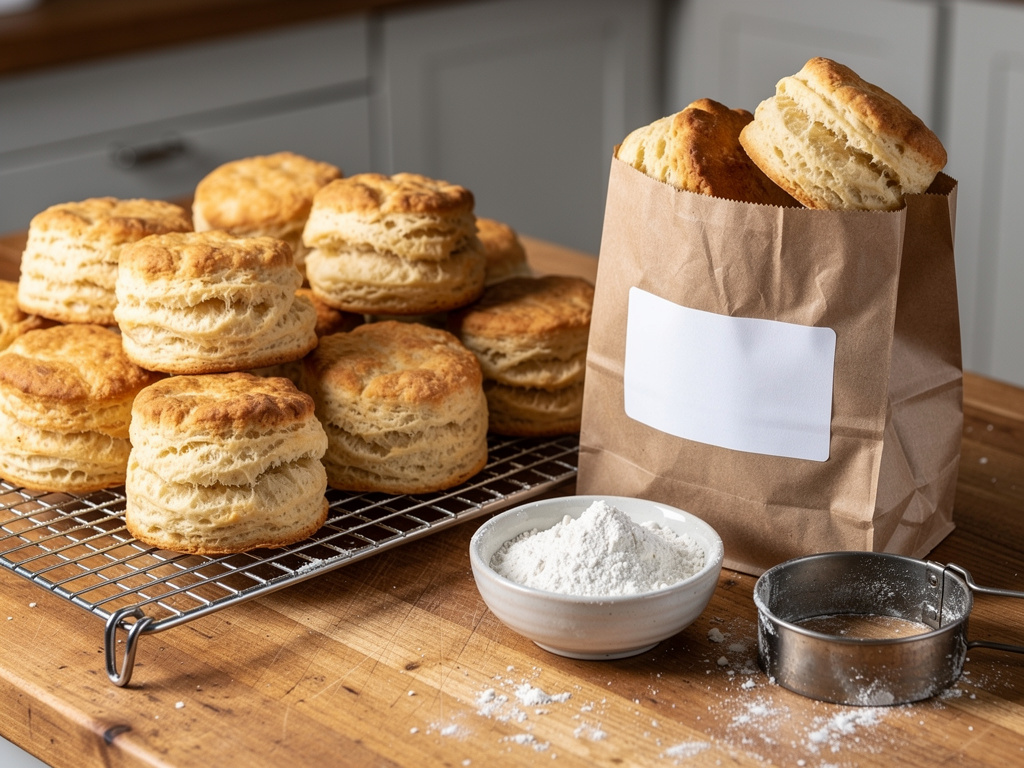


The short version: Yes, in all 9 states we checked you can sell plain homemade biscuits, the American buttermilk kind, from your home kitchen, and the official lists in California, Florida, Georgia, New Jersey and New York name biscuits outright. The paperwork runs from nothing to file (Florida, Georgia since July 1, 2025, Michigan, Tennessee and Texas for plain biscuits) to a $100 New Jersey permit good for two years or a North Carolina kitchen inspection before your first sale. Cheese is where states split: Michigan allows shredded hard cheese baked into the dough, New Jersey bans cheese as an ingredient, and New York's biscuit line names only fruit and dried herbs as add-ins. None of the 9 lets you sell a sausage, ham or bacon biscuit or biscuits and sausage gravy from a home kitchen, and frozen unbaked biscuits are barred in 7 of the 9, since only Texas and Tennessee allow some chilled or frozen home foods, with conditions.
Checked on each state agency's cottage food page, list or rule, September 30, 2026: the rules here are quoted from those pages, and laws change, so verify your state's current rules with your state agency or county health department before your first sale. Homegrown takes the orders but does not make a biscuit legal in your state, customers create a Homegrown account to place their first order, and Homegrown has no drops or countdown release feature.
This guide is about the American biscuit: flour, butter or shortening, buttermilk and baking powder, baked until tall and flaky. If you mean British biscuits, the sweet kind Americans call cookies, the homemade cookie rules are the ones you want. If you mean dog biscuits, those are pet food with their own rules, covered in the guide to selling homemade dog treats.
Your biscuits are the thing people bring up at church, at work and at the Saturday market. Someone wants two dozen for a brunch, a neighbor asks if you would sell a bag every week, and the coffee shop down the street wonders if you could supply them. Before you take the money, settle one question: does your state let you sell biscuits you baked in your own kitchen?
For a plain biscuit the answer is usually yes. The trouble starts with what goes inside or next to it: cheddar, jalapeños, a sausage patty, a ladle of gravy, a tub of honey butter, or a bag of frozen dough for customers to bake at home. This guide walks through what 9 states say about each one, with the agency's own words.
Yes, in all 9 states we checked on September 30, 2026, a home baker can sell plain baked biscuits in some legal form, and 5 of the 9 state lists name biscuits by name. A cottage food law is a state law that lets you make certain low-risk foods at home and sell them without a commercial kitchen. Biscuits fit because a baked biscuit does not need a refrigerator to stay safe.
Biscuits are a quick bread, so the closest companion to this page is can you sell homemade bread, which covers loaves, quick breads and bread labels. That page never mentions biscuits. This one covers the biscuit questions it leaves open: cheese, meat, gravy, frozen dough, butter on the side, and warm biscuits at a market.
Three things decide your answer:
If your state is not one of the 9 here, the cottage food laws by state guide lists every state's agency. Look for biscuits under breads or baked goods on your state's list.
A plain biscuit is low risk because baking drives off most of its water and the finished biscuit does not need a refrigerator to stay safe. That room-temperature test is how most states draw their home food lists. Michigan's agriculture department puts it as foods that "can safely be kept at room temperature and do not require refrigeration."
The buttermilk and butter in the dough do not change that. They are raw ingredients that go into a hot oven; the drop biscuit mix one Homegrown vendor sells tells you to bake at 450°F. Georgia's cottage food law, rewritten by House Bill 398, names "baked goods such as loaf breads, rolls, biscuits and cakes" as safe foods, "except those whose fillings require refrigeration or have high moisture content."
The things that make a biscuit risky get added after baking or folded into the dough:
Keep your biscuit plain, buttery, or brushed with honey or cinnamon sugar and it stays inside the breads and baked goods category in every state we checked. The rest of this guide goes through each add-on in turn.
Biscuits stale fast, so bake to orders, not to a guess. One Homegrown bakery's 8-pack listing says each order is "baked fresh for your pickup day," and a farm bakery lists its $6 cheddar cathead biscuit for its Thursday market only. One fixed pickup day a week lets you bake a single batch that morning and sell every biscuit in it. A dozen from White Lily's buttermilk recipe costs about $1.76 in ingredients, and how to sell biscuits from home lays out that pickup morning from the order cutoff to the reheating card in each box.
Five of the 9 states we checked put the word "biscuits" on their official lists (California, Florida, Georgia, New Jersey, New York), and the other 4 cover them under baked goods or under a rule that allows most shelf-stable foods. The columns that change are cheese, meat, the paperwork and the sales cap.
Swipe the table sideways to see all 9 states and every column.
| State | Plain biscuits | Cheese baked into the dough | Sausage, ham or bacon biscuits | What you file, and the cost | Yearly sales cap |
|---|---|---|---|---|---|
| California | Yes, "Biscuits" is on the list kept by the California Department of Public Health (CDPH) | Not named on the list; ask your county | No, the category is baked goods "Without Cream, Custard, or Meat Fillings" | Registration (Class A) or permit (Class B) from your county environmental health office, fee set by the county, plus a training course within three months | $88,878 for Class A and $177,756 for Class B in 2026 |
| Florida | Yes, "Loaf breads, rolls, biscuits" | Not named on the list; ask the Florida Department of Agriculture and Consumer Services (FDACS) | No, meat is not on the list | No FDACS food permit | $250,000 |
| Georgia | Yes, "Loaf Breads, Rolls, and Biscuits" | Not named on the list; ask the Georgia Department of Agriculture (GDA) | No, only foods that are not potentially hazardous | No state license or fee since July 1, 2025; an accredited food handler course | Not stated on the pages we read |
| Michigan | Yes, under breads and baked goods | Yes for shredded hard cheese mixed in before baking; no soft cheese or large chunks | No, "No meat and meat products" | Nothing to file, no license or inspection | $50,000 ($75,000 if products sell for $250 or more each), raised in 2026 |
| New Jersey | Yes, "Biscuits" is on the approved list | No, cheese is a prohibited ingredient | No, meat is a prohibited ingredient | $100 permit, good for two years, plus a food protection manager certificate, zoning approval and proof of safe water | $50,000 |
| New York | Yes, "Biscuits" is on the list for home processors, New York's name for home food businesses | Not named on the biscuit line, which allows fruit and dried herbs; ask the state Department of Agriculture and Markets | No, "Meat, fish, or poultry products" are prohibited | Home processor registration, no fee, review of up to 16 weeks | Not stated on the page we read |
| North Carolina | Yes, as a baked good that does not need refrigeration | Not named for biscuits; NCDA&CS lists "Dairy Products" as not permitted, so ask before you list a cheese biscuit | No, refrigerated products are not allowed | A home kitchen inspection before you sell; no permit is issued | Not stated on the page we read |
| Tennessee | Yes, as a homemade food that does not need temperature control | Not excluded by the law | No, the law bars meat from foods that need temperature control | Nothing to file; the state issues no permits | Not stated on the pages we read |
| Texas | Yes, Texas allows any food except a short excluded list | Not excluded; register with the Texas Department of State Health Services (DSHS) if the biscuit needs refrigeration | No, meat and poultry are excluded | Nothing to file for plain biscuits, but you must finish an accredited food handler course | $150,000, which Senate Bill 541 has the state adjust each year for inflation; DSHS still listed $150,000 on September 30, 2026 |
We read each rule on September 30, 2026, on the state agency's own page: CDPH's Approved Cottage Foods list (last reviewed April 2026), its cottage food page and its 2026 adjusted sales limit table; FDACS's cottage foods page; the Georgia Department of Agriculture's cottage food page and its House Bill 398 questions and answers; the Michigan Department of Agriculture and Rural Development's (MDARD) cottage food and "What Can I Make?" pages and its Getting Started FAQ, which gives the 2026 cap; the New Jersey Department of Health's approved and prohibited lists and its cottage food rule, N.J.A.C. 8:24-11; New York Agriculture and Markets' home processing page; the North Carolina Department of Agriculture and Consumer Services' (NCDA&CS) home processor page; the Tennessee Department of Agriculture's Food Freedom Act page and the text of Tenn. Code Ann. 53-1-118; Texas DSHS's cottage food page; and the enrolled text of Texas Senate Bill 541. "Not named on the list" means the agency's list neither allows nor bans it by name. CDPH's main cottage food page still shows the unadjusted $75,000 for Class A and $150,000 for Class B; the adjusted 2026 table is the current limit. Confirm with your agency before you sell.
Two patterns stand out. First, every state here treats a plain biscuit as a normal home-baked good. Second, filing nothing does not mean anything goes. Michigan is the only one of the 9 that spells out a yes for cheese in the dough, and none of the 9 allows a sausage or ham biscuit from a home kitchen.
Older guides still quote Texas's cap as $50,000 and California's as $50,000. Both are out of date. Texas DSHS's page now lists $150,000 after Senate Bill 541. The law also has the state adjust that cap each year for inflation, but DSHS still listed $150,000 when we checked. California resets its caps every January for inflation: $88,878 for Class A and $177,756 for Class B from January 1, 2026. We read both on September 30, 2026.
In Michigan you can, as long as the cheese is shredded hard cheese mixed into the dough before baking. In New Jersey you cannot, because cheese is on the state's list of ingredients a home kitchen may never use. Most other states in this guide do not say anything about cheese in biscuits, so the safe move is to ask your agency before you list a cheddar biscuit.
Cheddar biscuits matter because they are common. When we pulled Homegrown's product list on September 30, 2026, 3 of the 5 biscuit listings offered a cheddar version.
MDARD's "What Can I Make?" page allows "Breads with shredded hard cheeses incorporated into the dough prior to baking" and rules out "breads with soft cheese or large chunks of hard cheeses." It also allows jalapeño cheddar bread if the jalapeños are "chopped or pulverized and dried, freeze-dried, or commercially pickled and patted dry" before they go into the dough. We read it on September 30, 2026.
Here is how the 9 states line up on a cheddar biscuit:
Jalapeños are their own question. New Jersey's prohibited list names "Peppers" and "Vegetables (fresh, cooked, fried, or dried)," and New York's says "Vegetables are prohibited" on the biscuit line and bans "jalapenos" on the prohibited list. A jalapeño cheddar biscuit is out in both states even if cheese were fine.
A biscuit with sausage, ham or bacon inside is off limits in every state we checked, and a chicken biscuit is off limits in 8 of them, because meat needs refrigeration to stay safe and home food laws are built around foods that do not. Texas, which allows any food except the ones on its excluded list, still excludes "meat, meat products, poultry, or poultry products." Michigan says "No meat and meat products," New Jersey lists "Meat" as a prohibited ingredient, and New York prohibits "Meat, fish, or poultry products."
California's list makes the same point from the other side: the only baked goods it allows are "Baked Goods Without Cream, Custard, or Meat Fillings." A ham biscuit is a baked good with a meat filling.
Since July 1, 2025, Tennessee's Food Freedom Act lets home cooks sell some foods that need refrigeration, but those foods may not contain "meat, meat byproducts, or meat food products," and they must be sold in person. Chicken is allowed only if you meet one of two narrow federal poultry exemptions the law names (9 CFR 381.10). A sausage or ham biscuit is still out. We read the law and the state's page on September 30, 2026.
It does not help to buy the sausage already cooked. Michigan files meat under foods "requiring refrigeration," and a biscuit with a patty inside needs the same cold holding whether the patty came from your skillet or a grocery store package. The problem is what the finished biscuit needs, not where the filling came from.
If a breakfast biscuit is the product you want to build a business on, the legal routes are:
The fourth route is how most home biscuit bakers start. The guide to foods that need time and temperature control explains which states allow any cold-held foods from home and what they ask of you.
Biscuits and sausage gravy are out in all 9 states covered here, because sausage gravy is a meat food that needs refrigeration, and none of these states allows a refrigerated meat food from a home kitchen. An egg and cheese breakfast sandwich is out in 7 of the 9, because it needs a refrigerator once it cools; Texas, with DSHS registration and cold holding at 41°F or below, and Tennessee, with in-person sales only, are the two to check. Served warm at a booth, either one is usually treated as food service, which needs a permit from your county or city health department rather than a cottage food registration.
New York's list is the clearest on this. It prohibits "Any finished food product that requires refrigeration," and North Carolina's home processor page lists "Refrigerated or frozen products" among the foods a home kitchen cannot make. Even Texas, which allows some refrigerated foods from a registered home kitchen, excludes the meat that sausage gravy is built on.
What you can do with a plain biscuit and a breakfast crowd:
Frozen unbaked biscuits are out in 7 of the 9 states, every one except Texas and Tennessee, and a dry biscuit mix is named as allowed on at least 5 of the 9 lists (California, Michigan, New Jersey, New York and North Carolina). The difference is water and temperature. Raw biscuit dough made with butter and buttermilk has to stay cold, while a dry mix of flour, baking powder, salt and sugar sits in a pantry for months.
Here is what the lists say, word for word:
Texas and Tennessee are the two states here that allow some chilled or frozen foods made at home. Texas asks you to register with DSHS, keep cold foods at 41°F or below, and put the date made on the label and a safe handling statement on the label or on the receipt. Tennessee requires those foods to be sold in person. If frozen biscuits are your plan in either state, read that state's rules in full before you stock the freezer.
One Homegrown bakery that sells 8-packs of biscuits also sells a dry drop biscuit mix for $10: flour, baking powder, salt and sugar, with instructions to add milk and melted butter and bake at 450°F. The customer adds the perishable ingredients at home, which is why a mix can fit a cottage food list that a bag of frozen dough cannot. Pulled from the Homegrown catalog on September 30, 2026.
Fruit jam is allowed in each of the 9 states, with limits on which fruits, while honey butter usually is not, because butter is a dairy food. New York's prohibited list names butters outright: "Cheese, yogurt, fluid dairy products, butters." New York also prohibits "Spreads."
That matters because honey butter is the thing customers ask for next. If you want to offer it, you have two honest options:
Jam is the easier pairing. Georgia and Florida list jams, jellies and preserves, and New York lists fruit jams, jellies and marmalades and names the fruits it allows, from apple to strawberry. The rules for a jar of jam, including the fruits that are not allowed, sit in the homemade jam guide. Butter on its own, and which states allow it, is covered in the homemade butter guide.
If you sell both a biscuit and a jar of jam, each product needs its own label. A bundle of 8 biscuits and a jar of jam is two cottage foods in one bag, not one.
Georgia dropped its cottage food license and fee on July 1, 2025, when House Bill 398 took effect, and it now lets home bakers sell to grocery stores, restaurants and convenience stores as well as directly to customers. That puts Georgia among the 5 states in this guide where a plain biscuit needs nothing filed with the state. For a Georgia biscuit baker it is a big change: you can now supply a local café without a commercial kitchen, unless your city or county opts out.
The Georgia Department of Agriculture's cottage food page lists "Loaf Breads, Rolls, and Biscuits" first among the foods you may make, and says operators "must complete an American National Standards Institute (ANSI) accredited food safety training program," with food handler training accepted.
The department's questions and answers on House Bill 398 say cottage food operators "no longer need to obtain a license with the Georgia Department of Agriculture ("GDA") or pay a licensing fee to the state." A city or county may pass an ordinance that bars cottage food sales through stores and restaurants inside its borders, and general local rules like a business license or zoning still apply. We read both on September 30, 2026.
What Georgia's law asks of a biscuit baker now:
The full walkthrough, including labels and where you can sell, is in the Georgia cottage food law guide.
Tennessee lets you sell plain homemade biscuits with no license, permit or inspection under its Food Freedom Act, as long as you bake them at your own home and sell them inside Tennessee. The Tennessee Department of Agriculture's Food Freedom Act page says it does "not issue permits, licenses, or conduct inspections for products made under this law."
Tennessee is one of only 2 states here, with Texas, that permit any refrigerated homemade foods. Since July 1, 2025, the law has allowed some foods that need refrigeration, which sets Tennessee apart from most of the states in this guide. The catch for biscuits is in the details of Tenn. Code Ann. 53-1-118:
A shelf-stable plain biscuit can be sold remotely and delivered by a third-party carrier inside Tennessee, and it can go through a store. The state's page also warns that the department "cannot render advice to firms about their specific product," so a cheddar or chicken biscuit plan is a question for a lawyer or the University of Tennessee Extension. More detail is in the Tennessee cottage food law guide.
The paperwork for a plain biscuit runs from nothing to file in 5 of the 9 states (Florida, Georgia, Michigan, Tennessee and Texas) to a $100 permit in New Jersey. The other 3 ask for a county registration (California), a free state registration (New York) or a home kitchen inspection (North Carolina). Here is what the process looks like in each, as the agencies describe it.
No state filing does not mean no local rules. Georgia's own questions and answers say your city or county can still require a business license or zoning approval, and New Jersey asks for zoning approval before it issues a permit. Call your city clerk before your first sale. Laws move, too: Georgia and Tennessee both changed theirs on July 1, 2025, and Texas raised its cap under Senate Bill 541.
Budget for the costs that are not on any agency page: a food handler course where required, a label printer or printed labels, bags or boxes, and a well water test if your home is on a well (New Jersey, New York and North Carolina all ask for one).
A biscuit label in most states carries the product name, your name and address, the ingredients in order by weight, the allergens, and a sentence saying the food was made in a home kitchen. For a buttermilk biscuit, the allergens are almost always wheat and milk, plus egg if you use an egg wash. The exact home kitchen sentence changes from state to state, and in 4 of the 5 states in the table below it has to be copied word for word; New York lets you pick a phrase like "Made in a Home Kitchen."
Scroll right for each state's required sentence.
| State | The home kitchen sentence | What else the agency lists |
|---|---|---|
| Texas | "THIS PRODUCT WAS PRODUCED IN A PRIVATE RESIDENCE THAT IS NOT SUBJECT TO GOVERNMENTAL LICENSING OR INSPECTION." | Your operation's name, your address or DSHS registration number, the product name, major allergens; for refrigerated foods, the date made, plus a safe handling statement on the label or receipt |
| Tennessee | "This product was produced at a private residence that is exempt from state licensing and inspection. This product may contain allergens." | Your name, home address and phone number, the product name, ingredients in order of predominance |
| Georgia | "This product was produced at a residential property that is exempt from state inspection. This product may contain allergens." in at least 10-point type | Business name, address and phone, or a GDA identification number instead of the address |
| New Jersey | "This food is prepared pursuant to N.J.A.C. 8:24-11 in a home kitchen that has not been inspected by the Department of Health." | The same sentence goes on a placard with your permit wherever you sell away from home |
| New York | A phrase like "Made in a Home Kitchen," at 1/16 inch or larger | Product name, ingredients by weight, net quantity, your name and full address, allergens named in the ingredient list |
Each sentence is copied from the agency page or law we read on September 30, 2026: Texas DSHS's cottage food page, Tenn. Code Ann. 53-1-118, Georgia's House Bill 398 text posted by the Georgia Department of Agriculture, N.J.A.C. 8:24-11.4, and New York Agriculture and Markets' home processing page. California, Florida, Michigan and North Carolina have their own label rules, which are in each agency's guidance.
A few biscuit-specific label points:
The cottage food labeling requirements guide has a template you can adapt for any state.
You can sell biscuits at a farmers market in all 9 states, but in several of them they have to be packaged and labeled before you sell, and New York requires the packing to happen at home, which rules out warming, splitting or buttering them at your table. New York is the strictest: food "must be pre-packaged in the home and properly labeled," and packaging food at "an agricultural event (craft fair, farmers' market, etc.) is not permitted."
The New York Agriculture and Markets home processing page also lists farmers markets, farm stands, craft fairs, home delivery and the internet as places a registered home processor can sell. Florida says cottage foods "must be properly packaged and labeled" and that free samples "must be prepackaged." Texas says food "must be packaged and labeled," with an exception for foods too large to package.
What works at a market booth:
Tennessee and Georgia are looser here. Both allow unpackaged foods if the required information is on a placard at the point of sale. Even there, ask the market manager what the market's own rules say, since markets often set stricter rules than the state.
Online orders are allowed in most of the 9 states if you deliver or hand off inside the state, and selling to a coffee shop is allowed in some states and banned in others. New York, Michigan, New Jersey and Tennessee all say in writing that home-made food stays inside the state, so plan on no out-of-state shipping.
Online and delivery rules for biscuits:
Selling to a café or grocery store splits the states. Georgia now allows it under House Bill 398, New York allows wholesale to local restaurants and stores inside the state, Tennessee allows sales through a store for foods that do not need refrigeration, and California's Class B permit covers restaurants and food markets. North Carolina allows sales to restaurants and stores once your kitchen passes inspection. Texas allows wholesale of shelf-stable cottage foods only to a cottage food vendor registered with DSHS, who can then sell them at a café or store. Florida says cottage foods "cannot be sold wholesale," New Jersey bars delivery to a retail food establishment, and Michigan requires you to sell directly to the consumer. The guide to shipping cottage food goes deeper on mail and couriers.
Biscuits are a small, real category on Homegrown: 5 listings from 5 vendors in a catalog pull on September 30, 2026, and 3 of the 5 offer a cheddar version. Not one of the 5 biscuit listings is a sausage, ham, bacon or chicken biscuit.
In a pull of the Homegrown catalog on September 30, 2026, 5 of the 2,772 products listed by 312 vendors were biscuits, one listing each from 5 vendors. Bakery products made up 1,408 of the 2,772, from 181 vendors. We counted a listing when the thing sold is an American-style biscuit, judged by name, description and flavor options after reading every listing from each of those vendors; jams and honey described as "perfect on biscuits," biscotti, flour, a dog cookie and a dry biscuit mix were not counted. Pack prices ran from $7.99 for 8 soft biscuits to $17.00 for a dozen, and two shops charge $15 for 8.
Flavors offered across 5 biscuit listings on Homegrown
Source: Homegrown catalog pull, September 30, 2026, 5 biscuit listings from 5 vendors. A listing counts once per flavor it offers, so the bars add to more than 5.
What the listings have in common:
If you already sell bread, adding a biscuit pack is a small step, and the rules are the same ones you already follow for bread in most states. If biscuits would be your only product, a weekly pickup day keeps waste low.
Biscuits are best the day they are baked, so the order has to come in before you cut the butter into the flour. Homegrown gives you an ordering page for $10 a month billed annually ($12.50 billed monthly) with no percentage fees beyond standard payment processing. Customers choose their pack and a pickup day and pay when they order, so Saturday's bake matches Saturday's orders.
Drag sideways to compare the full cost per order and per month.
| Platform | Monthly plan | Trial | Platform fee | Card processing | Customer pays on a $20 order | Vendor pays on a $20 order | Vendor pays in a month of 50 orders at $20 |
|---|---|---|---|---|---|---|---|
| Homegrown | $10 billed annually ($12.50 monthly) | 7 days, no charge until day 8 | None, 0% commission | 2.9% + $0.30, paid by the vendor | $20.00 | $0.88 plus the plan | $54.00 ($56.50 on monthly billing) |
| Hotplate, default split | $0 | No monthly plan | 5% + $0.55, added to the customer's total | 2.9% + $0.30, paid by the vendor | $21.55 | $0.88 | $44.00 |
| Hotplate, vendor covers the fee | $0 | No monthly plan | 5% + $0.55, paid by the vendor | 2.9% + $0.30, paid by the vendor | $20.00 | $2.43 | $121.50 |
| Square Free, online | $0 | No monthly plan | None | 3.3% + 30¢ online, paid by the vendor | $20.00 | $0.96 | $48.00 |
We checked every fee on September 30, 2026, on findhomegrown.com/signup, Hotplate's pricing page, Hotplate's own post "What Hotplate does" (which says "we charge a fee to your customer" and "80% of Hotplate chefs keep the default as-is"), and Square's fee help page. Hotplate's pricing page calls the split "your choice," so both versions are shown. Card processing is figured on the $20 price; a platform that charges it on the total with tax or tips runs a few cents higher. Square's in-person rate on the Square Free plan is 2.6% + 15¢.
How the alternatives fit a biscuit baker:
What Homegrown does for a biscuit baker: pre-orders tied to a pickup day, payment when the order is placed, and one link to share at church, at work and at the market. The honest bounds: Homegrown does not tell you whether a cheddar biscuit is legal in your state, does not print labels, does not ship, and has no drops or countdown release feature. Customers create a Homegrown account to place their first order. Your storefront is listed on the Homegrown marketplace, but plan on most orders coming from people you send to your own link.
If your state allows your biscuits and you are tired of tracking brunch orders in a text thread, set up your Homegrown storefront and list your biscuit packs with a pickup day.
You can settle whether your biscuits are legal in one afternoon by reading your state's list, writing down every flavor you plan to sell, and emailing your agency one specific question. The 7 steps below work in any state, not only the 9 states in this guide.
Keep the agency's written answer, your registration or permit, your course certificate and your label file in one folder. When a market manager asks whether your cheddar biscuits are allowed, you can show them the email instead of arguing from memory. Then reread your agency's page once a year, since 2 of the 9 states here, Georgia and Tennessee, rewrote their rules on July 1, 2025.
In Florida, Georgia, Michigan, Tennessee and Texas you can sell plain homemade biscuits without filing for a license or permit, though Georgia and Texas require a food handler course first. New York asks for a free home processor registration, New Jersey charges $100 for a two-year permit, California requires a county registration, and North Carolina inspects your kitchen before your first sale.
It depends on the state. Michigan allows biscuits and breads with shredded hard cheese mixed into the dough before baking, while New Jersey bans cheese as an ingredient in home kitchen foods. California, Florida, Georgia, New York and North Carolina do not name cheese biscuits on their lists, so ask your agency in writing before you sell them.
No, not under the cottage food laws of the 9 states we checked. Meat needs refrigeration, and the rules in Texas, Michigan, New York and New Jersey all exclude it by name, while California's list covers only baked goods without meat fillings. A sausage biscuit needs a licensed kitchen or a food service permit from your county.
Yes, in most states a packaged biscuit needs a label with the product name, your name and address, the ingredients in order by weight, the allergens and a home kitchen statement. Each of the 5 states whose sentence we copied (Texas, Tennessee, Georgia, New Jersey, New York) sets its own wording. Tennessee and Georgia allow the same information on a placard when biscuits are sold unpackaged.
Yes, every state we checked lets you sell homemade biscuits at a farmers market. New York, Florida and Texas want them packaged and labeled, and New York bans packaging at the market itself, so bag them at home. Serving warm, split or filled biscuits from your table is food service and usually needs a county permit.
Some states allow it and some do not. Georgia allows sales to restaurants and stores since July 1, 2025, New York allows wholesale to local businesses inside the state, Tennessee allows sales through a store for biscuits that do not need refrigeration, California's Class B permit covers restaurants and food markets, North Carolina allows it once your kitchen passes inspection, and Texas allows it through a cottage food vendor registered with DSHS. Florida bars wholesale of cottage foods, New Jersey bars delivery to a retail food establishment, and Michigan requires direct sale to the consumer.
More on selling biscuits and baked goods legally:
You now know whether your state allows homemade biscuits, which add-ins and fillings cross the line, what the label has to say, and why a bagged biscuit beats a warmer at the market. The next step is taking orders in a way that fits a food that is best the morning it is baked: one pickup day, payment up front, and a count you can bake to.
A simple way to start: list a buttery 8-pack, a dozen and one flavor your state clearly allows, open a single pickup day a week, and send the link to the people who already ask. Add cheddar once your agency has said yes in writing. Each time you add a flavor, make its label the same day and check it against your state's list, so every biscuit in a pickup bag is one your state allows.
Start your Homegrown storefront and take biscuit pre-orders by pickup day for $10 a month billed annually ($12.50 billed monthly), with no percentage fees beyond standard payment processing.



