
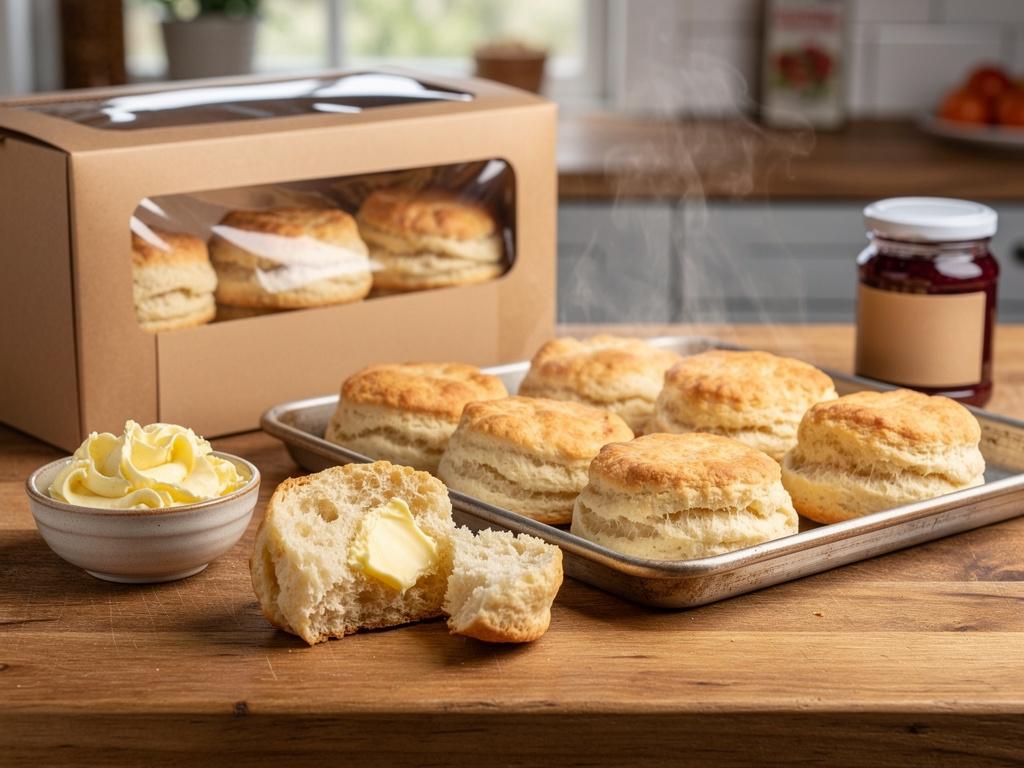


The short version: You can sell homemade biscuits from home in states whose cottage food lists name them, like Georgia and Florida, and the business works best when you sell them before you bake them, because a biscuit is at its best close to the oven. A dozen buttermilk biscuits from White Lily's recipe costs about $1.76 in ingredients, or $0.15 a biscuit, and $2.76 once it is boxed and labeled. Home bakers on Homegrown charge $1.00 to $1.88 a biscuit in packs of 8 or 12, and the most common pack size is 8, which two of them sell for $15. Take paid pre-orders with a cutoff, bake the morning of pickup, let the biscuits cool before they go in the box, and hand every order over with a reheating card.
Checked on Homegrown's signup page, October 1, 2026: $10 a month billed annually ($12.50 billed monthly), 0% commission and card processing of 2.9% + $0.30 per order paid by you, with ingredient and packaging prices loaded from Walmart.com and the Bureau of Labor Statistics the same day. Customers create a Homegrown account to place their first order, Homegrown has no drops or countdown release feature, and cottage food rules vary by state, so verify your state's current rules before your first sale.
Biscuits are cheap to make, fast to bake and loved by almost everyone who grew up with them. One batch of the classic Southern kind takes three ingredients and about 10 minutes in a hot oven. Biscuits are at their best close to the oven, so selling them is less about the recipe and more about timing: who ordered, when they pick up, and how the biscuits travel from your counter to their table.
This guide is about American biscuits, the flaky buttermilk kind you split and butter. If you mean British biscuits, those are cookies, and how to sell cookies from home is the guide for you. Below you will find a real dozen costed at October 2026 prices, what five real biscuit bakers on Homegrown charge, the pack sizes and boxes that work, a bake-day plan built around pickup, and how to get your first 10 orders.
Yes, in states whose cottage food lists name biscuits, like Georgia and Florida, you can sell plain baked biscuits from your home kitchen under a cottage food law. The Georgia Department of Agriculture's cottage food page lists "Loaf Breads, Rolls, and Biscuits" among approved products, and Florida's agriculture department lists "Loaf breads, rolls, biscuits" on its cottage food page, both checked October 1, 2026.
The rules are a whole topic of their own, so this guide only flags the ones that shape how you run a biscuit business. For the state-by-state detail, can you sell homemade biscuits walks through which state lists name biscuits, what happens with cheddar or sausage, frozen dough and biscuit mix, labels and paperwork.
The rules that change your day-to-day plan:
Rules change and every state writes its own list, so verify your state's current rules with your agriculture or health department before your first sale.
Biscuits sell differently because they are best close to the oven, so a biscuit vendor sells first and bakes second, while a cookie or bread vendor can bake ahead and sell from a table. A cookie vendor can bake Thursday for a Saturday market. A biscuit vendor who bakes Thursday is selling two-day-old biscuits on Saturday.
White Lily's recipe bakes in 8 to 10 minutes at 475°F, so the oven is rarely the hard part. The hard part is the 2 or 3 hours between the oven and the customer, and that one fact shapes the whole business:
You can see this in what real vendors write. All Rosey LLC tells customers its 8-count is "baked fresh for your pickup day," and Dolce Farm & Orchards sells its cheddar cathead biscuit at its Thursday market only. Neither one lists biscuits as something you can grab any day of the week.
Start with two biscuits, a plain buttermilk and one cheddar or sweet version if your state allows it, in one pack size people can share. Two of the five biscuit vendors on Homegrown on October 1, 2026 sold a plain biscuit next to a cheddar one on the same listing, a third sold only a cheddar cathead, and All Rosey added a cinnamon chip version.
Biscuit styles that work well from a home kitchen:
Leave sausage, ham and chicken off the menu. The states we checked exclude meat from home kitchens. Rules for gravy and other foods that need refrigeration change from state to state. Cheese rules differ by state, and the biscuit permission guide has the detail. Add-ins can be limited too: New York's home processing page says biscuits may contain high acid fruits, commercially dried fruits and commercially dried herbs, and "Vegetables are prohibited," so leave jalapeño off a New York menu. If you sell jam or honey butter alongside, check those separately with can you sell homemade jam.
A dozen 2-inch buttermilk biscuits from White Lily's "Light and Fluffy Biscuits" recipe costs about $1.76 in ingredients, or $0.15 a biscuit, at prices checked October 1, 2026. The recipe uses 2 cups of White Lily self-rising flour, 1/4 cup of butter or shortening, 3/4 cup of buttermilk and 2 tablespoons of melted butter brushed on top, and makes 1 dozen.
On a phone, swipe the table left to see where each price came from.
| Ingredient | Amount in one dozen | Price used | Cost |
|---|---|---|---|
| White Lily self-rising flour | 2 cups (240 g, 8.47 oz) | 5 lb bag, $4.44 on Walmart.com (5.6 cents an ounce) | $0.47 |
| Butter | 1/4 cup in the dough plus 2 tablespoons on top (6 tablespoons, 3 oz) | $4.021 a pound, BLS U.S. average for August 2026 | $0.75 |
| Buttermilk | 3/4 cup (6 fl oz) | Borden Whole Cultured Buttermilk, 1 quart, $2.86 on Walmart.com | $0.54 |
| One dozen, ingredients | 12 biscuits | $1.76 | |
| One biscuit | $1.76 divided by 12 | $0.15 |
Recipe amounts from White Lily's "Light and Fluffy Biscuits" page, read October 1, 2026. The 240 g of flour comes from the White Lily self-rising label, which lists a 1/4 cup serving as 30 g. Butter is the Bureau of Labor Statistics average price for salted grade AA butter, August 2026, the latest month published. Walmart.com prices were loaded October 1, 2026, and your store may differ.
A few things to notice:
Home bakers on Homegrown charged $1.00 to $1.88 a biscuit for packs of 8 or 12 when we pulled the catalog on October 1, 2026, and a single cathead biscuit sold for $6.00. With $0.15 of ingredients in each biscuit, every one of those prices leaves room for packaging, card fees and your time.
Price per biscuit in Homegrown biscuit packs
Source: Homegrown catalog pull, October 1, 2026, the four biscuit listings sold as packs. Dolce Farm & Orchards' single $6.00 cathead biscuit is left off the chart because it is one oversized biscuit, not a pack.
How those prices break down:
Notice that the flavored packs cost the same as the plain ones at both $15 bakers. One price across flavors keeps the menu simple and saves you a pricing decision for every new flavor. To build your own number from scratch, with your time and a margin in it, use the formula in how to price baked goods.
Sell biscuits in a pack that matches how people eat them: 8 is the most common pack on Homegrown (3 of the 5 biscuit listings on October 1, 2026), a dozen suits families and church breakfasts, and a half dozen is an easy first try. Whatever you pick, size the pack to the box you buy, not the other way around.
Scroll the table sideways to compare the box and full cost of each pack.
| Pack | How 2-inch biscuits sit | Box used | Biscuits | Box and label | Packed cost |
|---|---|---|---|---|---|
| Half dozen | 3 by 2, about 6 x 4 inches | 6x6x3 inch kraft box with window, $0.60 | $0.88 | $0.68 | $1.56 |
| 8-count | 4 by 2, about 8 x 4 inches | 8x8x4 inch kraft box with window, $0.92 | $1.17 | $1.00 | $2.17 |
| Dozen | 4 by 3, about 8 x 6 inches | 8x8x4 inch kraft box with window, $0.92 | $1.76 | $1.00 | $2.76 |
Boxes are YUSS kraft bakery boxes with a window on Walmart.com, 24 for $21.98 (8x8x4 inch) and 24 for $14.38 (6x6x3 inch). Labels are Avery 2 x 4 inch shipping labels, 100 for $7.97, about $0.08 each. All loaded October 1, 2026. Biscuit cost is $0.15 each from the White Lily dozen above. The fit assumes a 2-inch cutter and dough rolled 1 inch thick, as White Lily's recipe says. Biscuits spread a little in the oven, so test-fit one box with a real batch before you buy 24.
What each size is good for:
One recipe makes 12, so a dozen is one batch. An 8-count is two-thirds of a batch, which means a double batch of 24 fills exactly three 8-packs.
Twenty 8-packs at $15 on one pickup day leaves about $240.56 after ingredients, boxes, labels and card processing, before your time and the $10 monthly plan. The same 20 packs at $7.99 leaves $104.56, and 15 dozens at $17 leaves $201.75.
Slide the table across to read every cost in the week.
| One pickup day | Money in | Batches of 12 | Ingredients | Boxes and labels | Card processing at 2.9% + $0.30 | Left before your time and the plan |
|---|---|---|---|---|---|---|
| 20 eight-packs at $15 | $300.00 | 14 (8 spare biscuits) | $24.64 | $20.00 | $14.80 | $240.56 |
| 20 eight-packs at $7.99 | $159.80 | 14 (8 spare biscuits) | $24.64 | $20.00 | $10.60 | $104.56 |
| 15 dozens at $17 | $255.00 | 15 | $26.40 | $15.00 | $11.85 | $201.75 |
Pack prices are real Homegrown listings on October 1, 2026: All Rosey and Seriously Sourdough at $15 for 8, KairosGO at $7.99 for 8, Sweet Rise at $17 for 12. Ingredients are $1.76 a batch, boxes $0.92 and labels $0.08 per order. Card processing is Homegrown's 2.9% + $0.30 per order from its signup page the same day: $0.74 on $15, $0.53 on $7.99 and $0.79 on $17.
The number to watch is batches, not orders. Twenty 8-packs is 160 biscuits, which is 13 and a third batches, so you bake 14 and keep 8 spares. If your oven bakes two sheets of 12 at a time, 14 batches is 7 rounds. From fresh dough at about 10 minutes a round, that is about 70 minutes of oven time. From frozen dough, Taste of Home's extra 5 to 10 minutes makes each round 13 to 20 minutes, so 7 rounds take about 1.5 to 2.3 hours. Mixing, cutting and boxing come on top. Time a real week once, then divide what is left by your hours. If the bake-day plan below takes about 6 hours on Saturday (oven on at 6 AM to the end of pickup at noon) and about 4 hours on Friday for shopping, labels, boxes and mixing and cutting 14 batches, that is 10 hours, and the $240.56 week works out to about $24.06 an hour (240.56 / 10) before the $10 monthly plan.
Schedule backward from pickup: close orders two nights before pickup, cut and freeze your dough the day before if you want, bake in the last two to three hours before pickup opens, and let every biscuit cool before it is boxed. White Lily's recipe bakes at 475°F for 8 to 10 minutes, so the oven is rarely the slow part. Shaping and boxing are.
A bake day for a Saturday 10 AM to noon pickup:
If you sell at a farmers market instead, bake and box at home before you leave. New York, for one, requires home-processed foods to be packaged at home and does not allow packaging at the market. For a pickup routine that keeps porch handoffs short, how to take pre-orders for your food business covers cutoffs and windows.
Yes, cut biscuit dough freezes well for your own bake days and can go straight from the freezer to the oven. Taste of Home's guide to freezing biscuits says to freeze cut biscuits on a parchment-lined sheet, move them to a freezer bag once frozen, keep them up to 3 months, and add 5 to 10 minutes to the baking time when you bake them from frozen.
Why freezing helps a home biscuit business:
Two cautions. First, this is about freezing dough for your own baking. Selling frozen, unbaked biscuits to customers is a separate rules question. North Carolina, for one, lists "Refrigerated or frozen products" among the foods its home processors may not make, so check the biscuit permission guide before you list them. Second, bake one test sheet from frozen before your first big order, because every oven and recipe is a little different. Write the extra minutes on your recipe card.
Box biscuits only after they cool, in a paperboard bakery box rather than a sealed plastic bag, with a label on the outside. Steam from warm biscuits turns into water inside a closed box, and that water softens the crust and flattens the layers by pickup. Taste of Home makes a related point about freezing: it says to cool baked biscuits completely before freezing, because trapped moisture makes them "gummy and dense" once they are thawed.
A packing routine that keeps biscuits looking like your photo:
Your label is not optional. Buttermilk biscuits contain wheat and milk, and a cheddar version adds more milk. Cottage food labeling requirements walks through each line, and the Big 9 allergens guide shows how to word the allergen line.
Do not box biscuits warm "so they stay warm." The steam has nowhere to go, and a flaky batch turns soft by pickup. If customers want warm biscuits, give them a reheating card instead.
A biscuit reheating card should give one oven method, one note for frozen biscuits, and your ordering link, in about five lines. It turns a biscuit you baked at 7 AM into a warm one at their table, and it puts your next order in their hand.
What to put on the card:
Print 50 cards at a time on plain cardstock. A card in every box costs a few cents and does the work of a reminder text. If KairosGO can sell soft biscuits "ready to just warm up and eat," you can make the warm-up part of the product too.
All five biscuit vendors on Homegrown also sell bread, and none of them sells biscuits alone. Biscuits sit inside a bread menu as one listing among 10 to 114, which suggests that, for these five at least, biscuits work as an add-on to a bread or breakfast menu rather than a whole business on their own.
In a pull of the Homegrown catalog on October 1, 2026, 27 listings mentioned "biscuit" in the name, description or a variant, but only 5 of the 2,752 products from 308 vendors were American-style biscuits for sale, one listing from each of 5 vendors. We counted a listing only when the thing sold was a biscuit, after reading every listing from each of those vendors. Jams, honey, butters and syrup described as good on biscuits, flour, biscotti, a cookie box, a dog cookie and a biscuit mix were not counted. All 5 biscuit vendors also sell bread, and 3 of the 5 offer a cheddar biscuit.
What the five listings have in common:
If you already sell bread, add biscuits as one listing with 2 or 3 flavors at one price, the way All Rosey sells its 8-count at $15 in Buttery, Cheddar Bay and Cinnamon Chip. Biscuits ride along with bread orders, and at $0.15 a biscuit in ingredients, a pack of 8 adds $15 to an order for about $2.17 in packed cost.
If bread is your main product, how to sell bread from home covers the loaf side of the same menu.
Homemade biscuits sell best where people can pick them up the same morning they are baked: porch pickup, a farmers market with an early start, and standing breakfast orders from offices and churches. Shipping is a poor fit, because a biscuit that spends days in a mailer is not the biscuit you baked.
Places that work, from easiest to start:
Skip mail-order. Even where your state allows shipping, biscuits stale fast, and a box that arrives days later is not the biscuit your customer paid for. If you want a product that ships, a dry biscuit mix like All Rosey's is closer to the mark, and its rules are their own question.
For more on where baked products sell and how to set up each place, how to sell baked goods from home covers markets, pickup and pricing across a whole home bakery.
Biscuit customers should order and pay through one link that shows your pack sizes, your flavors, your pickup window and your cutoff, so you bake to a paid count instead of a guess. With biscuits, an unpaid order that does not show up is not stock you can sell next week. It is a box of biscuits that is past its best by dinner.
A Homegrown storefront fits that job. It costs $10 a month billed annually ($12.50 billed monthly) with no percentage fees beyond standard payment processing of 2.9% plus $0.30, which is $0.74 on a $15 eight-pack. The parts that matter for biscuits:
How it compares with what biscuit bakers usually try, on a $15 order:
Scroll sideways to see every column.
| Platform | Monthly plan | Trial period | Platform or service fee | Card processing | Customer pays on a $15 order | You pay on a $15 order | You pay on 50 orders a month |
|---|---|---|---|---|---|---|---|
| Homegrown | $10 billed annually ($12.50 monthly) | 7-day trial, no charge until day 8 | None, 0% commission | 2.9% + $0.30, paid by you | $15.00 | $0.74 plus the plan | $47.00 ($49.50 on monthly billing) |
| Hotplate, customer pays the fee | No monthly plan | None, no plan to try | 5% + $0.55, shown to the customer | 2.9% + $0.30, paid by you | $16.30 | $0.74 | $37.00 |
| Hotplate, you pay the fee | No monthly plan | None, no plan to try | 5% + $0.55, paid by you | 2.9% + $0.30, paid by you | $15.00 | $2.04 | $102.00 |
| Square Online, Square Free plan | $0 | None, the plan is $0 | None | 3.3% + $0.30 online, paid by you | $15.00 | $0.80 | $40.00 |
| Etsy | No monthly plan | None, no plan to try | $0.20 listing fee + 6.5% transaction fee | 3% + $0.25, paid by you | $15.00 plus shipping | $1.88 | $94.00 |
We checked every fee on each company's own page on October 1, 2026: findhomegrown.com/signup, hotplate.com/pricing, squareup.com/us/en/pricing and etsy.com/sell. Hotplate's own blog says it charges the fee "to your customer" by default and that "80% of Hotplate chefs keep the default as-is." Hotplate's card processing is our math on the $15 subtotal; its own worked example charges $1.27 on a $30.00 subtotal, so its rows are floors. Etsy's 6.5% also applies to the shipping price you set, it can add a 15% Offsite Ads fee on sales from its ads, and etsy.com/sell says new shops "may be charged a one-time shop set-up fee," so its row is a floor. Homegrown's 50-order total includes the plan at annual billing.
What Homegrown does not do for a biscuit baker: customers create a Homegrown account the first time they order. Your storefront is listed on the Homegrown marketplace, but plan on most orders coming from people you send to your own link. Card processing is paid by you, with no option to pass it to the customer. It does not ship, print your labels or bake on a timer.
If a paid pre-order link is what your biscuit menu is missing, start your Homegrown storefront, add your biscuit packs and flavors, set a pickup window and an order prep time, and send the link to the people who already ask when you are baking next.
Win your first 10 biscuit orders from people who already eat your cooking: one paid pre-order round for friends, neighbors and coworkers, one pickup window, and a biscuit in every hand you can reach. Ten 8-packs at $15 is $150 in sales and 80 biscuits, which is 7 batches.
Holidays are a natural second step. A dozen biscuits for Thanksgiving dinner is an easy yes for someone who already had your Saturday pack.
The mistakes that trip up new biscuit bakers are baking to a guess instead of paid orders, boxing biscuits warm, and adding meat or cheese without checking state rules. Each one costs a batch or a customer, and each one is cheap to fix before your first Saturday.
Each of these is easier with a written routine: one recipe card with costs, one label template, one menu and one link.
In several states, yes, as long as they are plain baked biscuits that do not need refrigeration and you follow your state's cottage food rules. Georgia lists "Loaf Breads, Rolls, and Biscuits" as approved cottage foods, requires a food safety course and, since July 1, 2025, no longer requires a state cottage food license, and Florida lists biscuits with no state food permit needed and a $250,000 yearly sales cap. Other states may require a registration, a permit or a kitchen inspection, so check with your own agriculture or health department before your first sale.
Biscuit packs on Homegrown ran from $1.00 per biscuit (KairosGO) up to $1.88 (All Rosey and Seriously Sourdough) on October 1, 2026, and 8 was the most common pack size, sold for $15 by two of the four. A biscuit from White Lily's buttermilk recipe costs about $0.15 in ingredients, and an 8-pack costs about $2.17 once it is boxed and labeled, so $15 leaves room for card fees and your time. Price your own using your real recipe and hours.
Bake them the morning of pickup, let them cool completely, and pack them in a paperboard bakery box instead of a sealed bag so steam does not make them soggy. Give customers a reheating card with a short oven warm-up. Cut dough can also be frozen ahead and baked straight from the freezer on pickup day, adding 5 to 10 minutes to the bake time per Taste of Home's guide.
Yes, in states where biscuits are an allowed cottage food, as long as they are packed and labeled. New York, for example, requires home-processed foods to be pre-packaged at home and does not allow packaging at the market, and Florida requires free samples to be prepackaged. Bake and box at home before you leave, and bring a reheating card in every box.
Not under the cottage food laws we checked, because those laws exclude meat. Texas, which allows almost any other food from a home kitchen, still excludes meat, meat products, poultry and poultry products, and New York prohibits meat, fish and poultry products. A sausage or chicken biscuit has to come from a licensed food business instead of a home kitchen in those states.
White Lily's buttermilk biscuit recipe makes 1 dozen 2-inch biscuits from 2 cups of self-rising flour, 1/4 cup of butter or shortening and 3/4 cup of buttermilk, baked at 475°F for 8 to 10 minutes. A double batch of 24 fills three 8-packs exactly. Plan homemade biscuit orders in batches of 12 and keep a few spares.
These guides cover what biscuit bakers usually need next, from the rules in your state to the price of a pack and a second product on the same menu. Each one is a live Homegrown guide written for small home vendors:
The simplest way to start is one batch, one pickup window and one link. Bake a dozen for the people who already ask for your biscuits, take paid orders for the next Saturday, and learn from a real morning instead of a plan. At $1.76 a dozen in ingredients, the risk of a first round is small.
Keep your recipe card, your cost table, your label and your reheating card together so the second Saturday goes faster than the first. Write down every order, every spare biscuit and every hour for four weeks, then adjust your pack price and your batch count to what actually happened. Check your state's cottage food page once a year, because lists and caps do change.
When you are ready to stop counting biscuit orders in your texts, create your Homegrown storefront, add your biscuit packs and pickup window, and send the link to your first 20 people.



