
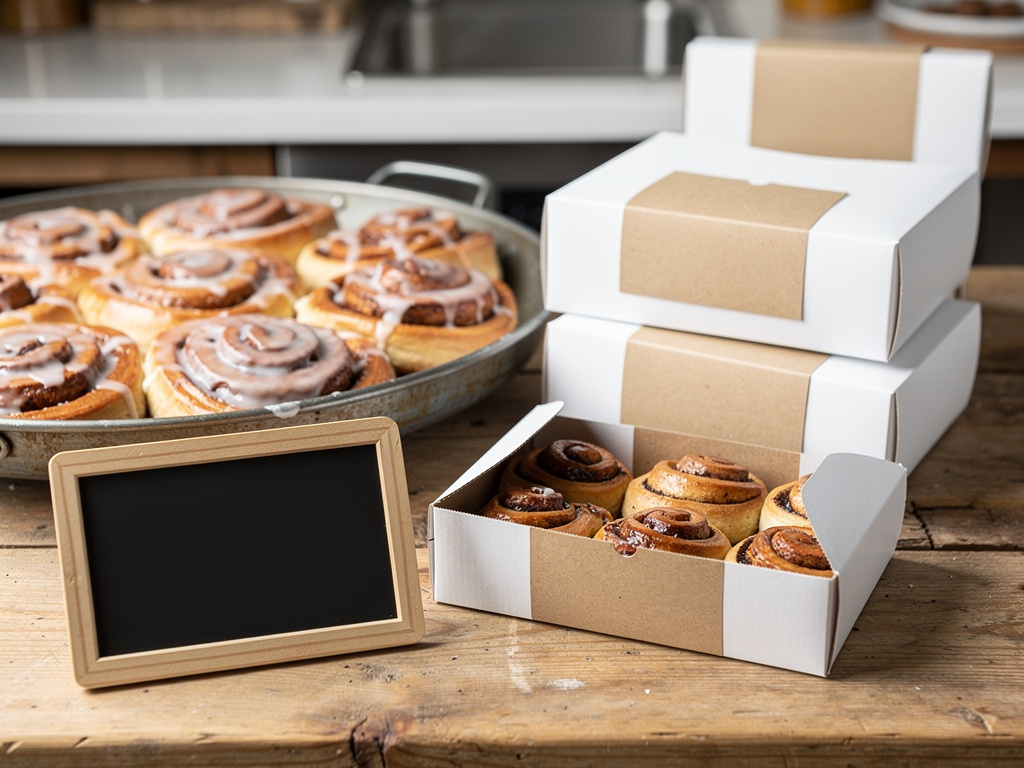


The short version: Cinnamon rolls sell in seven places: a farmers market booth, your own storefront link with porch pickup or delivery, holiday morning pre-orders, offices, churches and schools, craft fairs and holiday markets, a farm stand, and coffee shops. The first six are direct sales, where you hand the rolls to the person who eats them, and cottage food laws in most states allow that from a home kitchen. A coffee shop reselling your rolls is a different sale: of the four state rulebooks we read, only California (with a Class B permit) and Texas (for rolls without cream cheese frosting, through a shop that is registered with Texas as a cottage food vendor) open that door. Online, cinnamon rolls sell by the box, and a $20 half dozen through a Homegrown storefront link costs you $0.88 in card processing.
Checked September 24, 2026: Homegrown is $10 a month billed annually or $12.50 billed monthly, with 0% commission and card processing of 2.9% + $0.30 paid by the vendor (findhomegrown.com/signup), and the Hotplate, Square, Venmo and Shopify fees come from their own pricing pages, the rules from the California, Texas, Michigan and Florida cottage food pages, and the listings from a live pull of the Homegrown catalog, all loaded that day. Verify your state's current rules before you sell. The limits: your customer creates a Homegrown account to place a first order, there is no timed release feature, and most orders will come from people you send to your own link.
You brought a pan of cinnamon rolls to a Sunday potluck, and by Tuesday four people had texted to ask if you would make them a box for the weekend. One of them manages the coffee shop on the corner and wants to know if you could supply her pastry case.
Those two requests look alike, but the law treats them very differently, and that difference decides where your rolls can go. If you want the recipe side first (the frosting rules, cost per roll, the overnight method and packaging), start with how to sell cinnamon rolls from home. If you want the number on the sign, read how much to sell cinnamon rolls for. This guide is about where: seven places home bakers actually sell cinnamon rolls, which rule each place triggers, and what a real $20 half dozen costs you through each way of getting paid.
You can sell cinnamon rolls in seven places, and you can run two or three of them at once, usually one in person and one online. Six of the seven put the box straight into the hands of the person who will eat the rolls, and one runs through another business, which is where the rules change.
Two ideas are left off on purpose. Shipping cinnamon rolls across the country is not a real channel for a home baker: our cinnamon roll how-to guide puts their shelf life at 2 to 3 days at room temperature, and cottage food rules in Michigan and California limit sales to inside the state. Grocery store shelves are left off too, because a store resells to strangers and usually asks for a licensed kitchen, a full retail label and product liability insurance before the first case.
Pick the place that matches your oven, your schedule and your frosting, then add one place at a time. A baker with a Saturday free and a glaze recipe starts somewhere very different from a baker with a licensed kitchen and a cream cheese frosting people rave about. A market-first baker lives on $5 singles; a pre-order baker lives on $20 boxes.
Scroll sideways to see every column.
| Your situation | Start here | Add next | Why |
|---|---|---|---|
| You can bake early on Saturday and your glaze is sugar and butter | A farmers market booth | Pre-orders picked up at the booth | Warm rolls sell themselves by smell, and pre-orders set your batch size before Friday night |
| You work weekdays and bake on weekends | Your own storefront link with a Saturday pickup window | Holiday morning pre-orders | You bake only what sold, and nothing sits on the counter past its best day |
| Your buyers are coworkers or church friends | Group orders for a meeting or coffee hour | A standing monthly order | A dozen at a time, delivered by you, is still a direct sale |
| You want one big weekend a year | A craft fair or holiday market | A storefront link on a card at the table | Gift shoppers buy boxes, and the ones who loved them need a way to order in January |
| You have a Class B permit (California), a licensed kitchen, or glazed rolls in Texas and a shop that registers with the state | One coffee shop | A second shop on the same delivery day | Shops pay less than retail but buy every week |
These rows are planning guides, not legal advice. Your state and county decide what kitchen you need and which permit covers each place; the two rules sections below explain the lines that matter most for cinnamon rolls.
You may never need the last row. The first four keep every box going straight from your hands to the customer, which keeps you inside the simplest part of the cottage food rules (the state laws that let you sell low-risk foods made in a home kitchen), and those places can keep one home oven busy every weekend of the year.
Your frosting decides where you can sell because cream cheese frosting makes a cinnamon roll a food that has to stay cold, and most cottage food laws only cover foods that are safe at room temperature. A roll with a powdered sugar glaze, a butter and sugar icing or a caramel top can usually sit on a market table all morning. A roll with cream cheese frosting usually cannot.
The label for that second kind is TCS, short for time and temperature control for safety: a food that needs to be kept cold (or hot) to stop harmful bacteria from growing. Michigan's agriculture department says cottage foods must be foods that "do not require time and/or temperature control for safety," so a cream cheese frosted roll is outside its home kitchen rules. Our guide to TCS foods under cottage food law explains how states draw the line.
Texas is the big exception, and its rule shows how the frosting follows you from place to place. The Texas Department of State Health Services cottage food page says a home baker may now sell TCS foods, but must register with the state first, must add safe handling instructions to the label, and must store and deliver them at 41°F or below. The same page says TCS foods "are not eligible for wholesale" and are not eligible for donation.
What that means for each place:
Cream cheese frosting shows up on real listings: on September 24, 2026, 4 of the 62 Homegrown cinnamon roll listings mentioned it, including a $30 half dozen from SunDaze Micro-Bakery and a $60 pan of 12 from Once Upon A Time Bakery. Those vendors may be in food freedom states, registered TCS operations or licensed kitchens. Seeing it on someone else's page does not make it legal in your kitchen. Check what your own state allows before you list a cream cheese roll.
Selling through a shop changes the rules because nearly every cottage food law is written around a direct sale, where the person who eats your roll buys it from you, and a shop reselling your rolls is an indirect sale. Of the four states below, two forbid indirect sales outright, one allows them with an extra permit, and one allows them only for certain foods.
California's cottage food requirements page draws the line most clearly. A Class A cottage food operation registers with the county, is authorized to "engage only in direct sales" of cottage food products, and can gross up to $75,000 a year. A Class B operation gets a county permit, may make both direct and indirect sales, and can gross up to $150,000. The page lists holiday bazaars, bake sales, farm stands, certified farmers markets and phone or internet orders as direct sales, and sales through "retail shops or to retail food facilities where food may be immediately consumed on the premises" as indirect. A coffee shop is that second kind.
Here is how the four states we read on September 24, 2026 handle a shop reselling your rolls:
So the coffee shop question has a real answer, and it depends on your state and your frosting before it depends on your price. The full list of state rules is in our cottage food laws by state guide.
A farmers market is the best first place for most cinnamon roll vendors, because a warm roll sells itself by smell and the market brings walk-up buyers past your table all morning. Glazed rolls without cream cheese fit most states' cottage food rules at a market, and California lists certified farmers markets as a direct sale by name.
Cinnamon rolls sell best early: the breakfast crowd wants one now, still soft, and by early afternoon the same roll is a harder sell. Plan to sell most of your singles in the first two hours and your boxes to the people who shop late and want breakfast tomorrow.
Then the booth fee comes out before you earn anything. Say your market charges $40 a day (fees vary widely; this is only an example). At $5 a roll, you need 8 rolls just to cover the table, before flour, butter and boxes. The real cost of selling at a farmers market walks through every line of that.
What helps a cinnamon roll booth sell out:
The best way to sell cinnamon rolls from your own link is to sell the batch before you bake it: post this weekend's flavors on Tuesday, close orders Thursday night, bake Saturday morning, and hand out paid boxes during a Saturday pickup window. Cinnamon rolls are at their best the day they are baked, so a paid order on Thursday is worth more than a walk-up sale you are hoping for on Saturday.
That is the job a Homegrown storefront does for a cinnamon roll vendor who is tired of guessing how many pans to fill. It is $10 per month billed annually with no percentage fees beyond standard payment processing, which is 2.9% + $0.30 per order. You list your rolls once with each size as an option (a single, a 4-pack and a half dozen can sit under one listing, each with its own price), set how many you will bake, and the count goes down as people order. Customers pick a pickup time from the days and windows you set, or you turn on delivery with a radius, a flat fee and a minimum order, and keep all of the delivery fee minus card processing. Sales tax is calculated and filed for you, and a built-in QR code generator can point straight at your cinnamon roll listing.
Here is how it compares with what most cinnamon roll vendors try first:
What Homegrown does not do: your customer creates a Homegrown account to place a first order, and there is no timed release feature. It does not bill a standing order automatically every week, so a regular reorders each time. Your storefront is listed on the Homegrown marketplace, but plan on most orders coming from people you send to your own link. And it does not make your kitchen legal, keep cream cheese rolls cold, or bake anything for you.
In a pull of the Homegrown catalog on September 24, 2026, 62 of 2,706 products were cinnamon rolls or cinnamon buns, listed by 39 of 305 vendors, and 19 of those 62 had "sourdough" in the name. 52 listings from 33 vendors said how many rolls came in the order, and 20 of those 33 vendors listed only boxes or pans, with no single roll among the options that stated a count. Six-roll boxes ran $9 to $35, and the middle one was $20. Cinnamon swirl loaves, cinnamon cookies, bagels, a cinnamon roll croissant and a cinnamon roll focaccia were left out.
Where to send people to your link, closest circle first:
If you are tired of selling out by 9 a.m. and turning away the people who came at 10, set up a Homegrown storefront and post this weekend's cinnamon rolls before you buy the butter. Your regulars order and pay first, you bake exactly what sold, and the market table gets the extra pan.
Holiday morning pre-orders work by selling boxes two to three weeks ahead with a firm cutoff and one pickup window the day before the holiday, so families bake nothing and still have warm rolls on the table. Our guide to selling cinnamon rolls from home calls Christmas morning the biggest cinnamon roll day of the year and Easter the second biggest, also lists Thanksgiving and Mother's Day, and says holiday orders can double or triple a normal week.
The limit is your oven, not the demand. That same guide puts a solo home baker at 24 to 36 rolls per market day, which is four to six half dozens. A busy holiday list can fill that fast, so the cutoff has to be a box count, not only a date.
Close holiday orders by box count, not only by date. If your oven takes one 9x13 pan of 12 at a time and you can run three batches on Christmas Eve, that is 36 rolls, the top of a solo baker's day in our guide, or 6 half dozens. At the Homegrown middle price of $20 a half dozen that is $120, and the 7th order is the one that has you baking at midnight.
Unbaked take-and-bake pans are a popular holiday idea, but raw dough is a different food from a baked roll, and your state's list of allowed cottage foods may not cover it. Ask your health department before you offer one.
You can sell cinnamon rolls to offices, churches and schools by taking group orders of a dozen or more and delivering them yourself, and that is usually still a direct sale, because the group is eating the rolls rather than reselling them. Ask your county if your setup is unusual. An office that orders three dozen for a Friday staff meeting is one order, one delivery and one payment, which is exactly what a home oven handles well.
California lists bake sales among its direct sales, and many churches and schools run a coffee hour or fundraiser that already buys pastries. The difference to watch is who sells to the final eater. If the school buys your rolls to resell at its own bake sale table, ask your county how it reads that. If you run your own table at the event, you are selling direct. Our guides to selling food at work and selling food at school fundraisers and church events cover the pitch.
What works for group orders:
One more rule for fundraisers in Texas: the state's cottage food page says TCS foods are not eligible for donation, so a cream cheese frosted pan cannot go to the bake sale as a gift, even from a registered baker.
Craft fairs and holiday markets are worth it for cinnamon rolls when the event runs in the morning or spans a full weekend day, because the crowd is large, in a buying mood and shopping for gifts from late October through December. California's rules list holiday bazaars as a direct sale, and Michigan's rules name craft shows alongside farmers markets and roadside stands.
The trade-off is a one-time vendor fee, an application weeks ahead, and sometimes a temporary event permit from the county. Choosing a holiday craft fair as a food vendor covers which events are worth the fee.
What to plan for at a fair:
If you sell cream cheese frosted rolls in a state that allows them, a fair is the hardest place to keep them cold for six hours. Bring a cooler, keep the display to a few boxes, and refill from the cooler.
A farm stand works for cinnamon rolls when it is your own stand at your own address, because that is a direct sale that California and Michigan both name in their cottage food rules. It works poorly as an unattended honor box, where a pan sits in the sun until the glaze softens, and it becomes a very different sale when the stand belongs to someone else.
Putting your rolls on a neighbor's farm stand, where the farmer takes the money and pays you later, is consignment. Michigan's FAQ prohibits sales by consignment or at wholesale. In Texas, a farm stand that resells your rolls has to register as a cottage food vendor, and only rolls without cream cheese frosting qualify. In California, it is an indirect sale that needs a Class B permit.
What makes your own stand work for rolls:
You get cinnamon rolls into a coffee shop by first confirming your state allows a shop to resell a home baker's rolls, then pitching one shop with a sample box, a price sheet and a delivery day. Of the four states we read, only California (with a Class B permit) and Texas (rolls without cream cheese, through a registered cottage food vendor) allow it from a home kitchen. In Michigan and Florida, you need a licensed kitchen first.
A coffee shop pays you less than your market price because it has to make its own margin, and our cinnamon roll pricing guide puts a floor of about $3.25 to $3.50 a roll on a wholesale order. Getting your food into a local coffee shop covers the pitch itself.
Using the coffee shop only as a pickup spot for your pre-paid orders sounds like a way around the rule, but at least one state has said no. Michigan's cottage food FAQ, checked September 24, 2026, says a farm stop or small market may not serve as "go-between" or hold pre-sold cottage food for customers to collect, because holding it there is not delivering it to the consumer. Ask your own state before you leave a stack of named boxes on someone else's counter.
For a one-person home bakery, a coffee shop account is usually the last place to add, not the first. The direct places build the regulars, the recipes and the steady weekly count that a shop owner wants to see.
On a $20 half dozen, card processing costs you between $0 in cash and $1.00 on a premium card through Shopify ($0.96 on Square's free online checkout), and a Homegrown storefront link costs $0.88 plus the $10 plan. The bigger differences sit outside the card fee: on Hotplate either your customer pays $1.55 more at checkout or you pay it and the box costs you $2.43, and on Shopify you pay $29 a month or more before your first order once the first 3 months at $1 end.
Swipe left for the full fee stack on each row.
| Way to get paid | Subscription | Trial | Platform fee | Card processing | Customer pays on $20 | Vendor pays on $20 | 50 half dozens a month (vendor) |
|---|---|---|---|---|---|---|---|
| Homegrown storefront | $10/mo billed annually, or $12.50/mo billed monthly | 7 days, no charge until day 8 | $0, 0% commission, no shopper fee | 2.9% + $0.30 | $20.00 | $0.88 | $54.00 billed annually, $56.50 billed monthly |
| Square Free, online link | $0 | None needed | $0 | 3.3% + $0.30 online | $20.00 | $0.96 | $48.00 |
| Square Free, card at the booth | $0 | None needed | $0 | 2.6% + $0.15 in person | $20.00 | $0.67 | $33.50 |
| Venmo business profile | $0 | None needed | $0 | 1.9% + $0.10 | $20.00 | $0.48 | $24.00 |
| Hotplate | $0, no subscription | None needed | 5% + $0.55 per order, paid by the customer, or by you if you choose | 2.9% + $0.30, paid by the vendor | $21.55 ($20.00 if you pay the fee) | $0.92 on the $21.55 charge ($2.43 if you pay the fee) | $46.00 (your customers pay $77.50 more), or $121.50 if you pay the fee |
| Shopify Basic | $29/mo paid yearly, or $39/mo paid monthly | 3 days, then $1/mo for the first 3 months | $0 with Shopify Payments | 2.9% + $0.30 online on standard cards, 3.5% + $0.30 on premium cards | $20.00 | $0.88 ($1.00 on a premium card) | $73.00 paid yearly, $83.00 paid monthly |
| Cash at the booth | $0 | None needed | $0 | $0 | $20.00 | $0 | $0 |
We checked every fee on each company's own pricing page on September 24, 2026: findhomegrown.com/signup, squareup.com/us/en/pricing, venmo.com/resources/our-fees, hotplate.com/pricing and shopify.com/pricing. Card fees are figured on the $20 card charge and rounded to the cent, except Hotplate when your customer pays its fee: the card is then charged $21.55, and Hotplate's own example on its pricing page takes processing on more than the subtotal, so we figure it on $21.55; the monthly column multiplies the fee by 50 orders and adds one month of the plan. Hotplate shows its fee to the customer at checkout unless you choose to pay it yourself (its page says "You can pay it yourself or pass it on to customers"), and its pricing page gives the same $1.55 example on a $20 order. Square's in-person rate needs a reader or Tap to Pay on your phone. Sales tax and tips are left out.
The table hides the cost that matters most for cinnamon rolls: the pan nobody bought. One unsold half dozen is a $20 sale at the middle price that you never make, which is more than three months of the $6 monthly gap between Square's online checkout and Homegrown's annual plan at 50 boxes a month, and it cost you butter, flour, a box and an early morning. Whatever you use, the win is knowing your count before you roll the dough.
Box size matters too, because card processing is a percentage plus a flat 30 cents. A single $5 roll paid by card online loses $0.45 to 2.9% + $0.30, which is 8.9% of the sale, while a $20 half dozen loses 4.4%. That is one reason the online side of this business runs on boxes.
Real vendors on Homegrown mostly sell cinnamon rolls in boxes and pans, not as singles: 54 of the 68 priced options in the September 24, 2026 catalog pull held two or more rolls, and 50 held 4 to 12. Singles ran $3 to $7 (middle price $5.25), and dozens ran $20 to $65 (middle price $25.50).
Priced cinnamon roll options on Homegrown, by rolls per order
Source: Homegrown catalog pull, September 24, 2026. 68 priced options from 52 cinnamon roll listings (33 vendors) that said how many rolls came in the order; a listing with several sizes counts once per size.
A sample of what those listings look like:
Drag the table to see each listing.
| Vendor | Listing | Sizes and prices | Per roll | How it sells |
|---|---|---|---|---|
| Flowerdough Sourdough | Sourdough Cinnamon Rolls | single $7, half dozen $35, dozen $65 | $7.00 to $5.42 | Three sizes under one listing |
| Let It Shine Bakery | Sourdough Protein Cinnamon Rolls | single $4, half dozen $18, dozen $30 | $4.00 to $2.50 | Separate listing for each size |
| Traditional Rise | Sourdough Cinnamon Rolls | single $4.50, half dozen $15, dozen $25 | $4.50 to $2.08 | Prices written in the description |
| Roberts Recipe Box | Classic Cinnamon Rolls | 4 for $23, 6 for $34, 8 for $44, 12 for $63 | $5.75 to $5.25 | Four box sizes, no single |
| Caramel Kissed Bakery | Caramel Kissed Cinnamon Rolls | single $5, pan of 4 $15, pan of 6 $20 | $5.00 to $3.33 | Sold in the pan |
| Cassie's Cottage | Cinnamon Rolls, 5-pack (plus apple pie, pineapple upside-down and maple bacon) | 5 for $15 | $3.00 | One pack size, four flavors |
| Island Cravings801 | Classic cinnamon rolls | box of 12 for $32 | $2.67 | Preorder a day in advance |
| Seriously Sourdough | Cinnamon Rolls (doz) and flavored dozens | $20 a dozen, $25 flavored, 24 minis for $25 | $1.67 to $2.08 a full-size roll, $1.04 a mini | Dozens only |
Prices read from the live Homegrown catalog on September 24, 2026. Per roll is the price divided by the rolls in the order, rounded to the cent. Prices change, so treat these as a snapshot, and use the cinnamon roll pricing guide to build your own price from your costs and your time.
The pattern is clear for anyone selling online. Of the 33 vendors that stated a count, 20 listed no single roll among those counted options, only boxes and pans, 8 listed both a single and a box, and just 5 sold singles alone. Save the single for the market table, where it is the walk-up sale, and put boxes on your link.
Every place to sell cinnamon rolls needs your state's cottage food setup or a licensed kitchen, and the one place that runs through a shop needs an extra permit or registration in the two states that allow it. The table sorts the four states we read by place; your county can add its own rules on top.
Slide the table over for every state column.
| Place | Direct or through a shop? | California | Texas | Michigan | Florida |
|---|---|---|---|---|---|
| Farmers market booth | Direct | Class A or B; certified farmers markets are named as direct sales | Allowed; cream cheese rolls need state registration and 41°F cold holding | Allowed for rolls that need no refrigeration | Allowed in person |
| Your link, porch pickup, delivery and holiday pre-orders | Direct | Phone and internet sales count as direct; in person, mail or third-party delivery | You, an employee or a household member delivers; label details posted before you take payment | Buyer must be able to talk to you before the sale; Michigan only | Website and mail order allowed |
| Offices, churches and schools | Direct when you sell to the group | Bake sales are named as direct sales | Cream cheese rolls cannot be donated | Direct only | In person |
| Craft fairs and holiday markets | Direct | Holiday bazaars are named as direct sales | Allowed | Craft shows are named | In person |
| Your own farm stand | Direct | Farm stands are named as direct sales | Allowed | Roadside stands are named | In person |
| A shop, cafe or someone else's stand | Through a shop | Class B permit only | Rolls without cream cheese only, through a registered cottage food vendor | Prohibited, including as a pickup point | Wholesale not allowed |
From the California Department of Public Health cottage food requirements, the Texas Department of State Health Services cottage food page, the Michigan Department of Agriculture and Rural Development cottage food FAQ and the Florida Department of Agriculture and Consumer Services cottage foods page, all loaded September 24, 2026. Yearly sales caps on those pages: California $75,000 (Class A) or $150,000 (Class B), Texas $150,000, Michigan $50,000 ($75,000 if products sell for $250 or more a unit), Florida $250,000. This is a map, not legal advice.
Check the rules in your own state before you sell, and call your county health department with one question: "Which permit covers selling cinnamon rolls directly to customers at this place?" Write down the answer and the name of the person who gave it.
To start selling cinnamon rolls somewhere new this week, pick one direct place, confirm what your state and county need for it, and take your first 5 to 10 paid orders before you buy extra butter. The steps below fit in one week if your kitchen is already legal for glazed rolls in your state.
Cinnamon roll vendors who sell out every week sell the batch before they bake it, keep the menu short, and move their regulars from singles to boxes. They treat an unsold pan as the real cost of the business, bigger than any fee, and plan the whole week around knowing their count by Thursday night.
Habits worth building:
You can sell homemade cinnamon rolls anywhere the buyer is the one who will eat them: a farmers market booth, porch pickup or local delivery from your own ordering link, holiday pre-orders, group orders for offices and churches, craft fairs and your own farm stand. Those are direct sales, which cottage food laws in most states allow from a home kitchen. Selling through a coffee shop or someone else's stand is an indirect sale, which many states forbid.
It depends on your state and your frosting. In California you need a Class B cottage food permit from your county. In Texas, a shop can resell glazed rolls once it registers as a cottage food vendor, but cream cheese frosted rolls are not eligible for wholesale. Michigan prohibits consignment and wholesale for cottage foods, and Florida says cottage food products cannot be sold wholesale, so bakers in those states need a licensed kitchen to supply a coffee shop.
The states we checked let you take cinnamon roll orders online when the sale goes straight to the customer, and California and Michigan also require those sales to stay within the state. California counts internet orders as direct sales, Michigan allows them if the buyer can talk to you before the sale, Texas requires you, an employee or a household member to hand over the order, and Florida allows website and mail order sales. Local pickup or delivery beats shipping, because homemade cinnamon rolls keep only 2 to 3 days at room temperature.
In most cottage food states, no, because cream cheese frosting needs refrigeration, which puts the rolls outside home kitchen rules built for room-temperature foods. Texas allows it if you register with the state, add safe handling instructions to the label and keep the rolls at 41°F or below. Food freedom states and licensed kitchens are the other routes, so verify your state's current rules first.
Sell singles at the market and boxes online. A single $5 roll is the impulse buy at a table, but through an online checkout it loses 8.9% to card processing at 2.9% + $0.30, against 4.4% on a $20 half dozen. When we pulled the Homegrown listings on September 24, 2026, 54 of 68 priced cinnamon roll options were boxes or pans of two or more rolls.
Shipping homemade cinnamon rolls rarely works. They stay fresh for only a few days on the counter, and cottage food rules in states like California and Michigan limit sales to inside the state. Shipping across state lines usually needs a licensed kitchen, so most home bakers sell cinnamon rolls through local pickup, delivery and in-person places instead.
These six answer the next question most cinnamon roll vendors have once they know where to sell. Each one goes deeper on a single step this guide only touched, from the $5 single and the $20 half dozen to the coffee shop pitch. Start with the first two if you have not set your recipe and your price yet, since every place above assumes you know what a box costs you to make:
Cinnamon rolls are only worth what sells the morning they are baked, so the place you sell matters less than knowing your orders first. Donuts are stricter still, best the day they are fried, and where to sell donuts ranks seven places by how far ahead each one tells you the count, from Saturday pickup windows to coffee shops that buy by the dozen. A half dozen nobody claimed costs you the butter, the flour, the box and a 5 a.m. alarm. A half dozen paid for on Thursday costs you $0.88 in card processing on top of your plan, and it goes home warm with someone who asked for it.
Start with the direct places, where you hand every box to the person who eats it: a market booth, your own link, holiday mornings, the office and the church coffee hour, a fair, your own stand. Those six keep you inside the simplest cottage food rules in most states. Add a coffee shop only when your state allows it and the weekly volume makes the paperwork worth it.
When you are ready to take pre-orders, start your Homegrown storefront. It is $10 a month billed annually with no percentage fees beyond standard payment processing, and your regulars can reserve this Saturday's cinnamon rolls before you roll out the dough.



