
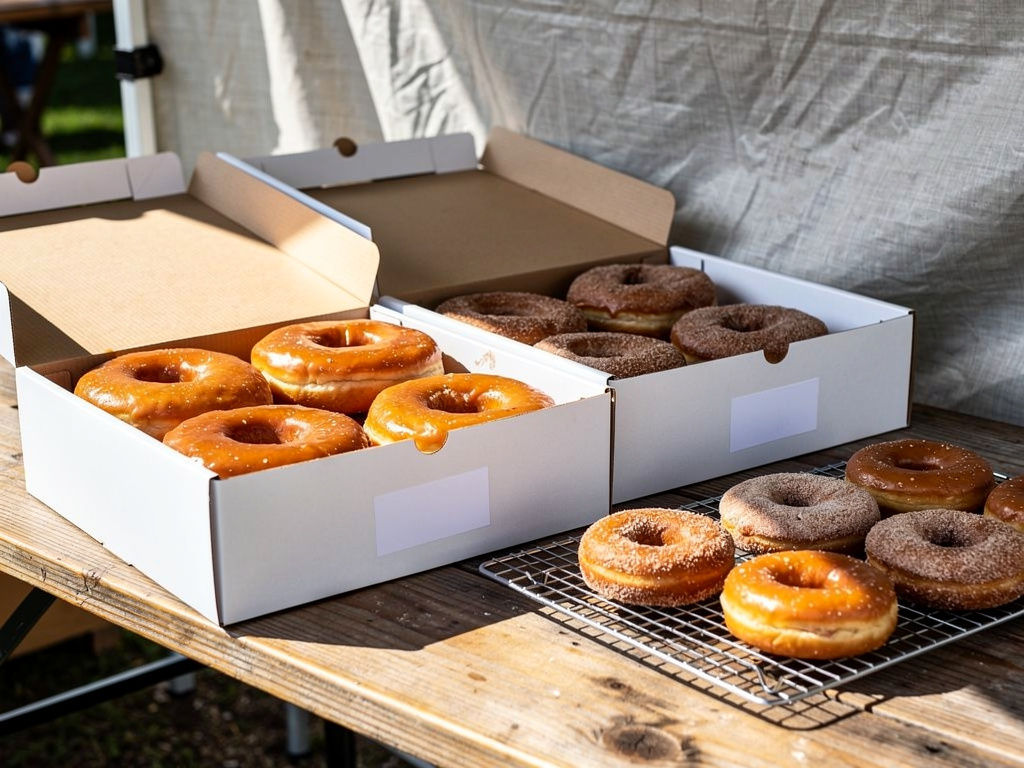


The short version: Homemade donuts sell in seven places: pre-orders with a pickup window, farmers markets, farm stands and pickup spots, pop-ups and donut trucks, coffee shops, bulk orders from offices, churches and schools, and craft fairs, with local delivery as an add-on and shipping as a poor fit. A donut is best the day it is made, so the places that work are the ones where you know the count before you fry. On a $20 dozen, selling fees take $0.67 on a booth card reader plus the booth fee, $0.88 through your own Homegrown link plus $10 a month, and $2.35 on Etsy before shipping. Your state decides the coffee shop question: a California Class B cottage food operation can sell through a permitted cafe, while Florida bans cottage food wholesale outright.
Checked September 26, 2026: fees read that day on findhomegrown.com/signup, hotplate.com/pricing (5% + $0.55 shown to the customer, 2.9% + $0.30 card processing paid by the vendor), squareup.com, shopify.com/pricing and etsy.com/sell, and state rules read in section 113758 of California's Health and Safety Code, the California Department of Public Health's Approved Cottage Foods list and Florida Statutes section 500.80. Homegrown customers create an account to place their first order, and Homegrown has no timed drop feature.
Donuts are among the easiest things at a bake sale to sell and among the hardest to sell tomorrow. A fresh glazed donut disappears in minutes. The same donut at 4 PM the next day is a hard sell at half price. That one fact decides where a home donut business works and where it quietly loses money.
King Arthur Baking's sourdough doughnut recipe says it plainly: the donuts "are best enjoyed the day they are made," and leftovers keep "for up to 1 day" in a paper bag. So the question is not only where people buy donuts. It is where they will tell you how many they want before you heat the oil.
This guide walks through the seven places home donut vendors sell, what each one takes from the same $20 dozen, where five real donut vendors on Homegrown hand over their boxes, and what California and Florida let you do.
Homemade donuts sell in seven places, and many part-time donut vendors run two or three of them: one where customers order ahead, one where new people taste your donuts, and one that brings orders by the dozen. The 5 donut vendors on Homegrown each use one or two, from a $20 dozen picked up at a farm stand to a $30 half dozen picked up in a Friday or Saturday morning window. Here are the seven:
Two more come up often. Local delivery works as an add-on to pre-orders. Shipping and Etsy fit donuts badly, for reasons covered further down.
If you are still sorting out whether your state lets you fry at home, which donut styles stay shelf-stable, and how to handle freshness, start with how to sell homemade donuts under cottage food law. That guide covers the fried-food and filling rules. This one is only about where the donuts go once they are out of the oil.
A one-day shelf life means every donut you fry without an order is a donut you might throw away, so the best places to sell donuts are the ones that give you a count before you fry. A cookie vendor can bring six dozen to a market and sell the leftovers Tuesday. A donut vendor cannot: at $20 a dozen, 2 unsold dozen is $40 of sales gone by dinner.
That turns every channel into one test: how far ahead do you know the number? Here is how the seven compare.
Scroll sideways to see all four columns.
| Place | When you know the count | Leftover risk | Best donut format |
|---|---|---|---|
| Pre-orders with pickup | Days ahead, when orders close | Almost none | Dozens and half dozens |
| Bulk orders | A week or more ahead | None if paid ahead | Dozens, boxed by the order |
| Coffee shop, wholesale | The morning of delivery | The shop's, once it buys them | Singles |
| Coffee shop, consignment | Only after the day ends | Yours | Singles (avoid) |
| Farm stand or pickup spot | Mostly ahead, plus walk-ups | Small | Pre-ordered dozens plus a few extra |
| Pop-up or truck | Partly ahead | Medium | Singles and half dozens |
| Farmers market | Only as the day goes | High | Singles, half dozens, a few dozens |
| Craft fair or festival | Only as the day goes | Highest | Singles and holes |
Leftover risk is our judgment, based on when each channel tells you the count. The one-day shelf life comes from King Arthur Baking's sourdough doughnut recipe, checked September 26, 2026.
The pattern is simple. Walk-up channels bring new customers and pre-order channels bring profit. A market or fair is where someone tries your maple glazed for the first time. A pickup window is where they order a dozen every Saturday after that.
Fry to your order count plus a small cushion, not to a guess. If 40 donuts are pre-ordered for Saturday, frying 48 leaves you 8 for walk-ups or a sample tray, and a sold-out sign at 10 AM does more for next week than a table of 30 unsold donuts at noon.
Pre-orders are the best way to sell homemade donuts because the customer pays before you fry, so the 40 pre-ordered donuts in a batch of 48 are already sold, fresh, and handed over in a two or three hour pickup window. Nothing else fixes the one-day problem as cleanly.
Two Homegrown donut vendors show what this looks like on September 26, 2026:
A pre-order setup that fixes the one-day problem has four parts:
For the full mechanics of cutoffs, deposits and pickup days, the guide to taking pre-orders as a home bakery walks through each step. The short answer for donuts: close orders the night before at the latest, and keep the window within a few hours of when you fry: a morning window if you fry at dawn, an evening one if you fry in the afternoon.
Donut customers should order ahead through one link that shows your flavors, your dozen and half dozen prices, and your pickup windows, then takes the card payment, so you wake up on fry day with a list instead of a pile of text messages. That list is what lets you heat the oil once and fry exactly what was sold.
Homegrown costs $10 per month billed annually ($12.50 month to month) with no percentage fees beyond standard payment processing of 2.9% plus 30 cents, which comes to $0.88 on a $20 dozen. Your customer picks a flavor, a size and a pickup window, and pays by card at checkout. Each order lands in your dashboard by date, so on Friday night you can see that Saturday needs 3 dozen glazed, 2 dozen cinnamon sugar and a half dozen maple. You can also turn on local delivery with your own radius, flat fee and minimum order, and you keep the delivery fee minus card processing.
Compare that to what most donut vendors try first:
What Homegrown does not do, said plainly. Your customers create a Homegrown account to place their first order, which is one more step for a neighbor who just wants a dozen. There is no countdown or drop feature for timed releases. It does not fry, box or deliver for you, and it does not supply drivers. Your storefront is listed on the Homegrown marketplace, but plan on most orders coming from people you send to your own link. And the 2.9% plus 30 cents of card processing is paid by you, with nothing passed on to your customer.
If your Saturday donut orders already come in as messages, set up a donut pre-order page on Homegrown and put its QR code on the lid of every box you hand out.
A farmers market is a good place to find donut customers but a risky place to earn from them, because booths usually cost $20 to $75 a week and every unsold donut is a loss by evening. A $20 dozen keeps $19.33 after a Square card reader's 2.6% plus 15 cents, so about one to four dozen cover the typical booth fee.
Those booth figures come from Homegrown's breakdown of what a farmers market really costs a vendor, which also puts busy city markets at $100 or more a week and counts gas, packaging and your hours. The booth fee is often the smallest line.
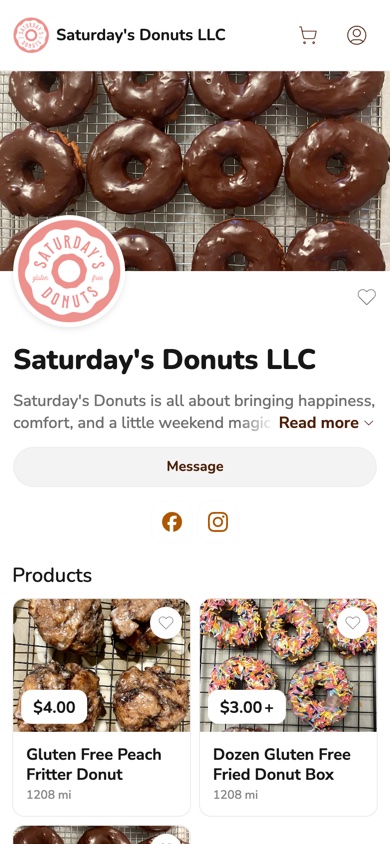
Saturday's Donuts, a gluten-free donut vendor on Homegrown, lists the Littleton Farmers Market in Littleton, Colorado as one of its two places to find them, next to a park pickup spot in Highlands Ranch, though neither showed any upcoming pickup dates on September 26, 2026. Its storefront sells gluten-free fried donuts at $3.00 each by the dozen and $3.25 each by the half dozen.
What a donut booth needs that a bread booth does not:
Frying at the booth is a different business from frying at home. Cottage food rules cover food made and packaged in your home kitchen: California's statute ties a cottage food operation to the kitchen of a private home, and Florida's requires products to be prepackaged with a label. Hot donuts fried to order at the market fall outside both, so ask your local health department or state food agency what permit a fry booth needs before you bring a fryer. In Florida, temporary food event licenses come from the state Department of Business and Professional Regulation's Division of Hotels and Restaurants.
Bring fewer donuts than you think for your first three markets. Count what sold by 9 AM, by 11 AM and by close, and let those three numbers set the fourth Saturday's batch.
A farm stand or a regular pickup spot works well for donuts because customers come to one place in a short window, often after ordering ahead, so you get the market's convenience without the market's leftovers. Two Homegrown donut vendors use this setup.
Seriously Sourdough in Loudon, Tennessee lists pickup at Howard Farmstand on Tuesday, Wednesday and Thursday from 4:30 to 8:00 PM, as shown on its storefront on September 26, 2026. Its menu includes a dozen donuts at $20 in 19 flavors, a dozen donut holes at $12, a dozen apple fritters at $15 and a dozen beignets at $20. Saturday's Donuts uses a park in Highlands Ranch, Colorado as its pickup location alongside the Littleton market.
Why a stand or pickup spot fits donuts:
Ask the stand owner three things before you start: whether they want a cut of sales or a flat fee, whether they allow cottage food on their table, and who handles leftovers. Put the answers in a text message so nobody remembers them differently in July.
A donut pop-up or truck works by showing up where people already gather, posting the location that morning, and letting regulars order ahead so their box is waiting. Lou's Donut Co. in Clare, Michigan runs this model: its order page tells customers to "Check our Facebook or Instagram to see today's location," lets them order ahead so their order is "waiting for you when you get here," and sells glazed sourdough donuts at $3.00 each, $15.00 for six and $28.00 for twelve, as listed on September 26, 2026.
Lou's also books its truck for private parties, corporate events and local festivals. That is the other half of the pop-up model: the same truck or table that sells singles on a Tuesday becomes a catered stop at an office on Friday.
A table of pre-boxed donuts fried at home is usually the cheapest pop-up to start. A truck is a bigger step, with a vehicle and a separate license from your city or county for selling food from it, and it is worth pricing out only after pop-ups sell out week after week.
Under cottage food rules, you can sell donuts to a coffee shop only where your state lets a business resell cottage food (frying in a licensed commercial kitchen under a state food permit is a separate route), and then only on a wholesale deal where the shop buys the donuts outright, usually at 40 to 50 percent below your retail price: about $10 to $12 for a dozen you sell for $20 at your own pickup, or $0.83 to $1.00 a donut. A coffee counter is a natural home for donuts, because people already buy one with a latte every morning.
That wholesale range comes from Homegrown's guide to selling food to local restaurants and cafes, which names coffee shops that sell pastries at the counter as a good fit. Its guide to getting food into local shops adds that small gift shops and boutiques mark up shelf-stable cottage food products 40 to 100 percent and that consignment shops keep 30 to 50 percent. A cafe's markup on a fresh donut may be different, so ask the owner what they charge for pastry. The consignment example below uses a $3.00 shop price, the single-donut price on Lou's Donut Co.'s order page. Either way, a cafe pays you less per dozen than your own pickup customers do, so price the deal knowing you give up margin for reach.
Never sell donuts on consignment. Consignment means the shop pays you only for what sells and hands back the rest, and with a one-day shelf life the rest is trash. At a 30 to 50 percent cut you would get $1.50 to $2.10 per $3.00 donut sold and nothing for the eight that were still in the case at 3 PM. Ask for a wholesale price per dozen, paid on delivery or on a weekly invoice.
State rules come first, and they point in opposite directions:
Where it is allowed, start small:
Per donut, the shop pays about half to 60 percent of what your own pickup customers pay. Its value is that your donuts are in front of new people at 7 AM with your name on them.
Offices, churches, schools, sports teams and fundraisers order donuts by the dozen ahead of the day, which makes bulk orders the most predictable place to sell donuts after your own pre-orders. A standing order for 4 dozen every Friday for a real estate office is $80 a week at $20 a dozen, known in advance, with no leftovers.
The buyers who order donuts in bulk:
Fundraisers deserve a closer look. Homegrown's guide to selling at school fundraisers and church events suggests offering 10 to 20 percent of your sales back to the organization, and notes that most school and church events charge little or no booth fee. On a $20 dozen, that is $2 to $4 back to the group, and the group does the selling to its own parents.
For bulk orders, settle four things in one message before you fry: the count, the flavors, the delivery or pickup time, and payment. Take payment ahead for any order of 4 dozen or more. A canceled staff breakfast should not leave you with 48 donuts at 7 AM.
Craft fairs and festivals are worth it for donuts only when the crowd is big and you can price by the single donut, because booth fees run from $50 to $75 at small local events to $300 to $500 or more at large regional festivals, and every unsold donut is lost. At $19.33 kept per $20 dozen, a $75 booth needs about 4 dozen sold just to cover the booth fee, before ingredients, and a $500 booth needs about 26 dozen.
Those booth ranges come from Homegrown's guide to selling food at craft fairs and festivals, which also points out that festival crowds are often there once, buying treats on impulse rather than restocking a pantry.
How donut vendors make fairs work:
If a fair's booth fee takes more dozens to cover than you can realistically fry the night before, skip it and put the booth money toward a month of farm stand pickups.
You can deliver donuts instead of setting up a booth by offering local delivery on your pre-orders with a set radius, a flat fee and a minimum order, which keeps delivery from eating a morning for one half dozen. Two Homegrown donut vendors set it up this way on September 26, 2026:
Delivery works for donuts for three reasons:
Keep the radius tight and the delivery window early. A donut delivered at 8 AM is breakfast. The same donut at 2 PM is a snack that has been sitting in a box.
You should not build a donut business on Etsy or shipping, because a donut is best the day it is made and Etsy takes $2.35 of a $20 dozen before you pay for overnight shipping. By the time a box arrives, the donuts are a day old at best.
Etsy's fees, read on its selling page on September 26, 2026, are a $0.20 listing fee, a 6.5% transaction fee on the sale price including any shipping you charge, and 3% plus 25 cents for payment processing, and the same page says a new shop may be charged a one-time shop set-up fee. On a $20 dozen that is $0.20 + $1.30 + $0.85 = $2.35. Sales that come through Etsy's Offsite Ads add a 15% fee on top.
State law adds a second limit. Some states allow cottage food to be shipped and some do not, and Homegrown's guide to whether you can ship cottage food walks through the state differences. Florida's statute allows mail order, and Homegrown's shipping guide reads that as shipping within Florida. California counts mail delivery as a direct sale, and a direct sale there is one made "within the state."
When shipping can make sense:
On a $20 dozen, selling fees range from $0.67 at a booth card reader to $2.43 when you cover Hotplate's 5% + $0.55 service fee yourself on top of its 2.9% + $0.30 card processing, and over a month of 50 dozen that gap grows to $33.50 against $121.50. The table below shows the full fee stack for each way of taking payment.
Swipe the table sideways for every column.
| Where the dozen sells | Subscription | Trial | Platform fee | Card processing | Customer pays on a $20 dozen | You pay on a $20 dozen | You pay on 50 dozen a month |
|---|---|---|---|---|---|---|---|
| Square card reader at a booth (Square Free) | $0 | Free plan | $0 | 2.6% + 15¢ in person | $20.00 | $0.67 | $33.50, plus booth fees |
| Hotplate, customer pays the service fee | $0 | None listed | 5% + $0.55, shown to the customer | 2.9% + $0.30 | $21.55 | $0.88 | $44.00 (customers pay $77.50 more) |
| Square Online (Square Free) | $0 | Free plan | $0 | 3.3% + 30¢ online | $20.00 | $0.96 | $48.00 |
| Homegrown | $10/mo billed annually, or $12.50/mo monthly | 7 days | $0, 0% commission | 2.9% + $0.30 | $20.00 | $0.88 | $54.00 ($56.50 on monthly billing) |
| Shopify Basic | $29/mo billed yearly, or $39/mo monthly | 3 days, then $1/mo for 3 months | $0 with Shopify Payments | 2.9% + 30¢ online | $20.00 | $0.88 | $73.00 ($83.00 monthly) |
| Etsy | $0, plus a possible one-time shop set-up fee | None | $0.20 listing + 6.5% transaction | 3% + $0.25 | $20.00 plus shipping | $2.35 | $117.50, before shipping and any Offsite Ads fee |
| Hotplate, you pay the service fee | $0 | None listed | 5% + $0.55, paid by you | 2.9% + $0.30 | $20.00 | $2.43 | $121.50 |
We checked every fee on September 26, 2026 on findhomegrown.com/signup, hotplate.com/pricing, Square's pricing page and its processing fees help article, shopify.com/pricing and etsy.com/sell. Hotplate's own page gives its service fee as $1.55 on a $20 order. Our math applies each card rate to the $20 subtotal with no tax or tip. Monthly totals include the plan fee. Booth, market and delivery costs are extra. At 20 dozen a month, closer to the part-time vendor frying 4 to 6 dozen a week described below, the plan fee weighs more: Homegrown comes to $27.60, against $19.20 for Square Online and $17.60 for Hotplate with your customer paying its service fee.
What you pay on 50 dozen donuts a month at $20 a dozen
Source: each platform's pricing page, checked September 26, 2026. Plan fees included at annual billing. Hotplate's customer-paid row leaves $77.50 of service fees on your customers.
Three things stand out:
Homegrown's five donut vendors sell through pickup, local delivery, a farm stand and a farmers market, and none of them ships, with prices from $1.00 a donut hole to $5.00 a donut. Here is what their storefronts showed on September 26, 2026.
In a pull of the Homegrown catalog on September 26, 2026, 10 of the 2,724 listed products, from 5 of 308 vendors, were donuts or close fried-dough cousins: ring donuts, donut holes, fritters, beignets and fried jelly buns. How we counted: a product counts when its name or description names a donut, doughnut, fritter, beignet or fried bun, and we then opened every listing in each matching vendor's shop and kept only donut-type pastries. We left out a savory corn fritter, an apple fritter coffee cake and a dog treat called a donut. Searching product names for "donut" alone finds 8, one of them the dog treat. These are listings, not sales.
Slide the table left to see all four columns.
| Vendor | What it lists | Price per donut | Where customers get them |
|---|---|---|---|
| Seriously Sourdough (Loudon, Tennessee) | Dozen donuts $20 in 19 flavors, dozen holes $12, dozen apple fritters $15, dozen beignets $20 | $1.67 a donut, $1.00 a hole | Howard Farmstand pickup, Tuesday to Thursday 4:30 to 8:00 PM; delivery within 10 miles, $5 fee, $10 minimum |
| Traditional Rise | Sourdough donuts, $25 a dozen or $15 a half dozen | $2.08 by the dozen, $2.50 by the half | Delivery within 13 miles, $15 fee, $25 minimum |
| Saturday's Donuts LLC (Colorado) | Gluten-free fried donuts by the dozen or half dozen, gluten-free peach fritter $4.00 | $3.00 by the dozen, $3.25 by the half | Littleton Farmers Market; pickup at Plum Valley Park, Highlands Ranch |
| Tallow & Dough (New Braunfels, Texas) | Half dozen tallow-fried donuts, $30.00 | $5.00 | Pickup windows Friday and Saturday, 8:30 to 11:00 AM |
| Island Cravings801 (West Valley City, Utah) | Fried jelly buns, $2.00 each, 10-bun minimum | $2.00 | Home pickup, 48 hours' notice |
From each vendor's Homegrown storefront, captured on a phone screen on September 26, 2026. Saturday's Donuts showed no upcoming pickup dates that day. Listing prices, not sales figures.
How Homegrown's 5 donut vendors get donuts to customers
Source: Homegrown storefronts, September 26, 2026, 5 vendors. Two vendors use two methods, so the bars add to more than 5.
The higher prices on Homegrown go with a specialty frying fat or a special diet. Seriously Sourdough sells 19 flavors at $1.67 a donut through a farm stand and local delivery. Tallow & Dough charges $5.00 a donut for a tallow-fried specialty picked up in a two and a half hour window. Saturday's Donuts charges $3.00 to $3.25 for gluten-free fried donuts, a specialty that earns a higher price.
Where you can sell donuts depends on your state's cottage food law, and the two rules that matter most for a donut vendor are whether a shop or cafe can resell your donuts and whether your donuts count as a cottage food at all. California and Florida show how different the answers can be.
The California Department of Public Health's Approved Cottage Foods list (last reviewed April 2026) names "Donuts (fried or baked)" under "Baked Goods Without Cream, Custard, or Meat Fillings," and allows sugar glazes. Health and Safety Code section 113758 lets a Class A operation make direct sales, which include certified farmers markets, farm stands, bake sales and internet orders, and lets a Class B operation also sell through a permitted shop or cafe. A Class B operation needs a permit from the local enforcement agency, usually the county health department, issued after an initial inspection under section 114365, while Class A only registers. All sales must be within California, and the yearly sales caps are adjusted for inflation, so check the current figure with your local health department.
Florida Statutes section 500.80 lets a cottage food operation with up to $250,000 in yearly gross sales sell over the internet or by mail, and deliver "in person directly to the consumer, to a specific event venue, or by United States Postal Service or commercial mail delivery service." It bans wholesale, so no coffee shop resale, and every product must be prepackaged with a label that includes "Made in a cottage food operation that is not subject to Florida's food safety regulations." Confirm with the Florida Department of Agriculture and Consumer Services that your donut qualifies before you fry for sale.
Three rules to check in any state:
State by state details live in Homegrown's guides to California cottage food law and Florida cottage food law. Rules change, so verify your state's current rules with your health or agriculture department before you sell.
You can start selling donuts somewhere new this month by adding one pre-order channel and one place where people can taste your donuts, then letting four weeks of sales tell you which one to keep. A part-time vendor frying 4 to 6 dozen a week does not need seven channels. Two is plenty.
When your pickup window starts filling before Thursday, that is the sign the pre-order link is doing its job. Start your donut pre-order page on Homegrown and give it one pickup window this Saturday.
The best place to sell homemade donuts is a pre-order page with a short pickup window, because customers pay before you fry and every donut goes out the day it is made. Pair it with one place where new customers taste your donuts, such as a farmers market, farm stand or pop-up, and put your ordering link on every box.
Yes, in states that allow donuts as a cottage food, you can sell donuts fried at home, boxed and labeled, at a farmers market. Frying on site at the booth is outside cottage food rules, so check with whichever local or state office licenses food booths where you live about the permit a fry booth needs. Booths usually cost $20 to $75 a week, so plan to sell at least one to four dozen just to cover the booth fee, before your ingredients.
Under cottage food rules, you can sell donuts to a coffee shop only if your state allows cottage food to be resold. A licensed commercial kitchen with a state food permit is a separate route. California allows it for Class B cottage food operations, while Florida bans cottage food wholesale. Where it is allowed, sell wholesale per dozen rather than on consignment, since unsold donuts go stale in a day.
You can take donut orders online for local pickup or delivery in states like California and Florida, which both count internet orders as allowed cottage food sales, and that is where online selling works best for donuts. Shipping donuts is a poor fit because they are best the day they are made, and Etsy's fees take $2.35 of a $20 dozen before shipping.
You can make money selling donuts from home when you fry to pre-orders instead of guessing. A standing order of 4 dozen a week at $20 a dozen is $80 of sales known in advance, and Homegrown donut vendors price a dozen donuts from $20 to $36. The profit depends on your ingredient costs, your oil and your hours.
Frying donuts at an event is cooking food on site, which falls outside cottage food rules because those cover food made and packaged in your home kitchen. Ask your local health department or state food agency what permit a fry booth or truck needs before the event. Pre-fried, boxed and labeled donuts from your home kitchen follow your state's cottage food rules instead.
These 5 guides answer the questions that come up right after you pick where to sell your donuts:
Read the cottage food guide first if you have not checked your state's rules on fried foods, then pick the sibling guide closest to your menu for more channel ideas.



