
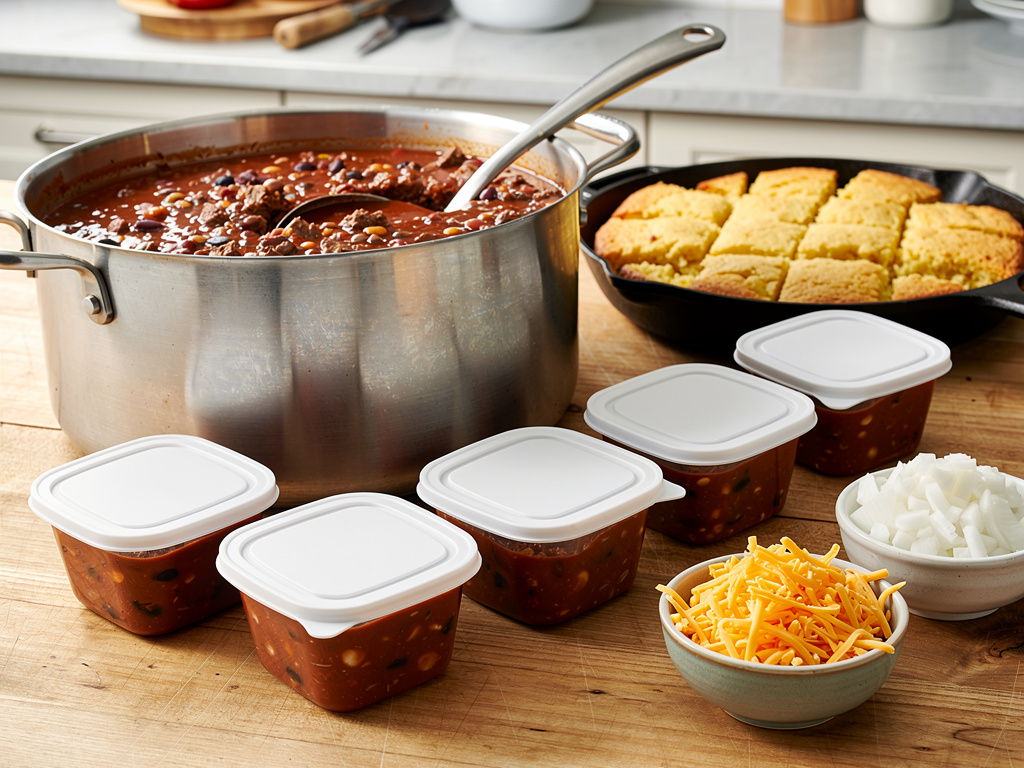


The short version: To sell homemade chili, start with the meat question, because beef or chicken chili made in a home kitchen falls outside the home food laws in all 12 states our soup guide checked (apart from narrow small-farm exceptions and the home restaurant permits in California and Utah), while a meatless chili can be legal from home in a few states, such as Texas. Beef chili usually means a rented licensed kitchen, and a dry chili kit of beans and spices is the shelf-stable option. Once the route is settled, sell it as a weekly batch: post the menu, close orders a few days ahead and cook only what was ordered. Cool each batch by spreading it no more than 2 inches deep (one of the Food Code's listed cooling methods), check that it drops from 135°F to 70°F within 2 hours and to 41°F within 6 hours total, then hand off cold or frozen quarts. Collect payment when the order comes in, so the beef you buy is already paid for.
Checked on October 12, 2026: FDA's 2026 Food Code, 9 CFR 303.1 on eCFR, the Texas DSHS cottage food page, California's approved cottage foods list, the Los Angeles County home kitchen permit pages, Utah Code 26B-7-416, Homegrown's signup page, Hotplate's and Square's pricing pages and WebstaurantStore. Meat rules and home kitchen rules for chili change by state and even by county, so verify your state's current rules with your health or agriculture department before the first pot you sell. Homegrown handles the order list and the payment for your chili, but it cannot make a chili legal that your state rules out. Every buyer makes a Homegrown account the first time they order, and Homegrown has no drops or countdown release feature.
Your chili already has fans. Coworkers ask for the recipe, neighbors hint about leftovers, and someone at the last tailgate asked if you would make them a quart. Turning that into money is mostly about three things that have nothing to do with the recipe: whether the meat in the pot is allowed, how fast a thick pot gets cold, and how orders reach you before you shop.
What follows is written for the cook who wants to move 10 to 40 quarts on a good week, not open a restaurant. If you want the price first, our chili pricing guide works out what to charge per bowl and per quart from real prices. If you want the soup and chili rules for 12 states in one place, our state-by-state guide to selling homemade soup covers Texas, California, Illinois and nine more, and chili follows the same rules as any cooked soup.
You start selling homemade chili in eight steps: pick a legal route, decide what meat goes in, choose two or three recipes, plan the cooling, freeze or chill in the right containers, set an order cutoff, take payment up front, and hand off cold. Each step is covered below.
Meatless chili can be sold from a home kitchen in a handful of states, but beef or chicken chili made at home falls outside the home food laws in all 12 states of our soup guide, apart from narrow small-farm exceptions and the home restaurant permits in California (same day) and Utah (same day, or within 72 hours with temperature logs). A pot of chili spoils if it sits warm, so the law treats it as a time and temperature control (TCS) food, a group many cottage food laws leave out. You can read why foods like chili count as TCS if the term is new. In the 12 states our soup guide checked, 5 let a home kitchen sell some cooked soup with conditions: Texas, Illinois (vegan only), Utah, Wyoming and North Dakota.
That leaves five practical routes for chili:
Slide the table to see what each route allows and its catch.
| Route | What chili it can cover | The catch | Read next |
|---|---|---|---|
| Home kitchen in a state that allows refrigerated foods | Bean or vegetable chili, sold cold or frozen | Texas requires registration and keeps meat and poultry out; Illinois allows vegan only | Texas cottage food law |
| Food freedom law | Chili sold directly to a buyer who is told it is homemade, inside that state | Utah, Wyoming and North Dakota in our soup guide; meat is limited to narrow exceptions | Food freedom states list |
| Home restaurant permit (California MEHKO, Utah microenterprise home kitchen) | A hot chili dinner cooked and served the same day, beef included, on a menu the county approves; in Utah, also chili served within 72 hours with time and temperature logs | California: only in counties that allow it; Los Angeles County allows 30 meals a day and 90 a week, and no leftovers the next day. Utah: a permit from your local health department, sold directly to the buyer, no eating on site | MEHKO laws explained |
| Rented licensed kitchen | Beef, pork, chicken or bean chili, hot or cold | Hourly rent and a food license from your health department | Commissary vs home kitchen |
| Dry chili kit | Dried beans and a spice packet the buyer cooks | No cooked chili at all | Selling spice blends from home |
We checked the Texas health department's cottage food page, California's approved cottage foods list (last reviewed April 2026), the Los Angeles County MEHKO page and FAQ, and Utah Code 26B-7-416 on October 12, 2026. The Illinois, Utah, Wyoming and North Dakota rows come from our soup permission guide, which read each state's own pages on September 30, 2026.
The Texas DSHS cottage food page says allowable foods "now include any foods, except" a list that opens with "meat, meat products, poultry, or poultry products." So a black bean or vegetable chili can come from a Texas home kitchen, and a beef chili cannot. A home operation selling foods like chili "must register on the DSHS Online Licensing Registry," finish a food handler training program, keep cold chili at 41ºF or below, and cannot wholesale or donate it. For online orders, the page says "The operator, an employee, or a household member personally delivers the food to the consumer," so a Texas home cook taking chili orders online delivers instead of running a pickup window. The same list says "Before the operator accepts payment for the food," all the required label information has to be posted as a legible statement on the operation's website. We read that page on October 12, 2026.
The California route deserves a closer look if you live there. The Los Angeles County MEHKO FAQ says "The food must be made and served on the same day," so it fits a Friday chili night with pickup or delivery, not a freezer full of quarts sold over a week. The same FAQ says "Customers can place orders on-site, through an internet website, or a mobile app approved by the State," and that "a MEHKO is not allowed to use a third-party delivery service for food deliveries," so check which ordering tools your county accepts before you post a menu.
Utah has its own home restaurant permit. Utah Code 26B-7-416 lets a local health department grant a microenterprise home kitchen permit, and it says "the operator shall prepare, cook, and serve time and temperature controlled food on the same day," or within 72 hours of when the food was prepared if the operator keeps time and temperature logs. The operator "may only provide food directly to a consumer," cannot let buyers eat on site and cannot sell to a wholesaler or retailer. We read that statute on October 12, 2026.
Yes: beef chili cooked in a licensed kitchen can be sold to people who eat it, but selling it to a grocery store to resell can bring in federal or state meat inspection. The federal rule at 9 CFR 303.1 exempts cooking done "at retail stores and restaurants" from meat inspection when the food is sold "in normal retail quantities" to consumers. It defines a retail store as a place where "The sales of product are made to consumers only," with at least 75 percent of sales, "in terms of dollar value," going to household buyers and the rest kept under a yearly dollar cap.
Here is what that means for a chili vendor in practice:
A second rule catches people who plan to cook at home and serve at a permitted booth. The FDA Food Code, a model code FDA offers "for adoption by local, state, and federal governmental jurisdictions," says "FOOD prepared in a private home may not be used or offered for human consumption in a FOOD ESTABLISHMENT" (section 3-201.11). In a state that adopted this section, home-cooked chili, beef or bean, cannot go into a licensed food stand, even if the stand itself has every permit.
Meat inspection and home kitchen rules change, and states layer their own meat programs on top of the federal one. We read 9 CFR 303.1 on eCFR on October 12, 2026. Before you sell beef chili anywhere other than straight to the person eating it, verify your state's current rules with your state agriculture or meat inspection office.
A dry chili kit, a bag of dried beans with a packet of your chili spice blend, is often the fastest legal way to sell your chili, because the buyer does the cooking. No pot is cooling on your stove, nothing has to stay cold, and the kit sits on a shelf like a jar of spices. California's approved cottage foods list, last reviewed April 2026, names both "Bean soup mixes" and "Spice mix or rubs," the two parts of a chili kit. Other states write their lists differently, so check your own state's list before you print bags.
A kit that sells well usually includes:
The kit has a second job. It puts your name on a pantry shelf in the months you are not cooking, and a buyer who likes the kit is a warm lead for the cooked chili later. If the spice blend is the real draw, our guide to selling spice blends from home covers grinding, packaging and shelf life.
Start with two or three chilis: one classic beef or meatless red, one bean or vegetable chili, and a white chili if your route allows chicken. Cap the first menu at 3 recipes: that fits in one cook day and one shopping trip, and they cover the buyer who wants meat, the buyer who does not and the buyer who wants something milder. Which ones you can offer depends on your legal route, so the menu and the route go together.
Drag sideways for the route each chili needs.
| Chili | Why buyers order it | How it freezes | Route it needs |
|---|---|---|---|
| Beef and bean red chili | The one most people picture; the tailgate default | Well; skim fat before packing | Licensed kitchen, or a home restaurant permit dinner in California (same day) or Utah |
| Bean or vegetable chili | Meatless buyers and a lower ingredient cost | Well; beans hold their shape | Every cooked-chili route, including a Texas or Illinois home kitchen (Illinois: vegan only, no cut or puréed fresh tomato) |
| White chicken chili | A milder option for kids and spice-shy buyers | Fair; cream or cheese stirred in can separate, so add it at reheat | A licensed kitchen; in California or Utah, also a home restaurant permit dinner |
| Texas red (beef, no beans) | Chili fans who argue about beans | Well | Licensed kitchen, or the home restaurant permit in California or Utah |
Routes follow the Texas DSHS page, Los Angeles County's MEHKO pages and Utah Code 26B-7-416, loaded on October 12, 2026, and the Illinois rule in our soup permission guide. Freezing notes follow USDA's caution that cream sauces do not freeze well.
Label the heat on every chili, mild, medium or hot, in the name itself. Heat is the easiest thing for a first-time buyer to guess wrong, and a word in the product name heads it off before they order.
A thick, dense pot of chili holds heat far longer than a thin broth, so a full pot left on the stove or set in the fridge whole can sit warm for hours. The FDA Food Code gives cooked food 2 hours to drop from 135°F to 70°F, and 6 hours total to reach 41°F or less (section 3-501.14). The Code's own inspection guidance uses chili as its example: if a kitchen cools chili from 135°F to 70°F in 1.5 hours, "they then have 4.5 hours to get it from 70°F to 41°F or less." The research list behind that rule includes a 1988 study on bacteria growing "in cooked chili during cooling."
Cooling starts with a fully cooked pot: brown ground beef to at least 160°F, USDA's number for ground beef, which also clears the Food Code's 155°F for 17 seconds for ground meat (section 3-401.11). The Code lists the methods that work, including shallow pans, an ice water bath, and "Placing the FOOD at a depth of no more than 2 inches." Here is how that looks on a home-sized cook day:
If a dish misses the clock, the Food Code's inspection guidance says chili still above 70°F within the first 2 hours can be reheated to 165°F and cooled again a faster way, while chili above 70°F after 2 hours, or above 41°F after 6 hours, should be thrown out. A cooling log takes two minutes and it is the kind of record a health inspector at a licensed kitchen can ask to see. It also tells you when a recipe change, like more beans, has made the pot slower to cool.
Freeze chili flat, cold and with a little headspace, and tell buyers it keeps its best quality for 2 to 3 months. USDA's food safety service lists soups and stews at 2 to 3 months for best quality on its freezer storage chart, says food kept at 0°F stays safe and only loses quality, and says, "Ideally, a food 2-inches thick should freeze completely in about 2 hours." The part of a chili that freezes worst is the dairy, since USDA names cream sauce among foods that "simply don't freeze well."
Follow these freezing rules for every batch:
Before a new chili goes on your menu, freeze one test quart for 7 days, then thaw and reheat it exactly the way your label tells buyers to. One quart and one week will tell you if the beans turn mushy, the fat separates or the heat fades, before 20 buyers find out for you.
Sell both: a pint is a lunch for one and a quart feeds two to four people, and offering both sizes lets a new buyer try your chili for less. Each case in the table below is a container-and-lid combo pack, so every pint and every quart comes with its own matching lid.
Move the table left for the price per container.
| Container | Case price | Per container | Best use |
|---|---|---|---|
| 16 oz deli container with lid, 240 per case | $26.99 | $0.11 | Single lunches, office orders, a first try |
| 32 oz deli container with lid, 240 per case | $35.49 | $0.15 | Family dinners, freezer stocking, game days |
Prices from WebstaurantStore's Choice heavy-duty translucent deli container listings, loaded October 12, 2026 (one-case price). Both are marked freezer safe, and the listing says "The container is microwaveable, but the lid is not microwaveable."
Put that last line on your label too, because buyers will microwave the quart with the lid on. If you set the product up with two sizes, the pint price should run a bit more than half the quart price, since the label and handling cost the same for both and the pint container costs nearly as much ($0.11 against $0.15). Our packaging guide for pickup and transport covers sealing and carrying containers that leak if tipped.
Run chili as a weekly order with a firm cutoff: post the menu early in the week, close orders two or three days before pickup, cook the day before pickup, and hand off the morning of the game. Game days are the natural chili week, since one buyer often orders for a whole group, and a set rhythm keeps that week from turning into a guessing game about how much beef to buy.
Slide across for each day's job.
| Day | Your job | What the buyer sees |
|---|---|---|
| Monday | Post this week's chilis and sizes | The menu, prices and the order cutoff |
| Thursday 8 p.m. | Close orders and total the quarts | Orders closed; an order summary with the pickup time |
| Friday | Buy beef, beans and containers for the exact count | Nothing; this is your shopping day |
| Saturday | Cook, cool on the clock, pack and label | Nothing; the chili is in the fridge by evening |
| Sunday 10 a.m. to noon | Hand off cold quarts from a cooler | Pickup before kickoff, reheating line on the label |
Closing Thursday night leaves you 2 days to shop, cook and cool before a Sunday pickup. Cook the order count plus one or two extra quarts, no more. The extras cover a spill or a short pour, and anything beyond that is beef you paid for and cannot sell. Set the cutoff in your ordering page rather than in a post, so buyers cannot slip in a Saturday order you never planned for. Homegrown's order prep time setting holds the cutoff for you, and its pickup schedule sets the Sunday window once and repeats it each week. Texas home cooks taking orders online deliver instead of holding a pickup window.
You can sell hot chili by the bowl at a market or event if it was cooked in a kitchen your health department accepts, usually a licensed one, you hold any temporary food permit the event needs, and you keep the chili at 135°F or above the whole time. The FDA Food Code's hot holding rule is 135°F (section 3-501.16), and chili that was cooked, cooled and then reheated for serving must reach 165°F, with the reheating done within 2 hours (section 3-403.11). A slow cooker that takes longer than 2 hours to bring cold chili to 165°F does not meet that rule.
What a hot chili booth usually needs:
Our guide to farmers market vendor permits by state walks through market permits in 36 states, including when prepared food needs a temporary food permit. Church suppers and school fundraisers sometimes run under their own exemption, and the fundraiser and church event guide explains how those are set up.
Our chili pricing guide, which checked real prices on October 9, 2026, landed on $7 to $9 for a 12-ounce bowl of beef chili and $15 to $18 for a cold quart. It found 9 farms and delis charging $10.50 to $24.00 a quart, with a median of $15.00, and costed a bowl of beef chili at about $2.84 and a quart of bean chili at about $2.58 to make. That guide shows every line of the math, so start there before you set a number.
The one chili listed on Homegrown on October 12, 2026 shows how far below that range a home cook can drift. Cryptid Kitchen's "The Best Veggie Chili in the World" sells for $4.00 for 16 ounces with 2 cornbread muffins and $6.00 for 32 ounces with 4 muffins. The listing says the vendor's batch "costs ~$7.20 to make 64 oz," about $3.60 per 32-ounce container before the muffins.
When you set your own prices, keep these in view:
The simplest setup is one ordering page that shows this week's chilis, closes on your cutoff, and takes payment before you shop, so a tailgate order never arrives as a text at 11 p.m. on Saturday. Chili has a hard deadline built in. You have to know the count before you buy beef, and every unpaid "save me two quarts" message is a quart you may cook for nobody.
That is the problem Homegrown is built for. It costs $10 a month billed annually ($12.50 billed monthly) with no percentage fees beyond standard payment processing, and it gives you a storefront where buyers pick a chili and a size, choose your Sunday pickup window and pay up front. What it does for a chili week:
Compare that with Hotplate, which has no subscription but adds 5% plus $0.55 to each order, paid by your buyer by default, on top of 2.9% plus $0.30 card processing paid by you, or Square's free plan, a general-purpose store tool that charges 3.3% plus 30 cents on online orders. Facebook posts and Instagram messages cost nothing but leave you with a pile of messages to total and no payment until pickup.
Scroll sideways to see every fee on each platform.
| Platform | Subscription | Trial | Platform fee | Card processing | Buyer pays on a $20 order | You pay on a $20 order | You pay for 50 orders a month |
|---|---|---|---|---|---|---|---|
| Homegrown (annual billing) | $10/mo | 7 days, no charge until day 8 | $0 (0% commission) | 2.9% + $0.30, paid by you | $20.00 | $0.88 | $54.00 ($44.00 card fees + $10) |
| Homegrown (monthly billing) | $12.50/mo | 7 days, no charge until day 8 | $0 (0% commission) | 2.9% + $0.30, paid by you | $20.00 | $0.88 | $56.50 |
| Hotplate (default: buyer pays the fee) | $0 | None (no plan to trial) | 5% + $0.55, paid by buyer | 2.9% + $0.30, paid by you | $21.55 | $0.88 | $44.00 (buyers pay $77.50 in fees) |
| Hotplate (you cover the fee) | $0 | None (no plan to trial) | 5% + $0.55, paid by you | 2.9% + $0.30, paid by you | $20.00 | $2.43 | $121.50 |
| Square Free plan (online orders) | $0 | None (free plan) | $0 | 3.3% + $0.30, paid by you | $20.00 | $0.96 | $48.00 |
We checked Homegrown's signup page, Hotplate's pricing page and its "What Hotplate does" post, and Square's fee page on October 12, 2026. Hotplate's pricing page says you can "pay it yourself or pass it on to customers," and its post says "80% of Hotplate chefs keep the default as-is." Card fees figured on the order amount; sales tax and tips left out.
What you pay for 50 orders of $20 in a month
Source: each platform's own pricing page, October 12, 2026. Homegrown on annual billing. Hotplate rows include its 2.9% + $0.30 card processing; its default adds $77.50 to your buyers' 50 orders.
Here is what Homegrown does not do. It does not make chili legal where your state says no, it has no drops or countdown release feature, and buyers create a Homegrown account before their first order. Your storefront is listed on the Homegrown marketplace, but plan on most chili orders coming from the people you send to your own link. Card processing of 2.9% plus $0.30 is paid by you, not passed to the buyer. If a Sunday cutoff and paid orders are what your chili week is missing, you can set up your Homegrown storefront and post this week's menu in one sitting.
Your first chili buyers are most likely people who have already eaten your chili: coworkers, neighbors, your tailgate group and the people at your place of worship. They need no convincing, so start with the people who already ask for the recipe and let them carry it to their friends.
Places that bring in chili orders fast:
Send every one of them to the same link instead of taking orders in replies. A buyer who orders once through your page already has a Homegrown account, and the list of who ordered, with names, emails and order history, stays with you. When a coworker asks if you are making chili this week, the answer should be the link, and a Homegrown storefront for your chili gives you one link that holds the menu, the cutoff and the payment.
Yes, cornbread is the easiest add-on to a chili order, and as a plain baked good it may be a cottage food you can bake at home even where the chili cannot be. California's approved list, for example, covers "Baked Goods Without Cream, Custard, or Meat Fillings," which takes in plain cornbread and corn muffins. A pan of cornbread adds a few dollars to an order for little extra work, and the buyer gets a full dinner.
In a pull of the Homegrown catalog on October 12, 2026, 1 of 2,864 products was chili, and 6 listings from 6 vendors sold cornbread or corn muffins, priced from $5.00 for 4 large muffins to $27.00 for a mix-and-match 6-pack of king-sized sourdough corn muffins. One corn muffin listing says they are "a delicious treat when paired with hearty chili." We counted a product as chili when the thing sold was chili, ready to heat, frozen, or a chili kit or seasoning, and as cornbread when the thing sold was cornbread or corn muffins, reading every match by name, description and category.
Bundle ideas that work with a chili menu:
Keep cold toppings in the same cooler as the chili, and label them with the same allergens and dates. A topping pack adds a few dollars to the order without another pot on the stove.
A chili label needs the product name, your business name and address, the ingredients, any major food allergens, the net amount, and how to keep and reheat it, plus whatever your state's cottage food or retail rules add. In Texas, a home-kitchen chili label also needs the statement "THIS PRODUCT WAS PRODUCED IN A PRIVATE RESIDENCE THAT IS NOT SUBJECT TO GOVERNMENTAL LICENSING OR INSPECTION," the date it was made, and the DSHS safe handling statement in at least 12-point type on the label or the receipt, and a DSHS registration number can stand in for your home address. FDA lists nine major food allergens: "milk, eggs, fish, Crustacean shellfish, tree nuts, peanuts, wheat, soybeans, and sesame." Chili can carry more of them than you might expect.
Allergens that hide in chili:
Then add the lines buyers need at home: "Keep refrigerated" or "Keep frozen," the cook date, a "best within 3 months" line on frozen quarts, and a reheating line. USDA's food safety service says to reheat leftovers to 165°F and to bring soups to a rolling boil. Our guide to cottage food labeling requirements covers the exact layout states ask for, and our guide to listing the big 9 allergens on a cottage food label shows how to word the allergen line.
The most expensive chili mistakes are cooking before you know the count, cooling a full pot in one piece, and putting meat in a chili your legal route does not allow. Each one either wastes beef you already paid for, which our pricing guide costed at $34.62 for the 5 pounds in one pot, or puts the whole business at risk.
Mistakes to avoid from the first week:
If your chili becomes a weekly habit with a steady list of buyers, the cost of a rented kitchen starts to make sense for the beef chili, while a meatless chili or dry kit keeps running from home where your state allows it. Our guide to selling frozen meals locally covers what changes when the freezer becomes the business.
Selling homemade chili is legal in some states only for meatless chili, and beef chili usually has to come from a licensed kitchen. Texas, for example, lets home kitchens sell foods like bean chili but excludes "meat, meat products, poultry, or poultry products," according to the Texas Department of State Health Services, checked October 12, 2026. Rules vary by state and county, so check with both before your first sale.
Package chili cold in lidded deli containers, a 16-ounce pint for one person or a 32-ounce quart for a family. On October 12, 2026, WebstaurantStore listed a case of 240 pints with lids at $26.99 and 240 quarts at $35.49. Leave ½ inch of headspace in a pint and 1 inch in a quart if the chili will be frozen, and label every lid with the cook date.
You can sell chili at a farmers market as cold or frozen quarts, or hot by the bowl, if it was made under your state's legal route and you hold the permits the market and county require. Ask your county whether hot chili needs a temporary food permit, and keep it at 135°F or above, the FDA Food Code's hot holding temperature. A dry chili kit is the simplest product for a market table, because it needs no cold or hot holding.
Homemade chili keeps its best quality for about 2 to 3 months in the freezer, according to USDA's freezer storage chart for soups and stews, and stays safe when held at 0°F. Chili with beans and ground beef freezes better than cream-based chili. Write the cook date on the lid so buyers know when to eat it.
Whether you can sell chili at a cook-off or church fundraiser depends on the event's permit or exemption, which your local health department decides. Ask the event organizer which permit covers the event, and whether chili cooked in a home kitchen is allowed under it, before you plan to sell chili there. A dry chili kit is often the easier product for a fundraiser table, since nothing needs to stay hot or cold.
The license to sell chili from home depends on your state: a cottage food registration in a state like Texas for meatless chili, a home restaurant permit in a California county that offers one or from a Utah local health department, or a food license for a rented licensed kitchen for beef chili. Selling beef chili wholesale to a store can also involve meat inspection under 9 CFR 303.1. Check with your state health department and agriculture department before your first batch.
These 6 guides pick up where this one stops, from what to charge to which kitchen to cook in:
Chili rewards the vendor who knows the count before the shopping trip. Beef is the biggest cost in each pot, so every quart should be sold and paid for before you buy it. That is the whole reason to run chili as a weekly order instead of a pot you hope to sell.
Start small. Post 2 or 3 chilis with pint and quart sizes, set a Thursday cutoff and a Sunday pickup window, and tell the people who already ask for your recipe where to order. Cook the count, cool it in shallow dishes on the clock, and hand off cold quarts with the reheating line on the lid. After a few weeks you will know which chili sells out, which size your buyers want and whether a rented kitchen for beef chili is worth it.
When you are ready to run your chili week from one link, start your Homegrown storefront for $10 a month billed annually ($12.50 month to month) with no percentage fees beyond standard payment processing, and let buyers pay when they order so Saturday is spent cooking instead of totaling messages.



