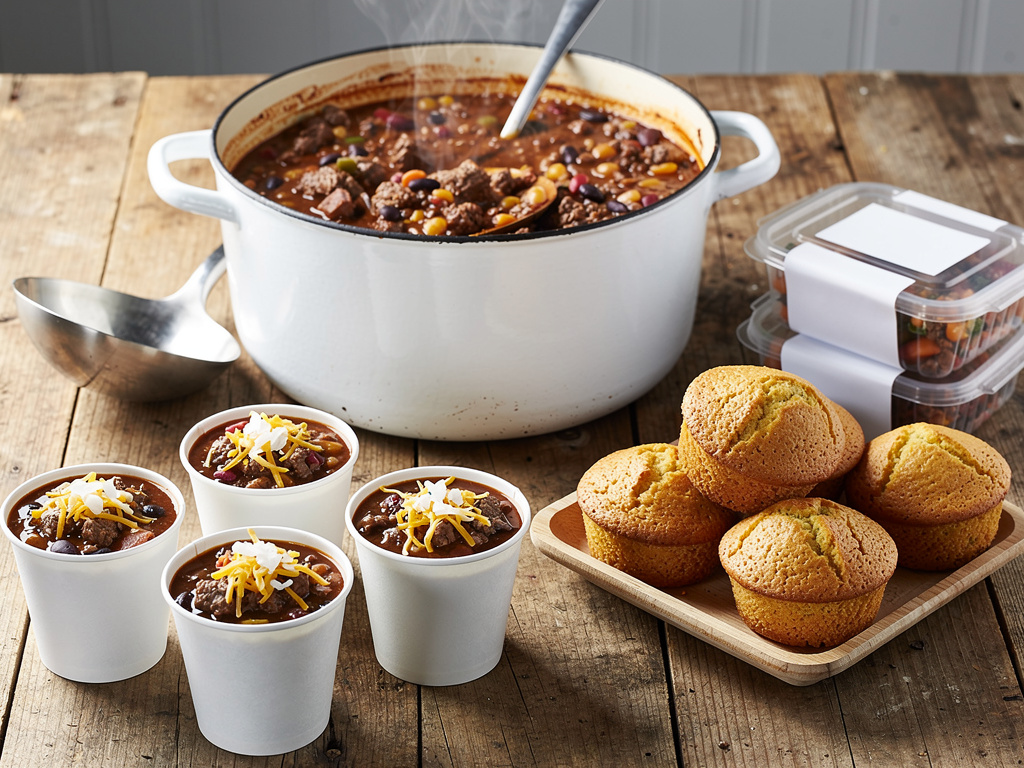


The short version: Charge $7 to $9 for a 12 ounce bowl of beef chili with cheese and onion, and $15 to $18 for a cold quart to take home. A bowl costs about $2.84 to make with ground beef at $6.92 a pound, the cup and the toppings, so $8 puts your food cost near 35%. The 9 farms and delis we checked charge $10.50 to $24.00 a quart, with a median of $15.00, and restaurants charge $5.99 to $12.00 for a bowl. Bean chili costs about $2.58 a quart to make, so a $12 bean quart leaves about the same dollars over cost as a $16 beef quart.
Checked on October 9, 2026: beef prices are the U.S. Bureau of Labor Statistics average for August 2026; bean, tomato, onion and other grocery prices are Walmart.com and seller prices are each seller's own page, loaded that day. Chili is a food that has to be kept hot or cold, so the home food rules in 7 of the 12 states in our soup guide do not cover it (California's county home restaurant permit, where offered, is the one exception), and the other 5 allow only meatless versions outside narrow small-farm exceptions; verify your state's current rules. Homegrown customers create an account to place their first order, and Homegrown has no drops feature.
Chili is one of the easiest things to cook in volume and one of the easiest to underprice. Ground beef averaged $6.92 a pound in August 2026, up 9.6% from a year earlier, so a 5-pound pot of beef chili now costs more than $50 in ingredients. If your chili price was set a year or two ago, it was set on cheaper beef.
This guide works out what to charge from today's real prices. You will see what diners, farm stores and church suppers charge, what one 8-quart pot costs dollar by dollar, how much of that is beef, and what a night of selling bowls actually leaves you. Every price here was loaded on October 9, 2026, and every calculation is shown so you can swap in your own numbers.
A 12 ounce bowl of beef chili should sell for $7 to $9, with $8 as a safe middle. At $8, the bowl's $2.84 in chili, cheese, onion and cup is 35.4% of the price, which leaves room for card fees, a booth fee and the bowls you make but never sell.
Here is the same bowl at different prices, so you can see what each one does to your food cost (the share of the price that goes to ingredients and packaging):
A smaller 8 ounce cup with half the toppings costs about $1.89 to make (using the 12 ounce cup's 15 cents, since we did not price an 8 ounce cup), so $5 to $6 is the cup price that matches. A cup fits next to a hot dog or a piece of cornbread, where chili is a side instead of the meal.
If you sell chili cold by the quart instead, aim for $15 to $18 for beef chili. A quart costs about $6.59 to make with its container, so $16 is a 41.2% food cost and $18 is 36.6%. A quart can carry a higher food cost than a bowl because you skip the warmer, the toppings and the hours behind a table, but you still have to cook, cool and pack it.
These numbers assume regular ground beef at the national average price. If you buy beef from a local farm, use lean beef or add steak, the cost per bowl goes up, and so should the price. The sections below show exactly how to rebuild the math with your own recipe. If chili is one soup on a bigger menu, our guide to pricing soup by the quart covers broth-based soups, frozen quarts and dry soup mixes, which this chili guide leaves out.
Restaurants checked on October 9, 2026 charge $5.99 to $12.00 for a bowl of chili and $3.99 to $6.00 for a cup. That is the price your customers have in their heads when they walk up to your table, so it is worth knowing before you set yours.
Scroll sideways to see each restaurant's cup, bowl and quart.
| Restaurant | Cup | Bowl | Quart to go | What the menu says |
|---|---|---|---|---|
| Cinder's Charcoal Grill, Appleton, WI | $3.99 | $5.99 | $11.99 | "Hearty homemade chili" |
| Town Club on 45th, Highland, IN (lunch menu) | $4 | $6 | $16 | Made with "100% Ground Chuck" and beans |
| Chili Willi's, Cornelius, NC | $6 | $8 | Not listed | Topped with cheddar, sour cream and green onion, served with tortillas |
| Real Chili, Milwaukee, WI | Not listed | $9.00 first bowl, dine-in | Bulk sizes sold separately | $10.00 for a single to-go bowl, mild or medium; hot chili is $11.00 dine-in and $12.00 to go |
We checked each restaurant's own online menu on October 9, 2026. Bowl sizes are not stated on any of these menus, so compare prices, not ounces. Real Chili's page also lists "THE ALL-IN," a bowl over spaghetti and beans with cheese, onions, jalapeños and sour cream included, at $13.00 for a first bowl dine-in.
Diners sell chili cheap because it is one dish among dozens, cooked in a kitchen they already pay for. At Cinder's, the grill, the staff and the rent are spread across a menu of burgers and fish fries, so a $5.99 bowl does not have to carry them alone.
The places that make chili the main event charge more. Chili Willi's gets $8 for a bowl with toppings and tortillas, and Real Chili gets $9.00 to sit down and $10.00 to go. When chili is the reason people came, they pay for it.
For a home vendor, the second group is your model. Your chili is the product, not a side dish, so price it like a chili shop rather than a diner.
Nine farms, delis and meat shops checked on October 9, 2026 charge $10.50 to $24.00 for a quart of chili, and the median is $15.00. These are the sellers closest to a small vendor: they cook in batches, pack quarts and sell them to take home.
Scroll sideways to see every seller and quart price.
| Seller | Where | What they sell | Quart price |
|---|---|---|---|
| Don's Specialty Meats | Scott, LA | Chili, quart | $10.50 |
| The Farmhouse Deli | Douglas, MI | Grassfed beef chili | $12.00 |
| Crane's Pie Pantry | Fennville, MI | Homemade chili with ground beef (marked unavailable that day) | $12.00 |
| Chestnut Deli & Catering | Ridgewood, NJ | Chicken, beef or vegetable chili | $14.95 |
| Drovers Trail Natural Farms | Minooka, IL | Beef chili with 2 pieces of cornbread | $15.00 |
| Arctic Foods | Washington, NJ | Beef and pork chili | $15.99 |
| Lilac Hedge Farm | Rutland, MA | Pasture-raised beef chili, 32 oz | $20.00 |
| Georgia's Northside | Concord, NH | Brisket chili, frozen | $23.00 |
| Riemer Family Farm | Brodhead, WI | Chili with the farm's own ground beef (pint $13.00) | $24.00 |
Prices come from each seller's own product page, loaded on October 9, 2026. Median of the 9 quart prices: $15.00.
The spread tells you what customers pay more for. The bottom of the range ($10.50 to $12.00) comes from a meat counter, a deli and a pie shop, and the deli's $12.00 quart is grassfed beef chili. The top ($20.00 to $24.00) is two farms selling chili made with their own beef, plus Georgia's Northside's brisket chili, where the beef is the selling point.
Riemer Family Farm also sells a 4-pack of quarts for $86.40, which works out to $21.60 a quart. That is a simple way to reward a customer who stocks the freezer without cutting your single-quart price.
If your chili is a family recipe with grocery-store beef, $15 to $16 puts you in the middle of this group. If you raise the beef yourself or buy it from a farm you can name, $18 to $22 is where farm beef chili can sit, because you can point to the beef in the description, though Drovers Trail sells chili made with its own Black Angus beef at $15 a quart with 2 pieces of cornbread.
The church and school chili events we checked, three of them dated 2026, charged $5 to $10 a person to eat, $10 a pint, $14 a quart and $20 a gallon to take home. Fundraiser prices are lower than a business can live on, because the cooks are volunteers and some ingredients may be donated, but they set expectations in small towns.
Here are four events, three of them dated 2026, each from the event's own page:
Notice the Holy Cross gallon: $20 for 4 quarts is $5 a quart. Our 8-quart pot costs about $6.45 a quart in ingredients alone, so that price only works because the church is not paying for labor, and possibly not for the beef.
If you cook chili for a living and a church supper is your competition, do not try to match it. Sell a different thing: a bowl with toppings, a quart that is ready on a set pickup day, or chili made with beef from a farm. Our guide to selling food at school fundraisers and church events covers how vendors work these events without undercutting the cause.
A 15 ounce can of Hormel Chili with Beans was $2.48 at Walmart.com on October 9, 2026, or 16.5 cents an ounce. Your homemade quart, at about $6.45 in ingredients, costs you 20 cents an ounce before the container, so the can is cheaper than your raw materials.
That gap is not a reason to lower your price. Canned chili is made at factory scale and sold shelf stable, so it is a pantry backup, not the same product.
What your customer gets from you that the can does not give them:
Use the can as a floor in your head, not on your price sign. If someone says your $16 quart is expensive, the honest answer is that two cans of chili (30 ounces) are about $5, and a quart of real homemade chili costs more than that just in ingredients.
In 7 of the 12 states our soup guide checked, the home food rules do not let you sell chili made in your home kitchen, because chili has to be kept hot or cold to stay safe. Foods like that are called time and temperature control foods, or TCS foods, and the cottage food laws in those 7 states only cover shelf-stable foods like bread, cookies and jam. Our guide to what makes a food TCS under cottage food laws explains the line. The other 5 states in our soup guide (Texas, Illinois for vegan soup only, Utah, Wyoming and North Dakota) let a home kitchen sell some cooked soup, with conditions, and none of them allows beef, pork or chicken in it outside narrow small-farm exceptions. California, one of the 7, allows home-cooked soup only under a county home restaurant permit, in counties that offer one.
The legal route changes your price, because it changes your costs. These are the usual routes:
Since September 1, 2025, Texas home kitchens can sell almost any food, but the Texas Department of State Health Services cottage food page lists the exceptions, and the first one is "meat, meat products, poultry, or poultry products." So beef chili and chicken chili are out, and bean or vegetable chili can be sold from home. A cottage food operation that sells TCS foods "must register with DSHS," must hold cold chili at "41ºF or below" and hot chili at "135ºF or above," and cannot donate or wholesale it. The yearly sales cap is $150,000, which Senate Bill 541 has DSHS adjust each year for inflation. We read both pages on October 9, 2026.
That Texas rule is why a meatless chili is worth pricing on its own. It is the one version home cooks in those 5 states can sell without renting a kitchen, within each state's conditions, and it costs less than half as much to make, as the bean chili section shows.
Our guide to whether you can sell homemade soup walks through 12 states one by one, and chili follows the same rules as any cooked soup. For Texas specifically, our Texas cottage food law guide covers labels, registration and where you can sell.
Rules for selling cooked food from home change often, and they differ by county as well as by state. Verify your state's current rules with your state health department, and your county's rules with the local health office, before you print a price sign. The Texas rule above was checked on October 9, 2026.
Our example pot, which finishes at about 8 quarts, costs $51.58 in ingredients at October 9, 2026 prices, or about $6.45 a quart. That pot uses 5 pounds of ground beef at the national average price plus canned beans, canned tomatoes, onions and chili powder.
Here is the pot, line by line. Beef is the BLS August 2026 average for 100% ground beef, and everything else is a Walmart.com store-brand price loaded the same day.
Swipe left to see each ingredient's price and cost.
| Ingredient | Amount | Price used | Cost in the pot |
|---|---|---|---|
| Ground beef, 100% beef | 5 lb | $6.923 a pound (BLS, August 2026) | $34.62 |
| Dark red kidney beans | 6 cans, 15.5 oz | $0.92 a can | $5.52 |
| Chili-ready diced tomatoes | 4 cans, 14.5 oz | $0.96 a can | $3.84 |
| Tomato sauce | 4 cans, 15 oz | $0.96 a can | $3.84 |
| Yellow onions | 2 lb | $2.40 for a 3 lb bag (sale price; regularly $3.64) | $1.60 |
| Chili powder | 2 jars, 3 oz | $1.08 a jar | $2.16 |
| Total | About 8 quarts | $51.58 |
Ground beef price from the BLS average price series for 100% ground beef; other prices from Walmart.com on October 9, 2026. Salt, garlic and cumin you already own are left out. The yield of about 8 quarts (256 fluid ounces, measured by volume, not weight) is an estimate: 361 ounces go in with a quart of water, and you lose the drained fat and the steam from a 2-hour simmer. The ingredients come to about 11 quarts before they cook down, so use a stockpot bigger than 8 quarts. Measure your own first batch.
From that pot you get:
Your recipe will differ. If you add a pound of sausage, a can of chipotles or a bottle of beer, add those lines and divide again. The point is to know the cost of your own pot down to the dollar before you choose a price, because a guess of "about $30" for a pot that really costs $52 is a mistake you repeat every week. Our guide on working out the real cost of each product has a worksheet for any recipe.
Ground beef is 67% of the cost of a beef chili pot: $34.62 of the $51.58. Every other ingredient put together costs less than $17. That means the price of beef, not the price of beans or spices, decides what your chili should sell for.
What each ingredient adds to an 8-quart pot of beef chili
Source: BLS average price for 100% ground beef, August 2026, and Walmart.com prices loaded October 9, 2026, for the 8-quart pot in the table above.
Beef has also been climbing. The BLS average for 100% ground beef was $6.318 a pound in August 2025 and $6.923 in August 2026, up 9.6% in a year. On a 5-pound pot, that is $3.03 more per pot, or about 38 cents more per quart.
Your choice of beef moves the cost too. Using the same BLS August 2026 averages:
Lean beef costs more per pound but leaves less fat to drain, so you lose less weight in the pan. If you switch to lean, weigh your yield again rather than assuming the pot shrinks the same way.
Write your beef price on your recipe card next to the date you bought it. When the price per pound moves by $1, your 5-pound pot moves by $5, which is about 63 cents a quart. That is the trigger to look at your price again, not the calendar. Our guide to handling ingredient price spikes covers how to raise a price without losing regulars.
Take the beef out, add 4 more cans of beans, and the same 8-quart pot costs $20.64, or about $2.58 a quart and 97 cents a bowl. That is 60% less than the beef version, and it is the version Texas home cooks can sell without a commercial kitchen.
A bean chili still needs to taste like a meal. Ways home cooks make it hearty without meat:
In a pull of the Homegrown catalog on October 9, 2026, 1 of the 2,916 products listed by 313 vendors was a chili: Cryptid Kitchen's "The Best Veggie Chili in the World," a meatless chili from a cottage food kitchen in San Antonio, at $4.00 for 16 ounces with 2 cornbread muffins or $6.00 for 32 ounces with 4. We counted a listing as chili only when the thing sold was the chili itself, after searching product names, descriptions and size options for "chili" and reading every match; chili oil, chili-pepper jams and pepper plants were left out. Three vendors, Cryptid Kitchen, The Weirdough Co. and Breadstreet, describe their corn muffins as a match for a bowl of chili.
Cryptid Kitchen posts its own cost in the listing: about $7.20 for 64 ounces of chili, or $3.60 for each 32-ounce container, plus about $0.70 for the 4 sweet cornbread muffins. That is $4.30 in ingredients for a $6.00 order. Its separate muffin listing puts a muffin at about 27 cents, which would make the 4 muffins $1.08 and the order about $4.68. It works as a neighborly price because the chili has no meat.
The same $6.00 for a quart of beef chili would lose money before the container, since the beef pot costs $6.45 a quart. That is the main lesson of this section: bean chili and beef chili are two products with two prices. If you sell both, price the beef chili from the beef chili's cost, not from the bean chili's.
A lidded paper cup and the standard cheese-and-onion topping add about 42 cents to each bowl, bringing a 12 ounce bowl of beef chili to $2.84. Small costs like these are easy to forget, and they add up over a night of 80 bowls.
Here is what each bowl carries beyond the chili itself:
Cornbread is the other big add-on. Cryptid Kitchen lists its sweet corn muffins at about 27 cents each to make and sells a dozen for $5.00. Drovers Trail sells its quart with 2 pieces of cornbread, and Cryptid Kitchen builds muffins into every chili size, so a muffin as a $1 or $2 add-on follows what sellers already do.
If you offer sour cream, jalapeños or corn chips for a Frito pie, give each one its own price or build it into a "loaded" bowl at $1 to $2 more. A free toppings bar sounds generous, but a heavy hand with cheese can double the topping cost of a bowl without you noticing.
Add up the pot, divide by the bowls or quarts it makes, add the cup and toppings, then divide by the food-cost share you want, usually 30% to 40%. The steps below take about 15 minutes with a receipt and a calculator.
A note on the food-cost target: it is not profit. The 65% that is left after ingredients still has to pay for your booth fee, card fees, kitchen rent if you have it, the chili you do not sell, and your own hours. That is why a price that looks generous on paper can still leave you with very little at the end of a night.
Charge about $9 a pint, $16 a quart, $30 a half gallon and $56 a gallon for beef chili, so each bigger size saves the customer a little. The gallon runs about 47% food cost, so offer it only as a freezer stock-up size. Bigger orders save you handling and checkout time, so a small break per quart is fair. A big break is not, because the beef costs the same per pound no matter how you pack it.
Swipe left to compare every size, cost and price.
| Size | Chili cost | Containers | Total cost | Suggested price | Food cost | Price per quart |
|---|---|---|---|---|---|---|
| Pint (16 oz) | $3.22 | $0.11 (one 16 oz deli container) | $3.33 | $9 | 37.0% | $18.00 |
| Quart (32 oz) | $6.45 | $0.15 (one 32 oz deli container) | $6.59 | $16 | 41.2% | $16.00 |
| Half gallon (2 quarts) | $12.89 | $0.29 (two quart containers) | $13.19 | $30 | 44.0% | $15.00 |
| Gallon (4 quarts) | $25.79 | $0.58 (four quart containers) | $26.37 | $56 | 47.1% | $14.00 |
| Bean chili quart | $2.58 | $0.15 | $2.73 | $12 | 22.7% | $12.00 |
Chili cost from the 8-quart pot priced on October 9, 2026 ($51.58 beef, $20.64 bean). Containers are WebstaurantStore's Choice deli containers with lids: $27.49 for 250 of the 16 ounce size and $36.49 for 250 of the 32 ounce size, checked the same day.
A few practical notes on sizes:
If you rent a commercial kitchen to cook chili legally, rent adds about $3.75 to $6.19 to every quart when you cook often enough to use up the kitchen's monthly minimum, and more when you cook less often, which can match or beat the cost of the ingredients. Rent is easy to leave out of a price, and it can turn a price that looks good into a loss.
Here is what two real kitchens list on their rates pages, loaded October 9, 2026, assuming you cook two batches of about 8 quarts each in a 3-hour booking. That covers browning the beef and a 2-hour simmer; cooling the chili from 135°F to 70°F can take up to 2 more hours, so add that time if you cool in the kitchen:
Swipe the table to see both kitchens' rates per quart and bowl.
| Kitchen | Rate on its page | 3-hour booking | Per quart (16 quarts) | Per 12 oz bowl (42.7 bowls) |
|---|---|---|---|---|
| Capital Kitchens, Austin, TX | $33 an hour, 12-hour monthly minimum ($396 a month) | $99.00 | $6.19 | $2.32 |
| Tampa Bay Kitchen, FL | $120 a month for 8 hours, then $15 an hour | $60.00 (half the $120 plan, cooking twice a month) | $3.75 | $1.41 |
Rates from each kitchen's own rates page, loaded October 9, 2026. The 3-hour, two-pot session is an example; time your own cook. Capital Kitchens' monthly minimum means you pay for 12 hours even if you only cook 6, so its $6.19 assumes you use all 12 hours, about four 3-hour cooks a month; at two cooks a month you still pay $396 for 32 quarts, about $12.38 a quart. A 5-hour booking that also covers cooling is $165 there, about $10.31 a quart. Tampa Bay Kitchen's $120 plan works the same way: it includes 8 hours, so a month with one cook still pays $120. Its rates page carries a 2017 copyright date and asks you to call for a quote, so confirm the current rate.
At Capital Kitchens' rate, a quart of beef chili costs $6.59 in food and container plus $6.19 in rent, or $12.78 before you sell it. A $12 quart loses money there. Even at Tampa Bay Kitchen's lower rate, the same quart costs $10.34, so a $15 or $16 price is the floor, not the ceiling.
Ways to bring rent per quart down:
Our guide to finding and renting a commissary kitchen covers how to compare rates, minimums and storage fees.
Before you book a kitchen, cook one pot at home and time every step with a phone timer. If browning 5 pounds of beef takes 25 minutes and the simmer takes 2 hours, you know a 3-hour booking fits browning and simmering two pots side by side but not three in a row, and cooling them to 70°F can take up to 2 more hours. Guessing the time is how a $99 booking at $33 an hour turns into $165.
At $8 a bowl, a 40-bowl night leaves about $126, an 80-bowl night about $252 and a 150-bowl night about $491, before a booth fee and your own time. The table shows where the rest of the money goes.
The example assumes our beef pot, $8 bowls with cheese and onion, every customer paying by card through Square's free plan at 2.6% + 15 cents in person, and kitchen time on Tampa Bay Kitchen's $120 plan: $60 for each of the first two 3-hour, two-pot sessions in a month, then $15 an hour past the plan's 8 hours. It assumes the chili goes hot from the kitchen to the event, so no cooling time is booked.
Move the table sideways for every cost on each night.
| Bowls sold | Pots cooked | Ingredients | Cups and toppings | Kitchen time | Card fees | Sales | Left before booth fee and your time |
|---|---|---|---|---|---|---|---|
| 40 | 2 | $103.15 | $16.69 | $60.00 | $14.32 | $320.00 | $125.84 ($3.15 a bowl) |
| 80 | 4 | $206.30 | $33.38 | $120.00 | $28.64 | $640.00 | $251.68 ($3.15 a bowl) |
| 150 | 8 | $412.60 | $62.58 | $180.00 | $53.70 | $1,200.00 | $491.12 ($3.27 a bowl) |
Card fee per $8 bowl: 2.6% + $0.15 = $0.36, from Square's pricing page on October 9, 2026. Kitchen time uses Tampa Bay Kitchen's $120 plan: a session is $60 when you cook twice that month, two sessions use $120 (6 of the 8 included hours), and the 150-bowl night's four sessions (12 hours) are $120 plus 4 extra hours at $15. Ingredient cost is per pot, so the 150-bowl night carries about 21 bowls of extra chili from its eighth pot.
Three things to take from this table:
Our breakdown of the real cost of selling at a farmers market covers booth fees, tents and the other costs this table leaves out.
Hot chili by the bowl costs more to sell than cold quarts, because it needs a warmer, a thermometer and often an event permit, and the FDA Food Code's model rule keeps it at 135°F or above while it is held, unless time is used as the control instead (up to 4 hours with written procedures, section 3-501.19). That is why a bowl should carry a higher price per ounce than a cold quart: $8 for 12 ounces is 67 cents an ounce, while $16 for 32 ounces is 50 cents.
The temperature lines that drive the cost all come from the FDA Food Code 2026, FDA's model code, which state and local health departments can adopt as the basis for their own rules:
What this means for your price:
Your local health department decides what permit you need for hot food at a market or event. Ask them which permit you need and which kitchens they accept before you buy a warmer.
On a $32 order of two beef quarts, card processing takes about $1.23 to $1.36, and Hotplate adds a $2.15 service fee that the customer pays by default. Across a month of 50 orders, that is $61.40 to $168.90 depending on the platform and who pays the fee.
Every row below shows the full stack: the monthly plan, how you can try it, the platform fee, card processing, what the customer pays on a $32 order, what you pay on that order, and what you pay in a month of 50 orders.
Swipe to see the full fee stack for each platform.
| Platform | Monthly plan | Trial | Platform or service fee | Card processing | Customer pays on a $32 order | Vendor pays on a $32 order | Vendor pays in a month of 50 orders at $32 |
|---|---|---|---|---|---|---|---|
| Homegrown | $10 billed annually ($12.50 billed monthly) | 7 days, no charge until day 8 | None, 0% commission, no shopper fee | 2.9% + $0.30, paid by the vendor | $32.00 | $1.23 plus the plan | $71.40 ($73.90 billed monthly) |
| Hotplate, default | $0, no subscription | Nothing to try; fees are per order | 5% + $0.55 ($2.15), paid by the customer | 2.9% + $0.30, the vendor pays | $34.15 | $1.23 | $61.40 |
| Hotplate, vendor covers the fee | $0, no subscription | No plan to try; you pay per order | 5% + $0.55 ($2.15), paid by the vendor | 2.9% + $0.30, also on the vendor | $32.00 | $3.38 | $168.90 |
| Square Online, free plan | $0 a month | Not needed with no plan | None | 3.3% + 30¢ online, paid by the vendor | $32.00 | $1.36 | $67.80 |
Fees from each company's pricing page on October 9, 2026: findhomegrown.com/signup, hotplate.com/pricing and squareup.com/us/en/pricing. Hotplate's own post "What Hotplate does" says it charges the fee "to your customer" and that "80% of Hotplate chefs keep the default as-is." Processing is figured on the $32 price; a platform that charges it on the total with fees, tips and tax runs a few cents higher. Sales tax is left out.
At 50 orders a month the gap between these options is $10 to $12.50, because every row carries similar card processing (2.9% + $0.30 on Homegrown and Hotplate, 3.3% + 30 cents on Square Online). The exception is covering Hotplate's fee yourself, which adds $107.50 a month. The bigger difference is what your customer sees. A $32 chili order that reads $34.15 at checkout feels different from one that reads $32.00, and the second is the price on your sign.
If most of your chili is sold in person at an event, Square's in-person rate of 2.6% + 15 cents is what matters, and the event-night table above uses it. If most of it is ordered ahead for pickup, the online rows are the ones to compare.
Chili's biggest cost is 5 pounds of beef bought before you know how many bowls or quarts will sell, so the best way to protect your price is to take orders first. Homegrown is $10 per month billed annually ($12.50 billed monthly) with no percentage fees beyond standard payment processing, and you get a storefront where customers order and pay for their quarts before your cooking day. You buy beef for 12 quarts because 12 quarts are ordered, not 20 because you hope. Our step-by-step guide to selling homemade chili lays out that order week day by day, from a Thursday night cutoff to a Sunday pickup before kickoff.
What it does for a chili seller:
Compared with the alternatives above: Hotplate adds $2.15 to a $32 order at checkout unless you pay it, on top of the 2.9% + $0.30 card processing you pay. Square Online's free plan has no monthly plan and takes 3.3% + 30 cents on each online order. Taking orders through Facebook messages costs nothing in fees but leaves you counting quarts across a dozen chats.
What Homegrown does not do: it does not make chili from your home kitchen legal, so the kitchen and permit rules above still apply. Your customers make a Homegrown account the first time they order. Homegrown has no drops or countdown release feature, and no way to price chili by the pound. Card processing of 2.9% + $0.30 is paid by you and cannot be passed to the customer. Your storefront is listed on Homegrown's marketplace, but plan on most orders coming from people you send to your own link. You can try it for 7 days, with no charge until day 8.
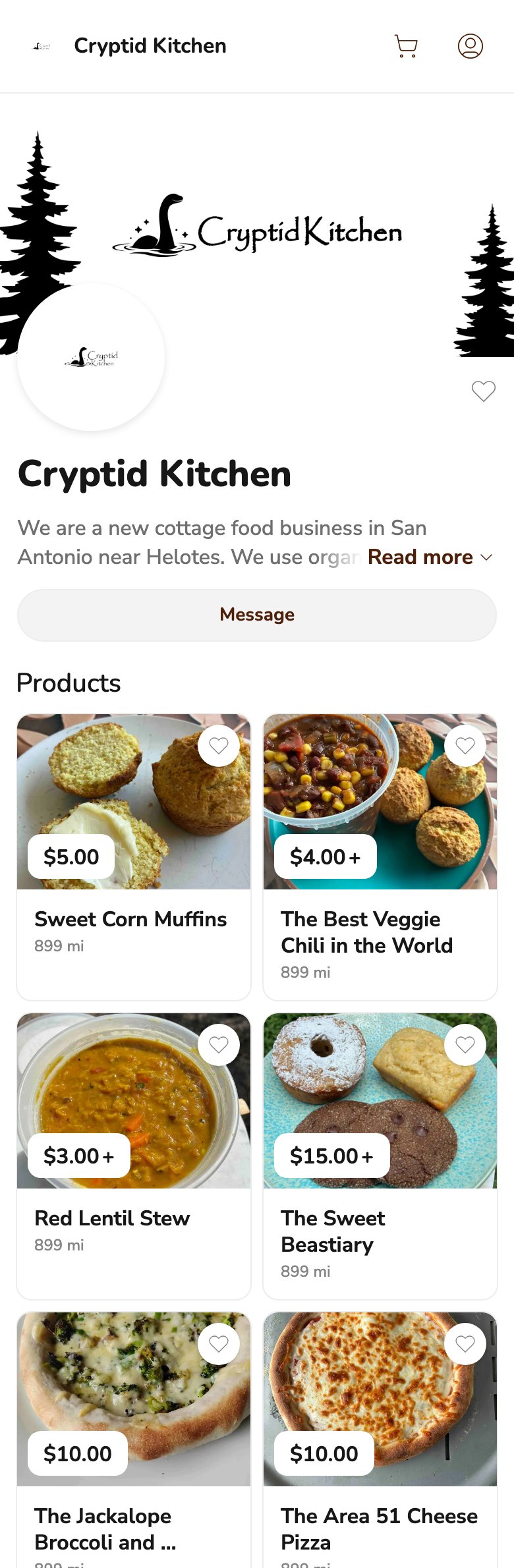
Cryptid Kitchen's storefront shows the setup in practice: one chili listing with a 16 ounce and a 32 ounce size, cornbread muffins built into each size, and the recipe and cost written right in the description. If you are ready to list your own sizes, set up your chili storefront and take next week's orders before you shop.
One easy chili mistake to miss is pricing from an old beef price. Ground beef rose 9.6% in a year, and a pot priced on 2025 beef is short $3.03 every time you cook it. These are the other common mistakes:
The fix for almost all of these is the same: price your own pot today, measure what it makes, and sell as much as you can ahead of the cook. Our guide to taking pre-orders for a food business walks through order cutoffs and pickup windows.
The church and school chili events we checked charged $5 to $10 a person, with kids at $5 to $6. That works when volunteers cook and some ingredients are donated. If you are paying for the beef at about $6.92 a pound, charge at least $7 a bowl, since a 12 ounce bowl with toppings costs about $2.84 to make.
Our 8-quart beef pot, made with 5 pounds of ground beef, beans, canned tomatoes, onions and chili powder, cost $51.58 at October 9, 2026 prices. That is about $6.45 a quart. A bean chili made the same way without beef cost $20.64, or about $2.58 a quart.
Sell a quart of beef chili for $15 to $18. Nine farms and delis checked on October 9, 2026 charged $10.50 to $24.00, with a median of $15.00. A bean chili quart can sell for about $12 and leave $9.27 over its cost, nearly the same as the $9.41 a $16 beef quart leaves.
A gallon is 128 ounces, so it fills about 10 and 2/3 bowls of 12 ounces or 16 cups of 8 ounces. When you plan how much to make, count servings by ounces, not by ladles. Use a ladle or scoop with a marked size so every bowl gets the same amount.
In our worked example, about 39% to 41% of an $8 bowl, or $3.15 to $3.27, is left after ingredients, cups, card fees and kitchen time, before a booth fee and your own hours. To get there, aim for a food cost of 30% to 40%, meaning ingredients and packaging are 30 to 40 cents of every dollar. At $8 a bowl, beef chili runs about 35%.
Usually not beef chili. In 7 of the 12 states our soup guide checked, the home food rules do not cover any cooked chili, because chili has to be kept hot or cold (California's county home restaurant permit, where offered, is the one exception), and the other 5 allow no beef, pork or chicken in it outside narrow small-farm exceptions. Texas allows home kitchens to sell bean or vegetable chili after registering with the state health department, but not chili with meat. Check your state health department before you sell, since rules change often.
These guides answer the questions that usually come right after "what should I charge for chili." Start with the soup permission guide if you have not checked your state yet, since the legal route sets your kitchen cost, and kitchen cost can add $3.75 to $6.19 or more to every quart. Then use the pricing guides to build the rest of a cold-weather menu around your chili, so a customer who comes for a quart leaves with tamales or a second soup too.
You now have the numbers: about $2.84 to make a 12 ounce bowl, about $6.59 for a packed quart, and a market where the median quart is $15.00 and the chili shops we checked charge $8 to $12 a bowl. Write your own pot cost on a card today, using what you paid for beef this week, and divide it by the quarts your pot really makes. If the answer is above $6.45, your price belongs at the top of the ranges in this guide, not the bottom.
The last step is to sell the chili before you cook it. In chili, one ingredient decides most of the cost, so every quart ordered ahead is 10 ounces of beef you do not have to guess at. Pre-orders also tell you whether this week is a two-pot week or a four-pot week before you book kitchen time. Start your Homegrown storefront, list your pint and quart sizes, and set a cutoff two days before your cooking day so you buy exactly the beef you need.