
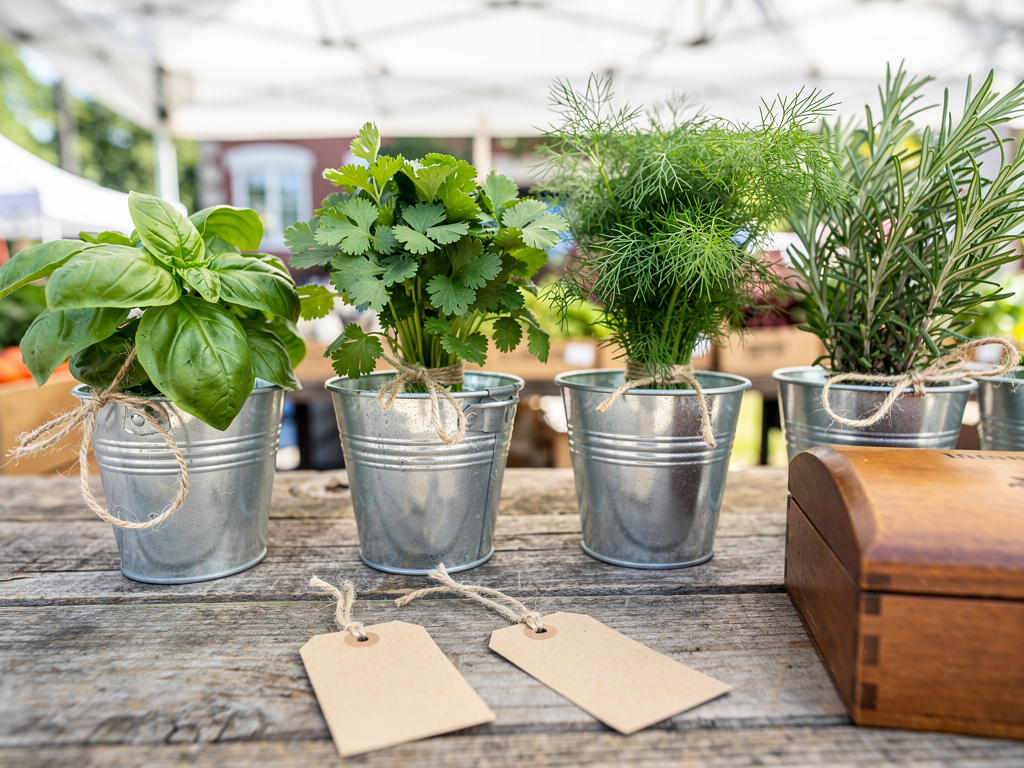


The short version: Charge $3 a bunch for everyday herbs like parsley, cilantro, dill, mint and oregano, $4 for basil, rosemary, thyme and sage, $5 for herbs the grocery store rarely carries, and $8 to $10 for a mixed bunch. Five Virginia farmers markets reported herb bunches at $2 to $5 in August 2026, an average of $3.10, and plain and single-herb listings on Homegrown run $1.49 to $5. Your supplies cost pennies (about 3 cents for a rubber band and 18 cents for a clamshell), so the price mostly pays for your time, the bunches that wilt unsold and card fees. In the market-day example below, dropping from $3 to $2 a bunch cuts what your morning pays you per hour roughly in half. Do not try to beat the supermarket on cilantro and parsley, which grocery ads put at 81 and 99 cents a bunch in mid-September 2026.
Checked September 22, 2026: the Virginia Market News Service retail farmers market report dated August 31, 2026, USDA's weekly grocery ad survey for September 18, 2026, a live pull of Homegrown's catalog, and the pricing pages of Homegrown, Square, Shopify and Etsy. Prices in your town can differ, so walk your own market before you set yours. Homegrown customers create an account to place their first order. Homegrown has no timed drop or countdown release.
Every herb grower hits the same moment at the market table: the basil looks great, the cilantro is standing in a jar of water, and you have no idea whether a bunch is worth $2, $3 or $5.
Most herb pricing advice stops at "charge $2 to $4 a bunch." That range is right, but it does not tell you where in it you belong, or why the bottom of it quietly loses money. This guide builds the price from real numbers checked the day it was written: what markets are charging, what the grocery store charges, what a bunch costs you in supplies, and what your morning of cutting is worth.
Sell a standard bunch of fresh herbs for $3, and move up to $4 or $5 for herbs that are harder to find or slower to grow. That puts you in the middle of what five Virginia farmers markets charged in August 2026 and well above what the bunch costs you to make.
Here is the price ladder most part-time herb growers can use as a starting point:
Scroll sideways to see every column.
| Herb group | Examples | Price per bunch | Why it sits there |
|---|---|---|---|
| Everyday bunching herbs | Parsley, cilantro, dill, mint, oregano, chives | $3 | The grocery store sells cilantro and parsley under $1, so freshness and size carry the price |
| Headline herbs | Basil, rosemary, thyme, sage | $4 | Stores tend to sell these in small plastic packs, so a full bunch stands out, and rosemary, thyme and sage regrow slowly |
| Specialty herbs | Thai basil, shiso, tarragon | $5 | Harder to find at a grocery store, so shoppers have little to compare your price against |
| Mixed bunch | Four or five herbs tied together | $8 to $10 | Priced near two or three single bunches, with less of each herb |
The ladder is our recommendation. It is anchored on the Virginia Market News Service report of August 31, 2026 ($2 to $5 a bunch across five markets) and on Homegrown's live catalog, both loaded September 22, 2026.
Three things back the $3 starting point:
If you are still deciding which herbs to grow, how to harvest them and how to keep them fresh, start with the companion guide on how to sell fresh herbs from home. It covers growing, packaging and which varieties sell. This guide picks up where it leaves off: the numbers behind the price tag. That guide now uses the same $3 a bunch for cilantro, mint, dill and parsley, and this page shows the market, cost and time numbers behind it: $2 sits under the cost of a bunch sold in the example.
At five Virginia farmers markets in August 2026, herb bunches sold for $2 to $5, and $3 was the most common price. The best public source for this is a state market news report, because it prints the actual prices market managers turn in each month.
The Virginia Market News Service's retail farmers market report, dated August 31, 2026, lists an herb price at five markets:
Swipe across to read the whole table.
| Market | Town | Herbs, per bunch | Organic herbs, per bunch |
|---|---|---|---|
| Annandale Farmers Market | Annandale, VA | $5.00 | Not reported |
| Burke Market | Burke, VA | $3.00 | Not reported |
| Farmville Community Marketplace | Farmville, VA | $3.00 | Not reported |
| Birdhouse Market | Richmond, VA | $2.50 | $4.00 |
| Lakeside Farmers Market | Richmond, VA | $2.00 | $2.00 |
Source: Virginia Market News Service, Retail Farmers' Markets publication, August 31, 2026 (Vol. 34 No. 04), loaded September 22, 2026. Market managers submit these prices monthly. The report lists herbs as one line, not by variety.
The five conventional prices add up to $15.50, an average of $3.10 a bunch. Two things stand out. Annandale, in Fairfax County, charged the most at $5, while Burke, in the same county, charged $3. And two markets reported organic herbs separately: Birdhouse charged $1.50 more for them, $4 against $2.50, while Lakeside charged the same $2 for both.
What an herb bunch cost at five Virginia markets, August 2026
Source: Virginia Market News Service retail farmers market report, August 31, 2026, conventional herbs, 5 markets.
In a live pull of the Homegrown catalog on September 22, 2026, 7 of the 2,605 products listed by 296 vendors were fresh-cut culinary herbs, from 5 vendors, priced from $1.49 to $17. Aliken Beach Farm lists a basil bunch at $5, rosemary at $5 and a mixed bunch of basil, dill, parsley, chives and fennel at $10. Kaufman Family Farms lists Genovese basil at $2.99, Harvest House Foods lists fresh herbs at $3, and Fields & Firelight Farms lists a $17 "Kitchen Herb Harvest" cut the day of pickup.
Two Homegrown vendors list basil about $2 apart, at $2.99 and $5. The $5 listing is labeled a bunch; the $2.99 listing does not state a size. Both can be right. The difference can come from bunch size and how rare basil is where each vendor sells.
Because grocery stores advertise them at under $1 a bunch, and you cannot grow, cut and bunch herbs for that. USDA's weekly survey of grocery ads, the Weekly Grocery Store Specialty Crops Feature Activity report for September 18, 2026, put the national average advertised price at:
Those are the only herbs in that week's national summary. The small plastic packs of basil, thyme and rosemary in the produce cooler did not show up in the ads at all, and they are the herbs where your bunch looks like the better deal next to a grocery pack.
So do not price your cilantro against 81 cents. Price it against what a shopper cannot get at the store: herbs cut that morning, a bunch twice the size, and varieties the store never stocks. The shopper who buys cilantro from you at $3 is buying a bunch that will still be green on Thursday.
Grocery ad prices change every week. We checked the cilantro and parsley prices in USDA's grocery ad report for September 18, 2026. The point is the gap, not the exact cents: when cilantro is on sale for under a dollar down the road, your $3 bunch has to look and smell like it came out of the ground that morning.
Your real competition on everyday herbs is the vendor two tables over. If three growers at your market sell parsley at $3, the fourth one selling it at $2 does not win more customers so much as teach everyone that parsley is a $2 herb.
Supplies for one bunch of herbs cost about 3 cents if you just band it, or about 21 cents if it goes in a clamshell. Sprouts flip that math because the seed costs more than the pack: a 4-ounce clamshell of alfalfa takes about 74 cents of seed, which is why sprouts sell for about $4 a pack rather than at an herb-bunch price. Seed barely registers. Here is the build for a basil bunch, from supplier prices loaded September 22, 2026:
Scroll right for the rest of each row.
| Cost line | What it costs to buy | Per bunch |
|---|---|---|
| Basil seed, bought by the ounce | $8.75 for about 19,300 seeds (Johnny's Selected Seeds) | Under 1 cent |
| Basil seed, bought by the packet | $5.25 for 200 seeds (Johnny's Selected Seeds) | About 3 cents a plant, spread over every cutting |
| Rubber band | $12.50 for a pound, about 425 bands (Fedco Seeds) | 3 cents |
| 0.75-ounce herb clamshell (optional) | $92.49 for 500 (WebstaurantStore) | 18 cents |
| Supplies, banded | About 3 cents | |
| Supplies, banded and in a clamshell | About 21 cents |
We checked each price on the supplier's own product page on September 22, 2026. Water, soil amendments and your garden space are left out because they vary too much from yard to yard to put one number on.
Fedco Seeds sells produce rubber bands at $12.50 a pound, roughly 425 of the #64 size that market growers use for bunching, which works out to 3 cents a band. That is the whole packaging cost for a banded bunch you stand in a jar of water.
This is why herb margins look so good on paper. The supplies for a $3 bunch cost less than a quarter. But supplies are not what makes herbs expensive to sell. Your time is, and so are the bunches you cut that never leave the table. The next two sections put a number on both.
Time yourself for one full market's worth of bunches, decide what an hour is worth to you, and divide. Herbs are cheap to grow and slow to handle. The University of Kentucky's crop profile on culinary herbs (CCD-CP-51) puts the total labor for one 100-foot by 4-foot bed of basil at seven hours or more, and says harvest and packing take nearly half of it.
Here is how to turn your own morning into a per-bunch number:
The example market day. Say you cut and pack 60 bunches in 3 hours, which is 20 an hour. You pay yourself $20 an hour, so your time is $60. Supplies at 21.44 cents a bunch, a rubber band (about 425 for $12.50 at Fedco) plus a 0.75-ounce clamshell ($92.49 for 500 at WebstaurantStore), come to $12.86. A bunch bigger than that clamshell holds needs a larger pack or a bag, so price your own pack if you go bigger. Your booth costs $25. That is $97.86 before a single sale, or $1.63 for every bunch you brought.
Now say 45 of the 60 bunches sell and 15 go home limp. Your cost per bunch sold is $97.86 divided by 45, which is $2.17. That number is your floor before card fees, which add another 20 to 25 cents a bunch at a card reader for prices from $2 to $4. Any price under it means you are paying to be at the market. These numbers are an example, not a rule, so swap in your own hours, booth fee and sell-through.
At $2 a bunch, the example market day above pays you about $14 an hour instead of $20, while $3 pays about $29 and $4 pays about $44. Same herbs, same morning, same booth. The only thing that changes is the price tag.
Here is the math, using the example day (60 bunches cut, 45 sold, 3 hours of work, $25 booth, 21.44 cents of supplies a bunch) and card payments on a Square reader at 2.6% plus 15 cents a sale:
Swipe left to see all five columns.
| Price per bunch | Sales from 45 bunches | Card fees on 45 sales | Left after paying yourself $20 an hour | What your 3 hours actually paid per hour |
|---|---|---|---|---|
| $2 | $90.00 | $9.09 | Short by $16.95 | $14.35 |
| $3 | $135.00 | $10.26 | $26.88 | $28.96 |
| $4 | $180.00 | $11.43 | $70.71 | $43.57 |
Card fees use Square's free plan in-person rate of 2.6% plus 15 cents per payment, checked on Square's pricing page on September 22, 2026, and assume every bunch is paid for separately by card. Cash sales carry no fee. The fixed cost in every row is $97.86: $60 of your time, $12.86 of supplies and a $25 booth. It assumes you already own a Square card reader; Square's hardware starts at $59.
Three things this table shows that the "$2 to $4" advice misses:
These hourly numbers count only the 3 hours of cutting and packing. Add the morning you spend at the table and the drive, and every row pays less per hour, which makes the gap between $2 and $3 matter even more.
A $2 price can make sense for the last bunches of the day, or for herbs you would compost otherwise. It should not be your default.
Make a $3 bunch the size a home cook uses in one or two meals, and keep every bunch the same weight so the price means something. A kitchen scale is the easiest pricing tool you will buy. Weigh ten bunches of each herb and settle on a target weight.
Weight also lets you compare your price with any other price, including a restaurant quote by the pound. Here is what a $3 bunch works out to at different sizes:
Scroll sideways for the per-pound column.
| Bunch weight | Price per ounce at $3 | Price per pound at $3 |
|---|---|---|
| Half an ounce | $6.00 | $96 |
| 1 ounce | $3.00 | $48 |
| 1.5 ounces | $2.00 | $32 |
| 2 ounces | $1.50 | $24 |
Simple division: $3 divided by the bunch weight in ounces, times 16 for the price per pound. Weigh your own bunches; herb density varies a lot between leafy basil and needle-like rosemary.
A few rules keep bunch sizes honest:
The companion guide on selling fresh herbs lists typical stem counts for each variety if you want a starting point for how many stems to band together.
Price every bunch in whole dollars. At $3 or $4 you only ever hand back bills, never coins, and three $3 bunches for $8 adds up in your head. At $2.75 you need a coin float and a calculator, and the line backs up while the herbs sit in the sun.
Price basil, rosemary, thyme and sage at $4, and herbs few stores carry, like Thai basil, shiso and tarragon, at $5. The harder an herb is to find, the less anyone compares it to a grocery price.
Basil needs its own note, because it is the herb everyone grows. NC State Extension's guide to fresh herb production and marketing says basil is the fresh herb produced in the largest volumes, and that in mid-summer, when most growers have it, prices are low. Its advice is to have fresh basil "when no one else does," in early spring after frost and in winter.
For a part-time grower that means two things:
Thyme and sage are perennials, and rosemary is too where winters are mild. They cost you almost nothing once the plant is established, but they can be slow to regrow after a hard cut, so you have fewer bunches to sell. That scarcity is worth the extra dollar. Specialty herbs earn $5 because the shopper who wants shiso or Thai basil for a specific recipe usually has nowhere else to get it that week.
Price a mixed herb bunch at $8 to $10, roughly the price of two or three single bunches, with a smaller amount of each herb. Mixed bunches sell to the shopper who wants a little of everything and does not want four separate bunches going limp in the fridge.
Real listings show the range. On Homegrown, Aliken Beach Farm sells a basil bunch for $5, rosemary for $5, and a mixed bunch of basil, dill, parsley, chives and fennel for $10. Fields & Firelight Farms charges $17 for its "Kitchen Herb Harvest," a hand-tied seasonal mix cut the day of pickup, which puts the mixed bunch at the top of the herb price range.
Ways to make a mixed bunch worth more than its parts:
A mixed bunch also takes longer to build than a single-herb bunch, so time a few before you price them. If it takes you twice as long to assemble, the $8 to $10 range already pays for that.
Sell to home cooks by the bunch and to restaurants by the pound. Shoppers at a market table think in bunches. Chefs think in weight, because their recipes and invoices do.
The per-pound price is usually much lower than your bunch price works out to, and that is fine. The University of Kentucky crop profile uses basil marketed at $10 a pound in its example of what a 100-foot bed could return. That is 62.5 cents an ounce, while a 1-ounce bunch at $3 works out to $48 a pound. The chef's price is lower because you skip the banding, the clamshells, the booth and the unsold bunches: you cut, bag loose and deliver on a set day.
Before you quote a restaurant, work out:
The $10 figure comes from a 2020 extension publication, so treat it as a starting point for the conversation, not a current market price, and ask the chef what they pay their distributor now. Homegrown's guide on selling food to local restaurants and cafes covers pitching the chef and setting payment terms.
Card fees take about 13% of a $3 bunch paid for on its own online, and about 6% of a $10 herb order. The reason is the flat part of the fee. A 30-cent charge barely matters on a $40 order and matters a lot on a $3 bunch.
Here is the full fee stack on a $10 herb order, plus a $20 order for comparison, on the platforms an herb grower is most likely to use. On Homegrown, Square and Shopify, the $10 order is two $3 bunches and a $4 basil bunch paid in one charge. On Etsy, where you would sell dried herbs, it is one $10 listing:
Swipe across for every fee in the stack.
| Platform | Monthly plan | Trial | Platform fee | Card processing | Customer pays on a $10 order | You pay on a $10 order | Customer pays on a $20 order | You pay on a $20 order | You pay in a month of 50 orders at $10 |
|---|---|---|---|---|---|---|---|---|---|
| Homegrown | $10 billed annually ($12.50 billed monthly) | 7 days, not charged until day 8 | None, 0% commission | 2.9% + $0.30, paid by you | $10.00 | $0.59 plus the plan | $20.00 | $0.88 plus the plan | $39.50 ($29.50 in fees plus $10) |
| Square Free, card reader at your table | $0 | None needed on the free plan | None | 2.6% + 15 cents | $10.00 | $0.41 | $20.00 | $0.67 | $20.50 |
| Square Free, online checkout | $0 | None needed on the free plan | None | 3.3% + 30 cents | $10.00 | $0.63 | $20.00 | $0.96 | $31.50 |
| Shopify Basic | $29 billed yearly ($39 billed monthly) | 3 days, then $1 a month for 3 months | None with Shopify Payments (2% with another provider) | 2.9% + 30 cents online | $10.00 | $0.59 plus the plan | $20.00 | $0.88 plus the plan | $58.50 ($29.50 in fees plus $29) |
| Etsy (dried herbs only, shipped) | $0 (a one-time shop setup fee may apply) | None | 6.5% transaction fee plus $0.20 listing fee; 15% Offsite Ads fee on ad-driven sales | 3% + $0.25 | $10.00 plus shipping | $1.40 on the $10 before shipping | $20.00 plus shipping | $2.35 on the $20 before shipping | $70.00 |
We checked every fee on each company's own pricing page (findhomegrown.com/signup, Square, Shopify and Etsy) on September 22, 2026. Card processing is figured on the $10 price; charged on a total with tax or shipping it runs a few cents higher. The Square card reader row assumes you already own a Square reader; Square's hardware starts at $59. Fresh-cut herbs rarely survive regular shipping, so Etsy mostly fits dried herbs and seasonings. The Etsy row assumes each order is one listing, such as a $10 or $20 jar of dried herbs, so it carries one 20-cent listing fee; an order of three separate products would carry three.
Two ways to keep fees from eating small herb sales:
For a deeper look at what each selling channel charges, Homegrown's breakdown of Etsy fees for food sellers walks through every line of the Etsy stack.
Take herb orders before market day, so you cut to the order instead of guessing. In the example earlier, 15 unsold bunches pushed the cost of every bunch that did sell from $1.63 to $2.17. Every bunch you skip cutting because nobody ordered it is money back in your pocket.
Homegrown gives you an online storefront where regulars order and pay for this week's herbs before you pick up the shears. It costs $10 a month billed annually ($12.50 month to month) with no percentage fees beyond standard payment processing of 2.9% plus 30 cents, which you pay. You list each herb at your bunch price, customers pick a pickup or delivery option, and you see the exact count on harvest morning. When a regular adds a $4 basil bunch to the same order, you pay the 30-cent part of the card fee once instead of twice: about 50 cents on the $7 order instead of about 80 cents on two orders.
Compare that to the options most herb growers start with:
Homegrown does not grow, cut or price your herbs for you. Customers create a Homegrown account to place their first order. Your storefront is listed on Homegrown's marketplace, but plan on most orders coming from the people you send your link to, like the regulars who already buy from your table. There is no timed drop or countdown release. If pre-orders would cut your wilted-bunch pile, you can set up a Homegrown storefront for your herbs in about 15 minutes and share the link at your next market.
Hold your price or add a dollar at the edges of the season, and give on size, not price, in the mid-summer glut. Herb supply swings hard. In June every grower has a little. By July every table at the market has basil.
A simple season plan for a part-time grower:
Market price data is monthly and local. The Virginia report we used covers August 2026 at five markets, the middle of basil season. Prices in your town, and in a spring or fall month, can run higher or lower. Check two or three tables at your own market each month and move your price with them, not with a number from another state.
If you need to raise prices mid-season, Homegrown's guide on raising prices without losing customers covers how to tell regulars and what wording keeps them buying.
Fresh herb listings run $1.49 to $17 on Homegrown, potted herb plants $4, and herb seasonings, salts and frozen herb cubes $5 to $9. Each form has a different price because each has a different shelf life and different work behind it.
Scroll right to see where to read more.
| Herb product | Listings on Homegrown | Price range | How long it keeps | Where to go deeper |
|---|---|---|---|---|
| Fresh-cut herbs | 7 listings from 5 vendors | $1.49 to $17 | Days | This guide |
| Potted herb plants | 4 listings from 1 vendor (Red Shed Market, 3.5-inch pots) | $4 each | A season, if planted | Selling potted herbs |
| Herb seasonings, salts and cubes | 4 listings from 4 vendors | $5 to $9 | Months | Selling dried herbs |
From a live pull of Homegrown's catalog on September 22, 2026: 2,605 products from 296 vendors. Herb breads, butters, jams, teas, oils, ready meals, microgreens, soaps, candles, a tincture and a $48 Thai basil stir-fry kit (Thai basil with peppers and garlic) were left out.
What this means for pricing:
The same herbs often end up in a tea blend too. If you dry mint, lemon balm or chamomile for tea, Homegrown's guide on how much to sell tea for prices the pouch.
One costly mistake is pricing cilantro and parsley against the grocery store, where 81 cents to 99 cents a bunch is a price no small grower can match. Most of the other mistakes come from the same place: counting supplies and forgetting time.
Watch for these:
Most of these are fixed by one habit: write down how many bunches you cut, how many sold and at what price, every market day, for a month.
Your herb price is right when you sell most of what you cut by the last hour of the market, and your time works out to what you wanted to earn. Selling out in the first hour means you are too cheap or cutting too little. Taking a third of your bunches home means you are cutting too much or the bunches are not worth the price.
Run this check after four market days:
Pre-orders make this check easier, because the orders tell you your demand before you cut. If you want to see your herb demand before harvest morning, a Homegrown storefront lets regulars reserve their bunches during the week for $10 a month billed annually, so the cutting list is set before you walk into the garden.
For the booth side of the math, Homegrown's guide to the real cost of selling at farmers markets lays out every fee a market vendor pays beyond the herbs themselves.
Charge $4 for a standard bunch of basil, and $5 early and late in the season when few other tables have it. Homegrown vendors listed basil at $2.99 (no size given) and $5 (a bunch) on September 22, 2026. NC State Extension notes basil prices drop in mid-summer, when most growers have it, so give a bigger bunch then instead of a lower price.
At the five Virginia farmers markets that reported herb prices in August 2026, a bunch cost $2 to $5: $2, $2.50, $3, $3 and $5, an average of $3.10. Organic herbs were $4 at one Richmond market and $2 at another. The report lists herbs as one line, so it does not show what specialty herbs like Thai basil or shiso sold for; this guide's $5 for those is our recommendation.
Sell to home cooks by the bunch and to restaurants by the pound. Shoppers find a bunch easier to judge and pay for. Weigh your bunches anyway: a 1-ounce bunch at $3 is $48 a pound, which helps you check your price against a chef's per-pound quote.
The supplies for one bunch cost about 3 cents with a rubber band, or about 21 cents in a clamshell, and seed adds a few cents at most. The real cost is your time and the bunches that do not sell. In a market-day example with 60 bunches cut, 45 sold and your time at $20 an hour, each bunch sold cost $2.17.
No, not on cilantro and parsley. Grocery ads put cilantro at 81 cents and parsley at 99 cents a bunch in September 2026, below what a small grower can cut and bunch it for. Price fresh herbs for size, freshness and variety instead, and when you sell herbs for $3 a bunch, make the bunch visibly bigger and greener than the store's.
Quote restaurants by the pound, well below your bunch price, because you skip the bunching, packaging and booth. The University of Kentucky's crop profile uses $10 a pound for basil in its 2020 example; ask the chef what they pay now and set a weekly minimum so one delivery pays for itself.
More pricing and selling guides for herb growers:
Herbs let a part-time grower hold a fair price and still sell out, as long as the bunches are fresh, generous and cut to what people ordered. Set your price from your own time and sell-through, and let your regulars reserve their bunches on a Homegrown storefront before market day.



