
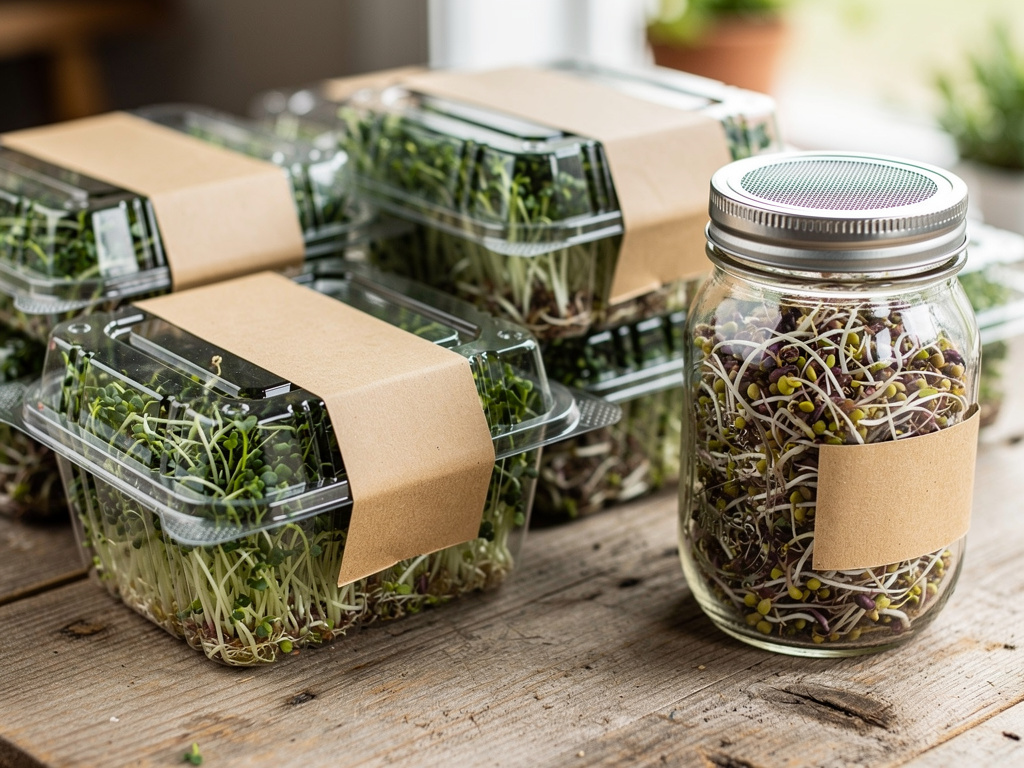


The short version: Charge $4 for a 4-ounce clamshell of alfalfa sprouts, and $5 for broccoli sprouts if you take pre-orders, or $6 off the table when you buy seed by the pound. A 4-ounce alfalfa pack costs you about $0.98 in seed, clamshell and label when you buy seed by the pound, and about $0.72 when you buy the 5-pound can. Grocery stores charged $2.69 to $4.43 for 4 ounces of organic alfalfa sprouts on September 24, 2026, and wholesale buyers in Atlanta paid about $1.67 a pack, so a $4 pack of fresher, same-week sprouts sits inside the grocery range, below the priciest store. Plan on about 1 pack in 5 not selling, because sprouts only last about a week.
Checked on True Leaf Market's seed pages, WebstaurantStore, three grocery product pages and the USDA Atlanta Terminal Market report (dated September 23, 2026), September 24, 2026. Your seed yield and your market will move these numbers, so weigh your own first batch. Homegrown figures were checked on findhomegrown.com/signup the same day: $10 a month billed annually, 0% commission, card processing 2.9% + $0.30 paid by the vendor. Customers create a Homegrown account to place a first order, and there is no timed drop or countdown feature.
Sprouts are one of the cheapest products you can grow and one of the easiest to underprice. A tablespoon or two of seed turns into a full jar in less than a week, so it is tempting to charge $2 and call it a good deal for everyone.
The trouble is that sprouts are cheap to grow and expensive to waste. They need a cooler at the market, they last about a week, and a single pack only brings in a few dollars, so card fees and unsold packs take a bigger bite than they do on a $12 loaf of bread.
This guide builds the cost of one pack from seed and packaging prices loaded the day it was written. It then checks that cost against what grocery stores and wholesale buyers pay right now, and walks through fees, waste and a week of sales at three sizes.
Charge $4 for a 4-ounce clamshell of alfalfa, clover or radish sprouts, and $5 for broccoli sprouts or a mix that includes broccoli when you take pre-orders, or $6 for either one off the table when you buy broccoli seed by the pound. A mix never costs more to make than a pack of pure broccoli, so the broccoli price clears the floor whatever the blend. Clover and radish fit the $4 price because their seed costs no more than alfalfa seed. On September 24, 2026, True Leaf Market sold organic red clover sprouting seed at $20.77 a pound and organic daikon radish sprouting seed at $15.48 a pound, against $20.83 for alfalfa. The radish page lists the same 7 to 1 yield as alfalfa, so a 4-ounce radish pack costs about $0.78 to make. The clover page lists no yield, so plan on about $0.97 a pack if your clover yields like alfalfa, and weigh your first batch. Both prices leave a clear margin over what the pack costs you.
Three numbers back that up:
If you are still working out whether you can legally grow sprouts at home, what equipment you need and how to keep them safe, start with how to sell sprouts from home. This guide picks up where that one stops: the actual numbers behind the price tag.
The one rule is to never price a 4-ounce pack below about twice your cost per pack sold. For alfalfa that works out to about $2.44 with seed bought by the pound ($1.22 times two), and about $1.81 with seed from the 5-pound can (twice the unrounded $0.905). Below that, a bad week of unsold sprouts wipes out the profit from a good one.
One 4-ounce pack of alfalfa sprouts costs $0.98 to make when you buy seed a pound at a time, and $0.72 when you buy the 5-pound can. Seed is the biggest line. The clamshell is second, and the label is almost nothing.
The seed math starts with yield. True Leaf Market's organic alfalfa sprouting seed lists a yield of 1 part seed to 7 parts sprouts, and sold a 16-ounce bag for $20.83 and a 5-pound can for $68.97 on September 24, 2026. A 4-ounce pack at 7 to 1 needs about 0.57 ounces of seed. True Leaf does not say whether that ratio is by weight or by volume. This guide treats it as weight, which is why your own weigh-in matters.
Scroll sideways to see every column.
| Cost line | What it is | Seed by the pound | Seed by the 5-pound can |
|---|---|---|---|
| Alfalfa seed | 0.57 oz of seed for 4 oz of sprouts | $0.74 ($1.30 an ounce) | $0.49 ($0.86 an ounce) |
| Clamshell | Clear 1-pint vented clamshell, case of 516 | $0.21 | $0.21 |
| Label | 2-inch blank label, roll of 500 | $0.02 | $0.02 |
| Total per pack | Before shipping, water, power, cooler and time | $0.98 | $0.72 |
We checked seed prices on True Leaf Market's alfalfa page, the clamshell on WebstaurantStore ($106.99 for 516) and the labels on Uline ($12 for a roll of 500) on September 24, 2026, all prices before shipping. Yield is the 7 to 1 ratio True Leaf lists for alfalfa. Totals are added before rounding, so a total can read a cent higher than its rounded lines.
Water and power for rinsing and a small fan add a few cents a pack at most. The bigger costs that do not show up on a seed receipt, like a market cooler, your time and a food safety course, are covered further down.
A $0.25 swing on seed does not sound like much. Across 60 packs a week it is $15, and across a year of weekly markets it is $780.
Broccoli sprouts cost about $2.22 a pack to make with seed bought by the pound, more than twice what alfalfa costs, because broccoli seed is pricier and, on the 4 to 1 planning yield used here, gives fewer ounces of sprouts per ounce of seed. That is the whole reason broccoli sprouts should sell for $5, not $4.
On September 24, 2026, True Leaf Market sold organic broccoli sprouting seed at $31.82 for a pound, against $20.83 a pound for alfalfa. The 4.5-pound can was listed at $109.75 but was out of stock that day, as were the 2.5-pound bag and the 30-pound bucket, so the largest broccoli size you could buy online was the 1-pound bag. The broccoli page does not list a yield ratio, so the table below uses 4 to 1 as a planning figure. Weigh your own first batch and swap in your real number.
Swipe across for all six columns.
| Sprout | Seed size bought | Seed cost per ounce | Yield used | Seed per 4-oz pack | Total with clamshell and label |
|---|---|---|---|---|---|
| Alfalfa | 1 lb bag, $20.83 | $1.30 | 7 to 1 (listed) | $0.74 | $0.98 |
| Alfalfa | 5 lb can, $68.97 | $0.86 | 7 to 1 (listed) | $0.49 | $0.72 |
| Broccoli | 1 lb bag, $31.82 | $1.99 | 4 to 1 (assumed) | $1.99 | $2.22 |
| Broccoli | 4.5 lb can, $109.75 (listed, out of stock on September 24, 2026) | $1.52 | 4 to 1 (assumed) | $1.52 | $1.76 |
Seed prices checked on True Leaf Market's alfalfa and broccoli sprouting seed pages on September 24, 2026. Clamshell $0.21 and label $0.02 as in the table above. Totals are added before rounding, so a total can read a cent higher than its rounded lines.
On September 24, 2026, True Leaf Market's broccoli seed page carried a supply notice limiting online orders to 5 pounds or less because of ongoing broccoli seed supply constraints, and every size above the 1-pound bag was marked out of stock online. The notice said larger amounts might be available by contacting True Leaf. If you build a weekly broccoli sprout order around a big bucket of seed, check the page before you promise a restaurant a standing order.
Broccoli at $5 still earns about 2.25 times its $2.22 cost, which is thinner than alfalfa at $4. That is fine for a product people ask for by name, but it is a good reason not to discount it or fold it into a cheap mix.
Check $5 against the one rule, though. With pound-bag seed and 80% sold, that floor is about $5.55 a pack, so $5 falls short. $5 passes if broccoli is pre-ordered and nearly every pack sells (floor about $4.44). If you buy pound bags and sell broccoli off the table, charge $6. If True Leaf's 4.5-pound can comes back in stock, $5 also clears the floor with that seed (floor about $4.39).
A 4-ounce pack of organic alfalfa sprouts cost $2.69 to $4.43 at three grocery stores on September 24, 2026. That is about 67 cents to $1.11 an ounce, and it is the price most of your customers carry in their heads.
What one 4-ounce alfalfa pack sold for, September 2026
Source: USDA AMS Atlanta Terminal Market report dated September 23, 2026 ($20 carton of twelve 4-ounce packs); grocery product pages loaded September 24, 2026.
Your sprouts do not need to beat the cheapest store. They need to be worth a special trip to your table, and freshness does most of that work. A pack you harvested on Friday for a Saturday market is days fresher than one that went through a distributor and sat on a grocery shelf.
Grocery prices also shift by region and by week, so check two stores near your market before you set your sign. If your nearest store sells organic alfalfa at $3.99, your $4 price needs no explaining at all.
A wholesale buyer paid $19 to $21 for a carton of twelve 4-ounce packs of alfalfa sprouts, mostly $20, in the USDA Atlanta Terminal Market report dated September 23, 2026. That works out to $1.58 to $1.75 a pack, with $1.67 the most common price.
A terminal market is where distributors sell produce to grocery stores, restaurants and other buyers in bulk. The same report listed bean sprouts (in the U.S. these are usually mung bean sprouts) at $12 to $14 for a 10-pound bag (mostly $12 to $13), which is only $1.20 to $1.40 a pound.
Those two numbers tell you a lot about where a small vendor fits:
If a café or grocery asks what you charge, the terminal market price is the number they know. For a standing weekly order, $2 a pack is about 20% above the $1.67 terminal price. $2.50 is 50% above it and above the highest price in the USDA report (about $2.08 a pack), so expect to justify it with same-week freshness. The floors from earlier assume 1 pack in 5 goes unsold, as at a market table. A standing order sells nearly every pack, so the floor drops to about $1.45 with 5-pound-can seed and about $1.95 with pound-bag seed. Hold the $2 end for can seed. With pound-bag seed, $2 barely clears the floor, so quote $2.50 to leave a cushion for a batch that fails.
Set your sprout price by costing one pack, adjusting for waste, checking the local grocery shelf and then rounding to a price that is easy to pay in cash. The whole process takes one evening with your seed receipt and a kitchen scale.
Keep the numbers from each step in a notebook or a note on your phone. When seed prices change, you only need to redo step two.
Price an 8-ounce pack at $7, a 4-ounce mix with broccoli at $5 on pre-order ($6 off the table with pound-bag broccoli seed) and a three-pack of different sprouts at $12. Bigger packs should cost a little less per ounce than the 4-ounce size, but never so little that the regular pack looks like a bad deal.
Scroll right for the rest of each row.
| Pack | Price | Price per ounce | Who buys it |
|---|---|---|---|
| 4 oz alfalfa, clover or radish | $4 | $1.00 | First-time buyers, sandwich and salad eaters |
| 4 oz broccoli or a mix with broccoli | $5 pre-ordered, $6 off the table | $1.25 to $1.50 | Health-minded regulars who ask for broccoli by name |
| 8 oz alfalfa | $7 | $0.88 | Families and juicing customers |
| Three 4-oz packs: alfalfa, clover and radish | $12 | $1.00 | Customers who want variety without choosing |
Suggested prices, built from the costs above. An 8-ounce alfalfa pack uses about $1.49 of seed from a 1-pound bag, so it needs a larger container than the pint clamshell priced above. That container is not priced here. Seed and a label come to about $1.51, so any container under about $1.29 keeps $7 at or above twice the cost per pack sold at 80% sold.
The three-pack works because it raises the size of each sale without cutting your price. Three $4 packs at $12 is still $4 a pack, but now card fees are spread across one $12 payment instead of three $4 payments.
Bundles also help you move whichever variety is running long that week. For more ideas on building sets that customers reach for, see how to build a bundle that increases your average order.
Plan on about 1 pack in 5 going unsold, and price as if it will. Sprouts last roughly a week in the cold, and a pack that comes home from Saturday's market is near the end of its week by Wednesday and should not go back on the table.
That 80% sell-through is a planning figure, not a law. Some vendors sell out every week, and some bring home a third of the cooler in bad weather. The point is to know your own number:
Broccoli is less forgiving. At $2.22 a pack and 80% sold, your real cost is $2.78 a pack, and at 60% sold it is $3.70. That is why broccoli should be the variety you make to order.
Start each new market with 20 packs of alfalfa and 8 of broccoli, with the broccoli pre-ordered or priced at $6, and write down what comes home. After four markets you will know your real sell-through, and that number is worth more than any price change.
Unsold sprouts are not always a total loss. You can eat them, give them to a regular or pass them to a neighbor. What you should not do is sell a tired pack at full price to a customer who will judge your whole booth by it.
If unsold packs are what eats your sprout margin, let regulars reserve ahead. A Homegrown storefront takes their order and payment midweek, so you soak seed only for packs that are already sold.
A small home sprout operation making 20 alfalfa packs a week keeps about $40 after seed, packaging and card fees, and one making 120 packs keeps about $273. Those figures use $4 a pack, 80% sold and in-person card payments.
Swipe sideways for all seven columns.
| Weekly size | Packs made | Packs sold (80%) | Sales at $4 | Seed, clamshell, label | Card fees | Left before booth fee and time |
|---|---|---|---|---|---|---|
| A few jars | 20 | 16 | $64.00 | $19.51 ($0.98 each) | $4.06 | $40.43 |
| A tray rack | 60 | 48 | $192.00 | $43.44 ($0.72 each) | $12.19 | $136.37 |
| Two tray racks | 120 | 96 | $384.00 | $86.88 ($0.72 each) | $24.38 | $272.74 |
Card fees use Square's free plan in-person rate of 2.6% + 15 cents on each $4 sale, checked on Square's pricing page on September 24, 2026. The two larger sizes use 5-pound-can seed prices. Every figure is worked out unrounded and rounded once at the end.
The jump from 20 to 60 packs is where sprouts start to feel like a business. You buy seed in bulk, your cost per pack drops by a quarter, and the extra work is mostly a few more jars or a second tray.
These figures leave out your booth fee, your cooler and ice, and your time. Most small farmers markets charge a flat weekly or seasonal booth fee, and the real cost of selling at a farmers market walks through booth fees, insurance and gear, so subtract yours before deciding which row is worth your Saturday.
Card fees take about 6% of a single $4 sprout sale in person and about 10% online, but only about 3% to 5% of a $20 order. Small tickets are expensive to process because of the fixed cents added to every payment.
Here is what each option costs on a $20 order of five 4-ounce packs, and across a month of 50 such orders:
Scroll right to read the whole fee table.
| Option | Subscription | Trial | Platform fee | Card processing | Customer pays on a $20 order | Vendor pays on a $20 order | Month of 50 orders |
|---|---|---|---|---|---|---|---|
| Homegrown | $10/mo billed annually ($12.50 monthly) | 7 days, no charge until day 8 | $0, 0% commission | 2.9% + $0.30 | $20.00 | $0.88 | $54.00 |
| Square Free, online | $0/mo | None needed | $0 | 3.3% + $0.30 | $20.00 | $0.96 | $48.00 |
| Square Free, in person | $0/mo | None needed | $0 | 2.6% + $0.15 | $20.00 | $0.67 | $33.50 |
| Shopify Basic | $29/mo billed yearly ($39 monthly) | 3 days, then $1/mo for 3 months | $0 with Shopify Payments | 2.9% + $0.30 (3.5% + $0.30 on premium cards) | $20.00 | $0.88 | $73.00 |
| Local Line Core | $87/mo billed annually ($109 monthly) | 7 days | $0 commission | 2.9% + $0.30 | $20.00 | $0.88 | $131.00 |
| Barn2Door Entrepreneur | $119/mo billed annually (monthly price not shown on the page), plus $399 one-time setup | None listed | Merchant support fee, amount not published | 2.9% + $0.30 | $20.00 | $0.88 plus the unpublished fee | $163.00 plus setup and the unpublished merchant support fee |
We checked each company's own pricing page on September 24, 2026: findhomegrown.com/signup, squareup.com/us/en/pricing, shopify.com/pricing, localline.co/suppliers/pricing and barn2door.com/pricing. "Month of 50 orders" is 50 times the vendor's processing on a $20 order plus one month of subscription at the annual rate.
Square's free plan is the cheapest way to take a card at your table, and it is hard to beat for walk-up sales. The online rate on the free plan was 3.3% + 30 cents on the day we checked, a bit higher than the other options.
The bigger lesson for sprouts is order size. At 2.9% + 30 cents, a $4 online payment loses $0.42 to processing, or 10.4%. A $12 three-pack loses $0.65, or 5.4%. Anything that turns single packs into one bigger payment keeps more of each dollar.
The best cure for unsold sprouts is to grow to order, and a pre-order page lets your regulars reserve and pay before you start a single jar. When most of Saturday's packs are already paid for by Wednesday, your 80% sell-through turns into something much closer to 100%.
Homegrown gives you an online storefront for $10 a month on the annual plan, with no percentage fees beyond standard payment processing of 2.9% + $0.30 per order. You list each sprout variety and pack size with how many you have, customers order and pay online, and they pick up at your market table or your door. You get the order list before you soak the seed, which is exactly what a 5-day crop needs.
Compare that to the options sprout vendors usually try first:
Homegrown has honest limits. It does not help you grow, test or label sprouts, and it does not replace the license or cooler your market requires. Customers create a Homegrown account to place their first order. Your storefront is listed on the Homegrown marketplace, but plan on most orders coming from people you send to your own link, like the regulars you already see every Saturday. Card processing is paid by you, with nothing added on top for the customer.
Selling sprouts to a café or restaurant can pay well if you quote about $2 to $2.50 per 4-ounce pack and buy seed in bulk. At $0.72 a pack from the 5-pound can, that is roughly three times your cost, with no booth fee and very little waste.
Restaurant buyers compare you to their distributor. In the USDA Atlanta report dated September 23, 2026, the terminal market price was about $1.67 a pack, before any distributor markup or delivery charge, so a quote near $2 is believable when your sprouts arrive a day after harvest instead of several days later.
Before you pitch a kitchen, have answers ready for these questions:
Keep wholesale to a share of your weekly jars, not all of them. A 4-ounce pack that earns $2 from a café and $4 at your table should only go to the café when the steady order makes up for the lower price.
The costs that do not appear on a seed receipt, like cold storage, training and your time, can add more per pack than the seed itself. Count them before you decide $4 is enough.
Sprout rules are stricter than rules for most produce and they vary by state, so check with your state department of agriculture before your first sale. The permit and food safety steps are laid out in the guide to selling sprouts from home, and any license fee belongs in your cost per pack.
None of these costs is a reason to skip sprouts. They are the reason your price should sit at $4, not $2.
The most common sprout pricing mistake is charging for the seed and forgetting the waste, the fees and the week. A $2 pack looks generous next to a $0.98 cost until a third of the cooler comes home.
Here are the mistakes that show up most often:
Every one of these mistakes has the same fix: know your cost per pack sold, then price and plan around it.
Your sprout price is right when you sell 80% or more of your packs by closing time and regulars come back the following week. Those two signals matter more than any price comparison.
Watch for these signs over your first four to six markets:
In a pull of the Homegrown catalog on September 24, 2026, none of the 2,653 products from 302 vendors was a jar or tray sprout like alfalfa, broccoli or mung bean. The closest product, microgreens, had 32 listings from 7 vendors, and the 20 two-ounce listings were priced $5 to $14, or $2.50 to $7 an ounce. Sprouts at $4 for 4 ounces are about $1 an ounce, which leaves real room for a local sprout vendor. These are listings, not sales.
Microgreens and sprouts share a customer, so a microgreens vendor at your market is a good sign, not a threat. If you grow both, they fit on the same weekly order page, and where to sell microgreens covers the restaurants, co-ops and CSA farms that take them on a standing weekly order. For a side-by-side look at the other crop, see how to sell microgreens.
Charge about $4 for a 4-ounce clamshell of alfalfa, clover or radish sprouts, $5 for broccoli sprouts you sell by pre-order ($6 off the table with pound-bag seed) and about $7 for an 8-ounce pack of alfalfa. Those are this guide's suggested prices, built from seed and packaging costs, not a survey of what other vendors charge. On September 24, 2026, grocery stores charged $2.69 to $4.43 for a 4-ounce tub of organic alfalfa, so a fresher local pack at $4 sits inside that range, below the priciest store.
A 4-ounce pack of alfalfa sprouts costs about $0.98 in seed, clamshell and label when seed is bought by the pound, and about $0.72 with seed from a 5-pound can, using September 2026 supplier prices. Broccoli sprouts cost about $2.22 a pack with pound-bag seed. Water, power, a cooler and your time come on top.
Sprouts can be profitable for a small vendor because a $4 pack costs under $1 in supplies. The profit depends on how many packs you sell before they spoil and how much time you spend rinsing. Growing to pre-order and selling in three-packs protect the margin more than a price increase does.
Quote about $2 to $2.50 per 4-ounce pack for a standing weekly order. Restaurants compare you to their distributor, and wholesale alfalfa sprouts ran about $1.67 a pack in USDA's Atlanta price report for September 23, 2026. Hold the $2 end for bulk seed, which brings an alfalfa pack down to about $0.72. With pound-bag seed, quote $2.50.
Sell by the pack at a farmers market. A 4-ounce clamshell at $4 is easy to understand and easy to pay for in cash. Price by the pound only for restaurants or larger orders, where $4 a pack works out to $16 a pound retail and about $8 to $10 a pound wholesale at $2 to $2.50 a pack.
Sprouts stay fresh for roughly a week when kept cold, and quality drops fast if they warm up. That short window is why sprout pricing should assume some unsold packs each week, and why it pays to harvest the day before market and grow to pre-order.
More on growing and pricing fresh produce for a local market:
Your sprout menu belongs on a page where regulars can order and pay midweek, so you soak exactly the seed you need. For a crop that takes five days and lasts one week, knowing the count ahead of time is worth more than any price change.
The setup is a one-evening job:
Do those four things and you will walk into every market knowing your cost per pack, your floor price and how many packs are already paid for.



