
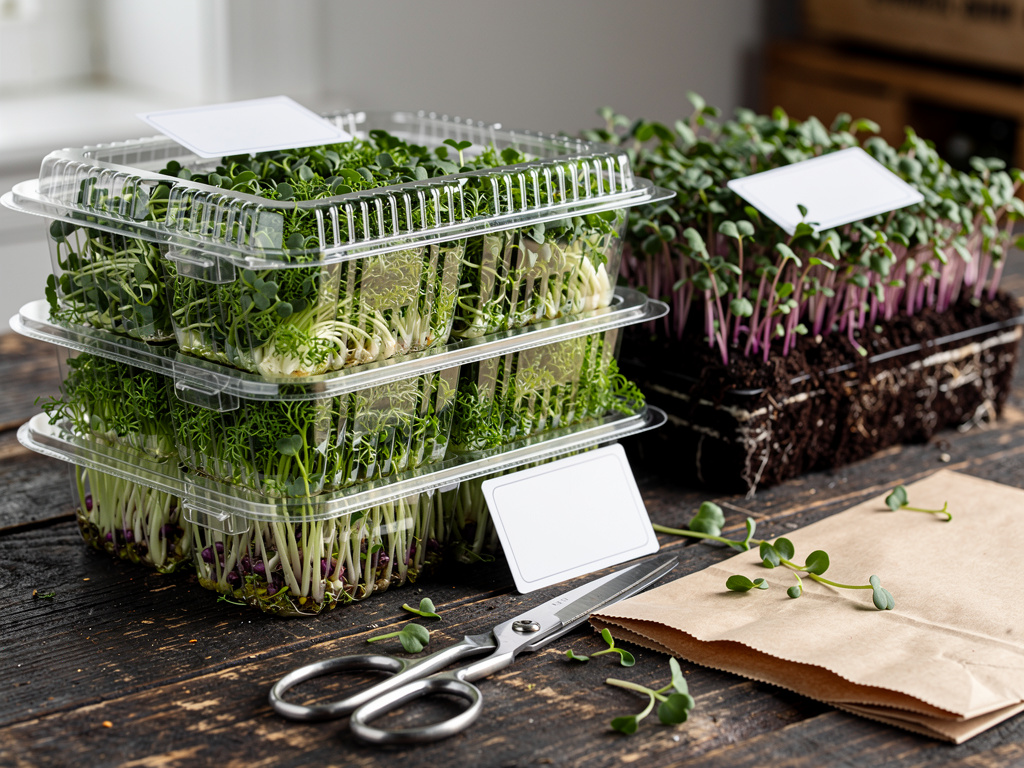


The short version: Microgreens sell in seven places: farmers markets, your own order-ahead link for pickup and local delivery, restaurants, grocery stores and co-ops, juice bars and cafes, CSA (community-supported agriculture) boxes and other farms' stands, and online, where grow kits and seeds ship well and fresh greens do not. A good start for a small grower is one market and a weekly pre-order link, then a restaurant on a standing weekly order. The 19 two-ounce packs listed on Homegrown had a middle price of $7.00 in a September 29, 2026 catalog pull, and a $20 order costs the vendor $0.88 in card processing through a Homegrown storefront plus the $10 monthly plan, $0.67 on a Square reader at a booth and $2.35 on Etsy for a $20 grow kit.
Checked September 25, 2026: Homegrown is $10 a month billed annually or $12.50 billed monthly, with 0% commission and card processing of 2.9% + $0.30 paid by the vendor, per its signup page, and the other fees come from each company's own pricing page and the federal rules from the FDA, all loaded that day, while listing prices come from Homegrown's own catalog as it stood on September 29, 2026. Sales to restaurants and stores count toward the FDA's small-farm qualified exemption only when the buyer is in your state or within 275 miles, so check your state's current rules before you sell. The limits: your customer creates a Homegrown account to place a first order, Homegrown has no recurring subscription billing and cannot price by the pound today, it is built for pickup and local delivery rather than shipping, it has no drops or countdown-timer release feature, and most orders will come from people you send to your own link.
You have a shelf of trays under lights, the sunflower shoots are standing up tall, and in four days the pea shoots will be ready whether anyone has ordered them or not. That is the whole puzzle with microgreens. They grow fast, they keep for about a week, and a tray you cannot sell becomes compost.
This guide covers the seven places small microgreens growers actually sell, what each one costs you on the same $20 order, what each one pays per ounce, and which rules change when your buyer is a chef or a store instead of a neighbor.
Microgreens sell in seven realistic places, and many part-time growers keep two or three of them going at once. The best ones share a trait: they tell you how much to cut before you cut it. Here is the full list, with the number that matters for each.
If you are still working out varieties, trays and packaging, the companion guide on how to sell microgreens covers the growing and pricing side: permits, costs per tray, clamshells and freshness. This article picks up where that one stops. You have a crop coming in on a schedule, and you need to know where every ounce of it goes.
Two traits set microgreens apart from almost every other product a small vendor sells. The crop cycle is 7 to 14 days from seed to harvest, so you can match supply to orders within two weeks. And cut greens last 5 to 10 days in the refrigerator, so there is no stockpiling your way through a slow week. Both traits push you toward channels where the order comes first.
Start with the place that matches how many trays you can harvest each week, because a restaurant that wants two pounds every Tuesday is a bad first customer for someone growing five trays. A standard 10x20 tray yields 6 to 12 ounces depending on the variety, which is 3 to 6 two-ounce packs. Use that math to pick your first channel and your second.
Scroll sideways to see every column.
| Trays you harvest a week | Rough output | Start here | Add next | Why |
|---|---|---|---|---|
| 1 to 4 | 6 to 48 ounces, up to 24 packs | Pre-orders from friends and neighbors | One farmers market | You only cut what is already paid for |
| 5 to 14 | 30 to 168 ounces | One farmers market plus a pre-order link | One restaurant on a standing order | The market finds customers, the link keeps them between Saturdays |
| 15 to 39 | 90 to 468 ounces | Market, link and two or three restaurants | A co-op, a juice bar or a CSA add-on | Wholesale steadies your harvest schedule |
| 40 or more | 240 ounces and up | Restaurants and stores on standing orders | A second market or a delivery route | Volume needs buyers who take the same amount every week |
Tray yields come from the companion microgreens how-to guide. Pack counts assume 2-ounce clamshells, the most common size on Homegrown on September 29, 2026.
Most growers do best with two channels that balance each other. A farmers market gives you new customers and cash on the day. A pre-order link or a standing restaurant order gives you a number you can plant against. With both, a slow Saturday no longer means twenty packs in the compost bin.
A farmers market is the best place for most microgreens growers to find new customers, because it is where people who have never tasted a pea shoot can try one. In the start-here table above it comes right after a pre-order list of people you already know, which keeps your first harvests paid for while you find a market. Booths usually cost $20 to $75 a week, and some busy city markets charge $100 or more, according to our breakdown of the real cost of selling at farmers markets. At a $7 pack, three sales cover a $20 booth and eleven cover a $75 one.
What makes a microgreens booth work is different from what makes a bread or jam booth work:
The market's weakness is the week-to-week guess. Rain, a holiday weekend or a street fair two blocks over can cut your sales in half, and unlike a jar of jam, your leftovers will not keep for next Saturday. That is why the growers who do best at markets also take orders in advance and bring the pre-paid bags to the booth for pickup.
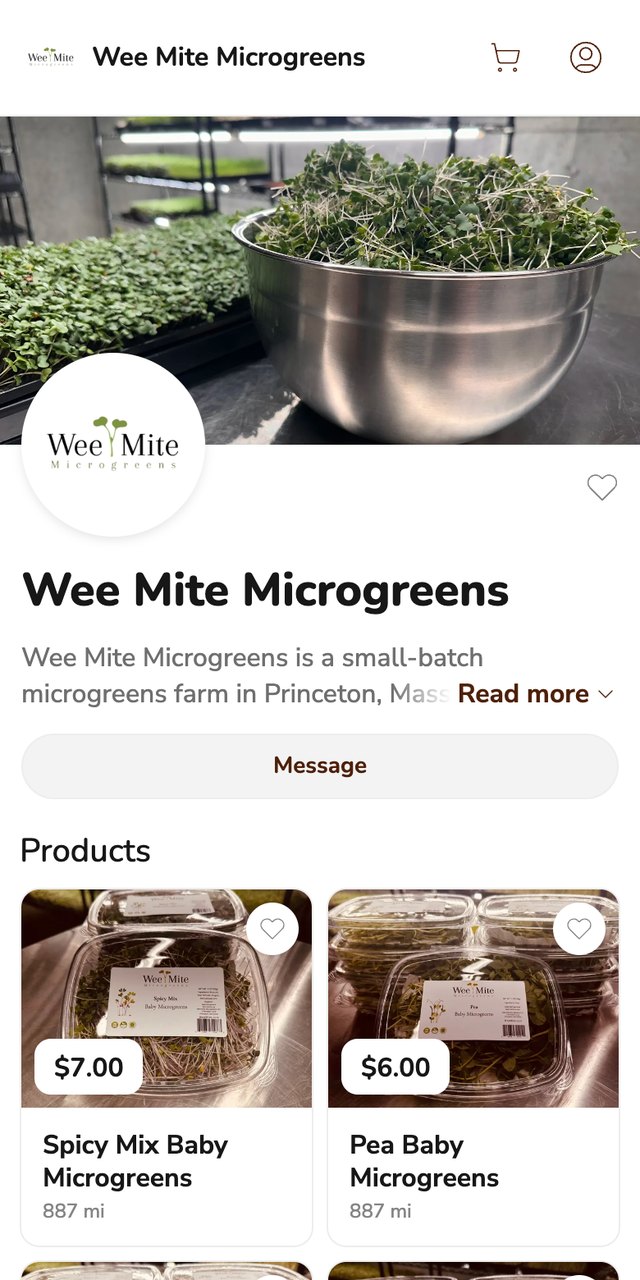
Wee Mite Microgreens in Princeton, Massachusetts, shows how this works on a real storefront. On September 29, 2026 it listed six 2-ounce packs at $6 and $7, a 1-ounce cilantro pack at $6 and three farmers markets as pickup points: Holden on Tuesday afternoons, Rutland on Wednesday afternoons and Sterling Street Market on Saturdays from 10 to 2. Its storefront says it plainly: "Order ahead here and pick up at the market." The same storefront listed Thursday pickups at a local school in November and Thursday delivery within 7 miles.
Count your pre-orders before you harvest for market, then cut those plus about a third more for walk-up sales. If 12 packs are pre-ordered, cut 16. Some weeks you will sell out and some weeks a few packs go in the compost, and a sold-out sign with a QR code for next week's orders is its own advertisement.
Between market days, microgreens sell best through a weekly order-ahead link: customers pick their packs by a cutoff day, you harvest to the order count, and they collect at your porch, your booth or their door. It fits the crop better than anything else, because a microgreen order placed on Monday can be growing by Monday night.
Real storefronts on Homegrown show three ways to set it up:
Konch prices delivery into the product instead: its 2-ounce tub is $12 for pickup and $14 delivered to the doorstep. Either way works. What does not work is free delivery on a $6 order.
This is where the ordering tool matters, because the problem you are solving is counting before you cut. Homegrown is $10 a month billed annually ($12.50 month to month) with no percentage fees beyond standard payment processing, 2.9% + $0.30 per order, paid by you and never passed to the customer. Your customers see your varieties, pick packs and a pickup spot or delivery, and pay up front. Every order lands in your dashboard, each product's stock count goes down as packs sell, and an order prep time you set closes orders before each pickup day, so by harvest day the counts tell you how many packs of each variety to cut. You can list several pickup points under one storefront, such as your porch and two markets, and set your own delivery radius and fee.
Compare that with the options most microgreens growers try first:
Homegrown has limits worth knowing before you set it up. It has no recurring subscription billing, so a weekly customer places each week's order rather than being charged automatically. It cannot price by the pound today, so list fixed sizes such as a 2-ounce pack or a 5-ounce wholesale clamshell. Customers create a Homegrown account to place a first order. It is built for pickup and local delivery, not shipping. It has no drops or countdown-timer release feature, so orders stay open right up to the lead time you choose before each pickup. Your storefront is listed on Homegrown's local marketplace, but plan on most orders coming from people you send to your own link.
If your harvest day is still a guess, a weekly order-ahead link is the fix: set an order prep time so orders for your Tuesday pickup close Sunday night, and by Monday morning you know exactly how many packs of each variety to cut. You can set up your microgreens storefront in about 15 minutes and send the link to your market regulars before this week's cutoff.
You sell microgreens to restaurants by bringing a chef a free sample box, quoting a price per ounce or per pound, and setting a standing delivery day. Restaurants are the most predictable channel in this business. A kitchen that orders $40 of greens every Tuesday is $160 over a four-week month that you can plant against.
Wholesale usually runs 40 to 60 percent of retail. Our how-to guide puts it at $12 to $25 a pound, against retail of $20 to $40 a pound; at the $7.00 middle pack price on Homegrown, half of retail is about $28 a pound. Actual listings can run higher. In the same September 29 catalog pull, Konch Republic Greens listed a 5-ounce clamshell at $25 and an 8-ounce clamshell at $40, both marked "Wholesale Pricing" and "Restaurant or Commercial Only" and both delivered, which works out to $5.00 an ounce. Local prices vary this much, so ask what the kitchen pays its current supplier before you quote.
Here is the pitch, step by step:
The guide to what to bring to a chef tasting covers the sample visit in more detail, and our walkthrough of selling food to local restaurants and cafes covers invoices and delivery windows.
Ask each kitchen how it pays before the first delivery: card at delivery, a weekly invoice, or a check. It changes your cash flow, and it decides whether a card fee applies at all. Put your farm's name, address and harvest date on every pack, which is what the University of Nevada, Reno's microgreens food safety sheet tells growers to do.
Yes, small grocers and food co-ops buy local microgreens, usually at wholesale prices with a fixed weekly quantity and a harvest date on every pack. A store can be the highest-volume channel you have and the lowest price per ounce, so it works best once you can grow the same amount every week without missing.
The math starts with the shelf price. Our guide to selling food products in local stores quotes MSU Extension putting store markups on frozen and refrigerated products at around 30 percent, so ask what the store adds on fresh produce. If a co-op sells a 2-ounce pack at $7.00, the middle retail price on Homegrown in September 2026, and adds that roughly 30 percent, it pays you about $5.40.
What a store will ask of you:
Watch the consignment offer. Consignment is a common first deal with a small store: you own the product until it sells and the store keeps 30 to 50 percent of the price. That works for a jar of honey that lasts a year. It is risky for a product that lasts a week, because every pack past its pull date is your loss, not theirs. Ask for a firm weekly order instead, even a small one, such as 12 packs every Wednesday.
Yes, and they can be easier first wholesale accounts than a full restaurant, because they tend to need smaller amounts of fewer varieties every week. A juice bar blending wheatgrass or sunflower greens, a cafe topping avocado toast, and a meal-prep kitchen adding a garnish to 60 lunch boxes all have the same need: a steady supply of one or two varieties they can count on.
The varieties each buyer tends to want:
An order from one of these buyers can be small. A cafe might take 8 ounces a week. At the $12 to $25 a pound our how-to guide gives for wholesale, that is $6.00 to $12.50 a week, or $24 to $50 over a four-week month, from one account that needs one stop on your delivery route. At the $5.00 an ounce Konch lists for commercial customers, the same 8 ounces is $40 a week.
Price these accounts the same way you price restaurants, per ounce with a minimum order. Konch Republic Greens labels its wholesale listings "Restaurant or Commercial Only" on the same public storefront as its retail tubs, so any visitor sees both prices. To keep wholesale prices out of retail view, send each account its own price sheet by email instead.
Yes, a CSA box or a neighbor's farm stand can carry your microgreens as an add-on, which puts your greens in front of customers who already buy local produce every week. A CSA (community-supported agriculture) is a farm whose members pay up front for a weekly share of the harvest. The farm gets a product it cannot grow in a field in January, and you get a known weekly order.
The usual arrangements:
Microgreens fit a CSA especially well in the cold months, when a field farm's box gets thin and yours does not change at all, because you grow under lights. Mini Acre Farm on Homegrown sells something close to this model: a $10 Basic Farm Share Bundle with 2 to 3 seasonal microgreens, vegetables, fruit, greens or herbs plus one bread item, such as rolls or a half loaf, and a $30 Homestead Bundle with 3 to 5 of those, two breads, a dozen eggs and a jar of jam or applesauce.
Our guide to getting your product added to a local CSA covers how to pitch the farm and what split to propose. If the farm stand route is closer to home, the guide to selling microgreens from a farm stand covers cold display, sampling and recipe cards for a stand.
Sell cut microgreens in clamshells for most channels, and add living trays where the buyer can keep them on a counter or a kitchen line. Cut greens are lighter, easier to price by the ounce and what restaurants and stores expect. Living trays, still growing in soil, stay fresh longer, and some buyers will pay for that.
Real Homegrown listings from the September 29, 2026 catalog pull show both:
Scroll sideways to see every column.
| Format | Real listing on Homegrown | Price | Keeps | Best places to sell it |
|---|---|---|---|---|
| Cut, 2-ounce pack | Wee Mite, Capon River Wellness, Konch Republic Greens | $6.00 to $14.00 | 5 to 10 days refrigerated | Pre-orders, markets, stores, CSA add-ons |
| Cut, by the clamshell for kitchens | Konch Republic Greens, 5 oz and 8 oz, wholesale only | $25.00 and $40.00 | 5 to 10 days refrigerated | Restaurants, cafes, caterers |
| Live 5x7-inch clamshell tray | OstroVolt, seven varieties | $5.00 each | Keeps growing on the counter | Pre-orders for pickup, markets |
| Live 8x8-inch tray | YolkinAround, eight varieties | $12.00 | Keeps growing | Pre-orders, markets, cafes |
| Live 10x20-inch tray | YolkinAround | $30.00 | Keeps growing | Restaurants that cut to order, serious home cooks |
Prices from a live pull of the Homegrown catalog on September 29, 2026. Keeping times for cut greens come from the companion microgreens how-to guide.
OstroVolt's listings explain the pitch in one line: open the clamshell, snip what you need and keep the rest growing on the counter. That sentence sells a tray at a market in a way a sealed pack cannot.
Living trays have costs of their own. They weigh more, take more cooler space, and send soil into a customer's kitchen. They also tie up a tray for the whole growing cycle instead of freeing it on harvest day. For most growers, a sensible split is mostly cut packs, with a few living trays as the showpiece on the table and a premium option on the order page.
You can sell microgreens online for local pickup and delivery easily, but shipping fresh cut greens across the country rarely works for a small grower. Cut microgreens keep 5 to 10 days refrigerated, and two or three of those days in a warm box in transit leave the customer with limp greens and you with a refund. When people search for how to sell microgreens online, the version that works is a local ordering page, not a shipping store.
What does sell online, and ships well:
If you want a national marketplace for kits and seeds, Etsy is the usual choice. It charges no subscription, $0.20 per listing (each lasts four months or until it sells), takes a 6.5% transaction fee on the sale price including the shipping you charge, and collects 3% + $0.25 in payment processing. On a $20 kit that is $2.35 before shipping, and sales that come from Etsy's Offsite Ads carry a 15% advertising fee. Etsy may also charge a one-time shop set-up fee, shown before you open the shop.
For fresh greens, stick to the orders you can hand over within a day of cutting. Our guide to selling produce online covers how local online ordering works for anything perishable.
On a $20 order, three 2-ounce packs such as Wee Mite's $7 Spicy Mix, $7 Wellness Mix and $6 Pea, your selling costs, card processing included, run from $0.48 on a Venmo business profile to $2.43 on Hotplate when you cover its fee, before any monthly plan or booth fee. Once you sell 50 orders a month, the monthly plan can matter as much as the per-order fee.
Swipe the table sideways to see all eight columns.
| Where you sell | Subscription | Trial period | Platform fee | Card processing | Customer pays on $20 | Vendor pays on $20 | Vendor pays, 50 orders a month |
|---|---|---|---|---|---|---|---|
| Venmo business profile | $0 | n/a | none | 1.9% + $0.10 | $20.00 | $0.48 | $24.00 |
| Square reader at a booth (Free plan) | $0 per location; reader from $59, or Tap to Pay on your phone with no reader | n/a, free plan | $0 | 2.6% + 15¢ in person | $20.00 | $0.67 | $33.50, plus the booth fee |
| Hotplate, fee shown to the customer | $0 | none | 5% + $0.55, paid by the customer | 2.9% + $0.30 | $21.55 | $0.88 | $44.00 |
| Square Online (Free plan) | $0 | n/a, free plan | $0 | 3.3% + 30¢ online | $20.00 | $0.96 | $48.00 |
| Homegrown | $10/mo billed annually, $12.50 billed monthly | 7 days, no charge until day 8 | $0, 0% commission | 2.9% + $0.30 | $20.00 | $0.88 | $54.00 ($56.50 on monthly billing) |
| Etsy, one $20 grow kit | $0; a one-time shop set-up fee may apply | none | $0.20 listing + 6.5% transaction fee, plus a 15% ad fee on sales from Offsite Ads | 3% + $0.25 | $20.00 plus shipping | $2.35 | $117.50 |
| Hotplate, you cover its fee | $0 | none | 5% + $0.55, paid by you | 2.9% + $0.30 | $20.00 | $2.43 | $121.50 |
| Local Line (Core) | $87/mo billed annually, $109 billed monthly | 7 days, no card needed | none | 2.9% + $0.30 | $20.00 | $0.88 | $131.00 ($153.00 on monthly billing) |
| Barn2Door (Entrepreneur) | $99/mo billed yearly, $119 billed monthly, plus a one-time $399 set-up fee | none listed | none | 2.9% + $0.30 | $20.00 | $0.88 | $143.00 ($163.00 on monthly billing), plus $399 once |
We checked every number in this table on each company's own pricing page on September 25, 2026 (Etsy's figures come from its sell page, Venmo's from its fees page). Card processing is figured on the $20 order; a platform that charges it on a total that includes tips or tax runs a few cents higher. Monthly totals add 50 times the per-order cost to the monthly plan. Local Line adds recurring orders to Core for $29 more a month ($278 a year on annual billing), and includes them in Premium at $159 a month billed annually with 2.7% + $0.30 processing. Barn2Door's Entrepreneur plan includes subscriptions and pricing by weight.
What 50 orders a month at $20 cost the vendor
Source: each company's pricing page, checked September 25, 2026. 50 orders of $20 a month; the Square booth figure excludes the booth fee, and Barn2Door excludes its $399 set-up fee.
Three things stand out for microgreens growers:
Microgreens are listed at about $2.75 to $7.00 an ounce on Homegrown, depending on the grower and the channel, and the middle price of a 2-ounce pack was $7.00 on September 29, 2026. One Florida Keys grower's pickup, delivery and restaurant listings sat at the top of that range. The three other growers who list a weight priced most packs between $2.75 and $4.00 an ounce, plus one 1-ounce cilantro pack at $6.00.
Price per ounce of microgreens on Homegrown, by listing
Source: Homegrown catalog pull, September 29, 2026, listed prices divided by listed ounces. Capon River's sunflower, pea and circulation blend packs are $4.00 an ounce; Wee Mite's two mixes are $3.50.
In a pull of the Homegrown catalog on September 29, 2026, 32 of the 2,779 products listed by 312 vendors were fresh microgreens, from 6 vendors. We found the vendors by looking for Vegetables listings whose name or description said microgreens or pea shoots. Then we opened every listing from those 6 vendors and counted each one that was fresh microgreens. 23 were cut greens sold by weight and 9 were living trays. We left out Capon River Wellness's $59.99 grow kit and $15.99 book. A second search of every category for "microgreens" and "sprout" turned up only products that are not fresh microgreens, such as two mixed farm-share bundles, Brussels sprouts, sprouted flour and a few baked goods, and we left those out too. The 19 two-ounce packs ran from $6.00 to $14.00, with a middle price of $7.00. These are listings, not sales.
Two lessons come out of those listings. First, delivery is worth charging for: Konch's same 2-ounce tub is $12 for pickup and $14 delivered, a $2 difference that covers the drive. Second, local wholesale prices vary more than any chart suggests. Our how-to guide puts typical restaurant pricing at $12 to $25 a pound, which is $0.75 to about $1.56 an ounce, while Konch lists its restaurant clamshells at $5.00 an ounce delivered. Price for your town and your buyers, then test it.
Whether you need a permit to sell fresh microgreens depends on your state and sometimes your county. In Wisconsin, for example, the state agriculture department's Spring/Summer 2025 produce safety newsletter says there is no license requirement for produce farms covered by the federal produce safety rule, but that mixing different types of microgreens in a container that goes to the customer counts as food processing and needs a food processing plant license or a retail food establishment license. That clearly covers blends you mix after cutting, such as a spicy mix packed from separate trays. The newsletter does not say whether a mix sown together in one tray, like the Wellness Mix in this guide's $20 example, counts too, so ask the department. Ask your state's agriculture department or your county health department which steps count as processing where you grow before your first sale. The rules that do apply come from the FDA's produce safety rule, your state and your county, and they shift slightly depending on whether you sell to a household, a restaurant, a store or a distributor.
The North Carolina Department of Agriculture's produce safety fact sheet for microgreens puts it directly: microgreens are "produce that is commonly consumed raw under the Produce Safety Rule." That puts them under the same federal rule as lettuce, with a few exemptions that most small growers fall into.
Here is how the FDA's produce safety rule sorts farms, as its page read on September 25, 2026:
What that means by channel: selling to households at a market or through pre-orders, and to restaurants and stores near you, all count toward the qualified exemption. Selling most of your harvest to a distributor, or to a store 400 miles away across a state line, does not. Selling to another farm for its CSA box or farm stand can count too, if that farm sells mostly straight to consumers and is in your state or within 275 miles, because FDA's definition of a retail food establishment (21 CFR 1.227) includes farm stands and CSA programs. Ask your state produce safety program how it reads your arrangement.
The University of Nevada, Reno's microgreens and produce safety fact sheet adds two practical points every wholesale buyer will appreciate. It tells growers to put the farm name, address and harvest date on final packaging, and it says that, as far as current research shows, it is best not to wash microgreens on the farm, because washing can damage the leaves and invite bacteria.
Sprouts are not microgreens. Sprouts are eaten with the seed attached and fall under a much stricter part of the FDA's produce rule, with required pathogen testing of each batch. If you add sprouts to your order page, the rules change. States and counties also differ on business licenses and on how a cut, packaged product is classified, so check your state department of agriculture and your county health department before your first wholesale account. We read the federal rules on September 25, 2026; verify your state's current rules before you sell.
Cut microgreens keep 5 to 10 days refrigerated at 38 to 40 degrees Fahrenheit, and each channel spends some of those days before the greens reach a plate. The channels that let you harvest to order hand the customer almost the whole window; the ones that make you guess spend it on the table or the shelf.
The guide to selling microgreens from a farm stand suggests selling only greens harvested in the last two to three days and discarding anything older than seven days, even if it still looks fine. That is a good house rule for anything you sell off a table, a stand or a market booth.
You can set up a new place to sell microgreens in one week: plant for it first, set up the order page second and pitch third, so the extra trays are ready to cut 7 to 14 days after you plant them. Here is the week, step by step:
Keep a simple record of every harvest: date, variety, trays cut, ounces sold and where they went. After four weeks you will know which channel pays you the most per tray, and that is the one to grow.
Five habits that help a grower plant to orders instead of planting to a hope show up on the microgreens storefronts on Homegrown, and every example below comes from three of the six stores: Wee Mite, Konch Republic Greens and OstroVolt. Not every store shows every habit. They come from the listings, not from sales numbers.
Stagger your plantings so something is ready every three to four days, and start new trays for your best seller twice a week. A grower who plants 6 trays every Monday and 6 every Thursday has greens for a Tuesday restaurant run, a Thursday delivery and a Saturday market, instead of 12 trays that all come due on the same day.
One more habit worth adding, though it does not show up in the listings: keep a second outlet for surplus. A restaurant that takes seconds at a lower price, a CSA farm that takes the extra, or a friend who runs a cafe turns a leftover tray into a small sale instead of compost.
The best place to sell microgreens when you are starting out is a pre-order list of friends, neighbors and coworkers, followed by one farmers market. Pre-orders let you cut only what is already paid for, and the market brings in new customers who can taste before they buy. Add a restaurant once you can harvest the same amount every week.
Whether you need a permit to sell microgreens to a restaurant depends on your state. In Wisconsin, for example, the state agriculture department says there is no license requirement for produce farms covered by the federal produce safety rule, but mixing microgreens you cut from separate trays into one container counts as food processing and needs a food processing plant license or a retail food establishment license. Ask whether a mix grown together in one tray counts too. Ask your own state's agriculture department which steps count as processing where you grow. You may still need a local business license, and under the FDA's produce safety rule, farms using its qualified exemption must show the farm's name and business address on the label or at the point of purchase. Ask the chef what paperwork the kitchen needs from a farm supplier, and check your state's current rules.
Yes, small grocers and food co-ops buy microgreens from local growers, at a wholesale price below retail and in fixed weekly amounts; a co-op that adds a 30 percent markup to a $7.00 pack would pay you about $5.40. Expect to label every pack with the variety, the weight, your farm's name and address, and the date you cut it. Ask for a firm weekly order rather than consignment, because a product that keeps 5 to 10 days loses value fast on a shelf.
The practical way to sell microgreens online is a local ordering page where customers pick packs by a weekly cutoff and collect them at a pickup spot or get local delivery. Shipping fresh cut greens rarely works because they keep only 5 to 10 days refrigerated. Grow kits, seed blends and books ship well; on a Homegrown storefront they sell for pickup or local delivery, and shipping them takes a store such as Etsy.
On Homegrown on September 29, 2026, 2-ounce packs of microgreens were listed from $6.00 to $14.00, with a middle price of $7.00, or $3.00 to $7.00 an ounce. Across every listing that states a weight, including a 3-ounce pack, the range was $2.75 to $7.00 an ounce. Restaurant and store prices usually start near half of retail. Living trays were listed from $5.00 for a small clamshell tray to $30.00 for a full 10x20 tray.
Leftover microgreens are best sold within a day or two at a lower price, for example to a cafe, a restaurant that uses seconds or a CSA farm that adds them to boxes. Anything older than about seven days from harvest should go in the compost, even if it looks fine. The long-term fix is harvesting to pre-orders, so fewer packs are left over in the first place.
If you are planning where the next harvest goes, these guides cover the steps around it.
Microgreens reward the grower who knows the order count before harvest day. Every channel in this guide works better when the order comes first: the market booth where regulars collect what they ordered on Tuesday, the chef with a standing Wednesday delivery, the co-op with a fixed weekly count, and the neighbors who order by Sunday night.
A weekly order link is the simplest way to get there. It gives you:
On Homegrown that costs $10 a month billed annually, or $12.50 month to month, with 0% commission and 2.9% + $0.30 in card processing per order. Start your Homegrown storefront, list this week's varieties in 2-ounce packs, and send the link out with your next harvest.



