
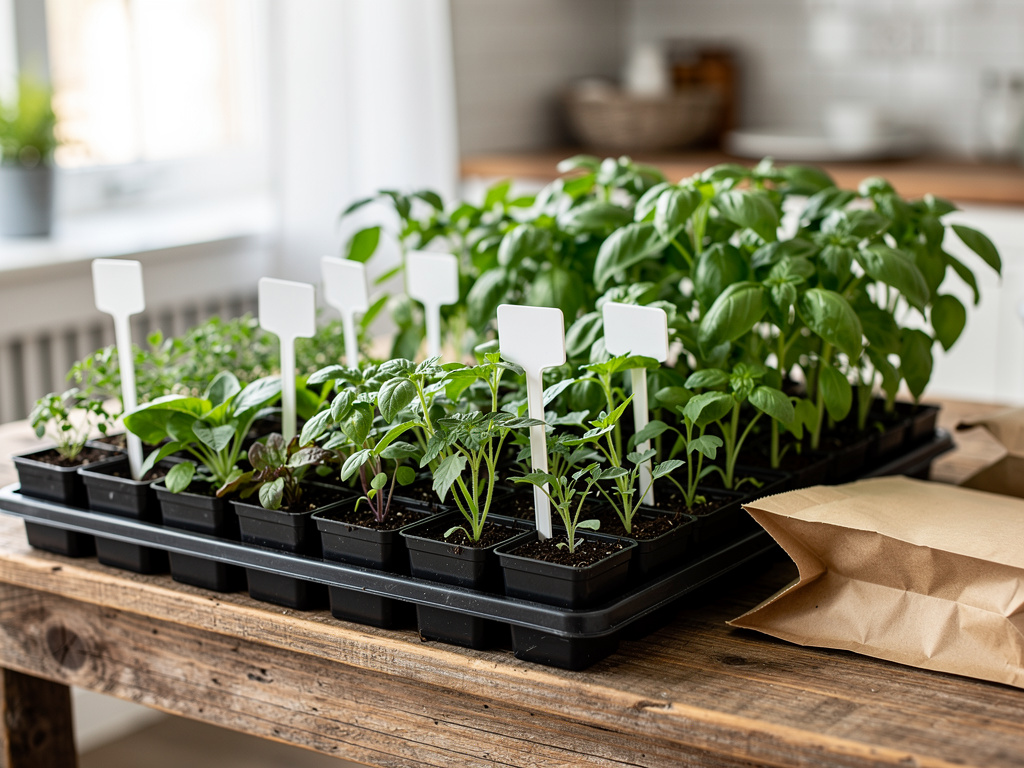


The short version: Charge $4 for a vegetable or herb start in a 3.5-inch pot. That is exactly what the one seedling vendor on Homegrown charges for all 43 of their starts, and it sits at a bit more than twice the $1.75 it costs to grow one at small-quantity supplier prices. Potting mix, not seed, is the biggest cost at $0.87 a pot. Plan on 1 in 6 plants not selling, which lifts your real cost to $2.10 per plant sold. A 5.25-inch jumbo pot costs $4.91 to grow and needs $10. Sell in threes where you can, because card processing at 2.9% plus 30 cents takes about 10% of a single $4 online sale but only about 5.6% of an $11 three-plant bundle.
Checked on September 22, 2026: seed, pot, tray and potting mix prices come from Johnny's Selected Seeds product pages loaded that day. Fees come from findhomegrown.com/signup, etsy.com/sell, squareup.com/us/en/pricing and shopify.com/pricing, loaded the same day. The $4 market price comes from a pull of Homegrown's live catalog that day. Honest bounds: these are supply costs, not a promise about what your town will pay, and your own sell-out time is the only real test. Homegrown customers create an account to place their first order.
Every spring the same question shows up at the seed-starting shelf: you have trays of tomato, pepper and basil starts coming along nicely, and no idea whether a young plant in a small pot is worth $2, $4 or $6 at the market.
Seedlings are easier to price than most people think, because every input is sold at a published price. Seed comes by the packet, pots come by the sleeve, and potting mix comes by the bag. Add those up per pot, allow for the plants that never sell, and the price falls out.
This guide builds that cost from real supplier prices loaded the day it was written, then sets a price for the pot sizes a part-time vendor actually sells. It also shows what card fees take out of a $4 sale, and what a whole spring looks like at three sizes of operation.
Charge $4 for a standard vegetable or herb start in a 3.5-inch pot. That covers tomatoes, peppers, basil, cabbage, broccoli, cucumbers and most herbs. It is the price the one seedling vendor on Homegrown uses for all 43 of their starts, and it leaves a clear margin over what the plant costs you.
Three things back that number:
If you are still deciding whether to grow starts for sale at all, what to grow and where to sell them, start with how to sell plants and seedlings at farmers markets. This guide picks up where that one leaves off: the actual numbers behind the price tag. That guide's pricing table now uses the same $1.75 to $1.85 for a potted tomato or pepper, because the pot costs $0.53 and the potting mix $0.87 at small-quantity supplier prices loaded on September 22, 2026.
A $4 price works best as the default for plants the garden center also carries. For varieties it does not stock, like a named heirloom or an unusual pepper, $5 is a reasonable test price. The one rule is to never price below twice your cost per pot, which is $3.50 for the tomato start costed below.
It costs $1.75 in supplies to grow one tomato start in a 3.5-inch pot at small-quantity prices, and $1.51 when you buy pots, seed and mix in bulk. Those totals come from five lines, each priced on Johnny's Selected Seeds product pages on September 22, 2026.
The method is simple. You sow each seed in a small cell of a 128-cell plug flat, then move the young plant up into its 3.5-inch pot once it has true leaves. The pot sits in a standard 1020 tray (a 10-by-20-inch carry tray), which holds 18 of them.
Scroll sideways to see every column.
| Cost line | What it is | Small quantities | Bulk |
|---|---|---|---|
| Seed | One Sun Gold tomato seed | $0.16 (packet of 40 for $6.45) | $0.12 (250 seeds for $28.80) |
| Plug cell | One cell of a 128-cell flat to start it in | $0.03 (5 flats for $19.50) | $0.03 |
| Pot | 3.5-inch square plastic pot | $0.53 (18 for $9.50) | $0.35 (540 for $189) |
| Potting mix | About 0.7 quart to fill the pot | $0.87 (20-quart bag, $24.95) | $0.85 (45-quart bag, $54.90) |
| Carry tray | One eighteenth of a 1020 tray | $0.16 (5 trays for $14.50) | $0.16 |
| Total per pot | $1.75 | $1.51 |
We checked every price in this table on Johnny's Selected Seeds product pages on September 22, 2026. Johnny's sells the 3.5-inch pot as its Maxi Square Plastic Pots, 3 1/2 inches square by 3 1/2 inches deep. Trays and pots are reusable, so their share drops in your second season. Shipping is not included.
Where the $1.75 goes in one 3.5-inch tomato start
Source: Johnny's Selected Seeds product pages, loaded September 22, 2026, small-quantity prices. Water, power and labels are not included.
The number that surprises most growers is how little the seed matters. One seedling-sale guide puts it at 10 to 30 cents a plant for a 72-cell tray, counting seed, soil and labor, and that is roughly right for a plant in a cell. It is not right for a plant sitting in a pot of soil, ready to sell. Seed matters far more when the seed itself is the product: seven seed companies charged $2.95 to $5.50 for one Cherokee Purple tomato packet on October 1, 2026, and pricing packets of seed you saved yourself starts from that range.
Potting mix costs you $0.87 a pot, the biggest single line, because a 3.5-inch pot holds almost three quarters of a quart and the Fort Vee mix priced here runs about $1.25 a quart. At 0.7 quart a pot, that is $0.87 of mix in every tomato start, half the total cost.
Here is the math, so you can redo it with your own bag:
Buying the 45-quart bag only moves that to $0.85, so bag size is not where the savings are. The bigger levers are these:
Plan your spring in trays, not plants. Eighteen 3.5-inch pots fit in one standard 1020 tray, so 10 trays is 180 plants and 30 trays is 540. Counting shelf space in trays tells you how many plants you can actually grow before you buy a single seed.
Every crop here costs between $1.67 and $1.85 to grow in a 3.5-inch pot, from basil at the low end to a hybrid pepper at the top. The pot, mix, tray and plug cell cost the same for every crop. Only the seed changes. Basil you leave in the ground earns its money a different way, as cut bunches, and the guide to how much to sell herbs for works out why a $3 bunch clears its cost where a $2 bunch does not.
Swipe across to read the whole table.
| Crop | Seed checked | Seed cost per pot | Total cost per 3.5-inch pot | Price at $4 | Left per plant |
|---|---|---|---|---|---|
| Tomato | Sun Gold F1, 40 seeds for $6.45 | $0.16 | $1.75 | $4.00 | $2.25 |
| Pepper | Pantera F1 jalapeño, 25 seeds for $6.45 | $0.26 | $1.85 | $4.00 | $2.15 |
| Basil | Genovese, 200 seeds for $5.25, 3 seeds a pot | $0.08 | $1.67 | $4.00 | $2.33 |
Seed prices from Johnny's Selected Seeds packet pages, checked September 22, 2026. Every row uses the same $1.59 of plug cell, pot, mix and tray from the small-quantity column above. "Left per plant" is before card fees, booth fees and plants that do not sell.
Two practical points come out of this table:
This is why one flat $4 price across your whole table is easy to defend. Your costs barely differ, and one price makes the sign, the math and the change-making simpler.
Set your seedling price in five steps: cost one pot, double it for your floor, check that floor against the plants that will not sell, check the local going rate, and pick a round number. It takes about 15 minutes with your receipts in front of you.
If the floor from step 2 is higher than the going rate from step 4, look at your cost before you look at your price. Usually the mix or the pot size is the fix.
Charge $10 for a tomato in a 5.25-inch jumbo pot, because it costs $4.91 to grow and needs the same twice-your-cost floor as a $4 start. Bigger pots hold much more mix, and the mix is what you pay for.
Scroll right for the rest of each row.
| Pot size | Mix it holds | Pot cost | Total cost to grow | Twice your cost | Suggested price |
|---|---|---|---|---|---|
| 3.5-inch square (18 per tray) | About 0.7 quart, $0.87 | $0.53 | $1.75 | $3.50 | $4 |
| 5.25-inch jumbo square (8 per tray) | About 2.5 quarts, $3.12 | $1.24 | $4.91 | $9.82 | $10 |
Pot prices from Johnny's Selected Seeds on September 22, 2026: Maxi 3.5-inch pots at 18 for $9.50, Jumbo 5 1/4-inch by 5 1/2-inch pots at 8 for $9.95. Mix at the 20-quart bag price of $24.95. The jumbo row adds a $0.36 tray share, because only 8 fit in a tray. Both pots are filled the same way: about 95% of their brim-full volume, leaving room to water. The jumbo pot holds 5.25 x 5.25 x 5.5 = 151.6 cubic inches, or 2.63 quarts, brim-full.
A big pot earns its price when the plant in it is bigger too. The NC State bulletin Retailing Vegetable Transplants describes growers staking early tomatoes in gallon-size pots so they are ready on the first frost-free date, and marketing them to the neighbor who wants the first ripe tomato on the block. That is the buyer for a jumbo pot. Houseplants follow the same rule: one online plant shop listed its common plants at $12 to $15 in a 4-inch pot and $18 to $25 in a 6-inch pot, and pricing houseplants by pot size works the same way for a home vendor.
Use the jumbo size for:
Sell singles at $4, and offer three for $11, because the fixed part of the card fee hits small tickets hardest. On a single $4 plant sold online, 2.9% plus $0.30 comes to $0.42, more than a tenth of the sale. On the $11 three-plant bundle, it is $0.62, about 5.6%.
A bundle price gives your customer a reason to take the third plant and lowers your fee per plant at the same time. There is a longer walk-through of how to set these in bundle pricing for food vendors, and it applies to plants the same way.
Bundle ideas that sell at a plant table:
Check the tray price against your floor before you print the sign. 18 plants at $4 is $72, so $65 works out to $3.61 a plant. That is still above the $3.50 floor for the small-quantity cost, and well above $3.02, twice the $1.51 bulk cost. A flat sale also moves 18 plants in one conversation.
If you already sell starts as a flat to another grower or a shop, the same floor applies: never below twice your cost per pot.
Plan on 5 of every 6 seedlings selling, and price as if the sixth costs you money, because it does. With 1 in 6 unsold, the $1.75 tomato start really costs $2.10 per plant you sell.
Plants go unsold for predictable reasons:
The NC State bulletin is blunt about the last one: know when to throw out poor quality plants, and grow them robust and in proportion to the container, and you can potentially sell them all. A leggy tomato at a lower price still tells customers something about your table.
Track the number. Count what you brought and what you took home every market day, by variety. After two weekends you will know your real sell-through, and you can swap the 5-in-6 guess for your own figure in the step-by-step pricing above.
At $4 a plant with 5 of 6 selling, 6 trays leaves about $171 over supplies, 30 trays about $985, and 60 trays about $1,969. Bulk prices cut the cost per pot from $1.75 to $1.51 from the 30-tray size up, so the two larger seasons keep more of each $4 sale.
Swipe sideways for all seven columns.
| Season size | Pots grown | Cost per pot | Supplies | Plants sold (5 of 6) | Sales at $4 | Left over supplies |
|---|---|---|---|---|---|---|
| One grow shelf, 6 trays | 108 | $1.75 (small quantities) | $189.00 | 90 | $360 | $171.00 |
| A spare room, 30 trays | 540 | $1.51 (bulk) | $815.40 | 450 | $1,800 | $984.60 |
| A small greenhouse, 60 trays | 1,080 | $1.51 (bulk) | $1,630.80 | 900 | $3,600 | $1,969.20 |
Built from the September 22, 2026 Johnny's Selected Seeds prices above. "Left over supplies" is before booth fees, card fees, electricity for lights and heat mats, labels and your time. The 5-in-6 sell-through is an example to replace with your own count.
Those numbers are why seedlings work as a side product rather than a whole business. The window is short, and the money arrives in a few weekends around your last frost date.
On a $12 order of three plants, card processing takes between $0.46 and $0.65 on the four setups in the table below, depending on how it is paid, and Etsy takes $1.59. The difference matters more on plants than on most products, because the tickets are small.
Scroll right for all eight columns.
| Platform | Monthly plan | Trial | Platform fee | Card processing | Customer pays on a $12 order | Vendor pays on a $12 order | Vendor pays in a month of 50 orders at $12 |
|---|---|---|---|---|---|---|---|
| Homegrown | $10 billed annually ($12.50 monthly) | 7 days, no charge until day 8 | None, 0% commission | 2.9% + $0.30, paid by the vendor | $12.00 | $0.65 plus the plan | $42.40 |
| Square Free, card reader at your table | $0 per location | No plan to try | None | 2.6% + 15¢ tap, dip or swipe | $12.00 | $0.46 | $23.10 |
| Shopify Basic | $29 billed yearly ($39 monthly) | 3 days, then $1 a month for 3 months | None with Shopify Payments (2% with another provider) | 2.9% + 30¢ online, standard cards (3.5% + 30¢ premium cards) | $12.00 | $0.65 plus the plan | $61.40 |
| Etsy | $0 (a one-time shop setup fee may apply) | No plan to try | $0.20 listing + 6.5% transaction; 15% on Offsite Ads sales | 3% + $0.25 | $12.00 plus shipping | $1.59 | $79.50 |
We checked every rate on the company's own page on September 22, 2026: findhomegrown.com/signup, squareup.com/us/en/pricing, shopify.com/pricing and etsy.com/sell. Monthly totals use annual billing. The Etsy row assumes the three plants sell as one bundle listing and no Offsite Ads fee, and its $1.59 leaves out the 6.5% and processing Etsy also charges on any shipping you add. The Square row is priced as a card reader for in-person sales at your table, plus the card reader you have to buy.
Read the table by how you actually sell:
Put your varieties, quantities and $4 price on a page people can order from, and let the page tell them when a variety is gone. Seedlings are the product where that matters most: the popular varieties can go early in the morning, and the people who missed them want to reserve next week's.
Many growers handle that through text threads and Facebook messages, which means Thursday night spent checking whether you still have the Cherokee Purple against twenty separate conversations. A Homegrown storefront is $10 per month billed annually with no percentage fees beyond standard payment processing (2.9% + $0.30, paid by you, never added to the customer's total). Compare that to Shopify Basic at $29 a month billed yearly plus 2.9% + 30¢ processing for a full website you have to build, or Etsy's 6.5% transaction fee plus 3% and $0.25 processing on a product that does not ship well.
What it does for a plant table:
Honest bounds: Homegrown does not help you grow starts, pick varieties or register to sell plants in your state. Customers create a Homegrown account to place their first order. There is no timed release or countdown feature for opening a batch. Your storefront is listed on the Homegrown marketplace, but plan on most orders coming from people you send to your own link, from the sign at your table or the post you share.
Seedling demand peaks in the weeks right around your last frost date and falls off once most gardens are planted. Timing, more than price, decides how many plants you sell at $4.
Get your local last frost date from your state's extension service, then count back from it to set sowing dates, so your plants are the right size when shoppers are ready to plant. The USDA Plant Hardiness Zone Map answers a different question: which perennial herbs and plants survive your winter. How the season usually runs for a small plant table:
When sales slow, you have three honest choices: pot the healthy ones up into a bigger pot and sell them as larger plants at a higher price, move the rest in a flat deal, or compost the ones that have stretched. Cutting the price on tired plants trains your regulars to wait for the end of the season.
Many states treat anyone who sells plants as a nursery dealer or plant dealer, and some require a registration or an inspection before you sell, even at a farmers market. The rules and any fees vary by state, so check with your state department of agriculture before your first market day and verify your state's current rules each spring. In Texas, a $180 Class M license for market vendors costs as much as 45 seedlings at $4, and our guide to the rules for selling homemade seedlings lists what 10 states charge a small grower. The licensing section of our farmers market plant guide walks through how to find your state's nursery dealer license.
Electricity, labels, water, booth fees and your time never show up in the per-pot cost, and together they are why your price needs to be about twice your supply cost, not just above it. None of them are large per plant, but all of them are real.
Work each one out once:
The NC State bulletin makes a point that belongs here too: let the foliage sell the plant, but let the signage sell the pack or flat. Its sign carries growing basics like days to maturity and spacing. Add the price and the three-for deal to that sign, and it is a cost that earns itself back.
The costliest mistake is pricing from the seed packet instead of the finished pot, which leads to $2 plants that barely cover their own soil. A $2 start costs $1.75 to grow and leaves you 25 cents before a single fee.
Other mistakes that cost new plant vendors money:
When you are ready to raise a price you set too low, raising prices without losing customers walks through how to say it.
Your price is right when your best varieties sell out by midday and fewer than 1 in 6 plants go home with you. Sell out in the first hour and you are probably too cheap. Carry home a third of the table and it is timing, variety or price, in that order.
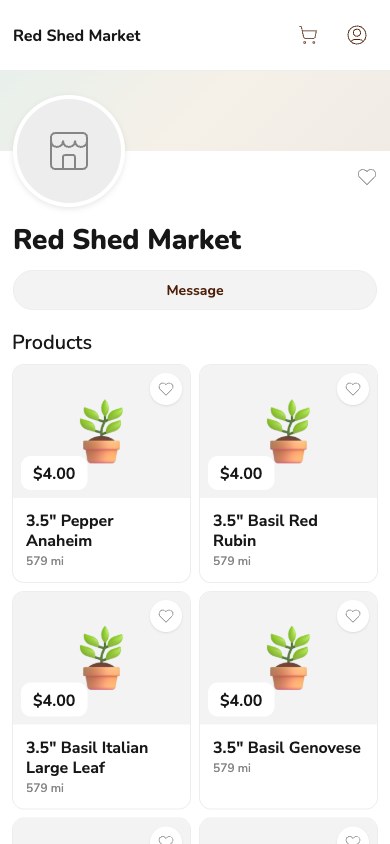
In a pull of the Homegrown catalog on September 22, 2026, 104 of the 2,585 products listed by 293 vendors were in Plants and Flowers. Most were cut flowers, houseplants and mushroom kits. Only one vendor, Red Shed Market, listed vegetable and herb starts: 43 of them, all in 3.5-inch pots at $4.00 each, made up of 16 peppers, 14 tomatoes, 3 basils, 2 cabbages, 2 cucumbers and 1 each of Brussels sprouts, broccoli, cauliflower, dill, tomatillo and eggplant. These are listings, not sales.
The signals to watch each market day:
After one full season you will have your own cost per pot, your own sell-through and your own sell-out times. Those three numbers set next year's price better than any guide, including this one.
Sell tomato seedlings in a 3.5-inch pot for $4, and try $5 on named heirloom varieties the garden center does not carry. A 3.5-inch tomato start costs about $1.75 to grow at small-quantity supplier prices, so $4 leaves room for plants that do not sell and for card fees.
A vegetable start in a 3.5-inch pot costs about $1.75 in seed, pot, potting mix and tray at small-quantity prices, and about $1.51 in bulk, based on Johnny's Selected Seeds prices checked September 22, 2026. Potting mix is the largest part at about $0.87 a pot. That figure does not include electricity, labels or your time.
Yes, for a plant in its own 3.5-inch pot. At $2 you keep about 25 cents over supplies before any fee, and a single $2 online sale then pays about $0.36 in card processing, so you lose about 11 cents on every plant. A $1 or $2 price only makes sense for plants in small cells, where the mix and container cost a fraction of a 3.5-inch pot.
A standard 1020 tray holds 18 plants in 3.5-inch pots, which is $72 at $4 each. A flat price of $65, or $3.61 a plant, rewards the bulk buyer and still sits above twice your supply cost. Set your flat price by checking it against double your own cost per pot.
For the same pot size, yes, in most cases. Tomato, pepper and basil starts cost within 20 cents of each other to grow, so one price keeps your sign and your change-making simple. Save a higher price for a genuinely hard-to-find variety or a larger pot.
Yes. Many plant vendors list their varieties with quantities on an order page, take payment when the customer orders, and hand the plants over at the market or at home. Card processing online runs about 3% plus 25 to 30 cents per order (2.9% plus 30 cents on Homegrown), so bundling plants into one order keeps that cost down.
More on growing and pricing plants and produce for a local market:
Your seedling list belongs on a page customers can order from, so your best varieties are reserved and paid for before Saturday. That turns "sold out by 9" into "picked up by 9."
The work before spring is short. Most of it is a one-evening job with your seed order and a calculator, and the rest is putting the list somewhere customers can find it between markets.
If you do those four things, you walk into your first spring market knowing your cost per pot, your floor price and which varieties are already spoken for.



