
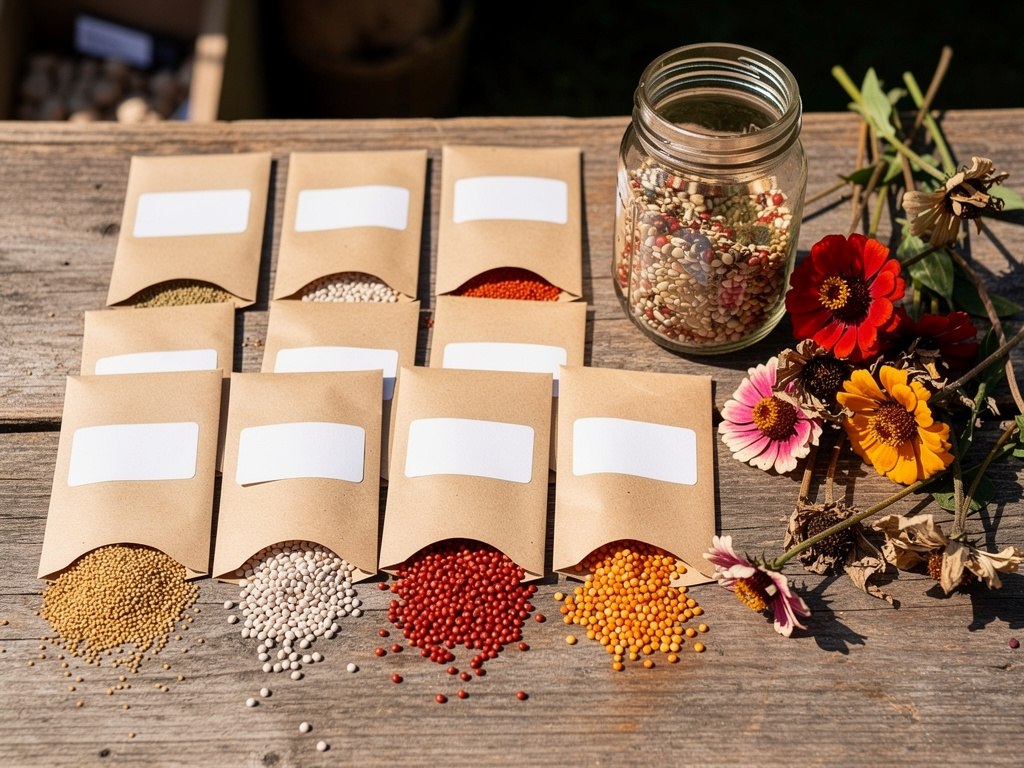


The short version: Charge $3.50 for a packet of 25 to 50 seeds you saved yourself, and $4 for a rare or hard-to-find heirloom. Seven seed companies we checked on October 1, 2026 charge $2.95 to $5.50 for a packet of Cherokee Purple tomato seed, with a middle price of $3.95. The envelope costs you about 4 cents, so your real costs are the paperwork: many states want a seed permit ($10 to $75 a year in the states we checked), and some want lab tests on every variety, which start at $136 a lot at Washington's state seed lab for the germination and noxious weed tests together. Sell fewer varieties in bigger batches, and sell three packets for $10 so card fees stay small.
Checked October 1, 2026: packet prices on seven seed company websites, fees on findhomegrown.com/signup, etsy.com/sell, squareup.com/us/en/pricing and shopify.com/pricing, and seed rules on the agriculture department or statute pages of seven states. Honest bounds: seed law differs in every state, so verify your state's current rules, and Homegrown handles pickup and local delivery, not mail shipping, with customers creating an account to place a first order.
You let a row of tomatoes go to seed, scooped out the best fruit, and now you have a jar of clean, dry seed that would fill fifty packets. Gardeners at your farmers market buy seed every spring. The question is what one of your packets is worth next to the racks at the hardware store.
This guide answers it with numbers loaded the day it was written. It compares what seven seed companies charge for the same tomato, works out what a packet costs you to fill, and covers the part most guides skip: selling seed is regulated by state seed laws, and a permit or a lab test can cost more than the envelopes.
We recommend $3.50 for a packet of 25 to 50 open-pollinated vegetable or flower seeds that you grew and saved yourself, and $4 for a rare or hard-to-find heirloom. That is close to what established seed companies charge, a little under the middle of the range, which suits a hand-packed envelope from a local grower.
Three things back that number:
If you also grow starts for spring, our guide to selling plants and seedlings at farmers markets covers the booth side of a plant table. Seed packets fit on the same table. This guide sticks to pricing, packing and the rules for the packets themselves.
The one price to avoid is $1. A $1 packet looks like leftovers, and on an online card sale the fixed 30 cents of processing takes nearly a third of it.
Seed companies charge $2.95 to $5.50 for a packet of one popular heirloom tomato, Cherokee Purple, and most land between $3.45 and $3.99. Using one variety across every company keeps the crop the same. Seed counts still differ from company to company, so the table below shows the price per seed too.
Scroll sideways to see each company's seed count and price per seed.
| Seed company | Price for one packet | Seeds in the packet | Price per seed |
|---|---|---|---|
| Holmes Seed | $2.95 | About 50 | About $0.06 |
| Victory Seeds | $3.45 | About 20 | About $0.17 |
| Baker Creek Heirloom Seeds | $3.50 | At least 25 | $0.14 |
| Sow True Seed | $3.95 | At least 40 | About $0.10 |
| Ferry-Morse | $3.95 | About 90 to 110 (400 mg) | About $0.04 |
| Thresh Seed Co. | $3.99 | 50 | About $0.08 |
| Johnny's Selected Seeds (certified organic) | $5.50 | 25 | $0.22 |
We checked every price on each company's Cherokee Purple product page on October 1, 2026. Price per seed uses the seed count the page states. Shipping is not included.
One Cherokee Purple packet, seven seed companies
Source: each company's Cherokee Purple product page, loaded October 1, 2026. 7 packets. Johnny's packet is certified organic.
What a store pays is useful too. Southern Exposure Seed Exchange sells packets to garden centers for seed racks, and its 2027 season pricing for an order of 150 to 399 packets is $1.99 a packet if the store keeps everything, or $2.65 if the store can return up to 40% of the packets it ordered for credit toward next year's order. So a shop that buys from you wholesale will not pay $3.50. Expect a store to want your packet for about $2, so it can sell it near the $3.95 middle retail price in the table above.
Put 25 to 50 seeds in a tomato or pepper packet, which is what Baker Creek, Johnny's, Holmes and Thresh pack in a Cherokee Purple tomato packet, and count rather than weigh small batches. Twenty-five tomato seeds is more plants than most home gardeners have room for, and it gives them a few spares for seeds that do not sprout.
Counting matters because tiny seeds weigh almost nothing. Johnny's lists Cherokee Purple at an average of 10,900 seeds per ounce, so 25 seeds weigh about 0.065 grams. Most kitchen scales cannot read that, so a scale only helps once you are filling hundreds of packets.
Use these counts as a starting point, then match whatever the companies above put in the same crop:
Price per seed falls fast at bigger sizes. Johnny's charges $5.50 for 25 Cherokee Purple seeds, 22 cents a seed, but $9.70 for 250, about 4 cents a seed. If a market gardener asks for 250 seeds, quote a bigger pack at a lower price per seed, such as $10 for 250, instead of selling ten $3.50 packets.
The cash cost of one packet is about 4 cents for the envelope, plus your share of any permit and lab test, which can run from nothing to several dollars a packet ($2.72 on a 50-packet Washington lot) depending on your state and how many packets each variety fills. Your own seed costs no cash, but your time and your paperwork do.
Swipe the table to see what each cost line adds to a packet.
| Cost line | What it is | Cost per packet |
|---|---|---|
| Envelope | Kraft coin envelope, 2 1/4 by 3 1/2 inches, $20 for 500 | $0.04 |
| Seed | Saved from your own plants | $0 in cash, your time to grow, dry and clean it |
| Label | Printed straight onto the envelope | A few cents of ink and paper, not counted here |
| Permit, if your state requires one | $20 a year in Washington, spread over 200 packets | $0.10 |
| Lab germination and noxious weed tests, if required | $136 per tomato or pepper lot in Washington, spread over a 50-packet lot | $2.72 |
The envelope price comes from Uline's product page for its S-7798 kraft coin envelope, loaded October 1, 2026, and the Washington permit and test fees on the state's seed labeling permit page and in its seed testing fee rule (WAC 16-303-200) the same day. A lot here means one variety from one harvest.
The last row is why lot size matters more than anything else on the cost side. $136 of tests on a lot that fills 20 packets adds $6.80 a packet, nearly twice a $3.50 price. The same tests on a lot that fills 200 packets add 68 cents. If your state wants lab tests, grow fewer varieties and save more seed from each one.
Your time is the cost the table leaves out. Time yourself filling, sealing and labeling ten packets, then do the math: at one minute a packet, an hour of packing fills 60 packets, which is $210 of sales at $3.50.
In most of the states we checked, yes: selling seed you labeled usually needs a seed labeler permit from the state agriculture department, at $10 to $75 a year for a small grower. A few states exempt seed you grew and sell from your own farm. Seed law is separate from cottage food law and separate from the nursery license that covers live plants. Outside the seven states below, the rules for whether you can sell homemade seeds run from Florida's $10 seed dealer registration to Texas's $350 vegetable seed license, and five states exempt seed you give away free through a seed library or swap.
Drag the state table sideways for each rule and fee.
| State | What the rule says | Small-grower fee |
|---|---|---|
| Washington | A permit is required for any person labeling seed for sale, and the state's small-farm handbook says a farm selling its own seed at farmers markets needs the permit and seed testing | $20 a year |
| Wisconsin | No seed label license needed for seed grown and sold on your own farm | $25 a year if licensed, for sales under $10,000 |
| Iowa | No permit for seed of your own production stored or delivered only on or from the farm or premises where it was grown, but that seed must still be labeled from a lab test | $10 new permit, $30 to renew for sales up to $25,000 |
| California | Every labeler of vegetable seed sold in the state registers each year; flower seed is not covered by the state seed law | $40 a year; no assessment on containers of 4 ounces or less |
| Ohio | A permit is needed to label vegetable or flower seed for sale; germination test completed within 12 months before sale | $50 a year, which covers the 2% fee on packets of 8 ounces or less until that fee passes $50 (about $2,500 of packet sales) |
| Minnesota | A permit is needed to label vegetable and flower seed packed for home gardens | $75 a year for gross sales of $0 to $25,000 |
| Missouri | A permit is needed to sell agricultural or vegetable seed (the law does not name flower seed); a person selling only labeled seed grown on their own property pays the lowest fee, and a farmer selling unlabeled seed of their own production is exempt unless they ship it by common carrier, sell it through a public sales service, or advertise its germination or purity (RSMo 266.031.2) | $20 a year |
Sources, each loaded October 1, 2026: the Washington State Department of Agriculture seed labeling permit page and its 2019 small-farm handbook chapter on selling seeds, the Wisconsin DATCP seed labeling page, Iowa Code chapter 199 (2026), the California Department of Food and Agriculture 2026-27 seed sales application instructions, the Ohio Department of Agriculture seed page, Minnesota Statutes 21.89 and 21.891, and Missouri statutes 266.031 and 266.080.
Two states show how wide the range is. Washington's seed labeling permit costs $20 and applies to anyone labeling seed for sale in the state. Wisconsin's seed labeling page says you do not need a license for seed grown and sold on your own farm.
Read exemptions like Iowa's and Wisconsin's word for word. Both tie the exemption to the farm where the seed grew. Read literally, a customer picking up at your place fits, and a table at a farmers market across town does not obviously fit. Ask your state's seed program before you count on it.
Some online guides say small seed vendors are exempt from licensing below a yearly sales figure. None of the seven states we checked on October 1, 2026 waives the seed permit below a sales figure. Washington, California, Ohio, Minnesota and Missouri require a permit for labeled vegetable packets from the first sale, and Washington, Ohio and Minnesota also cover flower seed. The exemptions in Wisconsin and Iowa depend on where the seed is grown and sold, and Missouri exempts a farmer selling unlabeled seed of their own production unless it is shipped by common carrier, sold through a public sales service, or advertised for its germination or purity. None of them depends on how much you sell. Verify your state's current rules with its department of agriculture seed program.
A seed packet for home gardeners generally needs the kind and variety, a lot number, the year it was packed for or a germination percentage with a test date, and your name and address. Iowa's seed law asks for those four lines and adds two more, shown as 5 and 6 below. Washington's handbook asks for similar lines plus a few more.
Iowa's code spells out the packet rule in one place. Its chapter 199 on seed says packets of vegetable seed for home gardens must carry:
Other states add their own lines. Washington's handbook lists a minimum germination rate, an arbitration statement and noxious weed information for packets. Ohio requires a germination test within 12 months before sale.
If you mail seed to another state, the federal rules apply too. The Federal Seed Act is a truth-in-labeling law for vegetable and farm seed shipped between states, and its rules (7 CFR 201.26 and 201.27) require the kind and variety, the word "hybrid" on hybrid seed, and the shipper's full name and address on the packet.
You should test every lot either way, and some states, including Washington and Ohio, require a germination test before you sell. For seed you mail to another state, federal rules set a minimum germination rate for each vegetable, and a packet that tests below it must say "Below Standard" with the actual percentage.
Move the table sideways to see how many seeds should sprout in a packet of 25.
| Crop | Federal minimum germination | What it means for 25 seeds |
|---|---|---|
| Tomato | 75% | At least about 19 should sprout |
| Pepper | 55% | At least about 14 should sprout |
| Garden bean | 70% | At least about 18 should sprout |
| Lettuce | 80% | At least 20 should sprout |
| Cucumber | 80% | At least 20 should sprout |
| Squash | 75% | At least about 19 should sprout |
Minimums from 7 CFR 201.31, the federal germination standards for vegetable seed shipped between states, loaded on ecfr.gov on October 1, 2026. States set their own standards for seed sold inside the state.
A lab test is the expensive part. Washington's state lab charges $60 to $82 for a standard 400-seed germination test in 20 of its 21 crop categories, plus an $8 sample processing fee, under its fee rule loaded October 1, 2026. Washington also requires a noxious weed test on every lot, which its lab runs with a purity test for $68 on tomato, pepper, bean and most other vegetable seed. Brassicas like kale and cabbage cost more: $117 for purity, or $185 a lot with germination and the sample fee. So a tomato or pepper lot costs $136 in fees at the state lab before you sell a packet. Flower seed can cost more. Washington's testing category rule lists tomato and pepper in its fruit and vegetable category, but it puts "flowers" with native species in a separate category, charged $90 for purity and $146 for germination. With the $8 sample fee, that is $244 a lot, or about 70 packets at $3.50, so ask the lab which category your flower lot falls in before you price it. Washington's small-farm handbook also says any lab that tests by Association of Official Seed Analysts (AOSA) rules may analyze seed for your labels, so the price depends on the lab you use.
A home test tells you whether a lot is worth packing at all, even where the law asks for a lab:
If a lot sprouts poorly at home, do not pay for a lab test on it. Compost it or keep it for your own garden.
Sell seed from open-pollinated varieties that are not under Plant Variety Protection, which lasts 20 years, and skip hybrids and protected varieties. Heirlooms like Cherokee Purple are open-pollinated, so their seed grows into plants like the parent.
Three kinds of seed cause trouble:
When you are not sure, sell the variety name only for seed whose parent you know. Your lot notebook, with the packet the original seed came from, is your proof.
Set your seed price in five steps: check the going rate, count your seeds, add up your paperwork per packet, set a floor, and round. It takes one evening with a calculator and your state's seed program page open.
If your paperwork share is under 50 cents a packet, $3.50 leaves you about $3 a packet before card fees and your time. If it is over $1.50, cut the number of varieties before you raise the price.
Yes, roughly: most of the flower, bean and tomato packets we checked sold between $3 and $4, so one price of $3.50 works across a seed table. The crop changed the seed count far more than the price.
The numbers we loaded on October 1, 2026 show how flat it is:
A flat price makes your table simple. A sign that says "$3.50 a packet, 3 for $10" covers every envelope, and customers mix flowers and vegetables in one bundle. Charge $4 only for varieties that are hard to find, like a family heirloom with a story you can print on the packet. If you also sell cut stems, our guide to pricing cut flowers covers the bouquet side, and zinnia seed is an easy add-on for flower buyers.
California is one place where flower seed is treated differently. The state's seed law registration covers vegetable and agricultural seed, and CDFA's instructions say flower seed is not covered by the California Seed Law.
Sell single packets at $3.50 and offer three for $10, because card fees take a bigger bite out of small tickets. On a single $3.50 packet paid online at 2.9% plus 30 cents, processing comes to 40 cents, about 11% of the sale. On a $10 three-packet order it is 59 cents, about 5.9%.
A bundle helps in three ways:
Themed sets are easy to sign once you know your best sellers. A "salsa garden" of a tomato, a pepper and cilantro, or a "cutting garden" of three zinnias, can carry $10 without a sign explaining the math.
On a $10 three-packet order, card processing costs you 59 cents on Homegrown at 2.9% plus $0.30, and Homegrown's $10 a month plan, billed annually ($12.50 billed monthly), is the only other cost. The table shows the full fee stack for each option on that order and on a month of 50 such orders.
Slide the fee table sideways to see every platform's full cost.
| Platform | Monthly plan | Trial | Platform fee | Card processing | Customer pays on a $10 order | You pay on a $10 order | You pay in a month of 50 orders |
|---|---|---|---|---|---|---|---|
| Homegrown | $10 billed annually ($12.50 billed monthly) | 7 days, no charge until day 8 | None, 0% commission | 2.9% + $0.30, paid by you | $10.00 | $0.59 plus the plan | $39.50 ($42.00 on monthly billing) |
| Etsy, shipped | $0 | No plan to try | $0.20 listing fee per packet sold, plus 6.5% of the sale including shipping | 3% + $0.25 | $11.50 with $1.50 shipping | $1.94, and you buy the postage | $97.13 |
| Square Free plan, online | $0 | Free plan | None | 3.3% + 30¢ online | $10.00 | $0.63 | $31.50 |
| Square Free plan, tapped at a table | $0 | Free plan | None | 2.6% + 15¢ in person | $10.00 | $0.41 | $20.50 |
| Shopify Basic | $29 billed yearly ($39 billed monthly) | 3 days, then $1 a month for 3 months | None with Shopify Payments, 2% without | 2.9% + 30¢ | $10.00 | $0.59 plus the plan | $58.50 ($68.50 on monthly billing) |
Fees come from Homegrown's signup page, Etsy's sell page, Square's pricing page and Shopify's pricing page, all loaded October 1, 2026. Etsy's row assumes three packets from three listings, each renewing at $0.20 when it sells, and a $1.50 shipping charge. Etsy may also charge a one-time shop set-up fee and a 15% Offsite Ads fee on sales from its ads. Taxes are not included.
What the table means for a seed table:
Gardeners plan their seed list before planting, and a gardener who sees your list in February wants to know you will still have the Cherokee Purple in April. Putting your packet list on an ordering page lets them pay for it now and pick it up at the market or at your place.
Homegrown is $10 a month billed annually ($12.50 billed monthly) with no percentage fees beyond standard payment processing of 2.9% plus 30 cents. You list each variety with its price, set how many packets you have so the count drops as orders come in, and set the pickup days and spots, including your market and your own porch. A "3 for $10" bundle can be its own product. Compare that to Etsy, which charges $1.94 on a $10 three-packet order and is built around mailing, or to collecting seed requests over Facebook messages and keeping the count in your head.
Here is what Homegrown does not do. It handles pickup and local delivery within 1 to 25 miles, not mail-order shipping, so if most of your buyers are out of state, Etsy fits better. Customers create a Homegrown account to place their first order. Your storefront is listed on the Homegrown marketplace, but plan on most orders coming from people you send to your own link, such as a QR code on your seed table sign.
If your seed list changes every season, set up your Homegrown storefront before seed-starting season so regulars can reserve packets of each variety before the market opens.
At $3.50 a packet in a state with Washington's fees, 200 packets across 5 varieties loses about $8 after envelopes, the permit and lab tests, and 400 packets across the same 5 varieties leaves about $684. The jump comes from selling twice the packets against the same testing bill.
Swipe left for the full season math at each size.
| Season | Packets sold | Varieties tested | Sales at $3.50 | Envelopes | Permit and lab tests | Left before booth and card fees |
|---|---|---|---|---|---|---|
| Small | 100 | 2 | $350 | $4 | $292 ($20 + 2 x $136) | $54 |
| Medium | 200 | 5 | $700 | $8 | $700 ($20 + 5 x $136) | A loss of $8 |
| Larger | 400 | 5 | $1,400 | $16 | $700 ($20 + 5 x $136) | $684 |
Uses Washington's $20 seed labeling permit and its tomato and pepper seed lab fees of $60 for germination, $68 for purity and noxious weeds and $8 for sample processing, all checked October 1, 2026, and the Uline envelope price checked the same day. A state with no lab test requirement cuts the last cost column to the permit alone. An exemption for seed sold from your own farm drops the permit, but not always the test: Iowa's own-farm seed must still be labeled from a lab test.
Each tested lot needs about 39 packets sold at $3.50 just to pay its $136 of tests. That is why, in a state that requires lab tests, seed pays when you sell 50 or more packets of each of a few varieties, not 3 packets each of 30.
In a pull of the Homegrown catalog on October 1, 2026, none of the 2,752 products from 308 vendors was a packet of garden seed for planting. We searched every product name and description for "seed", "seeds" and "seed packet", then opened all 105 listings in the Plants and Flowers category. The closest matches were a $59.99 microgreens grow kit that includes three packets of microgreen seed, and $15 mushroom spawn plugs. Red Shed Market lists 43 vegetable and herb starts at $4 each, so seed would sit next to plants that local gardeners can already order.
A one-ounce letter costs $0.82 with a stamp, and USPS can add a $0.49 nonmachinable surcharge to a lumpy envelope, for $1.31. Those prices come from the USPS price list effective July 12, 2026, loaded October 1, 2026.
A few packets in a regular envelope usually stay under an ounce. Seeds make an envelope lumpy, though, and a lumpy, rigid or uneven letter can be charged the surcharge. A padded mailer is safer for the seed, and it moves you into a higher price class.
Mailing also changes which rules apply:
If you sell mostly at one market, local pickup avoids all three. If you also grow starts, our guide on where to sell seedlings compares the places where a plant and seed table does well.
The costliest mistake is skipping the paperwork math, because one lab test can cost more than every envelope you will fill this year. The other mistakes are about matching the market.
Seed packets also sit well next to other small-grower products. Microgreen growers already buy seed by the pound, and our guide on how to sell microgreens shows how that business runs week to week.
A fair price is $3.50 for 25 to 50 open-pollinated seeds you saved, and $4 for rare heirlooms. Seven seed companies charged $2.95 to $5.50 for a Cherokee Purple tomato packet on October 1, 2026, with a middle price of $3.95. Offer three packets for $10 to keep card fees low.
It can be, if each variety fills a big enough lot. The envelope costs about 4 cents, so in a state without testing rules most of a $3.50 packet is yours. In a state that requires lab tests on every lot, as Washington does, a tomato or pepper lot costs $136 at the state lab, so each variety needs about 39 packets sold just to cover its tests.
In most states we checked, yes. Washington, Ohio, Minnesota, California and Missouri charge $20 to $75 a year for a permit to sell labeled vegetable seed, and all but California and Missouri cover flower seed too. Wisconsin and Iowa exempt seed you grew when it is sold from your own farm, and Missouri exempts a farmer selling unlabeled seed of their own production unless they ship it by common carrier, sell it through a public sales service, or advertise its germination or purity. Those farm exemptions cover sales at your farm. Iowa's applies only when the seed is delivered on or from the farm where it grew, so a farmers market table likely does not qualify. Iowa still wants that farm seed labeled from a lab test. Verify your state's current rules with its department of agriculture before you sell.
Most of the Cherokee Purple tomato packets we checked held 25 to 50 seeds (Victory packs about 20, and Ferry-Morse about 90 to 110 by weight), Baker Creek's California Wonder pepper packet holds at least 25, and the one bean packet we checked held about 40. Flowers like zinnias and small seeds like lettuce get more. Count your seeds for small batches, because 25 tomato seeds weigh only about 0.065 grams.
Usually not under the variety's name, because many store vegetables are hybrids, and hybrid seed rarely grows true to the parent. Some are also protected varieties. Seed labels must name the variety (Iowa Code 199.3, 7 CFR 201.26), so a variety name the seed will not grow into makes the label false. Sell seed from open-pollinated plants you know.
A one-ounce stamped letter costs $0.82 under the USPS prices effective July 12, 2026, and a lumpy envelope can add a $0.49 surcharge. Vegetable seed mailed to another state also needs a federal label with the kind and variety and your name and address.
These guides cover the plants, flowers and rules that sit next to a seed table at a small grower's booth.
Ready to let gardeners reserve your seed before spring? Start your Homegrown storefront, list each variety at $3.50 with a three-for-$10 bundle, and put the QR code on your seed table sign.



