
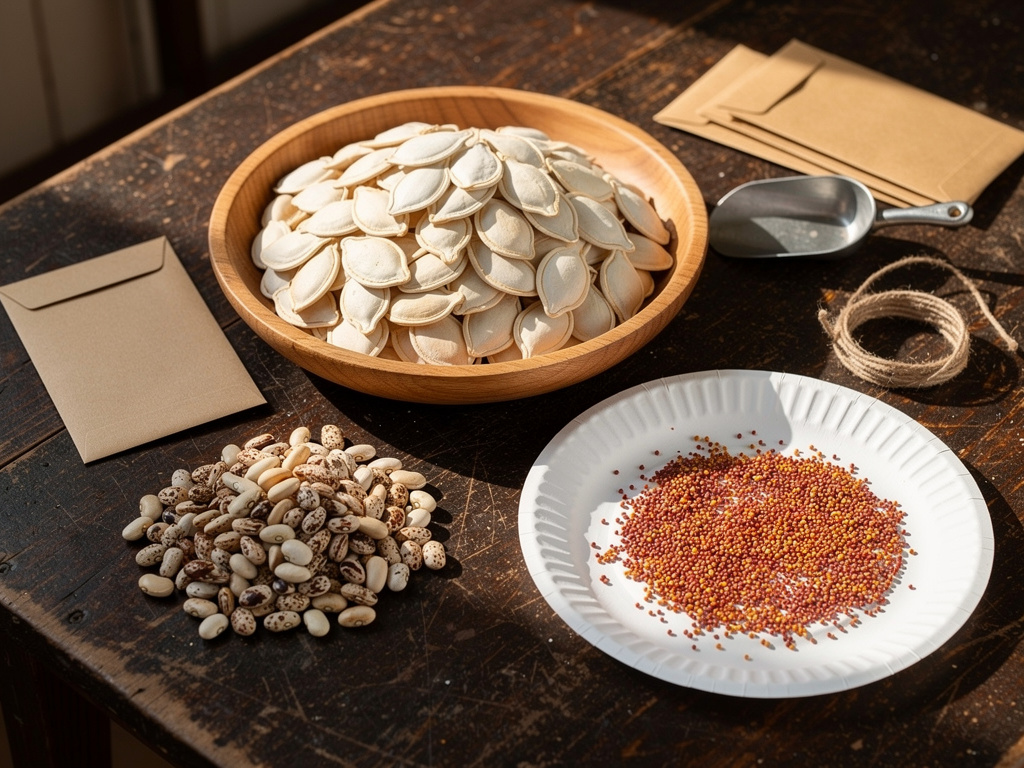


The short version: Yes, you can sell seed you saved in most states, but seed falls under your state's seed law, not its cottage food law. Plan on three things: a label on every packet with the variety, a date and your name and address, a germination test from the last 9 to 15 months in the states we checked, and in most of them a seed license or permit. In the nine states in our license table, that license ran from $10 a year in Florida to $350 in Texas, and Oregon and Illinois from that table, plus Iowa, let you skip it for seed you grew yourself under conditions spelled out in their laws. Giving seed away for free through a seed library or swap is exempt from most of these rules in Minnesota, Illinois and California, while Ohio's exemption covers seed libraries and native or pollinator sharing and Iowa's covers only seed libraries run by a library or food bank, and no state lets you sell a variety that is patented or under Plant Variety Protection without the owner's permission.
Checked October 8, 2026: every state rule here on that state's agriculture department or legislature website, federal rules on ecfr.gov and ams.usda.gov, and platform fees on findhomegrown.com/signup, etsy.com/sell, squareup.com/us/en/pricing and shopify.com/pricing. Seed laws change, so verify your state's current rules with its seed program before your first sale. Homegrown customers create an account to place a first order, and Homegrown handles pickup and local delivery, not mailing packets.
You saved a jar of Cherokee Purple tomato seed last fall, and a few regulars at your farmers market have already asked whether you will have packets in the spring. Selling them feels as simple as selling a jar of jam. It is not quite the same, because seed is a planting product, and every state has a seed law that treats a $4 packet the way it treats a 50-pound bag of farm seed.
The good news is that the rules are short and the costs are small in most places. This guide walks through what those laws ask of a home gardener, state by state, with the exact wording and fees loaded from each state's own site on October 8, 2026.
Selling seed you saved is legal in every state we checked, as long as you follow that state's seed law and the variety is not protected. Three separate layers of law decide what you have to do:
Apart from Florida's unclear farmer clause, no state we checked waives the label or the germination test because you are small. A $4 packet of 25 tomato seeds sold at a folding table counts as seed "offered for sale" in the same way a seed company's rack does.
If you already know you can sell and want to know what to charge, our guide to how much to sell seeds for compares seven seed companies' packet prices and works out what a lab test does to your margin. This guide sticks to the permission question: who needs a license, who is exempt, and what changes when you give seed away instead of selling it.
Cottage food laws cover food you cook at home, and seed sold for planting is not food, so it falls under a separate state seed law run by the agriculture department. That surprises most people who already sell baked goods or jam, because they expect one permit to cover the whole table.
Three different laws can apply to a garden vendor's booth:
Seed law has its own definitions. Texas, for example, defines vegetable seed as "the seed of any crop that is grown in a garden or on a truck farm and is generally known and sold in this state under the name of vegetable seed" (Texas Agriculture Code section 61.001). Seed sold for eating, such as sunflower seeds in a snack bag, is usually outside it. Iowa's seed law exempts "seed or grain not intended for sowing purposes," and Texas exempts the same thing.
The practical result: if you sell starts, seed packets and jam, you may hold three separate permits from two agencies. That is normal. The seed one is often the cheapest: $10 to $30 a year in four of the states in the next section.
Most of the 9 states we checked want a license or permit from the person whose name is on the seed packet, and only Oregon clearly waives it for every sale of seed you grew yourself. Here is what each state's own site said on October 8, 2026.
Swipe the table left to see each state's exemption and fee.
| State | Who needs the license | Exemption for seed you grew | Fee for a small vendor |
|---|---|---|---|
| Washington | Any person labeling seed for sale. The state's small-farm handbook says a farm selling its own seed at farmers markets, farm stands or online needs the permit and seed testing | None for sales to consumers | $20 a year |
| Oregon | Anyone selling agricultural, flower or vegetable seed | No license needed if you sell only seed you produced | $40 a year for a retail seed dealer license, expiring each June 30 (the statute caps it at $75) |
| Texas | Anyone selling vegetable seed for planting, one license per name and address on the label | None for the license. A farmer selling seed from their own farm to another farmer skips only the testing and labeling (Agriculture Code 61.016(c)), and only if the seed is not advertised outside the home county, not sold through someone else on the farmer's behalf, and not shipped by a common carrier | $350 a year |
| Florida | Anyone selling agricultural, vegetable, flower, tree or shrub seed registers as a seed dealer | Farmers selling only uncleaned, unpackaged, unlabeled seed are outside the law; farmers selling packaged, labeled seed over $10,000 a year are covered | $10 under $500 in sales, $25 from $500, $100 from $1,000 |
| Pennsylvania | Every distributor, meaning each name and address printed on the label | None listed on the seed program page | $25 a calendar year |
| North Carolina | Seed dealers, which the law defines as a person "not classified as a grower" | The license is for dealers, and a grower is anyone who produces seed offered for sale, so ask which one you are | $30 retail dealer, $125 wholesale |
| Georgia | All seed dealers, with a separate license for each point of sale | None for the license. Seed you grew and sell at your own farm, without advertising it or sending it by a public carrier, is exempt from the labeling sections (O.C.G.A. 2-11-33), and the state tests seed free for farmers without a seed license (2-11-26) | $100 for a license on a fixed three-year cycle; the current cycle ends July 31, 2027 |
| Illinois | Anyone named as the labeler on the packet | No permit for your own seed when buyers get it at the place it grew | Not stated in the permit section of the law |
| North Dakota | Anyone labeling and selling vegetable or flower seed needs a Seed Sales Permit | None listed | An annual report and a fee based on the volume sold |
Sources, each loaded October 8, 2026: the Washington State Department of Agriculture seed labeling permit page and its "Selling Seeds" small-farm handbook chapter, ORS 633.700 on oregonlegislature.gov and the Oregon Department of Agriculture seed licenses page, the Texas Department of Agriculture seed law page, its vegetable seed license form S297 and Texas Agriculture Code chapter 61, Florida Statutes 578.08 (2025), the Pennsylvania Department of Agriculture seed page, North Carolina General Statutes chapter 106 article 31, the Georgia Department of Agriculture seed page, rule 40-12-8-.01 and O.C.G.A. 2-11-26 and 2-11-33, 505 ILCS 110/10, and the North Dakota Seed Department's regulatory page.
The Texas Department of Agriculture's seed law page puts it in one line: to sell vegetable seed in Texas, "You must have a valid vegetable seed license." Texas has no license exemption for seed you grew. Its one farm rule lets a farmer sell seed to another farmer without testing or labeling it (section 61.016(c)), and section 61.013 still requires the license, so a farmers market full of home gardeners is fully covered.
A seed license for a small vendor cost between $10 and $350 a year in the states we checked, and the middle fee of the seven was $30. The chart shows the first-year cost for the smallest vendor each state's fee schedule describes.
First-year seed license fee for a small vendor
Source: each state's fee page or statute, loaded October 8, 2026. Florida is the fee for under $500 in yearly seed sales. Oregon's $40 is the retail seed dealer license fee on the Oregon Department of Agriculture's seed licenses page (its statute caps the fee at $75), and Oregon needs no license for seed you produced. Georgia's $100 license runs on a fixed three-year cycle that ends July 31, 2027, so a license bought in October 2026 covers about 10 months. North Carolina's $30 is the retail dealer license, which a grower may not need.
The fee is rarely the whole cost. A germination test is required before sale in most of these states, and it is paid per lot. Washington's small-farm guide says growers selling their own seed need "a germination test and a noxious weed test on every lot," which means every variety from every harvest gets its own test.
Two fees hide in the fine print:
Oregon, Illinois and Iowa waive the seed license for seed you grew yourself, and Oregon's is the only one whose wording plainly covers a farmers market booth. The wording is what matters, so here it is.
Oregon's seed law, ORS 633.700, says "a person is not required to obtain a license if the person is selling only seeds produced by the person." That covers a market booth, a farm stand or an online order, as long as every packet holds seed you grew. Buy a pound of seed and repack it, and the exemption is gone.
Illinois and Iowa write the exemption around a place:
A customer picking up packets in your driveway fits both. Illinois's "only on the farm" wording rules out a Saturday market across town. Iowa's "on or from the farm" could stretch to seed you deliver from the farm, so ask the Iowa Department of Agriculture before you count on it at a market.
An exemption from the license is not an exemption from the label or the germination test. Iowa says so outright: seed exempt from its permit "shall be labeled on the basis of tests" by a seed lab. Florida's law reads differently from the rest: it does not apply to farmers selling only uncleaned, unpackaged, unlabeled seed, and it does apply to farmers selling packaged, labeled seed above $10,000 a year. It does not spell out a farmer selling packets under $10,000, so ask the Florida Department of Agriculture before you count on that gap. We checked all of these on October 8, 2026.
Yes: giving seed away for free is exempt from most labeling and testing rules in the 5 states we checked, as long as no money changes hands and the seed is not patented, but only Minnesota, Illinois and California exempt seed swaps in general. Ohio limits its exemption to seed libraries and to sharing for native plants or pollinators, and Iowa limits its to seed libraries run by a library district, library board or food bank. Here is what each of the five allows.
Drag sideways for the catch in each state.
| State | What is exempt | The catch |
|---|---|---|
| Minnesota | Seed libraries and seed swaps for home, educational, charitable or personal use are exempt from most labeling | No patented or protected varieties without permission, no "certified" claims, no prohibited noxious weed seed. State inspectors may visit |
| Illinois | Unpatented, untreated seed free of noxious weed seed, shared non-commercially, including at libraries and swaps | Not non-commercial if the seed must be returned, or if it is given as pay for work. Organizers keep the year, species and source of each seed |
| California | Seed given or received through noncommercial seed sharing is exempt from the labeling article | Patented seed is excluded. The state may ask the group to file a notification form, with no fee |
| Ohio | Sharing for pollinator conservation, native habitat, native plant propagation, or a seed library of open-pollinated public domain varieties, since April 9, 2025 | Seed collected outside Ohio, patented, treated, or carrying noxious weed or invasive plant seed does not count |
| Iowa | A qualified seed library (a library district, library board or food bank) is exempt from labeling, testing and fees | Still needs a permit. One location, no money, 2 pounds or less per person a year, untreated seed |
Sources, each loaded October 8, 2026: the Minnesota Department of Agriculture "Seed Libraries and Seed Swaps" factsheet (May 2026), 505 ILCS 110/7 and 110/2.121-5, California Food and Agricultural Code sections 52255.5, 52351.5 and 52451 (CDFA extract), Ohio Revised Code 907.01 and 907.09, and Iowa Administrative Code 21-40.16.
Illinois has the clearest text. Its seed law, 505 ILCS 110/7, exempts "unpatented, untreated seed that is free of noxious and exotic weed seeds and that is distributed within this State by means of interpersonal non-commercial seed sharing activities, including, but not limited to, seed libraries and seed swap events."
The moment you charge, even $1 a packet, you are back under the full seed law. Illinois counts sharing as non-commercial only when "no monetary consideration or compensation is transferred in return for receiving seeds," so a donation jar next to the packets puts the exemption at risk.
A straight trade can lose the free-sharing exemption in Illinois, because its law says sharing is not non-commercial when someone "expects or creates the expectation that seeds must be returned in exchange for receiving seeds." A swap where everyone brings a bag and takes a bag is fine under that wording if nobody is required to give back. A rule that says "take two packets, bring two back" is the kind of expectation the law names.
Each of the 5 states words that line differently:
Protected varieties are a separate problem. Federal Plant Variety Protection covers more than sales: the North Dakota Seed Department explains that farmers who save seed of a protected variety "may not sell, barter or exchange it for reproductive purposes." A swap does not make a protected variety safe to hand out. Illinois, California and Ohio leave patented seed out of their exemptions outright, and Minnesota and Iowa allow patented, protected or proprietary varieties only with the permission of the patent or certificate holder.
A home-garden seed packet generally needs four lines: the kind and variety, a germination date or the year it was packed for, a "Below Standard" warning if it tests low, and your name and address, and some states, such as Pennsylvania and Florida, add a lot number. Texas law for packets under one pound (Agriculture Code 61.005) asks for:
Pennsylvania law adds a lot number "on each container" of vegetable seed (3 Pa.C.S. 7104(b)(4)(ii)), and the state's seed page allows a "Packed for" year with a "Sell by" date instead of a germination percentage on containers of one pound or less. Washington's handbook asks for a lot number, a minimum germination rate, an arbitration statement and noxious weed information on packets.
If any variety is a hybrid, federal rules for seed shipped between states say the label must call it "hybrid" (7 CFR 201.26). Federal rules also require "the full name and address of the interstate shipper or a code designation identifying the interstate shipper" on consumer packets (7 CFR 201.27), and the code has to be approved by USDA's Agricultural Marketing Service (7 CFR 201.28).
Print "Packed for 2027" and a lot code like "26-CP1" (2026 harvest, Cherokee Purple, lot 1) on every packet you fill this winter. Pennsylvania gives packets of one pound or less two options. One is the month and year of the test with a "Sell by" date no more than 12 months later (3 Pa.C.S. 7104). The other is "Packed for (YY)" with "Sell by (12/YY)" and a lot number, good only for the calendar year printed (7 Pa. Code 111.12), so "Packed for 2027" packets go on sale in January 2027, not this fall. One lot code per variety per harvest ties every packet back to its germination test if a customer complains. A "Packed for" year does not stretch your state's test window, though: Texas (Agriculture Code 61.009) and Iowa (Iowa Code 199.8) still want the test done within 9 months before sale, so in those states retest before the 9 months run out, even if the packet says 2027.
State seed laws want the germination test done within 9 to 15 months before you sell, counted without the month of the test. A test from two springs ago does not cover this spring's packets in any state we checked, unless the seed is in hermetically sealed packages, which Illinois (505 ILCS 110/5) and Iowa (Iowa Code 199.8) allow 36 months.
Slide the table over to read each state's rule.
| State | How recent the germination test must be | Where the rule is |
|---|---|---|
| Texas | Within 9 months before sale, not counting the month of the test | Agriculture Code 61.009 |
| Iowa | Within 9 months, excluding the month of the test | Iowa Code 199.8 |
| Pennsylvania | Packets of one pound or less: a "Sell by" date no more than 12 months from the test, or the percentage with a test within 12 months | 3 Pa.C.S. 7104(b)(4)(v)(A) |
| Illinois | Within 12 months (15 months for cool weather grasses) | 505 ILCS 110/5 |
| California | Within 15 months for seed sold at retail | Food and Agricultural Code 52481 |
Each law loaded October 8, 2026 on the state's legislature or agriculture department site. Seed in hermetically sealed packages gets longer periods in several states.
For seed you mail across state lines, the federal rule is simpler. Packets of one pound or less that meet the federal standard need no germination percentage on the label, and packets below it must say "Below Standard" in 8-point type (7 CFR 201.29). The federal minimums under 7 CFR 201.31 include:
Test 50 seeds in a damp paper towel first. If fewer than about 38 of 50 tomato seeds sprout, the lot is below 75% and not worth paying a lab to confirm.
You cannot sell seed of a variety that is patented or still under its 20-year Plant Variety Protection certificate without the owner's permission, and Texas, Illinois, Iowa and Florida all ban seed carrying prohibited noxious weed seed. Heirloom, open-pollinated varieties are the safe ground for a home vendor.
The off-limits list:
Hybrids are legal to sell if you label them, but seed saved from an F1 hybrid rarely grows true, so a packet labeled with the parent's variety name would be false labeling under the seed laws we read (Texas, Iowa and the Federal Seed Act). Save and sell seed from varieties you know are open-pollinated, and keep the original packet as proof.
You can sell seed at a farmers market in all 9 states in our license table once you have the license your state requires, and a market booth is exactly the venue that knocks out Illinois's on-farm exemption and puts Iowa's in doubt. Washington's handbook names markets directly: a farm that "grows seed and sells directly to consumers (e.g., at farmers markets, farm stands, online)" needs a seed labeling permit and seed testing.
What to sort out before market day:
Seed packets earn their space on a table that already sells starts. If you are planning that booth, our guide to selling plants and seedlings at farmers markets covers which starts sell best, what to charge and when in spring to sell them. A $4 packet next to a $4 tomato start gives a gardener a second reason to stop.
Selling seed online is legal under the same state license, but every packet you mail across a state line also falls under the Federal Seed Act, which requires the variety and your full name and address, or a USDA-approved code for you, on the label. USDA calls the act "a truth-in-labeling-law that regulates agricultural and vegetable seed shipped in interstate commerce."
A $4 packet mailed to a gardener two states away counts as seed shipped in interstate commerce. Three things change when you ship:
The simplest legal setup for a beginner is local: sell in your own state, at your own booth or for pickup, under your own state's license. Add mail orders after you know which states your customers live in.
Start at least 30 days before you want to sell, because Pennsylvania's seed lab rules say a germination test takes 6 to 28 days depending on the kind of seed and ask for samples 30 days ahead. Do it in this order so you only pay for tests on seed worth selling.
Write down each lot, its test date and where you sold it. Pennsylvania's seed page says complete records and a file sample of each tested lot must be kept for two years, and Texas law lets inspectors enter any place seed is sold during business hours.
Once your packets are licensed and labeled, the next problem is selling them without counting 40 packets into Venmo notes, and a $10 a month storefront with no percentage fees beyond standard payment processing keeps more of a $12 order than Etsy does. Seed is a small-ticket product, so per-order fees matter.
Homegrown gives you a storefront link where gardeners order your varieties and pay before market day, then pick up at your booth or your porch. You can set multiple pickup locations, print a QR code for your booth sign, keep your own customer list, and let Homegrown calculate and file sales tax. Etsy reaches shoppers nationwide but charges a listing fee, a 6.5% transaction fee and payment processing on every order, and its orders are built around shipping, which brings in the Federal Seed Act on every out-of-state packet. Square's free plan costs $0 a month and suits tapping cards at the booth, but online orders cost 3.3% + 30¢ each. Homegrown does not ship packets for you, does not test or label seed, and does not hold your state license. Customers create a Homegrown account to place a first order, and you should plan on most orders coming from people you send to your own link.
Scroll sideways to see every column.
| Platform | Monthly plan | Platform or listing fee | Card processing | Customer pays on a $12 order | Vendor pays on a $12 order | Vendor pays in a month of 50 orders at $12 |
|---|---|---|---|---|---|---|
| Homegrown | $10 billed annually ($12.50 monthly), 7-day trial with no charge until day 8 | None | 2.9% + $0.30, paid by the vendor | $12.00 | $0.65 plus the plan | $42.40 ($44.90 on monthly billing) |
| Etsy | None, no trial; a one-time shop set-up fee may apply | $0.20 for each packet sold (listing renewals), plus 6.5% of the sale price and shipping | 3% + $0.25 with Etsy Payments | $12.00 plus any shipping | $1.99 | $99.50 |
| Square Free, online | $0, free plan with no trial | None | 3.3% + 30¢ online | $12.00 | $0.70 | $34.80 |
| Square Free, tapped at the booth | $0, free plan with no trial | None | 2.6% + 15¢ in person | $12.00 | $0.46 | $23.10 |
| Shopify Basic | $29 billed yearly ($39 monthly), after 3 free days and then $1 a month for 3 months | None with Shopify Payments (2% with another provider) | 2.9% + 30¢ online | $12.00 | $0.65 plus the plan | $61.40 ($71.40 on monthly billing) |
A $12 order is three $4 packets. Etsy's figure counts a $0.20 listing fee for each of the three packets sold, which Etsy's "Fees and Listing Multiple Quantities" help page charges as renewals and extra-quantity fees, and no shipping charge: $0.60 in listing fees, $0.78 transaction fee and $0.61 processing; Etsy's 6.5% and processing also apply to any shipping you charge, and Offsite Ads add 15% on sales from those ads. We checked every fee on each company's own pricing page on October 8, 2026.
If your license is in hand and your regulars keep asking when packets are coming, you can open a Homegrown storefront and list each variety with its own price. Gardeners reserve packets before the market, and you bring the right count instead of guessing.
The five mistakes that get home seed vendors stop-sale orders are selling without the license, selling a protected variety, skipping the germination test, using a vague label, and repacking someone else's seed as your own. A stop-sale order means the state tells you to pull the seed until it complies, and Texas, Florida and Illinois all give their departments that power.
The list in detail:
A sixth is worth naming for anyone near a state line: driving packets to a market in the next state puts you under that state's seed law, not yours, and because the packets cross a state line, under the Federal Seed Act's labeling rules too (7 CFR 201.26 and 201.27).
Your state agriculture department's seed program answers these questions at no charge, and a written answer from it is the one that counts if an inspector visits your table. Each state in this guide lists a contact on its seed page:
Ask three questions in writing: do I need a license to sell seed I grew myself, does selling at a farmers market change that, and which germination test do you accept. Save the reply with your lot notebook.
In a pull of the Homegrown catalog on October 8, 2026, none of the 2,907 products from 310 vendors was a packet of garden seed for planting. We searched every product name and description for "seed," "seeds," "seed packet" and "heirloom seed," then opened all 107 Plants and Flowers listings one by one. The matches were seeded breads, granola, microgreens and starts, such as Red Shed Market's 43 three-and-a-half-inch starts at $4.00. The closest things to seed were two microgreens grow kits: OstroVolt's $9.99 Microgreenhouse, which comes with "20 grams of seed," and Capon River Wellness's $59.99 kit, which includes "three premeasured packets of microgreen seed." Clever Caracara Homestead's $4.00 Pride of Barbados listing mentions seeds in its first line, but it is a 6-to-8-inch plant grown from seed. A licensed seed vendor would have that shelf to themselves.
Selling seed is a slow, steady product: packets keep for a season, weigh almost nothing and sit happily next to starts and cut flowers. If you also want to know where packets sell best besides a market, our guide on where to sell seedlings covers spring plant sales, garden club events and porch stands that work for seed too.
It is legal without a license in a few states and situations. Oregon needs no license if you sell only seed you produced, Illinois waives its permit for your own seed sold and handed over on the farm, and Iowa's covers seed stored or delivered on or from the farm where it grew. Most other states we checked want a license or permit first, from $10 in Florida to $350 in Texas, so check with your state's seed program.
Yes. Apart from narrow farmer exceptions in Texas (one farmer selling to another, Agriculture Code 61.016(c)) and Florida (uncleaned, unpackaged, unlabeled seed, Florida Statutes 578.08(4)), every state seed law we read for this guide requires a germination test within a set window before seed is sold for planting. Texas and Iowa allow 9 months, Illinois 12 and California 15 for retail seed, each counted without the month of the test. Your packet shows either the test date or the year it was packed for, depending on the state.
Heirloom seed you saved yourself is the safest seed to sell, because heirlooms are open-pollinated and old enough that most are not protected. Check that the packet you started from did not say "PVP" or "patented," then follow your state's license, label and germination rules. Label it with the true variety name only if you know the parent plants did not cross with another variety.
Seed swaps are legal and exempt from most seed rules in Minnesota, Illinois and California, provided no money changes hands and the seed is not patented. Ohio's exemption covers seed libraries and sharing for native plants or pollinators, and Iowa's covers only seed libraries run by a library district, library board or food bank. Illinois, Ohio and Iowa also exclude treated seed. Illinois does not count a swap as non-commercial if people are expected to return seeds in exchange. Charging even a small fee turns a swap into a sale under the seed law.
You can list seed on Etsy, but your state's seed license and labeling rules still apply to every packet, and mailing seed across state lines adds the Federal Seed Act's labeling rules. Etsy charges a $0.20 listing fee for each packet sold, 6.5% of the sale and shipping, and 3% + $0.25 processing, which came to $1.99 on a $12 order of three packets when we checked on October 8, 2026.
Repacking bought seed takes away the own-seed exemptions, because Oregon's covers only "seeds produced by the person" and Illinois and Iowa cover only your own production. Under Washington's rules, buying seed and relabeling it calls for a labeling permit and seed tests, and a $125 dealer license unless you are a registered labeler selling packets of 8 ounces or less. Plan on the full license in any state before you repack.
These guides answer the questions that come right after "am I allowed":
Start with the pricing guide if your license is sorted, or the seedlings guide if starts will share your table with the packets.
Get your license sorted, pack your best varieties, and give your regulars a way to reserve packets before spring. Start your Homegrown storefront when your first labeled lot is ready.



