
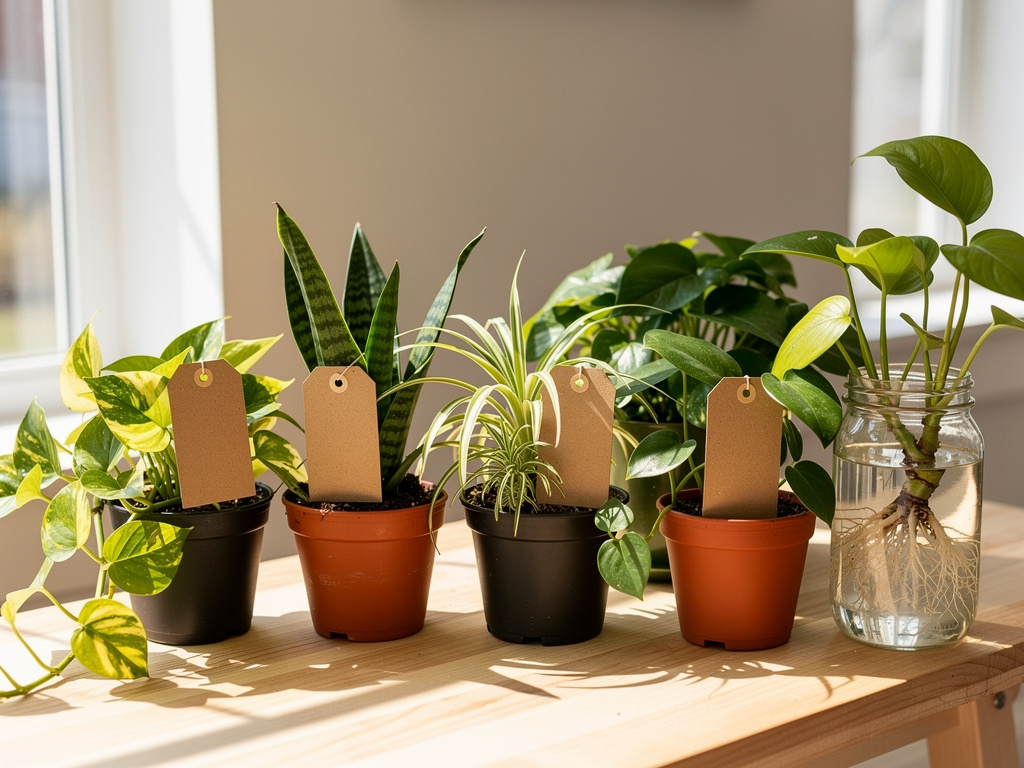


The short version: Sell a common houseplant like a pothos, snake plant or spider plant for about $15 in a 4-inch pot, $22 in a 6-inch pot and $6 as a rooted cutting, and a less common variegated plant for $20 to $40 in a 4-inch pot. The pot and potting mix for a 4-inch plant cost about $0.51 at today's grower-supply prices, so a $15 plant tapped on a card reader keeps about $13.95 before your time and booth fee. Plant Proper and Gabriella Plants listed common 4-inch plants at $8.00 to $15.00 and common 6-inch plants at $16.99 to $25.00, and the one Homegrown vendor selling houseplants lists 21 of them at $8.00 to $20.00. Some states require a license to sell houseplants and charge a fee for it, so count that fee in your price too.
Checked September 26, 2026: product listings on plantproper.com, gabriellaplants.com, costafarms.com and thesill.com, supplies on growerssolution.com and greenhousemegastore.com, a live pull of Homegrown's catalog, the Texas and California nursery license pages, and the fee pages of Homegrown, Square and Etsy. Honest bounds: shop prices are listed prices before shipping (several plants were sold out that day), the cost math assumes you own the plant you cut from, the weeks a cutting needs to fill a pot are yours to measure, and Homegrown customers create an account to place their first order.
Your pothos has taken over the bookshelf. You trimmed it, dropped the cuttings in a jar of water, and now you have a windowsill of rooted vines and a friend who keeps asking if you would sell her one. The only thing stopping you is the price tag.
Our own guide to selling houseplants from home says plants "sell for $8 to $40 or more" and splits that by plant type, from $8 to $18 for common plants up to hundreds for rare ones. Those ranges are a fair outline, but they do not tell you where a 4-inch pothos lands, what that pot cost you, or why a snake plant cutting should not cost the same as a finished plant. This guide builds your price from numbers loaded the day it was written: what plant shops and a Homegrown vendor charge, what a pot of mix costs, what card fees take, and what a state license adds.
Sell a common houseplant for about $15 in a 4-inch pot, $22 in a 6-inch pot, and $6 as a rooted cutting. Common means the plants every garden center stocks: golden pothos, heartleaf philodendron, snake plant, spider plant, ZZ plant, aloe. Less common variegated plants, like a variegated hoya, start at $20 and climb from there.
If you are still deciding whether to sell plants at all, how to sell houseplants from home covers the propagation, the plant choices and how to reach buyers. This page is only about the price.
Here is a price ladder most home plant vendors can start from:
Scroll sideways to see every column.
| Plant | Size | Suggested price | What it costs you in pot and mix | When it fits |
|---|---|---|---|---|
| Unrooted cutting, common plant | 1 to 3 nodes, in a bag or envelope | $3 to $4 | $0 | Plant swaps and add-ons at checkout |
| Rooted cutting, common plant | Bare roots or a small cup | $6 | A scoop of mix and the cup, if you use one | Beginners who want the cheapest start |
| Common houseplant | 4-inch pot | $15 | $0.51 | Your main shelf product |
| Common houseplant | 6-inch pot | $22 | $1.43 to $1.92 | Gifts and a fuller look |
| Common trailing plant | 6-inch hanging basket | $25 | Price the basket you buy | Porches and bright windows |
| Less common variegated variety | 4-inch pot | $20 to $40 | $0.51 | Collectors who already own the common version |
| Starter set of 3 common plants | Three 4-inch pots | $40 | $1.53 | Gift buyers and first apartments |
Pot and mix costs come from growerssolution.com and greenhousemegastore.com, loaded September 26, 2026. Suggested prices are our starting points, set against the shop prices in the next section.
Where your price lands inside each row depends on how full the pot is. A 4-inch pot with three or four rooted cuttings looks like a finished plant and earns the $15. A 4-inch pot with one lonely vine looks like a cutting in a pot and should be priced closer to $10.
Plant Proper and Gabriella Plants listed common houseplants at $8.00 to $15.00 in a 4-inch pot, most at $11.99 to $15.00, and at $16.99 to $25.00 in a 6-inch pot, on September 26, 2026. Larger growers and gift shops that ship small and medium plants, some in a self-watering or ceramic pot, listed them at $33.00 to $69.00, because the buyer pays for the pot and the brand too.
Swipe across to read the whole table.
| Shop | What they sell | Common plant, 4-inch or small | Common plant, 6-inch or medium | Named or variegated |
|---|---|---|---|---|
| Plant Proper | Plants in plain grower pots | $12.00 Pothos Neon; $13.50 Marble Queen pothos, Monstera, Hoya carnosa, Philodendron Brasil; $12.00 Sansevieria Robusta; $15.00 ZZ plant | $18.00 Philodendron Brasil; $20.00 Pothos Neon, Monstera, Sansevieria Laurentii; $25.00 ZZ plant | $20.00 Hoya carnosa 'Freckles', 4-inch |
| Gabriella Plants | Plants in plain grower pots | $11.99 Pothos 'Golden'; $8.00 Sansevieria 'Laurentii'; $14.99 Sansevieria cylindrica | $16.99 heartleaf philodendron; $18.00 Sansevieria 'Laurentii' and 'Futura Robusta'; $19.99 Pothos 'Neon' and 'Jade' | $16.99 Pothos 'Emerald' (green on green variegated); $19.99 Hoya 'Amore'; $39.99 marble variegated pothos; $59.99 Philodendron 'Golden Goddess' |
| Costa Farms | Plants shipped from a large grower | $33.00 small Golden Pothos in a grower's pot | $39.00 medium snake plant or ZZ plant in a self-watering pot | Not compared |
| The Sill | Plants with or without a decorative pot | $39.00 small snake plant 'Hahnii' in a grow pot; $69.00 the same small plant in a Hyde ceramic planter | Not compared | Not compared |
We loaded each shop's product listings on September 26, 2026. Prices are the listed plant price before shipping. Several of these plants were marked sold out that day, which is normal for small plant shops; the price still shows what they charge.
The pattern to copy is Plant Proper's. It sells plain plants in plain pots, and its common 4-inch plants sit at $12.00 to $15.00, with the 6-inch size at $18.00 to $25.00. A buyer can pick your plant up the same day without paying for shipping, so a local $15 sits at the top of what the plain-pot shops charge and well under the $33 and up that shipped plants cost.
One Homegrown vendor listed 21 houseplants on September 26, 2026, at $8.00 to $20.00 each, with a middle price of $15.00. That vendor is Jolene's Backyard Nursery, which sells mostly snake plants, plus desert roses, an arrowhead philodendron, a few succulents and an aloe. If your shelf runs more to echeverias, sedums and hens and chicks, pricing succulents by pot size starts lower, at about $5 for a 2-inch plant and 3 for $12.
In a live pull of the Homegrown catalog on September 26, 2026, 21 of the 2,727 products from 308 vendors were houseplants, and all 21 came from one vendor. We counted a listing when the product sold is a live potted plant of a kind grown indoors (a foliage plant or a succulent), judged by the category, the name and the storefront photo, and we opened every listing of all 15 vendors with a plant or flower listing. Vegetable and herb starts, bouquets, mushroom kits and an outdoor portulaca were not counted.
Jolene's Backyard Nursery houseplant prices on Homegrown, September 26, 2026
Source: live pull of the Homegrown catalog, September 26, 2026, 21 listings from one vendor. Bars are the listed price divided by the highest price. Not shown: whale fin snake plants at $9.99, $9.99 and $11.99, and a cylindrica snake plant at $15.00.
Here is what the listings show:
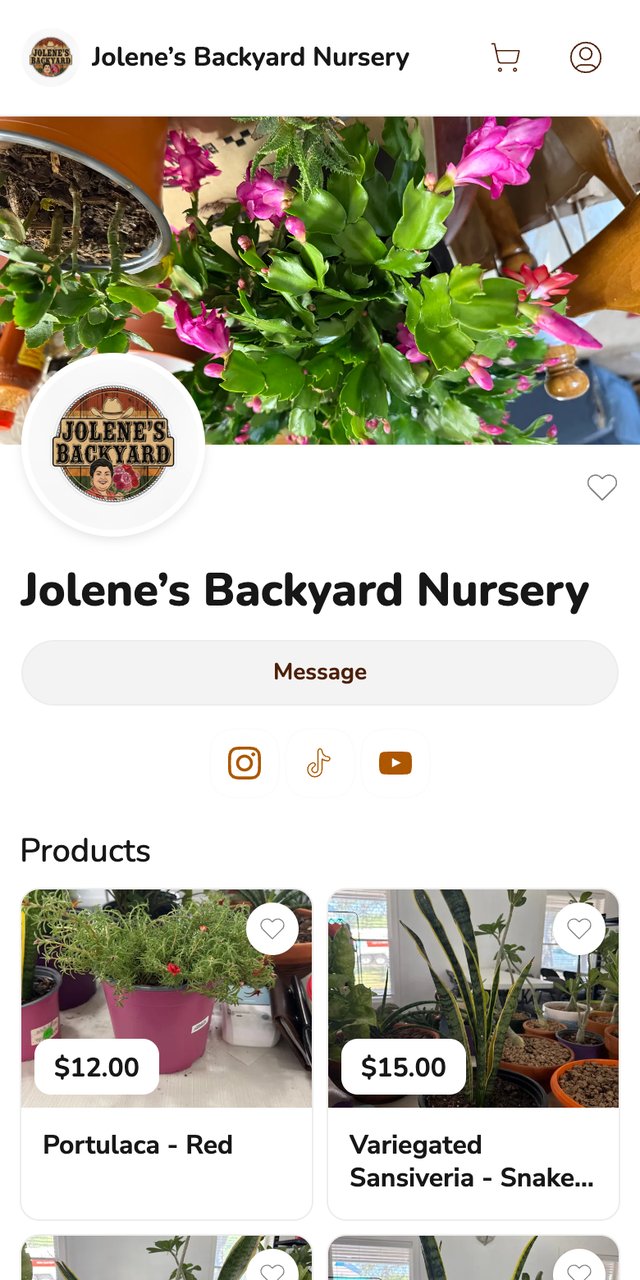
Notice two things Jolene does. First, the price follows the plant, not the pot: the classic and variegated snake plants are priced above the fernwood and whale fin kinds. Second, the $25 delivery minimum means a customer needs about two plants to get free delivery, which quietly turns a $15 sale into a two-plant order of $25 or more.
A 4-inch houseplant from your own cuttings costs you about $0.51 in pot and potting mix. The cutting itself is free once you own the parent plant, so the pot is the biggest line on the receipt.
Drag the table sideways to see the cost column.
| Supply | What you buy | Price | Per 4-inch plant |
|---|---|---|---|
| 4-inch plastic pot | Growers Solution 4-inch azalea pots, 30 pack | $9.95 | $0.33 |
| Potting mix | Espoma Organic Potting Mix, 2 cubic feet (fills about 112 of these pots) | $19.99 | $0.18 |
| Cuttings | From a plant you already own | $0 | $0 |
| Total | $0.51 |
Prices loaded September 26, 2026 on growerssolution.com and greenhousemegastore.com. Growers Solution's own chart says one cubic foot of mix fills 56 of its 4-inch azalea pots. A bagged indoor mix costs more: a 16-quart bag of Coast of Maine Indoor Houseplant Mix at $10.99 works out to about $0.32 to $0.37 a pot, depending on whether its 16 quarts are dry or liquid measure.
That $0.51 is small enough that supplies are rarely the problem. The real costs are the ones no receipt shows:
This is why a pothos that costs $0.51 still needs a $15 price. You are charging for the weeks, not the dirt.
Charge about $22 for a common plant in a 6-inch pot, roughly one and a half times the 4-inch price. Plant Proper listed its 6-inch common plants at $18.00 to $25.00 on September 26, 2026, against $12.00 to $15.00 for the 4-inch size, so the step up was $4.50 to $10.00 on the same plant.
The 6-inch pot costs you more than the 4-inch one:
That last line is the real reason the 6-inch plant costs more. It took longer to grow, it looks full on day one, and it makes a better gift. At $22, a 6-inch plant in a standard pot keeps about $19.36 when the buyer taps a card at your table, before your time and booth fee.
A good rule: only pot up to 6 inches when the 4-inch plant is already full. A 6-inch pot with a thin plant in it looks sparse, and sparse plants do not sell at $22.
Charge $3 to $4 for an unrooted cutting of a common plant and about $6 for a rooted one. A rooted cutting is worth more because you already did the part that fails: waiting for roots and throwing out the ones that rot.
Price cuttings as a step below the finished plant, so a customer can see what each step buys. The $6 rooted cutting is for a buyer who wants just one. A buyer who wants three or more pays less for them potted up as the $15 plant:
Stick to one clear rule about what "rooted" means and put it in your listing, such as "roots at least an inch long." Buyers who have had cuttings rot on them will pay the extra $2 or $3 for that promise.
Sell unrooted cuttings in sets of 3 of the same plant for $10 instead of $4 each. Three cuttings potted together fill a 4-inch pot fast, which is what the buyer really wants, and one $10 order carries one card fee instead of three. On Homegrown's rate, three separate $4 orders pay $1.25 in card fees and one $10 order pays $0.59.
Cuttings are also where your price is most exposed. A shipped cutting competes with every online listing in the country. A cutting picked up at your porch or your market table competes with far fewer sellers, because the buyer gets it today with no shipping box. Price local cuttings with that in mind and do not chase the cheapest listing you find online.
Gabriella Plants and Plant Proper listed 85 variegated plants in a 4-inch pot on September 26, 2026, at $7.00 to $99.99, leaving out spider plants and crotons, which are normally striped or spotted. The middle price was $29.99, about two and a half times the $11.99 Gabriella charged for a plain golden pothos, and $20 to $40 is a fair starting price for a home vendor. Gabriella listed a 4-inch 'Variegated Neon' pothos at $29.99 next to its plain 'Neon' at $12.99, and a 4-inch 'Golden Goddess' marble variegated philodendron at $59.99.
Your cost does not change with the variety. The pot is still $0.33 and the mix is still $0.18. What changes is how many other people can supply the plant, and that is the number to watch.
Rare plant prices change faster than any other price in this guide. A variety that sold for $60 last year can be common this year once large growers produce it. Before you price a variegated plant, look up at least three current listings for the same variety and pot size, and note the date. We checked every shop price in this guide on September 26, 2026, and they will drift.
One more thing to be honest about: if you bought a rare plant for $80, that does not make each cutting worth $80. Your buyers only pay what the plant is selling for now. Recover your cost over many cuttings, not in the first one.
A common mother plant that keeps giving cuttings costs you about $2 a cutting in our example, and a pricey rare one can cost $10 or more. The mother plant is the one you keep and cut from. If a $20 6-inch pothos, the price Plant Proper listed for a 6-inch Pothos Neon on September 26, 2026, gives you 10 cuttings over a year, each cutting carries $2 of the plant's cost.
That math is why it pays to start with plants you already own. The cost is already paid, and every cutting after the first pot is close to free material. Three ways to think about the mother plant:
If you buy a mother plant for a rare variety, run the same division with your real expectations. A $60 plant that gives you 6 cuttings a year carries $10 of cost per cutting, so a $40 price still works. A $60 plant that gives you 2 cuttings does not.
In some states you need a license to sell houseplants, and the fee belongs in your price. California and Texas both license plant vendors, and both publish the fees. Rules differ in every state, so verify your state's current rules with its department of agriculture before your first sale.
The California Department of Food and Agriculture says "a License to Sell Nursery Stock is required for any person who sells plants for planting, propagation, or ornamentation in California" on its nursery licensing page. Its licensing sheet, loaded September 26, 2026, lists a $150.00 minimum license fee and a $150.00 fee per sales location. It also lists a fee-exempt license, issued by the county, when all four of these are true: your total plant sales are under $1,000 a year, you have told your county agricultural commissioner that you plan to make those sales, every plant you sell is one you grew, and you sell them in the county where you grew them.
The Texas Department of Agriculture's Nursery Floral Licensing Program listed these fees on September 26, 2026: $75 for a permanent location that sells but does not grow, $110 for a permanent location that grows on 10 acres or less, and $180 for Class M, for vendors who sell at temporary markets such as flea markets, craft shows and plant shows. The fee chart lists Class M as a class that does not grow. Class M includes 30 event permits, and one permit covers one day at one location. More permits cost $50 for a block of 10. Class 1 to 4 licensees may only use event permits at trade shows, garden shows and other horticultural exhibits, so if you grow your own plants and want to sell at a flea market or farmers market, confirm the right class with TDA at (512) 463-7660. TDA's Nursery Floral FAQ also says you need a Nursery Floral license to sell plants using any Internet website, so selling from an online storefront counts even if you never set up a market table.
Here is what those fees mean per plant, using the $15 price from this guide:
The license is often a bigger cost per plant than the pot and the mix together, especially in your first year. If you only plan to sell a few dozen plants, that fee is the number to check first. The guide on how to sell plants and seedlings at farmers markets walks through the licensing steps in more detail.
Card fees take $0.54 to $0.80 from a $15 plant on Homegrown or Square. On Etsy, the listing fee, transaction fee and card processing together take about $1.88 before any shipping. That is more than the $0.51 your pot and mix cost, so the way you take payment matters almost as much as your supplies.
Swipe to see the remaining columns.
| How you take the order | Subscription | Trial | Platform fee | Card processing | Customer pays on a $15 plant | You pay on a $15 plant | You pay on 40 plants in a month |
|---|---|---|---|---|---|---|---|
| Homegrown storefront, pickup or delivery | $10/mo billed annually, or $12.50/mo billed monthly | 7 days, no charge until day 8 | $0 (0% commission) | 2.9% + $0.30, paid by you | $15.00 | $0.74 | $29.40 + $10 subscription = $39.40 on annual billing ($41.90 billed monthly) |
| Square Free plan, online order | $0 | None needed, free plan | $0 | 3.3% + 30¢, paid by you | $15.00 | $0.80 | $31.80 |
| Square Free plan, card tapped at a market or plant sale | $0 | None needed, free plan | $0 | 2.6% + 15¢, paid by you | $15.00 | $0.54 | $21.60 |
| Etsy, shipped | $0 | None needed, no plan | $0.20 listing fee plus 6.5% transaction fee on the price and shipping; a one-time shop set-up fee may apply | 3% + $0.25, paid by you | $15.00 plus shipping | $1.88 before shipping and packing | $75.00 before shipping and packing |
| Cash at pickup | $0 | n/a | $0 | $0 | $15.00 | $0.00 | $0 (no-show risk is yours) |
We checked these on each company's own page on September 26, 2026: findhomegrown.com/signup, Square's fee page for the Free plan, and Etsy's fees and Etsy Payments pages (US rate). One plant per order. The 40-plant column multiplies the unrounded fee per plant (for Homegrown, $0.735), so it can differ by a few cents from 40 times the rounded figure. Etsy's percentage fees also apply to what you charge for shipping, which is left out here. Fees on tips, tax and delivery are left out.
On a $6 rooted cutting the same rates work out like this:
The flat 15 to 30 cents in every fee hits a small sale hardest. That is one more reason to sell cuttings in sets and to nudge online buyers toward two or three plants per order.
Take orders before you pot up, so every plant on your shelf already has a buyer. A houseplant takes weeks to fill its pot, and a plant that does not sell keeps costing you water, light and shelf space until it does. That is the pricing problem no supply receipt shows, and it is the one Homegrown is built to shrink.
Homegrown is $10 a month billed annually ($12.50 billed monthly), with no percentage fees beyond standard payment processing. You list your plants with a photo, a pot size and a price, share one link, and customers order and pay ahead for a pickup time at your porch or market table, or for delivery inside the area you set. The order lands in your dashboard prepaid, so you know that five people want the $15 pothos before you cut the vines.
Compare that with the options most plant vendors start on:
Homegrown helps with the parts that come after the growing: a storefront, prepaid pickup and delivery orders, and one link for your Instagram bio. Here are the honest bounds. It does not root cuttings, set your prices, or tell you which varieties will sell. Customers create a Homegrown account to place their first order. Your storefront is listed on the Homegrown marketplace, but plan on most orders coming from people you send to your own link. Card processing of 2.9% + $0.30 is paid by you, with no option to pass it to the customer. And there is no drop or countdown feature for releasing a batch at a set time.
If your windowsill is full of rooted cuttings and your price is settled, set up a plant storefront on Homegrown and let buyers claim this month's pots before you plant them.
At $15 a plant and a card tapped at your table, 20 plants keep about $279, 40 keep $558 and 80 keep $1,116 before your booth fee and your time. Each $15 plant keeps $13.95 after $0.51 in supplies and a $0.54 card fee.
Slide the table left to see all five columns.
| Plants sold at $15 | Sales | Supplies at $0.51 | Card fees tapped at $0.54 | You keep before booth fee |
|---|---|---|---|---|
| 20 (a slow day or a porch sale) | $300 | $10.20 | $10.80 | $279.00 |
| 40 (a steady market day) | $600 | $20.40 | $21.60 | $558.00 |
| 80 (a busy spring plant sale) | $1,200 | $40.80 | $43.20 | $1,116.00 |
Fees from Square's Free plan rate for tapped cards (2.6% + 15¢), checked September 26, 2026. Supplies from the 4-inch cost build above. Booth fees vary by market; the guide to what it really costs to sell at a farmers market lays out typical fees.
Those numbers assume every sale is a $15 4-inch plant. Real tables mix sizes, and that usually helps you:
The number of plants you bring can matter as much as the price. A table with 12 plants can look picked over by noon. If you are planning your first plant table, how to sell non-food products at a farmers market covers which markets accept plants and how to ask.
Charge for delivery with either a fee or an order minimum, because the drive costs you the same whether the order is $15 or $60. Jolene's Backyard Nursery on Homegrown offers free delivery within 25 miles, but only on orders of $25 or more, which on its prices means at least two plants.
Pick one of these and state it on every listing:
Plants make delivery a little riskier than a jar of jam. A pot can tip in the car, and a cold car in winter can damage tropical plants. Box or crate each pot, and do not promise delivery in weather you would not leave your own plants in.
Price a set of three 4-inch plants at about $40, a $5 saving against $45 bought one at a time. Your supplies for three plants are $1.53, and on Homegrown the card fee on one $40 order is $1.46, against $2.21 on three separate $15 orders.
Sets help plant buyers who do not know what to pick. A set does the choosing for them:
Keep the saving small. A $5 saving on $45 is enough for a buyer to notice, and you still keep more money than on one plant. For the math behind picking a bundle price, the guide on bundle pricing for small vendors works through more examples.
Track the hands-on hours behind one batch of plants and divide what the batch keeps by those hours. At $0.51 in supplies per 4-inch pot, your time and shelf space are the costs that decide whether $15 is enough.
The hours above are examples, not measurements. Your number comes from your own log, and it is worth tracking a second batch, because the first one usually includes learning time you will not repeat.
The most common mistake is pricing by the cost of the pot instead of the weeks the plant took to grow. A $0.51 pot does not mean a $5 plant. These are the other mistakes that cost new plant vendors money:
If a plant keeps selling out in the first hour, that is your signal to raise its price by $2 or $3 next time, not to grow twice as many at the same price.
Sell an unrooted pothos cutting for $3 to $4 and a rooted one for about $6. If you charge $4 a cutting, a set of three unrooted cuttings of the same pothos is a fair offer at $10, enough to root together in a 4-inch pot. Named varieties like Marble Queen or Neon sell at about the same price as golden pothos, and a full 4-inch pothos in a pot sells for about $15.
A common houseplant in a 4-inch pot is worth about $8 to $15, most often $12 to $15, based on the plain-pot prices online plant shops listed on September 26, 2026. Plant Proper listed its common 4-inch plants at $12.00 to $15.00. For a local vendor, $15 is a fair price for a full, healthy pot of a common plant, and less common variegated varieties go for $20 to $40.
Charge about $10 to $16 for a snake plant in a small pot, and $18 to $25 in a 6-inch pot. On Homegrown, Jolene's Backyard Nursery listed 13 snake plants at $9.99 to $15.99 on September 26, 2026, and Plant Proper listed a 4-inch Sansevieria Robusta at $12.00 and a 6-inch Sansevieria Laurentii at $20.00. Plant Proper's 6-inch Fernwood was the top of its range at $25.00, so check listings for the exact type before you price.
Selling houseplants can be profitable because the pot and mix for a 4-inch plant cost only about $0.51, and a common plant sells for about $15. The real costs are your time, shelf space, lost cuttings and any state license. At $15 a plant tapped at a market, 40 plants keep about $558 before your booth fee and your hours.
It depends on your state. California requires a License to Sell Nursery Stock for anyone who sells plants, with a fee-exempt license from the county when yearly plant sales stay under $1,000, you have told your county agricultural commissioner, all the plants are your own production, and they are sold in the county where they were grown. Texas licenses plant vendors at $75 to $180 a year depending on the class, and TDA's FAQ says you need that license to sell plants on any website, so an online storefront counts. Verify your state's current rules with its department of agriculture before you sell.
Yes, with either a fee or a minimum order, because each drive costs you the same whatever the order size. One Homegrown plant vendor offers free delivery within 25 miles on orders of $25 or more. Pickup at a set time and place is the cheapest option for you, so consider making it the default.
More plant and pricing guides for home vendors:
Your plants are already growing on the shelf. Put your 4-inch pots, 6-inch plants and cutting sets on one link, let buyers pay before you pot up, and start taking houseplant orders on Homegrown.



