


The short version: Price a rooted succulent at about $5 in a 2-inch or 2.5-inch pot, $12 in a 4-inch pot and $20 to $28 in a 6-inch pot, and start small arrangements around $35. Online succulent shops listed single 2-inch plants at $5.49 to $8.75 at Planet Desert and $8.00 at Succulents Box, and 4-inch plants at a middle price of $12.87 at Planet Desert, all before shipping. If you grow from your own leaves, the pot and cactus mix for a 2.5-inch plant cost about $0.53, so most of your price pays for the months it takes to grow. Sell the small ones in sets, like 3 for $12, because a set turns a $5 sale into a $12 one, and the card fee on a lone $5 sale is 8.9% on Homegrown.
Checked October 1, 2026: product listings on planetdesert.com, succulentsbox.com, succulentmarket.com and thesucculentsource.com, supplies on growerssolution.com and greenhousemegastore.com, a live pull of Homegrown's catalog, the California and Texas nursery license pages, Arizona's native plant law, and the fee pages of Homegrown, Square and Etsy. Honest bounds: shop prices are listed before shipping (some plants were sold out that day), the cost math assumes you own the plants you take leaves from, and Homegrown customers create an account to place their first order.
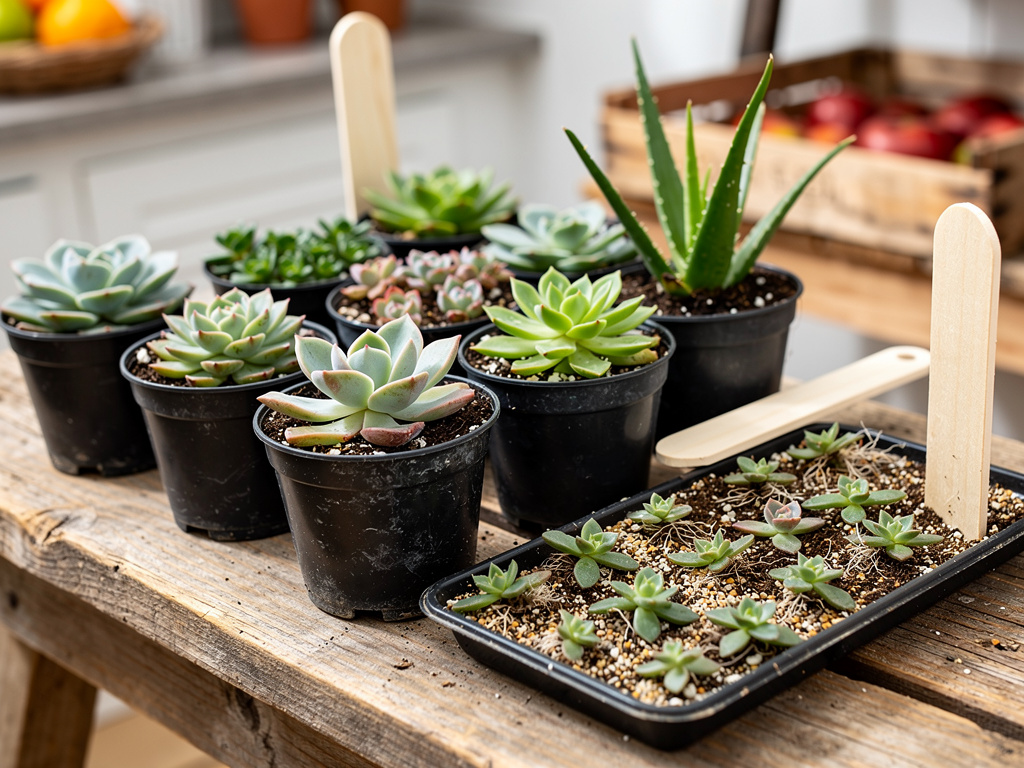
You knocked a few leaves off an echeveria, set them on a tray, and forgot about them. Two months later most of the leaves have a baby rosette, and now there are 40 of them on the windowsill. A neighbor wants six. A coworker wants a bowl for her desk. You have no idea what to charge.
The price guides that come up in a search quote a vague "$2 to $10" for small succulents, with no shop, no date and no source behind it. This guide prices succulents the way a home grower actually sells them: from leaves and offsets in small pots, in sets, and in simple arrangements. Every price comes from a page loaded on October 1, 2026, and the suggested prices are our own starting points.
Sell a rooted succulent for about $5 in a 2-inch or 2.5-inch pot, $12 in a 4-inch pot and $20 to $28 in a 6-inch pot. Sell unrooted cuttings at $1 to $2 each in bags of 5 or more, and price small arrangements from about $35. Rare or variegated kinds get priced off what shops charge for that exact plant.
For succulents, the 2-inch pot is the entry product, and most home growers fill it from a single leaf or a pup. If you also sell pothos and snake plants, our houseplant pricing guide covers 4-inch and 6-inch foliage plants, rooted cuttings and the mother plant. This page sticks to succulents: rosettes, trailing kinds, hens and chicks, aloes and the small pots most home growers start with.
Start from this ladder and move up or down inside each row based on how full and colorful the plant looks:
Scroll sideways to see every column.
| What you sell | Size | Suggested price | Pot and mix cost to you | Who buys it |
|---|---|---|---|---|
| Unrooted cuttings or leaves | Bag of 5 to 10 | $1 to $2 each | $0 plus a bag | Hobby growers who want to propagate |
| Rooted succulent | 2-inch or 2.5-inch pot | $5 | $0.53 | Impulse buyers at a table |
| Set of 3 rooted succulents | Three 2.5-inch pots | $12 | $1.60 | Gift buyers and first-timers |
| Rooted succulent | 4-inch pot | $12 | $0.85 | Your main shelf product |
| Rooted succulent | 6-inch pot | $20 to $28 | Price the pot you buy | Gifts and fuller rosettes |
| Small arrangement | 5-inch bowl, 5 plants | $35 to $45 | $7.50 bowl plus mix | Desk gifts and hostess gifts |
| Rare or variegated kind | Any | Shop price for that plant | Same as above | Collectors |
Pot and mix costs are worked out in the cost section below from growerssolution.com and greenhousemegastore.com, loaded October 1, 2026. The suggested prices are our starting points, set against the shop listings in the next section.
A set of 3 at $12 costs you three pots at $0.53 each, or $1.60 rounded. The sets section below shows what a set does to your order size and your card fees.
In the listings we loaded on October 1, 2026, Planet Desert listed single succulents at $5.49 to $8.75 in a 2-inch pot and $9.79 to $19.97 in a 4-inch pot, with a middle price of $12.87 for the 4-inch size. Of the Succulents Box listings we loaded, 66 of the 67 named 2-inch succulents were exactly $8.00 (one was $8.99), 4 "Random" picks were $3.50, and 16 of the 22 named 4-inch succulents were $15.00. Those prices are before shipping, which the buyer pays on top.
"Middle price" here means the median: half the listings cost more and half cost less. We counted single plants of common succulent groups (echeveria, sedum, crassula, haworthia, aloe, aeonium, graptopetalum, senecio such as string of pearls, sempervivum, gasteria, kalanchoe, pachyphytum and their crosses) in a plain grower pot, and left out packs and decorative pots. We also left out one rare species from the Planet Desert counts, the Spiral Aloe (Aloe polyphylla), which is priced in the rare and variegated section below.
Swipe across to read the whole table.
| Shop | 2-inch single plant | 4-inch single plant | 6-inch single plant | Packs and cuttings, per plant |
|---|---|---|---|---|
| Planet Desert | $5.49 to $8.75 (17 listings, middle $6.29) | $9.79 to $19.97 (30 listings, middle $12.87) | $14.95 to $36.99 (10 listings, middle $26.99) | Not counted |
| Succulents Box | $8.00 for 66 of 67 named plants (one $8.99); $3.50 for a "Random" pick of the shop's choosing | $14.40 to $18.06 (22 listings, middle $15.00) | Not compared | Sempervivum 25-pack $75.00, or $3.00 each |
| Succulent Market | No single-plant price counted. Packs: assorted 2-inch 6-pack $15.99 ($2.67 each); 40-pack $92.49 ($2.31 each) | No single-plant price counted. Packs: assorted 4-inch 4-pack $21.99 ($5.50 each); 15-pack $77.99 ($5.20 each) | Not compared | Assorted cuttings 20-pack $19.99 ($1.00 each); 100-pack $79.99 ($0.80 each) |
Loaded from each shop's public product listings on October 1, 2026. Each feed returns at most 250 products at a time, and we counted the first 250 each shop's feed returned (228 for Succulent Market), so the counts and ranges describe the listings we loaded, not the whole shop. Prices are listed prices before shipping and tax. Some listings were marked sold out; the listed price is still shown. "Middle" is the median.
Three things stand out in those listings:
Your local price can sit a little under the shop price and still win, because your buyer pays no shipping and takes the plant home today. A $5 2-inch plant at your table costs less than an $8.00 one that arrives in a box with a shipping charge on top.
On October 1, 2026, the one Homegrown vendor selling succulents listed 20 of them at $8.00 to $20.00, with a middle price of $15.00. That vendor is Jolene's Backyard Nursery, and most of the listings are snake plants, plus desert roses, an aloe, a gasteria and a donkey ear kalanchoe.
In a live pull of the Homegrown catalog on October 1, 2026, 20 of the 2,751 products from 309 vendors were succulents, and all 20 came from Jolene's Backyard Nursery. We counted a listing when it was a live potted plant from a succulent group (aloe, gasteria, kalanchoe, desert rose or snake plant), judged by its category, its name and the storefront. We read all 105 listings in the plants and flowers category and searched every other category's product names and descriptions for succulent and cactus words. The other hits were soaps, candles, a cactus fruit jelly and a craft item, not plants. We counted perennial potted succulents only. Jolene's arrowhead philodendron is not a succulent, and her red portulaca (moss rose), though a succulent, is sold as a one-season bedding annual, so neither was counted. One of the four desert rose listings is titled "Desert Rose (Copy)" and looks like a duplicate; we counted it as listed. This rule is wider than the one behind the shop counts above, which leave snake plants and desert roses out. Under that narrower rule, 3 of Jolene's listings would count: the aloe vera at $8.00, the ox tongue gasteria at $11.99 and the donkey ear kalanchoe at $12.99.
Jolene's Backyard Nursery succulent prices on Homegrown, October 1, 2026
Source: live pull of the Homegrown catalog and the storefront, October 1, 2026, 20 succulent listings. Bar length is the price divided by $20.00. Two of the three whale fin listings are $9.99.
What those listings show:
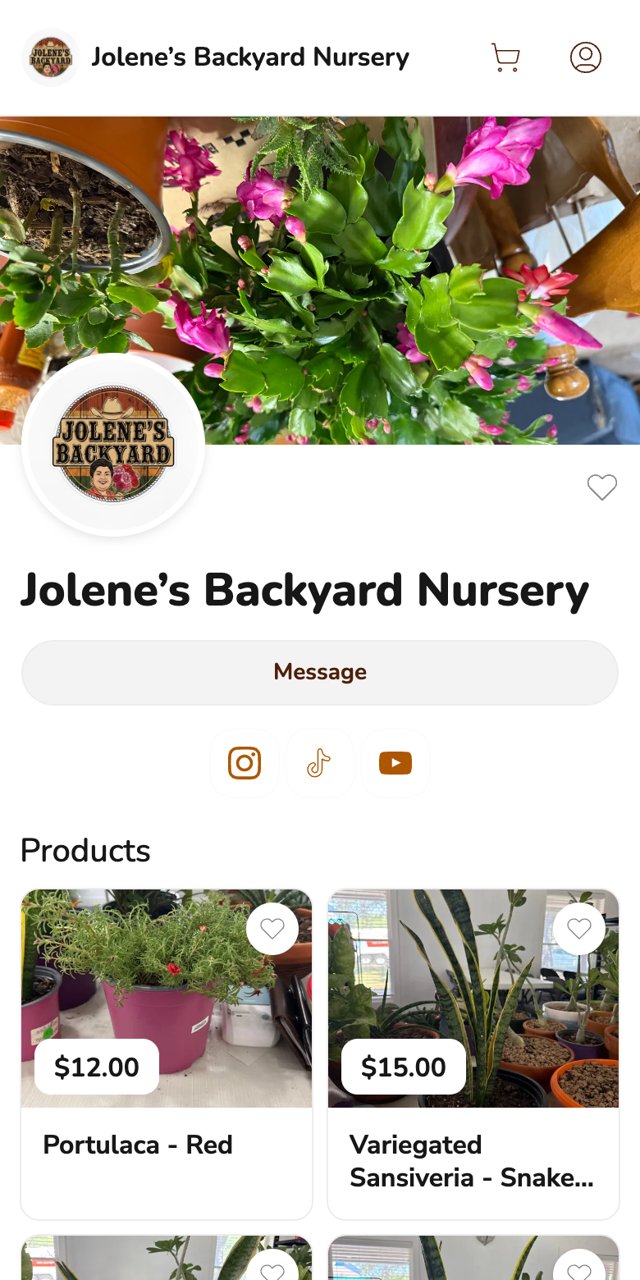
Jolene does not list pot sizes, so you cannot line her prices up against the shop table pot for pot. What you can borrow is the pattern. Each kind of plant gets its own price, the slow and showy desert roses sit at the top, and the $25 delivery minimum nudges a single $15 order up to two plants.
Expect to spend about $0.53 in pot and cactus mix on a 2.5-inch succulent grown from your own leaf, and about $0.85 on a 4-inch one. The leaf itself costs nothing if it comes from a plant you already own. Your real cost is time and shelf space, not supplies.
Slide the table left to see the cost per pot.
| Supply | What you buy | Price on October 1, 2026 | Per 2.5-inch pot | Per 4-inch pot |
|---|---|---|---|---|
| 2.5-inch deep square pot | 25-pack, Growers Solution | $6.95 | $0.28 | n/a |
| 4-inch azalea pot | 30-pack, Growers Solution | $9.95 | n/a | $0.33 |
| Espoma Organic Cactus Mix | 8-quart bag, Greenhouse Megastore | $7.69 | $0.25 | $0.51 |
| Leaf or offset | From a plant you own | $0 | $0 | $0 |
| Total | $0.53 | $0.85 |
The 2.5-inch pot holds 15.3 cubic inches, per Growers Solution's spec sheet, so an 8-quart bag fills about 30 of them. An azalea pot is a round pot that is shorter than a standard pot. This 4-inch one is 2.75 inches deep, per Growers Solution. Growers Solution says 1 cubic foot of mix fills 56 four-inch azalea pots, and the 8-quart bag is about 0.27 cubic feet. We counted a quart as 57.75 cubic inches, the smaller of the two common quart sizes, so the mix cost leans high. Totals use unrounded figures.
The slow part is the growing. The University of California's master gardener blog on propagating succulents from leaves and pups says to mist leaf cuttings sparingly every one to two days for four to six weeks while they root, and notes that some succulents "will take a year or more to become mature." That waiting time is what your customer is really paying for.
Here is what that means for your price:
Sell most of your succulents at 2 to 2.5 inches, and grow only your most popular kinds on to 4 inches. A 4-inch succulent earns about $12 against $5 for a small one, but it takes extra months on your shelf and about twice the cactus mix.
Weigh it this way:
Pot two or three rooted rosettes together in one 4-inch pot instead of waiting for a single plant to fill it. The finished pot costs you the same $0.85 in pot and mix as a single 4-inch plant. Potted together they look like a finished 4-inch plant months sooner and earn the $12. The trade-off: the same three plants would bring $15 sold as $5 singles, so do this with plants that are not selling on their own.
Sell unrooted succulent cuttings for $1 to $2 each, in bags of 5 or more. Succulent Market listed assorted cuttings at $19.99 for 20 and $79.99 for 100 on October 1, 2026, which is $1.00 down to $0.80 a cutting. A local buyer skips the shipping and gets fresher cuttings, so $1.50 each is a fair middle.
Ways to package cuttings so they sell:
For rosette succulents like echeveria, sedum and crassula, only whole leaves root. Snake plants are the exception: Iowa State says a section of a Sansevieria leaf will root. Iowa State's guidance on propagating succulents notes that the full leaf, with the base where it attached to the stem, has to come off cleanly or it will not grow, so check your leaves before you bag them. Selling a bag of broken leaves is the fastest way to lose a repeat buyer.
Price a succulent arrangement at what its plants would sell for one by one, plus double what the container cost you, plus $5 to $10 for your design time. A 5-inch bowl with five small succulents comes to about $45 that way, or $35 to $40 in a cheaper container.
Here is how that works, step by step:
Larger pieces climb fast. Succulents Box listed a 6.1-inch heart arrangement at $80.00, a 10-inch round terra cotta arrangement at $159.99, and The Succulent Source listed a 6-inch living succulent wreath at $55.00. If you make anything that size, count the plants. If a 10-inch bowl holds 15 small rosettes, at $5 each that is $75 before the container.
If you want to package sets and arrangements as a line, bundle pricing for small vendors explains how to price a group of products so the bundle still feels like a deal.
Sell small succulents in sets because a set turns a $5 sale into a $12 one, and card fees charge a flat amount on every order. On Homegrown, a lone $5 plant leaves you $4.55 after the card fee, and a set of 3 for $12 leaves you $11.35. The set gives the buyer $3 off three singles, and you trade that for a bigger order and a lower fee per plant.
The fee that matters is the fixed part. Card processing on Homegrown is 2.9% + $0.30, so on a $5 plant the 30 cents alone is 6% of the sale and the whole fee is 8.9%. On a $12 set the whole fee drops to 5.4%, about $0.22 a plant. If you price singles at $4, three separate $4 orders cost $1.25 in fees against $0.65 for one $12 order of the same three plants.
Sets that work for succulents:
A set is also easier to list online. One listing with three sizes (single, set of 3, set of 6) is simpler for a buyer than twenty separate $5 listings.
Card fees take $0.28 to $0.47 from a single $5 succulent on Homegrown or Square, and about $0.93 on Etsy before shipping. On a $12 sale the same fees run $0.46 to $0.70, and $1.59 on Etsy. Because the pot and mix cost only $0.53, the fee on a single small plant can be close to your supply cost.
Swipe to see the remaining columns.
| How you take the order | Subscription | Trial | Platform fee | Card processing | Customer pays on a $5 plant | You pay on a $5 plant | You pay on a $12 sale | You pay on 40 sales of $12 in a month |
|---|---|---|---|---|---|---|---|---|
| Homegrown storefront, pickup or local delivery | $10/mo billed annually, or $12.50/mo billed monthly | 7 days, no charge until day 8 | $0 (0% commission) | 2.9% + $0.30, paid by you | $5.00 | $0.45 | $0.65 | $25.92 + $10 subscription = $35.92 on annual billing ($38.42 billed monthly) |
| Square Free plan, online order | $0 | None needed, free plan | $0 | 3.3% + 30¢, paid by you | $5.00 | $0.47 | $0.70 | $27.84 |
| Square Free plan, card tapped at your table | $0 | None needed, free plan | $0 | 2.6% + 15¢, paid by you | $5.00 | $0.28 | $0.46 | $18.48 |
| Etsy, shipped | $0; a one-time shop set-up fee may apply | None needed, no plan | $0.20 listing fee (renewed after each sale on a listing with more than one in stock) plus a 6.5% transaction fee on the price and shipping | 3% + $0.25 on the total, paid by you | $5.00 plus shipping | $0.93 before shipping and packing | $1.59 before shipping and packing | $63.60 before shipping and packing |
| Cash at pickup | $0 | n/a | $0 | $0 | $5.00 | $0.00 | $0.00 | $0 (no-shows are your risk) |
We checked these on October 1, 2026, on findhomegrown.com/signup, Square's fee page for the Free plan, and Etsy's Fees and Payments Policy and payment processing help page (US rate). One sale per order. The monthly column multiplies the unrounded fee per sale (for Homegrown, $0.648), so it can differ by a few cents from 40 times the rounded figure. Etsy's percentage fees also apply to the shipping you charge, which is left out here, and Etsy's processing fee also applies to sales tax.
Square's tap rate is the cheapest card rate of the options here for taking a card at your own table. The guide to accepting payments at a farmers market compares readers and cash if you are setting that up for the first time.
Let regulars order and pay ahead, so you know how many leaves to start and which pots to fill. Succulents take weeks to root and months to fill a pot, which means the guess you make today shows up on your shelf next season. Pre-orders turn that guess into a list.
A Homegrown storefront handles that for $10 per month billed annually ($12.50 billed monthly), with no percentage fees beyond standard payment processing of 2.9% + $0.30, which you pay. One listing can carry a single 2.5-inch plant, a set of 3 and a 4-inch pot as sizes with their own prices. Quantities count down as people order, so you never sell the same echeveria twice. You set pickup days and time windows for each location, plus the lead time you need before each pickup date. You can also offer local delivery within a radius you set, from 1 to 25 miles, with your own fee and minimum order, the way Jolene's Backyard Nursery uses a $25 minimum.
How that compares with what most succulent vendors try first:
What Homegrown does not do: it is set up for pickup and local delivery, so if you want to mail bare-root succulents to buyers in other states, Etsy fits that better. Customers create a Homegrown account to place their first order. Your storefront is listed on Homegrown's marketplace, but plan on most orders coming from people you send to your own link. And it does not help your leaves root any faster.
If you want to see how pre-ordering works in practice, how to take pre-orders walks through the setup with a weekly example. When your price list is ready, build a succulent storefront on Homegrown and let buyers claim this month's sets before you pot them.
In California and Texas, yes: both treat a potted succulent as a plant that needs a license to sell. In California a home grower who sells under $1,000 of plants a year, grew every plant, sells only in their own county and has told the county agricultural commissioner can use a free county license. In Texas the cheapest license for a home grower is $110 a year, and selling at temporary markets takes a $180 class. Above California's $1,000 line with a sales location such as a home stand, or at a Texas market, the license can cost more per plant than the pot and the mix every year at a few hundred plants. Rules differ by state, so verify your state's current rules with its department of agriculture before your first sale.
The California Department of Food and Agriculture says on its nursery licensing page that "a License to Sell Nursery Stock is required for any person who sells plants for planting, propagation, or ornamentation in California." Its licensing sheet (revised November 18, 2025, loaded October 1, 2026) lists a $150.00 minimum license fee plus $150.00 per sales location. Its license application adds the two lines together, so a grower with one sales location, such as a yard or a home stand, pays $300 a year. The same form has a box to check if you have no sales locations, with $0 entered for that fee, and it lists farmers' market selling sites in their own section with no fee line. If you sell only at farmers markets, ask CDFA whether you owe only the $150 minimum. A fee-exempt license comes from your county when all four are true: you sell less than $1,000 of plants a year, you have told your county agricultural commissioner you plan to, you grew every plant you sell, and you sell them in the county where they grew.
The Texas Department of Agriculture's Nursery Floral program listed these yearly fees on October 1, 2026: $75 for a permanent spot that sells but does not grow, $110 for a permanent spot that grows on 10 acres or less, and $180 for Class M, the class for selling at temporary markets like flea markets and plant shows, which the fee chart lists as not growing. Its FAQ says "You need a Nursery Floral license to sell plants using any Internet website," and shipping plants out of state needs a phytosanitary certificate from a state inspector at $30 per inspection.
What that means at $5 a plant:
The step-by-step licensing walk-through in how to sell plants and seedlings at farmers markets shows how to find your state office and what the inspection covers. Its fee range runs lower than what California and Texas charge, so use the state numbers above for those two states.
Not without permission and paperwork, and in Arizona not without a state permit and tag on each protected plant. Cactus and succulents you grew from seed, leaves or cuttings are a different thing from plants dug out of the desert, and the law treats them differently.
Arizona's native plant law defines protected plants as ones "growing wild" on the state's lists, "without being propagated or cultivated by human beings." Under Arizona Revised Statutes 3-906, "a person shall not take, transport or possess any protected native plant taken from the original growing site in this state without possessing a valid permit," and saguaros "that are propagated by humans are exempt" from the permit, tag and seal rule for moving a saguaro more than four feet tall.
The Arizona Department of Agriculture's native plant page listed these fees on October 1, 2026: a one-time-use permit $7, a saguaro tag $8, a tag for other protected native plants $6, pincushion, Coryphantha and Mammillaria cactus tags $0.50, and a seal $0.15 per plant. The department also says plants cannot be removed from any land without the owner's permission and a permit. We only checked Arizona. Other states have their own wild plant rules, so check with yours before you dig anything up. Nevada, for one, protects every cactus species and charges $2 for each tag on a cactus taken for sale, and our guide to selling homemade succulents and cactus compares the wild cactus rules in Arizona, Nevada, California and New Mexico.
A cactus you grew from a pad or a pup carries no tag cost and stays outside Arizona's protected native plant rules, though your state's plant license still applies. Price and sell what you propagate, and leave the wild plants where they are.
Variegation adds a few dollars to a common succulent, while a truly rare species can cost about 5 times a common one in the same pot size. Price these off the shop listing for that exact plant, not off your usual ladder.
Examples from the listings loaded on October 1, 2026:
Rare succulent prices can drop once more growers start producing a plant. Before you price a collector plant, look up two or three current listings for that exact name and pot size on the day you list it. A price you saw last season can be far too high this season.
Selling 4-inch succulents at $12 with cards tapped on Square, you keep about $10.69 a plant after supplies and fees, or $534.65 on 50 plants, before your booth fee. Small 2.5-inch plants at $5 keep about $4.19 each the same way.
Swipe left to see what you keep.
| 4-inch succulents sold at $12 | Gross sales | Square tap fees | Pot and mix at $0.85 | What you keep before booth fee and time |
|---|---|---|---|---|
| 25 plants | $300.00 | $11.55 | $21.13 | $267.32 |
| 50 plants | $600.00 | $23.10 | $42.25 | $534.65 |
| 100 plants | $1,200.00 | $46.20 | $84.50 | $1,069.30 |
Square Free plan, 2.6% + 15¢ per tap, one plant per sale, from Square's fee page on October 1, 2026. Pot and mix cost from the cost section, $0.845 per 4-inch plant unrounded. Booth fees, license fees, labels and your hours are not included.
Your booth fee comes off the top of that. The guide to what it really costs to sell at a farmers market lists the fees and supplies that land before you sell a single plant. Selling small plants in sets of 3 for $12 instead of $5 singles also cuts the Homegrown card fee per plant, from $0.45 to about $0.22.
The most common mistake is pricing at what the supplies cost instead of what the plant took to grow. A $0.53 pot of mix that sat on your shelf for months is not a $1 plant.
Other mistakes to skip:
When your windowsill is full of rosettes and your price list is set, open a Homegrown storefront for your succulents so regulars can reserve sets between plant sales.
Sell a rooted 2-inch succulent for about $5, or 3 for $12. Online shops listed single 2-inch succulents at $5.49 to $8.75 at Planet Desert and $8.00 at Succulents Box on October 1, 2026, before shipping. Your local buyer pays no shipping, so a price a little under the shops still sells well.
Unrooted succulent cuttings sell for about $1 to $2 each when you sell them locally in bags. Succulent Market listed assorted cuttings at $19.99 for 20 and $79.99 for 100 on October 1, 2026, which is $1.00 to $0.80 a cutting. Mixed bags of 10 for $12 to $15 are a simple local product.
Selling succulents can be profitable because a 2.5-inch plant grown from your own leaf costs about $0.53 in pot and cactus mix and sells for about $5. A 4-inch plant at $12 keeps about $10.69 after supplies and a tapped card fee. Your real costs are time, shelf space, leaves that rot and any license your state requires.
A small succulent arrangement in a 5-inch bowl with five plants usually lands between $35 and $45. Add the plants at your single price, double the cost of the container, and add $5 to $10 for your time. Succulents Box listed small arrangements at $32.00 and $34.00 and a 6.1-inch heart arrangement at $80.00 on October 1, 2026.
It depends on your state. California requires a License to Sell Nursery Stock, with a fee-exempt county license if you sell under $1,000 of plants a year, grow them yourself, have told your county agricultural commissioner and sell in your own county. Texas requires a Nursery Floral license, $110 a year for a home that grows plants and $180 for Class M if you sell at temporary markets, including for plants sold online. Verify your state's current rules before you sell.
Cactus you grew from seed, pads or pups falls under the same plant rules as any other succulent, such as California's and Texas's licenses. Selling cactus dug from the wild is a different matter. In Arizona, protected native plants need a state permit and a tag on each plant, such as an $8 tag for a saguaro, and saguaros propagated by people are exempt from the saguaro tag rule.
More plant pricing and selling guides for home growers:
Your leaves are already sprouting. Put your 2-inch singles, sets of 3, 4-inch pots and arrangements on one link, let regulars pay before you pot up, and start taking succulent orders on Homegrown.



