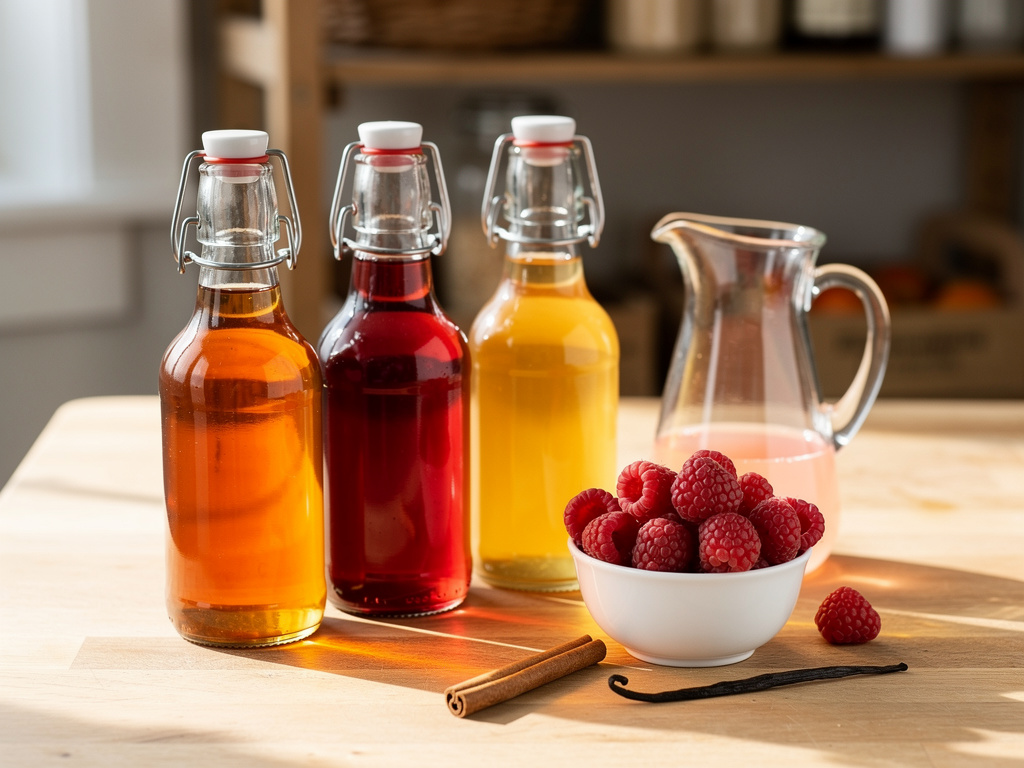


The short version: Homemade syrup lasts anywhere from about a week to about two years, and the kind of syrup decides which. A simple syrup kept in the fridge lasts about 2 weeks to a month by our rule, and syrups made with fresh fruit or herbs are the shortest of all. A fruit syrup canned from a tested recipe keeps its best quality for at least a year on a cool shelf, then about a month in the fridge once it is opened. Pure maple syrup that was boiled to at least 66% sugar and bottled hot keeps up to two years sealed and stored cool and dark, then belongs in the fridge.
Checked on the National Center for Home Food Preservation (NCHFP), Washington State, University of Maine, Ohio State and South Dakota State extension pages, 21 CFR 168.140, and the Washington, California, New Jersey and Texas cottage food pages, October 13, 2026: no federal or extension source we found publishes a shelf life for homemade simple syrup, so those numbers are our own rule and are labeled. Some states do not allow syrups under home food laws at all (Washington is one), and others list only honey and sorghum syrup, so verify your state's current rules before you bottle a batch to sell. Homegrown customers create an account to place their first order, and Homegrown has no drops or countdown-release feature.
Syrup feels like it should last forever. It is mostly sugar, and the bottle of pancake syrup in most pantries has been there longer than anyone remembers. That bottle came from a factory with its own process and its own label. A syrup you cooked on your stove last Sunday is a different product, and how long it keeps depends on three things: how much sugar is in it, what else went in with the sugar, and how you bottled it.
This guide is for people who sell syrup, or want to. It covers simple syrup, rich syrup, fruit and herb syrups, canned berry syrup, maple syrup and elderberry syrup, plus what date goes on the bottle, how far ahead to cook, and which states let a home kitchen sell syrup at all. If you are still deciding whether to start, our guide to selling cocktail syrup from home covers flavors, pricing and where the buyers are first.
Homemade syrup lasts about 1 week if it is a fresh fruit or herb syrup kept in the fridge, a few weeks if it is a plain simple syrup, at least a year if it is a fruit syrup canned from a tested recipe, and up to two years if it is pure maple syrup bottled hot. Those numbers come from different places, because no federal or extension source we found lists homemade simple syrup at all. The extension pages we found publish numbers only for canned berry syrup, pure maple syrup and homemade elderberry syrup.
Every number below is a best-quality window. Safety comes from the sugar level, the heat step and the seal. A bottle past its window is not automatically unsafe, and a bottle inside it is not safe if it was never heated, sealed or kept cold the way it needed to be.
Here is what each kind of syrup gets, checked on October 13, 2026:
Scroll sideways to see every column.
| Kind of syrup | Sealed, on the shelf | In the fridge | Can a home kitchen sell it? | Source |
|---|---|---|---|---|
| 1:1 simple syrup (equal sugar and water), not canned | Fridge only | About 2 weeks (our rule) | Not in Washington; allowed in Texas, which lets home kitchens sell most foods; check your state | Our rule; recipe sites range from 1 week to about a month |
| 2:1 rich simple syrup, not canned | Keep it out of the pantry | About 1 month (our rule) | Same as above | Our rule, matched to Washington State Extension's one month for opened canned syrup |
| Fresh fruit or fresh herb syrup, not canned | Never on a shelf | About 1 week (our rule) | Same as above, and New Jersey lists flower syrups as not included | Our rule |
| Berry syrup canned from the NCHFP tested recipe | At least 1 year, in a cool, dry place | Within 1 month after opening | Depends on the state; not in Washington or California | Washington State Extension (WSU) fact sheet FS238E; NCHFP Berry Syrup |
| Pure maple syrup, hot packed at 180°F or more | Up to 2 years in a cool, dark place (Ohio State says refrigerate even unopened) | Up to 1 year in tin or glass; refrigerate after opening | Depends on the state; maple must meet the federal 66% standard | South Dakota State Extension (SDSU); Ohio State fact sheet HYG-5522; 21 CFR 168.140 |
| Elderberry syrup | Never on a shelf; elderberries are not acidic enough to can safely | 2 weeks, or up to 8 months frozen (University of Maine Extension); we sell on 1 week (our rule) | Not in New Jersey's approved list; check your state | University of Maine Extension; New Jersey Department of Health |
We loaded each source on October 13, 2026. "Our rule" marks the rows where no source gives a number and we chose a conservative one, and the elderberry row, where we sell on a shorter window than the source gives. The fridge numbers assume a clean, sealed bottle kept at 40°F or below.
Sugar keeps syrup from spoiling by tying up the water that mold and yeast need, so the more sugar a syrup holds, the longer it keeps. Syrup makers measure this in Brix, which is just the percent of sugar by weight. A syrup at 66 Brix is 66% sugar and 34% water.
Maple producers live by this number. The federal standard for maple syrup in 21 CFR 168.140 says maple syrup "contains not less than 66 percent by weight of soluble solids." The University of Maine's maple quality control manual (Bulletin 7038) shows what that line does in practice: syrup below 66% Brix "cannot legally be sold" in Maine, and "such syrup is more likely to ferment and grow mold."
That is the key idea for every syrup you make. A thin syrup has more free water, and free water is where spoilage starts. Here is how common homemade recipes compare to that 66% line:
Sugar by weight in common syrup recipes
Source: 21 CFR 168.140 for the maple floor. The cup figures use King Arthur Baking's ingredient weight chart (1 cup granulated sugar = 198 g, 1 cup water = 227 g), loaded October 13, 2026. Sugar already in fruit juice is not counted.
A 1:1 simple syrup is nowhere near the maple line, so it behaves like a perishable food. And measuring by cups instead of by weight quietly costs you about 3 points of sugar, because a cup of water weighs more than a cup of sugar.
The math, so you can check it:
If you sell syrup, weigh your sugar and water. It is the cheapest shelf-life upgrade there is.
Plan on about 2 weeks in the fridge for a 1:1 simple syrup you sell, and treat it as a fridge-only product. That is our rule, not a published standard. No USDA page or extension fact sheet we found gives a number for homemade simple syrup.
The recipe and bartending sites we read on October 13, 2026 do not agree with each other. One put 1:1 syrup at 1 to 2 weeks in the fridge, another at about a month, and a third at 2 to 3 weeks. None of them cited a test. When published guesses differ by four times, a seller should pick the short end, because your customer will keep the bottle longer than you think. Our 2-week rule assumes a syrup weighed out at 1:1, brought to a boil, poured into a sanitized bottle, capped right away and kept at 40°F or below. It counts from the day you made the syrup, not the day your customer opens it.
Why 1:1 syrup goes bad fast:
Signs that a 1:1 syrup has turned are easy to spot: cloudiness, a film or speck of mold, bubbles, or a smell like beer or wine. Those are yeast and mold at work. Once you see any of them, the bottle is done.
A 1:1 syrup is not "shelf stable" just because it is sweet. If you sell it, sell it cold, label it "Keep refrigerated", and put a use-by date on the bottle. In Texas, a home food that needs temperature control for safety (a TCS food, in the state's terms) also has to carry the date it was made and a safe handling statement, which we cover in the label section below.
Yes, a 2:1 rich syrup keeps longer than a 1:1 syrup, and we give it about 1 month in the fridge when you sell it. Weighed out at two parts sugar to one part water, it lands at 66.7% sugar, just over the 66% floor for maple syrup. That extra sugar slows down yeast and mold a lot.
It still is not maple syrup, for two reasons:
Our 1-month rule matches two published numbers for similar sugar products after opening: Washington State Extension gives opened canned berry syrup "one month," and the National Center for Home Food Preservation gives opened full-sugar jam and jelly 1 month in the fridge at 40°F or lower. A rich syrup you never canned should not get more time than a canned syrup that was opened.
If you sell rich syrup, weigh it at 2:1 and write the ratio on your recipe card. A batch of 1,000 g sugar and 500 g water makes about 1,500 g of syrup at 66.7%. A 2:1 batch measured by cups, 5 cups sugar and 2½ cups water, lands near 63.6%, and you lose the margin that makes the 1-month window reasonable.
Fresh fruit and fresh herbs shorten a syrup's life to about 1 week in the fridge unless the syrup is canned, because they add water, pulp and the microbes that ride in on them. That is our rule for an uncanned fruit or herb syrup. Dried spices and extracts are gentler, since they add flavor without much water.
What each add-in does:
If you want a fruit syrup that can sit on a shelf, there is a tested way to do it, and it is the next section. Washington State Extension's fact sheet on preserving berry syrups at home puts it plainly: "To store syrup at room temperature, it must be canned."
A berry syrup canned from a tested recipe keeps its best quality for at least a year in a cool, dry place, and about a month in the fridge once opened. Washington State Extension gives both numbers, and the National Center for Home Food Preservation (NCHFP) publishes the tested recipe.
The NCHFP Berry Syrup recipe works only with the berries it lists: blueberries, cherries, grapes, raspberries and strawberries. It starts with 6½ cups of fruit, which gives about 4½ to 5 cups of juice, mixed with 6¾ cups of sugar. It makes about 9 half-pint jars. Here is the process in short:
After that, storage decides quality. NCHFP's storage guidance says to keep home-canned food between 50 and 70°F for best quality, to can no more than you will use within a year, and never to store jars above 95°F. NCHFP says food stored that hot will lose quality "in a few weeks or months."
If you skip canning, Washington State Extension says syrup can be frozen instead: frozen syrup "will maintain high quality if used within one year of freezing," then goes in the fridge once opened.
Sealed pure maple syrup keeps its quality for up to 2 years in a cool, dark place, and up to 1 year in the fridge if it is in tin or glass. South Dakota State Extension's guide to selling maple syrup at a farmers market gives the 2-year shelf figure and says "Refrigerate after opening." Ohio State's maple fact sheet (HYG-5522) is stricter: it tells buyers to put maple syrup in the fridge right after purchase "even if the container has not been opened," or freeze it, and says syrup in tin or glass keeps "up to one year in the refrigerator in its original container."
Container matters more than most people expect. Ohio State notes that plastic "breathes," and recommends moving syrup out of plastic jugs if you plan to keep it more than three months. Glass and tin hold up longer. If you sell in plastic jugs, tell customers to use it within a few months or pour it into glass.
Maple's long life depends on two things you control in your own kitchen:
If you are building a maple business from scratch, our guide on selling maple syrup from home covers grading, pricing and where producers sell.
Hot packing means pouring syrup into the bottle while it is at least 180°F and capping it right away, so the heat sterilizes the inside of the bottle and the cap. The same maple manual puts it simply: "Always pack maple syrup hot!" Packing below 180°F "increases the chance of mold growth or spoilage."
The published rule is written for maple. We would use the same habit for any syrup you bottle to sell, because the reason behind it applies to any sugar syrup, but no source we found has tested it on simple syrup. Mold and yeast spores float in kitchen air. A bottle filled with warm syrup and left uncapped for a minute can catch some of them. Hot syrup in a hot, capped bottle kills what is inside and pulls a vacuum as it cools.
The steps maple producers use, from the South Dakota State and University of Maine guides:
Fill and cap one bottle at a time, not a whole row before capping. The University of Maine maple bulletin warns that syrup "left uncapped for a few moments can cool sufficiently and collect enough yeast and mold spores from the air to spoil some cans in an otherwise perfect lot." On a big batch, the bottles that sat open longest are the ones most likely to spoil.
Hot packing is not a substitute for a tested recipe when a syrup has fruit, herbs or peppers in it. It is the finishing step that makes pure maple syrup's long shelf life possible.
New Jersey names elderberry syrup as not included on its home food list, other states may do the same, and we treat it as a refrigerated product with a window of 1 week unless your state approves a process for it. New Jersey's list of approved cottage food products includes sweet sorghum syrup but says it does "NOT include" elderberry syrup. University of Maine Extension's elderberry syrup guide says homemade elderberry syrup keeps 2 weeks in the fridge or up to 8 months in the freezer, and that elderberries are not acidic enough to can safely, so there is no tested recipe for a shelf-stable bottle. Our 1-week selling window is stricter than the University of Maine's 2 weeks.
The one elderberry syrup in Homegrown's catalog lists dried elderberries, filtered water, honey, cinnamon, cloves and ginger, and the vendor adds "a small amount of brandy" that the listing says keeps it shelf stable. We found no extension source that tests brandy as a way to make a water-and-honey syrup shelf stable. The University of Maine recipe uses the same berries, water, cinnamon, cloves, ginger and honey without the brandy, and it goes in the fridge or freezer, so we treat this one as a fridge product.
Before you sell it, search your state health or agriculture department's cottage food page for elderberry syrup by name. If your state uses a list of approved foods and elderberry syrup is not on it, or it is listed as not allowed, ask the agency before you sell. In a state like Texas that allows any food except a short list, check that elderberry syrup is not on the exceptions. Our rule if your state does allow it: sell it cold, label it "Keep refrigerated", and give it the same 1-week window as a fresh fruit syrup.
It depends on your state, and the four states we checked on October 13, 2026 give three different answers. Washington bars syrups by name, California and New Jersey list only honey and sorghum syrup, and Texas allows almost any food, with extra labeling for some. A cottage food law is a state law that lets you make certain low-risk foods in your home kitchen and sell them directly to customers.
Here is what four state pages said on October 13, 2026:
The Washington State Department of Agriculture's cottage food page answers a question about simple syrup for lemonade directly: "Syrups are not allowed under the Cottage Foods regulation." The permit is $355 for two years, with a $35,000 cap on yearly gross sales.
The California Department of Public Health's approved cottage foods list includes "Honey and Sorghum Syrups" with the note "Only pure; no additional ingredients are allowed." Flavored simple syrups and fruit syrups are not on the list.
The New Jersey Department of Health's approved food products page includes "Processed Honey and Sweet Sorghum Syrup." It lists elderberry syrup and flower syrups such as wildflower, hibiscus and chamomile as not included.
The Texas Department of State Health Services' cottage food page says allowable foods "now include any foods, except" a short list (meat, poultry, seafood, ice products, low-acid canned goods, products with CBD or THC, and raw milk products). Syrups are not on that exception list. A home seller of TCS foods (foods that need time and temperature control for safety, which DSHS defines as control "to limit pathogen growth or toxin production") must register with DSHS and follow extra label rules. Whether a refrigerated syrup counts as a TCS food is a question to ask DSHS before you sell.
That spread is why one answer does not fit everyone. A simple syrup that is legal to sell from a Texas kitchen is not allowed from a Washington one, and a California seller can sell pure sorghum syrup but not a lavender coffee syrup.
What to do before you make a batch to sell:
Maple producers have one more rule on top of the state rules. Anything labeled maple syrup has to meet the federal standard of at least 66% sugar by weight. Verify your state's current rules before your first sale, since lists change.
Put the date you made it, a "best by" or "use by" date, and a storage line on every bottle of syrup you sell. USDA's Food Safety and Inspection Service says on its Food Product Dating page that, except for infant formula, "product dating is not required by federal regulations." Some states do require a date, and the storage line is what keeps your customer from leaving a 1:1 syrup on the counter.
What the sources say about dates:
The label lines we would put on each kind of syrup:
Swipe the table to read all three columns.
| Kind of syrup | Date line | Storage line |
|---|---|---|
| 1:1 simple syrup | Made on [date], use by [date + 2 weeks] | Keep refrigerated |
| 2:1 rich simple syrup | Made [date]. Use within 1 month, by [date] | Keep refrigerated |
| Fresh fruit or herb syrup, not canned | Cooked [date]. Use within 7 days, by [date] | Keep refrigerated |
| Canned berry syrup | Canned on [date], best by [date + 1 year] | Store in a cool, dark place. Refrigerate after opening and use within 1 month |
| Pure maple syrup in glass or tin | Bottled on [date], best by [date + 2 years] | Store in a cool, dark place. Refrigerate after opening |
The use-by windows for uncanned syrups are our rule. The canned berry and maple windows come from Washington State Extension and South Dakota State Extension, both loaded October 13, 2026. Add any line your state requires on top of these.
Cook fridge syrups no more than a few days to a week before you sell them, depending on the syrup, and can or bottle shelf syrups weeks ahead. A 1:1 syrup with a 2-week window that sits in your fridge for 10 days before a market leaves your customer 4 days. That is a bad bottle to sell.
A simple schedule by syrup type:
The fridge syrups are where taking orders ahead pays off most. If you know Friday's order count by Wednesday, you cook to that count and nothing sits. Our guide on how to take pre-orders for your food business walks through setting a cutoff day.
Shelf syrups belong in the shade and under 95°F, and fridge syrups belong in a cooler at 40°F or below the whole time they are out. NCHFP's 95°F ceiling is for home-canned food in storage, and the 40°F line is the fridge temperature NCHFP gives for opened jams and jellies. A car or a booth in July can pass 95°F fast.
At the booth:
Shipping is a separate question from shelf life. Some cottage food laws limit sales to in-person or in-state, and a fridge syrup is hard to ship cold. Read can you ship cottage food before you promise anyone a box.
A syrup with a 1- or 2-week fridge window punishes guessing, so the cheapest fix for shelf life is knowing your order count before you turn on the stove. If 14 people ordered lavender syrup for Saturday pickup, you cook 14 bottles on Thursday, and none of them is half-expired when it leaves your hands.
That is the part Homegrown handles. It is $10 per month billed annually ($12.50 billed monthly) with no percentage fees beyond standard payment processing of 2.9% + $0.30 per order, which the vendor pays. For a syrup vendor, the parts that matter are:
In a pull of the Homegrown catalog on October 13, 2026, 8 of the 2,872 products listed by 317 vendors were syrups sold by the bottle, from 5 vendors. One bakery lists four coffee syrups at $4 to $6 for 8 oz and $7 to $11 for 16 oz, each marked "Made to order." The others are a jalapeño syrup at $5.50, a banana syrup at $7, a chocolate syrup at $5 and an 8 oz elderberry syrup at $12. No vendor listed pure maple syrup. We searched names and descriptions for syrup words, read every listing from the 7 vendors that sell a syrup or elderberry product, and kept only products that are a bottled syrup. Baked goods made with maple syrup or molasses, candied jalapeños packed in syrup, and herbal tinctures were left out.
Here is how the cost compares with two places a syrup vendor might sell instead, for 50 orders a month of one $8 bottle each, checked on each company's pricing page on October 13, 2026:
Slide this table left to see the fee columns.
| Platform | Monthly plan | Trial | Service or platform fee | Card processing | Customer pays on an $8 order | Vendor pays on an $8 order | Vendor pays in a month of 50 orders at $8 |
|---|---|---|---|---|---|---|---|
| Homegrown | $10 billed annually ($12.50 billed monthly) | 7 days, no charge until day 8 | None, 0% commission | 2.9% + $0.30, paid by the vendor | $8.00 | $0.53 plus the plan | $36.60 on the annual plan ($39.10 on the monthly plan) |
| Square Online, Free plan | $0 | None needed | None | 3.3% + 30¢ online, paid by the vendor | $8.00 | $0.56 | $28.20 |
| Square Online, Plus plan | $49 per location | 30 days | None | 2.9% + 30¢ online, paid by the vendor | $8.00 | $0.53 plus the plan | $75.60 |
| Etsy | $0 (a one-time set-up fee may apply) | None | $0.20 listing fee per bottle sold plus a 6.5% transaction fee | 3% + $0.25 on the order total, paid by the vendor | $8.00 plus the shipping you set | $1.21 before shipping and tax | $60.50 before shipping and tax |
Per-order math: Homegrown 8 × 2.9% = $0.232, plus $0.30 = $0.532, times 50 orders = $26.60, plus the $10 plan = $36.60. Square Free 8 × 3.3% = $0.264, plus $0.30 = $0.564, times 50 = $28.20. The per-order column rounds these to $0.53 and $0.56. Etsy $0.20 + $0.52 + $0.24 + $0.25 = $1.21, times 50 = $60.50. Etsy figures both of its fees on shipping, and its processing fee on sales tax too, so a shipped order costs more. Square's Free plan comes out $8.40 a month cheaper than Homegrown's annual plan at this volume.
So Homegrown is not the cheapest line on that table. Square's Free plan is, if all you need is a checkout. Homegrown is built around the thing a fridge syrup needs most: orders that close before you cook, with a pickup day attached. Etsy is set up for shipping, which a cold syrup does poorly, and its per-order fees run more than double Homegrown's at $8.
What Homegrown does not do, so you can decide with clear eyes:
If you sell fridge syrups that only last a week or two, set up a Homegrown storefront and take this week's orders before you cook. The 7-day trial means no charge until day 8.
Spoiled syrup usually shows at least 1 of 4 signs: mold on the surface or under the cap, cloudiness with rising bubbles, a lid that has come unsealed, or a sour, yeasty smell. NCHFP's guide to spoiled canned food lists "rising air bubbles and unnatural color," "spurting liquid," and "cotton-like mold growth (white, blue, black, or green)" as signs, and says, "Do not taste food from a jar with an unsealed lid or food that shows signs of spoilage."
Washington State Extension adds a rule for canned syrup: "If jar(s) unseal after 24 hours, product must be thrown away." Check every bottle for these before it goes on the table:
What about scooping off mold and reboiling? Do not. Ohio State's maple fact sheet says, "Do not simply remove the mold and reheat the product," because some microorganisms make toxins as they grow. The University of Maine reported in February 2026 that its food safety and maple specialists found mold toxins "that can survive the boiling process," and recommends discarding the syrup.
Crystals at the bottom of a maple bottle are different. The University of Maine manual says syrup above 68.9 Brix "may crystallize, causing consumer confusion and complaints." Those crystals are sugar coming back out of the syrup, not mold.
Tell every customer two things at handoff: where to keep the bottle and how long it lasts once opened, from about 1 week for a fresh fruit syrup to about 1 year for maple syrup kept in the fridge in glass. Your shelf life stops being your problem the moment they take the bottle home, but the bad review does not.
A storage card for each kind, in plain words your customer will read:
Print it on the back label or on a small card in the bag. A customer who knows their syrup lasts two weeks knows when to reorder, and those reorders are easier to plan around when weekly orders come through one link.
A 1:1 simple syrup lasts about 2 weeks in the fridge, and a 2:1 rich syrup about a month. Those are our selling rules, not a published standard, because no extension service we found publishes a number for homemade simple syrup. Recipe sites put 1:1 syrup anywhere from 1 week to about a month, so the short end is the safe one to put on a label.
Only canned fruit syrup from a tested recipe, or pure maple syrup bottled hot (Ohio State advises refrigerating maple even before it is opened), belongs on a shelf, and only until it is opened. Washington State Extension says berry syrup stored at room temperature "must be canned." Simple syrups, rich syrups and fresh fruit or herb syrups that were not canned belong in the fridge from the day they are made.
Sealed pure maple syrup keeps its quality up to 2 years in a cool, dark place, according to South Dakota State Extension. Refrigerate it after opening. Ohio State, which advises refrigerating maple syrup even before it is opened, says syrup in tin or glass keeps up to a year in the fridge in its original container. Homemade maple syrup earns that long life by being boiled to at least 66% sugar and bottled at 180°F or hotter.
A canned fruit syrup keeps its best quality for about a month in the fridge after opening, per Washington State Extension. A fruit syrup that was never canned is a fridge product from the start, and we give it about a week. Strain out all pulp and seeds before bottling to help either one last.
Yes. Washington State Extension says frozen berry syrup keeps high quality if used within one year of freezing. Leave 1 inch of headspace so the jar has room to expand. Once thawed and opened, store it cold and use it like a fresh bottle.
No. Ohio State says not to remove the mold and reheat the syrup, and the University of Maine says mold toxins can survive boiling. Throw out any homemade syrup that shows mold, even a small spot.
Two of the 5 guides below are about other syrups (cocktail and soda), one is about maple prices, and two cover shelf life for other bottled or stored foods. Start with the cocktail syrup guide if you have not chosen your flavors yet, and the maple pricing guide if you already sugar and want to know what each bottle size should cost. If you also sell hot sauce, that guide answers the same shelf-life questions for a bottled acid food.
Syrup is cheap to make and quick to spoil when it sits. A 1:1 syrup has about 2 weeks, a rich syrup about a month, and a fresh fruit syrup about a week by our rules, so every day a bottle waits on your shelf is a day your customer loses. Canned berry syrup and hot-packed maple give you a year or more, but only if the recipe, the sugar level and the seal are right.
The pattern that works for fridge syrups is simple. Take orders first, cook to the count, put a made-on date and a use-by date on the bottle, and hand it over cold. Your syrup reaches every customer with most of its life left, and you stop pouring old batches down the drain. If a flavor never sells, you find out from an empty order list instead of a full fridge. Start your Homegrown storefront and set your first pickup day.