
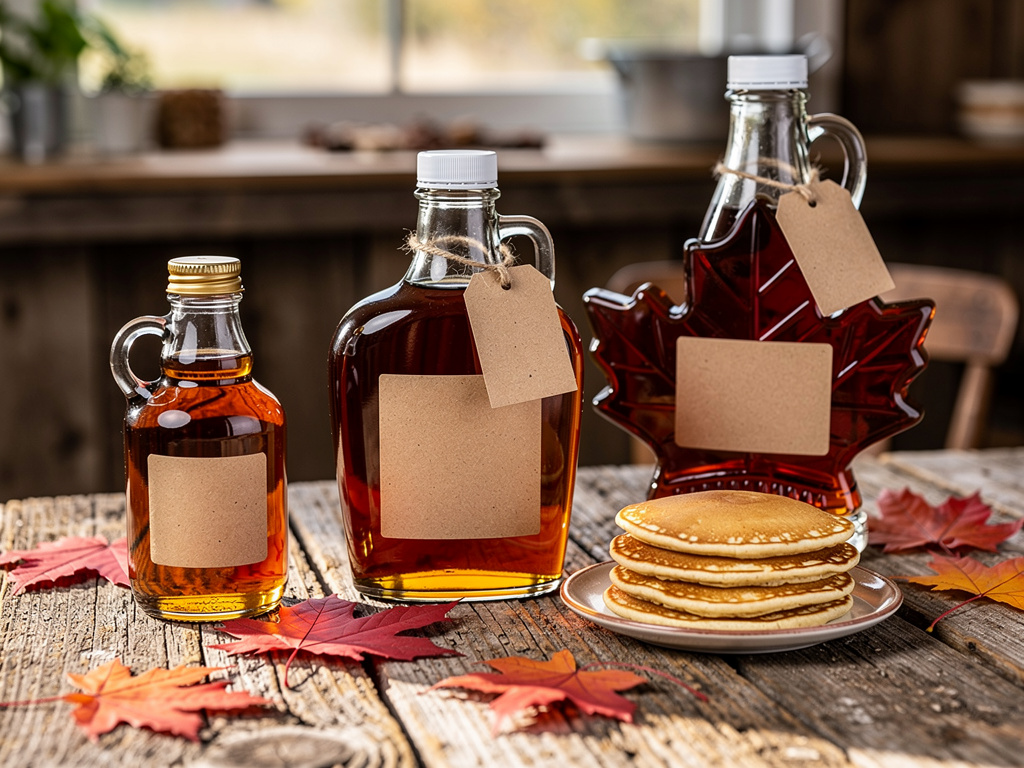


The short version: Sell pure maple syrup for about $12 a pint, $20 a quart, $34 a half gallon and $58 a gallon, with an 8-ounce jug at $8 and a 250 ml glass maple leaf bottle at $12. That gallon price sits right at the $56.70 a gallon American sugarmakers averaged on retail sales in 2025, according to the USDA. The same gallon sold by the barrel brought $31.00, so every gallon you bottle yourself is worth roughly $25 more than bulk before containers and fees. Smaller containers cost more per ounce, and they also earn you the most per gallon of syrup, because a plastic jug costs only $1.55 to $3.40.
Checked September 25 and 26, 2026: the USDA National Agricultural Statistics Service Crop Production report of June 11, 2026, syrup and supply prices on bascommaple.com, palmersugarhouse.com, cbmaplefarm.com, gmsh.com and runamokmaple.com, a live pull of Homegrown's catalog, and the pricing pages of Homegrown, Square and Etsy. Keep in mind: the ladder is our recommendation, prices differ by state by as much as $31.70 a gallon, and density and grade-label rules vary, so verify your state's current rules before you bottle. Homegrown customers create an account to place a first order, and Homegrown has no timed drop or countdown release.
You boiled more sap than your family can pour on pancakes in a year. Now a neighbor wants a quart, a coworker wants two pints for gifts, and the fall market has an open table. The question on the tag is simple: what is a jug of your syrup worth?
A search for this question on September 25, 2026 turned up forum threads trading opinions, farm pages listing their own prices, a shopper's cost guide and a university extension bulletin. None of the forum threads or farm pages start from the numbers the USDA actually collects from sugarmakers every year. This guide does. It lays out what syrup sold for in 2025 by the gallon, by the barrel and by state, what five sugarhouses charge for each size, what it costs you to fill a jug, and which container earns the most for each gallon you boil.
Charge $12 for a pint of pure maple syrup, $20 for a quart, $34 for a half gallon and $58 for a gallon. Add an 8-ounce jug at $8 for people trying you for the first time and a 250 ml glass maple leaf bottle at $12 for gift shoppers. The gallon price is anchored on the USDA's 2025 average retail price of $56.70 a gallon, and each smaller size steps up in price per ounce the way working sugarhouses price theirs. That USDA figure averages every retail sale, whatever the container size, so it is a reference point for the whole ladder rather than the price of one gallon jug.
Here is the starting price ladder:
Scroll sideways to see the full ladder.
| Container | Holds | Suggested price | Price per ounce | Share of the gallon price |
|---|---|---|---|---|
| Glass maple leaf bottle | 250 ml (8.45 oz) | $12 | $1.42 | 21% |
| Half-pint jug | 8 oz | $8 | $1.00 | 14% |
| Pint jug | 16 oz | $12 | $0.75 | 21% |
| Quart jug | 32 oz | $20 | $0.63 | 34% |
| Half-gallon jug | 64 oz | $34 | $0.53 | 59% |
| Gallon jug | 128 oz | $58 | $0.45 | 100% |
The ladder is our recommendation, built on figures loaded September 25 and 26, 2026: the USDA's 2025 retail average of $56.70 a gallon, and the price lists of Bascom Maple Farms, Palmer's Sugarhouse, Carman Brook Farm and Green Mountain Sugar House shown further down. Price per ounce is rounded to the cent.
Three numbers back the $12 pint:
How to make syrup, what the rules look like and where to sell it are covered in the companion guide on how to sell maple syrup from home. This page stays on the price.
American sugarmakers averaged $56.70 a gallon on retail sales in 2025, $48.70 a gallon wholesale, and $2.80 a pound, or $31.00 a gallon, for syrup sold in bulk barrels. Those figures come from the USDA Crop Production report of June 11, 2026, which reports maple prices from sugarmakers in 13 states. Across every type of sale, the national average was $35.60 a gallon.
Swipe across to read the whole table.
| Type of sale | What it means | 2024 price | 2025 price | Per ounce, 2025 |
|---|---|---|---|---|
| Retail | You sell straight to the person who eats it | $59.50 a gallon | $56.70 a gallon | $0.44 |
| Wholesale | You sell containers to a store or restaurant that resells them | $48.20 a gallon | $48.70 a gallon | $0.38 |
| Bulk | You sell unbottled syrup by the barrel to a buyer who bottles or uses it | $2.60 a pound ($28.90 a gallon) | $2.80 a pound ($31.00 a gallon) | $0.24 |
| All sales combined | The average across every gallon sold | $34.20 a gallon | $35.60 a gallon | $0.28 |
Source: USDA National Agricultural Statistics Service, Crop Production, June 11, 2026, pages 10 to 12, loaded September 25, 2026. The 2026 prices will not be published until June 2027. The pound-to-gallon figures in the report work out to about 11.1 pounds of syrup per gallon.
The same report shows how syrup actually leaves the sugarhouse. Of the 5.70 million gallons made in 2025:
The retail average slipped $2.80 from 2024 to 2025, a drop of about 5 percent, while the bulk price rose 20 cents a pound. The 2026 crop came in at 5.88 million gallons, up 3 percent. The USDA will not publish 2026 prices until June 2027, so the 2025 averages are the best guide for this fall.
Retail maple syrup ran from $50.50 a gallon in Indiana to $82.20 a gallon in Connecticut in 2025, a spread of $31.70 across the 13 states the USDA surveys. Vermont, which made 3.01 million of the country's 5.70 million gallons in 2025, sat near the bottom at $51.40.
Retail maple syrup, price per gallon by state, 2025
Source: USDA National Agricultural Statistics Service, Crop Production, June 11, 2026, "Maple Syrup Retail and Wholesale Price," 2025 column, loaded September 25, 2026. 13 states.
How to use your state's number:
Four sugarhouses checked on September 25 and 26, 2026 charged $55 to $92.95 for a gallon of syrup and $9.50 to $29.95 for a pint. The low end is Bascom and Palmer's, two farms selling syrup at plain farm prices. The high end is the online store of Green Mountain Sugar House, a Vermont sugarhouse that also runs a gift shop.
Swipe left for the larger sizes.
| Seller | Half-pint | Pint | Quart | Half gallon | Gallon |
|---|---|---|---|---|---|
| Bascom Maple Farms, plastic jug | $5.50 | $9.50 | $18.00 | $33.00 | $59.00 |
| Palmer's Sugarhouse, Shelburne, Vermont | $11.00 | $15.00 | $22.00 | $35.00 | $55.00 |
| Carman Brook Farm, Vermont | $7.25 | $12.00 | $20.00 | $32.00 | Not sold |
| Green Mountain Sugar House, Vermont, online | Not sold | $29.95 | $39.95 | $55.95 | $92.95 |
| Suggested ladder in this guide | $8.00 | $12.00 | $20.00 | $34.00 | $58.00 |
Every price was loaded from the seller's own website on September 25 and 26, 2026, before shipping and tax. Bascom sells its syrup in a New Hampshire association jug. Palmer's Sugarhouse takes orders by phone from the price list on its site.
What the table tells you:
You are not Green Mountain Sugar House or Runamok. You are closer to Bascom and Palmer's, which sell their syrup at plain farm prices with no gift-shop markup and no brand premium. That is why the suggested ladder sits between those two.
Every sugarhouse checked charges more per ounce for small containers, because a pint jug takes almost as much time and nearly half the jug cost of a gallon but holds one eighth of the syrup. Bascom's pint runs 59 cents an ounce against 46 cents for its gallon. At Palmer's the gap is wider: 94 cents an ounce for a pint against 43 cents for a gallon.
A useful way to set your ladder is to price each size as a share of your gallon price. Here is how the two farm ladders and ours compare:
Slide the table left to see each seller.
| Size | Bascom, share of gallon | Palmer's, share of gallon | This guide, share of gallon |
|---|---|---|---|
| Half gallon | 56% | 64% | 59% |
| Quart | 31% | 40% | 34% |
| Pint | 16% | 27% | 21% |
| Half-pint | 9% | 20% | 14% |
Shares are each size's price divided by the same seller's gallon price, from the price lists loaded September 25, 2026.
A quick rule that sits between the two farm ladders:
So if your area supports $62 a gallon, a pint lands near $12 to $13 and a quart near $21. Round to whole dollars. A $12 price is easier to make change for than $11.75 when a customer pays cash.
A pint of your own syrup costs about $5.62 to fill and label, and a gallon about $34.52, when you value the syrup at the $2.80 a pound it would bring in bulk. The syrup is most of the cost. The jug adds $1.55 to $3.40 and the label about 12 cents.
Move the table sideways to see the totals.
| Container | Syrup at bulk value | Container | Label | Total to fill |
|---|---|---|---|---|
| Half-pint jug (8 oz) | $1.94 | $1.55 | $0.12 | $3.61 |
| Pint jug (16 oz) | $3.88 | $1.62 | $0.12 | $5.62 |
| Quart jug (32 oz) | $7.75 | $1.94 | $0.12 | $9.81 |
| Half-gallon jug (64 oz) | $15.50 | $2.57 | $0.12 | $18.19 |
| Gallon jug (128 oz) | $31.00 | $3.40 | $0.12 | $34.52 |
| 250 ml glass maple leaf (8.45 oz) | $2.05 | $2.95 | $0.12 | $5.12 |
Syrup is valued at the USDA's 2025 bulk average of $31.00 a gallon. Container and label prices were loaded on bascommaple.com on September 25, 2026: All State 3-Color plastic jugs from $1.55 (8 oz) to $3.40 (gallon), 250 ml glass leaf bottles at $35.40 for 12 with caps, and a 4-color label for glass at $12 for 100. Bascom's rectangular 4-color syrup label, the kind that fits a jug, is $12.80 for 100, so the 12-cent label cost holds for jugs within a penny. The jugs come printed with a sugaring scene and a nutrition panel, so the label is for your name, the grade and anything else your state asks for. Totals are figured before rounding.
Why value your own syrup at $31.00 a gallon instead of zero? Because that is what it would bring if you sold it by the barrel instead of bottling it. Pricing it at zero hides the real question, which is whether the time you spend filling jugs pays better than selling bulk.
What this table leaves out, and why:
Bulk maple syrup averaged $2.80 a pound in 2025, or about $31.00 a gallon, and ranged from $2.44 a pound in Pennsylvania to $3.20 in Minnesota. That is the price buyers pay sugarmakers for unbottled syrup in barrels. It is also the floor under everything you bottle.
Bulk prices by state in 2025, per pound:
Bulk makes sense for sugarmakers with hundreds of gallons and a packer nearby. For 2026, Bascom Maple Farms announced it would pay $2.60 a pound for Golden and Amber syrup and $1.60 for Processing Grade, and the guide to where to sell maple syrup, including who buys it by the drum covers what to ask a bulk buyer before your first drum. For a small sugarmaker with 20 or 30 gallons, the retail jug is where the money is: $56.70 a gallon at retail against $31.00 in bulk is a gap of $25.70 a gallon before containers and fees.
If you buy sap instead of tapping your own trees, the USDA reports sap sold for an average of 30 cents a gallon in 2025. The UVM Proctor Maple Research Center's update to the Rule of 86 explains that sap at 2 percent sugar takes about 43 gallons to make one gallon of syrup. At 30 cents a gallon, that is about $12.90 in sap for each gallon of syrup, before a single log or gallon of fuel goes under the pan.
At the suggested prices, one gallon of syrup earns you about $21.50 above its bulk value when sold as one gallon jug, $45.90 as eight pints, and $94.46 as 250 ml glass leaf bottles, about 15 of them. Smaller containers earn more per gallon because the jug is cheap compared with the price jump per ounce. They also take more jugs, more labels and more customers.
Swipe across to read the whole table.
| Container | Price | Total to fill | Card fee | You keep per container | Containers per gallon | You keep per gallon of syrup |
|---|---|---|---|---|---|---|
| Gallon jug | $58 | $34.52 | $1.98 | $21.50 | 1 | $21.50 |
| Half-gallon jug | $34 | $18.19 | $1.29 | $14.52 | 2 | $29.05 |
| Quart jug | $20 | $9.81 | $0.88 | $9.31 | 4 | $37.24 |
| Pint jug | $12 | $5.62 | $0.65 | $5.74 | 8 | $45.90 |
| Half-pint jug | $8 | $3.61 | $0.53 | $3.86 | 16 | $61.77 |
| 250 ml glass leaf | $12 | $5.12 | $0.65 | $6.24 | 15.1 | $94.46 |
"You keep" is price minus the fill cost from the table above (syrup at its $31.00 bulk value, container, label) minus a card fee of 2.9% plus 30 cents, Homegrown's rate on its signup page on September 25, 2026. Paid in cash, add the card fee back. Your time is not counted. Figures are rounded to the cent.
That last column is the reason small sizes belong on your table, but it comes with a catch:
Fill your gallon and half-gallon jugs to order and keep only pints, quarts and half-pints bottled on the table. Taking pre-orders for the big sizes means you are never sitting on $58 jugs at the end of the season. At the suggested prices, ten pre-ordered gallons move $580 of syrup with ten transactions.
A glass maple leaf bottle should cost more per ounce than a jug, because a 250 ml leaf bottle costs you $2.95 against $1.55 for an 8-ounce jug, and sellers checked price 250 to 375 ml glass at $1.25 to $2.47 an ounce, two to four times the per-ounce price of a plastic quart. Carman Brook Farm sells a 250 ml leaf bottle (8.45 ounces) for $10.99 and a quart jug for $20. That is $1.30 an ounce in glass against 63 cents in plastic.
Glass is a gift product. The shopper is paying for how the bottle looks on a shelf or in a basket as much as for the syrup inside. Here is how Carman Brook Farm prices its five glass leaf sizes, loaded September 26, 2026:
A $12 price for the 250 ml leaf, as in our ladder, sits just above Carman Brook and below Runamok's $19.95 for 375 ml. Three things to know before you buy glass:
Price every grade the same, because every farm checked on September 25, 2026 charged one price for all grades in a given size. Bascom charges $9.50 for a pint of amber and $9.50 for a pint of dark. Carman Brook Farm sells five grades, from golden to very dark end-of-season, at the same $20 a quart. Green Mountain Sugar House prices golden, amber and dark the same at every size.
Grade in maple syrup is mostly about color and flavor, not quality. The Vermont Maple Sugar Makers' Association lists four color classes, from golden with a delicate taste early in the season to very dark with a strong taste at the end. Under the USDA's U.S. grade standards for maple syrup, all four are color classes of Grade A.
Reasons to keep one price across grades:
The one real price split is between Grade A and syrup that misses it, which is classed as Processing Grade and cannot be labeled Grade A. The USDA counted 177,962 gallons of Processing Grade syrup in 2025, about 3 percent of the crop.
Offer stores and restaurants 80 to 85 percent of your retail price, so about $10 for a pint you sell for $12. The USDA's 2025 wholesale average was $48.70 a gallon, which is 86 percent of the $56.70 retail average. Maple wholesale runs close to retail.
Why the gap is small for maple:
At $10 a pint wholesale, you keep about $4.39 above the syrup's bulk value, container and label, with no card fee if the store pays by check. That is less than the $5.74 you keep at retail, but a store might take four dozen pints in one delivery. The guide to wholesale pricing for food products covers minimum orders, invoices and when to say no.
A few wholesale rules that save trouble:
On a $12 pint, card fees and platform fees take 46 cents to $1.59 depending on how you sell it. Square in person is the cheapest per order. Etsy is the most expensive, because it adds a 6.5 percent transaction fee and a listing fee on top of card processing. Cash costs nothing.
Drag the fee table sideways to compare each way of selling.
| How you sell it | Monthly plan | Trial | Platform fee | Card processing | Customer pays on a $12 pint | You pay on a $12 pint | You pay in a month of 50 pints |
|---|---|---|---|---|---|---|---|
| Homegrown | $10 billed annually ($12.50 billed monthly) | 7 days, no charge until day 8 | $0, 0% commission | 2.9% + $0.30, paid by you | $12.00 | $0.65 plus the plan | $42.40 |
| Square Free, card at the table | $0 | None needed, no monthly plan | None | 2.6% + 15¢, paid by you | $12.00 | $0.46 | $23.10 |
| Square Free, online or invoice | $0 | None needed, no monthly plan | None | 3.3% + 30¢, paid by you | $12.00 | $0.70 | $34.80 |
| Etsy | $0 (a one-time set-up fee may apply) | None needed, no monthly plan | $0.20 listing fee plus 6.5% transaction fee on price and shipping | 3% + $0.25, paid by you | $12.00 plus shipping | $1.59 | $79.50 |
| Cash at the table | $0 | Not applicable | None | None | $12.00 | $0 | $0 |
Fees loaded September 25, 2026 from findhomegrown.com/signup, Square's fees page, and Etsy's Fees and Payments Policy and Etsy Payments Policy. Fees are figured on the $12 price with no shipping or tax. Etsy's transaction fee also applies to what you charge for shipping, and its processing fee applies to the full total including tax and shipping, so real Etsy orders cost a little more than shown. Etsy renews the 20-cent listing fee each time one unit of a multi-quantity listing sells.
What the fee table means for your pricing:
Syrup is made in a few weeks of late winter and early spring and eaten all year, so the pricing problem for a small sugarmaker is not one busy market. It is selling the rest of the crop in September, November and May, when the table is gone and customers text you instead. A Homegrown storefront gives those customers one link where they see your ladder, pick a size and a grade, pay, and choose a pickup time. It is $10 a month billed annually, or $12.50 billed monthly, with no percentage fees beyond standard payment processing of 2.9% + $0.30 per order, which you pay rather than your customer.
How that compares with what small maple sellers usually use:
What Homegrown does for a maple seller: one storefront with each size and grade listed at its own price, pre-orders for gallons you fill to order, pickup scheduling from your house or sugarhouse, and paid orders so nobody forgets to bring cash. What it does not do: it will not grade your syrup, check your density, print your labels or ship your jugs, and your customers create a Homegrown account the first time they order. Your storefront is listed on the Homegrown marketplace, but plan on most orders coming from people you send to your own link.
If your syrup is bottled and your ladder is set, you can put your maple syrup sizes on a Homegrown storefront and send the link to everyone who asked for a quart last spring.
Syrup must be boiled to at least 66 degrees Brix, a measure of sugar content, in many places, and to 66.9 to 68.9 in Vermont, so under-boiled syrup cannot legally be sold as maple syrup where these minimums apply. Brix is the percent of sugar in the syrup, and you check it with a hydrometer or refractometer. The Vermont Maple Sugar Makers' Association grading guide explains that this narrow band keeps syrup shelf-stable and prevents sugar crystals.
Why density is a pricing issue, not only a safety issue:
Density minimums and grade-label rules are set by each state, and the minimum is not the same everywhere. The UVM Proctor Maple Research Center notes that the minimum is 66.0 Brix in many places and 66.9 in some states, and the Vermont Maple Sugar Makers' Association notes that Vermont syrup sold at retail must be clear. Label rules for name, address, net contents and grade name also vary. Verify your state's current rules with your state department of agriculture before you bottle, and read our guide to cottage food labeling requirements for the parts most states share.
A correct label also protects your price. A jug that names the grade, the net contents and your farm looks like the $58 gallon on the table next to it.
The costliest mistake is pricing retail jugs close to the $31.00 bulk value, because a gallon sold at $40 at the market keeps only about $4 more than the barrel would have paid once you count the jug, label and card fee. It is easy to underprice when the sap came from your own trees. That syrup is still worth $31.00 a gallon by the barrel.
Mistakes that show up again and again:
In a pull of the Homegrown catalog on September 25, 2026, none of the 2,709 products listed by 306 vendors was bottled maple syrup. We counted any listing with "maple" in its name, description or options, then checked the category and opened every syrup, sap and pancake listing in the catalog. Maple showed up in 37 listings from 27 vendors, and 34 of those were baked goods using it as an ingredient or glaze, like maple pecan cookies and maple oat sourdough. Five vendors sold pancake mix. A sugarmaker who lists syrup would be the only one on the marketplace, and the pancake mix sellers are natural partners for a breakfast bundle.
If a nearby baker already uses maple in their scones, ask whether they want a gallon a month at your wholesale price. The companion guide on how to sell pancake mix from home shows how those vendors package and price a mix, which helps if you want to pair a pint with a bag.
Set your prices in five steps: find your state's USDA retail average, pick a gallon price near it, build the smaller sizes as shares of that gallon, check the fill cost of each, and round to whole dollars. Every number you need for the first four steps is in the tables above.
After your first season, adjust with real sales:
The cost of a booth changes the math at a market. The breakdown of what it really costs to sell at a farmers market shows how to spread booth fees across everything on your table.
A gallon of pure maple syrup should sell for about $55 to $60 at a market or from home, and $58 is a solid starting point. The USDA reports an average retail price of $56.70 a gallon for 2025, with state averages from $50.50 in Indiana to $82.20 in Connecticut. Two sugarhouses checked in September 2026 charged $55 and $59 for a gallon jug.
Charge about $12 for a 16-ounce pint of maple syrup, which is 75 cents an ounce. Farm prices checked on September 25, 2026 ranged from $9.50 at Bascom Maple Farms to $15 at Palmer's Sugarhouse, and $29.95 at an online Vermont gift shop. A pint costs about $5.62 to fill, counting your syrup at its bulk value, the jug and the label.
The U.S. average bulk price was $2.80 a pound in 2025, or about $31.00 a gallon, according to the USDA's June 2026 Crop Production report. State averages ranged from $2.44 a pound in Pennsylvania to $3.20 in Minnesota. Bulk means unbottled syrup sold by the barrel, usually to a packer.
Real maple syrup takes about 43 gallons of sap at 2 percent sugar to make one gallon, according to the University of Vermont's Proctor Maple Research Center. That sap has to be collected in a few weeks of late winter and boiled down over hours of fuel. Even in bulk, sugarmakers got $31.00 a gallon in 2025, so a retail price near $57 a gallon reflects the work and the short season.
No, dark maple syrup should cost the same as golden, amber and very dark in the same size. Every farm checked on September 25, 2026, including Bascom Maple Farms, Carman Brook Farm and Green Mountain Sugar House, charged one price for every grade. All four color classes are Grade A, and the difference is flavor, not quality.
Charge stores about 80 to 85 percent of your retail price, so around $10 for a pint you sell for $12. The USDA's 2025 wholesale average was $48.70 a gallon, which is 86 percent of the retail average. Set a case minimum, like 12 pints, and put your prices in writing.
These guides answer the questions that come right before and after the price tag. Start with the first one if you have not bottled a batch yet, and come back to the wholesale guide when a store asks for a case:
Your syrup took a whole winter to make. Price it like it did, then set up a storefront where neighbors can order maple syrup by the pint or gallon whenever they run out.



