
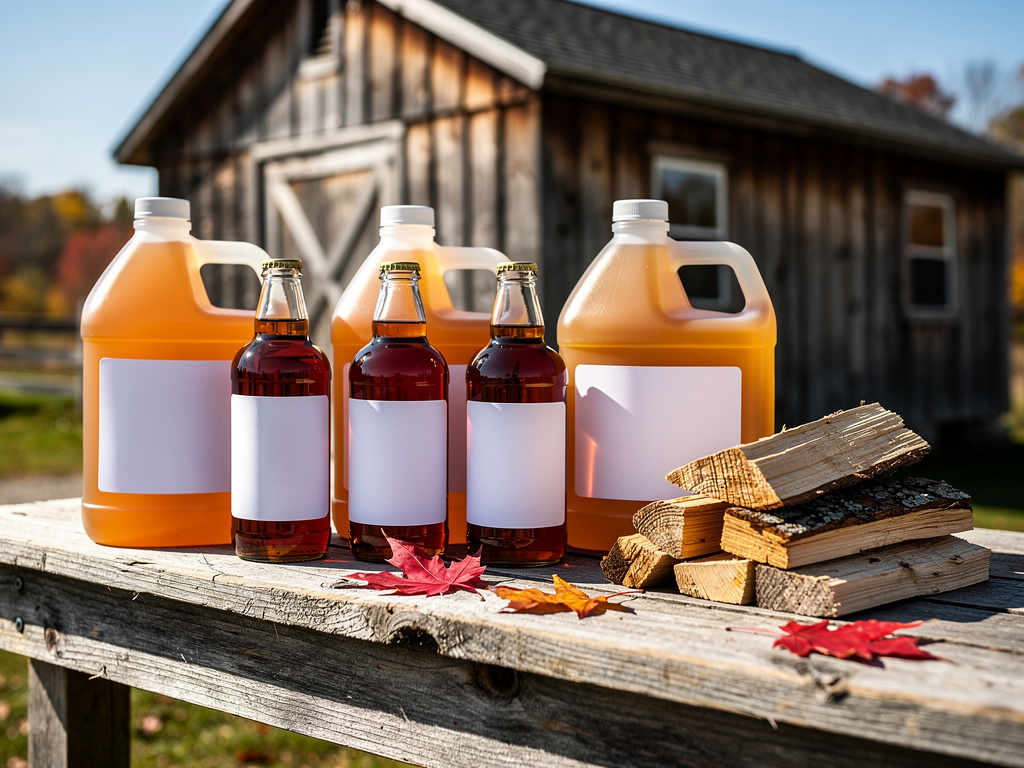


The short version: Maple syrup sells in seven places: your sugarhouse or driveway, a farmers market, your own storefront link, a maple weekend open house, holiday markets and craft fairs, local shops and restaurants, and a bulk buyer who takes whole drums, with Etsy and Amazon as an extra option for buyers far away. The USDA's June 2026 report puts the 2025 averages at $56.70 a gallon for retail sales, $48.70 for wholesale and $31.00 for bulk, and the country's largest bulk buyer, per The Maple News, is paying $2.60 a pound for top-grade 2026 syrup, about $28.80 a gallon. A $20 quart leaves you $19.12 through your own link before the $10 monthly plan, $17.65 on Etsy and $16.01 on Amazon's Individual plan, before containers and shipping. Most small sugarmakers do best bottling everything they can sell at retail and sending only the overflow, and any Processing Grade syrup, to a bulk buyer.
Checked September 26, 2026: Homegrown is $10 a month billed annually or $12.50 billed monthly, with a $0 platform fee, 0% commission and card processing of 2.9% + $0.30 paid by the vendor, and 7 days before the first charge on day 8 (findhomegrown.com/signup). Etsy charges a $0.20 listing fee, a 6.5% transaction fee and 3% + $0.25 payment processing (etsy.com/sell). Amazon's Grocery and Gourmet referral fee is 15% on anything priced over $15.00, plus $0.99 per sale on the Individual plan or $39.99 a month on the Professional plan (sell.amazon.com/pricing). Honest bounds: your customer creates a Homegrown account to place a first order, Homegrown does pickup and local delivery but not shipping, there is no countdown or timed release feature, and your storefront is listed on the Homegrown marketplace but most orders will come from the link you hand out yourself.
The drums are full, the jugs in the basement are stacked three high, and the family has already said no to a fourth gallon each. Selling a pint to a neighbor who stopped by during boiling was easy. Selling 40 gallons, every spring, means picking the places where syrup actually moves, and each place pays a very different price for the same gallon.
This guide covers seven places a small sugarmaker can sell maple syrup, what each one costs you on a single $20 quart, what one gallon of syrup brings in each place, and who buys syrup by the drum when the jugs run out before the syrup does.
Maple syrup sells in seven places, and a sugarmaker with 50 to 300 taps can run two or three of them without hiring anyone. Each place trades a different amount of your time for a different price per gallon, from about $80 a gallon in quarts at your own table to about $28.80 a gallon in a drum.
Etsy and Amazon are an extra option for mail-order buyers far from your road. They are covered further down with their full fees, because shipping a heavy jug changes the math.
Syrup has two advantages most homemade food lacks. Finished to the right density it keeps for months on a shelf, and buyers who find a sugarmaker they trust tend to come back every year. The limit is the season: the sap runs in late winter and early spring and then stops, so the question is less "who will buy it" and more "which place pays the most for the gallons you have."
If you have not sorted out the grade label, the jug sizes or the price yet, the companion guide on how to sell maple syrup from home covers the rules and production side. This article starts after that, with full jugs and no plan for where they go.
Start with the place that matches what you already have, because a sugarmaker on a busy county road has a different first move than one with 30 gallons, a day job and no booth. The table pairs five common starting points with a first and second place to sell. Whichever row fits, the goal is to sell as many gallons as you can at the retail price of about $20 a quart before any go into a drum at $2.60 a pound.
Scroll sideways to see all four columns.
| What you have right now | Start here | Add second | Why that order |
|---|---|---|---|
| A sugarhouse or house on a road with steady traffic | A stand or shelf at the sugarhouse | Your own storefront link | The stand finds buyers at no cost; the link lets them reorder in October when the stand is closed |
| 20 to 60 gallons and no customers yet | A farmers market | Your own storefront link | Strangers buy syrup after a taste, and a booth is where the taste happens |
| A market booth you already pay for | Your own storefront link | A local shop or co-op | The booth built the customers; the link covers the six days you are not there |
| More syrup than time, 100 gallons or more | Local shops and restaurants by the case | A bulk buyer for the overflow | Wholesale moves a case in one drop-off; bulk moves the rest by the drum |
| A sugarhouse the public can visit in March | Your state's maple weekend | Your own storefront link | One weekend brings local visitors to your door; the link turns them into fall reorders |
The $20 quart in the paragraph above is the quart price from the maple syrup pricing guide's ladder, and the $2.60 a pound is Bascom's 2026 bulk price for Golden and Amber syrup, from The Maple News report linked in the bulk buyer section below.
The mistake is opening five places in one year. Each one needs its own price sign, its own restock trip and its own share of a crop that does not grow back until next March. Two places run well beat five places that each run out of amber by August.
Yes, and for a sugarmaker on a road with traffic, a stand at the sugarhouse is the cheapest place to sell maple syrup: no booth fee, no drive, and nothing off the jug beyond whatever your card reader charges. Square's free plan charges 2.6% + 15 cents on a tapped card, which is 67 cents on a $20 quart, and cash costs nothing.
Syrup suits a stand better than almost anything else a farm sells. A sealed jug does not wilt, melt or go stale on a shaded shelf, so an unstaffed stand can hold a week of stock. Three setups work, from simplest to most involved:
A road sign does real work here. Bascom Maple Farms sells an 18 by 24 inch "Pure Maple Syrup Sold Here" sign for $85 (bascommaple.com, September 26, 2026), which costs about what four or five $20 quarts bring in, or about eight quarts once you count the jugs and what that syrup would fetch in a drum. Our guide on how to set up a roadside farm stand covers the build, the signage and the payment box.
The stand's limit is the calendar and the road. Drivers pass all year, but the only people who stop are the ones who pass your sign. A card on the shelf that says "sold out of quarts, order here for pickup Saturday" turns an empty shelf into an order instead of a lost sale.
A farmers market is one of the best places to sell maple syrup to strangers, because shoppers walk the aisles looking for something local and a taste of dark syrup on a spoon closes the sale. Booth space runs $20 to $75 a week at most markets, with a full season often costing $400 to $800 up front, as broken down in our guide to the real cost of selling at farmers markets.
Run the math on a $40 booth. Two $20 quarts cover it. Sell ten quarts and six pints in a morning and you take in $272, so the booth is about 15% of the day. Syrup does not spoil at the end of the day, so whatever you bring home goes back on the shelf instead of in the compost.
What a booth gives you that nothing else does:
Fall and winter markets matter more for syrup than for most farm products. Holiday baking starts in the fall, right when tomatoes and sweet corn leave the tables.
In at least one state, syrup has to be tested before it can be sold at a market. South Dakota's guidance, from SDSU Extension, says syrup has to pass a water activity test, coming in below 0.85, before it can go on a farmers market table there. Rules like that vary by state and by market, so check what your own state and market require before your first market day.
Your syrup needs a place to be ordered on the days your booth and your stand are closed, and for a part-time sugarmaker that place costs about $10 a month. Homegrown is $10 per month billed annually, or $12.50 billed monthly, with no percentage fees beyond standard payment processing of 2.9% + $0.30 per order, which is $0.88 on a $20 quart. The first 7 days are not billed, so nothing is charged until day 8.
For maple syrup specifically, the $10 buys four things: each jug size and grade listed with its price, so nobody texts to ask whether you have dark in a quart; orders paid ahead and picked up at your sugarhouse, your stand or your market booth on a day you pick; local delivery inside a radius you set, from 1 to 25 miles, with a delivery fee you keep, less card processing; and a page that is live in about 15 minutes without building a website.
Compare that to where sugarmakers usually land first:
Honest bounds, so you can weigh it fairly. Your customer creates a Homegrown account to place a first order, which is one more step at checkout. Homegrown handles pickup and local delivery, not shipping, so a customer in another state who wants a gallon mailed is an Etsy or direct-shipping order, not a Homegrown one. There is no countdown or timed release feature for a new-crop announcement. Your storefront is listed on the Homegrown marketplace, but plan on most orders coming from the link you text, print and hand out yourself. And it will not make your syrup legal to sell: the grade, the density and any state license are still yours to handle.
In a live pull of the Homegrown catalog on September 26, 2026, the marketplace held 2,714 products from 306 vendors, and not one of them was a jug or bottle of maple syrup. We searched every product name, description and size option for maple, syrup, sugarhouse, sugarbush and sap, read all 53 matches, then ran a second search for grade and color words. Thirty-seven listings from 27 vendors mention maple, and 34 of those are in the Bakery category, where maple shows up as an ingredient, glaze or flavor, from maple pecan cookies and cinnamon rolls to maple oat sourdough, granola and fudge. The other three are overnight oats, a freeze-dried taffy and a maple peanut butter. A sugarmaker who lists syrup there would be the only one.
If your regulars already ask when the new syrup is coming, that is the whole case for a link. Set up a storefront for your syrup, list each jug size with its grade and price, and text the link to last year's buyers the week you finish bottling, so the first quarts are spoken for before the stand even opens.
Yes, if the public can reach your sugarhouse safely, because a maple weekend sends local families out to watch the boil on the one or two weekends a year they go looking for a sugarhouse to visit. Maine's maple association says most sugarhouses on its map offer syrup samples and a demonstration of how syrup is made. The events run in March, when the sap is running and the steam is rising, and they are organized by each state's maple association. New York's runs over 4 days across two weekends.
The dates follow a pattern in each state:
A maple weekend is a sales day, not just a tour. Visitors taste, compare colors and buy the jug that matches the one they liked, so have every size priced and stacked before the doors open. Keep a pad of cards with your storefront link at the register, because the family that buys one pint in March is the family that wants a quart in November.
A maple weekend fills the register for two days, and then the sugarhouse goes quiet until fall. If you set up a Homegrown storefront for your syrup before March, every visitor who leaves with a card can order a quart for pickup in October without calling you, and you see the order and the payment before you pull the jug off the shelf.
Ask your state association how a sugarhouse gets on the open-house map, what it costs to join, and what the event requires of you. Parking, a safe path around the evaporator, and a restroom plan matter more than signage on a day when cars keep pulling in from 10 to 4. If your setup cannot take a crowd, a spot at a neighbor's open house, selling beside a larger sugarhouse, is a gentler first year.
Yes, and November and December are when maple syrup sells as a gift. Holiday buyers are shopping for teachers, hosts and relatives out of state, and a small glass maple leaf bottle with a ribbon is an easy yes at $12.
What sells at a holiday table is different from what sells at the stand:
A craft fair is one or two days of selling instead of a weekly routine, so ask each fair for its table fee and work out how many bottles cover it before you sign up. Our comparison of craft fairs and farmers markets for food vendors walks through which foods suit which venue, and why the gift crowd at a fair buys differently from the repeat customers at a weekly market. Bring enough small bottles, because a holiday crowd buys the gift size first and the everyday size second.
The gift season also sets up the rest of your year. A shopper who buys three gift bottles in December is a shopper who might want a gallon for the house in February, so the reorder card belongs in every gift bag.
Offer a local shop a case of 12 quarts at 80 to 85 percent of your own shelf price, so $16 to $17 for a quart you sell for $20, and deliver it yourself. The USDA's 2025 wholesale average was $48.70 a gallon, which is 86 percent of the $56.70 retail average, so maple wholesale runs close to retail.
Who buys syrup wholesale from a small sugarmaker:
Walk in with a sample, a one-page price list and a 12-quart case minimum. The list shows each size, the case price and how you want to be paid. Our guide to selling food products in local stores covers the pitch, the paperwork and how to follow up.
Wholesale's strength is volume per trip. One delivery of 48 pints to a co-op moves in a single stop what might take several market mornings to sell one pint at a time. Its weakness is the price: a quart at $17 wholesale leaves you $3 less than the same quart at your own table, and the store sets the shelf price. Ask the store to keep your quart at or near your own $20, so a shopper does not find it cheaper down the street from your stand.
For the full price math, including why maple wholesale sits close to retail, the maple syrup pricing guide walks through each container size and the wholesale discount.
Sell maple syrup on Etsy or Amazon only if you want mail-order buyers you cannot reach locally and you are ready to ship a heavy jug, because Etsy's fees come to $2.35 on a $20 quart before shipping and Amazon takes $3.99 on its Individual plan. Syrup ships well, since it is shelf-stable and a plastic jug does not break, but a quart of syrup alone weighs about 2.8 pounds, at the roughly 11.1 pounds a gallon implied by the USDA's bulk prices, before the jug and the box.
What each one charges, checked September 26, 2026:
Online marketplaces make the most sense for a sugarmaker who already has shipping boxes and a reason to reach far away buyers, such as family who moved out of state or an organic or single-grade syrup people search for by name. The detailed breakdown of Etsy's fees for food vendors shows how the listing, transaction and processing fees stack on a real order.
For local customers, the online marketplaces cost more than they need to. A neighbor who orders a quart for pickup through Etsy pays you the same $20, and you give up $2.35 of it for a buyer you already had.
On a $20 quart, card and platform fees take from $0 to $3.99 depending on where you sell it. Cash at your own stand costs nothing, a tapped card through Square's free plan costs 67 cents, your own storefront link costs 88 cents plus the monthly plan, Etsy costs $2.35 and Amazon's Individual plan costs $3.99. That leaves $20.00 in cash, $19.33 after a tapped card, $19.12 through your own link before the $10 monthly plan, $17.65 on Etsy and $16.01 on Amazon's Individual plan.
Swipe the fee table sideways to see every column.
| Where and how you sell | Monthly plan | Trial | Platform fee | Card processing | Customer pays on a $20 quart | You pay on a $20 quart | You pay in a month of 50 quarts |
|---|---|---|---|---|---|---|---|
| Homegrown storefront link | $10 billed annually ($12.50 billed monthly) | 7 days, no charge until day 8 | $0, 0% commission | 2.9% + $0.30, paid by you | $20.00 | $0.88 plus the plan | $54.00 ($56.50 on monthly billing) |
| Square Free, card tapped at your stand or booth | $0 | None needed, no monthly plan | None | 2.6% + 15¢, paid by you | $20.00 | $0.67 | $33.50 |
| Square Free, online order or invoice | $0 | None needed, no monthly plan | None | 3.3% + 30¢, paid by you | $20.00 | $0.96 | $48.00 |
| Etsy | $0 (a one-time shop set-up fee may apply) | None needed, no monthly plan | $0.20 listing fee plus 6.5% transaction fee on price and shipping | 3% + $0.25, paid by you | $20.00 plus shipping | $2.35 before shipping | $117.50 before shipping |
| Amazon, Individual plan | $0, plus $0.99 per sale | None needed, no monthly plan | 15% referral fee on a total over $15.00, plus $0.99 per sale | Not listed separately on Amazon's pricing page | $20.00 plus shipping | $3.99 before shipping | $199.50 before shipping |
| Amazon, Professional plan | $39.99 | None listed | 15% referral fee on a total over $15.00 | Not listed separately on Amazon's pricing page | $20.00 plus shipping | $3.00 plus the plan | $189.99 before shipping |
| Cash at your stand or booth | $0 | Not applicable | None | None | $20.00 | $0 | $0 |
We checked every fee in this table on September 26, 2026, on findhomegrown.com/signup, Square's pricing page, etsy.com/sell and sell.amazon.com/pricing. Fees are figured on the $20 price with no shipping or tax. Etsy's transaction fee also applies to what you charge for shipping, and Amazon's referral fee is figured on the total sales price, so a shipped quart costs more than the table shows. Booth fees, shipping boxes and postage are not included.
What the table means for where your syrup goes:
One gallon of syrup bottled into four $20 quarts leaves you about $56 to $72 after quart jugs and fees, depending on where the quarts sell, while the same gallon in a drum brings about $28.80 from a bulk buyer. That gap, about $27 to $43 a gallon, is the reason small sugarmakers bottle everything they can sell.
Slide the table left to see all five columns.
| Where the gallon goes | What the buyer pays you | Containers | Card and platform fees | Left from one gallon |
|---|---|---|---|---|
| Cash at your stand, four $20 quarts | $80.00 | $7.76 for four quart jugs | $0 | $72.24 |
| Card tapped at your stand or booth, four $20 quarts | $80.00 | $7.76 | $2.68 | $69.56, before any booth fee |
| Your own storefront link, four $20 quarts | $80.00 | $7.76 | $3.52 | $68.72, before the $10 monthly plan |
| Etsy, four $20 quarts | $80.00 | $7.76 | $9.40 | $62.84, before boxes and postage |
| A shop buying four quarts at $17 | $68.00 | $7.76 | $0 if paid by check | $60.24 |
| Amazon Individual plan, four $20 quarts | $80.00 | $7.76 | $15.96 | $56.28, before boxes and postage |
| Bulk buyer, Golden or Amber at $2.60 a pound | about $28.80 | Your drum | $0 | about $28.80 |
| Bulk buyer, Processing Grade at $1.60 a pound | about $17.70 | Your drum | $0 | about $17.70 |
Quart jugs are Bascom Maple Farms' All State plastic quart at $1.94 each, loaded September 26, 2026; labels are not counted. Bulk prices are Bascom's 2026 buying prices as reported by The Maple News on March 23, 2026, converted at the roughly 11.1 pounds per gallon the USDA uses when it turns $2.80 a pound into $31.00 a gallon.
The USDA's own averages tell the same story from the whole industry's side. In its Crop Production report of June 11, 2026, the average 2025 gallon brought $56.70 when sold at retail and $31.00 when sold in bulk, a gap of $25.70 a gallon before containers and fees.
What a gallon of maple syrup brought in 2025, by how it was sold
Source: USDA National Agricultural Statistics Service, Crop Production, June 11, 2026, maple syrup tables for the 2025 season, loaded September 26, 2026. Bar length is each price divided by the retail price.
Where the 5,701,000 gallons made in 2025 actually went:
The all-sales average of $35.60 sits close to the bulk price because 77% of all syrup is sold in drums. For a small sugarmaker, that means the industry average is not your price. A sugarmaker who sells 30 gallons in quarts is working in the 10.5% of the market that pays the most.
Bulk syrup goes to packers who buy it by the drum, weigh it, grade it and pay by the pound. Bascom Maple Farms, which The Maple News calls the nation's largest bulk syrup buyer, announced in March 2026 that it would pay $2.60 a pound for Golden and Amber syrup from the 2026 crop, a 20-cent increase over the year before.
Bascom's full 2026 price list, as reported by The Maple News on March 23, 2026:
The same story reports that other Vermont bulk buyers adopted similar prices for the 2026 season. The USDA's 2025 bulk average of $2.80 a pound shows what the whole market paid the year before, with state averages from $2.44 a pound in Pennsylvania to $3.20 in Minnesota.
Bulk makes sense in three situations. You made more syrup than you can bottle and sell before next season. You have Processing Grade syrup, which the USDA's voluntary grade standard reserves for bulk containers of at least 5 gallons, not retail jugs. Or you have no time to sell retail at all. A 40-gallon drum of Golden syrup at $2.60 a pound is worth about $1,150, paid in one transaction with no market days.
Before your first drum, call the buyer and ask what drums they accept, how they sample and grade, when they pay, and whether they have a minimum. Bascom sells 30- and 55-gallon epoxy-lined drums for $100 each and lists a 40-gallon stainless drum at $255, out of stock when we checked (bascommaple.com, September 26, 2026), which gives a sense of what a first drum costs. Massachusetts' maple association lists 17 sugarhouses in its directory under bulk sales, but that means they sell syrup in bulk, not that they buy it. A larger sugarhouse near you may still buy syrup from a smaller maker, so call and ask; the directories we checked list sellers, not buyers.
Yes, and in 2025 US sugarmakers sold 14,082,900 gallons of raw sap at an average of 30 cents a gallon, according to the USDA. Selling sap skips the evaporator, the fuel and the long boiling nights, and trades them for a much smaller check.
Where the sap was sold in 2025, in every state the USDA reports by name:
Look for a sap buyer among the larger sugarmakers near you, since a buyer needs evaporator capacity to spare. SDSU Extension notes that it can take 43 or more gallons of sap to make one gallon of syrup, so 43 gallons of sap at 30 cents is about $12.90, compared to about $28.80 for that same gallon of syrup sold in bulk, or $80 sold in quarts.
Sap selling fits a landowner with good maples, a few hundred taps and no sugarhouse. It does not fit someone who can boil, because every step up the ladder, from sap to bulk syrup to bottled syrup, at least doubles what the same trees earn. Sap also spoils fast: SDSU Extension advises that sap should not be stored more than a few hours before it is processed, so a sap buyer needs to be close enough to pick up quickly.
The rules that matter shift with the container, the grade and the place you sell. A federal definition and the USDA grade standard set the baseline, and your state adds its own rules on top.
What the federal definition and the USDA grade standard say:
Your state layers its own rules on top, and they differ from state to state. Two examples, loaded September 26, 2026:
The Maine farm stand FAQ answers "Can I sell honey or maple syrup?" with a yes, and the conditions on that yes are the licensing and labeling warning in the bullet above. If you sell at a stand in Maine, the call to the department comes before the first jug goes on the shelf.
Selling to a store or shipping out of state can bring more rules than a stand does, and this guide has not checked those rules for any state. Rules change and vary by state, so verify your state's current rules with its department of agriculture before you open a new place to sell.
Start by counting what you have and deciding which gallons go to which place, before the first jug leaves the sugarhouse. A sugarmaker with 40 gallons might plan 25 for retail, 10 for a shop account and 5 for a bulk buyer in a 5-gallon pail, if your buyer takes lots that small, and adjust after the first month.
The first season is a test. Keep a notebook of where each gallon went and what it brought, and next spring you will know whether the stand, the market or the shop earned the most for your time.
Experienced sugarmakers decide where the syrup goes before the sap runs, not after the drums are full. They know roughly how many gallons each place will take, so they bottle for retail first and send only the leftover to bulk.
What they do that first-year sugarmakers skip:
Before you sell a single drum, hold back 10 percent of it in jugs. On a 40-gallon drum, that is 4 gallons, or 16 quarts worth $320 at $20 each, against about $115 for the same 4 gallons in bulk at $2.60 a pound. Those 16 quarts carry your stand through November and December, when gift buyers show up and your shelf would otherwise be empty.
The same thinking applies to value-added products. Some sugarmakers turn part of the crop into maple candy and maple cream, which sit beside the syrup as gifts and give a holiday table more than one thing to buy. Our guide on how to sell maple candy from home covers that side, from labels to the holiday market.
The best place to sell maple syrup for most small sugarmakers is a sugarhouse stand or a farmers market, paired with an online storefront link for reorders. Those places sell syrup at retail prices, which averaged $56.70 a gallon in 2025 according to the USDA, against $31.00 a gallon for bulk syrup sold in drums. Send only the syrup you cannot bottle and sell to a bulk buyer.
Yes, a small sugarmaker can sell maple syrup to a local grocery, co-op or farm store, usually by the case at 80 to 85 percent of the shelf price. On a quart you sell for $20, that is $16 to $17 wholesale. Bring a sample, a price list and a minimum order, and check whether your state license covers wholesale before the first delivery.
Bascom Maple Farms, the biggest US bulk buyer by The Maple News' account, set its 2026 prices at $2.60 per pound of Golden or Amber syrup, $2.55 for Dark, $2.35 for Very Dark and $1.60 for Processing Grade, according to The Maple News on March 23, 2026. At about 11.1 pounds to the gallon, $2.60 a pound is about $28.80 a gallon. The USDA's 2025 bulk average across all buyers was $2.80 a pound.
Yes, maple syrup sells online through Etsy, Amazon or your own storefront. Etsy takes about $2.35 of a $20 quart before shipping and Amazon's Individual plan takes $3.99, so marketplaces fit buyers who live far away. For local customers, a storefront link with pickup or local delivery keeps more of each sale, at 88 cents in card processing on a $20 quart plus the $10 monthly plan.
It depends on your state and your market, so check with your state department of agriculture and the market manager before your first market day. SDSU Extension's guidance says syrup must test below 0.85 water activity before it goes on a South Dakota market table, and Maine's agriculture department says packaged maple syrup may need a license and labeling. The federal definition also requires maple syrup to contain at least 66 percent soluble solids by weight.
The USDA's grade standard, which is voluntary at the federal level, says Processing Grade maple syrup must be packed in containers of 5 gallons or larger, for use in making other foods, and not in consumer-size retail containers, so check whether your state's rules adopt it. Bulk buyers purchase it for use in other foods; Bascom Maple Farms listed $1.60 a pound for Processing Grade in its 2026 prices. That is about $17.70 a gallon, so keeping syrup in the Grade A range is worth real money.
Five guides that pick up where this one stops, each answering a question a sugarmaker usually hits right after deciding where to sell:



