
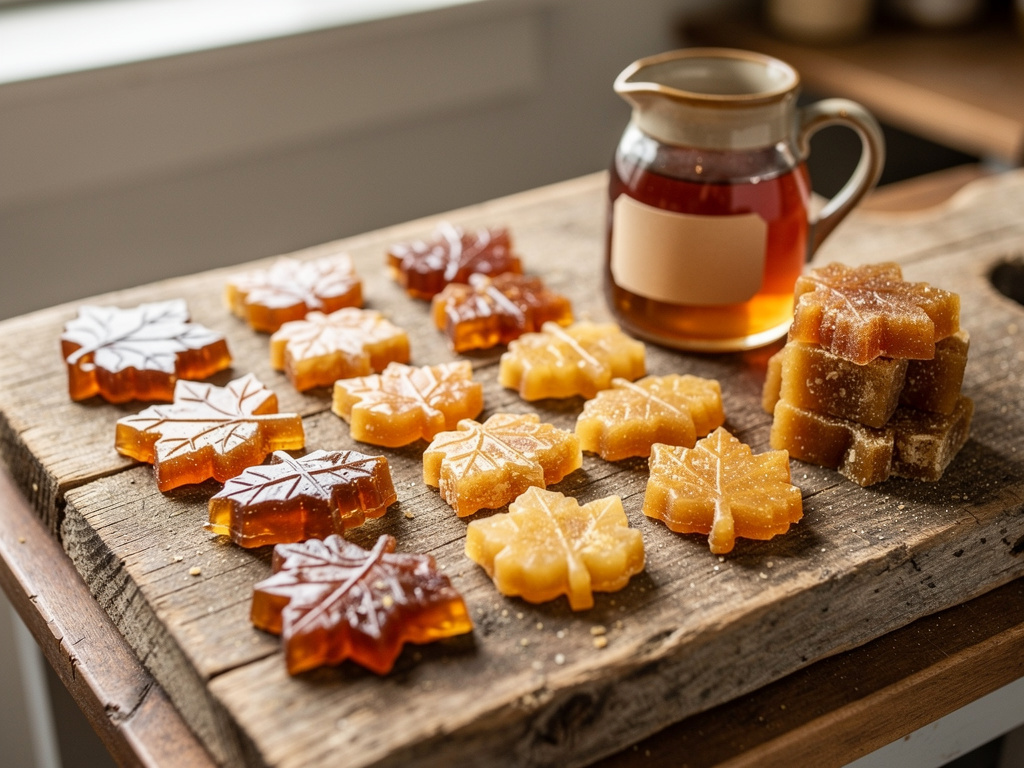


Maple candy, those melt-in-your-mouth leaf-shaped confections made from nothing but boiled pure maple syrup, is one of the most beloved regional treats there is, and a genuinely good home business. It's also a clean fit for cottage food law, because maple candy is a confection, and candy is a named approved category in essentially every state. The one thing that sets maple candy apart is the ingredient: real maple, properly graded and honestly labeled. This guide walks through how to sell maple candy from home, why it's cottage-eligible, and how to make and label it right.
The short version: Maple candy is a pure-sugar confection made by boiling and crystallizing real maple syrup, and candy is a standard approved cottage food category, so maple candy is cottage-eligible in nearly every state. Because it's just concentrated maple sugar, it's shelf-stable with essentially no spoilage risk. The two things that matter most: use pure, properly graded maple syrup (not imitation or pancake syrup), and label it honestly, since "maple" has a real meaning. Get the boil temperature right and keep it dry, and maple candy is one of the most giftable, high-value home confections you can sell. Homegrown gives you the storefront to sell your maple candy as gifts, regional treats, and holiday orders. This is general information, not legal advice.
This guide covers why maple candy is cottage-eligible, the pure-maple requirement, the types you can make, labeling, making and storing, the market, pricing, and mistakes. This is general information, not legal or food-safety advice.
Yes, in nearly every state you can sell maple candy as a cottage food, because candy and confections are a standard approved cottage food category and maple candy is a pure-sugar confection. It's one of the more clearly eligible products you can make.
Why maple candy is eligible:
The takeaway: candy is a standard approved cottage food category, and maple candy is a shelf-stable pure-sugar confection, so it's clearly eligible in nearly every state. The rule is to register under your state's cottage food program and confirm its candy rules, since eligibility is strong but the process still applies, the same first step as starting a cottage food business.
It has to be real maple because "maple" is a regulated term with grading standards, and selling imitation or pancake syrup as maple candy is mislabeling. Honesty about the ingredient is both a legal and a trust requirement.
Why the pure-maple rule matters:
The takeaway: maple candy must be made from real, properly graded maple syrup, because "maple" is a defined, regulated term and authenticity is the product's value. The rule is to use only pure Grade A maple and label it truthfully, never passing off imitation syrup as maple.
You can make several pure-maple confections, hard maple candy, granulated maple sugar, and spreadable maple cream, all from the same pure syrup crystallized in different ways. The range lets you build a full maple product line.
Popular maple confections:
The takeaway: from hard candy to granulated sugar to spreadable cream, pure maple crystallizes into a full range of confections. The rule is to build a maple product line around one great syrup source, since variety broadens your gift and retail appeal, a cousin of other heritage confections like divinity candy.
You should label maple candy with its ingredients (pure maple syrup), your cottage food disclosure, net weight, business information, and truthful use of the word "maple." Maple labeling is simple, but the honesty of the maple claim is the part that matters most.
Here's what the label needs to cover:
| Label element | Why it matters |
|---|---|
| Ingredient list | Usually just "pure maple syrup" |
| "Pure maple" claim | Must be true; no imitation syrup |
| Cottage food disclosure | Your state's "made in a home kitchen" line |
| Net weight and business info | Standard cottage food requirements |
| Allergen note | Usually none; note nuts if coated |
What to get right:
The takeaway: maple candy needs a standard cottage food label with a truthful "pure maple" claim, since the maple term carries real meaning. The rule is to label the real ingredient honestly, alongside the rest of your cottage food labeling.
You make maple candy by boiling pure syrup to the right temperature, cooling it briefly, stirring it to crystallize, and pouring it into molds, then storing the finished candy sealed and dry. Temperature control is the whole craft.
Making and storing well:
The takeaway: precise boiling temperature, timely stirring, and dry storage are what make good maple candy that holds up. The rule is to control the temperature exactly and keep the finished candy sealed against humidity, since both drive quality, a matter of careful food safety and craft.
The market for maple candy is gifts, regional and tourist demand, holidays, and specialty retail: it's an authentic, giftable treat that carries a strong sense of place. Real maple candy sells on authenticity and nostalgia.
Where maple candy sells:
The takeaway: maple candy sells on authenticity to gift buyers, tourists, and specialty retailers, with strong regional pull. The rule is to lean into the authentic, regional story of real maple, the same gift-market strength behind holiday gift boxes.
You price maple candy to reflect the real cost of pure maple syrup, which is expensive, plus the skilled labor of candy-making, packaging, and a premium margin. Unlike sugar candies, maple candy has a genuinely costly main ingredient, so pricing has to respect that.
Pricing guidance:
The takeaway: price maple candy to cover genuinely expensive syrup, skilled labor, and premium positioning, well above ordinary candy. The rule is to respect the real cost of maple and price it as the premium confection it is.
The biggest mistakes selling maple candy are using imitation syrup and calling it maple, missing the boil temperature, ignoring humidity, and underpricing costly maple. The labeling mistake is the one with legal weight.
Mistakes to avoid:
The takeaway: the mistakes that matter most are dishonest maple labeling, wrong temperature, humidity, and underpricing, all avoidable with real maple and careful craft. The rule is to use genuine graded maple, control your temperature, and price the ingredient in, before your first box ships.
Maple candy is an authentic, premium gift product with strong holiday and regional demand, so you need a clean way to take orders, offer gift boxes and assortments, and get paid, without losing a cut of every sale. That's what Homegrown is for.
Homegrown gives you an online storefront to sell your maple candy as singles, gift boxes, and assortments, take scheduled holiday and gift orders, and collect payment, all for a flat $10 a month with no percentage fees beyond standard payment processing. For a premium product with costly ingredients, a per-order commission cuts straight into an already-tight margin. A marketplace-style platform takes a percentage of every box, and a generic website builder wasn't made for taking gift orders with shipping. Homegrown bundles the storefront, order scheduling, and gift options into one flat rate, so your maple margin stays yours. It won't suit everyone, if you sell a little candy at a single stand for cash, you may not need a storefront yet, but the moment you're taking gift and shipping orders online, a flat monthly rate beats handing a percentage to a marketplace on a costly-ingredient product.
Ready to sell your maple candy online? Set up your Homegrown storefront and start taking orders.
In nearly every state, yes. Candy and confections are a standard approved cottage food category, and maple candy is a pure-sugar confection that's shelf-stable with essentially no spoilage risk. Register under your state's cottage food program, follow its candy and labeling rules, and use real, properly labeled maple.
Yes. "Maple" is a regulated term with USDA grading standards, so calling a candy made from imitation or pancake syrup "maple candy" is a labeling violation. Use pure, graded maple syrup, and authenticity is also the entire value of the product, since real maple candy sells precisely because it's the genuine article.
Maple candy is typically boiled to roughly 235 to 240 degrees Fahrenheit, then cooled briefly and stirred to crystallize. Hitting that temperature window is the whole craft, since a few degrees off changes the texture from properly set to grainy or soft. A reliable candy thermometer is essential.
Because it's concentrated maple sugar with very little moisture, maple candy is shelf-stable for weeks to months when sealed and stored dry. The main enemy is humidity, since maple candy draws moisture and can turn sticky, so keep it airtight and cool, and date each batch for freshness.
All three are pure maple crystallized differently. Maple candy is boiled and set into firm, molded pieces; granulated maple sugar is boiled further and stirred to a dry granule; and maple cream is boiled and stirred to a smooth, spreadable consistency, with no dairy despite the name. All are shelf-stable pure-maple confections.
It can be a strong premium product, but the margin depends on respecting the cost of maple syrup, which is genuinely expensive. Price it as a premium confection rather than ordinary candy, cover the skilled labor, and use gift boxes and assortments to raise order value. Authentic maple's gift and regional demand supports premium pricing.



