
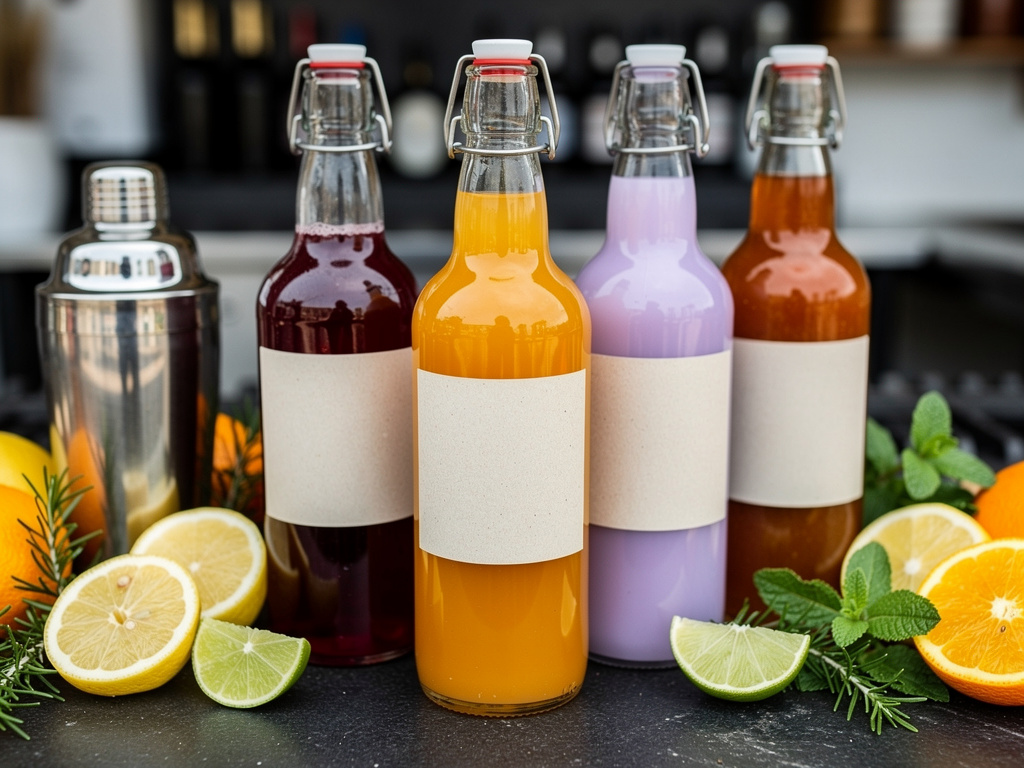


Craft cocktail syrups, ginger, lavender, grenadine, honey-citrus, spiced simple syrup, are having a moment, and making them at home is easy and cheap. Selling them legally is where it gets interesting, because flavored syrups sit in a genuine gray area of cottage food law. Unlike jams or candy, most state cottage food lists don't name flavored syrups, and several explicitly exclude them. This guide walks through how to sell cocktail syrup from home, why syrups are treated cautiously, and the paths that actually let you sell them.
The short version: Flavored cocktail syrups are a gray area in cottage food law, and in many states they are not eligible as a standard cottage food. State approved lists tend to name only specific syrups, like honey and sweet sorghum, while excluding flavored and flower syrups, and a dilute syrup can support microbial growth unless it's properly formulated. So before you sell, check your state's list carefully: some allow certain syrups, some require an acidified-food or licensed-kitchen path, and some don't allow flavored syrups at all. Don't assume a syrup is cottage-eligible just because it's sweet. Homegrown gives you the storefront to sell your syrups once you've confirmed your legal path. This is general information, not legal advice.
This guide covers whether cocktail syrup is cottage-eligible, why syrups are treated cautiously, the legal paths, which syrups might qualify, making and storing safely, the market, pricing, and mistakes. This is general information, not legal or food-safety advice.
In many states, no, or only with conditions, because most cottage food lists name only specific syrups like honey and sorghum and don't include flavored cocktail syrups. This is the opposite of a clearly eligible product, so it needs real homework.
Why flavored syrups are a gray area:
The takeaway: most cottage food lists name only specific syrups and exclude flavored ones, so a cocktail syrup is frequently not eligible as a standard cottage food. The rule is to check your state's exact list before assuming a syrup qualifies, treating it as a maybe, not a yes, unlike the clearer categories in starting a cottage food business.
Flavored syrups are treated cautiously because a pourable syrup can be dilute enough to support microbial growth, its safety depends on sugar concentration and acidity, and state lists reflect that uncertainty by excluding many of them. Sweetness alone isn't a safety guarantee.
Why the caution makes sense:
The takeaway: syrups are treated cautiously because their safety hinges on sugar concentration and acidity, not just sweetness, and many don't clear that bar. The rule is to respect that a syrup's safety is a formulation question, not an assumption, a core matter of food safety.
If your state doesn't allow flavored syrups as a cottage food, the legal paths are a licensed commercial or commissary kitchen, an acidified-food process reviewed by a process authority, or confirming your specific syrup fits an allowed category. There's usually a way to sell them, it just may not be cottage food.
Here's how the paths compare:
| Path | When it applies | Note |
|---|---|---|
| Cottage food | Only if your state lists the syrup | Often excludes flavored syrups |
| Licensed/commissary kitchen | Any syrup, any state | Reliable path |
| Acidified-food process | Acidic, shelf-stable syrups | Needs a process authority review |
The options for cocktail syrups:
The takeaway: when cottage food doesn't cover your syrup, a licensed kitchen or a validated acidified-food process is the reliable path. The rule is to confirm your path with your state before you sell, since guessing on a gray-area product is how businesses get shut down.
The syrups most likely to qualify are the ones your state specifically lists, such as honey or sorghum syrup, and high-sugar, properly acidified syrups where your state allows them. Eligibility is state-specific, so this is about checking, not assuming.
What tends to be more workable:
The takeaway: the syrups most likely to qualify are the specifically listed ones and genuinely shelf-stable, properly acidified formulas, all subject to your state's rules. The rule is to match your exact syrup to your state's list rather than assuming any sweet syrup counts.
You make and store cocktail syrups safely by using a high enough sugar ratio for stability, keeping acidity in mind, bottling clean, and refrigerating anything that isn't proven shelf-stable. Safety here is about concentration and handling, not just recipe.
Making and storing well:
The takeaway: safe syrups come from a strong sugar ratio, attention to acidity, clean bottling, and refrigeration when stability isn't proven. The rule is to treat any unproven syrup as perishable and refrigerated rather than assuming it keeps.
The market for cocktail syrups is home mixologists, coffee and mocktail fans, gift buyers, and bars or cafes looking for craft flavors. It's a trendy, giftable product with real demand once your legal path is set.
Where syrups sell:
The takeaway: syrups sell to home mixologists, coffee fans, gift buyers, and eventually wholesale accounts, driven by the craft-drink trend. The rule is to build your syrup business around the craft-drink and gift market once your legal path is confirmed, the same gift strength behind holiday gift boxes.
You price cocktail syrups to cover ingredients, bottles and packaging, the labor of cooking and bottling, any licensed-kitchen costs, and a craft margin, then lean on gift sets to lift order value. Ingredients are cheap, so packaging, labor, and positioning drive the price.
Pricing guidance:
The takeaway: price syrups for the bottle, the craft labor, and any kitchen costs, well above the cheap ingredients, using sets to lift order value. The rule is to price the craft and packaging, not the sugar, and cover your legal-path costs.
The biggest mistakes selling cocktail syrups are assuming any sweet syrup is cottage-eligible, ignoring shelf-stability, weak labeling, and skipping the process review for acidified syrups. The eligibility assumption is the costly one.
Mistakes to avoid:
The takeaway: the mistakes that matter most are assuming eligibility, mishandling shelf-stability, and skipping process reviews, all avoidable with real homework. The rule is to confirm your legal path and prove stability before your first bottle sells, alongside solid cottage food labeling.
Once you've confirmed your legal path, cocktail syrups are a trendy, giftable product that needs a clean way to take orders, offer gift sets, and get paid, without losing a cut of every sale. That's what Homegrown does.
Homegrown gives you an online storefront to sell your syrups as singles, gift sets, and wholesale, take scheduled and gift orders, and collect payment, all for a flat $10 a month with no percentage fees beyond standard payment processing. For a craft product where packaging and kitchen costs already eat into margin, a per-order commission takes another slice. A marketplace-style platform charges a percentage of every bottle, and a general website builder wasn't made for taking food and gift orders with shipping. Homegrown bundles the storefront, order scheduling, and set options into one flat rate, so your syrup margin stays yours. It won't suit everyone, if you're just gifting a few bottles to friends, you may not need a storefront yet, but the moment you're taking real syrup orders online, a flat monthly rate beats handing a percentage to a marketplace.
Ready to sell your cocktail syrups online? Set up your Homegrown storefront and start taking orders once your legal path is set.
Often not, or only with conditions. Most state cottage food lists name only specific syrups like honey and sweet sorghum and exclude flavored and flower syrups. Because a pourable syrup can support microbial growth unless properly formulated, its safety isn't guaranteed by sweetness alone. Check your state's exact approved list before assuming your syrup qualifies.
Because a syrup's safety depends on sugar concentration and acidity, not just sweetness. A dilute or low-acid syrup can support microbial growth, and botanical or floral ingredients add contamination and low-acid risk. States reflect this by listing only specific syrups, like honey and sorghum, and excluding flavored, floral, and low-acid ones.
You have paths: make it in a licensed commercial or commissary kitchen, pursue an acidified-food process validated by a process authority if your syrup is acidic and shelf-stable, or confirm whether your specific syrup fits an allowed category. A quick conversation with your state or local health department is the best first step.
The syrups your state specifically lists, most commonly honey and sweet sorghum syrup, plus genuinely shelf-stable, properly acidified formulas where your state permits them. Floral, botanical, and low-acid syrups are the ones most often excluded, so they're the least likely to clear a cottage food list.
Many do. Unless a syrup is formulated to be genuinely shelf-stable and, where required, validated as such, it should be treated as refrigerated with a short shelf life and labeled that way. A strong sugar ratio and appropriate acidity improve stability, but if you can't prove it, refrigerate it and say so on the label.
They can be, since ingredients are inexpensive and craft syrups command a premium, but the margin depends on covering bottles, packaging, labor, and any licensed-kitchen costs. Price for the craft and presentation rather than the sugar, use gift sets to raise order value, and confirm your legal path first so you're building on solid ground.



