
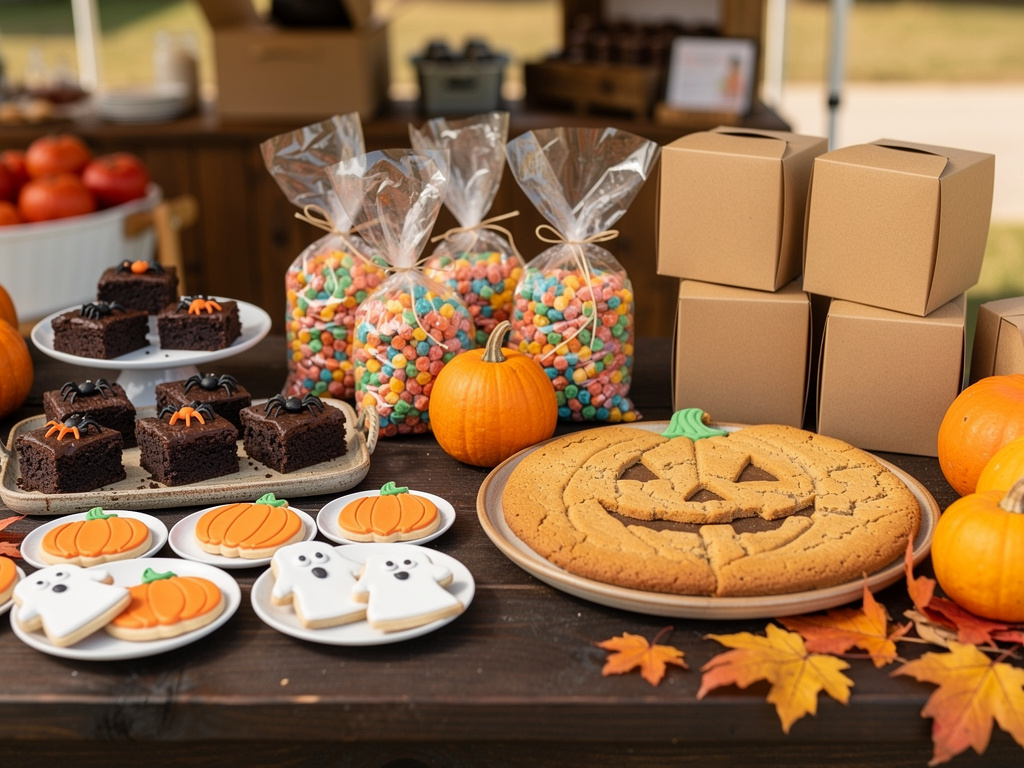


The short version: A spooky season dessert table sells best with one or two showpieces, three or four themed bakes at $4 to $8, and a few grab-and-go bags under $10, all built from foods your state lets you sell from a home kitchen. Halloween cookies, decorated brownies, freeze-dried candy and boo boxes are the easiest wins, because Homegrown's own catalog shows 109 pumpkin-flavored listings from 48 vendors but only 18 Halloween-themed ones from 8 vendors on October 14, 2026. Skip cream cheese frosting, custard (pumpkin pie included) and anything that needs a fridge unless your state allows it, and treat caramel apples as a product to check first. Read the labels on your sprinkles and gel colors, because FDA has revoked Red No. 3 in food and manufacturers have until January 15, 2027 to reformulate. Halloween falls on a Saturday this year, so open pre-orders now and close them 3 days before each pickup: Tuesday, October 27 for Friday and Wednesday, October 28 for Saturday.
Checked on October 14, 2026: California's Approved Cottage Foods list (last reviewed April 2026), FDA's Food Allergies and FD&C Red No. 3 pages, CDC's archived 2014 caramel apple outbreak page, the pricing pages of Homegrown, Hotplate, Square and Venmo, and a pull of Homegrown's own catalog. Home food rules differ by state, so verify your state's current rules with its agency. Homegrown customers create an account to place their first order, and Homegrown has no drops feature.
October is the month your regulars buy dessert for the look as much as the taste. A ghost cookie, a brownie with a candy spider on top or a bag of freeze-dried candy corn sells because it fits the week, not because it is the best thing you bake.
That makes a Halloween table one of the easiest seasonal menus a small vendor can run. This guide gives you 15 spooky season dessert ideas, with real prices Homegrown vendors listed this month, which ones hold up on an outdoor table, which ones California's cottage food list allows, the food color change to check your sprinkles for, and a pre-order calendar built around Saturday, October 31.
A spooky season dessert table works best with three price levels: one or two showpieces at $25 to $45, three or four themed bakes at $4 to $8 each, and a few bags or boxes under $10 that people grab on the way past. That mix gives every shopper something to buy, from the kid with $5 to the parent buying for a class party.
Think of the table the way a customer walks up to it. The showpiece stops them. The themed bakes are what they actually buy. The small bags are what they add when they are already paying.
Here is a simple formula that fits a 6-foot or 8-foot market table:
If you also sell treat boxes for pre-order, keep them separate from the table. Our guide to selling Halloween treat boxes as a home baker covers what goes in a box, how to price an assortment and when to launch. This guide is about the table itself: which desserts to make, what they sell for and how to take orders before the 31st.
On October 14, 2026, Homegrown's catalog held 109 pumpkin-flavored listings from 48 vendors, but only 18 Halloween-themed dessert and candy listings from 8 vendors. Pumpkin is crowded. A real Halloween look is still rare, which is the opening for your table.
In a pull of the Homegrown catalog on October 14, 2026 (2,920 products from 324 vendors), 18 listings sold a dessert or candy with a Halloween look or name, priced from $4 to $45 with a median of $7.50. We counted a listing when its name or description matched a Halloween theme word (ghost, spider, monster mash, boo, jack-o-lantern, candy corn, vampire bat, dirt cup) and the product was a sweet with that look. We left out classic monster cookies with no Halloween look, ghost pepper sauces, savory skull-shaped rolls and fall-flavor candy like mellowcreme pumpkins and harvest-mix chews. Pumpkin-flavored listings (109, from 48 vendors) were counted when the listing or one of its flavor options was pumpkin, not when pumpkin seeds were only an ingredient.
The 18 Halloween-themed listings on Homegrown, by type
Source: pull of Homegrown's public catalog, October 14, 2026, 18 Halloween-themed listings from 8 vendors.
Three things stand out in those 18 listings:
So if pumpkin is your only fall product, you are up against 48 vendors selling something pumpkin. Add a ghost cookie or a spider brownie and only 8 vendors are doing the same.
Most of the 15 ideas below are baked goods or candy that hold up at room temperature, which is what cottage food laws like California's were written for. The table shows a real price a Homegrown vendor listed for something similar on October 14, 2026, how each one does on an outdoor table, and whether California's Approved Cottage Foods list (last reviewed April 2026) names the category.
Scroll sideways to see every column.
| Dessert idea | A real Homegrown price, Oct 14, 2026 | On an outdoor table | California's cottage food list |
|---|---|---|---|
| 1. Monster mash cookies | 6 for $7.50, 12 for $14, 18 for $22 (Breadstreet) | Holds well | Cookies: allowed |
| 2. Ghost, bat and pumpkin decorated sugar cookies | $30 to $54 a dozen for custom decorated sugar cookies (Nonna's Table, Mal's Bake Shop) | Holds well once icing sets | Cookies and icing without cream cheese: allowed |
| 3. DIY Halloween cookie decorating kits | $28 a kit, three pickup dates (Amber's Cakes) | Holds well, boxed | Cookies and icing: allowed |
| 4. Spider and monster brownies | $7.00 to $7.50 each (Jugnu Bakehouse) | Holds well, watch chocolate in sun | Brownies: allowed |
| 5. Graveyard dirt cups | $7.00 brownie-base dirt cup (Jugnu Bakehouse) | Only if there is no pudding or cream | Brownie base: allowed; pudding: not on the list |
| 6. Jack-o-lantern cookie cake | $45, almost 12 inches across (The Drop: A Cookie Shop) | Holds well, boxed | Cookies: allowed |
| 7. Boo boxes and boo bags | $10 boo bag, $15 to $26 boo box (She Bakes, The Drop) | Holds well, sealed | Depends on what is inside |
| 8. Freeze-dried Halloween candy | $5 a bag (Over Terrill Creek) | Keep out of sun and damp | Freeze-dried candies: allowed |
| 9. Cake pops and cakesicles | $4 each or 12 for $42 (Clever Caracara Homestead) | Holds well, wrapped | Cake: allowed; cream cheese frosting: not allowed |
| 10. Caramel and candy apples | $4.50 vegan caramel apple (The Lemon Loaf) | Short hold only; check your state | "Candied apples" are named |
| 11. Pumpkin-shaped loaves and pumpkin bread | $10 to $18 (Gather & Grain AZ, LubaBakes, Baked by Blanquita) | Holds well | Bread and quick breads: allowed |
| 12. Pumpkin pie | $3.50 mini to $24 for 9 inches (Bakes with Bailey, South Street Pie Co.) | Needs the fridge | Pies: "fruit only, no pumpkin" |
| 13. Caramel corn and popcorn balls | No Halloween listing in the pull | Holds well, sealed | Popcorn balls and candied popcorn: allowed |
| 14. Halloween chocolate bark and fudge | No Halloween listing in the pull | Melts in direct sun | Fudge and chocolate-covered nonperishables: allowed |
| 15. Marshmallow ghosts and s'mores bars | $7.00 s'mores spider web brownie (Jugnu Bakehouse) | Holds well | Marshmallows without eggs: allowed |
Prices are what each vendor listed on its Homegrown storefront when we pulled the catalog on October 14, 2026. The last column comes from the California Department of Public Health's Approved Cottage Foods list (last reviewed April 2026). Your own state's list decides what you can sell.
Cookies are the strongest Halloween product for a small vendor because they are cheap to make, they hold up for days, and the decoration does the selling. Eight of the 18 Halloween listings on Homegrown are cookies or cookie kits.
A monster mash cookie is a chocolate or chocolate chip cookie loaded with Halloween candy, pretzels or sprinkles. It needs no piping skill, which makes it the easiest themed bake on this list. Breadstreet lists Halloween Monster Mash cookies, double chocolate with pretzels, Halloween M&Ms and toffee bits, at 6 for $7.50, 12 for $14 and 18 for $22.
Notice the pricing. That works out to $1.25 a cookie in the six, $1.17 in the twelve and about $1.22 in the eighteen, so the twelve is the best deal. A three-size ladder like that lets a customer pick the size of their party, and a clear best deal in the middle nudges them up from the smallest size.
Decorated sugar cookies sell for about $2.50 to $4.50 each on Homegrown, and they are the photo-ready product on a Halloween table. A ghost is the easiest shape to start with: white icing, two black dots and you are done. Bats, cats and jack-o-lanterns take a little more time.
Mal's Bake Shop lists custom royal icing sugar cookies at $36 a dozen for small cookies, $45 for medium and $54 for large, or $3 to $4.50 a cookie, and Nonna's Table lists custom decorated sugar cookies at $30 a dozen. That is the price level decorated work earns. For a simpler Halloween cookie, A Cup of Grace lists a candy corn cake cookie topped with a swirl of frosting and two candy corns at $18 for six, the same $3 a cookie it charges for every flavor it sells. Our guide to pricing decorated cookies walks through how to charge for decorating time so you are not working for free.
One rule to check before you pick your icing: California's cottage food list allows frostings and icings that do not contain eggs, cream or cream cheese, and it says icings made with meringue powder are allowed. Royal icing made with meringue powder fits that rule. Cream cheese frosting does not.
A DIY kit is usually a box of plain baked cookies, two or three bags of icing and a cup of sprinkles. The customer does the decorating, which turns your product into a family activity for the weekend.
Amber's Cakes sells a DIY Halloween cookie kit for $28 and lists it three times, once for each pickup date: October 17, October 24 and October 31. That is a smart setup. Each date has its own listing, so the vendor knows exactly how many kits to bake for each weekend.
Kits fit these customers best:
Brownies are the fastest way to make a whole tray look spooky, and one showpiece at $25 to $45 lifts what people spend at the rest of your table. Jugnu Bakehouse lists four Halloween brownies at $7.00 to $7.50 each, and The Drop: A Cookie Shop lists a jack-o-lantern cookie cake at $45.
Bake one sheet pan of brownies, cut it into squares and the topping makes each one Halloween. A peanut butter cup with candy legs becomes a spider. A sugar cookie ghost on top makes a monster mash brownie. Candy eyes on green-tinted frosting make a monster.
Jugnu Bakehouse prices its Spooky Spider brownie (stuffed with peanut butter, topped with a peanut butter cup and candy eyes) and its Monster Mash brownie (stuffed with Halloween cookies, topped with a ghost sugar cookie) at $7.50 each. Its 4-pack of four different Halloween brownies is $27, or $6.75 a brownie. That lower per-brownie price on the pack is what moves people from one brownie to four.
The classic dirt cup is chocolate pudding with crushed cookies on top, gummy worms and a cookie tombstone. Pudding needs the fridge, which takes it off most home kitchen menus.
Jugnu Bakehouse solves that with a brownie base instead. Its $7.00 dirt cup is a brownie topped with a chocolate hazelnut glaze, crushed cookies, gummy worms and teddy bear crackers. You get the graveyard look without a cup of pudding sitting in the sun.
A cookie cake is one big cookie baked in a pizza pan, decorated with a jack-o-lantern face. The Drop: A Cookie Shop lists one at $45. It is 1 to 1.5 inches thick and almost 12 inches across, in chocolate chip or sugar cookie.
Bring one finished cookie cake to the market as a display and take orders for the rest. Most people will not carry a 12-inch cookie around a market all morning, but they will order one for a Friday night party.
Boo boxes and boo bags sell for $10 to $26 on Homegrown, and every one is a gift. "Booing" is a neighborhood game: someone leaves a bag of treats and a "You've been booed" sign on a neighbor's porch, and that neighbor passes it on to another house.
She Bakes sells a $10 Boo Bag with a mini cake and two cookies in Halloween packaging. The Drop sells a BOO Box with a dozen mini cookies for $15 or a dozen midsize cookies for $26, and it comes with a sign for the recipient's door. A printed sign like that is cheap to add, and it is what makes the box feel finished.
Set the quantity on each Halloween listing to the number you will actually bake, for example 24 boo boxes, and let it sell out. A sold-out showpiece on October 28 is better than 9 leftover cookie cakes on November 1, because almost nobody buys a jack-o-lantern after Halloween.
Yes, in California and some other states freeze-dried candy is a cottage food: California's list names "freeze-dried candies" under candy and confections, so check your own state's list. It was the only Halloween candy in Homegrown's October 14, 2026 catalog pull: Over Terrill Creek lists four Halloween freeze-dried candy bags at $5 each.
Freeze-dried Halloween candy sells for $5 a bag on Homegrown, and it takes no baking at all. Freeze-drying puffs regular candy into a light, crunchy version of itself, and Halloween candy is a natural fit. Over Terrill Creek's lineup shows what works:
Two warnings come with it. First, you need a freeze dryer, which is a big purchase. Our guide to selling freeze-dried candy from home covers the machine cost and which states name freeze-dried candy in their rules. Second, it is fragile. Over Terrill Creek's listings warn that freeze-dried candy is "very sensitive to heat and cold" and cannot be left outside or in a mailbox at delivery, so seal every bag well and keep the bin out of the sun at the market.
Cake pops and cakesicles are worth making if you can make 12 to 24 at a time, because they sell for about $3.50 to $4 each and they look great in a Halloween color. Clever Caracara Homestead lists pumpkin spice cakesicles at $4 each or 12 for $42, every one individually wrapped in clear plastic.
A cake pop is a ball of cake mixed with frosting, on a stick, dipped in candy coating. A cakesicle is the same idea in the shape of an ice pop. For Halloween, dip them in orange, white or black coating and add candy eyes or a drizzle.
Here is what to plan for:
Our guide to selling cake pops from home covers the full process if you have never made them.
Caramel apples are a classic October treat, but they carry a real food safety risk, so check your state's rules and keep them cold until you sell them. They are not a casual add-on the way cookies are.
One Homegrown vendor, The Lemon Loaf, listed a vegan caramel apple at $4.50 on October 14, 2026. California's cottage food list names "candied apples" under candy and confections. Rules on caramel apples vary by state, and some states keep them off home-kitchen lists because the fresh fruit can need refrigeration, as our caramel apple guide explains, so check your state's list.
In 2014 and early 2015, caramel apples caused a Listeria outbreak. The CDC's outbreak page says commercially produced, prepackaged caramel apples were the likely source, 35 people in 12 states got sick, 34 were hospitalized, and Listeria contributed to at least three of the seven deaths reported. You can read the details on the CDC's archived caramel apple outbreak page (checked October 14, 2026).
If your state allows them, our guide to selling caramel apples from home explains why washing off the wax and keeping finished apples cold matter so much. If you are unsure, sell caramel apple flavor instead: caramel apple cookies, caramel corn or caramel apple granola carry the taste without the fresh fruit.
Pumpkin bakes belong on the table as the "fall but not spooky" option, but with 109 pumpkin listings from 48 Homegrown vendors, they will not set you apart on their own. One pumpkin product is enough. Make the rest of the table Halloween.
A loaf shaped like a pumpkin is the pumpkin product that still feels like Halloween. Bakers tie kitchen twine around a round loaf before the last rise, so it bakes into pumpkin sections, then add a cinnamon stick for the stem. Homegrown vendors list pumpkin-shaped sourdough loaves at $10 in plain dough or $13 in pumpkin spice (Gather & Grain AZ) and $16 (LubaBakes), and a pumpkin-shaped pumpkin loaf at $18 (Baked by Blanquita).
Pumpkin quick bread is easier still. California's list includes quick breads, and a pumpkin loaf holds up on an outdoor table for the whole market.
Pumpkin pie is a custard pie that needs the fridge, and California's cottage food list says pies are allowed "fruit only, no pumpkin." That is the opposite of what most bakers assume in October.
Some states treat it differently, and some vendors sell pumpkin pie from a licensed kitchen. On Homegrown, pumpkin pies run from a $3.50 mini (Bakes with Bailey) to $24 for a 9-inch pie (South Street Pie Co.). If your state allows it, our guide to pricing pumpkin pie breaks down cost and price. Either way, pumpkin pie is a Thanksgiving product more than a Halloween table product, so you can save it for November.
Caramel corn, chocolate bark, fudge and marshmallow treats fill the under-$10 spot on your table, and California's list names all four categories. None of them showed up as a Halloween listing in Homegrown's October 14 pull, which leaves room for you.
Caramel corn tossed with candy corn and orange and black sprinkles is cheap to make in big batches. Popcorn balls wrapped in clear bags and tied with orange ribbon look old-fashioned in a good way. California's list names popcorn balls and candied popcorn (balls, caramel, chocolate).
Bark is melted chocolate spread thin, topped with candy, pretzels and sprinkles, then broken into pieces. It needs no oven, just a sheet pan and a fridge to set it. California names fudge and chocolate-covered nonperishables like nuts and dried fruit. Bark melts in direct sun, so keep it in a shaded box and only put out a few bags at a time.
Marshmallows dipped in white chocolate with two dots of black icing make instant ghosts. A s'mores bar with a melted chocolate spider web on top is another easy win: Jugnu Bakehouse lists a S'mores Spider Web brownie, with a graham cracker base and vegan marshmallows, at $7.00. If you make your own marshmallows, note that California's list allows marshmallows "without eggs."
Many states' cottage food laws cover Halloween cookies, brownies, candy and quick breads, but usually not anything with cream, custard, cream cheese frosting or pudding. Cottage food laws let you sell certain foods made in your home kitchen, and they were written for foods that stay safe at room temperature.
California is a clear example of where the line falls. The California Department of Public Health's Approved Cottage Foods list (last reviewed April 2026, checked October 14, 2026) allows these Halloween-friendly categories:
California's list allows pies as "fruit only, no pumpkin," and it rules out frosting made with cream cheese. So a pumpkin pie or a pumpkin cupcake with cream cheese frosting is off a California home vendor's menu, even in October. Source: the CDPH Approved Cottage Foods list, checked October 14, 2026.
Other states draw the line in different places. Some name specific candies, some cap your yearly sales and some limit where you can sell. Check the current rules with your own state's health or agriculture department before you plan the table. Under California's list, a $7.50 spider brownie and a $5 bag of freeze-dried candy both fit, while a $24 pumpkin pie does not.
Here is a quick sort for Halloween desserts, based on California's list. Your own state's list may draw the lines in other places:
Halloween desserts lean on food color and candy toppings more than any other season, so read the labels on your sprinkles, gel colors and candy, and list every major allergen on your own label. Two federal rules matter here.
FDA has revoked the authorization for FD&C Red No. 3, also called erythrosine, in food. FDA's FD&C Red No. 3 page says the dye is found in certain candy, cakes and cupcakes, cookies, frozen desserts, and frostings and icings, and that food manufacturers have until January 15, 2027 to reformulate (checked October 14, 2026). Sprinkles and gel colors already on store shelves may still contain it, so read the ingredient list on every red, pink and orange decoration you buy this year.
The FDA also requires manufacturers to list FD&C Red No. 3 in the ingredient statement when it is added to food. If your Halloween sprinkles list "FD&C Red No. 3," "Red 3" or, on imported products, "erythrosine," you will see it there. Carry those ingredient names onto your own label the way your state's cottage food label rules describe. Our guide to cottage food labeling requirements covers what a home label usually needs.
The second rule is allergens. FDA's Food Allergies page (content current as of March 11, 2026, checked October 14, 2026) names nine major food allergens: milk, eggs, fish, crustacean shellfish, tree nuts, peanuts, wheat, soybeans and sesame. Sesame became the ninth on January 1, 2023.
Halloween toppings add allergens fast, even on a $7.50 brownie:
Halloween also means kids, and parents read labels closely in October. Our guide to the big 9 allergens on a cottage food label shows how to word the allergen line. On Homegrown, each listing has a spot for allergens and ingredients, so a parent can check before ordering.
Price a Halloween dessert table in four levels, from $5 and under for a single treat to $25 and up for a showpiece, using what Homegrown vendors actually charged on October 14, 2026 as your guide. The 18 Halloween-themed listings ran from $4 to $45, with a median of $7.50.
Swipe left for the price examples.
| Price level | What it is for | Real Homegrown prices, Oct 14, 2026 |
|---|---|---|
| $5 and under | Impulse buys and kids with pocket money | $4 monster mash cookie (The Cookie Cabinet), $4 cakesicle (Clever Caracara Homestead), $4.50 vegan caramel apple (The Lemon Loaf), $5 freeze-dried candy bag (Over Terrill Creek) |
| $6 to $10 | The main earner on the table | $7.00 to $7.50 Halloween brownies (Jugnu Bakehouse), 6 monster mash cookies for $7.50 (Breadstreet), $10 boo bag (She Bakes) |
| $11 to $24 | Gifts, boxes and party trays | 12 cookies for $14 (Breadstreet), $15 boo box (The Drop), 6 candy corn cake cookies for $18 (A Cup of Grace), 18 cookies for $22 (Breadstreet) |
| $25 and up | Showpieces, kits and party orders | $26 boo box (The Drop), $27 brownie 4-pack (Jugnu Bakehouse), $28 DIY kit (Amber's Cakes), 12 cakesicles for $42 (Clever Caracara Homestead), $45 jack-o-lantern cookie cake (The Drop) |
Prices are what each vendor listed on its Homegrown storefront in our catalog pull of October 14, 2026. Your costs and your local market set your own prices.
A few pricing habits help in October:
For more on holiday pricing in general, our guide to holiday pricing for food vendors covers how much of a seasonal markup customers accept.
The easiest way to take Halloween pre-orders is one ordering page with a fixed menu, set quantities and a pickup date, so you are not tracking 40 orders across text messages and comments the week of the 31st. Halloween orders bunch into a few days, which is exactly when DMs break down.
Picture the week before Halloween with no system. A neighbor wants 12 ghost cookies Friday. A teacher wants 24 for a class party Thursday. Someone asks if the spider brownies have peanuts. Three people pay by Venmo and forget to say what they ordered. That is the week a simple ordering page pays for itself.
Homegrown is $10 per month billed annually (or $12.50 billed monthly) with no percentage fees beyond standard payment processing of 2.9% + $0.30, paid by you. Here is how it fits a Halloween table:
Compare that to the tools Halloween vendors usually reach for. Hotplate is built for pre-orders, but by default it adds 5% + $0.55 to each customer's order, and you still pay 2.9% + $0.30 for card processing. Square's free plan costs $0 a month, but online payments cost 3.3% + 30¢, the highest card rate in the table below. Instagram DMs plus a Venmo business profile cost 1.9% + $0.10 a payment, but you track every order, quantity and pickup time yourself.
Swipe the table to see the full fee stack for each option.
| Option | Subscription | Trial | Platform fee | Card processing | Customer pays on a $20 order | You pay on a $20 order | You pay on 50 orders a month |
|---|---|---|---|---|---|---|---|
| Homegrown, billed annually | $10/mo | 7 days, no charge until day 8 | $0 (0% commission) | 2.9% + $0.30, paid by you | $20.00 | $0.88 | $54.00 ($44.00 processing + $10) |
| Homegrown, billed monthly | $12.50/mo | 7 days, no charge until day 8 | $0 (0% commission) | 2.9% + $0.30, paid by you | $20.00 | $0.88 | $56.50 ($44.00 processing + $12.50) |
| Hotplate, default (fee passed to customer) | $0, no monthly subscription | None (no subscription) | 5% + $0.55, paid by the customer | 2.9% + $0.30, paid by you | $21.55 | about $0.88 to $0.92 | about $44.00 to $46.25 |
| Hotplate, you cover the fee | $0, no monthly subscription | None (no subscription) | 5% + $0.55, paid by you | 2.9% + $0.30, paid by you | $20.00 | $2.43 | $121.50 |
| Square Free plan, online | $0/mo per location | None (free plan) | $0 | 3.3% + 30¢ online | $20.00 | $0.96 | $48.00 |
| Instagram DMs + Venmo business profile | $0 a month | None | $0 | 1.9% + $0.10 per payment | $20.00 | $0.48 | $24.00, plus tracking every order by hand |
We checked these on each company's own page on October 14, 2026: Homegrown's signup page, Hotplate's pricing page and its post "What Hotplate does," Square's pricing page and fee article, and Venmo's fee page. Hotplate's fee goes to the customer by default; its post says "80% of Hotplate chefs keep the default as-is." Hotplate's own $30 example charges the card fee on the order plus tip, which is the $0.88 end; $0.92 is the card fee on everything the customer pays. The Square row uses the online rate; at the booth, tap or swipe on the free plan is 2.6% + 15¢.
Homegrown has limits worth knowing before Halloween. Customers create a Homegrown account to place their first order. There is no drops feature, so you cannot run a countdown release that opens at a set minute. Your storefront is listed on the Homegrown marketplace, but plan on most Halloween orders coming from people you send to your own link, like your market regulars and your neighborhood group. Orders are for local pickup or local delivery within a radius you choose, so this is not a shipping setup.
If your Halloween orders already live in your DMs, set up your Homegrown storefront this week, list three spooky products with a cap on each, and send your regulars one link with a Friday or Saturday pickup. Signup takes about 15 minutes, and you get 7 days with no charge until day 8.
Halloween is Saturday, October 31, 2026, so open orders now, close them 3 days before each pickup (Tuesday, October 27 for Friday and Wednesday, October 28 for Saturday), bake and decorate Wednesday and Thursday, and run pickups Friday evening and Saturday. With the 31st on a Saturday, parties are likely to fall on Friday the 30th or Saturday the 31st, which gives you two clear pickup windows.
Next year, start earlier. Launching Halloween orders in late September gives you five or six market Saturdays instead of three. When the 31st has passed, our guide to Thanksgiving pre-orders for food businesses picks up where this one leaves off.
A Halloween table sells when it has height, one clear color theme and a price on every product, so people can decide in the few seconds they spend walking past. Spooky decorations help, but the desserts should still be the first thing people see.
Here is a setup that works at a farmers market or a fall festival:
If you also sell at Halloween events, our guide to selling food at a trunk-or-treat event covers what sells to a crowd of families on the move. For general booth layout, see these farmers market booth setup ideas.
The most common Halloween table mistake is making too much of a themed product with no cutoff, because a jack-o-lantern cookie does not sell on November 1. Most of the other mistakes come from treating October like any other month.
Watch for these:
Cookies are the most common Halloween listing on Homegrown: in the October 14, 2026 pull, 8 of the 18 Halloween-themed listings were cookies or cookie kits, 5 were brownies (all from one bakery) and 4 were freeze-dried candy (all from one vendor). A good spooky season dessert table mixes one showpiece, three or four themed bakes and a few bags under $10.
Breadstreet charged $1.17 to $1.25 a cookie for Halloween drop cookies sold by the half dozen or dozen, and Homegrown vendors charged $2.50 to $4.50 a cookie for custom decorated sugar cookies, on October 14, 2026. A single Halloween monster mash cookie sold for $4. Charge more for decorated cookies because the piping takes much longer than the baking.
In many states you can sell shelf-stable Halloween treats like cookies, brownies, fudge, caramel corn and candy from a home kitchen under your state's cottage food law. Desserts that need refrigeration, like cheesecake, pudding cups and cream cheese frosting, are usually not allowed. California's list, for example, allows baked goods without cream or custard fillings and frostings without cream cheese, so check your own state's list before you sell.
Often not. Pumpkin pie is a custard pie that needs the fridge, and California's Approved Cottage Foods list allows pies as "fruit only, no pumpkin." Some states treat it differently, and some vendors sell pumpkin pie from a licensed kitchen, so check your own state's list before you take orders.
Start taking Halloween pre-orders two to four weeks before October 31, and close them three or four days before each pickup. In 2026, Halloween is a Saturday, so a 3-day cutoff closes orders for Friday the 30th on Tuesday, October 27 and orders for Saturday the 31st on Wednesday, October 28. Next year, opening in late September gives a spooky season dessert vendor more market weekends to sell.
Yes, allergen labeling matters even more in October because many Halloween treats go to kids. FDA names nine major food allergens: milk, eggs, fish, crustacean shellfish, tree nuts, peanuts, wheat, soybeans and sesame. Candy toppings like peanut butter cups and candy-coated chocolates add allergens of their own, so read every candy label and list what is in the finished treat.
Five live Homegrown guides cover the products and dates around your Halloween table. Together they cover the fall season from September to Thanksgiving on Thursday, November 26, 2026, so you can plan the whole fall season from one place:
Your Halloween table only runs for a few weeks, so the orders have to be easy to place and easy for you to count. Start your Homegrown storefront, list your spooky season desserts with a quantity on each, and share one link with your regulars before the 31st.



