
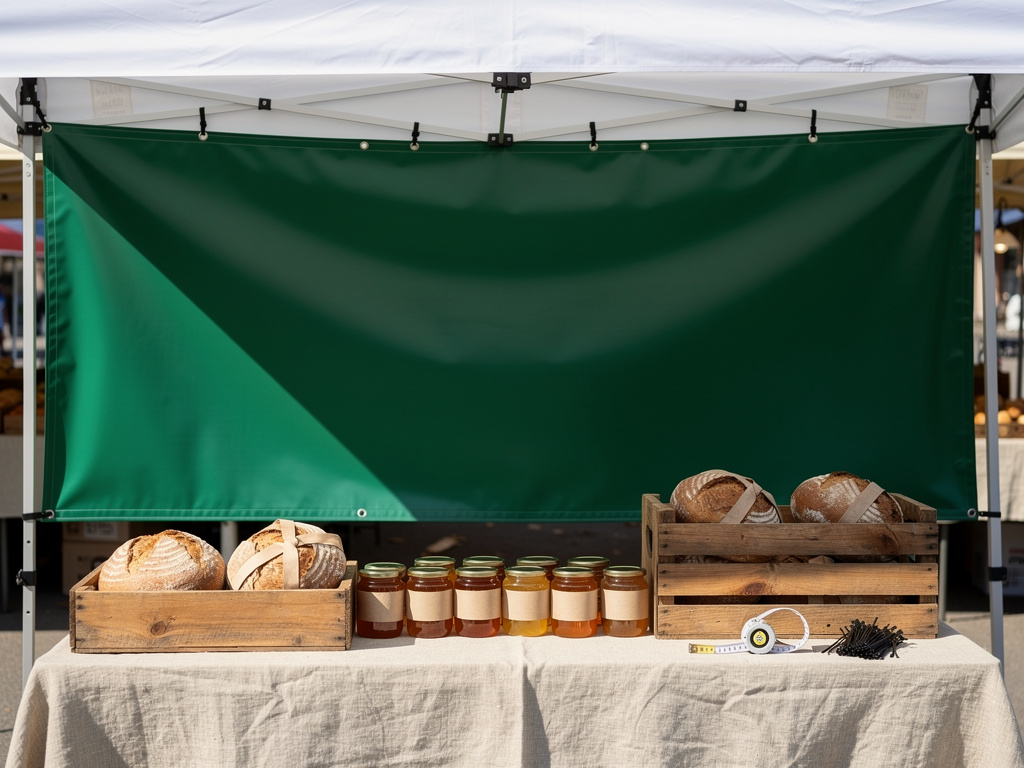


The short version: A good market stall banner says two things in big letters: your business name, and what you sell in two to four words. For a 10x10 canopy, start with a 2 by 6 foot vinyl banner with grommets, which cost $44.95 at Signs.com on October 13, 2026, and go 8 feet wide only after you measure the open space between your canopy legs. Plan on 1 inch of capital letter height for every 10 feet of reading distance, so a name meant to be read from 30 feet away needs 3-inch capitals. Keep prices, hours and claims you cannot back up, like "organic" or "no spray," off the banner, and put a storefront link or QR code on your table so the shoppers it pulls in can order between markets.
Checked on Signs.com, Vistaprint, Square, Shopify and findhomegrown.com/signup, October 13, 2026: banner prices are for one single-sided banner before shipping and tax, and market rules come from each market's 2026 vendor handbook. Homegrown does not design or print banners, customers create a Homegrown account to place their first order, and Homegrown has no drops feature.
Next Saturday, stand at the end of your market's main aisle and try to name each booth before you walk past it. Notice which ones you can name and why. Often it is not the booth with the nicest table, but the one with a big, plain banner up high that you could read before you got close.
A banner is the one sign in your booth that has to work from 30 feet away. This guide covers what to write on it, which type of banner fits your stall, how tall the letters need to be, how many letters actually fit on a 6 foot banner, wording ideas by product, words to keep off it, real 2026 market rules, materials, prices checked today, and how to hang it so it stays put. For every other sign in your booth, from price cards to allergen notes, our farmers market signage ideas cover the full set. This page goes deep on the banner alone.
A market stall banner should say your business name and what you sell in two to four words, and very little else. A shopper walking the aisle decides in a glance whether your booth is worth a detour. "Willow Lane" tells them a name. "Willow Lane, Sourdough and Pastries" tells them whether they want to stop.
Think of the banner as three lines, each smaller than the one above it:
At 3 markets we checked, that third line is a rule, not decoration. Portland Farmers Market, the Downtown Farmers' Market in Des Moines and Woodstock Farmers Market in Portland all ask for a sign that shows your business name and your location in their 2026 handbooks. If your banner is your main sign, putting your town on it covers that rule in one place.
Everything else, like prices, hours, flavors of the week and your Instagram handle, changes too often or reads too small from the aisle. Those details belong on table-level cards, which our signage guide walks through sign by sign.
Start with one banner across the front or back of your canopy, then add a table banner, printed tablecloth or feather flag only if your market allows it and your budget has room. Each type does a different job, and the prices below show why the canopy banner comes first.
Scroll sideways to see all six banner types.
| Banner type | Where it goes | Size to look at | Price checked October 13, 2026 | Best for | Watch for |
|---|---|---|---|---|---|
| Canopy front banner | Front crossbar of the canopy, above shoppers' heads | 2 x 6 ft or 2.5 x 8 ft | $44.95 (Signs.com 2 x 6 ft, 13 oz) to $68.99 (Vistaprint 2.5 x 8 ft, outdoor, grommets) | Being seen from the aisle | The bottom edge has to clear your customers' heads |
| Back wall banner | Back of the canopy frame or a back sidewall | 3 x 6 ft or 3 x 8 ft | $59.19 to $73.44 (Signs.com, 13 oz) | A big name behind you, framed by your table | You and your helpers block the lower third, so keep the name high |
| Table-front banner | Front edge of your table | 2 x 6 ft on a 6-foot table | $44.95 (Signs.com, 13 oz, 2 x 6 ft) | Indoor markets, or a canopy with no room up top | Shoppers standing at the table cover it |
| Printed tablecloth | Over the whole table | 6-foot table, 3-sided | $219.99 (Vistaprint, standard fabric, limited print) | A finished, branded look once you sell every week | Costs the most, and the name hides when people crowd in |
| Feather flag | A corner of your booth, on a ground stake or base | 7.5 or 10 ft tall | $149.99 to $174.99 (Vistaprint, ground stake included) | Being seen over other canopies | Pavement needs a separate base, and some markets limit flags |
| Retractable banner stand | Floor of an indoor booth | Varies by model | Vistaprint lists them from $119.99 | Indoor winter markets | Sold for events and trade shows; check it is made for outdoor use before a windy lot |
We loaded each price on the printer's own product page on October 13, 2026, with the size and options named in the row. Prices are for one single-sided banner before shipping and tax. Signs.com listed free shipping over $99, and Vistaprint showed $4.99 economy delivery, free over $100.
If you sell at one outdoor market every week, the canopy front banner does the most work for the price of a single banner. A back wall banner is the better first buy if your canopy front is busy with lights or a valance, or if your market packs booths so close that the front crossbar is hard to see from an angle.
A 2 by 6 foot banner is the size UPrinting's market signage guide gives for a standard 10x10 canopy, and the same guide suggests 3 by 8 feet for corner stalls or open-air markets. But "10x10" describes the canopy top, not the open space between the legs where your banner hangs. Brackets, slanted legs and sidewalls all eat into it.
Measure before you order. It takes about 10 minutes with your canopy up in the driveway:
If your canopy is new or you have not bought one yet, our guide to the best canopy tents for farmers market vendors covers frames, crossbars and the weights markets require, which all affect where a banner can hang.
One more size choice: height. A 2-foot-tall banner is easier to hang and fights less wind. A 3-foot-tall banner gives your name room for bigger letters, which matters when the aisle is wide.
Plan on about 1 inch of capital letter height for every 10 feet of distance you want shoppers to read your banner from at a glance. That figure comes from sign research, not guesswork. The US Sign Council Foundation measures legibility as feet of reading distance per inch of capital letter height. Its average figure is 30 feet per inch, but that is the distance where a sign becomes just barely readable. In its research on signs mounted parallel to the driver's line of sight, like wall signs read at a sideways glance, the Council uses 10 feet per inch, three times the threshold size, so the sign is quick and easy to read. A market aisle is closer to that second case: shoppers are moving and glancing sideways at your booth.
Drag the table sideways for every reading distance.
| Reading distance | Capital height to read at a glance (10 ft per inch) | Same, set in all caps (15% taller) | Capital height where it is barely readable (30 ft per inch) |
|---|---|---|---|
| 10 feet (standing at your table) | 1 inch | 1.15 inches | 0.33 inch |
| 20 feet (across a typical aisle) | 2 inches | 2.3 inches | 0.67 inch |
| 30 feet (two booths away) | 3 inches | 3.45 inches | 1 inch |
| 50 feet (down the row) | 5 inches | 5.75 inches | 1.67 inches |
Distances divided by the US Sign Council Foundation's 10 and 30 feet per inch figures. The Council's sign standards add 15% to letter height when every letter is a capital. The "typical aisle" and "two booths away" labels are our rough guides; measure your own market.
Two market rules line up with this math. Portland Farmers Market's 2026 handbook requires lettering at least 3 inches high on the vendor sign, which reads at a glance from about 30 feet. Historic Manassas wants your name readable from 20 feet away. Its handbook sets no letter height, but at the read-at-a-glance figure above, that means capitals of about 2 inches.
Measure from the capital letter, not the lowercase ones. In "Honey," the H sets the size. Banner design tools often show font size in points, so check the printed proof with a ruler instead of trusting the number on screen.
On a 6 foot banner, an 18-character name fits at about 4.5-inch capitals, which reads at a glance from about 45 feet. Longer names force smaller letters, and smaller letters shrink the distance your banner works from. On a 6 foot banner, a 22-character name gets 4-inch capitals, 33% smaller than the 6-inch capitals a 14-character name gets. That trade-off is why your character count matters as much as your banner size.
We measured it. In Arial Bold, a common sign font, each character of a mixed-case name (spaces included) took 0.70 to 0.83 of the capital letter height in width across 14 sample phrases, about 0.76 on average. Names with several wide letters like m and w sit at the top of that range: "Meadowbrook Farm" measured 0.83, so a name like that should drop about half an inch from the table value. Using 0.75 and leaving 3 inches of margin on each side, here is the tallest capital that fits across the banner:
Swipe left to compare all three banner widths.
| Characters in your name (with spaces) | 4 ft banner (42 in usable) | 6 ft banner (66 in usable) | 8 ft banner (90 in usable) |
|---|---|---|---|
| 10 characters | 5.5 in, reads from about 55 ft | 8.5 in, about 85 ft | 12 in, about 120 ft |
| 14 characters | 4 in, about 40 ft | 6 in, about 60 ft | 8.5 in, about 85 ft |
| 18 characters | 3 in, about 30 ft | 4.5 in, about 45 ft | 6.5 in, about 65 ft |
| 22 characters | 2.5 in, about 25 ft | 4 in, about 40 ft | 5 in, about 50 ft |
Our measurement in Arial Bold on October 13, 2026, rounded down to the half inch. Reading distance uses 10 feet per inch of capital height. Wider fonts fit fewer letters, and narrow fonts fit more.
Height limits the top of that table. On a 2-foot-tall banner with 3 inches of margin top and bottom, you have 18 inches to work with. An 8-inch capital name plus a 4-inch descriptor line takes about 16.5 inches once you count the tails on letters like g and y, so 8 inches is close to the ceiling for the name on a 2-foot banner. That ceiling is the most that physically fits, not the size to aim for. A 10-character name at 8.5 inches spans the full 66 inches of a 6 foot banner, a block of about 3.9 square feet, which uses most of the 40% word budget covered in the colors section below before you add a product line or logo. On a 2-foot banner, 6 to 7 inches is the safer target for the name.
Count your name's characters, spaces included, before you pick a banner size. If it runs past 18 on a 6 foot banner, drop "LLC" or "& Co." from the banner and keep it on your labels. Cutting a 22-character name to 16 characters takes you from 4-inch to about 5.5-inch capitals, roughly 15 more feet of reading distance.
The best banner line names the product a shopper is hunting for, in their words, so "Sourdough and Cinnamon Rolls" beats "Artisan Baked Creations" every time. Below are line 2 and line 3 ideas for ten of the product types Homegrown vendors sell most, largest first by number of vendors in our catalog. Use them as starting points and swap in your own product and town.
Scroll sideways for the wording ideas and cautions.
| What you sell | Line 2 ideas (what you sell) | Line 3 ideas (where or how) | Be careful with |
|---|---|---|---|
| Bread and baked goods | Sourdough and Pastries; Cinnamon Rolls and Cookies; Bagels Baked Fresh | Baked Friday Night; Home Bakery in [Town] | "Gluten-free" unless every product under the banner meets FDA's gluten-free definition in 21 CFR 101.91: no wheat, rye or barley ingredient unless it was processed to remove gluten, and under 20 parts per million of gluten |
| Jam, pickles and pantry products | Small-Batch Jam; Pickles and Preserves; Hot Sauce and Salsa | Made in [Town]; From [County] Fruit | Naming fruit you did not grow as "ours" |
| Vegetables | Tomatoes, Greens and Peppers; Seasonal Vegetables | Grown in [County]; Picked This Morning | "No spray" or "pesticide-free" (see the next section) |
| Eggs | Farm Fresh Eggs; Eggs From Our Hens | [Number] Hens in [Town] | Housing claims like "pasture-raised" unless they are true for every carton |
| Ready-to-eat meals | Tamales by the Dozen; Weekly Meal Prep | Order Ahead, Pick Up Here | A full menu, which belongs on a table board |
| Soap and skin care | Handmade Soap and Balms; Goat Milk Soap | Made in Small Batches in [Town] | Healing or medical promises |
| Flowers and plants | Fresh Cut Flowers; Bouquets and Starts | Grown on Our [Size] Farm | Listing every variety; rotate those on a chalkboard |
| Meat | Beef, Pork and Chicken; Pasture Pork | Raised in [County] | Feed or housing claims you cannot document |
| Pet treats | Homemade Dog Treats | Baked in [Town] | Health promises for pets |
| Drinks | Cold Brew and Lemonade; Kombucha on Tap | Brewed in [Town] | Anything your market or permit does not cover |
Rows follow ten of the largest product categories in our October 13, 2026 Homegrown catalog pull, ranked by number of vendors, largest first. Arts and crafts and fruit, with 12 vendors each, are left out. The banner lines are our suggestions, not wording any market or agency approved. Check each claim against your labels and your market's rules.
In a pull of the Homegrown catalog on October 13, 2026, 318 vendors listed 2,890 products. 189 of those vendors (59.4%) had at least one product in the Bakery category, and Bakery made up 1,500 of the 2,890 products (51.9%). Pantry products came next with 63 vendors, then vegetables with 31 and eggs and dairy with 25. We counted by the category each vendor picks for each product, not by words in product names, and a vendor who sells in two categories counts in both.
Homegrown vendors selling in each category
Source: Homegrown catalog pull, October 13, 2026, 2,890 products from 318 vendors, counted by the category field. A vendor can appear in more than one row.
Three banner formulas cover almost every booth:
Before you print your name on a banner, search it in your state's business registry and online, so you are not paying to promote a name someone nearby already uses. Our guide to naming a food business walks through that check.
Keep anything you cannot prove, anything that changes weekly and anything your market bans off your banner, because a banner gets printed once and hangs all season. A wrong price on a card costs you a marker. A wrong claim on a printed banner costs you the banner, and sometimes a talk with your market manager.
The words that cause the most trouble:
Rules on claims like "organic," "raw" or "pasture-raised" come from federal law, your state and your market, and they change. The organic exemption above is the federal rule as we read it on eCFR on October 13, 2026. Before you print any claim on a banner, check it against your product labels, your market's current handbook and your state's current rules.
All five 2026 market handbooks below require a sign with your business name, and most add a minimum size, a letter height, a location line or a limit on how far signs can reach. Your banner can satisfy all of that at once if you plan for it. Here is what 5 markets put in writing this year:
Move the table sideways to read each market's full rule.
| Market (2026 handbook) | What the sign must show | Size or letter rule | Where it can go | Other banner rules |
|---|---|---|---|---|
| Portland Farmers Market, Oregon | Farm or business name and location | At least 11 x 17 inches, lettering at least 3 inches high | No part of a booth may reach into shopper traffic areas | Posted by the opening bell and left up until close, tent and business banners included |
| Downtown Farmers' Market, Des Moines, Iowa | Farm or business name and location | No smaller than 8 x 10 inches, legible | Inside your booth; no more than 1 foot outside it in any direction, feather banners included | No other business name or logo |
| Historic Manassas Farmers Market, Virginia | Farm or company name | 3 x 5 feet or larger banner or sign, name readable from 20 feet | Displays cannot block foot traffic | No taking down the tent, weights or banners before closing |
| Woodstock Farmers Market, Portland, Oregon | Name and location of the farmer or craftsman | Clearly visible and legible | Inside your space; outside needs the manager's approval | "Organic" wording must follow federal and state law |
| McMinnville Farmers Market, Oregon | Vendor name, prominently displayed | "Professional looking or professionally made" | Stay within your allocated space while selling | Vendors who accept SNAP or WIC must post a sign saying so |
Each row quotes that market's 2026 vendor handbook, loaded October 13, 2026. These are five markets, not a national rule. Your market's handbook is the one that counts.
Two patterns stand out. First, a location line keeps coming up, so "Grown in [County]" on line 3 is cheap insurance. Second, markets care where the banner sits as much as what it says. A feather flag that leans into the aisle can break a 1-foot rule like the one in Des Moines even when the flag itself is fine.
Cottage food vendors must display a separate notice at the point of sale. Minnesota Statutes section 28A.152 requires "a clearly legible sign or placard stating: 'These products are homemade and not subject to state inspection.'" The same statement has to appear on a website that sells those foods. A banner does not replace that placard, so plan room for both. Other states have their own rules, so verify your state's current rules before market day.
Dark letters on a light background, or light on dark, in one plain sans-serif font set in upper and lower case, read best from across a market aisle. That matches what Ohio State University Extension recommends in its signage guide for direct farm sales, fact sheet ANR-70. It suggests a clean sans-serif font such as Arial, one font per sign, no ALL CAPITAL LETTERS, and strong contrast like black on white.
The same guide passes along a US Sign Council standard: no more than 40% of the sign for words, with at least 60% left as empty space. On a 12-square-foot banner (2 by 6 feet), that caps your name, product line and logo at about 4.8 square feet combined. If your design looks crowded on screen, it will look worse from 30 feet.
Color choices that trip vendors up:
If you already have a logo font, check it against these rules before you print. Our piece on fonts that make a food brand look established explains how to pair a display font with a readable one.
For a banner under a canopy at an outdoor market, 13 oz vinyl at $44.95 for the 2 x 6 ft size is the starting point, mesh at $50.35 is worth it if your market is windy, and 18 oz heavy-duty vinyl is the one to pick if you want both sides printed, since it is the only Signs.com material that offers double-sided printing. Its $70.41 price is for one printed side. Those are Signs.com prices for the same size, checked October 13, 2026, each with grommets every 2 to 3 feet. Signs.com includes a welded hem on its 13 oz vinyl only; its 18 oz banners come with a flush-cut edge instead.
Scroll sideways to compare the three materials.
| Material (Signs.com) | 2 x 6 ft | 3 x 8 ft | What Signs.com says it is for | Pick it when |
|---|---|---|---|---|
| 13 oz Standard Vinyl | $44.95 | $73.44 | "Great for everyday use indoors or outdoors" | You sell under a canopy at a typical outdoor market |
| 8 oz Mesh Vinyl | $50.35 | $84.57 | "Ideal for windy outdoor settings" | Your market is open, breezy or near water |
| 18 oz Heavy Duty Vinyl | $70.41 | $108.20 | "Best for extended outdoor use and double-sided printing" | You want both sides printed, or a banner that hangs all year |
Prices from Signs.com's vinyl banner page, configured at each size on October 13, 2026: single-sided, grommets every 2 to 3 feet, one banner, before shipping and tax. Signs.com says its welded hem is only available on 13 oz vinyl, and its 18 oz banners have a flush-cut edge.
Vistaprint sells the same kinds of banners with the choice split differently. Its 2.5 by 6 foot vinyl banner cost $29.99 with the indoor material and no grommets, and $41.99 once we switched to the outdoor material. Adding grommets brought it to $46.99. Vistaprint also offers a heavy-duty outdoor blockout material and optional wind flaps.
Do not save $12 on indoor material for an outdoor market. On Vistaprint's 2.5 by 6 foot banner, the gap between indoor ($29.99) and outdoor ($41.99) material was $12 on October 13, 2026, and the outdoor material is the one built for sun and rain.
One good canopy banner costs $44.95 to $68.99 before shipping, and a full branded booth with a banner, printed tablecloth and feather flag runs about $454.55. For a first season, you can start with just the first line of the table below. Add the rest when you sell every week and want shoppers to spot you from the parking lot.
Each kit sits in its own row; scroll right for the rest.
| Kit | What is in it | Price checked October 13, 2026 | Cost per market over a 40-week season | Good for |
|---|---|---|---|---|
| Starter | One 2 x 6 ft banner in 13 oz vinyl, grommets included (Signs.com) | $44.95 | About $1.12 | Your first season at one market |
| Weekly regular | One 3 x 8 ft, 13 oz banner for the back wall plus one 2 x 6 ft banner for the table front (both Signs.com) | $118.39 | About $2.96 | Two sight lines: high for the aisle, low for people at the table |
| Full branded booth | 3 x 8 ft mesh banner (Signs.com) + 6-foot printed tablecloth + 7.5 ft feather flag with ground stake (both Vistaprint) | $454.55 | About $11.36 | Busy markets where you need to stand out in a crowded row of canopies |
Totals add the single-item prices listed earlier in this guide: $73.44 + $44.95 = $118.39, and $84.57 + $219.99 + $149.99 = $454.55. Shipping, tax, bungee cords and a pavement base for the flag are extra. Per-market cost divides the total by 40 market days; your season may be shorter.
The per-market math is the reason the starter banner pays off fast. At $44.95 over 40 Saturdays, it costs about $1.12 a market. One extra $6 jar of jam sold per market adds up to $240 in sales over 40 markets, more than five times what the banner cost. If your market runs 20 weeks, the same banner costs about $2.25 a market.
Where you can save:
For the bigger picture of what a market season costs, from booth fees to insurance, see the real cost of selling at farmers markets.
A DIY banner works at a weekly market if it passes the same tests as a printed one: your name in 3-inch or bigger capitals, high contrast, and no more than 40% of the surface covered in words. McMinnville Farmers Market's 2026 handbook asks for signs that are "professional looking or professionally made," so neat matters more than printed.
DIY options that hold up outdoors:
Where DIY usually goes wrong: hand lettering that drifts uphill, letters too small because the cloth looked big on the floor, and paint that cracks when you roll the banner. Do a test before market day. Hang it, walk 30 feet away, and read it in one glance. If you squint, repaint the name bigger.
Hang your banner from grommets every 2 to 3 feet with ball bungees or zip ties on a canopy that is properly weighted, because a loose banner turns into a sail. The grommet spacing matches what Signs.com builds into its standard banners, and it spreads the pull from wind across the whole top edge instead of two corners.
If your market is windy, choose mesh vinyl or ask your printer for wind flaps, which Vistaprint offers as an option. Never zip-tie a big banner tight between just two points. Spread the load across every grommet so one gust does not tear a corner.
Usually not on the high canopy banner, because a QR code only works when someone can stand close enough to scan it, so it belongs at table level on a card or small sign. A code hung 7 feet up on a crossbar is easy to see and hard to scan with a phone. Shoppers scan when they are already at your table, waiting for change or deciding what to order next week.
What to do instead:
Homegrown's plan ($10 a month billed annually, or $12.50 billed monthly) includes a printable QR code for your booth sign, so the code on your table leads to the same storefront every week. For more ideas on where a code earns scans, read our guide to QR code ideas for farmers market vendors.
Your banner gets a shopper to stop once, and a storefront link they can order from before next week is what turns that stop into a regular. The person who bought your bread on Saturday may not remember your name by Wednesday unless something reminds them. A banner with your name in 6-inch letters helps them recognize you next week. A link they can tap helps them order before they forget.
Homegrown is built for that step. It costs $10 a month billed annually ($12.50 billed monthly) with no percentage fees beyond standard payment processing of 2.9% + $0.30 per order, which you pay, not your customer. Your storefront has its own banner image and your logo, so you can use the same colors and name as the banner on your canopy. You also get a printable QR code for your booth sign, and you can add your markets from a list near you so regulars can order ahead and pick up at your stall.
Here is how that compares with two other ways to take orders online:
Swipe left to see the full fee stack for each platform.
| Platform | Monthly plan | Trial | Platform fee | Card processing (online) | Customer pays on a $20 order | Vendor pays on a $20 order | Vendor pays in a month of 50 orders at $20 |
|---|---|---|---|---|---|---|---|
| Homegrown | $10 billed annually ($12.50 monthly) | 7 days, no charge until day 8 | None, 0% commission | 2.9% + $0.30, paid by the vendor | $20.00 | $0.88 plus the plan | $54.00 ($56.50 on the monthly plan) |
| Square Online, Square Free plan | $0 | No trial needed on the free plan | None listed | 3.3% + 30¢, paid by the vendor | $20.00 | $0.96 | $48.00 |
| Shopify Basic | $29 billed yearly ($39 monthly) | 3 days free, then $1 a month for 3 months | None with Shopify Payments, 2% with a third-party processor | 2.9% + 30¢, paid by the vendor | $20.00 | $0.88 plus the plan | $73.00 ($83.00 on the monthly plan) |
We checked each plan on Homegrown's signup page, Square's online store plans page and Shopify's pricing page on October 13, 2026. Card processing is figured on the $20 price. Square's in-person rate (2.6% + 15¢) is lower than its online rate. At $20 orders, Square's free plan costs less than Homegrown's annual plan below 125 orders a month.
That last line is worth taking seriously. Below about 125 online orders a month at $20 each, Square's free plan is cheaper on paper. Shopify Basic costs the most of the three at 50 orders a month, $73.00 on the yearly plan, because its $29 yearly-billed price is almost three times Homegrown's $10. Homegrown is built for local pickup and market sales: your markets, your pickup days, and a storefront that matches your banner.
To be clear about the limits: Homegrown will not design or print your banner. Customers create a Homegrown account to place their first order. There is no drops or timed-release feature. Your storefront is listed on the Homegrown marketplace, but plan on most orders coming from people you send to your own link, starting with the QR code on your table.
If your banner already brings people to your table, set up a Homegrown storefront that matches it, print the QR code for your booth, and let this Saturday's shoppers order for next Saturday.
The most expensive banner mistake is a name too small to read from 30 feet, because you pay for the banner and the walk-by traffic never learns who you are. Most of the others come from trying to fit too much on one piece of vinyl.
The mistakes to check before you order:
A 2 by 6 foot banner is the size UPrinting's market signage guide gives for a standard 10x10 tent, and it suggests 3 by 8 feet for corner stalls. Measure the open space between your canopy legs first, because brackets and slanted legs make it narrower than 10 feet. Some markets also set a minimum, like the 3 x 5 foot banner or sign Historic Manassas Farmers Market asks for in 2026.
Put your business name in the biggest letters, then two to four words that say what you sell, like "Small-Batch Jam" or "Farm Fresh Eggs." Add your town or county on a third, smaller line if you like, which also covers markets that ask for your location on your sign. Leave prices, hours and social media handles for table-level cards.
On October 13, 2026, a 2 by 6 foot, 13 oz vinyl banner with grommets cost $44.95 at Signs.com, and a 2.5 by 8 foot outdoor banner with grommets cost $68.99 at Vistaprint, both before shipping and tax. A 3 by 8 foot, 13 oz banner was $73.44 at Signs.com. Over a 40-week market season, a $44.95 banner works out to about $1.12 a market.
Standard 13 oz vinyl is the cheaper choice, and Signs.com describes it as "great for everyday use indoors or outdoors." Mesh vinyl lets some wind pass through, and Signs.com describes it as "ideal for windy outdoor settings," at $50.35 versus $44.95 for standard vinyl at 2 by 6 feet on October 13, 2026. Pick mesh if your market sits in an open lot, on a waterfront or anywhere your canopy fights the wind.
Plan on about 1 inch of capital letter height for every 10 feet of reading distance, the figure the US Sign Council Foundation uses for signs read at a glance. A name you want read from 30 feet away needs 3-inch capitals, and one read from 50 feet needs 5-inch capitals. Portland's 2026 vendor handbook sets 3 inches as the minimum lettering on vendor signs.
Only if your products are certified organic, or your operation sells $5,000 or less in organic products a year and follows the federal organic rules, which makes it exempt from certification under 7 CFR 205.101. Even then, an exempt operation cannot show the USDA seal or call its products certified organic under 7 CFR 205.310. Your market may add its own rules, so check its handbook and your state's current rules before printing the word.
These guides cover the rest of what hangs in and around your booth, from the price cards under your banner to the canopy that holds it up. Each one answers a question this banner guide only touches. If you are setting up a booth for the first time, read them in this order: canopy first, then layout, then signs, then the QR code and the flyer you hand shoppers on the way out.
A $44.95 banner costs about $1.12 a market over a 40-week season, and it pays off most when the shoppers it stops can order from you again before next week. Your name, your product line and your colors do the work at the market. Between markets, a shopper needs a link that looks like the booth they liked, so they can find you without hunting.
That is the job a Homegrown storefront does. You can give it the same name and banner image as your canopy, it gives you a QR code you can print for your table, and regulars can order ahead for pickup at your stall. It costs $10 a month billed annually, with no percentage fees beyond standard payment processing, and it starts with a 7-day trial, no charge until day 8.
Order your banner, measure twice, hang it high, and put your QR code at arm's length on the table. Then start your Homegrown storefront so the shoppers your banner stops this Saturday can order from you next week.



