

The short version: The best farmers market signage is a set of seven signs: a banner with your name and one line about what you sell, a name sign for each product group, a price on every product, a short story card, dietary callouts, a payment card and a QR code card for ordering ahead. Size the letters for the distance they are read from, about 1 inch of letter height for every 10 feet, so 2-inch letters on a banner work at 20 feet and 1-inch prices work at 10 feet. A starter set costs about $81 to $104: on October 13, 2026 Vistaprint charged $54.98 shipped ($46.99 plus $7.99 economy shipping) for a 6-foot-wide outdoor vinyl banner with grommets, a 12-pack of mini chalkboards was $8.99 on Amazon, and self-seal laminating pouches were $0.96 to $1.74 each. Missing prices are one of the costliest signage mistakes, and if you sell what California calls certifiable agricultural products inside a certified farmers market, the state requires a sign with your farm name, your county and a statement that you grow what you sell.
Checked on October 13, 2026: Vistaprint's vinyl banner and yard sign pages, Amazon listings for chalkboards, laminating pouches, acrylic sign holders, foam board and battery LED strips, SignsDirect's letter height chart, California's direct marketing regulation (3 CCR 1392.4) and CDFA's summary of it, the federal organic rules (7 CFR 205.101 and 205.310), a pull of the Homegrown catalog, and the Homegrown signup page plus Etsy, Square and Venmo fee pages. Prices change, so recheck before you order, and ask your market manager what your market's own vendor rules say about signs. If you take orders on Homegrown, customers create a Homegrown account to place a first order, there is no drops or countdown release feature, and plan on most orders coming from people you send to your own link.
Most farmers market signage fails in one of two ways. Either the signs are unreadable from more than three feet away, or they say nothing more useful than the product name and a price. Neither version is working for you. A sign that customers can't read at a glance does nothing to pull them toward your booth, and a sign that only lists what something costs doesn't give anyone a reason to care about buying it.
Good signage does three jobs at the same time. It draws attention from a distance before customers are close enough to see your actual products. It tells people what you sell and why it's worth buying once they're within reading range. And it removes the small hesitations and questions that cause people to walk past your booth instead of stopping.
The good news is that effective signage doesn't require professional design skills or expensive materials. What it requires is knowing what each sign needs to say, then making it readable, well-placed, and doing more than the bare minimum.
Bring a QR code that links to your online store. Take orders and get paid online in about 15 minutes. Set up a Homegrown storefront ($10/mo billed annually, 0% commission), or compare the best platforms to sell food from home.
The best farmers market signage ideas are the ones that answer a shopper's questions in the order they ask them: who are you, what is that, what does it cost, and can I get it again. Penn State Extension's guide to product signage for farm markets puts the core rule simply: if a sign "can't be read from 8–10 feet away, it's too small," and 5 to 7 words is the sweet spot.
Here are 12 sign ideas that do real work at a booth, starting with the ones every vendor needs:
The rest of this guide walks through each of these, with the letter sizes, materials and prices that make them work. If you only make three this week, make the banner, the prices and the QR code card.
Your main booth sign should include your business name and a one-line description of what you sell, and nothing else. It's the first thing customers see from across the farmers market, and it needs to communicate who you are and what you sell in roughly two seconds from 15 to 20 feet away.
Something like "Small-batch jams and preserves" or "Fresh sourdough and baked goods" or "Naturally raised pork and beef." That one line tells a customer walking by whether your booth has something they're interested in. Without it, they have to get close enough to study your table before they can figure out what you're offering, and most of them won't bother making that trip.
What doesn't belong on your main sign is everything else. Your full product list, your website URL, your entire backstory, a cluttered logo with fine print: none of that works at a distance. The main sign exists to be readable from 20 feet away. You can communicate the details on table-level signs once customers are standing in front of your booth. The details they should remember after they walk away, like your next market date and your order link, belong on a take-home card instead, and these farmers market flyer ideas show what fits on a quarter-page card cut four to a sheet.
Key guidelines for your main booth sign:
Signs.com's list of sign design mistakes covers the same traps from a print shop's side: too many fonts, low contrast and text that is too small for the viewing distance.
A farmers market banner should be about as wide as your tent front and short enough to hang under the top bar: for a standard 10x10 canopy, a banner 2.5 feet tall and 6 or 8 feet wide fits with room for the tent legs. Bigger is not better if the banner hangs so low that tall shoppers block it, so measure from the top bar down before you order.
Here is what the common sizes cost on Vistaprint's vinyl banner page on October 13, 2026, built as an outdoor banner, single-sided, with grommets for hanging:
Swipe the table left for prices.
| Banner size | Where it fits | Price before shipping | Economy shipping |
|---|---|---|---|
| 2.5 x 4 ft | Table front or a narrow booth | $37.99 | $7.99 |
| 2.5 x 6 ft | Across most of a 10x10 tent front | $46.99 | $7.99 |
| 2.5 x 8 ft | Nearly the full front of a 10x10 tent | $68.99 | $9.99 |
| 4 x 6 ft | Back wall of the booth | $76.99 | $11.99 |
Each price is the total Vistaprint's vinyl banner page showed with Outdoor material, Grommets and Single-Sided selected for that size, as we loaded it on October 13, 2026. The add-ons grow with the banner: at 2.5 x 6 ft, outdoor material added $12.00 over indoor and grommets added $5.00. Economy shipping is free on orders over $100, and the fastest delivery was $24.99 for the two smaller sizes, $34.99 for 2.5 x 8 ft and $36.99 for 4 x 6 ft. Double-sided printing took the 2.5 x 6 ft outdoor banner to $87.99, $41.00 more, because the page added $32.00 for the second side and required $9.00 reinforced edges. Vistaprint says its outdoor material holds up "for up to 2 years outside with proper care."
Banner ideas that work at a market:
Skip the phone number, the full menu and the social handles on the banner. They make every other word smaller.
Plan on letters roughly an inch tall per 10 feet between the shopper and the sign. Getting it wrong is expensive: a $46.99 banner reprinted because the name is too small costs more than a whole set of test cards. SignsDirect's letter height visibility chart, a guide sign shops use, lists 2-inch letters as best at 20 feet and 3-inch letters as best at 30 feet, and it notes the chart only holds with strong contrast like black on white, not gray on white.
Swipe left to see the reading distances.
| Letter height | Best impact at | Most it can be read from | Use it for |
|---|---|---|---|
| 2 inches | 20 feet | 50 feet | The smallest letters for your business name on a banner |
| 3 inches | 30 feet | 100 feet | A banner read across a wide aisle |
| 4 inches | 40 feet | 150 feet | A banner at a large market or a corner booth |
| 6 inches | 60 feet | 200 feet | An A-frame or yard sign read from a parking lot |
From SignsDirect's Letter Height Visibility Chart, loaded October 13, 2026. The chart assumes high contrast. The same 10 feet per inch puts table-level product and price cards, which Penn State Extension says should read from 8 to 10 feet, at about 1-inch letters.
In practice that means:
Print one test card at 1-inch letters, prop it on your table at home and read it from 10 feet away, the distance of the other side of a market aisle. If you have to squint, go to 1.5 inches. It takes five minutes and saves you from laminating a whole set that nobody can read.
Product name signs take over the communication job once a customer approaches your table: they should tell customers what each product group is and why it's worth a closer look, readable within a few seconds of scanning. Every product category or cluster needs its own name sign, and one $8.99 pack of twelve small chalkboards covers twelve product groups.
If your booth sells jam, granola, and honey, each of those groups needs a clearly labeled sign. The customer looking for honey shouldn't have to sort through your jam display to find it, and the person browsing for granola shouldn't have to ask you to point them in the right direction.
What goes on a product name sign is the product name plus one or two details that differentiate it:
Those extra details give customers a reason to pick up the product and look more closely, which is the next step toward buying.
For format, laminated cardstock or small chalkboard signs work well for table-level product signs. The key is consistency: all your product signs should be roughly the same size, style, and format. Mismatched signs in different colors, sizes, and fonts look disorganized even when the products themselves are excellent. Position each sign directly in front of or slightly above the products it describes.
Missing or unclear pricing is one of the costliest mistakes a farmers market vendor can make with signs. Penn State Extension's farm market signage guide calls confusing or hard-to-find pricing "one of the quickest ways to lose a sale," and says every product should have a clearly visible price at the point of display. A shopper who picks up a jar, looks for a price and doesn't find one often sets it down rather than ask.
Every product on your table needs a visible price, no exceptions. The price should be readable from where a customer is standing without having to pick anything up, lean in, or ask you. If a customer has to work to find the price, you've already lost some sales that you'll never even know about.
Pricing sign best practices:
A farmers market price sign should say the product, the unit and the price, in that order, with the price biggest: "Strawberry jam, 8 oz jar, $8." If the product comes in more than one size or a bundle, put every option on the same card so the shopper compares them in one glance.
Price sign formats that work:
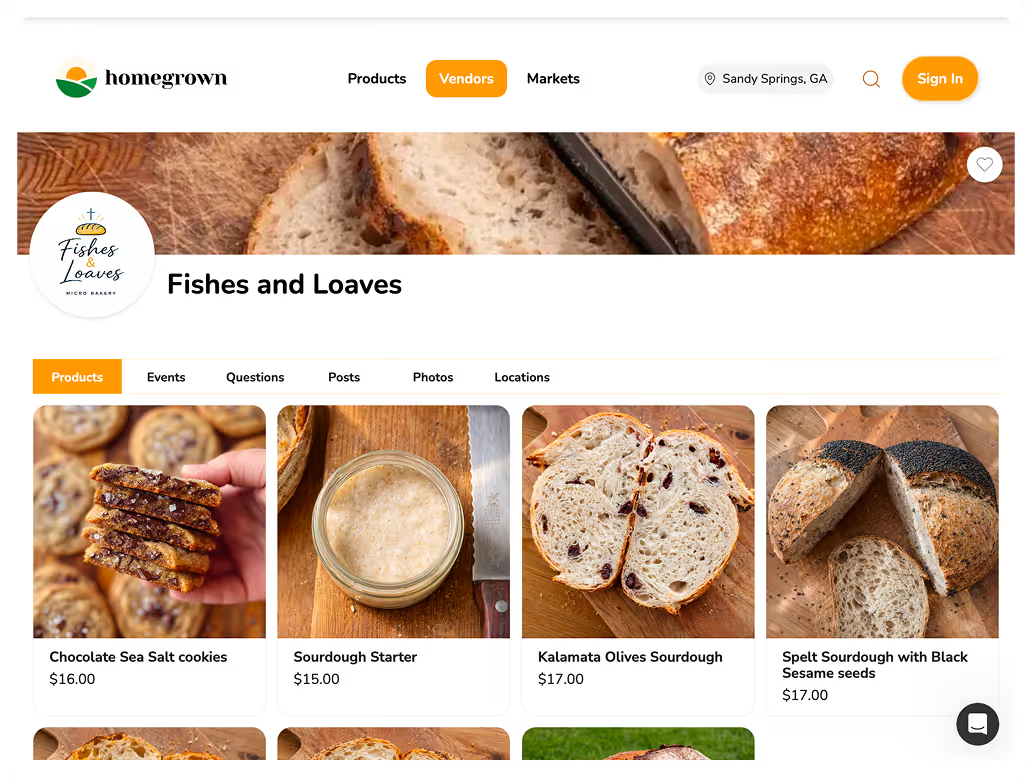
In a pull of the Homegrown catalog on October 13, 2026, 2,531 of the 2,880 products listed by 317 vendors (87.9%) had a starting price in whole dollars, 159 (5.5%) ended in 50 cents and only 106 (3.7%) ended in .99 or .95. 794 products (27.6%) listed two or more options under one listing, each with its own price. One vendor, Sonkissed Shire, lists its jam at $6.50 in five flavors and its pickled beets at $8.50 a pint or $16.00 a quart, which is exactly the "flavor group" and "size ladder" signs above. We counted the price field the catalog returns for every product (each product's lowest option price when it has options), not product names.
How 2,880 Homegrown products end their price
Source: Homegrown catalog pull, October 13, 2026, 2,880 products from 317 vendors, starting price of each product.
If you price by the pound at your booth, your online listings need fixed sizes instead. Selling by weight is on Homegrown's roadmap, not live, on the signup page we checked October 13, 2026, so list "1 lb bag" or "2 lb bag" as options, each with its own price, and keep the per-pound price for the scale at your table.
For a full method to set the numbers themselves, see this guide to pricing food products for farmers markets.
A story sign separates forgettable booths from the ones customers remember and talk about. It adds one or two specific sentences about your product's origin, production method, or the people behind your business: not marketing copy, but a real fact that gives customers a reason to care.
Effective story sign examples:
Story signs work at farmers markets because shoppers there came for something a grocery store can't tell them: who made it, where, and when. A story sign validates their choice and makes the price feel more justified. The customer who might hesitate at $10 for a jar of jam becomes the customer who feels good about spending $10 when they know it was made this week in small batches with local ingredients.
Keep story signs short: one or two sentences is the sweet spot. A 4x6 or 5x7 laminated card placed at the front of your table is the right size. You need one story sign per product category at most.
What to avoid: vague marketing language. Words like "artisan," "handcrafted," "premium," and "gourmet" have been used so heavily by mass-market brands that they've lost all meaning. Specific facts are always more convincing than buzzwords. "Baked this morning" is more powerful than "freshly baked." "12 ingredients, no preservatives" is more compelling than "all-natural."
You can write "organic" on a sign only if your farm is certified organic, or if it follows the organic rules and sells $5,000 or less of organic products a year, which makes it exempt from certification. That is the federal rule in 7 CFR 205.101, which we loaded on October 13, 2026: an operation "whose gross agricultural income from organic sales totals $5,000 or less annually" is exempt from certification but must still follow the organic production and labeling rules.
What an exempt grower can and cannot put on a sign, under 7 CFR 205.310:
At a California certified farmers market there is also a posting rule. 3 CCR 1392.4(f), which we loaded on October 13, 2026, says: "Any person selling organic products or representing products as organic at a certified farmers' market shall conspicuously post at the point of sale a photocopy of his or her current State of California organic registration and, if applicable, in accordance with the Code of Federal Regulations, Title 7, § 205.101 (1-1-20 Edition), which is hereby incorporated by reference, documentation of his or her organic certification." The rule names any person selling or representing products as organic, so it includes growers who are exempt from certification: post a copy of your current California organic registration at the point of sale, plus your organic certification documents if your farm is certified.
If you are not certified and not following the organic rules, leave the word off and say what you actually do: "No synthetic pesticides" or "We don't spray" is a fact a shopper can ask you about. It does the same job on a story sign without making a claim the rules reserve for organic growers.
Dietary and allergen callout signs act as purchase triggers for farmers market customers who are shopping for a specific dietary quality. A shopper looking for gluten-free, nut-free or no-added-sugar products scans for those words, and a visible sign is what catches their eye.
You don't need a full ingredient list on a sign; that level of detail belongs on your product label. But if your product has a meaningful dietary quality (gluten-free, vegan, nut-free, dairy-free, no added sugar, sweetened only with honey), surface that information on a visible sign. A small tag costs little: a 4 by 3 inch chalkboard tag from a 12-pack works out to about $0.75.
Two simple formats work well:
This type of sign is especially valuable for products where the dietary quality isn't obvious from looking at the packaging. A customer can see that your bread is bread, but they can't see that your cookies are made without dairy unless you tell them. Making that information visible turns an invisible selling point into an active one.
Only put a claim on a sign that you can back up. If you bake your "gluten-free" cookies in the same kitchen as wheat bread, say "made without wheat" and tell people about the shared kitchen when they ask, and check what your product labels must say in our guide to cottage food labeling requirements.
A QR code on a small table sign connects your physical farmers market booth to the place customers can order from you between markets, and on Homegrown the printable QR code generator is included in the $10-a-month plan. A customer scans it while they're already at your booth and interested, and the connection is made without a sales pitch from you.
The most useful QR code for most vendors points to a pre-order or ordering page. The customer who bought your last loaf of sourdough three weeks in a row would happily order ahead and guarantee their loaf next week. The person who wanted the raspberry jam but you sold out by 10 AM would jump at the chance to pre-order.
If you manage pre-orders through Homegrown, you can display your Homegrown storefront QR code on a small tent card or sign. Customers who want to pre-order for the following week scan it while they're standing at your booth, browse what's available, and place their order right there. That turns some of your walk-up customers into pre-order customers, and the only work on your end is putting the sign on your table and filling the orders.
Your QR code should link to a page where a customer can order and pay for pickup, because a scan that ends anywhere else still leaves you chasing the sale. Here is how the usual destinations compare.
Your Instagram profile gets them a follow, but followers don't equal orders. They'll scroll past your post next Wednesday the same way they scroll past everything else.
A Google Form takes orders but doesn't collect payment. You're still chasing Venmo requests and matching payments to form entries. A Venmo business profile collects the money, at 1.9% + $0.10 a payment on Venmo's fee page on October 13, 2026, but it gives you no product list and no pickup schedule.
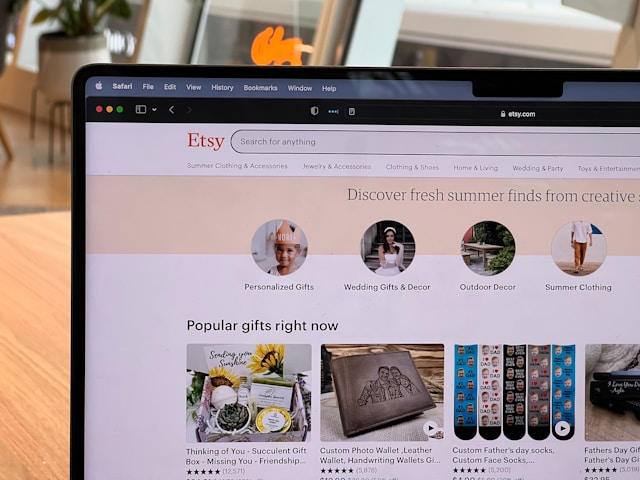
An Etsy listing works if you ship products, but for a farmers market vendor doing local pickup, it stacks fees: Etsy's fee policy lists a $0.20 listing fee, a 6.5% transaction fee and, for US shops, payment processing of 3% + $0.25, which is $2.35 on a $20 order.
A Homegrown storefront is built for this exact scenario: a market customer scans your QR code, sees your products, orders for next week's pickup, and pays right there. Homegrown costs $10 a month billed annually ($12.50 billed monthly) with no percentage fees beyond standard payment processing of 2.9% + $0.30, which you pay. You get a production list before you start baking. The customer gets a confirmation instead of hoping you saw their DM.
Here is the full fee stack for each destination on a $20 pickup order:
Swipe left for the full fee stack on each option.
| Where the QR code goes | Subscription | Trial | Platform fee | Card processing | Customer pays on a $20 order | You pay on a $20 order | 50 orders of $20 a month |
|---|---|---|---|---|---|---|---|
| Homegrown storefront | $10/mo billed annually, or $12.50/mo monthly | 7 days, no charge until day 8 | $0, 0% commission | 2.9% + $0.30, paid by you | $20.00 plus tax | $0.88 | $54.00 annual plan, $56.50 monthly plan |
| Etsy listing | $0, a one-time set-up fee may apply | None | $0.20 listing fee per item listed (renewed when one sells) + 6.5% transaction fee | 3% + $0.25 | $20.00 plus tax | $2.35 (one item) | $117.50, plus 15% on any order from an Etsy offsite ad |
| Square Online (Free plan) | $0 | None needed | $0 | 3.3% + $0.30 online | $20.00 plus tax | $0.96 | $48.00 |
| Google Form plus a Venmo business profile | None listed on Venmo's fee page | None needed | $0 | 1.9% + $0.10 per payment | $20.00 | $0.48 | $24.00, with no order list or pickup schedule |
We checked the Homegrown signup page, Etsy's fees policy and Etsy Payments policy, Square's online store plans page and Venmo's fees page on October 13, 2026. Etsy's transaction fee also applies to shipping you charge, and its processing fee applies to the whole order including tax. The 50-order column adds the monthly subscription to 50 times the per-order fee.
Venmo and Square Online's free plan cost less per month than Homegrown at 50 orders, and Square's free plan charges 2.6% + $0.15 per tap, dip or swipe for cards taken at the booth itself, on its pricing page. Where Homegrown fits a market vendor is the part those tools leave to you:
Homegrown does not print your signs, design your banner or include a card reader for your table, and its signup page lists pickup and local delivery within a radius you choose, not shipping. Customers create a Homegrown account to place their first order, there is no drops or countdown release feature, and while your storefront is listed on Homegrown's local marketplace, plan on most orders coming from the people you send to your own link, which is exactly what the QR code on your table does.
For the sign format, a small tent card in the 3x5 folded size works well. Include the QR code at least 1.5 inches square and a short prompt: "Pre-order for next week" or "Order ahead for pickup." Place QR code signs near your most popular products, since those are the products customers are most motivated to guarantee through pre-ordering.
If your QR code card keeps getting scanned but you want more of those scans to become orders, set up your Homegrown storefront and point the code at it. You start with a 7-day trial, no charge until day 8, and your table card can be printing the same afternoon.
Make the QR code at least one tenth as wide as the distance people scan it from. Any-QR's size guide puts it at 1.2 inches for a code scanned from 1 foot, 4 inches for 3.3 feet and 8 inches for 6.6 feet.
At a booth that works out to:
Leave a clear white margin around the code, print it dark on light, and scan your printed sign with two different phones before market day. Our list of QR code ideas for farmers market vendors covers what else a code can do, from reviews to an email list.
Chalkboard signs are a good choice for anything that changes week to week, like flavors, sold-out notices and "new this week," and a weaker choice for prices you want people to read in a hurry. They look right at a market and cost little, but they depend on your handwriting and can smear in humidity or rain.
Where chalkboards earn their spot:
Use chalk markers rather than stick chalk for sharper letters that don't brush off when a customer touches the sign. If your booth is in full sun or the forecast says rain, keep a printed, laminated backup of your price cards in the bin. Sizes and wording formulas are in this guide to a chalkboard sign for a farm stand, and they work for a market table too.
Vinyl for the banner and laminated cardstock for everything at table level is the combination that holds up best for the money, because both shrug off sun, wind and the odd shower through a whole season. Your signs need to survive sun, wind, occasional rain, and weekly setup and teardown. Here's an honest comparison of materials by sign type, with prices we checked on October 13, 2026:
Slide the table sideways for cost and durability.
| Material | Best For | Cost (checked October 13, 2026) | Durability | Weather Resistance |
|---|---|---|---|---|
| Vinyl banner | Main booth sign | $37.99 to $46.99 before shipping (2.5 x 4 or 2.5 x 6 ft, outdoor, grommets, Vistaprint) | Vistaprint rates its outdoor vinyl at up to 2 years | Excellent |
| Laminated cardstock | Product, price, and story signs | $0.96 to $1.74 per letter-size self-seal pouch (Scotch 25-pack $23.99, 10-pack $17.36, Amazon) | One full season | Good (moisture resistant) |
| Chalkboard signs | Product and price signs | $7.99 for 20 or $8.99 for 12 mini boards, about $0.40 to $0.75 each (Amazon) | Reusable indefinitely | Fair (smears in humidity) |
| Foam board | Temporary or starter signs | $3.29 a sheet in a 10-pack of 20 x 30 inch boards ($32.92, Amazon), or printed from $9.99 at Vistaprint | A few months | Poor (not weatherproof) |
| Acrylic/plexiglass | Holders for printed signs, featured displays | $3.48 to $5.33 per 8.5 x 11 inch holder (MaxGear 6-pack $20.89, 3-pack $15.99, Amazon) | Indefinite | Excellent |
Prices from Vistaprint's vinyl banner page and Amazon listings, loaded October 13, 2026, before tax and shipping except where noted. Durability and weather ratings are typical for each material, not a vendor's guarantee.
Vinyl banners are the clear winner for your main booth sign: durable, fade-resistant, and inexpensive. Laminated cardstock is the most practical option for everything at table level. Chalkboards look great but depend on your handwriting quality and can't handle humidity well. Foam board is fine for starting out but not a long-term solution. Acrylic is the premium option worth considering if you plan to do farmers markets long-term, and at under $6 a holder it costs less than most people expect: slide a printed card in and you can swap it without laminating a new one.
A full set of farmers market signs costs about $81 to $104 if you print the banner and make the table cards yourself. That covers a vinyl banner, a dozen chalkboard or laminated cards and a few holders, at the prices we checked on October 13, 2026.
Swipe sideways to compare both sets.
| Item | Where we priced it | Lean set | Fuller set |
|---|---|---|---|
| 2.5 x 6 ft outdoor vinyl banner with grommets, shipped | Vistaprint ($46.99 + $7.99 economy shipping) | $54.98 | $54.98 |
| 12 mini chalkboards, 4 x 3 inch, with stands | Amazon | $8.99 | $8.99 |
| Self-seal laminating pouches, letter size | Amazon (Scotch) | $17.36 (10) | $23.99 (25) |
| Acrylic 8.5 x 11 sign holders | Amazon (MaxGear) | None | $15.99 (3) |
| Total | $81.33 | $103.95 |
Prices loaded October 13, 2026, before sales tax and Amazon shipping (the banner row includes Vistaprint shipping). Amazon prices move often, so recheck before you order. Cardstock and printer ink you already own are not counted.
Add-ons, if you need them:
If you sell $8 jars, the fuller set is about 13 jars of sales. Put another way, if better signs sell one extra $8 jar each market day, the $103.95 set is covered in sales by your 13th market, before you count what the jars and ingredients cost you.
You can make a full set of table signs at home in one evening for $26.35 in supplies (an $8.99 pack of 12 mini chalkboards and a $17.36 pack of 10 laminating pouches): write them, print them, laminate them and test them from across the room. The banner is the only piece worth ordering from a print shop.
Where you put your signs matters as much as what's on them: a perfectly designed sign in the wrong position is invisible to the customers who need to see it.
Our booth layout planner helps you place each sign in a 10x10 space before market day.
Most market vendors don't need a yard sign, because the market itself does the street-side job; an A-frame at the edge of your booth is the more useful buy if your market allows it. Yard signs and roadside signs matter more for a farm stand, where nobody knows you are open unless a sign tells them.
When an outside sign does make sense:
For anything placed on a road shoulder or sidewalk, check with your town before you put it up.
Yes, in at least one state: California requires vendors selling certifiable agricultural products in a certified farmers market to post a sign naming the farm, its county and a grow-what-you-sell statement. We read California's rule and the federal organic rule for this guide; for any other state, ask your market manager and read your market's vendor handbook.
California's direct marketing regulation, 3 CCR 1392.4(k), says: "Every person selling certifiable agricultural products within a certified farmers' market shall, at the point of sale: (1) Conspicuously post their valid certified producer's certificate; and (2) Conspicuously post a legible sign or banner that states: (i) The name of the farm or ranch, as listed on the valid certified producer's certificate and 'doing business as' name ('dba') (if applicable), as listed on the valid certified producer's certificate; and (ii) The production county where the products being offered for sale were produced; and (iii) A statement of 'We Grow What We Sell' or a similar phrase." CDFA's summary of the 2021 rule changes lists missing sign elements as a "minor violation." We loaded both on October 13, 2026.
What that means for your California banner:
This rule covers certifiable agricultural products sold inside the certified farmers market area. If you sell baked goods or other prepared food in California, your rules come from your cottage food or health permit, and our California farmers market vendor permit guide walks through which one applies.
If you sell processed agricultural products, the next subsection, 3 CCR 1392.4(l), covers your label or sign. It says you "shall state in a clear manner by package label, container label, or bulk sales signage that they consist only, with the exception of incidental flavorings and necessary preservatives, of agricultural products grown or raised by the farm or ranch selling them, the farm or ranch name, and the city where the farm or ranch is located." It also says: "In addition, every processed product shall identify on a package label, container label, or on bulk sales signage the registration number or other identity reference of the facility where the food was processed, or another required labeling statement or information, in accordance with Sections 110460, 114365, and 114365.2 of the Health and Safety Code, or, in the case of meat or poultry products, the identity of the facility where the meat or poultry products were cut and wrapped, in accordance with the applicable United States Department of Agriculture or State of California inspection standards, or, in the case of dairy products, the identity of the facility where the dairy products were manufactured or processed."
What counts as a processed agricultural product is set in the definitions section, 3 CCR 1392.2(w), as of October 13, 2026: "Processed agricultural products shall be defined as agricultural products that have been altered or prepared by such means as, but not limited to, slicing, juicing, drying, shelling, smoking, freezing or cooking, provided, however, that the seller has produced all of the ingredients contained in the final product. The only exceptions to this production requirement shall be the inclusion of food coloring, pectin, rennin/rennet or ingredients used as preservatives, seasonings, and flavorings."
For most vendors, you need exactly seven types of signs. The right seven beat a table crowded with twenty.
That's seven signs, and the $81.33 lean set priced above covers every one of them with cards to spare. You might have more product signs if you carry a larger lineup, but the categories stay the same. Having this set complete and consistent is what makes signage work for you. Missing any one of them, especially prices, creates a gap that costs you sales.
Your payment sign should list every way you take money, in the order people use them, at the spot where they pay: "Cards, tap to pay, cash, Venmo @yourbooth." One card, 5 by 7 inches or smaller, is enough.
If you are still choosing how to take payments, this comparison of payment methods for farmers market vendors lays out the readers and their fees.
The most common signage mistakes at farmers markets are too much text, letters too small to read, missing prices, hard-to-read handwriting and cluttered tables, and they all reduce sales without the vendor realizing it. Signs are one part of getting more customers at farmers markets.
Most vendors can get a complete, professional-looking farmers market sign set for about $81 to $104. On October 13, 2026, Vistaprint charged $54.98 shipped ($46.99 plus $7.99 economy shipping) for a 6-foot outdoor vinyl banner, twelve 4 by 3 inch chalkboards with stands cost $8.99, and letter-size self-seal laminating pouches were $17.36 for 10 or $23.99 for 25 on Amazon. The quality of information on your signs matters more than the materials.
It depends on your handwriting. Chalkboard signs have the right look for farmers markets and photograph well for social media, and they are the best choice for flavors that change every week. But if your handwriting isn't consistently clean and legible, printed laminated cards are the better choice for prices, because they hold up better in humidity and are easier to read in direct sunlight.
Plan on about 1 inch of letter height for every 10 feet of reading distance. That is the ratio in the best-impact column of SignsDirect's letter height chart. The chart starts at 2-inch letters for 20 feet, so 1 inch at 10 feet is that same ratio carried down to table distance. That puts your banner name at 2 inches or more for 20 feet, and 3 to 4 inches if shoppers see you from across a wide aisle. Table-level product and price cards get read at roughly 10 feet, so aim for inch-tall letters, and print a test sign to check before you laminate the set.
You need a sign for every product group or category, not every individual product. If you sell three varieties of jam, one sign that says "Homemade Jam: Strawberry, Blueberry, Peach, $10 per jar" covers all three. Individual product signs are only necessary if products have significantly different descriptions or prices.
Consistency is what makes signage look professional, not expensive materials. Use the same font, colors, and format across all your signs. Print on heavy cardstock at home and seal each card in a self-seal laminating pouch, which worked out to $0.96 apiece in a 25-pack of Scotch pouches (checked October 13, 2026). A uniform set of laminated signs looks more polished than mismatched hand-lettered signs regardless of cost.
Include your Instagram handle or a QR code to your Homegrown storefront on one small sign, but don't clutter your main booth sign or product signs with social handles. Your main sign exists to attract passersby and tell them what you sell. Social media information belongs on a separate, smaller sign that interested customers can find at your table, and a QR code that lets them order does more for you than one that only earns a follow.
Your main booth banner and product category signs should last multiple seasons without changes; Vistaprint says its outdoor material lasts up to two years with care. Price signs need updating whenever your prices change. Story signs can stay the same unless your story changes. The signs that need the most frequent updates are seasonal product signs and any signs listing specific flavors or varieties that rotate week to week.
A farmers market banner should say your business name and one line about what you sell, like "Miller Bakehouse: Sourdough every Saturday." Keep it to those two lines so the letters can be big enough to read from 20 feet. If you sell certifiable agricultural products in a California certified farmers market, the banner or a sign beside it must also name your production county and say "We Grow What We Sell" or a similar phrase.
Yes, packaged products usually need their own labels as well as your booth signs, and the label rules come from your state's cottage food or food permit rules, not from your sign. A sign tells a shopper what a product is and what it costs, while the label travels home with the product. See our guide to cottage food labeling requirements for what your state asks for.
These guides go deeper on the booth and the signs around it:
Ready to give your QR code card somewhere worth sending people? Open your Homegrown storefront for $10 a month billed annually ($12.50 monthly), print the QR code it makes for your booth sign, and let regulars order for pickup at your next market with no commission on your sales.