
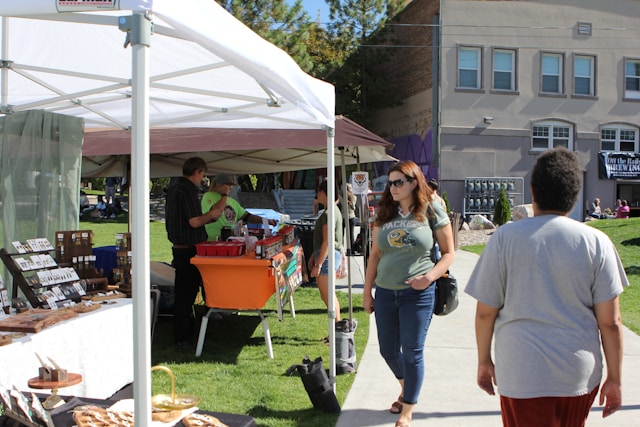


The short version: For most weekly farmers market vendors, the Eurmax Standard 10x10 ($188.86 in solid colors on Eurmax's store) is the best value: a straight-leg steel frame, a 500D polyester top and a wheeled bag. On a tight budget, the Crown Shades CenterLOK 10x10 ($145.99 to $149.99, 36 pounds, one-push setup) gets you to market, and the E-Z UP Eclipse (from $769 on E-Z UP's store, 73 pounds, 7-year limited frame warranty) is the tent to buy if you sell year-round. Weight rules vary more than most guides admit: the 8 market rule sets we read asked for 15 to 40 pounds per leg, so four 40-pound sand bags ($39.95 for the set at ABCCANOPY) cover every one of them on a 10x10. Add a 6-foot folding table, a table cover and one sidewall for the sunny side, and read your own market's rules on size, fire labels and weights before you buy anything.
Checked on October 8, 2026: tent and gear prices on the Crown Shades, Eurmax, ABCCANOPY, E-Z UP, Impact Canopies, Coleman and Lifetime stores; weight and fire rules in each market's or agency's published vendor rules; Homegrown's price on findhomegrown.com/signup. Prices change often and other stores may charge less. On Homegrown, a customer makes an account the first time they order, and there is no drops or countdown release feature.
Your canopy tent is the biggest equipment purchase you will make for the farmers market. Buy the wrong one and you replace it before the season ends. Buy the right one and it carries you through years of weekly markets.
Most canopy reviews are written for tailgaters and campers, or by a tent company selling its own tents. A market vendor needs a tent that survives weekly setup, meets the market's weight rules, handles rain and fits in the car. This guide compares six tents with prices from each brand's store on October 8, 2026, the weight rules of 8 real markets, the E-Z UP, Crown Shades and Eurmax matchups, and what a full booth costs. New to markets? Start with how to sell at a farmers market.
Bring a QR code that links to your online store. A QR code lets shoppers order next week's batch before they walk away. You can set up a Homegrown storefront in about 15 minutes for $10 a month (billed annually) with 0% commission plus 2.9% + $0.30 card processing on each order, or compare the best platforms to sell food from home first.
Look for five things: a 10x10 footprint, a straight-leg frame you can lift, a top that sheds rain, a setup you can do alone if you sell alone, and the labels and weights your market requires. A tent that works fine for a backyard party can fail at the market because it gets put up and taken down every week of the season, often in the wind, often by one person at 6 a.m.
Here is the short checklist before you compare models:
A 10x10 foot canopy covering 100 square feet is the standard size for a farmers market stall. It is the size the vendor rules we read are written around, and your canopy has to fit inside that footprint without crowding the vendors next to you. Parkland's farmers market in Florida gives each vendor a space "adequate to fit a 10'x10' tent only" and does not allow anything larger, and the High Desert Farmers Market in California sets its weight minimum "for 10 by 10".
Some markets allow 10x15 or 10x20 spaces, but those are usually for larger operations or vendors who pay for a double booth. If you are starting out, buy a 10x10. It fits every market and almost every vehicle, and every tent in this guide is sold in that size.
Canopy tent frames come in steel (starting prices of $109.99 to $769 in this guide) or aluminum (starting prices of $249.99 to $1,039). Steel costs less, and most budget and mid-range market tents use it. Aluminum does not rust and is easier to carry per foot of frame, but it costs more at the same quality level.
For most part-time vendors doing one to three markets a week, a steel frame is the right choice. You get a sturdy tent for less money, and a wheeled bag makes the weight manageable. Pick aluminum if you sell at coastal or humid markets where steel tends to rust. If you lift the tent alone, compare frame weights rather than metals: the 36-pound steel Crown Shades CenterLOK weighs less than the 38-pound aluminum Impact Canopy ULA.
Canopy fabric is described by its denier, written as a number with a "D" after it. A higher number means a thicker thread and a heavier, more durable fabric. Here is what the brands in this guide list for their tops:
Look for UV protection rated UPF 50+ and a coated fabric if you sell where it rains. Read the word the brand uses, too: Eurmax calls its 500D top "water resistant" and says it repels light to moderate rain, while ABCCANOPY claims its 300D top is "100% waterproof". If your tent leaks, you and your products get wet, and soggy packaging can cost you a whole market day of sales. For more on handling wet weather, see our guide on what to do when it rains at the farmers market.
How quickly you can put your canopy up matters more than you think. You will do it every market day, often before sunrise, while other vendors are loading in around you.
Every canopy on this list is a pop-up style, so no tools are needed. Avoid frame tents that need poles and connectors put together unless you are building a permanent booth.
Check your market's vendor rules for its 15 to 40 pound weight minimum, size limit and fire label before you buy a canopy. Vendors who buy first and read later end up with a tent that is too big, too light to anchor or missing the fire label their city asks for.
Farmers markets require anywhere from 15 to 40 pounds of weight on each canopy leg, and the number depends on your market, and sometimes on your city or fire department. We read the published vendor rules of 8 markets in 7 states on October 8, 2026. Two of them (Larimer County, Colorado and High Desert, California) require 40 pounds per leg, the most common rule was 20 to 25 pounds, and one Indiana market recommends 15. At least one top-ranking canopy guide says most markets require about 40 pounds per leg, but only 2 of the 8 rule sets we read actually do.
The Washington State Farmers Market Association writes the 24-pound rule into its member market guidelines, which is why two Washington markets below use the same wording. Its rule also allows, on grass or soft soil, steel auger anchors or spiral stakes at least half an inch thick and 12 to 15 inches long instead of weights. Plain straight tent stakes do not count. Both Washington markets in the table limit stakes, though: Kent's vendor agreement bans stakes in the ground, and Renton bars anchors in shrub beds and turf without approval, so plan on weights.
Swipe the table to see every market's rule.
| Market | State | Weight per leg (10x10) | Total on four legs | Other anchor rules |
|---|---|---|---|---|
| Larimer County Farmers' Market | Colorado | 40 lb required | 160 lb | Market will ask you to take the tent down without adequate weights |
| High Desert Farmers Market | California | 40 lb required | 160 lb | Only sand-filled bags made for canopies; no hanging weights |
| Dripping Springs Farmers Market | Texas | 25 lb required | 100 lb | 30 lb per leg on a 12x12, 50 lb per leg on a 10x20 |
| Renton Farmers Market (2025) | Washington | 24 lb required | 96 lb | No stakes in shrub beds or turf without approval |
| Kent Farmers Market (2025) | Washington | 24 lb required | 96 lb | Agreement bans stakes in the ground, so use weights |
| Corvallis-Albany Farmers' Markets (2026) | Oregon | 20 lb required | 80 lb | Add 15 lb more per leg (35 lb) when high winds are forecast |
| Parkland Farmers Market (2025-2026) | Florida | 20 lb required | 80 lb | Stakes recommended on top of weights; tents over 10x10 not allowed |
| Columbus Farmers Market (2024) | Indiana | 15 lb recommended | 60 lb | Weights required on each leg; manager can order tents down in high wind |
We read each market's published vendor handbook, agreement or canopy guideline on October 8, 2026; the year in brackets is the year on the document. Rules change every season, so read your own market's current rules before market day.
Minimum weight per canopy leg, 10x10 tent
Source: each market's published vendor rules, read October 8, 2026. Pounds per leg. Columbus recommends 15 pounds; the other 7 require their number.
What this means for your shopping list:
Weight rules change from season to season. Corvallis-Albany raised its minimum to 20 pounds per leg in its 2026 handbook and marked it "NEW". We read every rule in the table on October 8, 2026, but your market's current handbook is the rule that counts.
Some do, and California is the clearest case: a 10x10 canopy there needs a permanent fire label. California's fire regulations (Title 19, section 335) require a small tent, which includes a 10x10 canopy, to carry either a permanent label with the State Fire Marshal's Seal of Registration or a CPAI-84 label stating that its fabric meets that flame-resistance standard, along with the manufacturer's name and a fire warning. CPAI-84 is the fire test canopy brands print on their labels; NFPA 701 is a separate fabric fire test that some brands, like Eurmax, also list. If your fire department names one, buy a tent labeled for that one.
The City of Sacramento's fire department tent handout says small 10x10 tents "shall have a permanently affixed label" or "comply with the provisions specified in CPAI-84", citing Title 19, Division 1, Section 335. Some California markets write a fire rule into their own vendor terms too: Oceanside's Sunset Market, covered below, allows only flame-retardant canopies at its food booths.
Outside California, the one market fire rule we found applied only to booths that cook. Parkland's farmers market in Florida says that when you cook under a canopy it "must be of flame-resistant material" with "a flame-resistant tag/label affixed to each canopy". Back in California, Oceanside's Sunset Market rules for food vendors go further: every food booth's canopy must be flame retardant, with a certificate kept at the booth, and its rules for open-flame cooking booths add that tents and canopies must carry a State Fire Marshal seal.
Here is how the tents in this guide stack up on fire labels, from each brand's product page:
If your market requires a label, take a photo of the sewn-in tag when the tent arrives and keep it on your phone. Market managers and fire inspectors ask for it, and the tag is up on the roof seam where nobody can read it once the tent is open.
The best canopy tents for farmers market vendors are the Eurmax Standard 10x10 for weekly vendors, Crown's CenterLOK on a budget and E-Z UP's Eclipse for year-round use. The ABCCANOPY King Kong, Coleman Oasis and Impact Canopy ULA fill specific needs: two-person crews who want a 300D top, vendors at calm seasonal markets who want a light tent, and vendors who want aluminum. Every tent below is sold as a 10x10 pop-up, and every price comes from the brand's own store on October 8, 2026. Coleman credits the Oasis's overhanging eaves for its 100 square feet of shade and does not list the leg footprint, so measure the legs against your market's space limit.
How we picked: we did not field-test these tents in wind and rain. We ranked them on what we could check on each brand's own pages that day: price, published weight, top fabric, fire label, warranty length and whether the brand sells replacement parts. Then we matched each tent to how often you sell, because a tent you raise 10 times a year and one you raise 100 times need different things.
Slide sideways for fabric, fire label and warranty.
| Tent | Price on the brand's store | Frame | Weight | Top fabric | Fire label listed | Warranty listed | Best for |
|---|---|---|---|---|---|---|---|
| Crown Shades CenterLOK 10x10 (RM100H) | $145.99 to $149.99 | Steel | 36 lb | Not listed for this model | Not on the RM100H page (Crown's 4-sidewall CenterLOK bundle lists a 150D CPAI-84 top; check the tent for a sewn-in label) | 1 year limited (Crown's warranty page) | Budget starter, one-push hub |
| ABCCANOPY King Kong (S1 Nova Base Lite) | $159.95 to $169.95 | Steel | 58 lb | 300D silver-coated | CPAI-84 | 1 year frame, 6 months top | Value, comes with 4 sand bags |
| Coleman Oasis 10x10 | $161.99 on sale (list $214.99), out of stock | Steel | 37.9 lb | Polyester, thickness not published | Not listed | 1 year limited | Light tent for seasonal markets |
| Eurmax Standard 10x10 | $188.86 ($218.86 striped or flag tops) | Steel | 51 lb (Eurmax spec image) | 500D polyester | Not on this model's page (company-wide CPAI-84 and NFPA 701 certificates posted) | 1 to 5 years on frame by model, 3 months fabric | Weekly markets |
| Impact Canopy ULA 10x10 with weight bags | $249.99 | Aluminum | 38 lb | 210D polyester | CPAI-84 | 1 year limited (Impact's warranty page); weather damage not covered | Light aluminum frame, calm days |
| E-Z UP Eclipse 10x10 | From $769 (6 stock colors; $939 to $969 other colors, $859 and up aluminum) | Steel (aluminum option) | 73 lb | 500D Duralon PRO | CPAI-84 | 7 years frame, 1 year top (E-Z UP's warranty page) | Year-round, multiple markets a week |
Prices, weights, fabrics, fire labels and warranties come from each tent's product page on its brand's store (Coleman's on coleman.com, and the Crown Shades, Impact and E-Z UP warranties from those brands' warranty pages), read October 8, 2026. Eurmax gives the Standard 10x10's weight (51 pounds net) only in a spec image on its product page. Amazon and big-box prices for the same tents move daily and may be lower.
Price: $149.99 in most solid colors and $145.99 for the striped and flag prints on Crown Shades' store, on sale from $169.99 on October 8, 2026; the three $139.99 colors (coffee, gray and purple) were sold out on October 8, 2026. Weight: 36 pounds. Frame: alloy steel. Setup: patented one-push CenterLOK center hub.
The Crown Shades CenterLOK 10x10 (model RM100H) is the best budget canopy for vendors just getting started. At 36 pounds it is the lightest steel tent among our six picks, and Crown calls its CenterLOK hub a one-person setup on the Air-Light version, though Crown's listing for the CenterLOK 10x10 sold with 4 sidewalls says setup takes 2 people.
The tradeoff is the top. Crown's listing for this model calls the fabric "water resistant" and lists 95% UV protection, but it does not list the fabric weight, while Crown's $109.99 Air-Light Lite and its $189.99 CenterLOK bundle with 4 sidewalls both list a 150D top (the bundle's listing also calls it CPAI-84 compliant, so check the stand-alone tent for a sewn-in label). Treat it as a light-duty top: fine for sun, fine for a shower, not what you want for a full day of steady rain. Crown sells a replacement top for this model at $59.99 to $81.99 depending on color (on October 8, 2026 only the $81.99 blue one was in stock), so a worn top does not have to mean a new tent.
Best for: first-time vendors testing the market, vendors on a tight budget, or anyone who needs a light backup tent with a one-push hub.
Price: $159.95 in white or black (navy was sold out), $169.95 in other colors (list price $199.95), though most of those colors were out of stock on October 8, 2026. Weight: 58 pounds. Frame: steel, 3 height settings. Fabric: 300D silver-coated polyester with UPF 50+ that ABCCANOPY calls 100% waterproof. Setup: 2 people.
The ABCCANOPY King Kong is the best value for vendors who want a step up from budget tents without paying premium prices. ABCCANOPY now sells it under the name S1 Nova Base Lite, but the product page still lives at the old King Kong address. The 300D top is twice the fabric weight of a 150D budget top, and the package includes a wheeled bag, 4 sand bags, ropes and stakes. ABCCANOPY does not say how much those included bags hold, so check them against your market's minimum before you skip buying a set.
It is heavy at 58 pounds, the second heaviest of our six picks after the E-Z UP Eclipse, and ABCCANOPY says it sets up with 2 people. The warranty is short: 1 year on the frame and 6 months on the top. ABCCANOPY lists 18 colors in the 10x10 size, but only 4 (white, black, brown and pink) were in stock on October 8, 2026, so check your color is available before you plan your booth around it.
Best for: vendors doing weekly markets with a helper who want a top ABCCANOPY calls waterproof and a full anchoring kit in the box.
Price: $188.86 in solid colors, $218.86 for striped, flag or hi-vision orange tops. Frame: steel with a full truss and a hammer-tone powder-coated finish. Fabric: 500D polyester. Setup: one or two people, no tools.
The Eurmax Standard is the best overall canopy for vendors who sell every week. It carries the heaviest listed top fabric in this guide under $200 (500D), straight legs, a full truss frame (Eurmax's spec images on the product page show both) and a wheeled roller bag. Eurmax posts CPAI-84 and NFPA 701 fire certificates on its website, but they are company-wide and do not name the Standard, so if a market or fire inspector asks for a label, check the tent for a sewn-in one.
The biggest reason to choose it is parts. Eurmax says it stocks spare joints, poles and panels and sells them on its site, so one broken piece does not end the tent. Its warranty covers the frame for 1 to 5 years depending on the model (the warranty page does not say which term applies to the Standard, so ask before you buy) and the fabric and roller bag for 3 months, and it does not cover weather damage. Eurmax calls the 500D top "water resistant" and says it repels light to moderate rain, so plan on sidewalls when the forecast is bad. Eurmax gives the Standard's weight only in a spec image on its product page, 51 pounds net and 53 packed, so plan for that if you lift it alone.
Best for: vendors doing one to three markets a week who want one tent that lasts several seasons and can be repaired.
Price: $161.99 on sale (list $214.99) on Coleman's store, which showed it out of stock. Weight: 37.9 pounds. Frame: steel. Fabric: polyester with UPF 50+ and a vented roof. Setup: OnePeak one-push center hub.
The Coleman Oasis stands out for two reasons: it weighs 37.9 pounds, and Coleman says its OnePeak one-push hub makes setup quick and easy, though Coleman's answer to a shopper who asked about setting it up alone recommends two or more people. The vented roof lets trapped heat escape, and Coleman says the steel frame withstands winds up to 35 mph when it is fully staked with guy lines. The overhanging eaves spread 100 square feet of shade.
The downsides are durability, parts and stock. The Oasis is built as a camping and backyard canopy: Coleman's own answer to a shopper says it does not have the fabric thickness for this model, and its warranty is 1 year. Coleman Consumer Care also told a shopper on its product page (May 14, 2026) that the Oasis does not have replacement parts available, so one bent leg can end the tent. It also does not list a fire label, which matters in California. When we checked, Coleman's store showed it out of stock, so you may only find it through other retailers.
Best for: vendors at one seasonal market a week, ideally with a helper, who care most about a light tent.
Price: $249.99 with four weight bags. Weight: 38 pounds for the canopy. Frame: straight-leg aluminum. Fabric: 210D polyester with a CPAI-84 fire label.
The Impact Canopy ULA is the lightest aluminum frame in this guide, and aluminum will not rust, which matters at coastal markets. Impact now sells it as a kit with four weight bags; the stand-alone version's page no longer loads.
Read the fine print before you buy it for market use. Impact calls the ULA "recreational grade" and says on its own product page that "any rain and winds over 10-15 MPH will damage your canopy" and that it will not be held responsible for weather damage. Its included bags hold up to 25 pounds each, which is 100 pounds total, enough for the 15 to 25 pound markets in our table but short of Larimer County's and High Desert's 160 pounds.
Best for: vendors at sheltered or indoor-outdoor markets in calm weather who need a light aluminum frame and a fire label.
Price: from $769 on E-Z UP's store: $769 for the steel frame in 6 stock colors (black, white, red, royal blue, steel gray and limeade), $939 to $969 for the steel frame in the other 13 colors and $859 to $1,089 for the aluminum frame. Weight: 73 pounds. Frame: high-strength 1015 steel, or aircraft-grade aluminum as an option. Fabric: 500D Duralon PRO, treated to meet CPAI-84. Warranty: 7 years limited on the frame and 1 year on the top, sidewalls and enclosures (E-Z UP's warranty page).
The E-Z UP Eclipse is E-Z UP's heavy-duty 10x10 for daily commercial use, and it is the tent to buy if you sell year-round or at several markets a week. E-Z UP rates it "Heavy Duty", builds it with a cross-brace frame, a reinforced DualCore frame and welded steel foot plates, and offers it in 19 solid colors or custom printed. Its 7 year limited frame warranty is the longest of our six picks (only the $1,039 Endeavor, which is not one of the six, carries a longer lifetime limited frame warranty), though E-Z UP covers the top for 1 year. E-Z UP also sells individual parts on the same page: an outer leg kit for $86, a replacement top for $276 and a full frame for $605.
The downsides are weight and price. At 73 pounds it is the heaviest of our six picks, so plan on a cart or a helper. It ships in a cover bag without wheels; E-Z UP sells its Deluxe Wide-Trax roller bag separately. At $769 it costs more than five Crown Shades tents. E-Z UP shows list prices of $880 and up for the Eclipse and was selling it for $769 and up on October 8, 2026, the day after a sitewide 30% off sale ended. E-Z UP's prices move with its sales, so check the current price at the Eclipse page on E-Z UP's store and compare with other stores before you buy.
Best for: vendors who sell year-round or at multiple markets a week and want one tent with a long warranty and a full parts catalog.
Crown Shades is better if you want a light tent and want to spend under $150; E-Z UP is better if you sell every week for years and can lift a heavier tent. Crown's CenterLOK costs $145.99 to $149.99 and weighs 36 pounds. The E-Z UP Eclipse costs from $769 and weighs 73 pounds, but it is rated Heavy Duty, has the longest frame warranty of our six picks (7 years, limited; the top gets 1 year) and has a full parts catalog.
Swipe to compare both tents line by line.
| What matters at market | Crown Shades CenterLOK 10x10 | E-Z UP Eclipse 10x10 |
|---|---|---|
| Price on the brand's store | $145.99 to $149.99 | From $769 (6 stock colors) |
| Weight | 36 lb | 73 lb |
| Setup | One-push center hub (Crown calls it one-person on its Air-Light model; its 4-sidewall CenterLOK listing says 2 people) | E-Z Lock and Release corners; easier with two at 73 lb |
| Top | Water resistant, fabric weight not listed | 500D Duralon PRO, CPAI-84 |
| Warranty | 1 year limited (Crown's warranty page) | 7 years frame, 1 year top (E-Z UP's warranty page) |
| Parts | Replacement top $59.99 to $81.99 by color | Leg kit $86, top $276, frame $605 |
From each product page on October 8, 2026. E-Z UP's lighter models (Vista and Dome, both rated Light Duty by E-Z UP) are closer to the Crown in price, but E-Z UP lists both as slant-leg frames with 64 square feet of shade, one more reason to skip them; see the E-Z UP model section below.
The deciding question is how many times you will raise the tent. If you are trying one market for one season, the Crown gets you there for less than a fifth of the price. If you already know you will sell 2 or more markets a week, year-round, the Eclipse's warranty and parts catalog start to pay for themselves, as long as you have a cart or a helper for 73 pounds.
For weekly vendors the $39 to $43 upgrade is worth it, and for a test season it is not. The Eurmax Standard 10x10 costs $188.86, about $39 to $43 more than the Crown Shades CenterLOK at $145.99 to $149.99 (its $139.99 colors were sold out on October 8, 2026), and for that you get a 500D top, a full truss frame and spare parts sold on Eurmax's site. The Crown stays lighter at 36 pounds, with a one-push hub that Crown calls one-person on its Air-Light model.
The weight difference matters more than it looks on paper. Crown publishes 36 pounds for the CenterLOK; Eurmax's spec image puts the Standard at 51 pounds net, so the full truss steel frame with its 500D top is 15 pounds more to lift into a trunk alone. If you can, look at both in person at a market before you buy, and ask the vendors using them how many seasons they have had.
The E-Z UP Eclipse carries the longer frame warranty, 7 years limited against Eurmax's 1 to 5 years, but in our example below the Eurmax Standard costs less per market. Here is the math with round numbers we chose, so you can swap in your own:
These lifespans are assumptions, not promises: no brand publishes how many markets its tent survives, and wind or one bad storm can end any of them. What the math shows is that the Eclipse is not automatically the cheaper tent over time. You buy it for the warranty, the Heavy Duty rating and the parts, and it earns its price when you sell 2 or more markets a week, year-round.
Buy an E-Z UP rated Heavy Duty or Medium Duty, not one of the Light Duty models. E-Z UP rates each shelter on its own site, and the ratings line up with price:
Scroll sideways for weight and warranty.
| E-Z UP model (10x10) | E-Z UP's rating | Price on ezup.com | Weight | Warranty listed |
|---|---|---|---|---|
| Vista | Light Duty (slant leg, 64 sq ft of shade) | $165 | Under 40 lb | 3 years |
| Dome | Light Duty (slant leg, 64 sq ft of shade) | $219 | 36.9 lb | 3 years |
| Vantage | Medium Duty | $355 | 48 lb | 5 year limited |
| Express (aluminum) | Medium Duty | $605 | 48 lb | 5 year limited |
| Eclipse | Heavy Duty | From $769 | 73 lb | 7 year limited (frame) |
| Endeavor | Heavy Duty | From $1,039 | 80 lb | Lifetime limited |
Ratings, prices, weights and warranties from each model's page on ezup.com, October 8, 2026, the day after E-Z UP's sitewide 30% off sale ended. Every price shown was still below E-Z UP's list price (list: Vista $197, Dome $263, Vantage $418, Express $715, Eclipse $880, Endeavor $1,200), and E-Z UP's prices move with its sales, so check the current price. The warranty terms shown cover the frame; E-Z UP's warranty page gives fabric tops, sidewalls and enclosures 1 year on every model.
The Vantage at $355 is the E-Z UP worth a look if the Eclipse is out of budget: Medium Duty, 48 pounds and a 5 year limited warranty. The Endeavor adds a lifetime limited warranty for $1,039 and 80 pounds. For vendors set on E-Z UP who work at least two markets every week, the Eclipse is the sweet spot between the two. Whichever model you pick, buy it in a solid color from E-Z UP's stock list first; custom printing on any of them is a quoted extra you can add later.
Beyond the canopy, you need four things that add about $246 to $256 to your booth (four 40-pound bags, a commercial table, a stretch cover and one wall, from ABCCANOPY's $19.95 S-series wall to Crown Shades' $29.99 wall): weights for every leg, a 6-foot folding table, a table cover and at least one sidewall for the sunny side. Signs and a way to take orders between markets come next. For a complete first-market list, our guide on how to sell at a farmers market walks through permits, pricing and setup day.
Canopy weights are the cheapest piece of gear that can get you sent home. All 8 markets in our table require or recommend weights on each leg, anywhere from 15 to 40 pounds, and several say a vendor without them will not be allowed to sell under a canopy that day. A set of four fillable sand bags in stock costs $20.95 to $49.95 on the ABCCANOPY, Crown Shades and Eurmax stores (E-Z UP's own 45-pound 4-pack is $84.70), and the cheap sets hold less: ABCCANOPY's $20.95 sets in stock on October 8, 2026 (the 112-pound set, and the 150-pound set in black; its $17.95 100-pound set was sold out) hold 28 to 37.5 pounds a bag, short of a 40-pound rule. ABCCANOPY, Crown Shades, Eurmax and E-Z UP all sell theirs empty.
The standard approach is fillable bags that wrap around the base of each canopy leg with straps. These sets were listed on October 8, 2026:
Fill bags with sand or gravel, not water. High Desert Farmers Market allows only sand-filled bags made for canopies, and Renton's rules point out that a gallon of water weighs about 8 pounds, so jugs are not heavy enough for a gust. Skip cinder blocks and gym plates, and check your own market's rule on hanging weights, since Renton lists capped, cement-filled PVC pipe hung inside the canopy poles as a good weight. Dripping Springs calls cinder blocks a tripping hazard that is not heavy enough, and High Desert's rules say "NO HANGING WEIGHTS period" and "No dumb bells, weight plates or any other gym equipment". Renton's, Kent's and Dripping Springs' rules all say weights should sit on the ground, have soft edges and not create a tripping hazard.
Sidewalls attach to your canopy frame with Velcro or hooks and do four jobs: shade your products, block wind, keep sideways rain off your table and give you a backdrop for a sign. You do not need a full set to start. One wall on the sunny side, or behind you if the sun comes in low, is enough to start. That back wall is also the best spot for a backdrop, and a 72 x 120 inch cloth in your brand color spans the full 10 feet, one of the market stall decor ideas in a starter kit that costs about $51.
A 6-foot folding table, $149.99 for Lifetime's commercial model, is the standard for a 10x10 booth. It gives you enough display surface while leaving room to move behind the table and talk to customers.
Lifetime's 6-foot commercial fold-in-half table (model 80382G) was $149.99 on Lifetime's own site that same day, and Lifetime lists it at 33.5 pounds. The fold-in-half design fits in a car trunk, and the polyethylene top wipes clean. Big-box stores carry Lifetime and other brands' 6-foot fold-in-half tables too, so compare prices before you pay full price.
If you sell products that look better with height, like bread, cookies, candles or jam, add a small tiered shelf on top of your table. Even a wooden crate turned on its side adds a second level to your display.
Your display does not need to be expensive, but it needs to be clear. People walk past a booth quickly, so your sign and your table have a few seconds to tell them what you sell and what it costs.
A QR code card on your table that links to your online ordering page is one of the cheapest additions to any booth. More on what it should link to below, and our list of QR code ideas for farmers market vendors has more placements.
To check whether your booth spending pays for itself, see our guide on calculating your farmers market booth ROI.
Your canopy, table, weights and signage handle market day, and an ordering system that costs $0 to $12.50 a month handles the other six days of the week: pre-orders from regulars who want their favorites held instead of hoping you still have them at 11 a.m. on Saturday.
Most vendors start with text messages and Instagram DMs. That works for your first handful of regulars, but by customer fifteen you are losing track of who ordered what, chasing payment through Venmo and spending more time on your phone than on prep.
Google Forms plus Venmo costs nothing for the form, and Venmo charges a business profile 1.9% + $0.10 per payment. You match payments to form entries by hand, which works for a few weeks before the tracking gets hard to keep up with.
Etsy handles payments but is built around shipping. It charges $0.20 per listing, a 6.5% transaction fee and, through Etsy Payments in the US, 3% + $0.25 processing on each order. Etsy also owns the shop page your customers see, so building your own buyer list there is harder.
Homegrown costs $10 a month billed annually ($12.50 billed monthly), with 0% commission and 2.9% + $0.30 card processing. It is built for local pickup: customers see your products, order for your next market and pay in one step, and you get the order list before you start prepping. The full comparison with fees on a $20 order is in the pre-order section below.
A complete 10x10 farmers market booth costs about $376 to $1,005 before sand, depending on the tent. That covers the canopy, four 40-pound or 50-pound sand bags, a 6-foot commercial folding table and a table cover, all priced on the brands' own stores on October 8, 2026. Sidewalls made for the Crown Shades or Eurmax tent add $23.91 to $29.99 for one wall, up to $89.96 for Eurmax's full kit, and E-Z UP sells its own walls for the Eclipse.
Swipe to see the full total for each booth.
| Booth level | Canopy | Weights (4 bags, empty) | Table | Table cover | Total before sand and sidewalls |
|---|---|---|---|---|---|
| Testing the market | Crown Shades CenterLOK, $149.99 (solid colors) | ABCCANOPY 160 lb set, $39.95 | Lifetime 6-ft commercial, $149.99 | Eurmax 6-ft stretch 2-pack, $35.95 | $375.88 |
| Selling weekly | Eurmax Standard, $188.86 | Same 160 lb set, $39.95 | Same Lifetime table, $149.99 | Same 2-pack, $35.95 | $414.75 |
| Year-round | E-Z UP Eclipse, from $769.00 (6 stock colors) | ABCCANOPY 200 lb set, $49.95 | Same table, $149.99 | Same covers, $35.95 | $1,004.89 |
Prices from each brand's store on October 8, 2026, before tax and shipping. Sand bags are sold empty, so you also need about 160 to 200 pounds of sand. The Eclipse ships in a cover bag without wheels, and E-Z UP's Wide-Trax roller bag is sold separately and not in this total. The ABCCANOPY King Kong includes 4 sand bags in the box, but ABCCANOPY does not list how much they hold, so check them against your market's minimum before you drop the weights column for that tent.
Ways to spend less without breaking a market rule:
Write your booth's total weight on a piece of tape on your bin: canopy, four bags, table and stock. A setup with a 36 to 73 pound canopy, a 33.5 pound table and 160 to 200 pounds of sand (the year-round booth uses the 200 pound set) comes to about 230 to 307 pounds before your products. Knowing that number tells you how many trips from the car you are making at 6 a.m., and whether a folding wagon or hand truck is worth buying before your second market.
Get a custom printed canopy once your booth has a steady spot and a name people search for, not in your first season. A printed 10x10 top runs $279.95 to $459.95 at ABCCANOPY depending on how many peaks and valances get your logo, and a complete custom 10x10 tent with a printed back wall starts at $469.95 there. E-Z UP prints the Eclipse with your design as well.
Put a QR code on your table that opens an ordering page, let customers pay when they order, and hand their bags over at your canopy on market day. Your tent is already a pickup spot every week; a pre-order page turns the people who walk past it into customers who order again on a Tuesday. Homegrown is built for exactly that: $10 a month billed annually ($12.50 billed monthly) with no percentage fees beyond standard payment processing, a storefront live in about 15 minutes, and a built-in QR code generator that prints a high-resolution code for your booth sign or a code that opens one specific product.
Here is how it compares with what most market vendors use instead, on a $20 pickup order:
Slide sideways for the full fee stack on each option.
| Option | Monthly plan | Platform or listing fee | Card processing | Customer pays on a $20 order | Vendor pays on a $20 order | Vendor pays in a month of 50 orders at $20 |
|---|---|---|---|---|---|---|
| Homegrown, billed annually | $10 (7-day trial, no charge until day 8) | None, 0% commission | 2.9% + $0.30, paid by the vendor | $20.00 | $0.88 plus the plan | $54.00 |
| Homegrown, billed monthly | $12.50 (7-day trial, no charge until day 8) | None, 0% commission | 2.9% + $0.30, paid by the vendor | $20.00 | $0.88 plus the plan | $56.50 |
| Square Online, Free plan | $0 | None | 3.3% + 30¢ online (2.6% + 15¢ in person) | $20.00 | $0.96 | $48.00 |
| Etsy | $0 (a one-time setup fee may apply) | $0.20 listing fee per sale plus 6.5% transaction fee | 3% + $0.25 (Etsy Payments, US) | $20.00 plus any shipping | $2.35 | $117.50 |
| Venmo business profile plus DMs | $0 | None | 1.9% + $0.10 | $20.00 | $0.48 | $24.00 |
Checked October 8, 2026 on findhomegrown.com/signup, Square's pricing page, Etsy's Fees and Payments Policy and payment processing help page, and Venmo's fees page. Fees are figured on the $20 price with no tax. Etsy's $0.20 assumes one listing renewal per sale, which is how Etsy charges for multi-quantity listings. Square's Free plan, Etsy and Venmo have no monthly plan, so there is no trial period to compare.
Venmo is the cheapest on fees, but it gives you no ordering page: you still take every order in your DMs and match payments by hand. Square's Free plan costs a little less than Homegrown at 50 orders a month and works well if you already use a Square reader at your booth, though its online store is a general-purpose builder rather than a pickup-first ordering page. Etsy charges the most per order and is built around shipping, which you do not need when customers pick up at your canopy.
What Homegrown does for a market vendor specifically:
What it does not do: customers create a Homegrown account the first time they order, there is no drops or countdown release feature, and it does not handle nationwide shipping or wholesale accounts. Your storefront is listed on the Homegrown marketplace, but plan on most orders coming from people you send to your own link, starting with the people standing under your canopy.
In a pull of the Homegrown catalog on October 8, 2026, 59 of the 404 vendors had at least one market from Homegrown's market list saved as a selling or pickup location, across 89 different markets, and 50 of those 59 had products listed. We counted a vendor when a location on their storefront was linked to a market in Homegrown's market list, and read every match by hand.
If your canopy already draws a line on Saturday, give that line a way to order for next week. Start your Homegrown storefront, add your market as a pickup location and print the QR code for your table before your next market.
Set up and weight the canopy as one job, with your market's minimum on each leg, then add walls, signs and product. Dripping Springs' rules say setup and takedown are the times a canopy is most exposed to the wind, and Renton's and Kent's rules require weights from the moment the canopy goes up until it comes down. So weights go on before anything else does.
If the wind picks up during market, lower the canopy legs a notch or two, add your spare weight, and move customers out from under it before you take it down. Dripping Springs' rules ask vendors to direct customers out of the way when a canopy has to come down mid-market.
A canopy lasts longest when you dry it before storing it, keep the top out of the sun when you are not selling, and replace parts instead of the whole tent. The warranties tell you what the brands expect: Eurmax covers fabric for 3 months, ABCCANOPY covers the King Kong's top for 6 months, Crown Shades covers its canopies for 1 year (limited), Coleman covers the Oasis for 1 year and E-Z UP covers the Eclipse's frame for 7 years and its top for 1 year (limited). Eurmax and Impact both say their warranties do not cover weather damage, Crown's warranty excludes damage caused by extreme weather, and E-Z UP excludes weather damage from high winds, heavy rain, hail or snow.
The four most expensive canopy mistakes are buying a slant-leg tent, showing up without weights, buying a tent with no parts behind it and buying before reading your market's rules. Each one either costs you a market day or a second tent.
The right tent depends on how often you sell and how much you can spend up front. Here is the short answer by situation, using the October 8, 2026 prices from each brand's store:
If you are testing the market ($145.99 to $149.99): start with Crown's one-push CenterLOK. It is light at 36 pounds, it has the one-push hub Crown calls a one-person setup on its Air-Light model, and it is cheap enough that you are not overinvesting before you know whether the market works for your business. If you commit to selling every week, move up to a Eurmax or E-Z UP after your first season.
If you are selling weekly ($159.95 to $188.86): the Eurmax Standard 10x10 ($188.86) is the best choice for vendors doing weekly markets. The 500D top, full truss frame and spare parts on Eurmax's site are what you want from a tent you plan to keep for several seasons. The ABCCANOPY King Kong ($159.95 to $169.95) is a strong alternative if you have a helper and want 4 sand bags in the box.
If you are selling year-round or at multiple markets ($769 and up): the E-Z UP Eclipse 10x10 (from $769 on E-Z UP's store) is the long-term tent. Its Heavy Duty rating, 7 year limited frame warranty and parts catalog make it the one to own when you sell 2 or more markets a week. Get the Eclipse or Endeavor, or the Medium Duty Vantage ($355) if the budget is tight, not the Light Duty Vista or Dome.
If weight or rust is your top concern: the Coleman Oasis (37.9 pounds, $161.99 on sale but out of stock on Coleman's store) and the Impact Canopy ULA (38 pounds, $249.99 with weight bags) are the lightest of our six picks after the Crown CenterLOK. The ULA's aluminum frame does not rust, which suits coastal markets, but Impact warns that any rain or winds over 10 to 15 mph will damage it.
No matter which tent you choose, add $39.95 for four 40-pound sand bags, a 6-foot table ($149.99 for Lifetime's commercial model, or the one you own), $35.95 for a pair of stretch table covers and one sidewall made for your tent ($19.95 to $23.95 for the King Kong, $23.91 to $29.86 at Eurmax, $29.99 at Crown Shades). Then add a Homegrown storefront ($10 a month billed annually) for pre-orders between markets.
A 10x10 foot canopy is the standard size for farmers market vendors. It covers 100 square feet and fits the booth space most vendor rules are written around; Parkland's market in Florida does not allow anything larger. Larger 10x15 or 10x20 tents are for vendors who pay for a double booth, and they need more weight: Dripping Springs, Texas asks for 50 pounds per leg on a 10x20.
You need 15 to 40 pounds on each leg of a 10x10 canopy, depending on your market. In the vendor rules of 8 markets we read on October 8, 2026, Larimer County (Colorado) and High Desert (California) require 40 pounds per leg, Dripping Springs requires 25, Renton and Kent require 24, Corvallis-Albany and Parkland require 20, and Columbus, Indiana recommends 15. A set of four 40-pound sand bags costs $39.95 at ABCCANOPY and meets every one of those rules.
Buy steel unless rust or carrying weight is your biggest problem. Steel frames cost less, starting at $109.99 for the Crown Shades Air-Light Lite and at $769 for the E-Z UP Eclipse in its stock colors in this guide, and they handle weekly market use. Aluminum frames do not rust, which suits coastal and humid markets, but Impact warns that any rain or winds over 10 to 15 mph will damage its light 38-pound ULA. E-Z UP's 48-pound aluminum Express costs $605, and its 80-pound aluminum Endeavor starts at $1,039.
Yes, with the right tent. The Crown Shades CenterLOK uses a one-push center hub that Crown calls a one-person setup on its Air-Light model, and Eurmax says one or two people can set up its Standard 10x10. The Coleman Oasis has a one-push hub too, but Coleman suggests a second person for setup. ABCCANOPY says its 58-pound King Kong sets up with 2 people, and the 73-pound E-Z UP Eclipse is much easier with a helper. If you always sell alone, know that Crown's 4-sidewall CenterLOK listing and Coleman both suggest a second person for those one-push tents, and the Eurmax Standard weighs 51 pounds. Crown's $109.99 Air-Light Lite (about 33 pounds, in stock in 2 of 9 colors on October 8, 2026) is the one tent in this guide whose listing says "1-Person Instant Setup".
A farmers market canopy lasts as long as its frame holds up and its top keeps out rain, and the brands' warranties are the only firm numbers. Eurmax covers its frames for 1 to 5 years and its fabric for 3 months, ABCCANOPY covers the King Kong's frame for 1 year and top for 6 months, Crown Shades covers its canopies for 1 year (limited), Coleman covers the Oasis for 1 year, and E-Z UP's Eclipse warranty runs 7 years on the frame and 1 year on the top (limited). Eurmax, ABCCANOPY and E-Z UP all cover the frame longer than the top (up to 5 years against 3 months, 1 year against 6 months, and 7 years against 1 year), so plan on a replacement top ($59.99 to $81.99 for the Crown CenterLOK's, $69.95 to $75.95 for the King Kong's, $276 for the E-Z UP Eclipse's) instead of a new tent.
None of the 8 markets in our weight table requires sidewalls, but one is worth buying. A wall blocks low sun, cuts wind and keeps sideways rain off your products. You do not need a full set to start: one wall on the sunny side costs $19.95 to $29.99 (the low end is ABCCANOPY's S1-series wall, which fits only its own S-series frames), and a full kit runs $89.96 at Eurmax (Crown Shades' $63.99 4-pack was sold out on October 8, 2026).
E-Z UP is better for vendors who sell every week for years, and Crown Shades is better for a first season or a vendor on a budget who wants a light tent. The Eclipse costs from $769, weighs 73 pounds and has E-Z UP's 7-year limited frame warranty, while the Crown Shades CenterLOK costs $145.99 to $149.99, weighs 36 pounds and goes up with one push. If the Eclipse is too much, E-Z UP's Medium Duty Vantage costs $355.
More on setting up a booth that sells:
Your canopy, weights and table get you through market day. A pre-order page keeps the customers you met there buying all week. When you are ready, set up your Homegrown storefront, add your market as a pickup spot and put the QR code on your table, so next Saturday's orders are paid before you load the car.



