
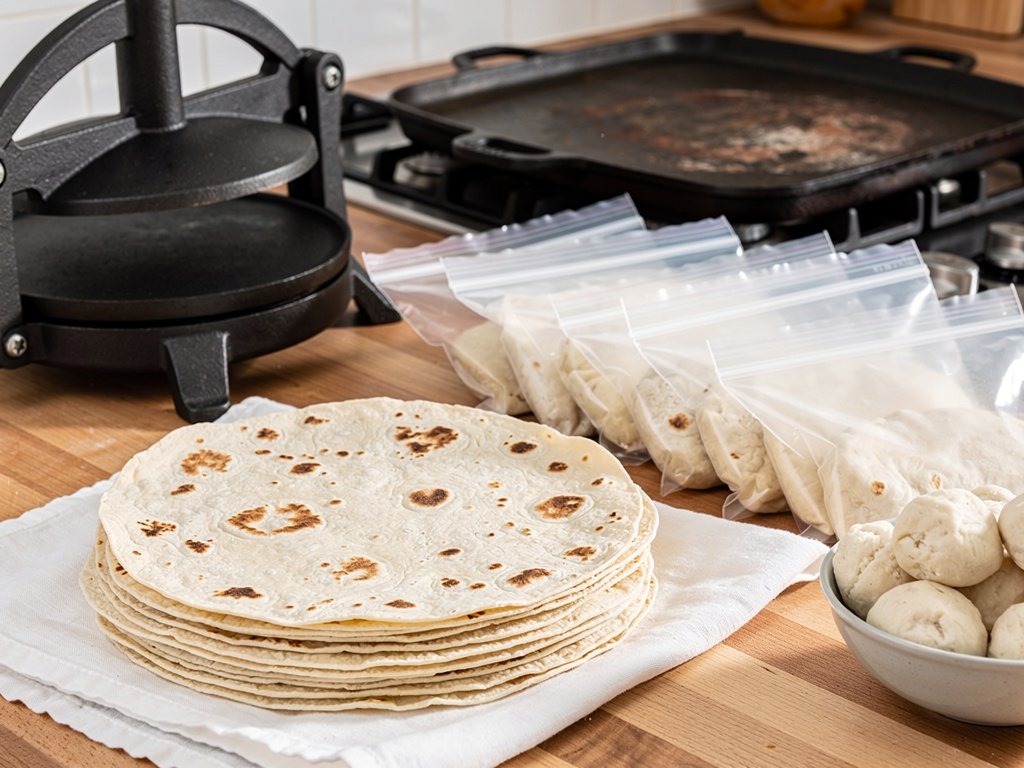


The short version: To sell tortillas from home, confirm your state lets a home kitchen sell plain tortillas, start with one flour dozen and one corn dozen, and take orders by a set cutoff so you press exactly what was ordered. A dozen 8-inch flour tortillas takes about 450 grams of flour at King Arthur's ratio and about 12 minutes of griddle time on one pan, so a 10-dozen week is about 10 pounds of flour and two hours of griddle time, or one hour on a griddle that cooks two at once. Let every tortilla cool completely before it goes in a bag, because warm tortillas sweat, and tell customers to freeze what they will not eat within the time your own counter test supports, since the fridge stiffens them faster even though it slows mold. Sell by the pack at pickup, at a farmers market and to the people who already ask you for them.
Checked October 12, 2026: King Arthur's Simple Tortillas recipe, the Tortilla Industry Association's 2024 conference paper on staling, Victoria Cookware's product pages, the Washington State Department of Agriculture cottage food page, the Texas, Colorado, Arizona, New Mexico, Georgia and California cottage food pages, the Texas Health and Safety Code as amended by Senate Bill 541, a live pull of Homegrown's catalog, and the pricing pages of Homegrown, Hotplate, Square and Etsy. Rules differ by state, so verify your state's current rules before your first sale. If you take orders on Homegrown, customers create an account to place a first order, there is no drops or countdown release feature, and Homegrown is built for pickup and local delivery, not shipping.
Somebody always asks. A coworker tastes your flour tortillas at a potluck, your sister wants three dozen for a birthday, and the neighbor who smelled the comal asks if you sell them. You already know how to make a good tortilla. The open question is how to make 10 dozen of them on a schedule, keep them soft until pickup, and get paid without a pile of text messages.
This guide is the working plan. It covers what to make first, the equipment, how much dough a dozen takes, a production day from dough to bag, how to keep tortillas fresh, a weekly order calendar, where to sell, and what each way of getting paid costs you on a real order. The rules and the pricing each have their own guide, linked below, so this one stays on the work.
You start selling tortillas from home in eight steps: check your state's home kitchen rules, pick two products, buy a press and a griddle, scale your recipe to the dozen, plan one production day, pack and label each dozen, set a weekly order schedule, and choose where you sell. In a state with no permit to wait for, the eight steps can take as little as a week or two. In 7 of the 9 states in the rules guide linked below, which read each state agency page on October 8, 2026, the rules step includes food safety training: a course in Texas, Arizona, New Mexico, Georgia and Colorado, a food worker card in Washington, and operator training within 3 months of registering in California. States that inspect your kitchen first take longer.
Here is the order this guide follows:
If you have not checked the rules yet, start with our guide on whether you can sell homemade tortillas, which reads 9 states' cottage food pages line by line. Then come back here for the production side.
Plain cooked tortillas are legal to sell from a home kitchen in many states because they are a baked flatbread that stays safe at room temperature, which is the kind of food cottage food laws are written for. A cottage food law is a state law that lets you make certain lower-risk foods at home and sell them, usually straight to the person who eats them. What changes from state to state is the paperwork, the yearly sales limit, and whether you can ship or sell to a store.
The Washington State Department of Agriculture's cottage food page names "Donuts, tortillas, pizelles, krumkake, kale chips and similar products" on its approved list. The permit is $355 for two years and is issued only after a department representative inspects your kitchen, and you also need a Master Business License, which costs $50 to open through the Department of Revenue, and a Food Worker Card for each person named on your application. Adding products between renewals costs a $105 amendment fee, and the department says an additional $125 inspection fee "may also be imposed." Adding them at renewal costs nothing beyond the renewal fee. If your first kitchen inspection fails, the return inspection costs another $125. Gross sales "may not exceed $35,000 annually." One answer on the page says you can "take orders over the Internet," but its answer on who you may sell to lists "Internet, mail, consignment, wholesale, & retail sales outside the state" as prohibited. You also "cannot ship Cottage Food Products by mail or a courier service," and "Product delivery and payments must be directly from the producer to the end consumer in a person to person transaction." We read that page on October 12, 2026. If you sell in Washington, ask the department in writing whether online orders and prepayment are allowed before you take them.
Three tortilla products cross the line in most of the 9 states our permission guide checked:
Our permission guide covers each of those state by state, plus labels, caps and restaurant sales. For filled foods, our guide on how to sell tamales from home explains the permits that cover cooked, perishable foods. Verify your state's current rules with your state's cottage food program before you sell, because they change. Texas, for one, raised its yearly sales cap from $50,000 to $150,000 on September 1, 2025, and Health and Safety Code 437.001 has the state health department adjust that cap for inflation every year.
Put two tortillas on your first menu: a flour dozen and a corn dozen, in one size each. Two products is enough to cover taco night and breakfast burritos, and it keeps your production day simple, one dough and one griddle routine for each. Add a third product only after the first two sell out two weeks in a row.
Here is how the common choices stack up for a beginner:
Sell each one in a fixed pack, such as a dozen and a half dozen, and keep the size the same every week. Customers reorder what they already know.
If you already bake sourdough bread, tortillas are the easiest second product you can add. Honey Buns Bakehouse, a Homegrown bakery that also sells bagels, focaccia and cookies, makes its hand-rolled tortillas from four ingredients, sourdough starter, flour, sea salt and water, and sells them 6 to a pack for $14.00, about $2.33 a tortilla, on October 12, 2026. Our guide on selling sourdough bread from home covers the loaf side of the same kitchen.
You need a press or a rolling pin, a flat cast iron griddle or comal, a kitchen scale, a clean cloth or tortilla warmer, and food-safe bags. A cast iron press and a two-burner griddle cost about $96 together from one maker on October 12, 2026, and most of the rest is already in your kitchen.
Scroll sideways to see every column.
| Item | What it does | Price we found | Do you need it on day one? |
|---|---|---|---|
| 8-inch cast iron tortilla press | Flattens a dough ball in one squeeze; best for corn | $45.99, Victoria 8-Inch Tortilla Press and Pataconera | Yes for corn; optional for flour, which King Arthur's recipe rolls with a pin |
| 10-inch cast iron tortilla press | Presses rounds "up to 10 inches" for bigger tortillas | $94.99, Victoria 10-Inch Tortilla Press, HD Spherrous Iron | No; wait until burrito size sells |
| 10.5-inch cast iron comal | Cooks one tortilla at a time | $26.99, Victoria 10.5-Inch Cast Iron Comal Griddle and Crepe Pan | Yes, if you do not own a cast iron skillet |
| 18.5 x 10 inch reversible griddle | Covers two burners, so two tortillas can cook at once if both fit on the flat side | $49.99, Victoria Rectangular Cast Iron Reversible Griddle | Once you sell more than 5 dozen a week |
| Kitchen scale in grams | Weighs flour and each dough ball so every tortilla is the same size | Your own, or any scale that reads grams | Yes |
| Clean cloth or tortilla warmer | Keeps cooked tortillas soft and pliable while you finish the batch | Your own | Yes |
| Gallon zipper bags and labels | Packs one dozen per bag with your label | Varies by store | Yes |
Victoria prices from victoriacookware.com product pages, all listed as available, checked October 12, 2026. Victoria is one maker we checked, not the only good choice; a cast iron skillet you already own works the same as a comal.
The two-burner griddle is the piece that changes your week. Victoria describes its 18.5 by 10 inch reversible griddle as "double burner size" with a "smooth flat side for pancakes, eggs, tortillas." Victoria lists it as 18.5 by 10 inches overall, with loop handles, and does not publish the size of the flat cooking area, so lay two of your tortillas on it before you plan on two at a time. If both fit, the second cooking spot cuts your griddle time in half once you can roll or press fast enough to keep both spots full.
One dozen 8-inch flour tortillas takes about 450 grams of flour (just under 1 pound), 86 grams of lard and 300 to 341 grams of hot water, plus a teaspoon and a half of baking powder and three quarters of a teaspoon of salt. That is one and a half times King Arthur's Simple Tortillas recipe, which makes 8 tortillas from 300 grams of all-purpose flour, a quarter cup of lard (57 grams), 200 to 227 grams of hot water, 1 teaspoon of baking powder and half a teaspoon of salt. The recipe also lets you swap the lard for butter, shortening or vegetable oil. It is always a quarter cup per batch, but the weights differ: butter is 57 grams like lard, shortening is 48 grams and oil is 50 grams. So a dozen takes 72 grams of shortening or 75 grams of oil in place of the 86 grams of lard in the table below. If you use oil, King Arthur says to add it with the water instead of working it into the flour.
Scale it once and write it on a card by the flour bin:
Swipe sideways to see the full batch.
| Dozens to make | Tortillas | King Arthur batches | Flour | Lard | Hot water |
|---|---|---|---|---|---|
| 1 dozen | 12 | 1.5 | 450 g, just under 1 lb | 86 g | 300 to 341 g |
| 5 dozen | 60 | 7.5 | 2,250 g, about 5 lb | 428 g | 1,500 to 1,703 g |
| 10 dozen | 120 | 15 | 4,500 g, about 10 lb | 855 g | 3,000 to 3,405 g |
| 20 dozen | 240 | 30 | 9,000 g, about 20 lb | 1,710 g | 6,000 to 6,810 g |
Scaled from King Arthur's Simple Tortillas recipe (8 tortillas from 300 g flour, 57 g lard, 200 to 227 g water), loaded October 12, 2026. Pounds are grams divided by 453.6, rounded. Mix big batches in recipe-sized rounds if your bowl or mixer is small.
Each King Arthur batch makes roughly 560 to 590 grams of dough, so each of the 8 balls weighs about 70 to 74 grams. Weigh your first batch, divide by 8, and write down your own number. From then on you weigh every ball to that number, and every tortilla in the bag comes out the same size, which is what makes a customer trust a dozen they cannot see inside.
For corn tortillas made from masa harina, follow the ratio on your bag and weigh the balls the same way. Corn balls are smaller than flour ones, so press a test batch, measure the diameter, and adjust the ball weight until you hit the size you print on the label.
A tortilla production day runs in eight steps, from mixing the dough the night before to sealing labeled bags once every tortilla is cool. At King Arthur's pace of about 30 seconds a side, each tortilla takes about one minute on the griddle, so one pan cooks a dozen in about 12 minutes of griddle time, before you count rolling or pressing.
The griddle math scales in a straight line, which makes it easy to plan your morning:
Swipe the table to see both griddle setups.
| Week's orders | Tortillas | Griddle time, one at a time | Griddle time, two at once |
|---|---|---|---|
| 5 dozen | 60 | About 1 hour | About 30 minutes |
| 10 dozen | 120 | About 2 hours | About 1 hour |
| 20 dozen | 240 | About 4 hours | About 2 hours |
Based on King Arthur's "about 30 seconds on each side," loaded October 12, 2026, so about one minute of griddle time per tortilla per cooking spot. Mixing, resting, rolling, cooling and bagging come on top, and your own pace may be faster or slower.
Rolling is usually the real limit, not the griddle. If you cannot roll a flour tortilla in under a minute, a second cooking spot sits empty. Time yourself on your first 24 and plan the rest of your week from that number. Our tortilla pricing guide works out that a $10 dozen pays you $15 an hour only if a dozen takes you about 32 minutes or less, so speed is money here.
Keep tortillas soft by cooling them completely before they go in a bag, keeping them at room temperature for pickup within a day or two, and telling customers to freeze what they will not eat soon. A paper presented at the Tortilla Industry Association's 2024 technical conference says to "cool tortillas sufficiently before packaging to minimize condensation" and that "refrigeration speeds up staling."
That paper, from the enzyme maker Enzyme Innovation, names a "rapid staling zone" from 23°F to 50°F. A refrigerator at 40°F sits inside that range, and room temperature sits above it. So a tortilla kept in the fridge likely gets stiff faster than one on the counter or in the freezer, though the paper does not test that comparison itself, and it lists slower microbial growth as a benefit of cold storage.
The tips in this section are about keeping tortillas soft, not about food safety. Plain tortillas are allowed under many states' home kitchen rules because they are a low-risk baked food, and any tortilla that shows mold goes in the trash, whatever the date.
What that means for your packing and your pickup notes:
Some customers will keep your tortillas in the fridge, and that is their call. One Homegrown vendor, KairosGO, tells buyers its tortillas "can be kept in the fridge for up to a week" or put in the freezer for later, on its listing as checked October 12, 2026. Write your own storage line from your own tests: leave one bag on the counter and one in the fridge for a few days and note when each stops folding without cracking.
Pack tortillas in a fixed count, in a sealed food-safe bag, with a label that names the product, the count, the size, the ingredients and any allergens, plus whatever wording your state requires. A gallon zipper bag is one option for a dozen 8-inch tortillas, but lay one of your tortillas on the bag before you buy a case. Pick one bag and one count and keep them the same every week.
A good tortilla label answers what a customer asks before they buy:
State label rules differ in the details, especially the exact home kitchen statement and whether you need a net weight. Our guide to cottage food labeling requirements shows the parts most states ask for and how to fit them on a small label. For carrying orders to a pickup spot, our guide to packaging food for pickup and transport covers crates, bags and keeping orders sorted by name.
A weekly schedule with one order cutoff and one production day works best for tortillas, because they are best fresh and you cannot keep a stock of them on a shelf. Open orders early in the week, close them about a day and a half before pickup, mix the night before, and press the morning of pickup. You then make exactly what was paid for, with nothing left over.
Scroll sideways to see the whole week.
| Day | What you do | Why it matters |
|---|---|---|
| Sunday | Post the week's menu and share your order link | Regulars order while they plan the week's meals |
| Thursday, 8 p.m. | Orders close | You know the exact count before you buy flour |
| Friday | Shop, mix dough, refrigerate overnight | Saturday morning is only dividing, pressing and cooking |
| Saturday morning | Divide, rest, press, cook, cool, bag, label | Tortillas are hours old at pickup |
| Saturday, 11 a.m. to 1 p.m. | Pickup at your porch, or bring bags to the market | One window means you are not waiting at home all day |
An example schedule, not a rule. Move every day to fit your week and your market. The dough-ahead step comes from King Arthur's note that the dough can rest in the fridge overnight, loaded October 12, 2026.
A real Homegrown vendor runs a tight version of this. KairosGO's listing says its tortillas are "freshly baked on Monday to be cooled, packed and delivered on Tuesday," as checked October 12, 2026. Bake, cool, pack and deliver within about a day is the same rhythm, on a weekday.
Our guide on how to take pre-orders for your food business walks through cutoffs, reminders and what to do with the customer who messages an hour late. For tortillas, hold the cutoff. Every late dozen means another round of dough, another rest and another 12 minutes at the griddle.
The best places to sell homemade tortillas are pickup from your home, a farmers market table, and standing orders from people who already know you, because all three are direct sales, the kind cottage food rules are built around. Restaurants, grocery stores and shipping are allowed in only some states, so they come later, after you check.
Swipe sideways to compare every channel.
| Where you sell | How it works | Good for | Watch for |
|---|---|---|---|
| Porch or home pickup | Customers order ahead and pick up in a set window | Your first 20 customers; no booth fee | Your city's rules on home businesses; share your exact address only after an order |
| Farmers market table | Sell bags at the booth and hand over pre-orders | Meeting new customers who taste and come back | Booth fees and the market's own rules on samples and permits |
| Workplace, church or school drop | One person collects orders, you deliver in one trip | A dozen orders in one stop | Delivery rules in your state |
| Local delivery | You drop bags at doors on a set day | Customers who cannot make pickup | Your time and gas; set a minimum order |
| Restaurants and taquerias | Weekly wholesale order at a lower price | Steady volume | 4 of the 9 states in our permission guide allow restaurant or store sales, some with conditions, and Texas allows them through a registered cottage food vendor |
| Shipping | Mail tortillas to customers | Out-of-town family and fans | Some states ban it, and tortillas stale in transit |
Channel rules vary by state. Washington, for one, rules out shipping, consignment and sales to restaurants, grocery stores and wholesalers for cottage food on its agriculture department's page, read October 12, 2026. Our permission guide lists 9 states' answers.
If a restaurant asks, read our guide on selling food to local restaurants and cafes for how to pitch and price a standing order, then confirm your state allows it before the first delivery. If family out of state wants a box, our guide to whether you can ship cottage food shows which states let a home kitchen mail orders.
At a farmers market, pre-bagged dozens, a big price sign, a stack of pre-orders sorted by name and a card with your order link do most of the work. Tortillas sell on smell and taste, so the table's job is to make buying a bag fast and buying next week's bag easy.
What to bring:
Ask the market manager about samples before you bring a warm comal. Markets set their own rules on cooking and sampling at the booth, and many health departments add their own. Our farmers market booth setup ideas guide covers table height, signs and layout.
Count your pre-orders before you count your walk-up stock. If 20 dozen are already paid for, press a small fixed number of extra dozen for walk-ups, not another 20; our own suggestion, not a measured figure, is 4 to 6 to start, adjusted from your own sell-out record. Pressing a fixed number over the pre-order count, then raising it only after you sell out two Saturdays in a row, keeps leftover tortillas from going stale in your kitchen.
Your first 20 tortilla customers are usually people who have already eaten your tortillas: family, coworkers, neighbors and friends from church or school. Tell them you are taking orders, give them a pickup day and one link, and ask each one to bring one more person. Twenty regulars at one dozen a week is 20 dozen, which at 30 seconds a side is about four hours on one pan.
Ways that work for a food people already love:
For more ways to reach the people around you, our guide on finding your first 100 customers as a food vendor covers neighborhood groups, word of mouth and market follow-up.
Charge by the pack, not by the tortilla, and price for freshness, not to match the grocery store. Our guide to how much to sell tortillas for recommends about $10 a dozen for 7 to 8 inch flour tortillas, $6 a dozen for corn made from masa flour, and $8 to $10 a dozen for corn pressed from heirloom corn masa, built from small shop prices, ingredient costs and the time a dozen takes.
The two tortilla vendors on Homegrown show how wide real prices run. On October 12, 2026:
Both price a fixed pack. Neither sells by the pound. Pick your pack, price it so your time is paid, and keep the price steady for a few months so regulars stop thinking about it.
Stop counting tortilla orders in text messages by giving customers one order page with your menu, a cutoff and a pickup time, so the count adds itself up before you mix a single batch. A Homegrown storefront does that for $10 a month billed annually ($12.50 billed monthly) with 0% commission and no percentage fees beyond standard payment processing of 2.9% + $0.30 per order, which you pay, as checked on the signup page October 12, 2026.
The parts that matter for tortillas specifically:
Here is how that compares with what tortilla vendors usually try first:
What Homegrown does not do: it does not check your state's rules, write your label or make your tortillas faster. It does not ship, so out-of-state orders are not a fit. Customers create a Homegrown account to place their first order. There is no drops or countdown release feature, so you cannot open a limited batch at a set minute. Your storefront is listed on the Homegrown marketplace, but plan on most orders coming from people you send to your own link. The 2.9% + $0.30 card fee comes out of your side, not the customer's. A 7-day trial runs with no charge until day 8.
On a $20 order, two flour dozens at $10 each, you pay between $0.67 and $2.55 to get paid, depending on where you take the order and who covers Hotplate's fee, plus any monthly plan. Over 50 orders a month that spread runs from $33.50 on a card reader at the booth to $127.50 on Etsy, or $121.50 on Hotplate if you cover its fee yourself.
Move the table sideways for every fee column.
| Way to get paid | Monthly plan | Trial | Platform or listing fee | Card processing | Customer pays on a $20 order | You pay on a $20 order | 50 orders a month, you pay |
|---|---|---|---|---|---|---|---|
| Square Free, card reader at your booth | $0 | None | $0 | 2.6% + $0.15, paid by you | $20.00 | $0.67 | $33.50 |
| Homegrown storefront | $10 billed annually or $12.50 monthly | 7 days, no charge until day 8 | $0, 0% commission | 2.9% + $0.30, paid by you | $20.00 | $0.88 | $44.00 plus the plan: $54.00 annual, $56.50 monthly |
| Hotplate, default split | $0 | No plan to try | 5% + $0.55, paid by the customer | 2.9% + $0.30, paid by you | $21.55 | $0.88 | $44.00 |
| Square Online, Free plan | $0 | None | $0 | 3.3% + $0.30 online, paid by you | $20.00 | $0.96 | $48.00 |
| Hotplate, you cover the fee | $0 | No plan to try | 5% + $0.55, paid by you | 2.9% + $0.30, paid by you | $20.00 | $2.43 | $121.50 |
| Etsy, one $10 dozen listing, 2 sold | $0, possible one-time set-up fee | None | $0.20 listing, renewed at $0.20 after each dozen sells ($0.40 on this order), plus 6.5% transaction fee | 3% + $0.25, paid by you | $20.00 plus any shipping | $2.55 before shipping | $127.50 |
Fees from each company's own pages, checked October 12, 2026: findhomegrown.com/signup, hotplate.com/pricing (Hotplate's own post "What Hotplate does" says "we charge a fee to your customer" by default and that 80% of its chefs keep that default), squareup.com/us/en/pricing, and Etsy's Fees and Payments Policy and payment processing table for US shops. Etsy also charges its 6.5% on shipping and a 12% or 15% Offsite Ads fee, depending on a shop's past-year sales, on orders its ads bring in. Square's card reader hardware is not counted. Sales tax is extra where it applies.
What you pay on one $20 tortilla order
Source: each platform's pricing or fee page, checked October 12, 2026. Each bar is everything you pay on the order, card processing included (2.6% + $0.15 Square in person, 2.9% + $0.30 Homegrown and Hotplate, 3.3% + $0.30 Square Online, 3% + $0.25 Etsy). Homegrown's plan ($10 a month billed annually, $12.50 billed monthly) and Etsy's shipping are not in the bars, and the Hotplate default bar leaves out the $1.55 its customer pays at checkout.
On $20 orders, Square's free online store costs less than Homegrown until you pass about 125 orders a month on Homegrown's annual plan ($10 divided by the 8 cent difference per order). A card reader at the booth costs the least of all, but it does not take next week's order, set a cutoff or add up your dozens. You can use both: a reader for walk-up sales and an order page for pre-orders.
Homegrown's catalog shows that tortillas are still rare and that the vendors who sell them already sell bread and add tortillas to that lineup. In a pull on October 12, 2026, 2 listings out of 2,847 sold tortillas on their own.
In a pull of the Homegrown catalog on October 12, 2026, 2 of the 2,847 products listed by 313 vendors were tortillas sold on their own. We searched every product name, full description and option name for "tortilla," "masa" and "nixtamal," read all 5 matches, including two sourdough loaves that matched only because "Parmasan" in their names contains "masa," then read each matching vendor's other listings. KairosGO sells 6-count sourdough flour or corn tortillas for $3.29 in a listing that also offers naan, alongside sourdough loaves, bagels and a weekly grocery lineup. Honey Buns Bakehouse sells 6-packs of hand-rolled sourdough tortillas for $14.00 next to bagels, focaccia and cookies. We left out a $37.00 slow cooker fajita kit that comes with tortillas. Bakery listings made up 1,470 of the 2,847 products, or 52%.
Two things stand out. First, both vendors already bake bread, so tortillas ride on customers they already have. Second, with only two tortilla listings in a catalog of 2,847 products, a vendor who sells fresh flour and corn tortillas every week has very little company on Homegrown. If your regulars already ask for your tortillas, set up a Homegrown storefront with a flour dozen and a corn dozen, a Thursday cutoff and a Saturday pickup, and send them the link.
The habits that sink a new tortilla business are making tortillas before orders are in, bagging them warm, adding too many products too soon, and pricing against the grocery store. None of them is about the recipe. Each one costs you either tortillas you throw away or hours you are not paid for: a 5-dozen batch nobody ordered is 60 tortillas and about 1 hour of griddle time, gone.
To start selling homemade tortillas, check your state's cottage food rules, pick one flour and one corn product, scale your recipe to the dozen, and set a weekly order cutoff and pickup day. Pack each dozen in a labeled bag once the tortillas are completely cool. Then tell the people who already ask for your tortillas and give them one place to order.
A home tortilla business can be profitable when you price for fresh, handmade tortillas and sell by pre-order, so nothing goes to waste. Our pricing guide puts the ingredients for a dozen flour tortillas at about $1.28, so your time is the real cost of a $10 dozen. If a dozen takes you an hour to roll and cook, you need either a higher price or a faster routine, such as a press and a two-burner griddle.
In a day, how fast one person rolls or presses usually sets the limit, not the griddle. At King Arthur's pace of about 30 seconds a side, one pan could cook about 20 dozen in a 4-hour session, which is about 5 dozen an hour. A two-burner griddle could cook about 10 dozen an hour if two of your tortillas fit on its flat side and you can keep it full. Time your first 24 tortillas, and mix the dough the night before so the morning is all cooking.
Keep homemade tortillas fresh for customers by letting them cool completely before bagging, sealing them in a food-safe bag, and making them close to pickup. Refrigeration makes tortillas stiff faster, according to a 2024 Tortilla Industry Association conference paper, though the same paper says cold slows microbial growth. So tell customers to eat them within the time your own counter test supports and freeze the rest.
Yes, farmers markets are one of the best places to sell homemade tortillas in states whose cottage food rules allow market sales. Bring pre-bagged, labeled dozens, a clear price sign, your pre-orders sorted by name and a way to take next week's order. Ask the market manager before you cook or sample at the booth.
You usually do not need a commercial kitchen to sell plain tortillas, because many states allow them under cottage food rules for home kitchens. Fresh masa sold as dough and tortillas with meat or cheese fillings usually do need a licensed kitchen or a different permit. Check your state's cottage food program before your first sale.
These 6 guides pick up where this one stops. The first two finish the tortilla set: one reads the cottage food rules of 9 states line by line, and one builds a price per dozen from shop prices, ingredient costs and your time. The rest cover the orders, labels, market table and filled foods that come up once a weekly tortilla business gets going, each written for a part-time vendor working from a home kitchen:
Your first week only needs two products, one cutoff and one pickup window. Everything else, the bigger press, the third dough, the restaurant account, can wait until the first two sell out. A first week of 5 dozen is about 1 hour of griddle time on one pan, which is a fair test of whether people come back. Here is the short list:
Open your tortilla storefront on Homegrown for $10 a month billed annually ($12.50 monthly) with no commission on your sales, list flour and corn as options with their own prices, and let the pick list tell you how many dozen to press.



