
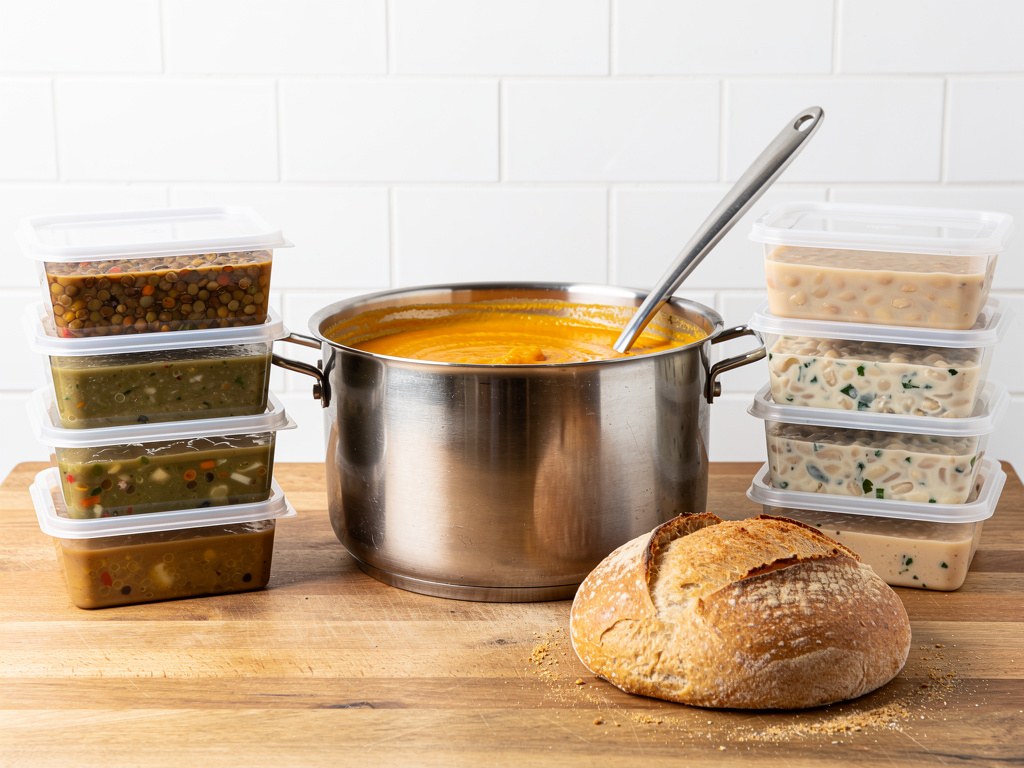


The short version: To sell soup from home, first confirm your state gives you a legal route, because soup has to be kept cold or hot to stay safe and many home food laws leave it out. Then run it as a weekly loop: post two or three soups, close orders a day or two before cook day, cook only what was ordered, cool it from 135°F to 70°F within 2 hours, and hand it off cold or frozen at a set pickup time. Broth-based vegetable, bean and lentil soups freeze best, while potatoes, noodles and cream are better added fresh or left out. Take payment when the order is placed, so every quart you cook is already sold.
Checked on FDA's 2026 Food Code, the Texas DSHS cottage food page, California's approved cottage foods list, Homegrown's signup page, Hotplate's and Square's pricing pages and WebstaurantStore, October 12, 2026. Soup rules differ by state and county, so verify your state's current rules with the agency that runs your program before your first sale. Homegrown can run your weekly soup orders and payments, but your state decides whether the soup itself is legal. Buyers set up a Homegrown account before their first order, and there is no drops or countdown release feature.
You make a pot of soup every Sunday, and people keep asking if they can buy some. Turning that into a small business is less about the recipe and more about the week around it: what you promise, when you stop taking orders, how fast the pot gets cold and how the quart gets from your freezer to someone else's.
Whether your state allows homemade soup at all is its own question, and our state-by-state guide to selling homemade soup answers it with each agency's own wording. This guide picks up from there. It is the working plan for a home cook selling somewhere between 10 and 30 quarts a week.
You sell soup from home in eight steps: confirm a legal route, pick soups that freeze well, choose containers, set an order cutoff, cook to the order count, cool fast, hand off cold, and tell buyers how to reheat. Each step has its own section below.
There are five routes to selling soup, and which ones you have depends on your state: a home kitchen under a cottage food law that allows refrigerated foods, a food freedom law, California's home restaurant permit, a rented licensed kitchen, or a dry soup mix. In the 12 states our permission guide checked, 5 let a home kitchen sell cooked soup with conditions: Texas, Illinois (vegan soup only), Utah, Wyoming and North Dakota.
Swipe left for the catch on each route.
| Route | What it can cover | The catch | Read next |
|---|---|---|---|
| Home kitchen, cottage food law that allows refrigerated foods | Meatless soup, sold cold or frozen | 2 of the 12 states in our permission guide: Texas, which requires registration and keeps meat, poultry and seafood out, and Illinois, for vegan soup only, with no puréed fresh tomato, kept cold and registered with the local health department | Texas cottage food law |
| Food freedom law | Homemade food sold straight to an informed customer in that state | 3 of the 12 states in our permission guide: Utah, Wyoming and North Dakota. Meat is limited; in Utah and Wyoming, sales stay inside the state; in North Dakota, soup must be sold frozen and labeled as transported and kept frozen | Food freedom states list |
| California home restaurant permit (MEHKO) | Same-day meals, including soup, from your home kitchen | Only in counties that allow it; Los Angeles County caps it at 30 meals a day and 90 a week, and food must be made and served the same day, so no frozen quarts sold later | MEHKO laws explained |
| Rented licensed kitchen | Almost any soup, including meat soups with the right inspection | Hourly rent and a food license | Commissary vs home kitchen |
| Dry soup mix | Beans, lentils, grains and spices in a jar or bag | No cooked soup; the buyer cooks it | Homemade soup rules |
We checked the Texas DSHS cottage food page, California's approved cottage foods list (last reviewed April 2026) and the Los Angeles County MEHKO page the same day, October 12, 2026. The state counts come from our permission guide, which read each of the 12 states' own pages.
The Texas DSHS cottage food page says "Allowable foods now include any foods, except" a short list that starts with meat, poultry and seafood and includes "low-acid canned goods". Operators who sell foods that need time and temperature control must register with DSHS, and those foods must be kept at "41ºF or below" when cold and "135ºF or above" when hot. Every operator must also complete an accredited food handler course, and each soup label needs the date it was made, plus the statement "SAFE HANDLING INSTRUCTIONS: To prevent illness from bacteria, keep this food refrigerated or frozen until the food is prepared for consumption." in at least 12-point type on the label or the receipt. A Texas lentil or black bean soup can be legal from home. A chicken noodle soup cannot.
California shows how a state can say yes to part of soup. Its approved cottage foods list covers only foods that do not need refrigeration, and it names "Bean soup mixes" and "Vegetable soup mixes" on that list, so a California home cook can sell the dry jar but not the cooked quart without a home restaurant permit or a licensed kitchen. The home restaurant permit does not fit the cook-ahead, freeze and pick-up-later plan in this guide, because the Los Angeles County MEHKO FAQ says "The food must be made and served on the same day" and "Leftovers cannot be served the next day".
Meat changes the answer in most of the states we checked. Texas leaves meat, poultry and seafood out of its cottage food law entirely, and our permission guide found that chicken noodle soup is not allowed under the home food rules of 9 of the 12 states it checked. If your best soup has chicken, beef or sausage in it, plan on a licensed kitchen for that one, or start with your meatless soups.
Broth-based soups made from vegetables, beans or lentils hold up best, and soups built on potatoes, noodles, rice or cream hold up worst. That matters because frozen soup is what lets a home cook sell on one cook day a week instead of cooking to order every night. The University of Georgia Extension lists 4 to 6 months of freezer storage at 0°F for soups, and Iowa State Extension suggests 2 months for dairy-based soups and 3 months for broth-based ones if you want the best flavor.
The University of Georgia Extension's guide to freezing prepared foods gives the short rule for soups: "Omit potatoes. If possible, concentrate by using less liquid. Cool quickly. Leave headspace." Penn State Extension's soup guide explains why: "Starchy ingredients such as pasta, noodles, and rice become mushy when frozen," and "Potatoes crumble and become mushy."
Slide the table to see how to fix each soup.
| Soup type | How it freezes | What to do about it |
|---|---|---|
| Broth-based vegetable, bean or lentil | Well. Iowa State Extension says vegetable and meat based soups "generally freeze very well" | Your first menu. Slightly undercook the vegetables so they are not soft after reheating |
| Puréed soups (butternut, carrot ginger, tomato) | Well | Freeze as is; tell buyers to stir while reheating |
| Soups with potatoes | Poorly; potatoes crumble and go mushy | Leave potatoes out, or swap in white beans for body |
| Soups with noodles, pasta or rice | Poorly; the starch goes mushy | Pack the noodles or rice separately, dry or cooked on the side |
| Cream, milk or cheese soups | Fair; milk-based soups can separate | Sell them fresh, or have buyers add the cream or cheese while reheating |
Sources: University of Georgia Extension "Freezing Prepared Foods", Penn State Extension "Let's Preserve: Soup" and Iowa State Extension's AnswerLine on freezing homemade soup, all loaded October 12, 2026.
Cryptid Kitchen's listing for its red lentil stew on Homegrown includes rice, cooked by default or raw if the buyer asks. Rice on the side turns a soup into a full dinner, and when it travels in its own container it cannot go soft in the stew.
Start with two or three soups, and add a fourth only after a few weeks of steady orders. A short menu means fewer ingredients to buy, one or two big pots instead of five small ones, and an easy choice for the buyer.
A first menu that covers most buyers:
If your state allows chili from home under the same rules, a meatless chili fits the first slot just as well. Our guide on what to charge for chili covers that pot. Keep every soup on the menu meatless until you know your state's rule on meat.
Before you list a new soup, freeze 1 test quart, wait 7 days, then thaw and reheat it the way your buyer will. Taste it next to a fresh bowl. If the texture slipped, change the recipe now, not after 20 customers find out.
Use polypropylene deli containers with lids, bought by the case: on October 12, 2026, a 32-ounce container with lid cost $0.15 and a 16-ounce one $0.11 at WebstaurantStore. They stack in a home freezer, the buyer can see the soup, and they are cheap enough that nobody needs to return them.
Drag this table to compare container prices.
| Container | Size | Case price | Per container | Good to know |
|---|---|---|---|---|
| Choice Heavy-Duty deli container and lid combo, case of 240 | 32 oz | $35.49 | $0.15 | Listed as freezer safe; the container is microwavable but the lid is not |
| Choice Heavy-Duty deli container and lid combo, case of 240 | 16 oz | $26.99 | $0.11 | Your pint size |
| Tamper-evident safe lock deli container with lid, case of 50 | 32 oz | $38.99 | $0.78 | Shows if it was opened; listed as microwave safe, freezer use not stated, so test one |
Prices from WebstaurantStore's product and search pages on October 12, 2026, before shipping and tax. WebstaurantStore says its container capacities are "an approximate maximum capacity".
That last note matters for what you promise. Iowa State Extension says to leave "½ inch of headspace for pint-size- and 1 inch for quart-size-containers" when freezing, because liquid expands. A 32-ounce container filled to leave an inch at the top holds less than 32 ounces. Fill one with water to that line, pour it into a measuring cup, and put the real amount on your label and your menu.
What else to buy before the first cook day:
Close orders 36 to 48 hours before cook day, so you can shop for the exact count in between and still have a full day to cook and cool. A Wednesday night cutoff fits a Friday cook day and a Saturday pickup for most part-time vendors.
Move the table over for the reason behind each day.
| Day | What you do | Why it is on this day |
|---|---|---|
| Sunday | Post this week's soups and pickup time | Gives buyers a few days to decide |
| Wednesday, 8 pm | Orders close | You now know how many quarts of each soup to make |
| Thursday | Shop for the exact count, plus one or two quarts of cushion | Nothing bought on a guess |
| Friday | Cook, cool, pack, label, freeze or chill | A full day for the cooling clock |
| Saturday, 9 to 11 am | Pickup window | Soup leaves your freezer once, straight into a buyer's bag |
A sample week, not a rule. Shift every day by the same amount if your free day is Sunday.
Cap each soup at what one pot can make. When the count for a soup reaches your pot's limit, mark it sold out instead of starting a second batch you did not plan for.
A soup cook day is planned backward from the cooling rule: each batch has to drop from 135°F to 70°F within 2 hours and to 41°F within 6 hours total, so you stagger the pots instead of finishing them all at once. The numbers are in section 3-501.14 of the FDA Food Code, which many state health departments copy into their own rules, and Texas holds cottage food soup to the same 41°F and 135°F lines.
Here is a sample Friday for 24 quarts, two soups of 12 quarts each:
FDA's cooling methods include "Placing the food in shallow pans", "Stirring the food in a container placed in an ice water bath" and "Adding ice as an ingredient". The last one works when you make the soup a little thick on purpose and finish it with ice instead of water. Our permission guide has more on cooling a big pot safely.
Hand soup off in a short, fixed pickup window from a cooler, so it moves from your freezer to the buyer's bag without sitting out. Keep the window to 2 hours for a weekly pickup: long enough for buyers with errands, short enough that you are not standing by a cooler all morning.
A handoff that keeps soup cold:
Some states set rules for this step. In Texas, a cottage food operator who sells online must have the operator, an employee or a household member "personally" deliver the food, and before taking payment the operator must post all the label information where the buyer orders, according to the Texas DSHS cottage food page. Texas also says these foods are not eligible for wholesale or donation, so no consignment shelf at the coffee shop. Our guide to packing food for pickup and transport covers coolers and bags in more detail.
A reheat card should tell buyers to thaw the soup in the fridge or heat it straight from frozen, and to bring it to a rolling boil or at least 165°F. That matches the University of Georgia and Penn State Extension guidance for frozen soups, and it is the one instruction that protects your buyer and your name.
Print the card once and tuck it into every bag, or put the same words in each soup's description so buyers see them before they order. Add your name and how to reorder at the bottom.
Price soup by the quart, with the pint at a little over half the quart price, and set the quart from your own costs, not from the cheapest soup in your area. Our soup pricing guide builds that number from real shop menus, recipe costs, your time and kitchen rent, and lands at about $12 a quart for a meatless soup made in a home kitchen your state allows.
Homegrown's own catalog shows how far apart soup prices can sit. On October 12, 2026, Cryptid Kitchen listed its red lentil stew at $3.00 for 16 ounces and $5.00 for 32 ounces, with rice included, and its veggie chili at $6.00 for 32 ounces with four cornbread muffins. Mama K's Kitchen listed a slow cooker beef stew kit, sold raw and frozen for the buyer to cook, at $44.00. A low price fills a first week fast, but it is hard to raise later, so start where your numbers say.
Soup only works when you know the count before you shop, and a preorder page with payment at checkout gives you that count without a single text thread. Homegrown handles that part. It is $10 per month billed annually ($12.50 billed monthly) with no percentage fees beyond standard payment processing, which is 2.9% + $0.30 per order, paid by you.
What it does for a weekly soup menu:
The usual alternatives each miss something for soup. Instagram DMs and texts leave you counting quarts across a dozen conversations. Hotplate has no monthly plan, but by default it adds 5% + $0.55 to your customer's checkout, and you still pay card processing. Square's Free plan costs nothing a month, but online orders carry 3.3% + 30¢ in processing, the highest card processing rate in the table below.
Scroll sideways to see every column.
| Ordering tool | Subscription | Trial | Platform or service fee | Card processing | Customer pays on a $20 soup order | Vendor pays on that $20 order | Vendor cost for 50 orders of $20 in a month |
|---|---|---|---|---|---|---|---|
| Homegrown | $10 a month billed annually ($12.50 billed monthly) | 7 days, no charge until day 8 | $0, 0% commission | 2.9% + $0.30, paid by the vendor | $20.00 | $0.88 plus the plan | $54.00 ($56.50 on monthly billing) |
| Hotplate, default | $0 | No plan to try | 5% + $0.55, paid by the customer | 2.9% + $0.30, paid by the vendor | $21.55 | $0.88 | $44.00 |
| Hotplate, vendor covers the fee | $0 | No plan to try | 5% + $0.55, paid by the vendor | 2.9% + $0.30, paid by the vendor | $20.00 | $2.43 | $121.50 |
| Square Free plan, online | $0 | No plan to try | None | 3.3% + 30¢, paid by the vendor | $20.00 | $0.96 | $48.00 |
Every fee in this table was read on October 12, 2026 from Homegrown's signup page, Hotplate's pricing page and Square's fee page. On who pays Hotplate's fee, its pricing page says "your choice", and its post "What Hotplate does" says 80% of Hotplate chefs leave the default, which charges the customer. We figured card processing on the $20 soup price alone; tips, tax or a customer fee in the total push it up by a few cents.
What fifty $20 soup orders cost the vendor in one month
Source: the fee table above, figured from each company's published fees as of October 12, 2026. Every bar includes card processing (2.9% + $0.30 per order on Homegrown and Hotplate, 3.3% + 30¢ on Square online), and Homegrown's bar includes the $10 plan on annual billing. Hotplate's default also adds $77.50 to your customers' checkouts across those 50 orders.
Where Homegrown stops: it will not tell you whether your soup is legal, track your cooling log, or keep a single quart cold, so the rules, the thermometer and the cooler stay your job. Each buyer sets up a Homegrown account before a first order. You pay the 2.9% + $0.30 card processing on every order, and it cannot be passed on to the buyer. There is no drops or countdown release feature for a limited soup batch. Your soups also show up on the Homegrown marketplace, but expect most orders to come from the regulars you send your own link to.
Your first soup buyers are people who have already eaten your cooking: neighbors, coworkers, friends from church or school, and anyone who asked for the recipe. Soup is a trust purchase, because the buyer is putting your food in their freezer and feeding it to their family. Aim for 10 orders in your first week, which is about one full pot, and grow from the people who reorder.
Where the first orders usually come from:
Once a buyer has your link, the next order should take them a minute. If you are still collecting soup orders in texts, set up a Homegrown storefront with your two soups, a Wednesday cutoff and a Saturday pickup window, and send that one link to everyone who asked.
Yes, once 8 to 10 customers reorder most weeks, a standing weekly order, sometimes called a soup club, makes your count predictable and saves both of you a step. The buyer gets a quart of whatever you make that week, and you plan your pots around a number you already know.
How to run one without new tools:
A standing order also tells you when to stop. If club members skip 3 weeks in a row, the menu may need a change before your sign-ups slow down.
Bread, cornbread and crackers sell well next to soup, and in California and Texas they are easier to sell legally than the soup itself. California's approved cottage foods list includes "Baked Goods Without Cream, Custard, or Meat Fillings", and Texas allows any food outside its short exclusion list, so a loaf beside the quart is often the simple part of the order.
In a pull of the Homegrown catalog on October 12, 2026, 7 of the 2,872 products listed by 317 vendors were a soup, stew, chili, broth or dry soup mix, from 4 vendors. The rule we used: a listing counts when the thing sold is one of those, ready to heat, frozen or raw for the slow cooker, or a dry mix. We read all 116 keyword matches in names, descriptions, categories and size options, and every listing from the 4 vendors. Three vendors pair soup with bread: Cryptid Kitchen sells its veggie chili with cornbread muffins, Mama K's Kitchen sells a $6.00 loaf of crusty bread it recommends as an add-on with soup, and Scratch Made Sourdough lists sourdough bread bowls at $8.00 for two or $16.00 for four, which it calls "perfect for soup season".
Add-ons that fit a soup order:
If you do not bake, team up with a local baker and point buyers to each other's pages, so both of you sell more on the same pickup day.
You have outgrown the home kitchen when demand passes what your pots, freezer or state rules allow, usually around the point where you are turning orders away every week. That is the moment to price a rented commercial kitchen, not before.
Signs it is time:
Our commissary kitchen vs home kitchen guide walks through what renting by the hour costs and what the license involves. Frozen soup also shares a lot with frozen dinners, so our guide to selling frozen meals locally is worth reading before you scale.
The most common mistake is cooking for the orders you hope to get instead of the orders you have, which leaves you with quarts nobody paid for. The rest are small habits that add up.
It depends on your state. Of the 12 states our permission guide checked, 5 let a home kitchen sell cooked soup with conditions: Texas, Illinois (vegan soup only), Utah, Wyoming and North Dakota. In Texas you must register with DSHS, take an accredited food handler course, keep meat, poultry and seafood out, keep the soup at 41°F or below (or 135°F or above if you sell it hot), and put the date it was made on each label, with DSHS's safe handling statement on the label or the receipt. In the other 7 states our guide checked, your routes are a licensed kitchen, California's home restaurant permit (same-day meals only), or a dry soup mix, so verify your state's current rules before you sell soup from home.
16-ounce and 32-ounce polypropylene deli containers with lids are a simple choice for home vendors. On October 12, 2026, a 240-count case of 32-ounce containers with lids cost $35.49 at WebstaurantStore, or $0.15 each. Leave about an inch of headspace in a quart container before freezing, freeze flat, and label each one with the soup's name, ingredients, allergens, the real amount and a reheating line.
Broth-based bean, lentil and vegetable soups and puréed soups like butternut squash are the easiest, because they freeze and reheat well and most can be made without meat. Soups with potatoes, noodles or cream lose texture in the freezer. Apart from KairosGO's bone broths (one liquid, one freeze-dried), the only two cooked soups on Homegrown on October 12, 2026 were a red lentil stew and a veggie chili.
The University of Georgia Extension lists 4 to 6 months at 0°F for frozen soups. Iowa State Extension suggests eating dairy-based soups within two months and broth-based soups within three for the best flavor. Put the shorter window on your label so buyers eat it while it still tastes like the day you made it.
Start with what you already own: a large stockpot, your freezer and a cooler. Your first real costs are containers (about $35 for 240 quart containers with lids in October 2026), labels, any state registration or permit fee, and an ordering page. Take payment with each preorder, so the ingredients for each week are paid for before you buy them.
Frozen or cold soup in sealed, labeled containers is the simpler booth where your state's rules cover it, sold from a cooler that keeps it at 41°F or below. Hot soup ladled into cups is food service, and our permission guide found it usually needs a temporary food permit from your health department. Ask your market manager and health department which one applies before your first market day.
These five guides answer the questions that come right before and right after this one: whether your state allows soup, what to charge, and where to cook once your stove is too small.
Pick two soups you already make well and freeze a test quart of each. Once both pass the one-week taste test, set a cutoff two days before your cook day and post the menu with a pint and a quart for each soup. When the orders come in first, the shopping list writes itself and every quart in the freezer already has a name on it.
Keep the first weeks small. One pot, one pickup window, one cooler. Use month one to learn how many quarts your kitchen, your freezer and your Saturday morning can really handle without a rushed cooling log or a missed pickup. Write down how long each step took and how many quarts you sold, and add a third soup only when the first two sell out. Start your Homegrown storefront with a 7-day trial and no charge until day 8, list your two soups with their sizes and your pickup time, and post your first soup menu this week.



