
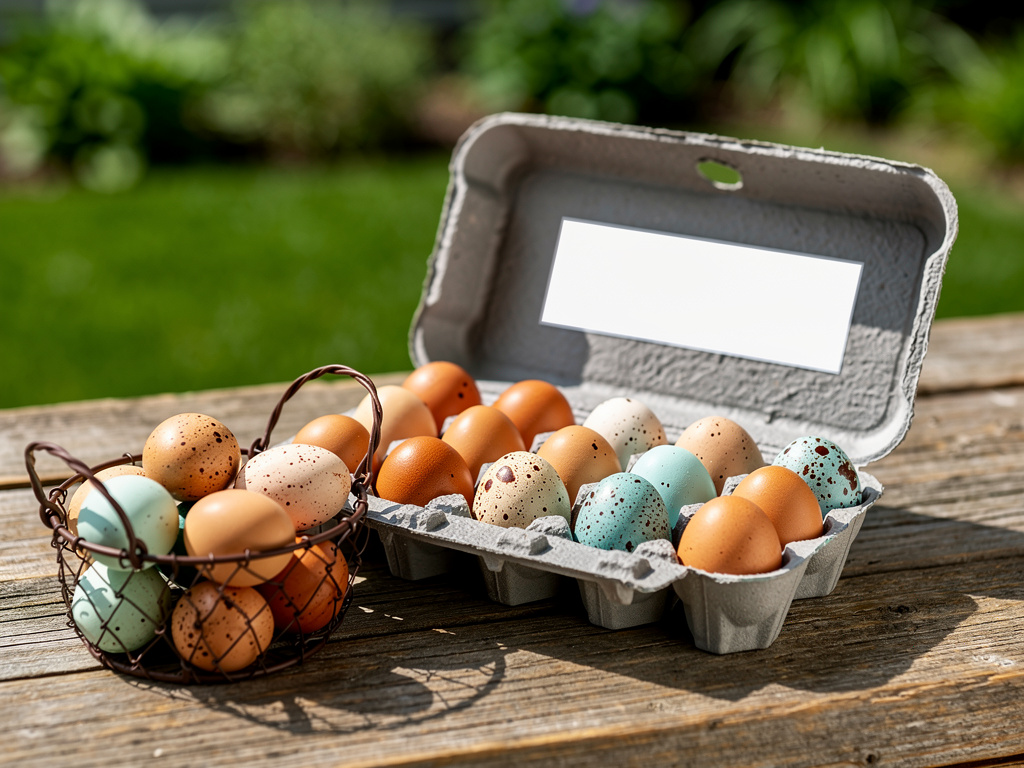


The short version: In 6 of the 8 states we read (Texas, Ohio, Wisconsin, Washington, Pennsylvania and Colorado), you can sell your own hens' eggs straight from your home to the person who will eat them with no license, while California and Florida want a paid registration or permit first. Five of those states (Texas, Ohio, Wisconsin, Washington and Pennsylvania) add a license or permit once you sell at a farmers market. Plan on a carton label with your name, address and pack date, plus the safe handling statement that federal rules apply to all shell eggs, and keep eggs at or below 45°F, the federal limit for eggs held for retail sale, or 41°F in Wisconsin and Colorado. Grocery eggs averaged $2.27 a dozen in August 2026, while the 16 egg listings sold by the dozen on Homegrown ran $3 to $10 with a middle price of $5.50. Start with neighbors and coworkers, then give your regulars one ordering link when the group text gets out of hand.
Checked on October 8, 2026: the eight state agency pages and rule texts, the federal rules on eCFR, the Bureau of Labor Statistics egg price series, Tractor Supply's feed and carton prices, and Homegrown's signup page. Rules change (Ohio dropped its small-producer registration on October 1, 2025), so verify your state's current rules before your first sale. Homegrown customers create an account to place their first order, and Homegrown has no drops or countdown release feature.
Your chickens are laying more eggs than your family can eat. The fridge is full. You've given away two dozen to your neighbor this week alone, and there are still more coming. At some point, you realize: people would pay for these.
And they will. Farm-fresh eggs from backyard chickens are one of the easiest products to sell locally. The product practically makes itself, and in most of the eight states we read, selling from home to the people eating your eggs needs no license, with a few state rules that catch people out.
This guide covers what's legal, how to handle and label your eggs, what to charge, where to find customers, and what to do when more people want eggs than your chickens can keep up with.
Yes, you can sell eggs from your own flock at home without a license in six of the eight states whose rules we read, as long as you sell directly to the people eating them. California requires everyone who sells eggs to register, and Florida requires a $100 permit for small egg farms. The details live in your state's rules, so read them before your first sale.
Federal law draws its main line at 3,000 hens. The FDA's egg safety rule covers producers "with 3,000 or more laying hens at a particular farm that does not sell all of your eggs directly to consumers" (21 CFR 118.1). USDA's egg inspection rules exempt sales by a producer with a flock of 3,000 hens or less from their controls on restricted eggs, such as cracked or dirty ones (7 CFR 57.100). A backyard flock of 6 to 20 hens sits far below both lines.
The states then set their own small-flock lines. Wisconsin's is 150 birds, Ohio's is 500 birds, Colorado's is 250 dozen eggs a month, Florida's is under 30 dozen a week, and Pennsylvania's is 3,000 laying hens. For the full rules state by state, our state by state guide to whether you can sell eggs lays out seven states side by side, with the federal rules by number.
What's typically required:
What's typically NOT required for small vendors:
The rules change if you sell to stores or restaurants. Once you move beyond direct-to-consumer sales, the states we read add licensing, grading or inspections. Colorado requires a Class I Egg Producer license and an inspection to sell to a grocery store or restaurant. Washington adds egg seals for direct-to-retail sales, at $2.68 per 1,000 dozen, and its off-farm guidelines ask for a seal on each dozen sold at a farmers market too. Wisconsin requires a food processing license for retail or wholesale sales. Ohio is the exception: since October 1, 2025, its small egg producers count as an approved source for retailers and restaurants. For selling from your property, the small-flock rules usually cover you. A farmers market or home delivery is an off-farm sale: five of the eight states we read add a license or permit at the market, and Washington's no-license rule and Ohio's retail food license exemption for 500 or fewer birds (Ohio Revised Code 3717.22) both name the place where the eggs are produced.
Look up your state's specific rules. Spend 15 minutes reading your state agriculture department's egg page before your first sale. It's straightforward, and it protects you. When you do, read the farm answer and the farmers market answer separately, because Washington, Wisconsin, Pennsylvania, Texas and Ohio all let you sell at your own place without that license and then want a license or permit at the market table.
The eight states we read split three ways: six let you sell at home with no license, California makes everyone register, and Florida issues a $100 small-farm permit. The table below puts the home sale, the farmers market, the flock line, the carton rules and the cold rule side by side.
Swipe the table left for all six columns.
| State | Selling at home | Selling at a farmers market | Small-flock line | Carton rules worth knowing | Cold rule |
|---|---|---|---|---|---|
| Texas | No egg license for ungraded eggs from your own flock sold to the end user | Permit from the regulatory authority | None stated for ungraded own-flock sales; graded eggs need a license | "Ungraded" plus name and address; reusing cartons is prohibited at the market | 45°F or less |
| Ohio | No registration since October 1, 2025 | License from your local health department | 500 birds | Name and address, count, pack date, "ungraded" or "unclassified", "mixed size", safe handling statement; reused cartons allowed with old information covered | Not stated on the small egg page we read |
| Wisconsin | No food processing plant license; free registration for nest-run eggs | Transient retail food establishment license | 150 birds | Name and address, pack date, sell-by within 30 days, "ungraded and uninspected" statement | 41°F for eggs packaged for retail sale |
| Washington | No license or egg seals at the place of production | Egg Handler/Dealer license, $30 for the first location, through a business license application listed at $19/$90, plus an egg seal on each dozen | Guidelines written for flocks of 3,000 or fewer hens | For off-farm sales: new packaging; "Eggs", "One Dozen", name and address, "Keep Refrigerated", safe handling statement; a pull date (30 days recommended, 45 at most); no grade or size if ungraded and not weighed | 45°F or less for off-farm sales, including transport |
| Pennsylvania | Allowed under 3,000 laying hens if you sell on the farm or within 100 miles, following the state's protocols | Retail Food License: $103 new, $82 renewal, $14 temporary | 3,000 laying hens | Name and complete address with zip code, date of lay, "eggs", net contents, "Keep Refrigerated", safe handling; "Unclassified" if not weighed; the species named if the eggs are not from chickens; the eggs page also lists selling within 5 days of lay, which the May 2026 sheet leaves out | 45°F within 24 hours of lay until sale |
| Colorado | Exempt from state ag licensing under 250 dozen a month | Same exemption; the state notes retail food rules may also require a license | 250 dozen a month | Name and address with zip code, pack date, grade (AA, A or B), size, safe handling, and "These eggs do not come from a government-approved source." | 33°F to 41°F, and eggs must be washed |
| California | Registration required, "no exemptions": $75 new, $50 renewal | Same registration; for a certified farmers market, CDFA also says to contact your county agricultural commissioner | No small-flock exemption | Name, address, zip, quantity, "keep refrigerated", your California handler code (or a USDA plant or surveillance number), "CA SEFS Compliant", grade, size, sell-by and Julian pack date (the numbered day of the year); size, grade and "CA SEFS Compliant" in type ¼ inch or larger | 45°F or less |
| Florida | Limited Egg Farm Operation permit, $100, with an initial inspection | Same permit; the rule text does not single out markets | 3,000 hens and under 30 dozen a week | Clean, unused cartons with the farm's name and address | Not stated in the rule text we read |
We read each state's own page or rule text on October 8, 2026: the Texas Department of Agriculture Egg Quality Program page and Texas DSHS Regulatory Clarification No. 9 (revised May 19, 2017), the Ohio Department of Agriculture's Small Egg Production page, Wisconsin DATCP's Egg Sales and Licensing page, WSDA's Eggs page and its linked Shell Egg Producer Guidelines for Off-Farm Sales (Ver. 11-06-08), the Pennsylvania Department of Agriculture's Farmers Market and Farm Stand Guidelines (Rev 2/2026) and its Eggs From Small Flock Producers sheet (Rev 5/2026), the Colorado Department of Agriculture's Egg Producers page, CDFA's Egg Safety and Quality Management page and its registration form, and Florida rules 5K-4.033 and 5K-4.020. This is 8 states, not 50, so check your own state's agriculture department before you sell.
Ohio changed its rules on October 1, 2025. The Ohio Department of Agriculture's Small Egg Production page says a producer with 500 or fewer birds no longer registers with the state and counts as an approved source for retailers and restaurants. To sell at a farmers market, you still need a license from your local health department.
The Texas Department of Agriculture does not license individuals who sell ungraded eggs from a personal flock to the end user, but grading your eggs means you need a license. At a farmers market, Texas DSHS Regulatory Clarification No. 9 asks for a permit, eggs at 45°F or less, cartons marked "ungraded" with your name and address, and no reused cartons.
State egg rules move. Ohio dropped its small-producer registration on October 1, 2025. California's per-case assessment rose from 10 cents to 13 cents on July 1, 2026. Pennsylvania's small-flock egg sheet was revised in May 2026. We checked these pages on October 8, 2026; check yours again before you sell.
Yes in five of the eight states in our table, even when you need nothing to sell at home. Texas asks for a permit from the regulatory authority, Ohio for a local health department license, Wisconsin for a transient retail food establishment license, Washington for a $30 Egg Handler/Dealer license (plus the $19/$90 business license application fee WSDA lists beside it, and an egg seal on each dozen), and Pennsylvania for a Retail Food License at $103 for a new stand.
The reason is simple. At home you are a farmer selling your own eggs. At the market table, the state treats you as a food vendor holding a food that needs to stay cold. That's why the market rules talk about coolers, thermometers and labels more than flock size.
Colorado is the only one of the eight whose licensing exemption names the farm, the farmers market and a CSA alike: under 250 dozen a month it covers all three, though the state's page notes that retail food rules may also require a license, and every egg must still be washed, candled for off-farm sale and kept at 33°F to 41°F. California's page says the state registration is all the state needs, though your city may require a business license, and for a certified farmers market it also sends you to the agricultural commissioner for the county where you will sell. Florida's rule text does not mention markets, so ask the market and your county.
Before your first market day:
Sell unwashed eggs only where your state allows it and keep them cold either way; then let your customers decide. Colorado requires every egg offered for sale to be washed, while Wisconsin's page defines nest-run eggs as eggs that are not washed, graded or candled and requires producers who collect, package and store nest-run eggs from their own flock to register, at no charge, with no flock size named. Wisconsin also says eggs labeled "Ungraded" must still be candled to remove defective ones.
Freshly laid eggs have a natural protective coating called the "bloom." This coating helps seal the shell's pores. Washing removes it, which is why washing has to be done right if you do it at all.
Unwashed does not mean unrefrigerated when you sell. Where a state we read sets a cold rule, it covers the eggs you sell, washed or not: 45°F in Texas, Pennsylvania and California, 45°F for off-farm sales in Washington, 41°F in Wisconsin, and 33°F to 41°F in Colorado. USDA's Food Safety and Inspection Service says refrigerated eggs should not be left out more than 2 hours, and that a cold egg left at room temperature can sweat, which helps bacteria move into the egg.
Here's what this means for you:
Practical egg handling rules regardless of washing:
At or below 45°F under the federal rule and in Texas, Pennsylvania, California and (for off-farm sales) Washington, and 41°F or colder in Wisconsin and Colorado. The federal rule at 21 CFR 115.50 says shell eggs held at a retail establishment must be stored and displayed at an ambient temperature no higher than 45°F.
On a phone, slide this table sideways.
| Where | Temperature | Extra detail |
|---|---|---|
| Federal (eggs held for retail sale) | 45°F or below | 21 CFR 115.50 |
| Texas | 45°F or less | Transport and store before sale at that temperature |
| Pennsylvania | 45°F or less | Within 24 hours of lay, including time at the market |
| California | 45°F or less | Applies to all shell eggs |
| Washington | 45°F or less | Off-farm sales, from storage through transport until the eggs are sold |
| Wisconsin | 41°F | For packaged eggs held for retail sale |
| Colorado | 33°F to 41°F | Including transport to a farmers market or CSA |
Read on eCFR and each state's page on October 8, 2026; Washington's figure is from WSDA's Shell Egg Producer Guidelines for Off-Farm Sales (Ver. 11-06-08), linked from its eggs page. Ohio's small egg page and Florida's rule text did not state a temperature on the pages we read.
A home fridge set at 40°F or below works for storage. The hard part is the drive and the market table. A cooler with ice packs and a cheap thermometer you can show an inspector solves both.
Plan on your name and address, a pack date and the count on each carton, plus the federal safe handling statement. Pennsylvania's list has six lines, plus "Unclassified" for mixed sizes, while Texas, at a farmers market, asks for "ungraded" with your name and address. You don't need fancy printed cartons, but you do need certain information on them.
Common state requirements for egg carton labels:
The statement reads: "SAFE HANDLING INSTRUCTIONS: To prevent illness from bacteria: keep eggs refrigerated, cook eggs until yolks are firm, and cook foods containing eggs thoroughly." Under the federal safe handling rule, it can go on the inside of the lid, but then "Keep Refrigerated" must appear on the outside, and the statement is set off in a box.
Order one stamp with your name, address and the 23-word safe handling statement in a box, and print the pack date by hand. Ohio's page says the safe handling statement printed on a reused carton can stay, as long as the old producer's name, grade and dates are covered.
Texas, Ohio, Wisconsin and Pennsylvania let you sell eggs you haven't graded by size to the people eating them, and Washington allows cartons with no grade or size on them; Florida's rule text does not say. Texas licenses nobody who sells "un-graded eggs from a personal flock to the end user", Ohio's label says "ungraded" or "unclassified", Wisconsin treats "Ungraded" as a grade of its own (the eggs must still be candled), Pennsylvania wants "Unclassified" when you don't weigh the eggs, and Washington's off-farm guidelines say ungraded, unweighed eggs carry no grade or size on the carton. Commercial eggs are sorted into Jumbo, Extra-Large, Large, Medium, Small, and Peewee. If you want to sort yours, that's great; it looks more professional. But two of the states we read do ask for it: California says all shell eggs shall be graded and sized, and Colorado says all eggs are graded into its consumer grades and weight classes before sale. Elsewhere, unsorted cartons get the "ungraded", "unclassified" or "mixed size" wording your state asks for. If you do sort, "Large" and "Medium" groups are enough.
Egg sizes by weight, two columns.
| Size | Minimum weight for a dozen |
|---|---|
| Jumbo | 30 ounces |
| Extra Large | 27 ounces |
| Large | 24 ounces |
| Medium | 21 ounces |
| Small | 18 ounces |
| Peewee | 15 ounces |
Weight classes from USDA FSIS, "Shell Eggs from Farm to Table," read October 8, 2026. Size is the weight of the whole dozen, not of any one egg.
Simple labeling options:
If you're reusing cartons, make sure any old branding is covered or removed, and check that your state allows reuse at all (Texas prohibits it at farmers markets, Washington wants new packaging when you sell off the farm, and Florida's rule calls for clean, unused cartons).
On Homegrown on October 8, 2026, 6 of the 16 dozen-priced egg listings sat between $5 and $6.50, 7 sat at $3 or $4, and the middle price was $5.50, so $5 to $6.50 a dozen is a fair place to start. The full range on October 8, 2026 ran from $3 to $10 a dozen. Grocery eggs are much cheaper right now: the Bureau of Labor Statistics put the average U.S. price of a dozen grade A large eggs at $2.27 in August 2026.
That grocery number swings hard. The same BLS series hit $6.23 in March 2025 during the bird flu shortage, then fell 63.5% to $2.27 by August 2026. If you priced against the grocery store from February to April 2025, when the BLS average ran $5.12 to $6.23, your $5 dozen looked cheap; now it looks like a premium product. Price for what you're selling, not for this month's supermarket shelf.
Be honest with yourself about the economics. For a small backyard flock, the cost math below says you break even or earn a little. The real value is having eggs for your family and covering your flock costs. If you're looking for serious income, you'd need far more hens and multiple sales channels, which puts you into a different category of operation, and past 150 birds in Wisconsin or 500 in Ohio into different rules.
Don't compete with grocery store prices. Your eggs are fresher, come from chickens with names, and were collected that morning. Price them like the premium products they are. Cooked eggs are priced on a different scale: seven caterers and delis charged $9.00 to $29.99 for a dozen deviled eggs (usually 12 halves from 6 eggs) when we checked on September 26, 2026 for our guide to pricing deviled eggs, and that's a different legal question: Texas lets home cooks sell cold foods like that once they register with the Department of State Health Services, keep them at 41°F or below and complete an accredited food handler course, while outside a state like Texas the same tray may need a licensed kitchen. If someone will only pay the grocery store's $2.27, they're probably not your customer.
Check local prices before setting yours. Look at what farm eggs sell for at your nearest farmers market, on Facebook Marketplace, and on Craigslist in your area. Price your eggs in the same range: slightly lower if you're just starting and want to build a customer base, at the top of the range if you have colorful eggs or a feed story your customers care about. Our egg pricing guide for farm stands goes deeper on seasonal pricing.
On Homegrown, 16 egg listings priced by the dozen ranged from $3 to $10 on October 8, 2026, with a middle price of $5.50 and an average of $5.27. Four listings sat at $3, three at $4, one at $5, five at $6 to $6.29, and three at $7 or more.
Homegrown egg listings by price per dozen
Source: a pull of the Homegrown catalog on October 8, 2026, 16 egg listings from 15 vendors that state a dozen in the name, description or options.
In a pull of the Homegrown catalog on October 8, 2026 (2,907 products from 310 vendors), we searched product names and descriptions for the whole word "egg" or "eggs", read every match, then read every product from each egg vendor. 16 listings from 15 vendors sell chicken eggs, or eggs with no species named, by the dozen. Four more egg listings ($5, $6, $6 and $12) do not say how many eggs you get, three sell a half dozen or 6 count ($4 to $6), one sells duck eggs ($5 a dozen) and four sell quail eggs ($4 to $8 a dozen). We left out pickled and cooked eggs, and seven listings from one vendor named only by egg size (Small, Medium, Large, Jumbo, Medium 30 pack, 3x large and 3x medium) that never say "egg" or a dozen.
What the listings tell you:
Puller Farm Stand on Homegrown lists its dozen at $4 and says customers who bring their own clean, undamaged carton pay $3. Before you copy that, check your state: Texas prohibits reused cartons at farmers markets, Washington asks for new cartons when you sell off the farm, and Florida's small egg farm rule calls for clean, unused cartons.
Feed is the big cost: about $20 to $25 a month for 8 to 10 hens at today's feed store price. Alabama Extension says a laying hen eats roughly 0.25 pounds of feed a day, and a 50-pound bag of Producer's Pride 16% Layer Pelleted Chicken Feed cost $16.99 at Tractor Supply on October 8, 2026, about 34 cents a pound.
Your actual costs:
Swipe left to see how each cost was figured.
| Cost Item | Monthly Amount | How we got it |
|---|---|---|
| Feed (flock of 8 hens) | $20.39 | 8 hens × 0.25 lb × 30 days = 60 lb, at $16.99 per 50 lb |
| Feed (flock of 10 hens) | $25.49 | 10 hens × 0.25 lb × 30 days = 75 lb, at $16.99 per 50 lb |
| Egg cartons | $10.00 (18 new cartons at about $0.56 each) or free (reused) | $39.99 for a 72-pack of one-dozen pulp cartons at Tractor Supply |
| Bedding, grit and oyster shell | Varies | Not priced here; price them at your own feed store |
Feed use from Alabama Extension's "Feeding the Laying Hen" and prices from Tractor Supply's product pages, both read October 8, 2026 (store set to Woodstock, Georgia). Your feed store's price will differ.
A flock of 8 hens lays roughly 4 dozen eggs per week in its first months of laying. University of New Hampshire Extension's guide to producing your own eggs says 10 hens lay about 9 eggs a day once they all get started, which works out to 7.2 eggs a day from 8 hens, or 18 dozen in a 30-day month. If you sold all 18 dozen at $5.50, that's $99 in revenue. Take out $20.39 of feed and $10.00 of new cartons and you keep about $68.61, before bedding, the eggs your family eats and any slow weeks. That figure also leaves out your time, the coop, replacement hens and any ordering or card fees. That's enough to cover your chicken expenses and pocket a little extra, but this isn't going to replace a paycheck.
Over a hen's first 13 months of laying, the feed math looks like this. UNH Extension says each hen should produce 20 dozen eggs or more over 13 months of laying while eating 90 to 100 pounds of feed. At 34 cents a pound, that's at most about $1.53 to $1.70 of feed per dozen, and less if your hens beat 20 dozen.
Plan on about 4 dozen a week from 8 hens and about 5 dozen from 10 hens at their best, minus what your family eats. UNH Extension's figure of 9 eggs a day from 10 hens gives 63 eggs a week, or 5.25 dozen. The same source says a 10-hen flock eases off to 6 or 7 eggs a day after 13 months of production.
Age and molting change the count too. Penn State Extension says pullets come into lay around 20 weeks of age and a well-run flock should stay above 60 percent production until about 80 weeks. After that, a molt takes about 10 to 12 weeks before the hens lay again, and each later laying cycle gives fewer eggs for a shorter time. If you add lights for winter, Penn State's warning is to never shorten the light period on hens in production, or they will stop laying.
How many hens for how many customers:
Start with the people you already know: neighbors, friends, and coworkers are the easiest first customers for a small flock. Expand from there as your flock grows.
People you already know are the easiest first customers for a backyard flock. You already have people in your life who would buy your eggs the moment they knew they were available. A text to your contacts, a post on your personal social media, or a mention at work is all it takes.
From there, word of mouth does the rest. One person tells two people, and suddenly you have more demand than supply. Selling straight to the household that eats the eggs is also the sale the federal and state rules treat most lightly.
If you live on a road with any traffic, a small stand works with almost zero effort. A cooler with eggs, a price sign, and a way to pay: cash box, Venmo QR code, or both. Some vendors use a mini fridge on a covered porch. Others use an insulated cooler with ice packs. Either way, keep the eggs at or below your state's temperature, which is 45°F in Pennsylvania, whose rule covers eggs sold from the farm. Our guide to selling eggs at a farm stand covers stand setup and display.
Check your local zoning for any signage restrictions. Many areas allow a small roadside sign for farm products, but some HOAs or municipalities have rules. In Ohio, a stand at the place where the eggs are produced, run by someone with 500 or fewer birds, needs no Retail Food Establishment license.
Farmers markets are a good channel if you sell eggs alongside other products. On their own, eggs have thin margins: a booth fee, plus the market license that Texas, Ohio, Wisconsin, Washington and Pennsylvania require (Pennsylvania's is $103 for a new stand), can eat up most of your profit on a few dozen eggs. But if you also sell produce, baked goods, honey, or other products, eggs become an add-on that attracts customers to your booth.
For a full walkthrough on market selling, see our guide on how to sell at a farmers market.
"Farm fresh eggs" posts do well in local buy/sell groups and on Facebook Marketplace. It's an easy way to reach beyond your immediate social circle. The downside is managing messages and coordinating pickups, which can get time-consuming once you have regular customers. Our guide on whether it's legal to sell food on Facebook covers the platform rules and the state rules that apply to those sales.
Once you have repeat customers who want eggs every week, managing those orders through texts and DMs gets old fast. Three people texting you on Tuesday asking if you have eggs this week, one person who forgot to pick up, another who wants to pay you next time.
Give your regulars one link where they can see what's available, place their order, and pay. Everyone orders through the same place, you get a clean list of who wants what, and nobody has to text you to find out if you have eggs this week. The next section compares what that link costs.
Use one ordering page that shows how many dozen you have, takes payment, and lists who is picking up when. For a flock that turns out 4 to 5 dozen a week, the order list matters more than the fee, because the fees on a $6 dozen run between 21 cents and $1.02 depending on the tool.
Venmo moves money but includes no order details, so you still track who wants how many dozen and when they are picking up. Etsy's fee stack on a $6 dozen is a 6.5% transaction fee, 3% + $0.25 payment processing and a $0.20 listing fee, and its payments policy has every shop agree to ship sold items, which doesn't fit "come grab eggs from the cooler on my porch Saturday." Homegrown costs $10 per month billed annually ($12.50 billed monthly) with no percentage fees beyond standard payment processing (2.9% plus $0.30 per transaction, paid by you, not added to your customer's total). It gives you one link where customers see what is available, order, pay, and choose pickup or local delivery, with real-time inventory tracking and low-stock alerts so you can list exactly the dozens you have this week. Homegrown does not manage your flock, track your egg production, or make the deliveries; it handles the ordering and payment step so you stop managing a group text and start managing a clean order list.
Scroll sideways to see every fee column.
| Tool | Monthly plan | Trial | Platform fee | Card processing | Customer pays on a $6 dozen | You pay on a $6 dozen | You pay in a month of 9 orders at $6 (8 hens, after the family's 2 dozen a week) | You pay in a month of 50 orders at $6 |
|---|---|---|---|---|---|---|---|---|
| Homegrown | $10 billed annually ($12.50 monthly) | 7 days, no charge until day 8 | $0, 0% commission | 2.9% + $0.30, paid by you | $6.00 | $0.47 plus the plan | $14.27 ($16.77 on monthly billing) | $33.70 ($36.20 on monthly billing) |
| Etsy | $0 (optional Etsy Plus $10) | None listed | 6.5% transaction fee plus $0.20 listing fee | 3% + $0.25 | $6.00 plus any shipping you charge | $1.02 | $9.18 | $51.00 |
| Square Online, Free plan | $0 | None needed | $0 | 3.3% + 30¢ online | $6.00 | $0.50 | $4.48 | $24.90 |
| Venmo business profile | $0 | None needed | $0 | 1.9% + $0.10 per payment received | $6.00 | $0.21 | $1.93, with no order page | $10.70, with no order page |
Checked on October 8, 2026: Homegrown's signup page, Etsy's Fees and Payments Policy and Etsy Payments Policy (US rate), Square's pricing page and Venmo's fees page. Fees are figured on the $6 price. The 9-order month is about what the 8-hen flock in the cost section has left to sell (about 18 dozen laid a month, minus a family's 2 dozen a week); the 50-order month is for a bigger flock. Etsy charges processing on the total including tax and shipping, and may charge a one-time shop set-up fee shown at signup. A $6 dozen is the most common price among the Homegrown egg listings above (tied with $3).
On fees alone at this size, about 9 one-dozen orders a month, Venmo ($1.93), Square's free plan ($4.48) and Etsy ($9.18) all cost less than Homegrown ($14.27 with the plan). Square's free plan also builds an online ordering page. On Homegrown, the $10 gets you an order page built for pickup (customers pick a pickup time or a delivery address, pay when they order, and the order lands in your dashboard) and a storefront listed on Homegrown's local marketplace. Plan on most orders coming from people you send to your own link, not from the marketplace, and know that customers create a Homegrown account to place their first order.
Ready to stop answering "do you have eggs this week?" When your regulars order from a listing that tracks how many dozen you have left, the Tuesday texts stop. Set up your egg ordering page on Homegrown: a 7-day trial with no charge until day 8, then $10 a month billed annually.
Manage customer expectations upfront and use pre-orders to keep your limited supply organized. Here's what happens: you start selling eggs, word spreads, and within a few weeks, more people want eggs than your chickens produce. This is a good problem, but it needs managing.
Seasonal production is the biggest factor. Chickens lay based on daylight hours. Penn State Extension recommends 14 to 16 hours of light a day for maximum production, and in fall and winter natural daylight falls short of that, so production drops. Some people add supplemental lighting to their coop, but many backyard keepers don't.
This means your egg supply isn't consistent year-round. Your customers need to know this.
How to manage limited supply:
In Pennsylvania, pre-orders also help with timing. The state's eggs page and its February 2026 farmers market guidelines list selling within five days of the date of lay as a condition of the small-flock rules, though the newer Eggs From Small Flock Producers sheet (Rev 5/2026) leaves it out, so confirm with the Pennsylvania Department of Agriculture. Knowing your buyers before you collect keeps you inside that window.
Use clean, labeled cartons for every sale; presentation turns eggs from a favor into a product. Eggs thrown in a reused carton with someone else's branding feel like a favor.
Carton options comparison:
Carton prices and uses, side by side.
| Carton Type | Cost | Best For |
|---|---|---|
| New paper pulp cartons, bulk pack | About $0.56 each ($39.99 for 72) | Farmers markets, new customers |
| Printed "fresh eggs" pulp cartons | About $0.58 each ($34.99 for 60) | A stand or market table |
| Single carton from the feed store | $0.89 each | Topping up when you run short |
| Reused cartons | Free | Friends and family, where your state allows it |
Nest Box Queen and Flock Party carton prices from Tractor Supply's site on October 8, 2026. The 72-pack's product description says each carton holds one dozen small to extra large chicken eggs.
Buy in bulk: the 72-pack works out to about 56 cents a carton against 89 cents for a single one.
Reused cartons are fine for close friends and family in many places, but not everywhere. Texas prohibits reusing egg cartons at farmers markets, Washington's off-farm guidelines say to use new packaging, Florida's small egg farm rule calls for clean, unused cartons, and Ohio allows reuse only with the old producer's name, grade and dates covered. If you do reuse, make sure the old branding is covered and the carton is clean.
Small touches that matter:
Ready to sell your eggs to local customers? The easiest way to take local orders and get paid is an online storefront. See the best platform to sell food from home, our comparison of platforms for selling eggs online, or set up a Homegrown storefront in about 15 minutes ($10/mo billed annually, 0% commission, 2.9% + $0.30 card processing paid by you).
The common ones are a missing label line, a warm cooler and selling where your exemption doesn't reach. Each of these comes straight from the state pages we read.
In six of the eight states whose rules we checked (Texas, Ohio, Wisconsin, Washington, Pennsylvania and Colorado), you can sell eggs from home to the people eating them without a license, though Wisconsin asks anyone who packages nest-run eggs (not washed, graded or candled) to register, at no charge. California requires everyone who sells eggs to register ($75 new) and Florida requires a $100 small egg farm permit. Check your state's department of agriculture egg page before you sell.
Six to eight hens is usually enough to feed your family and have extras to sell. At University of New Hampshire Extension's rate of about 9 eggs a day from 10 hens, 8 hens give about 4 dozen a week at their best, so a family that eats 2 dozen has about 2 dozen left to sell. Twelve to fifteen hens gives you a more consistent surplus for regular customers. Watch the small-flock lines if you keep growing: 150 birds in Wisconsin and 500 in Ohio.
Yes, and many backyard vendors use these sites to find local buyers. Just follow your state's labeling and direct-to-consumer rules, which apply the same way whether the buyer found you online or at your gate. Be clear about pickup logistics (where and when), and consider requiring pre-payment to reduce no-shows.
If you keep ducks or quail, they can round out your table. On Homegrown on October 8, 2026, the one duck egg listing was $5 a dozen and four quail egg listings ran $4 to $8 a dozen. Rules can differ by species: Washington's farmers market rule covers eggs from any species of fowl, and California requires duck and quail egg containers to carry identity, responsibility and quantity (it calls this I.R.Q.). Pennsylvania's small-flock sheet asks that cartons of eggs from any fowl other than chickens name the species, such as ducks or quail.
USDA FSIS says raw eggs in the shell keep 3 to 5 weeks in the refrigerator. For the carton, Wisconsin requires a sell-by date within 30 days of packing, Colorado makes an expiration date optional but caps it at 30 days, and FSIS sets the same 30-day limit for expiration dates on graded eggs. FSIS also says refrigerated eggs should not be left out more than 2 hours. Always label your cartons with a pack date so customers know when the eggs went into the carton (Pennsylvania asks for the date of lay instead, and wants small-flock eggs sold within 5 days of it).
None of the eight state pages we read listed insurance as a requirement for selling eggs. Some farmers markets ask vendors for proof of coverage, so ask your market manager before you sign up. As one price point, the Food Liability Insurance Program (FLIP)'s Pro plan for food vendors listed general liability coverage from $299 a year, or $25.92 a month, when we checked its site on October 8, 2026.
Blood spots are harmless and common in farm-fresh eggs. USDA FSIS says they are caused by a small blood vessel breaking at the time of ovulation and do not mean the egg is unsafe. Candling catches them before you sell, and Wisconsin's page notes that large spots lower an egg's grade. On colors, FSIS says yolk color follows the hen's diet and is safe, and a cloudy white means the egg is very fresh, but a pink or iridescent white means spoilage from Pseudomonas bacteria, some of which are harmful to people, so throw that egg out. A quick note on your carton or a printed info card explaining blood spots and yolk color helps educate new customers and builds trust.
Read these five guides next for egg permits, egg pricing, steady customers, ordering tools and the other foods you can sell from home.
Selling eggs from your backyard flock is one of the simplest ways to turn a hobby into something that pays for itself. The regulations for small vendors are straightforward once you know your state's line. Once people know you have eggs, they know where to find you. And the product shows up in your coop every morning without you having to do much beyond feeding and watering your chickens.
Check your state's egg page, label your cartons, then tell the people around you that you have eggs for sale. The customers will find you faster than you expect.
When regulars start asking for eggs every week, give them a link instead of a group text. An ordering page takes about 15 minutes to set up and replaces the dozen text conversations you are managing every Tuesday.



