
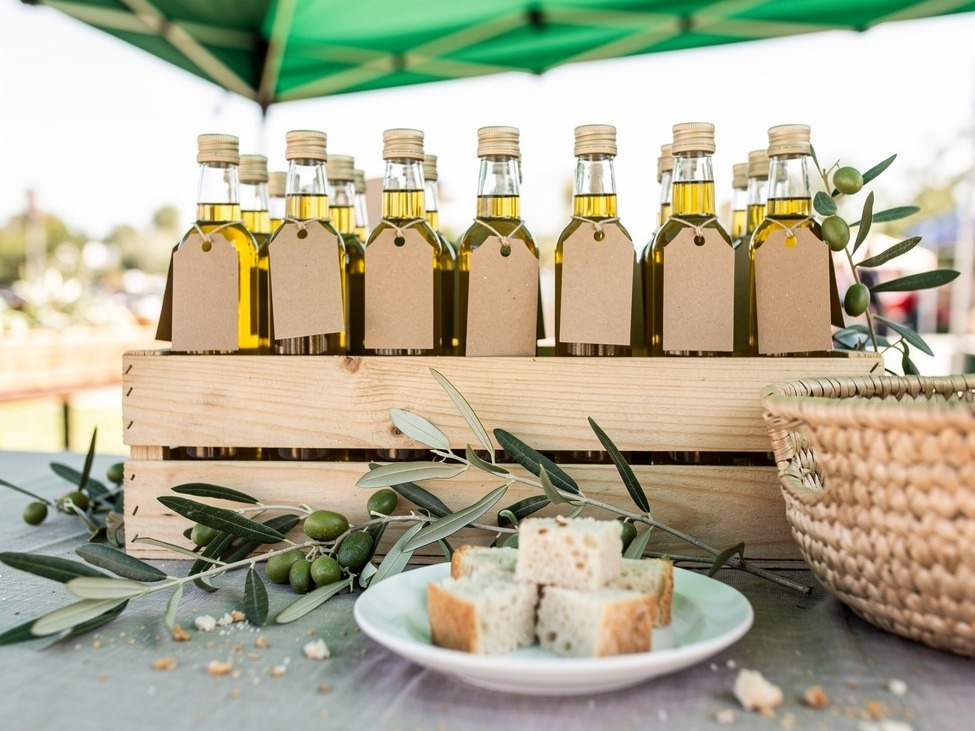


The short version: Olive oil sells in seven places: farmers markets, your grove or farm stand, pre-orders with pickup or local delivery, holiday markets and gift sets, specialty and wine shops, restaurants, and online with shipping. A licensed kitchen or bottler can use all seven, but a home kitchen is far more limited, and of the six states checked here only Texas has a home kitchen route into stores for olive oil, through a registered cottage food vendor and only for oil that does not need temperature control. Under the FDA Food Code, the model most health departments follow, restaurants can only use food from a lawful source, which rules out cooking with oil made in a private home. On a $14 bottle, card processing costs you $0.71 through your own Homegrown link and $0.51 on Square at the booth, and Etsy's fees come to $1.78 before shipping.
Checked October 7, 2026: fees come from Homegrown's signup page and the Square, Shopify, Etsy and Faire pricing pages, and the rules come from the FDA Food Code 2026 and the Texas, Michigan, Washington, California, Florida and Colorado agency pages, all loaded that day. This is a guide to places, not a fifty-state rulebook, so verify your state's current rules with your health or agriculture department before you sell. Homegrown customers create an account to place their first order, and you should plan on most orders coming from people you send to your own link.
A good bottle of olive oil sells the moment someone tastes it on a cube of bread. The hard part is finding enough places to pour that taste, because olive oil is not like a loaf of bread you can sell anywhere. It comes in glass, it is often a gift, and if it has herbs or garlic in it, the rules for where it can go get strict fast.
So the answer to where to sell olive oil starts with one question: how is your oil made? A licensed kitchen, or a grower whose oil is bottled in a licensed facility, can use every place on this list. A home kitchen cook making flavored oil has far fewer doors open, and in several of the states we checked, no cottage food list names oil at all. Our olive oil pricing guide walks through what six states say about selling oil from home and what a bottle costs you to make, and the infused olive oil how-to covers recipes, safety and labels. This guide picks up where they stop: once you are allowed to sell, where does olive oil actually move?
Below are the seven places, which kinds of sellers can use each one, how the one olive oil vendor on Homegrown runs delivery, and what each way of getting paid costs you on a $14 bottle.
You can sell olive oil in seven places: a farmers market, your own grove, farm stand or porch, pre-orders with pickup or local delivery, holiday markets and gift orders, specialty and wine shops, restaurants, and online with shipping. Start with the first 3, because they sell straight to the person who will use the bottle and keep the most money per bottle.
The seven places, roughly in the order a new vendor can add them:
You do not need all seven. Pick two or three that match how your oil is made, then add the rest as your volume grows.
The olive oil sellers this guide is written for fall into one of 3 groups, and the group you are in decides which places are open to you. Figure that out first, because it saves you from booking a market booth or pitching a shop you are not allowed to use.
One real example of the first group: a University of California case study of Smith Bros Farming in Oakdale, California describes olives "pressed by a local processor," the oil delivered to a commercial kitchen in a 100-gallon stainless steel container and "hand bottled," then sold at the family's farm stand and at local farmers markets. The study is from December 2015, but the pattern is a useful model for a small grove today: the mill and the licensed kitchen do the regulated steps, and the family does the selling.
A licensed kitchen can use all 7 places, a Texas home kitchen can use 4 of them directly and 2 more only through a cottage food vendor registered with the state, and a home kitchen in Michigan or Washington should not plan on selling infused oil under the cottage food law without a written answer from the state, since both ban garlic in oil by name and neither list names any oil. The route your oil is made under decides the list.
Here is how the main routes line up place by place:
Swipe the table left to see each place.
| How the oil is made | Farmers market and farm stand | Pre-orders and delivery | Shops | Restaurants | Shipping to customers |
|---|---|---|---|---|---|
| Licensed kitchen or licensed bottler | Yes, under the market's rules and your license | Yes | Yes, it is a licensed source | Yes, it is a licensed source | Yes, under your license and the carrier's rules; ask your agency whether out-of-state sales need more |
| Texas home kitchen (cottage food) | Yes, direct to the customer, with samples allowed at any location | Yes, but online orders must be delivered in person by you, an employee or a household member | Only through a registered Texas cottage food vendor, and never for food that needs temperature control | Only as packaged bottles a registered cottage food vendor sells to diners at a food service establishment, which is not the same as the kitchen cooking with it | No, online sales require personal delivery |
| Michigan or Washington home kitchen | Garlic in oil is banned by name in both states ("garlic in oil mixtures"), and no other oil is on either allowed list. Get a written answer from the state before you sell any infused oil from home | ||||
| California, Florida or Colorado home kitchen | None of these states' approved cottage food lists names oil. Ask your state in writing before you sell any flavored oil from home | ||||
We read each rule on the agency page on October 7, 2026: the Texas Department of State Health Services cottage food page, the Michigan Department of Agriculture and Rural Development cottage food one-pager (dated March 2026), the Washington State Department of Agriculture cottage food page, the California Department of Public Health approved cottage foods list (last reviewed April 2026), the Florida Department of Agriculture and Consumer Services cottage foods page and the Colorado Department of Public Health and Environment cottage foods page. These are examples; check what your state requires before you sell.
Garlic in oil is the riskiest flavor you can make. The FDA Food Code 2026, the model code most health departments follow, lists "garlic-in-oil mixtures" that are not treated to stop bacteria as a food that needs time and temperature control for safety. In Texas, a food in that group can still be sold, but the home kitchen operator must register with the state, keep it at 41°F or below, and cannot sell it wholesale.
If you are not sure which group you are in, start with the state table in our cottage food laws by state guide, then email your state agency the exact product: "rosemary infused olive oil made with dried rosemary." Get the answer in writing before you print labels.
Yes, a farmers market is the best first place for most olive oil vendors, because a taste on bread sells a $14 bottle faster than any description. A shopper who walks past a $14 bottle on a shelf will often stop for a free taste, and the taste is what makes the sale. Put the price on the sign right next to the tasting tray, so the taste and the price land at the same moment.
What makes an olive oil booth work:
Market rules vary, and cottage food laws often name which venues count. Washington's cottage food page, for example, limits home kitchen sales to "direct sales from your home, at farmers markets, craft fairs & other public venues." That list may not help a Washington oil maker, since oil is not on the state's allowed list and garlic in oil is banned by name, but it shows the kind of venue line to look for in your own state's rules.
The real cost of selling at farmers markets breaks down booth fees, tents and time, which matters when your product sells in ones and twos instead of by the bag.
Yes, selling from your own grove, farm stand or porch is often the most profitable place for olive oil, because there is no booth fee and no driving. It works best once you have regulars who know your schedule. A set pickup day, like Saturday morning, beats "come by anytime," since glass bottles should not sit out in the sun waiting.
The Oakdale case study shows how strong this place can be for a grove. The family sold its olive oil, honey and jam at its own bake shop and farm stand, and the study says "about 50 percent of the bake shop's sales are to tourists on their way to Yosemite." That figure is for the whole bake shop, not the oil, but a farm on a road tourists already drive gives a bottle of oil a ready buyer.
If you are a home kitchen seller, check that your state lets you sell from home before you put out a sign. Texas does, for cottage food sold directly to the customer. Colorado's page says products must be delivered directly to "an informed end consumer," which covers your porch, but oil is not on Colorado's eligible list in the first place.
A few things that make farm and porch sales smoother:
Pre-orders let customers pick and pay for their oil before you bottle, and local delivery lets you drop it off on one or two set days. Together they let a market customer reorder without waiting for your next booth. They also mean you bottle exactly what sold.
Here is how the one olive oil vendor on Homegrown runs it. Rosbrook Farm, a Texas farm that lists 12 infused olive oils, offers delivery "within 25 mi of the vendor," with "Free delivery · $25.00 minimum order," and "Delivers Sun, Sat," per its storefront on October 7, 2026. Its 8 oz bottles cost $10 and its 12 oz bottles cost $15.
Rosbrook Farm's $25 delivery minimum is exactly one 12 oz bottle at $15 plus one 8 oz bottle at $10. Set your minimum at the price of your two most common sizes together, and a single-bottle order becomes a two-bottle order instead of a wasted drive.
To set up pre-orders for olive oil:
In Texas, pre-orders taken online come with conditions. The Texas cottage food page says the food must be bought online from the operator, delivered in person by the operator, an employee or a household member, and that the full label information must be posted on your website before you accept payment. The same page says every Texas cottage food operator must complete an accredited food handler training course.
Our guide to setting a delivery fee as a food vendor walks through the math on fees and minimums.
Olive oil sells best next to the things people cook with it: dried herbs, flavored salts, vinegar and bread. A customer who came for rosemary oil may add a jar of the same rosemary, dried, and that second sale costs you no extra booth fee or delivery trip.
In a pull of the Homegrown catalog on October 7, 2026, 12 of the 2,900 listings were olive oil sold as the product, all from one vendor, Rosbrook Farm in Texas: eight 8 oz bottles at $10, three 12 oz bottles at $15 and one Italian basil oil listed without a size at $10. That is $1.25 an ounce at both sizes. Rule used: we searched every listing's name and full description for olive, evoo, infused oil, flavored oil, garlic oil, chili oil, chile oil, dipping oil and herb oil (93 matches), read each one, and left out breads, crackers, granola and soaps that only use olive oil as an ingredient, a wellness oregano oil, and a 5 oz chili oil whose listing does not say which oil it is made with.
Rosbrook Farm is a good model for a full table. Its 56 listings on October 7, 2026 were 12 infused olive oils, 12 dried herbs at $10 each, 10 teas, 10 infused honeys, 8 infused salts and 4 tinctures. Its sage, Italian basil and purple basil oils are described as made from herbs it grows and dries itself, and it sells a jar of each of those herbs dried, so the herb jar and the oil tell the same story.
Good companions for olive oil, depending on what your state allows:
Yes, holiday markets and gift orders are one of the strongest places for olive oil, because a small bottle is an easy gift at $10 to $15. A three-bottle sampler in a simple box can carry a December. Plan it in October, so the boxes, tags and order link are ready before the first holiday market.
What works for olive oil gifts:
Craft fairs work too, since the shoppers there are already buying gifts. Before you pay a table fee, read our guide to choosing a holiday craft fair as a food vendor, and check that your state counts a craft fair as an allowed venue for home kitchen food. Washington's page names craft fairs; your state may not.
Our holiday gift box guide has more on packaging and timing.
Yes, specialty food shops, wine shops and gift boutiques do carry local olive oil, but outside Texas, the states checked here only let them take oil made in a licensed kitchen. Florida's cottage food page says "Cottage food products cannot be sold wholesale," and Washington's says a cottage food maker who wants to sell to stores "must acquire a WSDA Food Processor's License." Colorado's page says products "cannot be sold to restaurants or grocery stores."
Texas is the one state in this guide where a home kitchen's olive oil has a route into stores. The Texas cottage food page says a home kitchen "may wholesale cottage foods to a cottage food vendor, unless the foods are TCS," meaning foods that need temperature control. Two other states have store routes for some cottage foods, but not for oil: Colorado's page says a store selling cottage food "would need to function as the designated representative" of the maker, and California's cottage food operations page lets a Class B operator sell "indirectly through restaurants and food markets," yet neither state's list of allowed cottage foods names oil.
A "cottage food vendor" is a person in Texas who has a contract with a home kitchen cook and sells to customers on its behalf. That vendor must register with the state, and the Texas page says it "can sell directly to consumers at a farmers' market, a farm stand, a food service establishment, or any retail store," with a sign stating the product "WAS PRODUCED IN A PRIVATE RESIDENCE THAT IS NOT SUBJECT TO GOVERNMENTAL LICENSING OR INSPECTION," and the date the food was made on the label. Oil that needs temperature control, like an untreated garlic oil, cannot be sold this way.
If you are licensed, here is how a shop deal usually works:
Wine shops are worth a special look, because oil and wine sell to the same shopper. Our guide to running a tasting event at a wine shop covers how to set one up, and how to sell food products in local stores walks through the buyer meeting.
Yes, restaurants buy olive oil, but only from a lawful source, which in practice means a licensed kitchen or bottler. The FDA Food Code 2026 says at section 3-201.11 that food "shall be obtained from sources that comply with LAW" and that "FOOD prepared in a private home may not be used or offered for human consumption in a FOOD ESTABLISHMENT." Most state and local health departments base their rules on this model code, so plan on restaurants as a licensed-only place, sold in 1 liter or 1 gallon containers rather than 250 ml bottles.
That rules out a restaurant using home kitchen oil in its cooking in most places, even if the chef loves it. Texas is a partial exception: its page lets a registered cottage food vendor sell packaged bottles to customers at a food service establishment. That is a retail sale at the restaurant, not the kitchen cooking with the oil, so ask the restaurant's health inspector before home kitchen oil goes into a dish.
If you are licensed, restaurants are a different kind of customer than shoppers:
Our wholesale price sheet guide for restaurants shows how to lay out sizes and prices for a chef.
A licensed producer ships olive oil under the terms of its own license, and should ask its licensing agency whether out-of-state sales need anything more. Most home kitchen routes checked here keep you inside your state, and some keep you out of the mail too. Michigan's one-pager allows internet or mail order but says a cottage food product "may only be sold or delivered within Michigan," and Washington's page says "Internet, mail, consignment, wholesale, & retail sales outside the state are prohibited." Texas requires online orders to be delivered in person.
Florida is one state whose page says cottage food can be sold "on their website, by mail order, and direct to consumer," but oil is not on Florida's approved list. So even in a state that allows mail order, the product itself has to be allowed first.
If you are licensed and want to ship:
For a home kitchen seller, local pickup and delivery do the job shipping would. Our guide to whether you can ship cottage food covers the state rules in more detail.
On a $14 bottle, the fees run from nothing in cash to $1.78 on Etsy, and at 50 bottles a month, Homegrown's and Shopify's subscriptions add $10 to $39 a month on top of the per-order fees, depending on the plan and billing. Cash at the booth costs nothing to take. Every card payment costs something, and online orders cost more than in-person ones.
Scroll sideways to see every column.
| Way to get paid | Subscription | Trial | Platform fee | Card processing | Customer pays on a $14 bottle | You pay on a $14 bottle | A month of 50 one-bottle orders |
|---|---|---|---|---|---|---|---|
| Cash at the booth | $0 | None | $0 | None | $14.00 | $0.00 | $0.00 |
| Square Free, in person | $0 | None | $0 | 2.6% + 15¢ | $14.00 | $0.51 | $25.70 |
| Square Free, online | $0 | None | $0 | 3.3% + 30¢ | $14.00 | $0.76 | $38.10 |
| Homegrown link (pickup or delivery) | $10/mo billed annually, or $12.50/mo billed monthly | 7 days, no charge until day 8 | $0, 0% commission | 2.9% + $0.30 | $14.00 | $0.71 | $45.30 annual plan, $47.80 monthly plan |
| Shopify Basic | $29/mo paid yearly, or $39 paid monthly | 3 days, then $1/mo for 3 months | $0 on Shopify Payments (2% if you use another processor) | 2.9% + 30¢ online (3.5% + 30¢ on premium cards) | $14.00 | $0.71 | $64.30 yearly plan, $74.30 monthly plan |
| Etsy | $0 (a one-time shop set-up fee may apply) | None | $0.20 listing + 6.5% transaction fee | 3% + $0.25 | $14.00 plus any shipping you charge | $1.78 | $89.00 |
We checked every fee on the companies' own pages on October 7, 2026: Homegrown's signup page, Square's pricing page, Shopify's pricing page and Etsy's seller and fees pages. Etsy's fees are shown on the $14 item price alone; its transaction and processing fees also apply to any shipping you charge, and a 15% Offsite Ads fee applies to sales from its ads. Booth fees are not included, since every market sets its own.
What 50 one-bottle orders at $14 cost you in a month
Source: fee pages for each company, checked October 7, 2026. 50 orders of one $14 bottle, $700 in sales. Homegrown and Shopify include the monthly plan on annual or yearly billing.
The bar chart shows the real trade. Square's free plan is the cheapest card payment per order at the booth in this guide, at $0.51, and Square is a fine card reader there. Online, its $0.76 per order is more than Homegrown's $0.71, but since the free plan has no subscription, it still comes out lower on 50 orders. Homegrown costs $7.20 more than Square online on 50 orders. Square's free plan includes an online site with pickup and local delivery too, so what the extra $7.20 buys is a listing on the Homegrown marketplace. Etsy costs nearly twice what Homegrown does at this volume and is built around shipping, which a home kitchen oil seller in the states checked here cannot plan on.
On a first $96 case of 12 bottles at $8 each, Faire, a wholesale marketplace where shops order from makers, takes $27.00 in fees, or $2.25 a bottle, which leaves you $69.00, or $13.56 after the $55.44 the bottles cost you to make. Reorders from the same shop cost $17.00, and on shops you bring yourself through your Faire Direct link, you pay no commission at all. Faire only fits a licensed vendor: outside Texas, none of the store routes checked here covers oil, and Texas's route needs a shop in Texas that has registered with the state as a cottage food vendor and has a contract with you, which a Faire listing alone does not give you.
Swipe to see each kind of Faire order.
| Faire order on 12 bottles at $8 ($96) | Commission | New customer fee | Payment processing (30-day payout) | Total fees | Per bottle |
|---|---|---|---|---|---|
| A shop's first order through the marketplace | 15% = $14.40 | $10.00 | 2.4% + $0.30 = $2.60 | $27.00 | $2.25 |
| A reorder from that shop | 15% = $14.40 | $0 | $2.60 | $17.00 | $1.42 |
| A shop you brought through your Faire Direct link | 0% | $0 | $2.60 | $2.60 | $0.22 |
From Faire's help page on what it costs brands in North America, loaded October 7, 2026. Faire is free to join. Processing is 3.5% + $0.30 for a next-day payout, 2.4% + $0.30 for 30 days and 1.9% + $0.30 for 60 days; the table uses 30 days.
Here is what that leaves you. Our pricing guide costed a 250 ml bottle at $4.62 in oil, glass, cap, herbs and label at September 30, 2026 prices, so 12 bottles cost you $55.44. After Faire's fees on a first order, you keep $69.00 minus $55.44, or $13.56, before your time. The same 12 bottles sold one at a time at $14 through your own link leave about $104 before your monthly plan.
That is why wholesale is a volume play, not a margin play. Take it when you can bottle more than your direct customers buy.
A customer who loved your rosemary oil in May will run out eventually, and if the only way to reorder is to find your booth again, the grocery store is the easier choice. A simple ordering link on your label catches that second sale. That is the problem a Homegrown storefront solves for an olive oil vendor.
Homegrown is $10 a month billed annually, or $12.50 billed monthly, with no percentage fees beyond standard payment processing of 2.9% plus $0.30, which comes to $0.71 on a $14 bottle. You list each oil with its sizes as options, and customers order and pay before your pickup day or delivery run. What fits an olive oil vendor:
Compare that to the usual alternatives. Etsy takes $1.78 on a $14 bottle and assumes you ship glass, which a home kitchen oil seller in the states checked here cannot plan on: Texas, the one state here whose rules allow oil from a home kitchen, has you, an employee or someone in your household hand each online order to the buyer. Shopify Basic starts at $29 a month paid yearly and is built for a brand shipping nationwide, more store than six flavors at a Saturday market need. Square's free plan is the cheapest card reader in this guide at the booth, and its online orders cost 3.3% plus 30 cents.
What Homegrown does not do: it does not ship oil nationwide, it does not manage wholesale accounts for shops, and it has no drops or countdown release feature. Customers create a Homegrown account to place their first order. Your storefront shows up on the Homegrown marketplace, but plan on most orders coming from people you send to your own link.
Add one place at a time, and only after you have checked that your route allows it. A new place that turns out to be off limits costs you a booth fee, a case of labels or a shop relationship.
If your regulars keep asking when the next batch is ready, set up a Homegrown storefront and put the link on your next round of bottle tags. The trial runs 7 days with no charge until day 8, so you can take a week of real orders before you pay anything.
Experienced olive oil sellers sell the taste, keep the bottles out of the light, and put as much effort into the customer who already bought once as into new market traffic. A $14 reorder from a regular costs you no booth fee and no sample tray.
Habits worth copying:
Where you can sell homemade olive oil depends on your state. Texas allows any cottage food except a short list that does not include oil, so a Texas home kitchen can sell at farmers markets, from home and through delivered online orders. Michigan and Washington bar garlic in oil and do not list oil as allowed, and California, Florida and Colorado do not name oil on their approved lists.
Yes, you can sell olive oil at a farmers market if your route allows it, and it is usually the best first place to sell. A licensed vendor can apply to any market that takes its product. A home kitchen seller should check both the market's rules and the state's cottage food venue list first.
You can sell olive oil to a store if it is made in a licensed kitchen or bottled by a licensed bottler. Of the six states checked here, most bar wholesale; Florida's page says cottage food "cannot be sold wholesale." Texas is the exception in this guide: a home kitchen can wholesale to a cottage food vendor registered with the state, but only oil that does not need temperature control.
Usually not from a home kitchen. The FDA Food Code 2026 says food prepared in a private home may not be used or offered in a food establishment, and most health departments follow that code. A licensed kitchen can sell to restaurants, usually in liter or gallon sizes at a lower price per ounce.
A licensed kitchen ships olive oil under the terms of its own license, packed well enough to protect the glass, and should ask its licensing agency whether out-of-state sales need anything more. Most home kitchen routes do not allow it: Michigan's cottage food sales must stay inside Michigan, Washington bans internet and mail sales, and Texas requires online orders to be delivered in person.
On a $14 bottle, it costs $0.71 through a Homegrown link plus $10 a month billed annually, $0.76 on Square's free plan online, $0.71 on Shopify Basic plus $29 a month paid yearly, and $1.78 on Etsy before shipping. Those figures were checked on each company's pricing page on October 7, 2026.
These six guides answer the questions that usually come next once you know where your olive oil can go. Start with the pricing guide if you have not costed your bottle yet, since shops and restaurants pay a different price than your booth customers for the same 250 ml of oil:



