
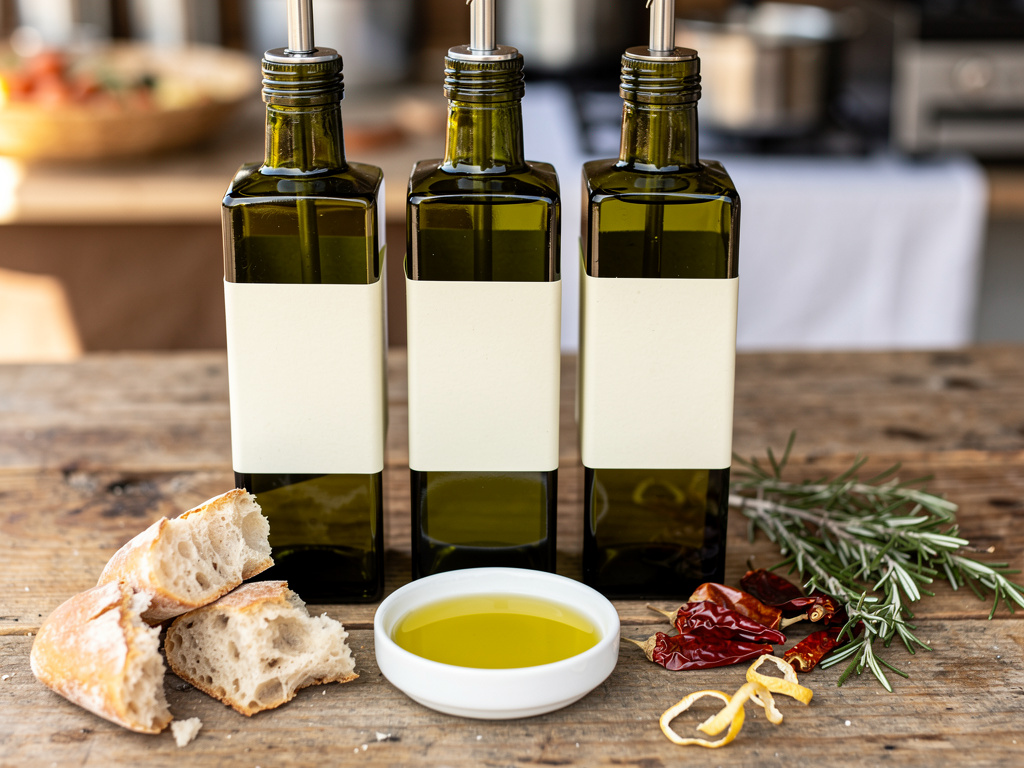


The short version: Price a 250 ml (8.45 oz) bottle of dried-herb infused olive oil at $12 to $16, which is 2.6 to 3.5 times the $4.62 it costs to make with 35-cent-an-ounce grocery olive oil, a glass bottle, a pour cap and a label. That sits above the six garlic-flavored oils on Hy-Vee's website (70 cents to $1.23 an ounce) and below five US olive oil brands' flavored oils ($2.95 to $4.43 an ounce). Plain extra virgin oil from your own trees prices off US producers' plain oils instead, a median of $1.74 an ounce across six of them. Before you price anything, confirm your state lets you sell the oil at all: Michigan and Washington name garlic in oil as a food a home kitchen cannot sell and name no oil on their allowed lists, and California's approved cottage food list names no oil either.
Checked on each company's own page, September 30, 2026: grocery prices on Hy-Vee's website, brand prices on each brand's own online store, supply prices on the supplier sites, and fees on findhomegrown.com/signup, Etsy, Shopify and Square. Homegrown customers create an account to place their first order, and Homegrown has no drops or countdown release feature.
This guide covers two kinds of olive oil vendors. Many readers make flavored or infused olive oil at home, steeping dried rosemary, chili or citrus peel in olive oil they buy. A smaller group has olive trees of their own and wants to know what a bottle of plain oil from the grove should cost. Both get real numbers below, loaded on September 30, 2026.
If you have not made a batch yet, start with our guide to making and selling infused olive oil from home, which walks through the dried-herb method, bottles and labels. Use only its dried-herb method, not its fresh-ingredient one; the garlic section below explains why. This page picks up where that one stops: what to charge, what it costs you, what the grocery store and US olive oil brands charge for the same bottle, and which states let a home kitchen sell oil in the first place.
A 250 ml bottle of olive oil steeped with dried herbs should sell for $12 to $16, with $14 as a good starting price. It costs about $4.62 to make, so $14 is roughly three times your cost and leaves you $8.68 over that cost after the card fee.
Here is the full ladder by size, using the costs worked out later in this guide:
Scroll sideways to see every column.
| Bottle size | What it costs you | Suggested price | Card fee at the middle price | You keep at the middle price | Price per ounce |
|---|---|---|---|---|---|
| 100 ml (3.38 oz) | $2.34 | $6 to $8 | $0.50 on $7 | $4.15 | $1.77 to $2.37 |
| 250 ml (8.45 oz) | $4.62 | $12 to $16 | $0.71 on $14 | $8.68 | $1.42 to $1.89 |
| 500 ml (16.9 oz) | $7.80 | $22 to $27 | $1.00 on $24 | $15.21 | $1.30 to $1.60 |
Costs use Hy-Vee's 68-ounce extra virgin olive oil at $23.99, dried rosemary from Monterey Bay Herb Co. at $7.28 a pound, green glass bottles and caps from California Bottles, and a 4-cent label, all checked September 30, 2026. The card fee is 2.9% plus 30 cents, the rate on Homegrown's signup page that day. Costs and fees are rounded to the cent, so what you keep can differ by a cent from subtracting the rounded numbers.
Three things set where you land inside each range:
It depends on your state, and only one of the six states checked below, Texas, clearly allows it. Texas allows any food except a short list that does not include oil. None of the other five state pages below lists oil among its allowed foods, and Michigan and Washington bar garlic in oil from home kitchens. Confirm your state allows the exact product before you price it. The FDA Food Code singles out garlic in oil.
The reason is botulism. The 2026 FDA Food Code, the newest edition of the model food code FDA publishes for state and local regulators, lists "garlic-in-oil mixtures" that are not modified to stop bacteria growth as a food that needs time and temperature control for safety. In plain words, garlic sitting in oil that has not been treated to stop bacteria is put in the same safety category as raw meat, not the one jam is in.
Here is what six states' own pages said on September 30, 2026:
Swipe left to see the state rules side by side.
| State | What the state's page says about oil | Sales cap on the same page | Wholesale to shops |
|---|---|---|---|
| Michigan | "Garlic in oil mixtures" is listed under foods that cannot be cottage foods, and the allowed list does not name oil | $50,000 a year ($75,000 if your products sell for $250 or more each) | No, direct to the consumer only |
| Washington | "Garlic in oil mixtures" is on the prohibited list, and the allowed list does not name oil | $35,000 a year | No, direct to the consumer only |
| California | The approved cottage food list has 10 categories and none of them is oil | Not used here | Not a cottage food, so it needs a state food registration |
| Texas | Any food is allowed except a short list (meat and poultry, seafood, ice, low-acid canned goods, CBD or THC products, raw milk); oil is not on it | $150,000 | Only to a Texas seller you have a contract with, who registers with the state as a cottage food vendor; not foods that need temperature control |
| Florida | The approved list includes dry herbs and flavored vinegars and does not name oil | $250,000 | No |
| Colorado | The eligible list does not name oil; the state asks you to email it to confirm a product | $10,000 in net revenue for each type of product | No; sold directly to the consumer only, not to restaurants or grocery stores |
Sources, each loaded September 30, 2026: Michigan Department of Agriculture and Rural Development cottage food one-pager (dated 03/2026), Washington State Department of Agriculture cottage food page, California Department of Public Health approved cottage foods list (last reviewed April 2026) and Processed Food Registration page, Texas Department of State Health Services cottage food page, Florida Department of Agriculture and Consumer Services cottage foods page, and the Colorado Department of Public Health and Environment cottage foods page.
The state's own cottage food one-pager, dated March 2026, lists "Garlic in oil mixtures" and "Salad dressings, sauces, or condiments" under foods that cannot be cottage foods. A Michigan home kitchen should not plan a garlic oil around the cottage food law.
What this means for your price:
Cottage food lists change. Michigan's one-pager is dated March 2026, and California's list says it was last reviewed in April 2026. Verify your state's current rules on its own agency page before you print labels, and treat any list here as the September 30, 2026 version.
For the full state picture beyond oil, our cottage food laws by state guide covers caps and permits in more detail.
Plain extra virgin olive oil in bottles and jugs on Hy-Vee's website ran from 29 cents to $1.18 an ounce on September 30, 2026, and six garlic-flavored oils ran from 70 cents to $1.23 an ounce. That is the price a shopper can walk into a store and pay, so it is your floor, not your target.
Slide the table sideways for the price per ounce.
| Product on Hy-Vee's website | Size | Regular price | Price per ounce |
|---|---|---|---|
| Pompeian Imported Extra Virgin Robust | 68 fl oz | $19.99 | 29 cents |
| Hy-Vee Extra Virgin Olive Oil | 68 fl oz | $23.99 | 35 cents |
| Hy-Vee Extra Virgin Olive Oil | 17 fl oz | $7.49 | 44 cents |
| Bertolli Rich Taste Original Extra Virgin | 16.9 fl oz | $7.99 | 47 cents |
| Pompeian Smooth Imported Extra Virgin | 16 fl oz | $7.94 | 50 cents |
| Colavita Classic Extra Virgin, 1 liter | 33.8 fl oz | $29.99 | 89 cents |
| Graza Drizzle Extra Virgin | 16.9 fl oz | $19.99 | $1.18 |
| Nothing But The Truth Organic Garlic Extra Virgin | 8.5 oz | $5.99 | 70 cents |
| Gustare Vita Garlic Flavored Olive Oil | 8.5 fl oz | $7.99 | 94 cents |
| Benissimo Naturals Roasted Garlic Olive Oil | 8.1 fl oz | $9.99 | $1.23 |
| Benissimo Naturals Siciliano Garlic Olive Oil | 8.1 fl oz | $9.99 | $1.23 |
| Benissimo Parmesan Garlic Flavored Cooking Oil | 8.1 fl oz | $9.99 | $1.23 |
| Benissimo Naturals Balsamic Garlic Oil | 8.1 fl oz | $9.99 | $1.23 |
| Stonewall Kitchen Dipping Oil, Garlic Parmesan (sunflower and olive oil with vinegar and cheese; not counted in the garlic range) | 8 fl oz | $9.99 | $1.25 |
| Gustare Vita Truffle Olive Oil | 8.5 fl oz | $7.99 | 94 cents |
| Roland Black Truffle Oil | 3.38 fl oz | $19.99 | $5.91 |
Prices come from Hy-Vee's online store (the site's default store, Urbandale, Iowa) on September 30, 2026. Three of the flavored oils showed a lower sale price that day ($5.29 on one, $4.99 on two); the table uses the regular price. The plain oils are bottles and jugs; spray cans are left out. This is one grocery chain's website, so your local shelf may run higher or lower.
Two takeaways from the shelf:
Five US olive oil brands selling flavored oils from their own websites charged $2.95 to $4.43 an ounce on September 30, 2026, with a median of $3.15 an ounce. The two that sell a 250 ml bottle charge $24.95 and $26.00 for it.
Drag the table sideways to compare all five brands.
| Brand | Flavored oil | Size | Price | Price per ounce | Other sizes |
|---|---|---|---|---|---|
| Texas Hill Country Olive Co. | Black Pepper Garlic Infused | 250 ml | $24.95 | $2.95 | 100 ml $13.95, 500 ml $32.95 |
| Olivelle | Garlic & Herb Infused | 250 ml | $26.00 | $3.08 | 100 ml $14.00, 500 ml $42.00, 750 ml $60.00 |
| McEvoy Ranch | Organic Garlic Olive Oil | 375 ml | $39.95 | $3.15 | 100 ml $14.95, 200 ml tin $28.95 |
| Durant | Garlic Fused Olive Oil | 200 ml | $26.00 | $3.85 | Half gallon $120.00 |
| Pasolivo | Garlic Olive Oil | 200 ml | $29.95 | $4.43 | 100 ml $19.95, 500 ml $49.95 |
Each price comes from the brand's own online store on September 30, 2026, and each bottle showed as in stock. We compared garlic flavors because every brand on the list sells one.
What shoppers pay per ounce for flavored olive oil
Source: Hy-Vee's website, five brands' own stores and Homegrown's catalog, all checked September 30, 2026. The $14 bar is the suggested price in this guide, not a store price.
Why not just charge what these brands charge? At least two of their bottles are a different product. Durant says its garlic oil is made by milling whole garlic cloves "simultaneously" with fresh olives, and McEvoy Ranch describes "co-milling" fresh garlic with its own estate olives. That happens inside a licensed olive mill, not a home kitchen. Price below them, and let your booth, your story and a free taste close the gap.
A 250 ml bottle of dried-rosemary olive oil costs $4.62 to make, and the oil is about two thirds of that. Here is every part, priced on September 30, 2026:
Scroll sideways for all three bottle sizes.
| Part | Where the price came from | 100 ml bottle | 250 ml bottle | 500 ml bottle |
|---|---|---|---|---|
| Extra virgin olive oil | Hy-Vee 68 fl oz for $23.99, 35 cents an ounce | $1.19 | $2.98 | $5.96 |
| Dried rosemary | Monterey Bay Herb Co., $7.28 a pound | $0.05 | $0.11 | $0.23 |
| Square green glass bottle (the "Marasca" shape) | California Bottles, cases of 24 ($15.98) or 12 ($12.98, $13.98) | $0.67 | $1.08 | $1.17 |
| Tamper-proof cap with pour spout | California Bottles, 500 caps for $200, one cap for all three bottles | $0.40 | $0.40 | $0.40 |
| Weatherproof 2-inch label | OnlineLabels, 2,000 labels for $79.81 | $0.04 | $0.04 | $0.04 |
| Total | $2.34 | $4.62 | $7.80 |
The herb amounts are our estimate and on the generous side: a tenth of an ounce of dried rosemary for 100 ml, a quarter ounce for 250 ml, a half ounce for 500 ml. Oil the herbs soak up when you strain them is not counted, so weigh your first batch. Shipping on the glass, caps and labels is not counted either; add it from your first order's receipt. Supplier prices checked September 30, 2026. Each part is rounded to the cent and the totals are added before rounding, so a total can differ by a cent from the sum of its parts.
A few things the table shows:
Buy bottles with the same neck in every size. California Bottles' 31.5mm pour cap fits its 100, 250, 500 and 750 ml oil bottles listed as "ROPP finish," which have the wider 31.5mm threaded neck, so one $200 bag of 500 caps covers all three sizes in this guide. Its 24mm-neck 100 ml bottle needs a separate bag of caps with no pour spout.
Among three grocery oils, the base oil swings your cost per 250 ml bottle from $4.62 to $9.13, which moves your price more than any other choice. Here is the same rosemary bottle with three grocery oils from Hy-Vee's website:
Slide sideways to compare the three oils.
| Base oil | Price per ounce | Oil in a 250 ml bottle | Full bottle cost | Price at three times cost |
|---|---|---|---|---|
| Hy-Vee Extra Virgin, 68 oz | 35 cents | $2.98 | $4.62 | about $14 |
| Bertolli Rich Taste Extra Virgin, 16.9 oz | 47 cents | $4.00 | $5.63 | about $17 |
| Colavita Classic Extra Virgin, 1 liter | 89 cents | $7.50 | $9.13 | about $27 |
Oil prices from Hy-Vee's website, September 30, 2026. Bottle, cap, label and rosemary costs are the same as the table above. The Colavita row at three times cost comes to $3.19 an ounce, more than the cheapest brand in step 4 below ($2.95), so price that bottle near $24 instead.
What to do with that:
Add up one bottle, multiply by about three, check it against the grocery shelf and the brands above, then round to a price that is easy to say. Here is the order:
Once you have a number, write it on a card and leave it for a month. Moving price every week confuses the regulars who are just starting to trust you.
Price the small bottle higher per ounce and the big one lower, so each size has a job: $6 to $8 for 100 ml, $12 to $16 for 250 ml, and $22 to $27 for 500 ml. The brands do the same thing: Texas Hill Country Olive Co. charges $13.95 for 100 ml and $32.95 for 500 ml of the same infused oil, five times the oil for about 2.4 times the price.
Sell three 100 ml bottles as one gift set for $21 instead of three separate $7 sales. The card fee on one $21 order is 91 cents, against $1.51 on three $7 orders, so you save 60 cents and keep $13.07 over your $7.02 cost.
Try the gift trio from November through the holidays. Our guide to holiday subscription boxes for food vendors shows how vendors bundle several products for the season.
Only when the flavor costs you more. At Monterey Bay Herb Co.'s September 30, 2026 prices, dried chili and dried orange peel cost about 12 and 14 cents for a 250 ml bottle, against about 11 cents for dried rosemary, so keep them at the base price. For blends or specialty ingredients that really do cost more, add 2.5 to 3.5 times what they add to your cost, and price those from your receipt.
The grocery shelf shows that a flavor name alone does not set the price: six garlic-flavored oils on Hy-Vee's website ran 70 cents to $1.23 an ounce, and truffle oils ran from 94 cents to $5.91.
A few rules keep your flavor pricing honest:
The garlic oils from Durant and McEvoy Ranch in the table above are made by milling fresh garlic with olives in a licensed mill. That is not something a home kitchen can copy. If your state allows a garlic flavor at all, make it with dried garlic and say so on the ingredient list. Michigan's one-pager and Washington's cottage food page bar "Garlic in oil mixtures" with no exception for dried garlic.
Unflavored extra virgin oil sold for $1.42 to $2.95 an ounce on six US producers' websites on September 30, 2026, a median of $1.74 an ounce. That is about $24 to $30 for a 500 ml bottle at most of them.
Scroll right to see all six plain oils.
| Producer | Plain extra virgin oil | Size | Price | Price per ounce |
|---|---|---|---|---|
| Queen Creek Olive Mill | Robust Extra Virgin | 500 ml | $24.00 | $1.42 |
| Corto | TRULY Extra Virgin | 500 ml | $24.50 | $1.45 |
| McEvoy Ranch | Cooking Extra Virgin | 500 ml | $28.95 | $1.71 |
| Texas Hill Country Olive Co. | Hojiblanca Extra Virgin | 500 ml | $29.95 | $1.77 |
| Durant | Arbequina Extra Virgin | 375 ml | $25.00 | $1.97 |
| Pasolivo | Cucina Extra Virgin | 500 ml | $49.95 | $2.95 |
Checked on each brand's own online store on September 30, 2026. Durant also sells a gallon for $140 ($1.09 an ounce), McEvoy Ranch a gallon of its cooking oil for $149 ($1.16 an ounce), and Corto a 3-liter box of its TRULY oil for $74 (about 73 cents an ounce).
Here is how to set your own grove price:
The state's 2026-2027 olive oil grade and labeling standards, which take effect October 1, 2026, apply to handlers who process 5,000 gallons or more a year. Handlers under 5,000 gallons "are deemed to be engaged in casual sales of olive oil and are not subject to these standards." Oil is still not on California's approved cottage food list, so a small grove selling bottles generally needs the state's Processed Food Registration, the basic permit California requires of food manufacturers.
Twelve 250 ml bottles of rosemary oil sold at $14 bring in $168 and leave about $104 after ingredients, glass and card fees. That batch uses about 101 ounces of oil, or one and a half of Hy-Vee's 68-ounce jugs.
Here is the working:
The University of Maine's infused oil guide says to throw out homemade infused oil three months after it is made and to put the date it was made on the label. That clock keeps running in your customer's kitchen, so bottle only what you can sell in the first few weeks, and an unsold 250 ml bottle is a $4.62 loss.
Our estimate is about two hours of hands-on time for that batch: warming the oil with the herbs, straining after the steep, bottling and labeling. That works out to about $52 an hour before booth fees and your market day. Your own time will vary, so time your first batch with a phone timer and redo the math.
Booth fees come out of that $104, and they are easy to leave out. Our breakdown of the real cost of selling at farmers markets shows what a season of booth fees, insurance and supplies adds up to.
On a $14 bottle, Homegrown's card fee is 71 cents and Etsy's fees add up to $1.78. Here is the full fee stack on each platform a small oil vendor is likely to use, for one bottle and for a month of 40 one-bottle orders:
Scroll sideways to see the full fee stack on every platform.
| Platform | Monthly plan | Trial | Platform or transaction fee | Card processing | Customer pays on a $14 bottle | Vendor pays on a $14 bottle | Vendor pays on 40 orders at $14 |
|---|---|---|---|---|---|---|---|
| Homegrown | $10 billed annually ($12.50 billed monthly) | 7 days, no charge until day 8 | None, 0% commission | 2.9% + $0.30, paid by the vendor | $14.00 | $0.71 plus the plan | $38.24 ($40.74 on the monthly plan) |
| Etsy | $0 (a one-time shop set-up fee may apply) | None | $0.20 listing fee plus 6.5% transaction fee; 15% Offsite Ads fee on ad sales | 3% + $0.25 | $14.00 plus shipping | $1.78 | $71.20 |
| Shopify Basic | $29 billed yearly | 3 days, then $1 a month for 3 months | None with Shopify Payments (2% with another provider) | 2.9% + 30 cents online (3.5% + 30 cents on premium cards) | $14.00 | $0.71 plus the plan | $57.24 |
| Square Free, online | $0 | None | None | 3.3% + 30 cents | $14.00 | $0.76 | $30.48 |
| Square Free, in person | $0 | None | None | 2.6% + 15 cents | $14.00 | $0.51 | $20.56 |
We checked every fee on each company's own page (findhomegrown.com/signup, etsy.com/sell, shopify.com/pricing and squareup.com pricing) on September 30, 2026. Card processing is figured on the $14 price; on a total with tax or shipping it runs higher by the same percentage. On Etsy, the 6.5% transaction fee also applies to the shipping price you set, so an order with $8 shipping costs you at least 52 cents more than the $1.78 shown. Etsy's Offsite Ads fee applies only to sales from those ads and is left out of the totals.
What the table means for an oil vendor:
A reorder link that regulars can use between market days is what turns a $14 first bottle into a repeat order. Plan your pricing around the second bottle, not just the first. Someone loved your rosemary oil at the booth in May, ran out in June, and has no easy way to get more until they happen to walk past your table again. Pricing only works if the reorder happens.
That is where a simple ordering link does its job. Homegrown is $10 a month billed annually, with no percentage fees beyond standard payment processing. You list each flavor and size, share one link on your bottle label and at your booth, and customers order and pay before your market day or pickup window. You bottle to the orders you already have instead of guessing how many 500 ml bottles to bring. Some states set extra rules for cottage food ordered online, like the Texas label and delivery rule above, so check yours before you share the link.
Compare that to the usual alternatives:
What Homegrown does not do: it lets you offer pickup and local delivery that you run yourself, not nationwide shipping, it does not manage wholesale accounts for shops, and it has no drops or countdown release feature. Customers create a Homegrown account to place their first order. Your Homegrown storefront shows up on the Homegrown marketplace, but plan on most orders coming from people you send to your own link.
If your regulars keep asking when your next batch is ready, set up a Homegrown storefront and put the link on your next round of labels. The trial runs 7 days with no charge until day 8.
One Homegrown vendor, Rosbrook Farm in Texas, lists 12 infused olive oils and prices the 11 with a size in the name at $1.25 an ounce: $10 for 8 ounces and $15 for 12 ounces.
In a pull of the Homegrown catalog on September 30, 2026, 12 of the 2,763 products listed by 312 vendors were olive oil sold as the product, all from Rosbrook Farm, at $10 for 8 ounces and $15 for 12 ounces ($1.25 an ounce). Nine of them say they are made with herbs or peppers dried on the farm: six 8-ounce oils at $10 (basil, cayenne, rosemary, sage, tarragon and thyme), purple basil and Italian basil in 12 ounces at $15, and one Italian basil oil at $10 with no size in the name. We searched every listing's name and full description for olive, infused oil, flavored oil and chili oil, then read all 92 matches by hand and left out breads, soaps and recipes that only use olive oil as an ingredient, and one $24 oregano oil from a different vendor that is sold as a wellness product. One more listing, from a different vendor, a 5-ounce chili oil for $7, does not say what oil it uses.
Two things stand out from that one storefront:
If you grow herbs too, our guide on what to charge for fresh and dried herbs covers the other half of that business.
Sometimes, but check your state first, because several cottage food laws ban wholesale outright. Florida's page says "Cottage food products cannot be sold wholesale," Washington's says products "can only be sold directly to the consumer," and Michigan's one-pager says they "must be sold directly from the cottage food operation to the consumer." Colorado's page says products "cannot be sold to restaurants or grocery stores." Texas bars wholesale of foods that need temperature control, and allows it for other foods only to a Texas seller you have a contract with, who registers with the state as a cottage food vendor and sells to consumers for you.
If your state allows it, here is what a shop deal looks like:
If a restaurant asks, it will likely want bigger containers than a 250 ml retail bottle, so price that size from its own cost. At $4.62 a bottle, an $8 wholesale price leaves you $3.38, which gets thin fast, so hold off until retail sales are steady. Until then, a farm stand, a pickup window or a holiday market usually pays more per bottle than a shop does, and where to sell olive oil, place by place compares seven of them with the fees on a $14 bottle.
One expensive mistake is pricing from the grocery shelf instead of from your own costs. A 70-cent-an-ounce garlic oil at the store does not mean your $4.62 bottle should sell for $6. Here are others to watch for:
Most of these come down to one habit: write your cost per bottle on a card and check it every time a supplier's price changes. If you already sell infused vinegar, our guide to selling infused vinegar from home is the lower-cost companion product to put next to your oils.
Charge $12 to $16 for a 250 ml (8.45 oz) bottle of olive oil flavored with dried herbs. It costs about $4.62 to make with 35-cent-an-ounce grocery olive oil, glass, a cap and a label, so $14 is about three times cost. A 100 ml bottle sells for $6 to $8 and a 500 ml for $22 to $27.
It depends on your state. Michigan and Washington list garlic in oil among foods a home kitchen cannot sell and name no oil on their allowed lists, California's approved cottage food list names no oil, and Texas allows any food except a short list that does not include oil. Confirm your state allows the exact product before you price it.
A 250 ml bottle costs about $4.62 using Hy-Vee's 68-ounce extra virgin olive oil at $23.99, a quarter ounce of dried rosemary, a green glass bottle, a pour cap and a label, with prices checked September 30, 2026. The oil is about two thirds of that. With an 89-cent-an-ounce oil the same bottle costs $9.13.
Six US producers charged a median of $1.74 an ounce for unflavored extra virgin oil on their own websites on September 30, 2026, or about $24 to $30 for 500 ml at most of them. Start from your cost per ounce after milling, multiply it by 16.9 for a 500 ml bottle, add about $1.61 for the bottle, cap and label, and put the harvest date on the label.
Not without checking your state first. The FDA Food Code lists garlic-in-oil mixtures that are not treated to stop bacteria growth as a food that needs time and temperature control, and Michigan and Washington bar garlic in oil mixtures from cottage food sales, with no exception written for dried garlic. The University of Maine Cooperative Extension calls dried garlic and herbs the safest way to make infused oil at home, though its guide says it is not meant for products you sell. If your state allows a garlic flavor, use dried garlic.
Make the 250 ml bottle your main size, with 100 ml as a tasting size and 500 ml for regulars. Price the small bottle higher per ounce and the large one lower, the way Texas Hill Country Olive Co. charges $13.95 for 100 ml and $32.95 for 500 ml of the same oil.
These five guides answer the questions olive oil vendors usually ask next, from making the oil safely to what else to put on the table beside it:
You now know what a bottle costs you, what the grocery shelf and US olive oil brands charge, and what your state allows. The last step is making the second bottle easy to buy.
Here is a simple plan for your first month:
Start your Homegrown storefront, list your flavors and sizes at the prices you just worked out, and put the link on every label and on a card at your booth. It is $10 a month billed annually with no commission and no percentage fees beyond standard payment processing, and orders placed through your link are paid before you bottle them.



