
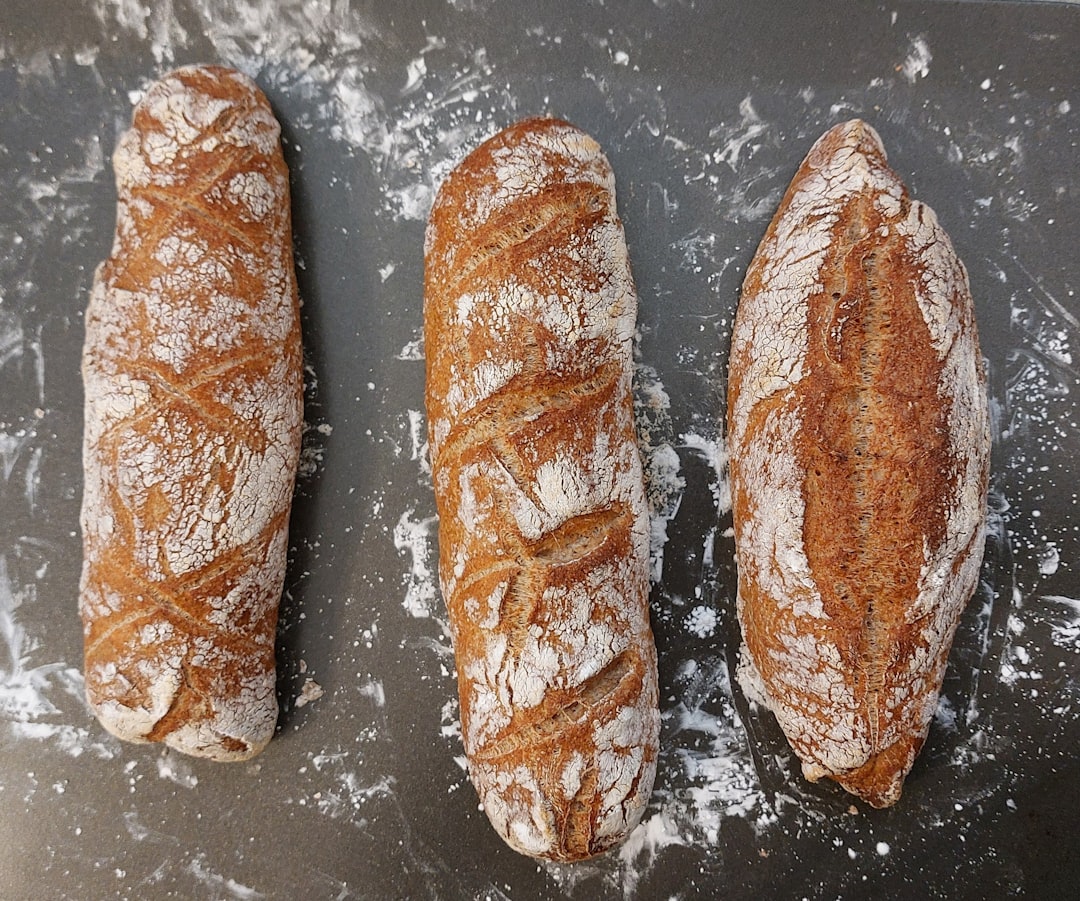


A microbakery is a very small bakery, usually run by one person out of a home kitchen, that produces a limited menu on a fixed schedule and sells it directly to local customers who ordered ahead.
That's the whole definition. What makes the term worth understanding is that it isn't a legal category, it isn't a license you apply for, and nobody issues you one. It's a description of an operating model, and the model has specific mechanics that separate a microbakery from a hobby, from a custom-order baker, and from a retail bakery that happens to be small.
If you bake a set menu on a set day for people who ordered in advance, you're running a microbakery. Most people who are running one have never used the word.
The short version: A microbakery is defined by four things: a single operator or a very small team, a home or small rented kitchen, a limited fixed menu, and production tied to pre-orders rather than speculation. Legally it operates under your state's cottage food law, the same as any home baker. What distinguishes it from other small-baking models is the pre-order batch rhythm, which is also what makes the economics work at a scale where a retail bakery would fail. The term carries no regulatory weight; your state's cottage food law is what actually governs what you can sell and where.
One operator, or close to it. Microbakeries are typically a single person, sometimes with a partner or occasional help on bake day. There's no staff schedule, no shift coverage, and no separation between the person mixing the dough and the person answering the customer emails. That constraint drives every other design decision.
A home kitchen, or a small rented one. Most microbakeries operate under cottage food law out of a residential kitchen. Some rent hours in a shared commercial or church kitchen, usually because they've outgrown their state's sales cap or want to make products the cottage food list excludes.
A short, fixed menu. Three to six items, repeated. Not a case full of options. The menu is short because a single person cannot batch-produce twelve products in one session without the day falling apart.
Production driven by orders, not guesses. This is the load-bearing one. A microbakery opens an order window, collects orders and payment, closes the window, and bakes exactly that. Nothing is made on speculation, so nothing goes stale unsold. This is the difference that makes a one-person operation viable, and it's why the model spread so quickly.
Almost every microbakery converges on a version of the same cycle, usually because it's the only shape that fits around a job or a family.
Menu goes up. Sunday or Monday. Same day every week, which matters more than which day. Customers who know when to look will look. Customers who have to guess will forget.
Order window is open. Two to four days. Customers see what's available, pick quantities, and pay. Each item has a cap, and when the cap is reached the item shows sold out.
Window closes. Usually 48 to 72 hours before bake day, which is what gives you time to shop, do the math, and start a levain.
Prep and bake. One or two days. Everything for the week happens in this block.
Pickup. One window, usually two to three hours on a weekend morning. Everyone comes to one place at one time.
Then it repeats. The rigidity is the feature. It compresses all the coordination into predictable blocks instead of spreading it across seven days, which is what lets someone run this alongside a full-time job.
If you want the operational detail on setting the window length, cap sizes, and cutoff timing, how to run a weekly food drop and the weekly drop model cover it.
These get used interchangeably, and the distinctions are real but soft.
Home bakery describes *where*. Any bakery operating out of a residence. It says nothing about how you sell, so a custom cake decorator taking one order at a time and a batch sourdough operation are both home bakeries.
Cottage bakery describes *the legal frame*. It signals you're operating under cottage food law, with its product limits, sales caps, and label requirements. It's the most precise term legally and the least descriptive operationally.
Microbakery describes *the model*. A short menu, batch production, pre-orders, direct local sales. A microbakery is almost always also a home bakery and a cottage bakery, but the word is doing different work: it tells you how the business runs, not where it sits or which statute covers it.
The practical implication is that if you're searching for rules, "microbakery" won't find them, because no state uses the word. Search your state's cottage food law instead.
This is the distinction that actually changes your income, so it's worth more than a definition.
A custom-order baker takes individual commissions. A birthday cake for the 14th, a cookie set for a shower on the 22nd. Each order is quoted separately, made in its own small batch, and delivered on the customer's timeline.
A microbakery sets the menu and the date. Customers choose from what's offered, on the schedule that's offered.
The economics diverge sharply. Custom work has a higher sticker price per item and a much lower effective hourly rate, because you're producing small quantities on scattered days with consultation time attached to every order. Batch work has a lower price per item and far better hourly economics, because one mixing session, one preheat, and one cleanup serve twenty or forty units instead of one.
Concretely: four loaves baked in three hours pay roughly half what twelve loaves baked in four hours pay, per hour, for identical product. That's the entire argument for batching, and it's covered in full in how to price baked goods and bake to order vs. bake to sell.
Most microbakeries that survive end up running a batch menu as the backbone and accepting a strictly limited number of custom orders on top, priced high enough to be worth the disruption. Taking unlimited custom orders is the most common way a promising home bakery becomes an exhausting one, which is the subject of why custom orders keep food businesses overcommitted.
Real numbers, because the vague version isn't useful.
A single weekly bake producing 20 sourdough loaves priced at $16 grosses $320. Ingredients run about $25, packaging and labels about $9. That leaves roughly $286 before your own labor, from one bake day.
Scale that across common configurations:
| Configuration | Weekly gross | Roughly, monthly |
|---|---|---|
| 20 loaves, one bake day | $320 | ~$1,280 |
| 20 loaves + 15 cookie dozens | $560 | ~$2,240 |
| 40 loaves + 20 dozens, two bake days | $1,000 | ~$4,000 |
The third row is where most microbakeries hit a genuine ceiling, and it's rarely a demand ceiling. It's an oven ceiling, a pan ceiling, or a hours-in-a-weekend ceiling. A standard home oven fits a finite number of loaves per cycle, and cycles take what they take.
Two other ceilings arrive around the same point. Your state's cottage food sales cap, which ranges from about $5,000 in the most restrictive states to $150,000 in Texas, with many in the $25,000 to $75,000 band. And the coordination ceiling, which shows up as messages you didn't answer and orders you can't reconcile.
Every microbakery hits a wall, and it's the same wall: the informal system that got you here can't hold the volume you now have.
It's gradual, not dramatic. Two people ask about the last loaf on different platforms and you say yes to both. A request sits unread in a filtered folder for three days. Friday morning you can't tell from your notes whether someone paid or just said they would. You bake for someone who never confirmed and never arrives.
For most people this lands somewhere between ten and twenty orders a week, and it arrives faster than expected once word of mouth kicks in.
None of it is a personal failure. It's a message inbox, a spreadsheet, and a payment app being asked to do a job that requires them to talk to each other, which they don't.
What resolves it is connecting the pieces: a menu with live quantities that go sold-out on their own, payment taken at the moment of ordering so a confirmed order is genuinely confirmed, automatic confirmations and pickup reminders, and a bake list generated from the orders rather than assembled by hand. That's what a pre-order storefront does, and it's the single highest-leverage thing a microbakery adds after the first few months.
The reason microbakeries proliferated is that the barrier to entry is almost entirely equipment you already own. But a few specific bottlenecks show up for everyone at the same point, and knowing them in advance saves a scramble on a Friday night.
What you already have and don't need to upgrade: your oven, a stand or hand mixer, a kitchen scale, and basic bowls and utensils. A standard residential oven handles microbakery volumes fine. The instinct to buy a deck oven before you have customers is the most expensive early mistake available.
The real bottleneck is pans, not the oven. Going from baking for your family to baking twenty units means you run out of sheet pans, loaf pans, and bannetons long before you run out of oven capacity. A second full set of whatever you make most is usually the highest-return purchase you'll make, and it typically costs under a hundred dollars.
Cooling space is the second bottleneck, and nobody expects it. Twenty loaves need somewhere to sit for two hours, and a countertop doesn't hold twenty loaves. Stackable cooling racks solve it cheaply.
A dedicated packing area matters more than it sounds like it should. Bake day ends with sealing, labeling, and staging orders, and doing that on the same counter you're still baking on is how labels end up on the wrong bags.
A label printer becomes worth it around order thirty a week. Below that, sheet labels through a home inkjet are fine. Above it, the hand time adds up. Label and sticker printers for food businesses compares the options.
Food safety practice matters as much as equipment, and your cottage food exemption doesn't exempt you from it. Cross-contamination and allergen control are the two that matter most in a shared home kitchen, especially if you make both gluten-containing and gluten-free products, since customers with celiac disease can't safely eat from a kitchen that also handles wheat regardless of the specific recipe. The USDA's Food and Nutrition Information Center is a reasonable starting reference, and many states fold this into the food-safety course they require anyway.
Microbakeries aren't a new idea so much as an old one that got its infrastructure back.
Neighborhood-scale baking was the norm before industrial distribution consolidated it. What changed recently is that three things arrived at once: cottage food laws expanded across nearly every state through the 2010s and 2020s, home sourdough baking went mainstream, and payments plus online ordering became cheap enough for a one-person operation to use.
Consumer demand moved the same direction. USDA's Economic Research Service tracks local food markets, and the direct-to-consumer channel has grown steadily as buying from an identifiable local producer became something people actively want rather than a fallback.
The legislative trend is still moving. Georgia removed its cottage food license and sales cap outright in 2025. Texas tripled its cap to $150,000 the same year and barred local governments from charging fees. Several states have added permission for refrigerated and temperature-controlled products that were universally prohibited a decade ago. The regulatory direction of travel is toward making this easier, not harder.
Yes, in all fifty states, under cottage food law. The word "microbakery" appears in no statute, so what governs you is your state's cottage food rules like any other home baker.
Three things to establish before you sell:
Your permit requirement. In 38 states there's no state permit fee at all for standard shelf-stable baked goods sold direct to consumers. Twelve charge, ranging from $30 a year in Delaware to $355 for two years in Washington. California and Massachusetts set fees locally. The full state-by-state picture is in how much a cottage food license costs.
Your sales cap. Some states have none. Others cap in the low thousands. It's measured on gross sales, not profit, and crossing it moves you out of the exemption rather than fining you.
Your label. Every state requires one, and nearly all specify exact disclaimer wording, often at a minimum type size. Paraphrasing doesn't satisfy the requirement. See cottage food labeling requirements and the printable label checklist.
One more that state law won't cover: your city, county, or HOA can layer on zoning rules, limits on residential traffic, or signage restrictions. A neighbor complaint about cars during a Saturday pickup window is the most common real-world friction a microbakery encounters, and one call to your local health department before your first pickup usually prevents it. Full detail in is it legal to sell baked goods from home.
The setup is genuinely short.
The complete home bakery guide walks each of these in detail.
A very small bakery, usually one person working from a home kitchen, producing a short fixed menu on a set weekly schedule and selling directly to local customers who pre-ordered. It's an operating model rather than a legal category, and it operates under your state's cottage food law like any other home baking business.
"Home bakery" describes the location, meaning any bakery run out of a residence. "Microbakery" describes the model: short menu, batch production, pre-orders, direct local sales. A custom cake decorator working from home is a home bakery but not a microbakery, because the production model is different.
It depends entirely on your state, and it has nothing to do with the word. In 38 states there's no permit or fee for standard shelf-stable baked goods sold directly to consumers, though some of those require a free registration or a food-safety course. Twelve states charge a fee. Check your state's cottage food law.
A single weekly bake of 20 loaves at $16 grosses about $320 a week, or roughly $1,280 a month before labor. Adding a second product line roughly doubles it. Two bake days a week at 40 loaves plus 20 cookie dozens puts you near $4,000 a month gross. The ceiling is usually oven capacity and available hours rather than demand, and above that your state's sales cap becomes the binding constraint.
Three to six. Fewer than most people expect. A single operator cannot batch-produce a dozen products in one session without the day collapsing, and every added product multiplies ingredient inventory, packaging, and timing complexity. Products that share ingredients and oven temperatures are worth far more than products that don't.
Rarely. Interstate shipping moves your product into federal jurisdiction where a state cottage food exemption doesn't apply, and almost no state permits it. North Dakota and Pennsylvania are the notable exceptions. A larger group of states allow shipping within state lines. See can you ship cottage food.
No. That's the point of cottage food law and the reason the model is accessible. A commercial or shared-use kitchen only becomes necessary if you exceed your state's sales cap, want to make products the cottage food list excludes, or want to sell wholesale in a state that doesn't permit it under the exemption.
If you bake a set menu on a set day for people who ordered ahead, you have a microbakery, and the useful question isn't what to call it. It's which of the three ceilings you're closest to: oven capacity, your state's sales cap, or the coordination limit.
The first two you solve with equipment or a licensing change. The third you solve by getting orders out of your messages, and it's usually the one people hit first and recognize last.
A Homegrown storefront gives your microbakery a link for your bio, a live batch menu with quantity caps that sell out on their own, checkout and payment at the moment of ordering, and pickup management. Plus a listing in a local marketplace where nearby customers can find you. It's $10 a month billed annually, or $12.50 month to month, with no commission on your sales at any volume.



