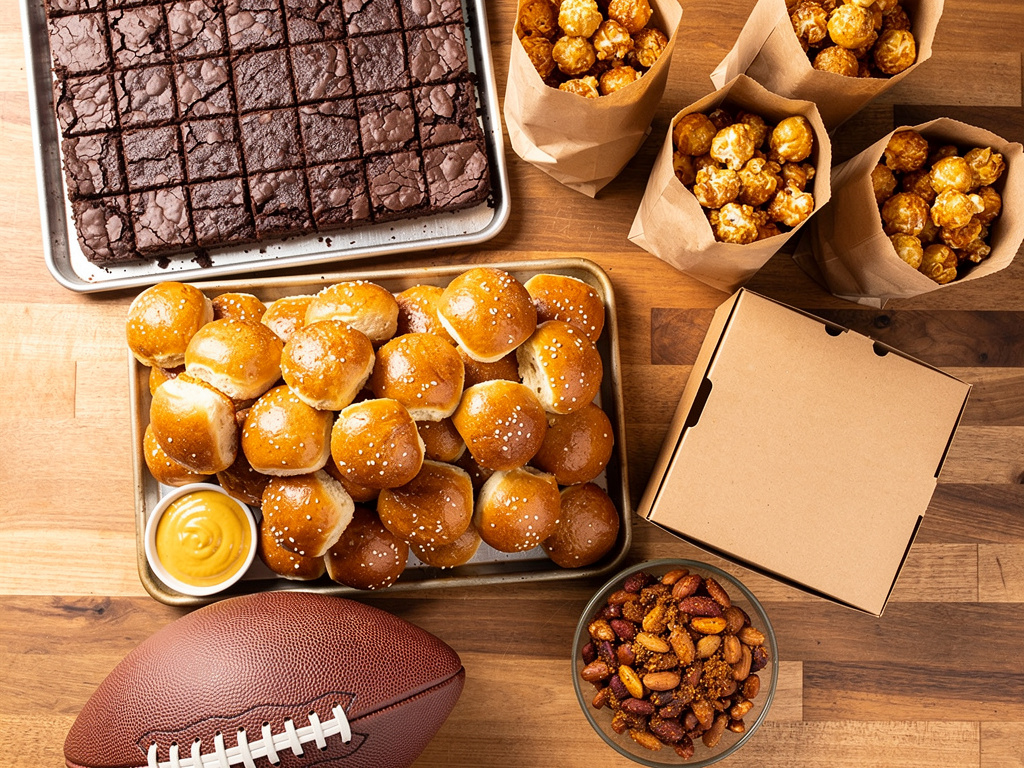


The short version: Super Bowl LXI is on Sunday, February 14, 2027, the same day as Valentine's Day, so a home food vendor gets two kinds of orders on one weekend. The snacks that work best are party-size trays of foods your state lets you make at home, like soft pretzel bites, brownies, cookies, popcorn and spiced nuts, while salsa, cheese dip, wings and cream cheese frosting are not on California's list and often need a licensed kitchen. Open pre-orders about two weeks out, close them the Wednesday before the game, cap every item at what your kitchen can make, and give customers a Saturday and a Sunday morning pickup window. Homegrown is $10 a month billed annually with no percentage fees beyond standard payment processing, and on a $40 game-day order the vendor pays $1.46 in card processing.
Checked on October 14, 2026: the game date (FOX 11 Los Angeles), NRF's 2026 Super Bowl survey, California's Approved Cottage Foods list (last reviewed April 2026), the pricing pages of Homegrown, Hotplate, Square and Venmo, and a pull of Homegrown's own catalog. Home food rules differ by state, so verify your state's current rules with its agency. Homegrown customers create an account to place their first order, and Homegrown has no drops feature.
Every February, your regulars have a party to feed and no time to bake for it. That is the whole opportunity. A host who is buying chips, setting up the TV and texting the group chat is happy to hand off the snack table to someone local who makes it better.
This guide is for the small, part-time vendor who wants to run one strong Super Bowl weekend without wrecking the rest of the month. It covers which game day snacks you can legally sell from a home kitchen, which ones to skip, what party sizes to offer, a day-by-day order calendar for February 2027, how many orders one kitchen can realistically handle, and what it costs to take those orders online.
Super Bowl Sunday is a party day for most of the people who watch: in NRF's 2026 survey, 121.1 million U.S. adults planned to throw or attend a party, and total game day spending was expected to reach a record $20.2 billion, or $94.77 per person. A slice of that goes to food, and every one of those parties needs a snack table.
The numbers come from the National Retail Federation's annual Super Bowl spending survey, which polled 7,791 adults from January 2 to 8, 2026. The same survey counted 213.1 million adults planning to watch and 18.2 million planning to watch at a bar or restaurant. In other words, more than half of the people planning to watch (121.1 million of 213.1 million) also planned to throw or attend a party.
That matters for a home vendor because party food is bought in bulk and bought ahead. A host does not want one cookie. They want a tray for 15 people, ready on Saturday afternoon or Sunday morning. That is a bigger ticket than your usual order and it is easier to plan, as long as you know the count before you start baking.
Here is why the weekend works so well for a small kitchen:
The single most important piece of the plan is a firm cutoff. If you have never set one, start with our guide to setting order cutoff times for a food business, which explains why most cottage food vendors land on 48 hours for regular orders and longer for big ones.
In 2027 the Super Bowl falls on Valentine's Day: Super Bowl LXI is set for Sunday, February 14, 2027, at SoFi Stadium in Inglewood, California, the first time the game has been scheduled on February 14. For a home baker, that turns one busy weekend into two overlapping ones.
FOX 11 Los Angeles reported the date and the Valentine's Day first, and we checked it on October 14, 2026. Some of your customers will be hosting a watch party. Others will be buying heart cookies for a partner, a friend or a coworker. Some will want both.
You have three ways to handle the overlap:
Most part-time vendors do best with option 3, because it gives each menu its own bake instead of squeezing both into the same 3 days of Thursday-to-Saturday prep. The two crowds want different things. A Valentine's buyer wants pretty and giftable. A Super Bowl host wants quantity, salt and something easy to grab with one hand.
If you plan to run both, read our guide to Valentine's Day sales for home bakers first. Its two-week marketing calendar lines up almost exactly with the game day calendar later in this guide, so you can announce both menus in the same posts.
Under cottage food laws like California's, you can sell shelf-stable snacks like soft pretzels, brownies, cookies, popcorn, candied popcorn, roasted nuts, potato chips, trail mix and toffee, because they do not need a fridge to stay safe. Cottage food is the set of state rules that lets you make and sell certain low-risk foods from your home kitchen.
California is a useful example because its list is specific. California's Approved Cottage Foods list, last reviewed in April 2026, describes cottage foods as foods that do not support the rapid growth of germs when held outside time and temperature control. That is exactly the kind of food you want on a party table that sits out for four hours. The table below checks 8 common game day products against that list.
Scroll sideways to see every column.
| Game day snack | On California's list? | Which category | Party note |
|---|---|---|---|
| Soft pretzels and pretzel bites | Yes | Baked goods without cream, custard or meat fillings (pretzels are named) | The anchor of most game day menus |
| Brownies and cookies | Yes | Baked goods (both named) | Sell by the tray, not the piece |
| Cupcakes | Yes, with an approved frosting | Baked goods, plus frostings that do not contain eggs, cream or cream cheese | Buttercream yes, cream cheese frosting no |
| Popcorn and candied popcorn | Yes | Dried foods (popcorn) and candy (candied popcorn) | Cheap to make, easy to bag ahead |
| Roasted or spiced nuts | Yes | Nuts, roasted or pasteurized only | Label for tree nut and peanut allergies |
| Potato chips and trail mix | Yes | Dried foods (both named) | Seal well; stale chips lose repeat customers |
| Toffee, fudge, chocolate-covered snacks | Yes | Candy and confections | A sweet add-on to a salty tray |
| Plain mustard | Yes | Mustards, plain and without eggs | Pairs with pretzels |
We read every category on California's Approved Cottage Foods list on October 14, 2026. Other states use different lists, and some allow fewer foods. Check your own state before you build a menu.
A Cottage Food Operation has to register with or get a permit from its local Environmental Health Department, and it can only make foods on the approved list. We checked that on the California Department of Public Health's Cottage Food Operations page on October 14, 2026.
Outside California, start with our list of what foods you can sell under cottage food laws, then open your own state's page. If you are in California, our California cottage food law guide covers the two permit classes and the labeling rules.
Leave off wings, sliders, chili, queso, cheese dips, salsa and anything with cream cheese frosting unless you have a licensed kitchen or your state says yes in writing. The foods in the list below are game day staples, and they are also the ones most likely to need a fridge.
Read the California list again with game day in mind and you notice what is missing. There is no category for meat, and baked goods are allowed only without meat fillings. There is no category for salsa, dips or cheese. Frostings are allowed only when they contain no eggs, cream or cream cheese.
Foods to think twice about:
Salsa is a game day staple, and the rules on it change from state to state. California's April 2026 list has no salsa category at all. Other states treat canned and fresh salsa differently, and some add steps before you can sell either. Read our guide to whether you can sell homemade salsa and your state's own page before you put a jar on the menu.
The good news is that the legal list is still a great party menu. A tray of salted pretzel bites with plain mustard, a bag of spiced nuts, a pan of brownies and a bag of caramel corn feeds a room just fine.
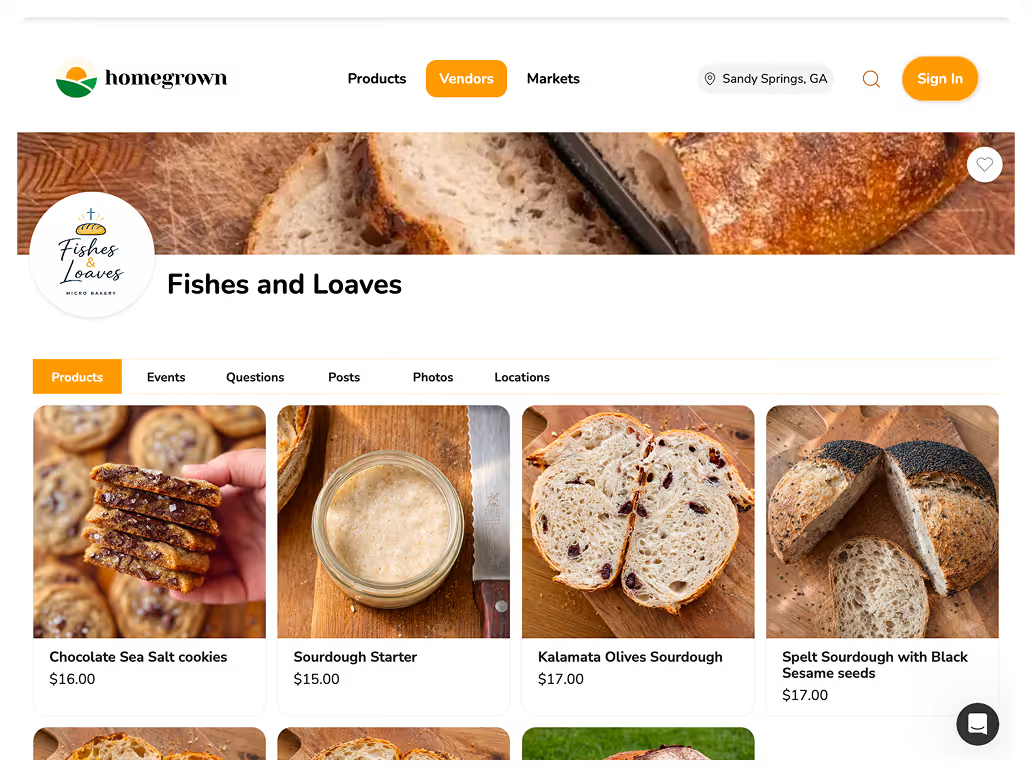
In Homegrown's catalog on October 14, 2026, not one of the 2,919 listings mentioned football, the Super Bowl or game day, while 16 listings sold soft pretzels or pretzel bites, 17 sold salsa and 3 sold bags of popcorn. Vendors already sell the snacks. Nobody on Homegrown packaged them for the game that day.
In a pull of the Homegrown catalog on October 14, 2026 (2,919 products from 323 vendors), we searched every listing's name, description and flavor options. Zero mentioned football, the Super Bowl, game day, the big game, a touchdown or tailgating. Pretzels: 16 listings from 4 vendors, counting only soft pretzels and pretzel bites, not cookies, candy, bagels or breads with pretzel in them. Salsa: 17 listings from 8 vendors, counting jars or tubs of salsa and one canned-goods listing with three salsa options, not plants, peppers or seasoning mixes. Popcorn: 3 listings from 2 vendors, counting bags of popcorn only. We read each match by hand.
Homegrown listings by game day snack type
Source: pull of the Homegrown catalog, October 14, 2026, 2,919 products from 323 vendors. Each match read by hand.
What the catalog tells you:
The salsa listings are a reminder that rules differ by state. Those vendors sell under their own state's rules, and that does not mean salsa is allowed where you live.
A strong Super Bowl snack menu has five to seven products: one salty anchor, one or two sweet trays, one crunchy bag, one add-on under $10 and one bundle that feeds a whole party. More than seven products and your bake day turns into a short-order kitchen.
Here is a menu built only from foods on California's list:
Keep every item easy to eat standing up. Nobody at a watch party wants a fork. Think bites, squares, handfuls and things that do not leave frosting on the remote.
Team colors sell, but they cost you time. A neutral football theme (brown and white) works for every customer no matter who is playing. If you want to offer team colors, add them as a choice on one product only, and set the cutoff for that product earlier, because you will not know the two teams until the conference championship games are over.
Size Super Bowl orders by headcount, not by the piece: a small tray for 6 to 8 people, a medium for 10 to 15 and a large for 20 or more, with each step costing less per person than the one below it. Hosts know their headcount. They do not know how many pretzel bites that is.
Real Homegrown prices show how one vendor does it. On October 14, 2026, Retro Pretzels listed pretzel bites at 50 for $33, 100 for $60 and 250 for $135, and Philly-style soft pretzels at 4 for $18, 6 for $25, 12 for $50 and 24 for $90. Each bite size also had an option that adds FUNacho nacho cheese cups, a packaged store brand, not something a cottage food kitchen makes. Pryority Sourdough listed a bag of 20 sourdough pretzel bites for $10.
Notice the pattern in those prices:
For your own prices, our guide on how much to sell pretzels for works through ingredient cost, packaging and per-bite pricing. For brownies, cookies and popcorn, use the same idea: figure your cost per piece, then set three tray sizes that step down in price per person.
On Homegrown, put the sizes on one listing as options. Each option gets its own price, so "Pretzel Bites" can carry 50, 100 and 250 count without three separate products cluttering your page.
Retro Pretzels sells bites two ways: ready to eat, which its listing says are best within 6 hours, or with the salt on the side so the customer can freeze them and reheat at 350F for 5 to 10 minutes. For a Saturday pickup and a Sunday party, offer a bake-at-home or reheat-at-home version. Your pretzels taste fresh at kickoff instead of 24 hours old.
Open Super Bowl pre-orders about two weeks before the game and close them the Wednesday before: for 2027, that means opening Sunday, January 31 and closing Wednesday, February 10 at 8 PM. That gives customers 10 days to order, and leaves Thursday and Friday to shop and prep dry goods and Saturday to bake.
A Wednesday cutoff is earlier than you might use for a weekly menu. It needs to be. A big weekend means bigger shopping trips, more packaging and, in 2027, Valentine's orders landing in the same kitchen.
Here is the 2027 calendar:
If your Valentine's menu runs on the same weekend, move its cutoff to Monday, February 8. That way you know your Valentine's count first, and the party trays fill whatever oven time is left.
With one home oven and one Saturday of baking, the example math below lands at about 16 pans of fresh-baked trays, plus whatever dry goods you make ahead on Thursday and Friday. Your real number depends on your oven, your pans and how many hours you have, so work it out before you open orders.
Here is a simple way to find your number:
Those numbers are an example, not a rule. Write down your own oven time and pan count and run the same steps.
Set a quantity on every listing before orders open. On Homegrown, real-time inventory tracking counts down as orders come in, so when your 8 brownie trays are spoken for, nobody can order a 9th. That one setting is what keeps a good weekend from turning into a 2 AM bake.
Also plan the boring parts. You need boxes, bags, labels and a place to stage finished orders. A folding table by the front door with each order bagged and named saves you 20 minutes of searching during pickup.
If a customer asks for a very large order, like 500 bites for an office party, treat it as a custom order with its own price and a deposit. Our guide to deposits and partial payments for custom food orders covers how much to collect up front, and what to do when you underestimate the cost of a big order covers the mistake most vendors make once.
Offer two short pickup windows: Saturday afternoon for people who want everything a day early, and Sunday morning, done by noon, for people who want it as fresh as possible. Two windows of about 3 hours each spread the traffic at your door without dragging pickup into the game.
A few things make game day pickup smooth:
On Homegrown you set the pickup days and time windows per location, and you can create a one-time event tied to a location with a date and time, which expires automatically once it passes. That fits a weekend that happens once a year. If you also deliver, you set a radius from 1 to 25 miles, a flat delivery fee and a minimum order, and you keep the full delivery fee minus card processing.
Customers outside your delivery radius still see pickup as an option. Your home address stays hidden until someone completes an order, which matters when you are posting your menu in public neighborhood groups.
Super Bowl orders come in fast and all point at the same weekend, so the ordering system is what decides whether your bake day goes smoothly. Twenty-five customers asking "do you still have the 100 count?" in your messages is a full evening gone.
Homegrown is $10 per month billed annually ($12.50 billed monthly) with no percentage fees beyond standard payment processing. You get one link that holds your game day menu, every party size as an option with its own price, a quantity limit on each item, the allergens and ingredients on each listing, and your pickup windows. Customers pay when they order, so you shop from paid orders, not maybes.
Compare that with the tools vendors usually try first:
Be clear on what Homegrown does not do. It does not take orders by text or phone for you, it has no drops or countdown release, and your customers create a Homegrown account to place their first order. Your storefront is listed on the Homegrown marketplace, but plan on most game day orders coming from people you send to your own link.
If your Super Bowl menu is ready and you want one link to post in the neighborhood group, you can set up your Homegrown storefront and have it live before you open pre-orders. Homegrown's trial runs 7 days, with no charge until day 8.
On a weekend of 25 game day orders at $40 each, card processing on Homegrown costs the vendor $36.50, or $46.50 including a month of the annual plan. The other common setups range from $21.50 on a Venmo business profile, which has no order page, to $100.25 on Hotplate if the vendor covers Hotplate's fee.
Scroll sideways to see every column.
| Setup | Monthly plan | Trial | Platform or service fee | Card processing | Customer pays on a $40 order | Vendor pays on a $40 order | Vendor pays on 25 orders at $40 |
|---|---|---|---|---|---|---|---|
| Homegrown | $10 billed annually ($12.50 billed monthly) | 7 days, no charge until day 8 | None, 0% commission, no shopper fee | 2.9% + $0.30, paid by the vendor | $40.00 | $1.46 plus the plan | $36.50 plus $10 = $46.50 ($49.00 on monthly billing) |
| Hotplate, default | $0 | No plan to try | 5% + $0.55, paid by the customer | 2.9% + $0.30, paid by the vendor | $42.55 | About $1.46 to $1.53 | About $36.50 to $38.35 |
| Hotplate, vendor covers the fee | $0 | No plan to try | 5% + $0.55, paid by the vendor | 2.9% + $0.30, paid by the vendor | $40.00 | $4.01 | $100.25 |
| Square Online, Free plan | $0 | No plan to try | None | 3.3% + $0.30 online, paid by the vendor | $40.00 | $1.62 | $40.50 |
| Venmo business profile | $0 | No plan to try | None | 1.9% + $0.10, paid by the vendor | $40.00 | $0.86 | $21.50, with no menu, order page or item limits |
We checked every fee on each company's own pricing page on October 14, 2026: Homegrown's signup page, Hotplate's pricing page and its "What Hotplate does" post, Square's pricing page and Venmo's fees page. Card fees are figured on the $40 price, except the top of the Hotplate default range, which is figured on the $42.55 the customer pays. Hotplate's default puts its fee on the customer; its own pricing example charges the card fee on the order and tip, which is the $1.46 end, and $1.53 is the card fee on everything the customer pays. Sales tax is left out of every row.
The cheapest row is not automatically the best one. The Venmo number looks great until you count the hours you spend matching payments to orders by hand. The Hotplate default costs the vendor about the same as Homegrown's card fee (2.9% + $0.30 on both, with Hotplate's 5% + $0.55 paid by the customer), but your customer sees $42.55 at checkout instead of $40.00, which changes how a $40 tray feels.
Things worth weighing beyond the fee:
Market a Super Bowl menu to the people who already buy from you, starting about three weeks out: your regulars, your market customers and your neighborhood groups bring in most game day orders. A stranger scrolling past is unlikely to trust a new vendor with their party food. A regular already does.
What works for a small vendor:
Keep your messages honest. If you have five brownie trays left, say five. If you still have plenty, do not invent a shortage. Scarcity you made up costs you trust the first time a customer notices.
If you sell New Year's Eve snack boxes, you already have most of this menu. Our guide to selling a New Year's Eve snack box covers the savory lineup, and the same nuts, popcorn and pretzels come back six weeks later for the game.
The costliest Super Bowl mistakes are taking orders with no cutoff, selling foods your state does not allow, offering too many products and leaving quantities open, each of which can turn a profitable weekend into a loss. All four are easy to prevent before the first order comes in.
Watch for these:
Super Bowl LXI is on Sunday, February 14, 2027, at SoFi Stadium in Inglewood, California. It is the first Super Bowl scheduled on Valentine's Day. For a food vendor, that means party trays and Valentine's orders land on the same weekend, so plan your oven time for both.
The best Super Bowl snacks to sell from home are shelf-stable party foods: soft pretzel bites, brownie trays, cookies, caramel corn, spiced nuts, toffee and trail mix. They hold safely on a party table for hours and are on cottage food lists like California's. Sell them in tray sizes that feed 6 to 20 people.
Usually not. Meat and dairy dips need refrigeration, and cottage food laws generally cover only foods that are safe without it. California's April 2026 list has no meat, dip or cheese category. If you want to sell them, you usually need a licensed commercial kitchen and the permits that go with it. A few places allow more. In California, counties that have approved it can issue a home kitchen restaurant permit called a Microenterprise Home Kitchen Operation (MEHKO), and in Los Angeles County a MEHKO may serve 30 meals a day and 90 a week. Check with your local environmental health department before you plan on it.
Open Super Bowl pre-orders about two weeks before the game and close them three or four days out. For 2027 that is Sunday, January 31 to Wednesday, February 10. The early cutoff gives you two days to shop and prep before the Saturday bake.
Price a Super Bowl snack tray by headcount, with the cost per person going down as the tray gets bigger. As one real example, a Homegrown pretzel vendor listed 50 bites for $33, 100 for $60 and 250 for $135 on October 14, 2026. Work out your own cost per piece first, then set three sizes.
You need one link where customers can see the menu, choose a size, pay and pick a pickup time. That can be a storefront like Homegrown at $10 a month billed annually ($12.50 monthly) plus card processing, a Hotplate page (no plan, with 5% + $0.55 added to the customer's checkout by default) or a Square Online site (Free plan, 3.3% + 30 cents per online order). Messages and a payment app work for a handful of orders but get hard to track past about ten.
These guides cover the parts of a big pre-order weekend this one only touches:
Super Bowl Sunday rewards the vendor who plans in January. Pick five to seven legal snacks, size them for a party, set a Wednesday cutoff, cap every item at what your oven can do, and give customers one link to order from. If you want that link ready before your first menu post, you can start your Homegrown storefront for $10 a month on the annual plan and have your game day menu live in an afternoon.