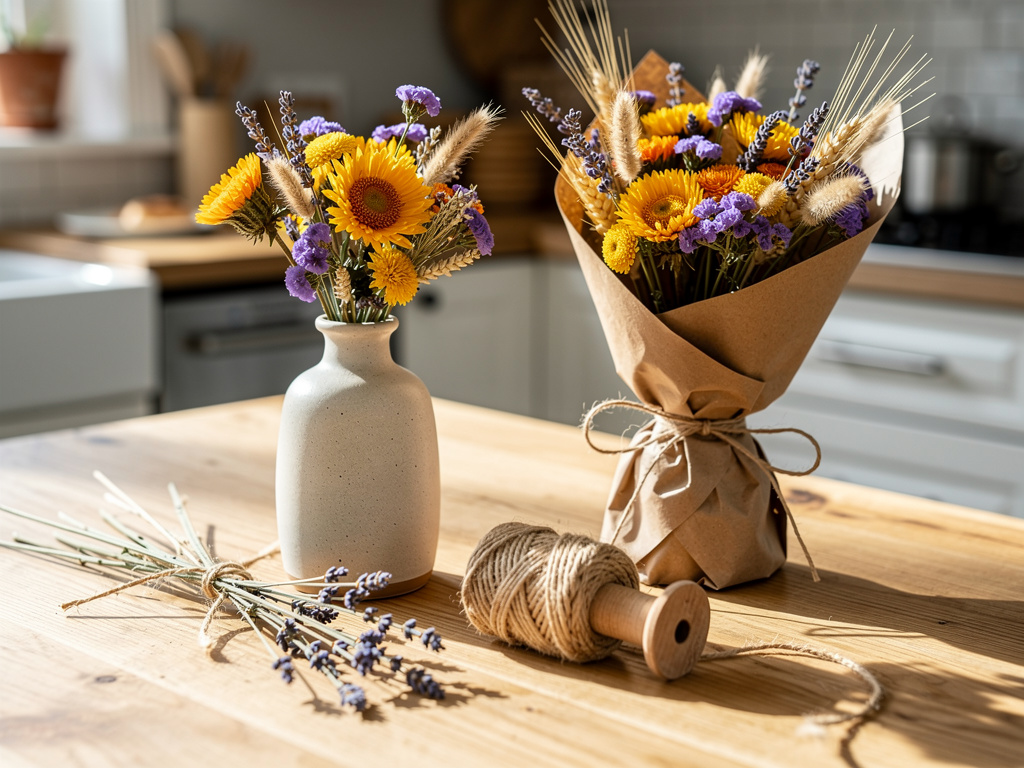


The short version: A dried flower arrangement is home decor, not food, so cottage food laws do not cover it; what you need are your city's business basics, a sales tax permit where your state taxes goods, and records of every sale for your tax return. Start with three sizes, a mini bundle, a vase arrangement and a wreath, and count what your stems really cost: a grower's bunch of dried statice was $16 at Sunny Meadows Flower Farm on October 15, 2026, which is $1.60 to $2.29 a stem. Sell to local buyers first, because USPS charges a box over one cubic foot by its size, so a 3 pound arrangement in a 14 by 14 by 16 inch box costs $55.60 at the post office counter (retail) to ship to zone 5 by Ground Advantage, against $15.70 in a 12 inch cube. Take orders before you build, so every arrangement you glue together is already paid for.
Checked on October 15, 2026: Sunny Meadows Flower Farm's dried flower page, USPS Price List Notice 123 (effective October 4, 2026) and DMM 133, the IRS Form 1099-K page, the Texas Comptroller's sales tax page, the UF/IFAS and MU Extension flower drying guides, and the pricing pages of Homegrown, Etsy, Square, Shopify and Venmo. City and state rules differ, so verify your state's current rules before your first sale. Homegrown is for pickup and local delivery and does not ship, and your customers create a Homegrown account to place a first order.
Dried flowers solve the worst problem in the flower business. A fresh bouquet starts to wilt within days, so every unsold stem on Sunday is money in the trash. A dried bundle of strawflower and lavender tied in the fall still looks good in March if it is kept out of the sun and away from damp.
That makes dried flower arrangements one of the friendliest products to sell from a spare room. You can build them on a weeknight, store them on a shelf, and hand them over at your door whenever the buyer shows up. This guide walks through the whole thing: the rules, what to make, where your stems come from, how to dry and arrange them, how to sell them near home, why shipping is harder than it looks, and what each way of taking orders costs you.
Yes, you can sell dried flower arrangements from home under the same rules as a candle or a wreath, not under your state's food rules, because an arrangement is a decorative product. Cottage food laws exist to keep homemade food safe. Your arrangement never goes in anyone's mouth, so those permits, labels and sales caps do not apply to it. And because dried flowers keep, you can build stock in a quiet week and sell it later in the season. MU Extension suggests replacing dried flowers about once a year, though with good care they often last longer, so sell within the season you dried them and your buyer still gets most of that year.
What does apply is the paperwork any small vendor of handmade products deals with:
The one exception is when a buyer plans to eat the flowers. Pressed pansies for a cake, dried rose petals for tea or lavender for baking are food, and food rules take over. If you want to sell into that market, our guide to selling edible flowers at a farmers market covers the extra steps.
Pricing gets its own guide. How much to sell dried flowers for works through a working flower farm's whole price list, seed costs and three monthly sales scenarios. This page stays on the rest of the business: what to make, how to make it, and how to get it into a buyer's hands.
Plan on three things: a sales tax permit if your state taxes retail sales, any business license your city asks for, and reporting every dollar of income. None of them is specific to flowers, and none of them is a food permit.
Sales tax is the one most new vendors miss. A dried arrangement is not a grocery, so the food exemptions some states give to groceries do not help it. On sales you take yourself, in cash, through Venmo or at a market table, you charge the buyer the tax, keep it separate, and send it to the state on the schedule your permit sets. On a platform that collects and remits sales tax for you, such as Homegrown, the tax on those orders is sent for you, so do not send it a second time.
The Texas Comptroller's sales tax page says Texas charges a 6.25% state sales and use tax on retail sales of most physical products, and cities, counties and special districts can add up to 2% more, for a combined maximum of 8.25%. At 8.25%, a $20 mini bundle carries $1.65 in sales tax. The same page links to the sales tax permit application, and permit holders are told whether they file monthly or quarterly. We checked that page on October 15, 2026.
For income tax, the line people quote is the Form 1099-K threshold, and it is easy to read the wrong way. The IRS page on Form 1099-K says payment apps and online marketplaces must send you the form once your payments total over $20,000 in more than 200 transactions. The same page says that no matter what gets reported, if you receive payments for selling products, you must report all of that income on your return. The threshold decides when a form shows up in your mailbox, not whether you owe tax.
Here is the short list to finish before your first sale:
Our guide on whether you need a license to sell crafts walks through the registration steps in more detail for any handmade product. Verify your state's current rules before you sell, because rates and permit rules change.
Start with a short ladder of sizes: a small piece people grab as a gift, a medium arrangement for a table, and a big statement piece like a wreath. Three sizes give every buyer a yes, and they let you use short stems, long stems and broken stems without waste.
Here is how the main formats compare, with real prices from a working flower farm and from vendors on Homegrown.
Scroll sideways to see every column.
| Format | What it is | A real price to compare | Hands-on time | Who buys it |
|---|---|---|---|---|
| Grower's bunch | One kind of flower, banded the way it dried | $16 at Sunny Meadows Flower Farm ($18 for most strawflower colors) | Low | Crafters and people filling their own vases |
| Mixed bouquet | A hand-tied mix of flowers, fillers and grasses | $30 for about 25 stems, $55 for about 50 stems, Sunny Meadows (sold out that day) | Medium | Gift buyers, hostess gifts |
| Mini bundle or bud vase | 5 to 15 short stems in a small vessel or sleeve | No outside price checked; price it from your stem cost | Low | Impulse buyers, teacher and coworker gifts |
| Vase arrangement | A designed piece set into a vessel that goes home with the buyer | Carolina's Flowers on Homegrown lists fresh arrangements in vintage vessels at $50, $100 and $150 (fresh, for comparison) | High | Home decor buyers, offices, cafes |
| Wreath | Dried flowers wired onto a ring base | From $100 small and $150 medium, Sunny Meadows, made to order in 2 to 3 weeks (sold out that day) | High | Front doors, fall and holiday gifts |
| Flower crown | Dried flowers wired onto a band with ribbon | $75, $100 and $125 by fill, Carolina's Flowers on Homegrown | High | Weddings, birthdays, photo shoots |
| Craft box | Loose dried stems sold for other people's projects | Gabriella's plants and produce on Homegrown, extra stems $1 to $5 each | Low | Crafters, card and candle vendors |
We read Sunny Meadows Flower Farm's dried flowers, wreaths and bouquets page and the Homegrown listings on October 15, 2026. Sunny Meadows' bouquets and wreaths were sold out that day; the prices are still listed.
A few patterns show up when you put these side by side:
If wreaths become your main product, our wreath pricing guide covers wreath pricing, mostly for fresh evergreen wreaths, with a section on how dried flower, grapevine and silk wreaths price differently.
Growing your own is how the math works long term, and buying bunches is how you start this month. A grower's bunch costs a buyer $16 at retail, so if you design with bought stems, you need to price every stem you use into the arrangement.
Here is what that looks like per stem, from the same farm's page:
Swipe the table to see the stem counts and cost per stem.
| What you buy | Price on October 15, 2026 | Stems the farm says you get | Your cost per stem |
|---|---|---|---|
| Dried statice, one bunch | $16 | 7 to 10 stems, each with several branches | $1.60 to $2.29 |
| Dried French lavender, one bunch | $16 | 25 or more | $0.64 or less |
| Dried strawflower, one bunch | $18 | 12 to 18 stems | $1.00 to $1.50 |
| Box lot of 16 bunches (strawflower, foliage, fillers) | $250 plus UPS Ground shipping | 16 bunches | About $15.63 a bunch before shipping |
Prices and stem counts come from the Columbus, Ohio farm's product pages, read October 15, 2026. Cost per stem is the bunch price divided by the stem count.
Now build a small piece from those numbers. A mini bundle of 3 statice stems and 10 lavender stems costs you $4.80 to $6.86 for the statice and no more than $6.40 for the lavender, so as much as $11.20 to $13.26 in stems alone. At a $20 price, that can be 56% to 66% of the sale gone before the vessel, the paper or your time.
Buying retail bunches to resell as small arrangements rarely leaves room for your time. Use bought bunches to test which designs sell, then grow your fillers (statice, lavender, globe amaranth, grasses) and buy only the showpiece stems. Our dried flower pricing guide counted about 87 cents of seed and sleeve in a 25-stem homegrown bouquet at seed prices it checked on September 23, 2026.
The middle path is the one most part-time vendors land on: grow what is easy in your yard, buy a box lot once a year for color you cannot grow, and forage what is legal to take, like grasses from your own property.
Air drying is the default: hang small bunches upside down in a dry, dark room with moving air, and wait one to three weeks. The UF/IFAS Extension guide to drying and preserving plant materials calls air drying the simplest and least expensive method and gives one to three weeks as the usual time, depending on how thick the stems and foliage are.
The three methods most home vendors use, as step cards:
The MU Extension guide to drying flowers and foliage adds one useful trick: dried stems that come out straight can be softened in warm water and bent before you arrange them. That is handy when a design needs a curve.
Write the cut date on a strip of tape on every bunch you hang. MU Extension's guide recommends swapping out dried flowers about once a year, so the bunch you dried in July should be in a sold arrangement before next July, not still on your drying rack.
The best flowers for dried arrangements are the ones that hold their shape and color when air dried, often sold as "everlastings." You want a mix of three jobs in every piece: a focal flower that draws the eye, fillers that make it look full, and texture from grasses and foliage.
Good choices by job:
Most of these air dry in 1 to 3 weeks, so flowers you cut in July can be in arrangements by August. Start each design with about 3 filler stems for every focal flower, then adjust by eye. A few practical notes:
A dried arrangement holds up when it starts with a firm base, goes in from the outside edge to the middle, and gets its tallest stems last. Dried stems are stiff and brittle, so they need support you never think about with fresh flowers.
Here is the order that works for a vase arrangement:
For size, the $30 regular dried bouquet at the farm we checked is about 25 stems and the $55 deluxe about 50, which are useful targets for a medium and a large vase piece. Two habits save hours. First, make each design 3 times before you list it, and time the third one; that time is what goes into your price. Second, photograph each finished piece from the same spot so your listings look like one shop, not a pile of snapshots.
For wedding work like bouquets, boutonnieres and confetti, the guide to selling dried flowers for DIY weddings covers what brides ask for and how far ahead they order.
Price a dried arrangement from three numbers: what the stems and vessel cost you, how long it took to build, and what a working farm charges for something similar. A $16 bunch, a $30 bouquet of about 25 stems and a $100 small wreath are real reference points from the farm we checked on October 15, 2026.
A simple way to set your first prices:
Our full dried flower pricing guide has the detail: stem-by-stem bouquet costs, mini, regular and deluxe sizes, wreath pricing, bulk boxes for crafters and what a month of sales looks like at three volumes. Use it before you set your menu, and come back here for the selling side.
Take every photo in the same window light, on the same plain surface, with one object for scale, and list the size in inches. Dried flowers are all about texture and muted color, and a dim kitchen photo turns them into brown fuzz.
What a good listing includes:
If you sell made to order, say how long it takes. Sunny Meadows tells buyers 2 to 3 weeks for a wreath, and that kind of plain promise stops the "is it ready yet?" messages before they start.
The easiest places to sell dried arrangements are the ones where your buyer can pick them up: your porch, a farmers market table, a holiday craft fair, and local shops that sell decor. Local selling keeps the fragile part of the business, the trip from you to the buyer, in your own hands.
Ways to sell near home, from least to most effort:
If you deliver, keep it close: Homegrown lets you set a delivery radius anywhere from 1 to 25 miles and keep 100% of the delivery fee, minus card processing, so a fragile piece rides in your car, not a mail truck. Our list of places to sell flowers compares stands, markets, florists and shops for fresh flowers; most of the same doors open for dried ones, with the bonus that a shop can keep your stock on a shelf for months.
Ship only small, flat or boxed pieces that fit in a box of one cubic foot or less, and sell bigger arrangements for local pickup. USPS charges large, light boxes by their size, and a dried arrangement is about as large and light as a product gets.
The rule sits in USPS's mailing standards for Ground Advantage. A box over one cubic foot (1,728 cubic inches) is charged at its actual weight or its dimensional weight, whichever is greater. Dimensional weight is length times width times height, with each side rounded up to the next whole inch, divided by 139 and rounded up to the next pound.
Here is what that does to a 3 pound arrangement at the USPS Ground Advantage retail price to zone 5, a middle-distance zone:
What a 3 pound arrangement costs to ship, by box size
Source: USPS Price List Notice 123, effective October 4, 2026, USPS Ground Advantage retail, zone 5, read October 15, 2026. The 12 inch cube is billed at its 3 pounds; the others are billed at 14, 23 and 37 pounds of dimensional weight. Bar widths are each price divided by $89.05.
The 12 inch cube is exactly one cubic foot, so it ships at its real weight. Every larger box ships as if it were full of something heavy. Even in zone 1, the closest zone, the box billed at 23 pounds costs $31.35 against $11.80 for the cube. Those are post office counter (retail) prices. A vendor who buys the label online pays the commercial price in the same Notice 123, effective October 4, 2026, which is $35.80 for the 23 pound box against $12.12 for the cube at zone 5, still about 3 times as much.
USPS rounds each side up to the next whole inch before it does the math. A box that measures 12¼ by 12 by 12 inches counts as 13 by 12 by 12, which is 1,872 cubic inches, over the one cubic foot line, and it jumps from $15.70 to $30.55 at the zone 5 retail price. Measure your box with the lid closed before you quote a shipping price.
If you do ship a small piece, pack it so nothing can move:
What ships well, then, is the small stuff: flat pressed-flower pieces, bud bundles in a sleeve, craft boxes of loose stems and boxed flower crowns. Bigger vase arrangements and wreaths belong at your door, a market or a shop, where no shipping box is involved.
On a $20 order, the vendor keeps the most with a Venmo business profile ($0.48 in fees) and the least on Etsy ($2.35), with Square ($0.96), Shopify and Homegrown ($0.88 each plus a monthly plan) in between. The full stack matters more than any one fee, so here is every piece on every row.
Scroll sideways for every fee column.
| Way to take orders | Monthly plan | Trial | Platform or listing fee | Card processing | Customer pays on a $20 order | Vendor pays on a $20 order | Vendor pays in a month of 50 orders at $20 |
|---|---|---|---|---|---|---|---|
| Texts or Instagram messages, paid through a Venmo business profile | $0 | None needed | None | 1.9% + $0.10 per payment, paid by the vendor | $20.00 | $0.48 | $24.00, plus every order typed up by hand |
| Etsy | $0 (Etsy Plus is an optional $10 a month) | None needed (a one-time set-up fee may apply) | $0.20 listing fee for each item sold (one arrangement here) plus a 6.5% transaction fee ($1.30) | 3% + $0.25 through Etsy Payments ($0.85), paid by the vendor | $20.00 plus shipping | $2.35 | $117.50 |
| Square Online, Free plan | $0 (Square Plus is $49 a month per location) | None needed | None | 3.3% + 30¢ online, paid by the vendor | $20.00 | $0.96 | $48.00 |
| Shopify Basic | $29 billed yearly ($39 monthly) | 3 days, then $1 a month for 3 months | None with Shopify Payments | From 2.9% + 30¢ online, paid by the vendor | $20.00 | $0.88 plus the plan | $73.00 ($83.00 on monthly billing) |
| Homegrown storefront | $10 billed annually ($12.50 monthly) | 7 days, no charge until day 8 | None, 0% commission | 2.9% + $0.30, paid by the vendor | $20.00 | $0.88 plus the plan | $54.00 ($56.50 on monthly billing) |
Every price comes from the company's own page, loaded October 15, 2026: Venmo's fees page, Etsy's Fees and Payments Policy and Etsy Payments Policy, Square's online store plans page, Shopify's pricing page and Homegrown's signup page. The math is figured on the $20 price with no shipping or sales tax. Etsy's Payments Policy says sellers agree to ship sold products, and on a shipped order its 6.5% transaction fee also applies to the shipping charge, while its payment fee applies to the total including tax and shipping. An Etsy order that came through Offsite Ads adds a 15% fee for a shop under $10,000 a year in sales that has not opted out, or 12% once a shop passes $10,000. Square's in-person rate on its Free plan is 2.6% + 15¢, or $0.67 on $20, for sales at a market table.
Venmo looks cheapest, and on fees alone it is. What it does not do is keep the order list. At 50 orders a month you are matching payments to messages, writing down who wants the lavender bundle and who wants the wreath, and sending pickup times one by one.
Etsy costs the most per order, and it is built around shipping. That is the opposite of where dried arrangements make the most sense, and our Homegrown vs Etsy comparison goes deeper on local pickup against a shipped marketplace.
The hard part of selling dried arrangements is not making them; it is knowing how many to make and getting each one to the right person without a crushed box. A pre-order page solves both. Buyers pick the size and the pickup day, pay up front, and you build exactly that many.
Homegrown is $10 a month billed annually with no percentage fees beyond standard payment processing (2.9% + $0.30 per order, paid by you). That compares with Etsy, where a $20 shipped arrangement costs you $2.35 in fees on the price alone, plus shipping, which you or your buyer pays and which can cost more than the flowers. Square Online's Free plan costs $0 a month but charges 3.3% + 30¢ per online order ($0.96 on $20), so it costs less than Homegrown below about 125 orders a month (about 156 on Homegrown's $12.50 monthly billing). Next to a stack of Instagram messages and Venmo payments, Homegrown keeps every order in one list.
What it does for a dried flower vendor:
The honest bounds: Homegrown does not ship, so a buyer three states away cannot order your wreath. Your customers create a Homegrown account the first time they order. Your storefront is listed on Homegrown's marketplace, but plan on most orders coming from people you send to your own link. If most of your buyers are far away, Etsy or Shopify fits that better.
You can set up a storefront for your dried flower arrangements in an evening and send the link to the people who already asked about your flowers.
Dried arrangements sell around gift-giving dates and the seasons people redecorate, so plan your building around a calendar, not around your drying rack. Because dried flowers keep, you can build stock weeks before each date instead of rushing the week of.
Dates worth planning for:
A simple rhythm that works: dry in summer, build in early fall, and open orders for each date 3 to 4 weeks ahead. The farm we checked quotes 2 to 3 weeks for a made-to-order wreath, so a 4 week window leaves you room. A Thanksgiving centerpiece order list that opens in late October tells you exactly how many vessels to buy.
Give every buyer a small care card: keep the arrangement out of direct sun, away from humidity, and far from candles and heaters. A buyer who knows how to care for it is happier with it, and happy buyers come back.
What to put on the card:
That last line is worth saying out loud. A card that says "enjoy it for about a year, then come see us for a fresh one" can turn a one-time sale into a repeat order next fall.
Two mistakes cost the most: pricing small pieces from bought bunches without counting the stems, and building big pieces before anyone has ordered them. Both are easy to fix once you see them.
Mistakes to avoid:
In a pull of the Homegrown catalog on October 15, 2026, 4 of the 2,927 products listed by 324 vendors were dried flower products, from 2 vendors: Carolina's Flowers' three dried flower crowns ($75, $100 and $125, made to order from locally grown flowers) and Gabriella's plants and produce's dried flower craft boxes. The Plants and Flowers category held 112 listings, 25 of them fresh cut flowers from 7 vendors. Not one listing was a finished dried flower arrangement in a vase or a dried bouquet. We read every listing whose name, description or options mentioned a flower or drying word to get these counts.
You do not need a food or cottage food permit, because dried flower arrangements are decor, not food. You may need a city business license or home business permit, and a sales tax permit if your state taxes retail sales. Check your city clerk and your state revenue department before your first sale.
Selling dried flowers can be profitable when you grow most of your stems or keep your stem cost low. A grower's bunch costs $16 at retail from a working flower farm, so building small arrangements from bought bunches leaves little room for your time. Growing fillers like statice and lavender and pricing by stem count is what makes the numbers work.
You can ship dried flower arrangements, but large boxes get expensive fast. USPS charges a large, light Ground Advantage package by its dimensional weight, so a 3 pound piece packed in a box billed at 23 pounds cost $55.60 at the post office counter (retail) to zone 5 on October 15, 2026. Small bundles and craft boxes that fit a 12 inch cube ship far more cheaply.
Dried flower arrangements usually look their best for about a year. MU Extension's drying guide says to replace dried flowers about once a year, and adds that well cared for ones often last longer. Keeping them out of direct sun and humidity slows fading.
The dried flowers that work best in arrangements are the ones that keep their color and shape, like strawflower, statice, globe amaranth, lavender, celosia and wheat. Pair one focal flower with fillers and grasses for texture. Natural, undyed flowers in a clear color palette are an easy first line to sell from home.
In states that tax retail sales, a dried flower arrangement is usually taxed like other decor. Texas, for example, charges 6.25% state sales tax plus up to 2% local tax on retail sales of most products. Get a sales tax permit in your state and verify the current rate before you sell dried flower arrangements from home.
These guides cover the parts of a dried flower business this one only touches. Each was live on findhomegrown.com/blog on October 15, 2026, and together they cover pricing, wedding orders, wreaths, paperwork and platform choice. Read the pricing guide first if you have not set your menu yet, since it prices bunches, bouquets in three sizes, wreaths and box lots, from a $16 bunch to a $100 wreath.
Fall and the December holidays are the big gift-buying stretch of the year, so a pickup link set up now has a full season ahead of it. Pick three sizes, build each design three times so you know your time, and price from your real stem cost. Ten mini bundles at $20 and three wreaths at $100 is $500 in sales, and every piece goes home with a care card that brings the buyer back next year.
A Homegrown storefront for dried flower arrangements costs $10 a month billed annually, takes card payments at 2.9% + $0.30 per order with no commission, and handles sales tax on the products that need it. Your neighbors choose a size and a pickup day, and you see one list of what to build before the weekend. When someone asks in March whether you still have the lavender bundle, you send the same link instead of starting another message thread.