

The short version: To transport a cake safely, chill it hard, set it on a board as wide as its box, and ride it flat on a non-slip mat on the floor or cargo area of a car you already cooled, with nothing stacked on top. Keep it cold, because the FDA advises that refrigerated food should not sit out more than two hours, or one hour above 90°F, and some states add delivery rules for cheesecake and cream cheese frosting. Of at least 82 cake listings on Homegrown on October 14, 2026, 15 were cheesecakes, tiramisu or cakes with a cream cheese, custard or tres leches layer that need that cold, and 33 were pound, coffee, bundt, loaf and other cakes with no soft frosting that travel easily. A box and a cake drum for a 10-inch cake up to 4 inches tall cost about $2.76, and the IRS business rate of 76 cents a mile is a fair stand-in for what the drive costs you.
Checked October 14, 2026: findhomegrown.com/signup, Hotplate's pricing page, Square's online store plans page, Venmo's fee page, the FDA, the cottage food pages of the Texas Department of State Health Services, the Nebraska Department of Agriculture, the Michigan Department of Agriculture and Rural Development, the Colorado Department of Public Health and Environment and Illinois, the IRS mileage page and WebstaurantStore product pages. Cottage food rules change and differ by state, so check your own state's page before you deliver a cheesecake or a cream cheese cake. Homegrown costs $10 a month billed annually plus 2.9% + $0.30 card processing per order, paid by you. Customers create an account to place their first order, and there is no drops feature.
You spent six hours on a cake. The frosting is smooth, the piping is clean, and the customer is picking it up at noon or you are driving it across town. Then one hard stop at a yellow light slides the whole thing into the side of the box.
A cake that leaves your kitchen perfect can still be ruined on the way. The good news is that cake transport is a short list of habits, a few dollars of supplies and a couple of rules you should know before a cheesecake ever leaves your fridge.
This guide is for the home baker and the small cake vendor who delivers a few cakes a week or hands them off at the door. If you are still setting up the business side, start with how to sell cakes from home, which covers pricing, packaging and your first customers. This article picks up at the moment the cake is finished and has to travel.
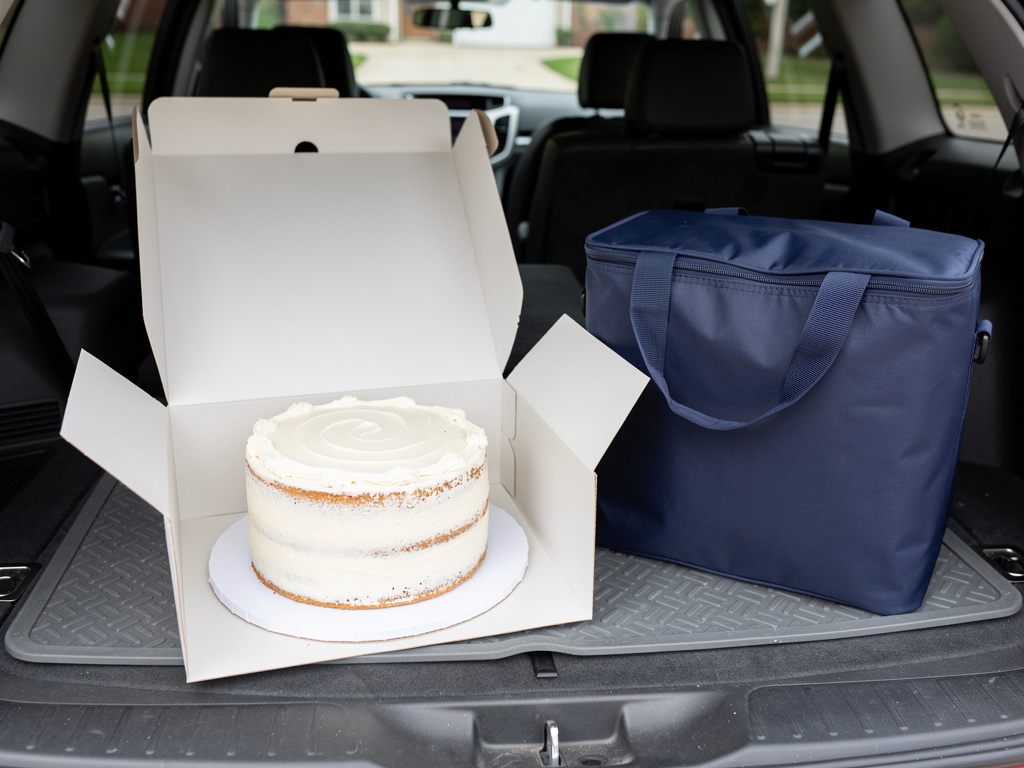
The safest way to transport a cake is cold, boxed, flat and still: a chilled cake on a sturdy board, in a box the same width as that board, on a non-slip mat on a flat floor of a car you cooled down first. The eight cake transport guides we read, from bakers, cake supply shops and one newspaper, keep coming back to the same few habits, and each guide covers some of them.
Here are the six rules that do most of the work:
One more rule sits above all six: drive like the cake is in charge. Brake early, take turns slowly, and cross speed bumps at a crawl. The cake cannot brace itself.
Cakes with soft or perishable outsides are the hardest to transport: cheesecake, cream cheese frosting, whipped cream fillings and tres leches need cold the whole way, and tall frosted layer cakes need support so the layers do not slide. A pound cake, a coffee cake or a glazed bundt is the easy end. It can ride in a box on the floor with little more than a mat under it.
In a pull of the Homegrown catalog on October 14, 2026, we found 82 cake listings from 35 vendors. We counted a listing in a food category when its name or description names a cake, including cheesecake, tres leches, flan, tiramisu and pound, coffee or bundt cake, then opened each vendor's other listings to see what the product really is. We removed cupcakes, cake pops, pancakes, cookies and cookie cakes made from one big baked cookie, bite-size tea cakes, gift bags and a few non-cake products, and read each of the 82 by hand. A Portuguese bolo de bolacha, a layered biscuit cake that its listing calls a cookie cake, stays in. We grouped them by the frosting, filling or topping each listing describes. A cake named only by its flavor, with no description, such as a banana creme pecan cake, counts as "Listing does not say," because the name alone does not tell you what is on or in it. Cream cheese as its own filling or topping layer counts as needing cold, the same as cheesecake. Cream cheese baked into the batter, as in a cream cheese pound cake, does not. A listing that offers several products sits in the group of its most perishable cake. Listings that never name a cake are not counted, so 82 is a floor.
What is on the outside of 82 cake listings on Homegrown
Source: Homegrown catalog pull, October 14, 2026, 82 listings from 35 vendors. Each listing read by hand and placed in one group by its name and description.
So 33 of the 82 listings, or 40%, were the kind of cake that travels easily. Another 15, or 18%, were the kind that needs cold, and 13 were frosted with buttercream, frosting, ganache or fondant. The prices ran from $3.00 for a Pennsylvania Dutch sugar cake to $325.00 for a two-tier custom cake covered in buttercream or fondant, with a middle price of $30.00. The frosted cakes had a middle price of $35.00, against $25.00 for the group with no soft frosting, and the single priciest listing was that two-tier cake, the hardest kind to move.
Here is how each kind of cake behaves on the road:
Swipe the table left to read all four columns.
| Kind of cake | Main risk on the drive | Keep cold the whole way? | What to do |
|---|---|---|---|
| Pound, coffee, bundt, loaf or other cake with no soft frosting | Sliding and crushed corners | No, unless it has a perishable filling | Box it snug, mat under the box, nothing on top |
| Buttercream layer cake | Soft frosting in heat, layers sliding | Chill before the drive; keep the car cold | Chill overnight, board the same width as the box, air conditioning on |
| Fondant cake | Sweating when cold fondant meets warm, humid air; cracks from bumps | Keep it cool and steady | Box it, cool car, open the box only at the venue |
| Cheesecake | Food safety, plus a soft top that dents | Yes | Cooler bag with ice packs, short direct drive, straight into the customer's fridge; check your state allows it at all |
| Cream cheese frosting, whipped cream, custard or tres leches | Food safety, plus frosting that slumps | Yes | Same as cheesecake; check your state allows it at all |
| Tiered or stacked cake | Top tiers sinking or sliding off | Depends on the frosting | Dowels in every tier that carries another tier, or travel with tiers boxed apart and stack on site |
The "keep cold" column follows the food safety rules in the next section. Michigan allows buttercream only from store-bought shelf-stable frosting or two tested recipes, and Colorado only without butter. Wherever you are allowed to sell buttercream, it travels far better chilled.
Yes, for any cake that needs the fridge: it should spend no more than 2 hours out of the cold under the FDA's food safety advice, Texas and Illinois say 41°F or colder, and some states also say who may deliver it. A pound cake has no time limit on the drive. A cheesecake does.
The baseline comes from the FDA's own consumer advice. In the FDA's guide to storing food safely, food that needs refrigeration should never sit at room temperature for more than two hours, and only one hour on a day hotter than 90°F. A parked car gets past 90°F fast: the National Weather Service office in Little Rock says that even on an 80 degree day, the air inside "can rise as much as 30 to 35 degrees in a half hour." Treat a parked car in warm weather as a one-hour clock at best, and never leave a cake that needs the fridge in one.
Where cold cakes or cold frostings are allowed from a home kitchen, the rules write the cold chain in:
Cheesecake counts as a food that needs time and temperature control, and the Nebraska Department of Agriculture's cottage food page says such food must be delivered by the home baker to the customer in person, kept cold, and "not be transported for longer than two hours." Shelf-stable cakes may go by mail. We read that page on October 14, 2026.
A home baker who sells foods needing time and temperature control must register with the state, and the Texas Department of State Health Services cottage food page says those foods "must be stored and delivered" cold enough to stay at 41ºF or below inside. A cake sold online must be personally delivered by you, an employee or a household member. Before you take payment online, Texas also requires all the label information to be posted where the buyer can read it, which on an online storefront means the listing. Checked October 14, 2026.
Illinois puts it most plainly. The state's 2024 cottage food guide, written by the Illinois Department of Public Health with partners and hosted by University of Illinois Extension, says "Cream cheese frosting should always be transported and sold under 41 F." The Illinois Department of Public Health's cottage food page points bakers to that guide. The same guide does not allow cheesecake, custard pies or cream pies from a cottage kitchen, so in Illinois the 41 F rule covers cream cheese frosting, not cheesecake. That is the number to plan around: 41°F or colder, all the way to the customer's hands.
What that means on a delivery day:
These rules are written state by state, and they change. The three states above are examples, not the national rule. Before you deliver any chilled cake, verify your state's current rules on its own cottage food page, or with your county health department. We read every rule in this section on October 14, 2026.
Which cakes a home baker can sell and deliver depends on the state, and the line usually sits at cakes that need the fridge. Michigan bans cheesecake and cream cheese frosting from home kitchens, while Texas allows both once you register, and our guide to selling homemade cake found cream cheese frosting out in most of the 9 states whose agency pages it read. Some states go further and limit the buttercream itself: Michigan allows it only from a shelf-stable store-bought frosting or from 2 recipes, both lab-tested, followed exactly. Your transport plan starts with knowing which side of that line each cake on your menu sits on.
Two examples show how far apart the rules are:
The Michigan Department of Agriculture and Rural Development's "What Can I Make?" page allows birthday, anniversary and wedding cakes, but says "no cheesecake" and "no cream cheese frosting," and allows buttercream only from commercially made shelf-stable frosting or one of two lab-tested recipes followed exactly. We read that page on October 14, 2026.
In Colorado, the Colorado Department of Public Health and Environment's cottage foods page allows buttercream made with ghee or vegetable oil, and says "buttercream made with butter is not allowed." The same page says the home baker or someone they name can deliver straight to "an informed end consumer," meaning the person who bought it and was given the product details. We read it on October 14, 2026.
So a cake that is legal to deliver in Texas, after registering, may not be legal to sell at all from a Michigan home kitchen. Here is what to check before you plan a cold delivery:
For every state's basics in one place, see the cottage food laws by state guide, then confirm on your state's own page. These pages change, so read yours again before you list a cold cake.
Get a cake ready for travel by finishing it a day early, chilling it overnight, and building in the supports before it goes in the box. Many transport problems are set up in the kitchen the day before, not on the road.
Here is the day-before routine many experienced bakers use:
One step new cake vendors often skip: leave fragile decorations for the end. Sugar flowers, tall toppers and anything on a wire travel better in their own small box and go on at the venue, or right before the customer picks up.
Put the finished cake in its box in your fridge the night before, then pick up the whole box and walk it 20 steps across the kitchen. If anything shifts in 20 steps, it will shift far more in 20 minutes of driving. Fix it while the cake is still at home.
You need five things to transport cakes well: a box, a board, supports for anything tall, a non-slip mat and, for cold cakes, a cooler bag and frozen packs. The per-cake part costs a few dollars, and the rest you buy once.
Here is a priced kit from one restaurant supply store's live pages:
On a phone, slide this table to see the prices.
| Item | Pack and price | Cost each | What it is for |
|---|---|---|---|
| 10" x 10" x 5" kraft window cake box (Baker's Lane) | 10 for $11.99 | $1.20 | An 8-inch cake on a 10-inch board, 3 inches tall at most with decorations |
| 12" x 12" x 5" white window cake box (Baker's Lane) | 10 for $15.99 | $1.60 | A 10-inch round on its 12-inch drum, up to 3 inches tall with decorations |
| 12" x 12" x 6" white cake box, no window | 10 for $14.49 | $1.45 | A 10-inch round on its 12-inch drum, with decorations no higher than 4 inches |
| 12" x 12" x 12" adjustable tall cake box (Enjay Flexbox) | 5 for $28.99 | $5.80 | Tall layer cakes and stacked two-tier cakes up to 10 inches tall with decorations |
| 12" round 1/4" thick cake drum (Baker's Lane) | 24 for $31.49 | $1.31 | A rigid base for a 10-inch cake |
| 12.25" plastic cake dowel rods (Wilton) | 4 for $5.49 | $1.37 | Supports inside a tier that carries another tier; cut to length with a serrated knife |
| 18 1/4" x 12 1/4" non-slip PVC liner (Choice) | 6 for $14.99 | $2.50 | Sold as a cutting board liner; a sheet under the box stops it sliding |
| Insulated delivery bag, 23" x 13" x 15", with hot or cold pack kit (Choice) | 1 for $30.99 | $30.99 | Keeping a cheesecake cold. The inside is 21 x 12 x 14 inches, so a 10- or 12-inch box lies flat with the cold packs standing in the space at its end; a 12-inch box fills the full width |
Prices from WebstaurantStore's product pages, checked on October 14, 2026, before tax and shipping. Box sizes are the sizes the store lists; measure your cake with its decorations before you order.
The math per cake is short. A 10-inch cake up to 4 inches tall needs the 12 x 12 x 6 box at $1.45 and a 12-inch drum at $1.31, so $2.76 per cake. A tall or two-tier cake in the adjustable box, on a drum, with one pack of four dowels runs $5.80 + $1.31 + $5.49 = $12.60. The mats and the bag are a one-time $45.98.
Build that per-cake cost into your price. A $2.76 box and board on a $30 cake is about 9% of the sale, and it is easy to forget until the first case of boxes arrives.
The right cake box is the same width as your cake board and at least 2 inches taller than the cake with its decorations. A box that is too wide lets the board slide into a wall. A box that is too short crushes the top. A 10 x 10 x 5 window box at $1.20 each holds an 8-inch cake up to 3 inches tall on its 10-inch board.
Use these sizing rules:
Never put anything on top of a cake box, even another cake box. Boxes are made to protect the cake from bumps, not to carry weight.
A cake should ride on the flattest surface in the car: the floor behind the front seats, the front passenger footwell, or the flat cargo floor of an SUV or minivan. Never on a seat and never on a lap. Seats slope back and dip in the middle, so a cake on a seat leans for the whole drive.
Here is how to load the car, in order:
A few rules about the rest of the car:
Drive straight there. Every stop for coffee is time the cake spends in a warming car, and every parking lot adds a speed bump.
Keep a cake cool in a hot car by chilling it before the drive, cooling the car before loading, and putting every cold cake in a cooler bag with frozen packs. A cold buttercream cake holds its shape for a short drive with the air conditioning running. A cheesecake needs the bag every time, to help it stay at 41°F or below. Keep that drive under 60 minutes, and check the bag with a thermometer when you arrive.
Here is the hot-weather routine:
The FDA's one-hour guideline on hot days is the one to remember for every chilled cake. Plan the route so the whole trip, bag and all, stays well under an hour.
Put a cheap fridge thermometer in the insulated bag on your first few summer deliveries. If the bag reads above 41°F when you arrive, you need more ice packs or a shorter route, and you found out before a customer did.
For a short drive on smooth roads, a well-doweled two-tier cake can travel stacked. For anything taller, heavier or farther, box each tier on its own board and stack them at the venue. Stacking on site adds time at the venue and removes most of the risk. Stacking at home calls for a 12-inch-tall box and dowels, about $12.60 per cake at the prices above for the box, the base drum and four support dowels. The board under the top tier and the long center dowel come on top of that.
If you stack at home:
If you stack at the venue:
Wedding cakes have their own timing, insurance and venue questions. Our guide to taking wedding cake orders as a cottage baker covers the delivery and setup side of a wedding in more detail.
When the customer picks the cake up, your job is to make their drive as safe as yours: carry the box out level, set it on the flattest spot in their car, and send a short care card with it. Many customers have never moved a decorated cake and will set it on the passenger seat unless you tell them not to.
At the hand-off:
A short card in the box does the rest. Ours would say:
Our guide to how long homemade cake lasts has the storage times you can print on the back of that card, and the cheesecake shelf life guide covers cheesecake on its own.
Charge enough to cover the car and your time: at the IRS business rate of 76 cents a mile, plus your time at $20 an hour, a cake delivered 8 miles away costs you about $27 to drive. A common way to cover it is a flat fee for a short distance, more for a long one, and a setup fee on top for tiered cakes.
The IRS standard mileage rates page lists 76 cents a mile for business driving from July 1 to December 31, 2026. We checked it on October 14, 2026. The time in this table is an example that includes the carry-in and the hand-off. Change it to your own.
Drag sideways for each cost.
| Distance one way | Miles driven, there and back | Car cost at 76¢ a mile | Your time at $20 an hour (example) | What one cake delivery costs you |
|---|---|---|---|---|
| 4 miles | 8 | $6.08 | 30 minutes, $10.00 | $16.08 |
| 8 miles | 16 | $12.16 | 45 minutes, $15.00 | $27.16 |
| 15 miles | 30 | $22.80 | 75 minutes, $25.00 | $47.80 |
Car cost uses the IRS business rate checked on October 14, 2026. Times are examples, not measured averages. A stacked cake set up at a venue adds the setup time on top.
You do not have to charge the whole cost on every order, but the number should shape your fee. A few ways to set it:
Our guide to delivery fee pricing for food vendors works the same math for routes with several stops, where the cost per stop drops fast.
A cake order with the date, address, delivery fee and payment captured in one place prevents the usual delivery mix-ups before the cake is even baked. When those details live in a text thread, a cake shows up at the wrong time or the delivery fee never gets paid.
Homegrown costs $10 a month billed annually, or $12.50 billed monthly, with no percentage fees beyond standard payment processing of 2.9% + $0.30 per order, which you pay. You set a delivery radius from 1 to 25 miles, one flat delivery fee and a minimum order. That is one fee for the whole radius, with no distance tiers and no setup fee, so build a long drive or a tiered-cake setup into that cake's price. Customers inside that radius get delivery at checkout and everyone else gets pickup. You keep 100% of the delivery fee minus card processing. Each order lands in your dashboard with the day it is picked up or delivered, so your delivery day starts with a list, not a scroll through messages.
What Homegrown has for cake delivery:
Compare that to three common ways cake vendors take orders now. Instagram DMs with Venmo cost little in fees (1.9% + $0.10 on a Venmo business profile, no monthly plan), but the address, the date and the payment sit in different apps. Hotplate has no monthly subscription and is built around scheduled pickup drops, but by default its 5% + $0.55 fee is added to your customer's total, on top of the 2.9% + $0.30 card processing you pay. On a $40 cake, that default puts $2.55 on your customer's bill. Square Online's Free plan costs $0 a month, but you pay 3.3% + 30¢ on each online card payment, or $1.62 on a $40 cake.
Scroll sideways to see every column.
| Platform | Monthly plan | Trial | Platform or service fee | Card processing | Customer pays on a $40 cake | Baker pays on a $40 cake | Baker pays in a month of 20 cakes at $40 |
|---|---|---|---|---|---|---|---|
| Homegrown | $10 billed annually ($12.50 monthly) | 7 days, no charge until day 8 | None | 2.9% + $0.30, vendor-paid | $40.00 | $1.46 plus the plan | $39.20 ($41.70 on monthly billing) |
| Hotplate, default | $0 | Not applicable, no monthly plan | 5% + $0.55, paid by the customer | 2.9% + $0.30, paid by the baker | $42.55 | $1.46 | $29.20 |
| Hotplate, baker covers the fee | $0 | Not applicable, no monthly plan | 5% + $0.55, paid by the baker | 2.9% + $0.30, also the baker's | $40.00 | $4.01 | $80.20 |
| Square Online, Free plan | $0 per location | Not applicable, no monthly plan | None | 3.3% + 30¢ online, paid by the baker | $40.00 | $1.62 | $32.40 |
| Instagram DMs + Venmo business profile | $0 | Not applicable | None | 1.9% + $0.10, paid by the baker | $40.00 | $0.86 | $17.20 |
We checked findhomegrown.com/signup, Hotplate's pricing page and its "What Hotplate does" post, Square's online store plans page and Venmo's fee page on October 14, 2026. Card processing is figured on the $40 cake price, before any delivery fee, tip or tax. Hotplate's pricing page says you can pay its fee yourself or pass it on, "your choice"; its own post says it charges the customer by default and that 80% of its chefs keep that default.
Venmo is the cheapest line in the table, and that is a fair choice if you only take a few cakes a month. What it does not give you is an order page: no delivery zone, no minimum, no record of which cake goes to which address on which day.
Homegrown does not drive your cakes. You make the delivery or send someone, and in Texas an online cottage food order has to be delivered by you, an employee or a household member, with the full label information posted on your listing before the customer pays. Customers create a Homegrown account to place their first order. There is no drops feature for timed cake releases, and you should plan on most orders coming from people you send to your own link, not from the marketplace.
If cake orders are already coming in by text, the fix is a single link with your cakes, your delivery zone and your fee on it. Set up your Homegrown storefront and the next cake order arrives with the date, the address and the delivery fee already paid.
The common cake delivery problems are a dented side, a smudged border, a slid tier and soft frosting in heat, and many can be fixed on the spot if you brought the right kit. Cake vendors who deliver every week keep a small repair box in the car.
What goes in a cake repair kit:
And the fixes for the usual problems:
Send the customer a photo of the finished cake on the table. It shows how it arrived, and it is the photo they will share.
Experienced cake vendors plan the drive when they take the order, not the morning of the delivery. They ask the delivery address, the time window, who will receive the cake and whether there is a fridge on site before they quote a price.
Habits that separate a calm delivery day from a stressful one:
Ask one question on every delivery order: "Will there be room in a fridge when the cake arrives?" If the answer is no for a cream cheese or cheesecake order, you just found the problem days early instead of on the doorstep.
Put the cake on a board stuck down with a spoonful of frosting, in a box the same width as the board, with a grippy liner under it on a level spot in the car. Block the box in with rolled towels. Then drive gently: brake early, turn slowly and cross speed bumps at a crawl.
A pound cake or buttercream cake can ride for a normal drive with the air conditioning on, but it should not sit in a parked car in warm weather at all. For a refrigerated cake, the FDA's food safety advice is two hours out at most, and one hour above 90°F. The National Weather Service says that even on an 80 degree day, the air inside a parked car can rise as much as 30 to 35 degrees in half an hour, so drive straight there.
Keep the cheesecake in the fridge until you leave, then carry it in a cooler bag with ice packs beside the box, and drive straight to the customer. Nebraska's cottage food rules, for example, say a cheesecake sold from a home kitchen must be delivered in person, kept cold and transported for no more than two hours. Hand it to a person who will put it in the fridge right away. Rules differ by state, so check your own state's cottage food page before you sell or deliver a cheesecake.
A sedan trunk is flat but has no air conditioning, so it is only a good spot in mild weather. An SUV or minivan cargo floor is better, since it is flat and inside the cooled cabin. In hot weather, the rear footwell is the safest place for a sedan.
Sometimes, but the rules are strict. Nebraska's cottage food page lets shelf-stable cottage foods go by mail, while the Illinois cottage food guide allows shipping only inside Illinois and only for foods that are not potentially hazardous. A frosted layer cake also rarely survives a shipping box, so whole cakes usually go by delivery or pickup instead. Check your own state's cottage food page before you ship any cake.
Start from your cost. At the IRS rate of 76 cents a mile and $20 an hour for your time, a delivery 8 miles away costs about $27.16 round trip. One simple setup is a flat fee inside a short zone, more farther out, and a separate setup fee for stacked cakes, which keeps your delivery price in line with the work.
These guides cover the parts of a cake business this article only touches.
A cake that arrives perfect is the one customers post, tag and order again. If you want those orders to come in with the date, the address and the delivery fee already set, start your Homegrown storefront at $10 a month billed annually.