
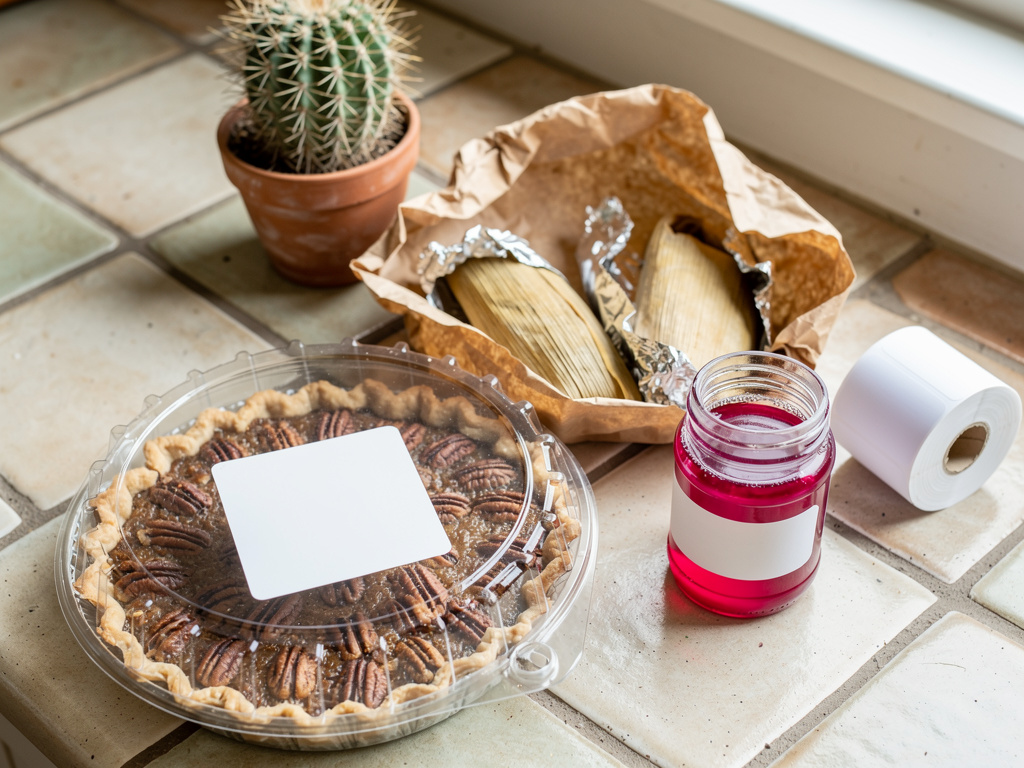


The short version: Arizona's cottage food law lets you sell homemade food with no yearly sales cap, no license fee and no kitchen inspection, as long as you take an accredited food handler course and register for free with the Arizona Department of Health Services (ADHS). Since the 2024 "Tamale Bill," the law covers perishable foods like meat tamales, burritos and cheesecake, not just cookies and bread. Shelf-stable foods can be sold through stores and shipped to Arizona addresses (ask ADHS first if the recipe has butter, milk or cheese), but dairy products, meat, poultry and other perishable foods must be handed over in person by you or your employee, and any delivery goes to one destination within two hours. Every package needs a label with your registration number, the exact home-kitchen sentence and the line pointing to azdhs.gov/Cottagefood, and any online listing that takes orders must show the same label information.
Checked on the ADHS Cottage Food Program page, October 14, 2026: the rules in this guide come from that page, Arizona statutes 36-931 and 36-932, and rule R9-8-101.02, all loaded that day. ADHS gives itself 4 to 6 weeks to process a registration, so this is not a start-this-week project. Rules change; verify your state's current rules with ADHS before you sell. Homegrown customers create an account to place their first order, and Homegrown has no drops feature.
Once you are registered with ADHS, you can set up a Homegrown storefront so local customers can order ahead, and try it free for 7 days.
In Arizona, you can sell homemade foods with no sales cap and free online registration, and thanks to 2024's "Tamale Bill," you can now sell perishable foods like tamales, prepared meals, dairy foods and acidified foods, not just baked goods. This guide is the rulebook: what you can sell, what you can't, how registration and the food handler card work, what goes on the label and your online listings, and who is allowed to deliver which foods.
Ready to begin? Follow our step-by-step guide to starting a cottage food business in Arizona. It covers the setup in order, from the course to your first sale.
No, Arizona has no annual revenue limit on cottage food sales. State law says a registered food preparer "may sell cottage food products to the maximum extent allowed by federal law" (A.R.S. 36-932, subsection D), and no dollar cap appears anywhere in the statute or in ADHS's rule.
The limits Arizona does set are about how you make, label and deliver the food, not how much you sell. Here is the whole law on one screen, as we read it on October 14, 2026:
Scroll sideways to see where each rule comes from.
| Arizona rule | Detail | Where it comes from |
|---|---|---|
| Annual sales cap | None | A.R.S. 36-932(D)(1) |
| Registration | Required, free, online through ADHS; renew every 3 years | A.R.S. 36-136; ADHS registration page |
| Food handler training | Required before you make anything, from an accredited program (about $10.99 online); a Food Manager certificate also counts | A.R.S. 36-932(C); ADHS training page |
| Kitchen inspection | None | ADHS FAQ |
| Allowed foods | Very broad, including perishables (tamales, prepared meals, dairy foods, meat) since HB 2042; no fish, shellfish, raw milk, alcoholic drinks or marijuana | A.R.S. 36-931; ADHS Approved Foods list |
| Where you can sell | Arizona only. Shelf-stable foods like cookies and bread can go through stores and carriers (for recipes with butter, milk or cheese, check with ADHS). Dairy products (like cheese), meat, poultry and other perishables are handed over in person by you or your employee | A.R.S. 36-932(E); R9-8-101.02(D) |
| Label | Name and registration number, ingredients, production date, the home-kitchen sentence, the azdhs.gov/Cottagefood line, plus a developmental disabilities statement if it applies | A.R.S. 36-932(A); R9-8-101.02(C) |
| Online listings | Must show the label information when customers can order from them | A.R.S. 36-932(B); R9-8-101.02(E) |
| Key law | HB 2042, the "Tamale Bill" (Laws 2024, chapter 18; effective September 14, 2024) | Arizona Legislature |
We read each source on October 14, 2026: the ADHS Cottage Food Program page (every tab), the statutes on azleg.gov and ADHS's copy of rule R9-8-101.02. The $10.99 course price is StateFoodSafety's Arizona food handler card, checked the same day.
One more limit worth knowing: the law defines a home kitchen as a normal residential kitchen that "does not exceed one thousand square feet" (A.R.S. 36-931), and you may not store your products or equipment outside your home.
You do not need a paid license, but you must register online with ADHS and complete an accredited food handler training course before you make anything to sell. ADHS's registration page says Arizona residents are required by A.R.S. 36-136 to register "in order to prepare food products in a kitchen of a private home for commercial purposes," and ADHS runs the registration through its MyHealthDepartment portal. People search for this as a "cottage license," and that registration certificate is the closest thing Arizona has to one.
What the registration asks for, according to ADHS's program presentation:
Your registration lasts three years. ADHS's registration page says that to renew, you complete a new registration, and the rule requires you to send ADHS any change to your information within 30 calendar days.
Not every county hands out food handler cards. ADHS's food handler page, checked October 14, 2026, lists four counties that can provide them: La Paz, Mohave, Pima and Yuma. Maricopa is not on the list. Pima County's own class page says "This food handler certificate is not ANSI-accredited," so if you plan to use Pima's card, ask the Cottage Food Program at CottageFood@azdhs.gov whether it counts before you register. An online course from an ANAB-accredited provider avoids the question.
The course has to be done first. ADHS says the requirement "needs to be fulfilled before preparing any products," and an active Food Manager Certification also satisfies it. StateFoodSafety's Arizona food handler course, which is ANAB accredited, was $10.00 plus a $0.99 fee ($10.99 total) on October 14, 2026, takes about 30 minutes and is valid for 3 years.
The ADHS cottage food registration costs $0. ADHS says registrants can sell "without inspections or fees" as long as they follow the rules. Your real out-of-pocket cost is the food handler course, plus a state sales tax license if you sell taxable products.
Slide the table to see who needs each cost.
| Cost | Amount | Who needs it | Source, checked October 14, 2026 |
|---|---|---|---|
| ADHS cottage food registration | $0 | Every cottage food seller | ADHS FAQ |
| Online food handler course (StateFoodSafety, Arizona) | $10.99 ($10.00 + $0.99 fee), valid 3 years | Every seller without a Food Manager certificate | statefoodsafety.com |
| Pima County food handler exam | $20 exam fee (slides and handouts $10 more, optional) | Only if you choose Pima's in-person class; not ANSI-accredited | pima.gov |
| Arizona transaction privilege tax (TPT) license | $12 per location | Sellers of products subject to TPT | Arizona Department of Revenue |
| City business or TPT license | Set by each city | Depends on your city | Your city clerk |
Add the first two rows and you can register for $10.99. With a $12 state TPT license, the total is $22.99. City fees vary, so call your city clerk.
For tax, ADHS's FAQ says "food intended for home consumption is tax-exempt on the state level, but some cities charge tax on retail sales of food." The Arizona Department of Revenue's TPT license page says a business selling taxable products "will likely need a license" from the state and from the city, that the state license is $12 per location, and that a home business uses the home address on the application.
You can sell most foods made in your home kitchen, including perishable ones, as long as they are not on Arizona's short list of banned foods. ADHS's Approved Foods page opens with "Most foods are allowed!" and lists examples in 8 groups, from baked goods to drinks. Commonly sold items include:
All of it has to be made and packaged in your home kitchen. ADHS puts it plainly: products "must be processed, packaged, and labeled within the home kitchen then offered to the consumer in that same unaltered packaging. Open sampling, assembly of food, and pouring drinks are not covered under this program!" Its program presentation adds that there is "No outdoor grilling, smoking, drying" either. The processes themselves are allowed in the kitchen: ADHS's Special Processes tab lists freeze-drying, hot or cold smoking, dehydrating, canning, pickling and fermenting as approved processes, and says a perishable food stays perishable after processing unless a lab test shows it is shelf-stable.
Before HB 2042, the program only covered a narrow list of baked and confectionery foods. The broader list means more foods that need careful handling, which the perishable section below covers. Confirm specifics with ADHS before you add a new product: the program says you "must receive prior approval" by emailing CottageFood@azdhs.gov to expand your menu.
Arizona bans five kinds of food outright: fish, shellfish, raw milk, alcoholic beverages and marijuana-infused products. ADHS's Not Approved list and its FAQ name the same five. State law carves fish, shellfish, unpasteurized milk and alcoholic beverages out of the definition of a cottage food (A.R.S. 36-931), along with meat and poultry that federal law does not allow, and A.R.S. 36-932, subsection F, bars marijuana.
ADHS's approved-foods page adds a second list of things that fall outside the program:
Alcohol is fine as an ingredient when the finished food is not meant to get anyone drunk. ADHS's FAQ says a product that "is not intended to intoxicate the consumer or contains less than 0.5% alcohol" counts as an approved ingredient, which is why vanilla extract and rum cake are fine.
Searching for an "Arizona cottage food list PDF"? The full approved list lives on the Approved Foods tab of the ADHS program page as web text. None of the eight PDFs on ADHS's Cottage Food Guidance tab is the full list. The closest is its program overview presentation, which repeats the five banned foods and the shipping rules but not every example.
Perishable foods are allowed, but you or your employee must sell them and hand them over in person, with no more than 2 hours on the road. ADHS calls these TCS foods, short for "time/temperature control for safety." Its plain-English test: "if the item needs to be refrigerated to be safe, it is most likely considered TCS." Cheese, meats, eggs, cut fruit and cooked vegetables are TCS. Cookies, cakes, breads and brownies are not.
For TCS foods and anything containing meat or poultry, rule R9-8-101.02, subsection D, says the food must be:
State law adds its own version, which names dairy products plus foods that contain meat or poultry. Under A.R.S. 36-932, subsection E, cottage foods that are dairy products or contain meat or poultry "must be sold by the food preparer" in person or remotely, "including over the internet but excluding third-party food delivery platforms, and delivered to the consumer in person." Taking the order online is fine. The handoff has to be yours or your employee's: ADHS's FAQ says TCS items "must be delivered directly to the customer by the registrant or an employee of the registrant."
Meat has one extra rule. ADHS's Meat/Eggs tab says meat and meat by-products "do not have the option for third party sale even if they are classified as shelf-stable and non-TCS." So beef jerky, which can be shelf-stable, still cannot sit on a coffee shop counter. Beef and pork must come from a USDA-inspected source, like a grocery store or butcher. Home-raised chickens can work if you stay inside the state and federal poultry exemptions; the statute names the 1,000-bird exemption in federal rules.
Can a perishable recipe become shelf-stable? Sometimes. ADHS lets you send lab results showing a water activity below 0.85 or a pH of 4.6 or below, and a food that tests as non-TCS can then be sold through stores, except dairy products and foods with meat or poultry; if the recipe has a dairy ingredient, ask ADHS first. Testing is optional, and ADHS's Food Testing tab lists two University of Arizona labs. Our TCS food list explains the TCS idea with more examples.
You start in six steps, and the slowest one is waiting for ADHS. Its step-by-step registration guide says "Applications have 4-6 weeks to process but, typically you'll receive an email from us within two weeks." Plan your first sale for after the certificate arrives, not the week you apply.
ADHS does not send an automatic confirmation email when you apply. Check your status in MyHealthDepartment. If ADHS emails you asking for more information, answer within 30 days: rule R9-8-101.02 says ADHS treats the application as withdrawn after that. The same rule says you cannot prepare cottage food for sale without a current registration.
Once your certificate arrives, print it. Rule R9-8-101.02 says you must display it when you sell anywhere other than your home kitchen, such as a farmers market booth or a pop-up.
Each Arizona cottage food product must be packaged at home with a label that has six parts (the sixth only if it applies). Even 1 jar of jelly needs the first five, and the home-kitchen sentence alone runs 28 words. Rule R9-8-101.02, subsection C, and the ADHS labeling page list them:
Copy the disclaimer from the statute word for word. ADHS's FAQ still shows an older version ("may process common food allergens"), but A.R.S. 36-932 and the rule both say "may come in contact with," and the statute is the one that binds you.
The package itself has rules too. It must be clean, secure and fully enclose the food, and it needs a tamper-evident seal; the rule says the seal "could be the label." Samples follow the same rule: ADHS says "each sample must be packaged and labeled."
Selling to a store? ADHS's labeling page adds two more label lines for products sold to a retail establishment: a Declaration of Responsibility and a Declaration of Quantity, under A.R.S. 3-3431. Questions about those go to the Arizona Department of Agriculture's Office of Weights and Measures.
See our cottage food labeling guide for templates, and the cottage food label checklist to check a finished label line by line.
Yes, if customers can order from your post, page or storefront, Arizona law requires the label information in the listing itself, not just on the package. A.R.S. 36-932, subsection B, calls it a "prominent notification" with your name and registration number, ingredients and production date, the home-kitchen sentence and the ADHS website. ADHS's rule R9-8-101.02, subsection E, then requires "all of the labeling information" from the package label, so every listing that takes orders carries the whole six-part label (the sixth part only if it applies). In our pull of the Homegrown catalog on October 14, 2026, none of the 44 products Arizona vendors listed as food (some, like a radish bunch and fresh quail eggs, are not cottage foods at all) carried the home-kitchen sentence or a registration number in its name or description. Our pull does not include the separate allergens and ingredients field, so some of these vendors may show the label information there instead.
ADHS's Online Advertising FAQ explains what counts:
Gather & Grain AZ, an Arizona bakery on Homegrown, names the ingredients in the description of all nine of its listings, and six of them open with a line like "Ingredients: Flour, Water, Salt, Natural Yeast Starter, Jalapeño Peppers, Cheddar Cheese." Write that line first, then add your name, registration number and production date, the 28-word home-kitchen disclaimer and the ADHS website line, and one block of text covers the online rule for that product. A photo of the printed label works too, but text is easier to read on a phone.
You can sell anywhere inside Arizona, and what you sell decides who can hand it over. Rule R9-8-101.02 says you "shall only offer cottage FOODS for sale and delivery in Arizona," and ADHS's FAQ says online sales go "only to addresses in Arizona." Allowed channels include:
Swipe the table to see which foods can go which way.
| How you sell or deliver | Shelf-stable foods with no meat or poultry (cookies, bread, jam; ask ADHS about recipes with dairy) | Perishable foods, dairy products, meat or poultry (meat tamales, cheese, cheesecake, jerky) |
|---|---|---|
| Farmers market, event or pop-up | Yes | Yes, sold by you or your employee |
| Pickup from your home | Yes | Yes |
| You or your employee deliver it | Yes | Yes: one destination, 2 hours at most, kept at temperature |
| Online or phone orders | Yes, Arizona addresses only, label info in the listing | Yes, but you or your employee hand it over in person |
| Store, coffee shop or kiosk | Yes, in a separate section with a "homemade" sign | No |
| Shipped by a carrier | Yes, within Arizona | No |
| Third-party food delivery app | Rule allows it if the platform agrees to follow state law | No |
| Outside Arizona | No | No |
From A.R.S. 36-932(E), rule R9-8-101.02(D), ADHS's FAQ and its program presentation, all read October 14, 2026. A food that lab tests as non-TCS can move to the left column, except dairy products and foods with meat or poultry, which state law keeps out of stores and carriers; ADHS adds that meat never has a third-party option, even when it is shelf-stable.
Which column is your food in? ADHS's FAQ says "Non-TCS or shelf-stable items are allowed to be sold at retail stores" and gives cookies, cakes, breads and brownies as its examples of non-TCS foods, while the statute's in-person rule covers dairy products and anything containing meat or poultry. Cheese and other dairy products stay out of stores and carriers. The gray area is a shelf-stable recipe with butter, milk or cheese in it. The statute's store and carrier permission, A.R.S. 36-932 subsection E(1), is written for cottage foods that "do not contain dairy, meat or poultry." ADHS draws its line somewhere else: its labeling page says "perishables (foods requiring refrigeration) and meat/ meat by-products are not allowed to be sold by a third party," and the cookies and cakes its FAQ calls store-eligible are usually made with butter or milk. So the statute's wording and ADHS's guidance differ for recipes with a dairy ingredient. If yours has one, email CottageFood@azdhs.gov and ask before you stock a store shelf.
A store that carries your shelf-stable products has its own job: state law says it must keep them in "a separate section of the store or on a separate display case" and post a sign saying they are "homemade and exempt from state licensing and inspection." And no matter the food, a cottage food cannot become an ingredient in food sold by a permitted retail food establishment, so a restaurant cannot buy your salsa to serve on its tacos.
ADHS's Online Advertising FAQ says it in one line: "Food requiring refrigeration (perishables), meat, and meat by-products cannot be shipped! They must be offered directly from your hands to the consumer." Customers can still order online or by phone; you or your employee deliver, or they pick up. Read it on the ADHS Cottage Food Program page, FAQ tab.
Because Arizona allows a wide product range with no cap, a real storefront helps you take orders and manage pickup without living in your DMs, and it gives each product a place to hold its label information. Homegrown gives Arizona vendors an online storefront with built-in payments, an allergens and ingredients field on every listing, and a pickup schedule you set, from $10 per month billed yearly ($12.50 billed monthly), with no percentage fees beyond standard payment processing. That fits the perishable rule: customers order and pay online, then pick up from you or get your delivery.
Compare that to two tools a home food vendor might weigh it against. Hotplate has no monthly plan but adds a 5% + $0.55 fee to your customer's order by default, and you still pay 2.9% + $0.30 card processing. Square Online's Free plan costs $0 a month and charges 3.3% + 30¢ on each online card sale. Here is the full fee stack on a $20 order, checked October 14, 2026:
Scroll sideways to see every fee for each platform.
| Platform | Monthly plan | Trial | Platform fee | Card processing | Customer pays on a $20 order | You pay on a $20 order | You pay in a month of 50 orders at $20 |
|---|---|---|---|---|---|---|---|
| Homegrown, billed yearly | $10 | 7 days, no charge until day 8 | $0, 0% commission | 2.9% + $0.30, paid by you | $20.00 | $0.88 | $54.00 |
| Homegrown, billed monthly | $12.50 | 7 days, no charge until day 8 | $0, 0% commission | 2.9% + $0.30, paid by you | $20.00 | $0.88 | $56.50 |
| Hotplate, default (fee passed to customer) | $0 | None needed | 5% + $0.55, paid by the customer | 2.9% + $0.30, paid by you | $21.55 | $0.88 to about $0.92 | $44.00 to $46.25 (your customers pay $77.50 more) |
| Hotplate, you cover the fee | $0 | None needed | 5% + $0.55, paid by you | 2.9% + $0.30, paid by you | $20.00 | $2.43 | $121.50 |
| Square Online, Free plan | $0 per location | None needed | $0 | 3.3% + 30¢ online, paid by you | $20.00 | $0.96 | $48.00 |
Every fee comes from the company's own page, loaded October 14, 2026: Homegrown's signup page, Hotplate's pricing page and its post "What Hotplate does", which says "we charge a fee to your customer" and "80% of Hotplate chefs keep the default as-is," and Square's online store plans. Hotplate's default card fee is shown as a range: $0.88 if it is figured on the $20 order alone and about $0.92 ($0.925) if it is figured on everything the customer pays, because Hotplate's own pricing example puts the card fee on the order and tip, not on its own fee. Monthly totals use the unrounded fee, so the top of that range is $0.925 x 50 = $46.25. Sales tax is left out, since Arizona does not tax food for home consumption at the state level.
Honest bounds: Homegrown does not register you with ADHS, write your label or check your listings against the law; that part is yours. Customers create a Homegrown account to place their first order. Homegrown has no drops or countdown release feature, and no release date for one. Your storefront is listed on the Homegrown marketplace, but plan on most orders coming from people you send to your own link. Card processing is paid by you, with no way to pass it to the customer. If you are ready to put your Arizona menu online with the ingredients on every listing, set up your Homegrown storefront.
Arizona puts no limit on what you can earn from cottage food; your ceiling is demand and how much your kitchen can make. With no cap and a food list that now includes tamales, prepared meals and dairy foods, the practical limit is kitchen capacity and how consistently you can produce.
Arizona's wider food list is your edge. Prepared meals, dairy foods and tamales are products Arizona's old baked goods and candy program never allowed, so they can set your booth apart at a Phoenix or Tucson market. A few ways to get the most out of it:
In a pull of the Homegrown catalog on October 14, 2026, 8 vendors listed an Arizona location (in Surprise, Sun City, Kingman, Tucson, Paulden, San Tan Valley, Queen Creek and Maricopa County). Seven of them had 48 products listed. 35 sat in the Bakery category (31 baked goods, plus 2 coffee creamers, a fresh mozzarella and a cream cheese), with prices from $3.75 for a sandwich loaf to $32 for a pumpkin sourdough coffee cake. Of the 44 listings that are food (the other 4 are body care products like lip balm), 12 named their ingredients in the description and 14 had no description at all. We counted by reading every listing's name and description, not by category alone.
Arizona listings on Homegrown, by the category the vendor chose
Source: Homegrown catalog pull, October 14, 2026, 48 products from 7 vendors with an Arizona location. Bars are each count divided by 35.
A practical way to start is a single weekly market or a Friday pickup window: build a base of regulars, and only then add products and channels, keeping food safety front and center as you make more perishable food. If you sell at markets, our Arizona farmers market vendor permit guide covers what the market itself may ask for.
The cottage food program itself needs nothing else: ADHS's FAQ says it "does not require any outside licensing to be accepted into the program." Your city, county and state tax office are separate, and ADHS suggests you contact:
Add one call ADHS's list leaves out: the Arizona Department of Revenue, which issues the transaction privilege tax (TPT) license, the state's version of a sales tax license, for $12 per location.
ADHS's program presentation adds a reminder: "Cities may require seller's permits and HOA's have restrictions." Check your HOA rules before you put a pickup cooler on the porch. ADHS's FAQ also notes that some cities charge tax on retail sales of food even though the state does not, so ask about food tax when you call your city clerk.
The most common mistakes are skipping a step ADHS treats as required. Each of these can cost you your registration:
ADHS can suspend or revoke your registration, and selling without one makes you an illegal food business. The FAQ spells out the trade: follow the rules and you can "grow your small business without inspections or fees." Break them and "you lose these benefits through suspension or revocation of your registration. You would become an illegal food establishment, subject to fines."
Problems reach ADHS in 3 main ways:
If you think a batch you already sold had a problem, ADHS asks you to email cottagefood@azdhs.gov or foodsafety@azdhs.gov with your name, registration number, the product and what went wrong.
Arizona's "Tamale Law" is HB 2042, which turned a program for baked goods and candy into one that covers perishable foods. Governor Katie Hobbs signed it on March 29, 2024, it became Laws 2024, chapter 18, and it took effect on September 14, 2024.
ADHS's approved list now names "Tamales (Red Beef, Green Corn, Chicken, Pork, Cheese & Jalapeño)," so beef, chicken, pork and cheese tamales are all on it. Our guide on how to sell tamales from home covers pricing and packing a dozen. The registration and food handler requirements remain. Always confirm the current allowed-food list with ADHS.
No. Arizona imposes no annual revenue cap on cottage food sales. Arizona cottage food law lets a registered preparer sell "to the maximum extent allowed by federal law," checked in A.R.S. 36-932 on October 14, 2026.
You need a free ADHS registration, not a paid license, and you must finish an accredited food handler course before you register (StateFoodSafety's Arizona course was $10.99 on October 14, 2026, valid three years). Registration renews every three years. If you sell taxable products, the state's TPT license is $12 per location.
Yes. HB 2042, the Tamale Bill, effective September 14, 2024, opened Arizona cottage food law to tamales, prepared meals, dairy foods, acidified foods and meats from approved sources. ADHS's approved list names beef, chicken, pork and cheese tamales. Because they are perishable (TCS) or contain meat or poultry, you or your employee sell them and hand them over in person.
Yes. Arizona allows perishable (TCS) foods under its cottage food program since HB 2042, with conditions: you or your employee hand them over in person (pickup or your own delivery), keep them at a safe temperature, and any delivery goes to a single destination within two hours. They cannot be shipped, sold in stores or sent through a third-party delivery app.
Your name and registration number, all ingredients, the production date, the disclaimer "This product was produced in a home kitchen that may come in contact with common food allergens and pet allergens and is not subject to public health inspection," and the line "To obtain additional information about cottage foods or to report a foodborne illness, go to azdhs.gov/Cottagefood." Add a developmental disabilities statement if it applies. The same information goes in any online listing customers can order from.
Anywhere in Arizona, to Arizona customers: markets, events, your home and online for local pickup or your own delivery. Shelf-stable products such as cookies, bread and jam can also go through stores and be shipped to Arizona addresses. If the recipe has butter, milk or cheese, ask ADHS first; the statute and ADHS's guidance differ on those. Perishable foods, dairy products, meat and poultry must be handed to the customer by you or your employee.
ADHS registration is free, and there's no inspection fee. Your main cost is the food handler course, $10.99 at StateFoodSafety on October 14, 2026, plus a $12 state TPT license if you sell taxable products and any city license your town requires.
Yes. ADHS registration renews every three years, and ADHS says you renew by completing a new registration. Your food handler certificate also has to stay active; StateFoodSafety's card is valid for three years. Report any change to your registration information within 30 days.
These guides answer the questions that come right after the rules:
With no cap, a $0 registration and a food list that now includes tamales and prepared meals, Arizona gives home food businesses room to grow. Once you're registered and your labels carry the disclaimer and the ADHS line, the next step is making it easy for customers to order and pay. Set up a Homegrown storefront for Arizona cottage food orders with local pickup, then compare the rules in nearby states like California, Nevada, Utah and New Mexico, or see the full cottage food laws by state hub.
*This guide is general information, not legal advice. Cottage food rules change, so verify current requirements with ADHS before selling. Last verified: October 14, 2026.*



