
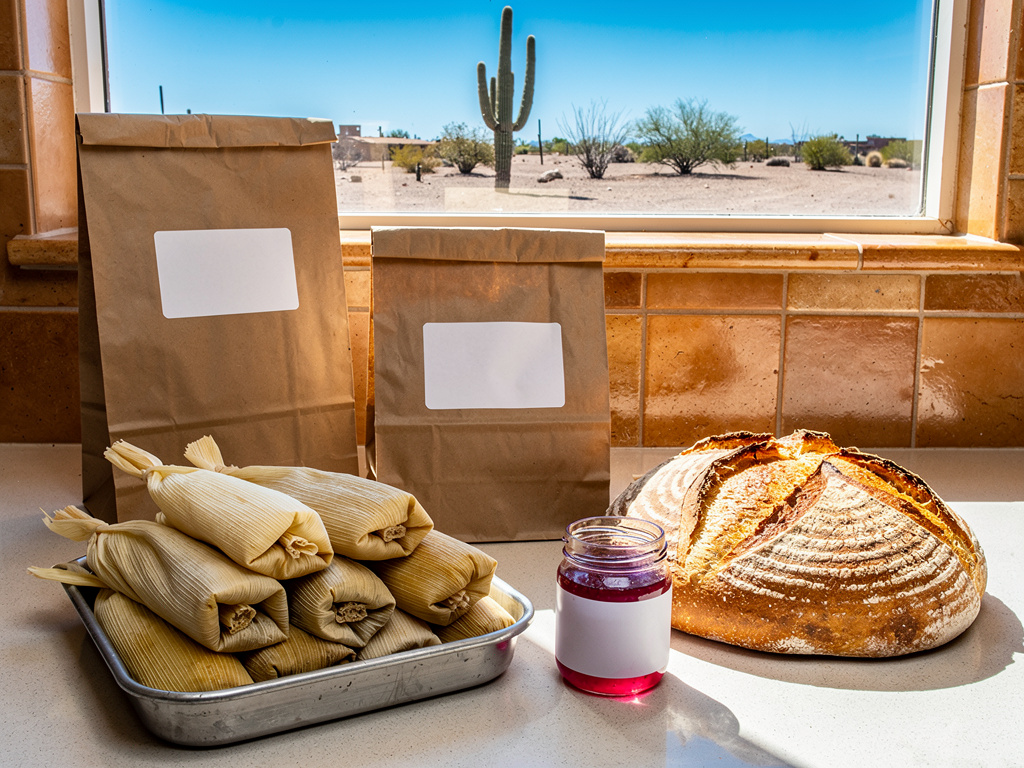


The short version: To start a cottage food business in Arizona, you take an accredited food handler course, register for free with the Arizona Department of Health Services (ADHS) Cottage Food Program, wait for your certificate, label every package the way state law spells out, and then sell to customers in Arizona. There is no state cottage food license fee, no kitchen inspection and no sales cap, and since the 2024 "Tamale Bill" you can sell perishable foods like tamales, burritos and cheesecake, not just cookies. The slow part is the wait: ADHS gives itself up to six weeks to process an application, though most people hear back within two. Perishable foods, dairy products and anything with meat or poultry must be handed to the customer in person, so they cannot go in stores or be shipped, and every online listing has to show your label information.
Checked on the ADHS Cottage Food Program pages, A.R.S. 36-932 and Homegrown's signup page, October 12, 2026. Food handler price from StateFoodSafety's Arizona page the same day. Homegrown is $10/month billed annually (or $12.50 monthly) plus 2.9% + $0.30 card processing, which the vendor pays. Customers create a Homegrown account to place a first order, and there is no drops or countdown release feature. This guide is general information, not legal advice; verify your state's current rules with ADHS before you sell.
Once your ADHS certificate arrives, you can set up a Homegrown storefront so local customers can order ahead, and try it free for 7 days.
Arizona makes it easy to turn a home kitchen into a small food business. The paperwork is one free online registration and one food handler certificate. What trips people up is the order of the steps and the rules that kick in after you register: what goes on the label, who can deliver a tamale, and what your Instagram post has to say. This guide is the setup playbook. For the full rulebook (every allowed food, every label line, the history of the law), read our Arizona cottage food law guide.
You start an Arizona cottage food business in seven steps, and the only one you cannot rush is the ADHS review of your registration. Everything else (the course, your label, your ordering page) fits in a weekend.
Here is the order that keeps you from redoing work:
After that, two dates go on your calendar: your food handler certificate's expiration and your registration renewal three years out.
Arizona does not issue a cottage food license: you pay $0 to register with the state, and there is no home kitchen inspection. What people call an "Arizona cottage license" or "AZ cottage food license" is really a free registration with the ADHS Cottage Food Program, plus an accredited food handler certificate. Together they are your permission to sell.
Here is what each piece is, in plain terms:
ADHS's FAQ says that when you follow the program's rules, you can make approved foods at home, sell them and grow your business "without inspections or fees." The cost to apply is $0. We read it on the ADHS Cottage Food Program page on October 12, 2026.
So if you searched "how much is a cottage license in Arizona," the honest answer is $0 for the state registration and about $11 for the food handler course, plus a $12 state TPT license if you sell taxable products and any city license your town requires.
You register online through ADHS's MyHealthDepartment portal, and the form goes quickly if your food handler certificate is already saved. ADHS publishes a 22-step picture guide, but the application itself asks for four things:
You also answer "yes" to a set of policy statements and sign on screen. Those statements are the rules you agree to follow: make food only in your home kitchen, label every package, sell and deliver the way state law allows, and keep your food handler certificate active.
After you submit, ADHS does not send an automatic confirmation email. You can check the status in your MyHealthDepartment account. ADHS will either email your certificate or email a list of what is missing. Under the rule, if ADHS asks for more information and you do not answer within 30 days, it treats the application as withdrawn.
Check your spam folder at day 14. ADHS's step-by-step guide says applications have 4 to 6 weeks to process but you will "typically" get an email within two weeks, and its FAQ tells applicants who hear nothing to check junk mail before writing to CottageFood@azdhs.gov.
Any food handler course from a program accredited to national standards counts. ADHS links to the ANAB (ANSI National Accreditation Board) directory of accredited certificate issuers, and an active Food Manager Certification also works. ADHS itself says the easiest way to get certified is to take a course online.
One example we checked: StateFoodSafety's Arizona Food Handlers Card listed a $10.00 training price plus a $0.99 health department and processing fee, $10.99 total, on October 12, 2026. The page says it is ANAB accredited, takes about 30 minutes, and the certificate is valid for 3 years.
ADHS also names four counties whose health departments can provide food handler cards: La Paz, Mohave, Pima and Yuma.
A county class is not automatically an accredited one. Pima County's food certification page said on October 12, 2026: "This food handler certificate is not ANSI-accredited. It is intended for educational purposes only and may not meet regulatory requirements in all jurisdictions." Arizona's cottage food rule asks for a course from an accredited program, so check the course page or the ANAB directory before you pay for any class.
Your registration also depends on the certificate staying current. If it expires, the rule says you are no longer covered, so renew the course before the date printed on it.
The two required costs come to $10.99: $0 for the ADHS registration and $10.99 for an online food handler course. If you also need a state sales tax license and buy printed labels, the fixed startup cost comes to about $79.40 before ingredients and packaging.
Scroll sideways to see where each price came from.
| Cost | Price | Required? | Where we checked it |
|---|---|---|---|
| ADHS Cottage Food Program registration | $0 | Yes | ADHS program pages and presentation |
| Food handler course (StateFoodSafety, Arizona) | $10.99 ($10.00 + $0.99 fee) | Yes | StateFoodSafety Arizona page |
| Arizona transaction privilege tax (TPT) license | $12 state fee per location, plus any city fee | Depends on what you sell and where | Arizona Department of Revenue TPT license page |
| Labels (Avery 5168, 400 labels, 3-1/2 x 5 in) | $50.46 sale price + $5.95 shipping = $56.41 | No (handwritten labels are allowed) | Avery product page |
| Ingredients and packaging | Depends on your menu | Yes | Your own recipe costs |
| Online storefront (Homegrown) | $10/month billed annually, or $12.50 monthly, plus 2.9% + $0.30 per card sale | No | findhomegrown.com/signup |
We checked every price in this table on October 12, 2026. The $79.40 total is $10.99 + $0 + $12 + $56.41. A city TPT or business license fee is extra and depends on your city.
A few notes on what this means for your budget:
Plan on two to six weeks, almost all of it waiting on ADHS. The course takes about 30 minutes and the application is one online form, but ADHS's guide allows up to six weeks for processing, with most applicants getting an email within two weeks.
A realistic timeline looks like this:
Budget the full window, especially if you are aiming for a holiday market or a fall festival.
You can sell almost any food made in your home kitchen; ADHS names 5 types it will not approve. Its Cottage Food Program page says "Most foods are allowed!" and rules out fish, shellfish, raw milk, alcoholic beverages and marijuana-infused products. Its approved list, read October 12, 2026, includes:
Everything on that list has to be made, packaged and labeled in your home kitchen and sold in that same package. ADHS's program presentation adds that all processing happens inside the home kitchen, so no outdoor grilling, smoking or drying. ADHS says open sampling, assembling food and pouring drinks are not covered by the program, so bottle and label the agua fresca at home before market day.
A few limits sit next to that list. Beef and pork must come from a USDA-inspected source, like a grocery store or butcher. Home-raised eggs are regulated by the Arizona Department of Agriculture, not the cottage food program. Pet treats, supplements in capsules and cosmetics are not cottage foods. ADHS also rules out wild-foraged produce (fruit picked outside a home garden or an approved farm, like wild prickly pear), hunted game and slaughtered home-raised quail, and any ingredient the FDA does not recognize as safe, such as kava or CBD. On Homegrown, Arizona vendors had 35 products listed on October 12, 2026, and 22 of them, all from 3 of the 6 vendors, were filed under Bakery. 18 of those 22 are baked goods like sourdough loaves, pies and scones, and the other 4 are coffee creamers and fresh cheese. Want to add a food to your menu after you register? ADHS says you need its approval first: email your updated menu to CottageFood@azdhs.gov, and for a perishable food, include a completed attestation form if you have not sent one before.
The Arizona cottage food law guide covers the full allowed and banned lists, and our general tamale selling guide covers pricing, packaging and where to sell. That guide is written for all states; in Arizona, ADHS's approved list includes beef, chicken, pork and cheese tamales.
Perishable foods follow a stricter rule: they must reach the customer in person, within 2 hours, at one destination. Foods that need refrigeration or hot holding to stay safe (ADHS calls them TCS, short for time/temperature control for safety) can be made at home, but they must go straight from you or your employee to the customer. Shelf-stable foods like cookies and bread have far more options.
Here is how the rules split, based on A.R.S. 36-932 and the ADHS rule:
Swipe the table to see who can deliver each type of food.
| Type of food | Examples | Sell online to Arizona buyers? | Who can deliver it? | Sell in a store? |
|---|---|---|---|---|
| Shelf-stable, with no meat, poultry or dairy products | Cookies, bread, brownies, most jams | Yes | You, an agent, a third-party vendor or a carrier, inside Arizona | Yes, in a separate section with a "homemade" sign |
| Perishable (TCS) | Tamales, cheesecake, cut fruit, cooked vegetables | Yes | You or your employee, in person | No |
| Dairy products, or contains meat or poultry | Fresh cheese, burritos, jerky, meat empanadas | Yes | You or your employee, in person (even if shelf-stable) | No |
From A.R.S. 36-932(E), R9-8-101.02(D) and the ADHS Cottage Food FAQ, read October 12, 2026.
For perishable foods, the rule spells out three handling limits. Keep the food at a safe temperature the whole trip. Take it to one destination. And make the trip no longer than two hours, "including any time spent delayed in traffic." No delivery apps like DoorDash for these foods, and no shipping.
A product that starts perishable can sometimes become shelf-stable, like a freeze-dried fruit or a tested salsa. ADHS says lab results showing a pH of 4.6 or below, or water activity below 0.85, can get it treated as shelf-stable. The University of Arizona runs two food testing labs ADHS lists for this.
Every Arizona cottage food package needs a label with 5 required parts (a sixth applies only to food made in a facility for individuals with developmental disabilities), and the rules set the exact wording of two of them. A.R.S. 36-932 and the ADHS rule require:
Printed labels cost about $0.13 each (an Avery 400-pack at $50.46), and handwritten ones are allowed. The package itself must be clean, fully closed and tamper-evident. The rule says the label can be the tamper-evident seal, so a label across the fold of a bag works.
Copy the home-kitchen sentence from the statute, not from memory or an old template. On October 12, 2026, one answer in the ADHS FAQ still showed an older wording ("may process common food allergens"), while A.R.S. 36-932, the rule and ADHS's labeling page all say "may come in contact with common food allergens and pet allergens." Use the statute's version.
Selling online adds one more step. If a product is offered for sale online, the law requires a "prominent notification" with the same label information: your name and registration number, ingredients, production date, the home-kitchen sentence and the ADHS website. ADHS's FAQ suggests two easy ways: post a photo of the label next to the product photo, or type the label details into the listing. It applies to Facebook, Nextdoor, Instagram and your own site, and to pre-orders you pick up at a market. Label examples and the disclaimer wording for 13 other states are in our cottage food labeling guide.
You have 5 ways to sell inside Arizona, and none outside the state. The ADHS rule says a registered preparer "shall only offer cottage FOODS for sale and delivery in Arizona." Within the state, your options include:
Two limits are easy to miss. You cannot sell cottage food to a restaurant or other permitted food business to use as an ingredient in what it sells. And you cannot store your products or equipment outside your home, so no rented storage unit for inventory.
Shelf-stable foods without meat, poultry or dairy products can be shipped to Arizona addresses. Perishable foods, dairy products and foods containing meat or poultry cannot be shipped at all. Our guide on whether you can ship cottage food compares Arizona with other states. Before market day, ask the market manager what vendor paperwork the market and your county want; our Arizona farmers market vendor permit guide covers the county event permit application and the state sales tax license.
The cleanest setup is an ordering page that shows your label details on every product and lets customers pick a pickup time, so perishable orders come straight to you. That covers the two rules Arizona vendors trip on most: the online label notice and the in-person handoff for perishables.
A Homegrown storefront costs $10 per month billed annually ($12.50 billed monthly), with no percentage fees beyond standard payment processing of 2.9% + $0.30 per card sale, which you pay. Each listing has its own page with a description plus allergen and ingredient fields, so your registration number and the home-kitchen sentence can sit right next to the ingredients. You set pickup days, time windows and locations (your porch, a market booth), and customers pay when they order, so you bake to a known count. Homegrown also lists your storefront on its marketplace. Plan on most orders coming from people you send to your own link.
How it compares with what Arizona home cooks usually try first:
Slide the table to see every fee for each platform.
| Platform | Subscription | Trial | Platform fee | Card processing | Customer pays on a $20 order | Vendor pays on a $20 order | Vendor cost for 50 orders a month |
|---|---|---|---|---|---|---|---|
| Homegrown (annual) | $10/mo billed annually | 7 days, no charge until day 8 | $0 (0% commission) | 2.9% + $0.30, vendor pays | $20.00 | $0.88 | $54.00 |
| Homegrown (monthly) | $12.50/mo | 7 days, no charge until day 8 | $0 (0% commission) | 2.9% + $0.30, vendor pays | $20.00 | $0.88 | $56.50 |
| Hotplate (default, fee passed to customer) | $0 | No subscription to trial | 5% + $0.55 on subtotal, customer pays | 2.9% + $0.30 on what the customer pays, vendor pays | $21.55 | $0.92 | $46.25 (customers pay $77.50 in fees) |
| Hotplate (vendor pays the fee) | $0 | No subscription to trial | 5% + $0.55, vendor pays | 2.9% + $0.30, vendor pays | $20.00 | $2.43 | $121.50 |
| Square Online (Free plan) | $0/mo | Free plan, no trial needed | $0 | 3.3% + $0.30 online, vendor pays | $20.00 | $0.96 | $48.00 |
We checked these on Homegrown's signup page, Hotplate's pricing page and Square's online store plans page on October 12, 2026. Hotplate's own post "What Hotplate does" says it charges "a fee to your customer" by default and that "80% of Hotplate chefs keep the default as-is." Sales tax and tips are left out of every row.
The honest read of that table: counting every fee the vendor pays, Hotplate's default (2.9% + $0.30 processing on $21.55, with the 5% + $0.55 fee on the customer) and Square's Free plan (3.3% + $0.30) cost the vendor less than Homegrown (2.9% + $0.30 plus $10 a month) at 50 orders a month. The $10 subscription is the whole difference: on card processing alone, Homegrown's $44.00 for 50 orders is less than Hotplate's $46.25 or Square's $48.00. With Homegrown your customer pays the menu price plus any sales tax (and any delivery fee you set), with no added platform or service fee, and you get pickup scheduling and ingredient fields built for food.
What Homegrown does not do: it does not deliver for you (for tamales and other perishables, you or your employee still hand off the order, which is what Arizona requires), it has no drops or countdown release feature, and customers create a Homegrown account to place their first order. It also does not file your ADHS registration or write your label. You start with a 7-day trial, no charge until day 8.
Arizona puts no dollar cap on cottage food sales, so your income is limited by demand and your kitchen, not by the state. The statute says a registered preparer "may sell cottage food products to the maximum extent allowed by federal law."
To see what that looks like, take a real price range. The 22 listings Arizona vendors filed under Bakery in Homegrown's catalog on October 12, 2026 ran from $3.75 to $20.00. Say you sell 40 sourdough loaves a week at $10. That is $400 in sales. If each loaf is its own $10 order, card processing at 2.9% + $0.30 is $0.59 a loaf, or $23.60, which leaves $376.40 before ingredients, packaging and your time.
In a pull of the Homegrown catalog on October 12, 2026 (2,847 products from 313 vendors with listings), 7 vendors had an Arizona pickup location and 6 had products listed, 35 products in all. By the category each vendor chose: 22 Bakery, 5 Health and Wellness, 3 Ready-to-Eat, 2 Eggs and Dairy, 2 Pantry and 1 Vegetables. We read all 35 listings. 31 are foods (the other 4 are skin care): 12 of the 31 list their ingredients in the description, 14 listings have no description at all, and none of the 35 carry the home-kitchen sentence or a registration number in the product name or description. Homegrown's separate allergen and ingredient field was not part of this pull, and a photo of the label beside the product also meets the ADHS online rule, so this counts only the names and descriptions.
Arizona listings on Homegrown by category
Source: Homegrown catalog pull, October 12, 2026, 35 products from 6 vendors with an Arizona pickup location. Category is the one the vendor picked.
Ways to make the most of an uncapped state:
Most early problems come from skipping a step or missing the rules that apply after you register:
You do not need an LLC to start, and the state TPT license, when you need one, costs $12 per location. ADHS registers you as an individual, so you can start as a sole proprietor. An LLC is about protecting your personal assets as you grow; our guide on whether you need an LLC to sell food from home covers when it is worth it.
Taxes take a little more thought, and ADHS says plainly that it has no oversight of them. Here is how they break down:
You renew every three years by submitting a new registration through the same portal. Arizona law (A.R.S. 36-136) says a registered food preparer "shall renew the registration every three years," and the ADHS registration page says to renew you "complete a new registration." Your certificate lists its expiration date.
Keep these three things current between renewals:
If ADHS finds you out of step with the rules, the rule lets it suspend or revoke your registration, and its FAQ says you would then be an illegal food establishment, subject to fines. A registered vendor can appeal a suspension or revocation. The simplest protection is a short checklist taped inside a cabinet: certificate date, renewal date, label template and menu on file with ADHS.
ADHS also keeps a public live list of registrants, so customers and market managers can check that you are registered. As of October 12, 2026, ADHS's list of active rulemakings had no cottage food item, so ADHS had no cottage food rule change in progress.
No cottage food license, and no state registration fee. To start a cottage food business in Arizona you register for free with the ADHS Cottage Food Program and hold an active food handler certificate from an accredited course. There is no home kitchen inspection. If you sell taxable products, you may also need a $12 state TPT license, and your city may require its own business license.
The required costs are $0 for ADHS registration and about $11 for accredited food handler training ($10.99 at StateFoodSafety on October 12, 2026). Add $12 for a state TPT license if you sell taxable products, plus any city license fee, labels, ingredients and packaging. An online storefront is optional.
There is no annual sales cap in Arizona. State law lets registered home cooks sell "to the maximum extent allowed by federal law," so your income depends on your prices, your customers and how much your kitchen can make.
Most foods. ADHS allows baked goods, candy, jams, salsas, and perishable foods like tamales, burritos and soups. It excludes fish, shellfish, raw milk, alcoholic beverages and marijuana-infused products, and beef and pork must come from a USDA-inspected source.
Yes, but only to Arizona addresses. Every online listing must show your label information, and perishable foods, dairy products or anything with meat or poultry must be delivered in person by you or your employee. Shelf-stable foods made without meat, poultry or dairy can also be shipped within Arizona.
The course takes about 30 minutes, but the ADHS registration can take 4 to 6 weeks to process. Most applicants get an email within about two weeks. You cannot make food for sale until your certificate arrives.
No. ADHS registers you as an individual, so you can start as a sole proprietor, and it does not ask for a business entity. An LLC is optional and mainly about liability protection as you grow.
Yes, every three years, by submitting a new registration through ADHS's MyHealthDepartment portal. Your food handler certificate also has to stay active the whole time you sell.
Once your registration is in, these six guides answer the next questions most new Arizona vendors ask, from what to cook first to which permit the market manager will want to see:
Arizona keeps the start simple: no state cottage food license fee, no inspection, no cap, and perishable foods like tamales on the menu. Take the food handler course today, submit your free ADHS registration, and use the wait to finish your label and your ordering page. When the certificate lands, you are ready to sell the same week. Start small: one product, one pickup window, a dozen regulars. Then, once ADHS approves your updated menu, add the perishable foods Arizona allows, keeping each delivery inside the two-hour rule.
If you want customers to order and pay ahead, with your label details on every listing and pickup windows for perishables, set up a Homegrown storefront for $10 a month billed annually. Start with the 7-day trial, no charge until day 8.
*This guide is general information, not legal advice. Cottage food rules change, so verify your state's current rules with the Arizona Department of Health Services Cottage Food Program before you start selling. Last verified: October 12, 2026.*



