
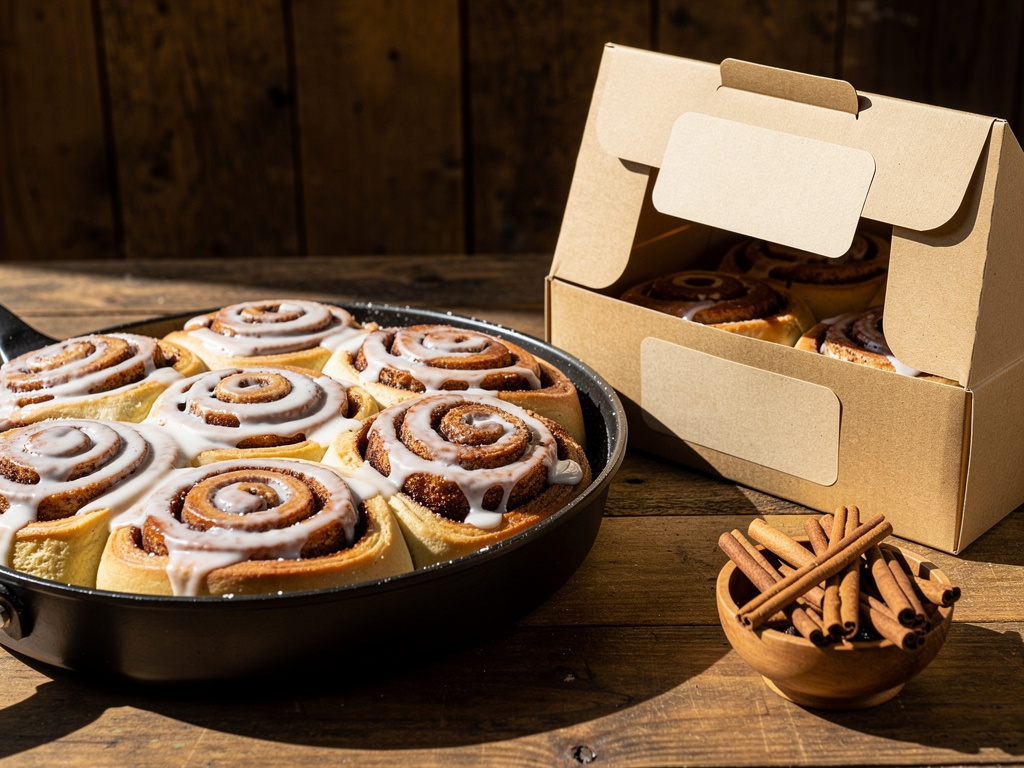


The short version: Yes, you can sell homemade cinnamon rolls from your home kitchen in all 8 states we checked, as long as the topping is shelf stable, like a simple powdered sugar glaze. The frosting is where it gets strict: California, Michigan and Washington name cream cheese as off limits, Colorado bans buttercream made with butter, and Michigan allows homemade buttercream only from two lab-tested recipes, though store-bought shelf-stable frosting is also allowed there. Texas lets you sell cream cheese frosted rolls from home once you register with the state and add a safe handling label, and Ohio covers refrigerated baked goods under a separate $10-a-year Home Bakery license. Among the 6 states that set one total yearly cap, it runs from $35,000 in Washington to $250,000 in Florida. Check your own state's agency page before you take the first order, because these rules change.
Checked on September 23, 2026: the cinnamon roll and frosting rules come from each state agency's own cottage food page (Texas DSHS, California CDPH, Florida FDACS, Michigan MDARD, Ohio ODA, Washington WSDA, Colorado CDPHE, Minnesota MDA), plus the University of Florida IFAS fact sheet for Florida's frosting and shipping rules, and platform fees from each company's pricing page the same day. Homegrown customers create an account to place their first order, and Homegrown has no timed drop feature.
Your cinnamon rolls are the first thing gone at every bake sale, and now a coworker wants a dozen every Saturday and is offering $48 for them. Before you take the money, you want to know whether that is legal where you live. For a glazed cinnamon roll it almost always is. For a cream cheese frosted one, it depends on your state.
The line is not the dough. Every state we checked allows sweet yeast rolls. The line is the topping, and whether it needs a refrigerator to stay safe. Below you will find the rule, 8 states quoted from their own agencies, the frosting questions that trip people up, and what to do once you are allowed to sell.
Yes, you can sell homemade cinnamon rolls from your home kitchen in all 8 states whose agency pages we read on September 23, 2026, as long as the topping does not need refrigeration. Each of those states has a cottage food law, which is a state law that lets you make certain low-risk foods at home and sell them without a commercial kitchen. Cinnamon rolls fit the allowed baked goods in Texas, California, Florida, Michigan, Ohio, Washington, Colorado and Minnesota.
The "yes" gets narrower as the topping gets richer. Here is the quick version:
If your state says yes and you want the practical side (batch timing, packaging, market setup, flavors), our guide on how to sell cinnamon rolls from home covers that. This page is the permission half: which rolls, which toppings, in which states, under which rules.
A cinnamon roll is allowed or refused based on one question: does it need to be kept cold to stay safe? Food safety rules call a food that needs cold holding a "time and temperature control for safety" food, or TCS food for short. Older state laws say "potentially hazardous food" for the same idea. Most cottage food laws allow only foods that are not TCS.
The frosting decides it because the roll itself almost never needs refrigeration, while a soft dairy topping usually does, and 3 of the 8 states we checked name cream cheese directly. Michigan's cottage food page describes the allowed group as foods "that can safely be kept at room temperature and do not require refrigeration," and a baked yeast roll filled with butter, brown sugar and cinnamon sits on a counter just fine. The toppings are where the trouble starts:
That is why a thick powdered sugar glaze is fine almost everywhere, and a soft, tangy cream cheese frosting is not. Washington's agricultural department puts it plainly: "All frostings or glazes must have a cook step or be made with ingredients (such as a large amount of sugar) that when combined are stable at room temperature and won't spoil."
Texas is the exception on our list. Its cottage food page says a home operation "may sell time and temperature control for safety food (TCS)," as long as it registers with the state and keeps those foods at 41ºF or below. So in Texas the refrigerator question changes your paperwork, not your yes or no. Our guide to TCS foods under cottage food laws explains the term in more depth, including the water activity test some states use.
A sugar glaze and a plain roll are allowed in every state on our list, and cream cheese frosting is covered by the cottage food law of only one of them, Texas (Colorado joins it on January 1, 2027). Buttercream sits in the middle and depends on the state. The table below sorts the common toppings by how the state rules we read treat them.
Swipe left to see all four columns.
| Topping | Needs refrigeration? | How the 8 states treat it | Example wording |
|---|---|---|---|
| No topping, or cinnamon sugar | No | Allowed in all 8 | Florida lists "Loaf breads, rolls, biscuits" |
| Powdered sugar glaze or flat icing | No, when made only with shelf-stable ingredients | Allowed in all 8 when made that way; Michigan wants every icing ingredient shelf stable and Washington wants 3 parts sugar to 1 part perishable by weight | California lists "Flat icing" and "Sugar glazes" |
| Cooked caramel or sticky bun topping | Usually not, once cooked | Accepted in WA with a cook step; not addressed by the other 7, so ask | Washington: frostings "must have a cook step" or a large amount of sugar |
| Buttercream made with butter | Depends on the recipe | Allowed in CA and TX; only two tested recipes or store-bought shelf stable in MI; not allowed in CO; must meet 3 to 1 in WA | Colorado: "buttercream made with butter is not allowed" |
| Buttercream made with ghee or vegetable oil | Usually not | Allowed in CO; check your state elsewhere | Colorado allows "Buttercream made with ghee or vegetable oil" |
| Cream cheese frosting | Yes | Not allowed in CA, MI, WA; allowed in TX with registration and in OH with a Home Bakery license; possible in CO from January 1, 2027 as your one refrigerated product | Michigan: "No cream cheese frostings or icings" |
| Whipped cream | Yes | Not allowed where addressed; TX with registration; OH with a Home Bakery license; possible in CO from January 1, 2027 as your one refrigerated product | Colorado bars "cream, custard or meringue fillings or toppings" |
Each row comes from the state agencies' own cottage food pages, read on September 23, 2026. The Colorado cells for 2027 rest on the signed HB26-1033, read on leg.colorado.gov on September 28, 2026. Florida, Ohio and Minnesota do not name frostings on their pages; all three allow only foods that do not need refrigeration under their cottage food rules.
Two things to notice. First, the flavor is almost never the problem. Cinnamon, brown sugar, raisins, pecans and cooked apple filling all sit on a counter safely. Second, "glaze" and "frosting" are not legal terms. What matters is the recipe: how much sugar, whether it was cooked, and whether it has cream, cream cheese or raw eggs in it.
No, not in most states: Texas is the only state on our list whose cottage food law covers cream cheese frosted rolls. Colorado joins it on January 1, 2027, when its Tamale Act allows one refrigerated product type for registered home bakers. California, Michigan and Washington each list cream cheese among the fillings or frostings a home kitchen cannot use, and the cottage food rules in Florida, Ohio and Minnesota allow only foods that do not need refrigeration. Colorado's cottage food page bars baked goods with "cream, custard or meringue fillings or toppings." In Texas you can sell cream cheese frosted cinnamon rolls from home after you register with the Department of State Health Services and follow its cold-holding and labeling rules.
Here is how each state words it, all read on September 23, 2026:
Since SB 541, Texas lets a cottage food operation sell time and temperature control foods, which covers a cinnamon roll with cream cheese frosting. You register on the DSHS Online Licensing Registry, put the date the rolls were made on the label, and add this statement in at least 12-point type on the label or receipt: "SAFE HANDLING INSTRUCTIONS: To prevent illness from bacteria, keep this food refrigerated or frozen until the food is prepared for consumption." These rolls must be held at 41ºF or below, and they cannot be sold wholesale or donated. We read that on the Texas DSHS cottage food page on September 23, 2026.
Cream cheese frosting is the topping most cinnamon roll customers ask for, so this is the rule most likely to cost you a sale. Outside Texas, the honest answer to "can you do cream cheese?" is "not from my home kitchen." The last section of this page covers what bakers do instead.
Buttercream is named as allowed in California and covered by Texas's law, allowed only with conditions in Michigan and Washington, barred when made with butter in Colorado, and not addressed in Florida, Ohio or Minnesota, so it is not a safe default. Colorado's cottage food page says "buttercream made with butter is not allowed" and allows only buttercream made with ghee or vegetable oil. Michigan allows buttercream only if it is shelf stable from the store, or made from one of two lab-tested recipes followed exactly. California allows "Buttercream made with butter." Washington allows a frosting that has a cook step or meets its 3 to 1 sugar ratio, as long as it has no cream, cream cheese or uncooked eggs.
Many cinnamon roll guides say buttercream is fine everywhere. The state agency pages we loaded on September 23, 2026 say otherwise in two places, and set conditions in two more:
A popular trick for faking cream cheese flavor is a buttercream with lemon juice or vinegar stirred in. That can work in California, where butter buttercream is on the approved list. In Colorado it is still a butter buttercream, which is not allowed, and in Michigan any change to one of the two approved recipes, other than coloring or flavoring extracts, takes it off the approved list. We checked both states' pages on September 23, 2026.
Washington's 3 to 1 rule is worth doing the math on. A common cream cheese frosting uses 8 ounces of cream cheese, 4 ounces of butter and 16 ounces of powdered sugar. That is 16 ounces of sugar against 12 ounces of perishable ingredients, about 1.3 to 1, nowhere near 3 to 1. A simple glaze of powdered sugar and a splash of milk clears it easily.
All 8 states allow a glazed cinnamon roll from a home kitchen, and 3 of them name cream cheese frosting or filling as off limits. The table below puts each state's frosting rule next to its permit, its sales cap and where you can sell. Every row comes from the state agency's own page, plus the University of Florida IFAS fact sheet for Florida's frosting and shipping lines, all loaded on September 23, 2026.
Swipe left for the rest of each state's row.
| State | Glazed rolls | Cream cheese frosting | Buttercream | Permit or registration | Yearly sales cap | Sell outside the state? |
|---|---|---|---|---|---|---|
| Texas | Yes | Yes, with DSHS registration and safe handling label | Yes | None for shelf-stable rolls; registration for refrigerated ones | $150,000 gross income | Not addressed on the page; online sales need personal delivery |
| California | Yes, "Buns" and "Pastries" | No | Yes, "made with butter" | Register (Class A) or permit (Class B) with county Environmental Health | $88,878 Class A, $177,756 Class B (2026, adjusted yearly for inflation) | Not stated on CDPH's pages; mail delivery allowed |
| Florida | Yes, "rolls" and "pastries" | Not on the approved list | Not addressed | None from FDACS | $250,000 gross | Yes, by mail or commercial delivery, per the UF/IFAS fact sheet; website and mail order allowed |
| Michigan | Yes | No, named | Only two tested recipes or store-bought shelf stable | None, exempt from licensing and inspection | $50,000 gross ($75,000 if products sell for $250 or more a unit) | No, "only be sold or delivered within Michigan" |
| Ohio | Yes, as a bakery product | Not as cottage food; with a $10 yearly Home Bakery license | Not addressed | None for cottage food | Not stated on the page | No for cottage food; a licensed Home Bakery may |
| Washington | Yes, "rolls" and "pastries" | No, cream cheese fillings and low-sugar frostings named | Only if it meets 3 to 1 by weight | $355 permit, kitchen inspection, good for 2 years | $35,000 gross | No, direct to consumer only, no shipping |
| Colorado | Yes, baked goods | No, cream toppings barred; from January 1, 2027, possible as your one refrigerated product type under HB26-1033 | No with butter; yes with ghee or vegetable oil | Food safety training before you start; from January 1, 2027, yearly CDPHE registration too (HB26-1033) | $10,000 net revenue per product type through December 31, 2026; from January 1, 2027, $150,000 gross a year in total, adjusted for inflation (HB26-1033) | No, Colorado only |
| Minnesota | Yes, baked goods | Not allowed (refrigerated) | Not addressed | Yearly registration; $50 fee in Tier 2 | $78,000 gross | Cannot ship human food until the 2027 change |
We checked every row on the state agency's own page on September 23, 2026: Texas DSHS, California CDPH, Florida FDACS, Michigan MDARD, Ohio ODA (page dated April 4, 2018), Washington WSDA, Colorado CDPHE and Minnesota MDA. A cell that says "not addressed" or "not stated" means the agency page we read did not say, not that there is no rule. Colorado's cells that begin January 1, 2027 come from the signed text of HB26-1033, which we read on September 28, 2026.
These 8 are not the whole country. They are states spread across the South, West, Midwest and Great Lakes whose agency pages spell out baked goods rules clearly, and four of them (California, Michigan, Washington and Colorado) name frostings. For the other 42 states and Washington, D.C., start with our cottage food laws by state guide, then read your own agency's list, because a state summary can lag a new law by a season.
The paperwork to sell cinnamon rolls from home runs from nothing at all to a $355 permit with a kitchen inspection, which Washington pairs with a food worker card and a state Master Business License. Of the 8 agency pages we checked that day, Florida, Michigan and Ohio require no permit for shelf-stable rolls, Texas requires none unless you sell refrigerated rolls, and California, Washington and Minnesota require you to register or get a permit before your first sale. Colorado requires a food safety course first, and from January 1, 2027, every Colorado cottage food vendor must also register with the state health department each year before selling (HB26-1033).
Here is what each path looks like in practice:
Your permit lists every product by name, and each frosting needs a cook step or has to meet the state's 3 to 1 rule. The WSDA cottage food page says an approved frosting has "a 3 to 1 ratio of non-perishable ingredients (example: sugar) to perishable ingredients (example: eggs, butter, cream, milk) based upon weight." Adding a new product between renewals takes an amendment form and a $105 amendment fee, or you can add it at renewal with no extra fee. A failed first inspection costs $125 for the return visit. We read that on September 23, 2026.
Separate from the state's food rules, your city or county may have zoning rules for a home business, and your state will want sales tax on taxable sales. Minnesota and Washington both tell applicants to check local zoning. A phone call to your city's permit desk costs nothing and saves you from a letter after your first busy Saturday.
Six states on our list set one total yearly cap on home kitchen sales, and the lowest is Washington's $35,000 while the highest is Florida's $250,000. Colorado sets its limit at $10,000 for each kind of product instead, through December 31, 2026; from January 1, 2027, its Tamale Act replaces that with one $150,000 yearly cap on gross sales, adjusted each year for inflation. A cap is the most you may sell out of a home kitchen in a year before a licensed kitchen is required. At $48 a dozen, Washington's $35,000 is about 729 dozen, or roughly 14 dozen a week all year.
Yearly home kitchen sales caps, by state
Source: each state agency's cottage food page, checked September 23, 2026. Colorado caps each product type at $10,000 instead of one total (through 2026; one $150,000 gross cap from January 1, 2027), and Ohio did not state a number on the page we read, so both are left off. Michigan's $50,000 rises to $75,000 for products that sell for $250 or more a unit. California adjusts its caps for inflation each January; these are CDPH's 2026 figures.
What the caps mean for a cinnamon roll business:
If you want the other "how much," the price to charge, our cinnamon roll pricing guide lands on about $5 a single roll and $48 a dozen once your time is paid. If you are on track to pass your state's cap, that is the moment to price out a shared commercial kitchen, not a reason to stop selling.
Each of the 8 states on our list wants a label on a home kitchen cinnamon roll, and most want the same core facts: your name, your address or a state ID number, the product's name, its allergens, and a statement that it was made in a home kitchen. The exact home kitchen statement is where states differ, and it has to match your state's words.
The core list, from the Texas DSHS page as an example:
The home kitchen statements for four of the states, as each agency wrote them on the day we checked (California, Florida, Michigan and Washington set their own wording, so copy it from your agency's labeling page):
Cinnamon rolls sold one at a time off a market tray are the tricky case. Texas says cottage foods must be packaged and labeled, and it allows the label information on an invoice or receipt only for foods too large or bulky for conventional packaging. A cinnamon roll is not one of those, so bag or box each roll with its label. The University of Florida's fact sheet says Florida products must be prepackaged and labeled for individual sale, and Colorado's page says all cottage foods should be packaged and labeled. Our full guide to cottage food labeling requirements walks through ingredient order, allergen wording and net weight.
Selling direct to the person who eats the roll is allowed in all 8 states we read: from your home, at a farmers market, and by pickup or your own delivery. Selling through someone else, like a coffee shop, is where states split. Ohio allows it, California allows it for a Class B operation, and Texas allows it for shelf-stable rolls through a registered cottage food vendor. Colorado, Florida, Michigan, Minnesota and Washington do not.
The places a home cinnamon roll business usually sells:
A coffee shop that wants your rolls is possible in Texas, but only through a middle step. The DSHS page says a home operation may sell shelf-stable foods at wholesale to a "cottage food vendor," someone in Texas with a contract with you who registers with DSHS and sells to customers at a farmers market, farm stand, food service establishment or retail store. Cream cheese frosted rolls are not eligible for wholesale. We read that on September 23, 2026.
If a coffee shop asks for a standing weekly order and your state says no, a licensed kitchen is the next step, which we cover near the end of this page.
The agency pages in 7 of the 8 states on our list say you can take orders online; Ohio's page does not address it, so ask. Of the states whose cottage food rules address shipping across state lines, only Florida allows it: the University of Florida's extension fact sheet says products may be "shipped across state lines by the United States Postal Service or commercial mail delivery service." Michigan, Colorado, Ohio, Washington and Minnesota keep sales inside the state or bar shipping. Florida allows sales "on their website, by mail order," California lets a direct sale be fulfilled "via mail delivery," and Michigan allows internet and mail order sales "within Michigan." Minnesota does not allow shipping home kitchen food at all until its law changes on August 1, 2027.
The online rules, in plain terms, as of our September 23, 2026 check:
In practice, shipping is rarely the right plan for a cinnamon roll even where it is legal. A roll is best within a day of baking, and a glaze that arrives smeared across the box lid is a refund. The simpler plan is to take orders ahead and hand the rolls over in person at a set pickup time. That in-person handoff is allowed in every state on this list; in Ohio, ask the agency before you take the order online. Our guide on whether you can ship cottage food covers the mailing rules in the states this page leaves out.
Once your state says yes, the problem changes from "am I allowed" to "how do I keep 25 dozen a month in Saturday orders straight without living in my text messages." Most of the rules above point the same way: sell direct, hand the rolls over yourself, and in Texas, show the label information before the customer pays. A pre-order page with a pickup time does exactly that. In Washington, payment has to be person to person, so take the order online and ask WSDA before you collect card payment ahead of pickup.
Homegrown is $10 per month billed annually, with no percentage fees beyond standard payment processing. You get a storefront where customers see your rolls, your frosting choices and your pickup window, order and pay ahead, and you walk into Friday night's dough with an exact count. That matters for cinnamon rolls, because the dough rises overnight and every roll you shape without an order is flour, butter and a 5 a.m. alarm spent on a roll that may not sell.
Here is what that costs next to the other places home bakers take orders, on a $48 dozen and a month of 25 dozens:
Scroll sideways to see the full fee stack.
| Platform | Monthly plan | Platform or service fee | Card processing | Customer pays on a $48 dozen | Vendor pays on a $48 dozen | Vendor pays in a month of 25 dozens |
|---|---|---|---|---|---|---|
| Homegrown | $10 billed annually ($12.50 monthly); 7-day trial, no charge until day 8 | None, 0% commission | 2.9% + $0.30, paid by the vendor | $48.00 | $1.69 plus the plan | $52.30 |
| Hotplate, default | $0, no monthly subscription, so no trial needed | 5% + $0.55, paid by the customer | 2.9% + $0.30, paid by the vendor | $50.95 | $1.69 | $42.30 |
| Hotplate, vendor covers the fee | $0, no monthly subscription, so no trial needed | 5% + $0.55, paid by the vendor | 2.9% + $0.30, paid by the vendor | $48.00 | $4.64 | $116.05 |
| Shopify Basic | $29 billed yearly ($39 monthly); 3-day trial, then $1 a month for 3 months | None with Shopify Payments (2% with another provider) | 2.9% + 30¢ online | $48.00 | $1.69 plus the plan | $71.30 |
Fees come from Homegrown's signup page, Hotplate's pricing page and Shopify's pricing page, all checked on September 23, 2026. Card processing is figured on the $48 price; a platform that charges it on the total with tips or tax runs a few cents higher. Homegrown and Shopify monthly totals use annual billing; on monthly billing they are $54.80 and $81.30.
What each option means for a cinnamon roll vendor:
Homegrown fits the way these laws want you to sell: direct, local, pickup. What it does not do: it does not check whether your frosting is legal in your state (that part is on you and this page), it has no timed "drop" release feature, and your customers create a Homegrown account to place their first order. Your storefront is listed on Homegrown's marketplace, but plan on most orders coming from people you send to your own link. If you want your Saturday roll orders in one place instead of thirty text threads, you can set up your cinnamon roll storefront in about 15 minutes.
The cinnamon roll vendors who never get a letter from the health department do a handful of small things: they pick a topping their state names, they write the recipe down by weight, and they keep a simple sales log. None of it takes more than an hour a week, and it keeps a fun side business from turning into a problem.
In a pull of the Homegrown catalog on September 28, 2026, 53 of the 2,779 in-stock products listed by 312 vendors were cinnamon rolls or cinnamon buns, from 36 vendors. We counted a listing when its name or its description called it a cinnamon roll or cinnamon bun, and left out cinnamon swirl loaves, focaccia and mixed boxes. The September 18 count in our pricing guide also included cinnamon swirl breads, so the two numbers differ. Only 3 of the 53 mentioned cream cheese frosting in the name or description, 12 described a glaze, and 7 named another icing or frosting. The other 31 did not name the topping at all. Nineteen of the 53 were sourdough cinnamon rolls. Naming the topping in the product title is the easiest way to show a customer, and an inspector, what they are buying.
Habits worth copying:
Write your frosting recipe by weight, not by cups. A cup of butter weighs about 8 ounces, while a cup of powdered sugar weighs only about 4. A frosting that looks sugar heavy on a recipe card (1 cup butter, 2 cups powdered sugar) is really 8 ounces of sugar to 8 ounces of butter, a 1 to 1 ratio by weight, which is a long way from Washington's 3 to 1. Weigh it once and you will know.
You can confirm whether your cinnamon rolls and your frosting are legal in your state in 2 or 3 hours by reading two pages on your state agency's website and making one phone call. Cottage food rules usually live with the state Department of Agriculture or the Department of Health. Follow these steps in order:
If your state's page is hard to read, our guide on whether it is legal to sell baked goods from home explains the terms these pages use.
If your state bars cream cheese frosting, you have four real options: change the topping, get a license that covers refrigerated baked goods, rent a licensed kitchen, or keep checking the law. Texas's SB 541, in effect since September 1, 2025, is the change that opened up cream cheese frosted rolls there. Minnesota's 2027 change covers its fee, tiers, shipping and training, Michigan's 2026 update raised its sales cap, and Colorado's Tamale Act, signed June 4, 2026, lets a registered home baker sell one type of refrigerated food, with up to five variations, starting January 1, 2027. That could be cream cheese frosted rolls.
Your options, from cheapest to most work:
Always verify your state's current rules with the agency before you sell, and keep the date you checked. This page reports what 8 agencies said on September 23, 2026. Its Colorado 2027 rules come from HB26-1033 as signed, read September 28, 2026. It is not legal advice, and a rule can change the week after a page is written.
In Florida, Michigan and Ohio, yes: the state agencies say shelf-stable home kitchen baked goods need no license or permit, as of September 23, 2026. Texas needs no permit either for rolls that do not need refrigeration, though you must complete a food handler course. California, Washington and Minnesota require registration or a permit first, and Colorado asks for food safety training before the first sale, plus a yearly registration with the state health department from January 1, 2027. Check your own state's cottage food page before you sell homemade cinnamon rolls.
Only in a few places. Three of the states we checked, California, Michigan and Washington, rule out cream cheese in home kitchen frostings or fillings, and most other cottage food laws allow only foods that stay safe without refrigeration. Texas allows cream cheese frosted rolls if you register with the Department of State Health Services, date the rolls, add the safe handling statement and keep them at 41ºF or below. Ohio covers refrigerated bakery products under its $10 Home Bakery license. From January 1, 2027, Colorado's Tamale Act adds a path too: a registered home baker may sell one type of refrigerated food, which could be cream cheese frosted rolls.
Yes, in every state we checked, as long as the glaze is made with shelf-stable ingredients and meets the 3 to 1 sugar ratio Washington sets. California lists "Flat icing" and "Sugar glazes" as approved, and Washington approves a frosting with at least 3 parts sugar to 1 part perishable ingredients by weight, as long as it has no cream or uncooked eggs. A glaze of powdered sugar with a little water and vanilla clears that easily, and Michigan asks that every icing ingredient be shelf stable.
Our pricing guide recommends about $5 for a single roll and $48 for a dozen once your time is paid. In our September 28, 2026 pull of the Homegrown catalog, the 7 cinnamon roll listings sold as one roll (a name or size option reading "(1)", "1ct", "1 roll" or "Single") had a median price of $5.50. The legal limit is the other "how much": Washington caps home kitchen sales at $35,000 a year, Texas at $150,000 and Florida at $250,000, while Colorado caps each product type at $10,000 through 2026 and moves to one $150,000 gross cap on January 1, 2027.
Yes. A farmers market sale goes straight to the customer, which every cottage food law we read allows for approved baked goods. Your market will likely have its own application and booth fee on top of your state's rules. Bring your labels and your state's home kitchen sign, since Colorado and Minnesota require one at the point of sale.
Sometimes. Ohio's cottage food page allows cottage foods to be used in restaurants, California lets a Class B operation with a county permit sell "indirectly through restaurants and food markets," and Texas allows it for shelf-stable rolls through a registered cottage food vendor. Colorado, Florida, Michigan, Minnesota and Washington do not allow home kitchen sales through a business. If a cafe wants your rolls every week and your state says no, a licensed kitchen is the next step.
More on selling cinnamon rolls and baked goods from home:
You know which toppings your state allows, what the label needs and where you can sell. The next step is a place for customers to order and pay before you mix the dough, so every roll you pull from the oven already has a name on it. With Homegrown you get a pre-order storefront with pickup times for $10 a month billed annually and no percentage fees beyond standard payment processing. Start your cinnamon roll storefront on Homegrown and share the link before your next bake.
A simple way to start: list a single roll and a half dozen with the glaze your state clearly allows, set one Saturday pickup window, and send the link to the people who already ask you for rolls. Put your full label information (business name, address or state ID number, product name, allergens and your state's home kitchen statement, plus the date made and the safe handling statement for refrigerated rolls in Texas) in each product's description, so customers read it before they pay, the way Texas requires of online vendors. Your customers create a Homegrown account the first time they order, and card processing of 2.9% + $0.30 comes out of your side, not theirs.



