
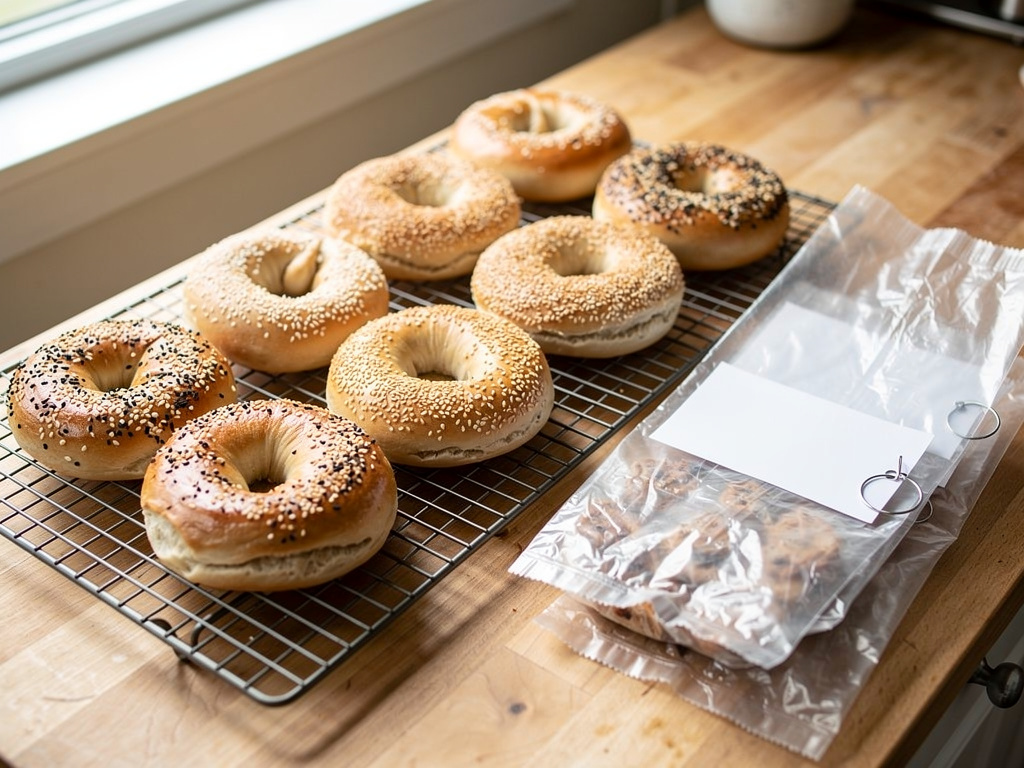


The short version: Yes, in all 9 states we checked you can sell plain homemade bagels from your home kitchen, because a baked bagel keeps at room temperature and fits the bread or baked goods category of each state's home food rules (in Wisconsin, a court order rather than a law). California's approved cottage food list and New York's home processor list both name "Bagels" outright. The paperwork runs from nothing at all (Michigan, Ohio, Florida, Wisconsin) to a free New York registration that can take up to 16 weeks, a $35 Pennsylvania registration with a home kitchen inspection, or a $100 New Jersey permit every two years that also requires a food protection manager certificate. The flavors and the schmear are where states split: New York prohibits vegetables in its bagels and names jalapeños as prohibited, Michigan allows dried vegetables and dried or pickled jalapeños, New Jersey prohibits cheese and dried vegetables as ingredients, and Texas is the only one of the 9 whose home food rules clearly allow a bagel with cream cheese, after you register with the state and keep it at 41°F or colder.
Checked on each state agency's cottage food page, list or rule, September 26, 2026: the rules in this post come from those pages, quoted where it matters, plus the FDA's food allergen page for the sesame rule. Laws change, so verify your state's current rules with your state agency or county health department before your first sale. Homegrown takes the orders; it does not make a bagel legal in your state, customers create a Homegrown account to place their first order, and Homegrown has no drops or countdown release feature.
Your bagels are the thing people ask about. A neighbor wants a half dozen every Saturday, a coworker wants everything bagels for a Monday meeting, and the coffee shop down the street asked if you would bring them a dozen a day. Before you take the money, settle one question: does your state let you sell bagels you boiled and baked in your own kitchen?
For a plain or sesame bagel the answer is usually yes. The trouble starts with what goes in, on or next to it: fresh onion, jalapeño, cheddar baked into the dough, a tub of cream cheese, or lox. This guide walks through what 9 states actually say, the federal sesame rule that changed bagel labels in 2023, and where you can and cannot sell.
Yes, in all 9 states we checked on September 26, 2026, a home baker can sell plain baked bagels in some legal form, and 2 of those states (California and New York) name bagels on their official lists. A cottage food law is a state law that lets you make certain low-risk foods at home and sell them without a commercial kitchen. Bread is covered by the home food rules of every state we read. In Wisconsin that rule is a court order rather than a law, and the state agriculture department warns that "Ongoing litigation may change the applicability or accuracy" of its guidance.
This page is about the rules. If you want the cost per dozen, the flavors that sell and how to turn buyers into weekly regulars, the companion guide on selling bagels from home covers the business side. What that guide does not do is name states, quote the agencies, or say which flavors each state allows, and that is what you will find here.
Three things decide your answer:
A plain bagel is flour, water, yeast, salt and a little malt or sugar, boiled briefly and then baked until the crust is dry, so it does not need a refrigerator to stay safe. That room-temperature test is how 8 of the 9 states in this guide draw the line. Texas is the exception, since it also allows foods that need refrigeration once you register with the state. Ohio offers a separate $10-a-year Home Bakery license for bakery products that need refrigeration.
The boil does not change anything. Wisconsin's agriculture department defines a baked good as one "generally exposed to dry heat, transferred via air, at a temperature above 140°F" in something like an oven. A bagel goes from the pot into a hot oven (one Homegrown bagel vendor lists 500°F), and it is sold after the oven, not after the pot.
The things that make a bagel risky are added after baking or mixed into the dough:
Keep your bagel plain, or add only dried fruit, cinnamon sugar or a seed topping, and you are selling the version every state here treats most simply.
All 9 states in the table below allow plain baked bagels from a home kitchen. The columns that change are the flavors, the schmear and the paperwork, and 4 of the 9 (Michigan, Ohio, Florida and Wisconsin) ask for no filing and no course. Texas needs no filing for plain bagels but requires a food handler course.
Swipe the table to see all 9 states and every column.
| State | Plain bagels | Onion, garlic or jalapeño in the dough | Cheese in the dough | Bagels with cream cheese | What you file, and the fee |
|---|---|---|---|---|---|
| California | Yes, "Bagels" is on the CDPH list | Not named on the list; ask your county | Not named; the food must not need refrigeration, so ask your county | No, not on the list | Registration or permit from your county environmental health office, fee set locally, plus training within three months |
| New York | Yes, "Bagels" is on the home processor list | No, "Vegetables are prohibited" and jalapeños are on the prohibited list | Not named for bagels; cheese is on the prohibited list, so ask first | No, refrigerated foods and spreads are prohibited | Home processor registration, no fee, up to 16 weeks to review |
| Michigan | Yes, under breads | Dried or freeze-dried vegetables yes; jalapeños only dried or commercially pickled; no fresh | Shredded hard cheese mixed into the dough only | No, cheese and cream cheese products are not allowed | Nothing to file, no license |
| Ohio | Yes, under bakery products | Not named; dry seasoning blends are on the list | Not named for cottage food; a $10-a-year Home Bakery license with an inspection covers bakery products that need refrigeration | Not as cottage food | Nothing to file for cottage food; label "This Product is Home Produced." |
| New Jersey | Yes, under bread and rolls (submit each product) | No, vegetables (fresh, cooked, fried or dried) and peppers are prohibited ingredients; seasonings bought from a licensed facility are allowed | No, cheese is a prohibited ingredient | No, cream cheese is a prohibited ingredient | $100 permit, good for two years, plus a food protection manager certificate, proof of safe water and zoning approval |
| Pennsylvania | Yes, as a registered Limited Food Establishment | Ask your inspector | Baked goods with cheese may count as hazardous | No, foods that need refrigeration are not allowed | $35 registration plus inspection, $35 a year after |
| Texas | Yes, any food except a short excluded list | Yes | Yes (register if it needs refrigeration) | Yes, after DSHS registration, kept at 41°F or colder | Accredited food handler course; DSHS registration only for foods that need refrigeration |
| Florida | Yes, under loaf breads and rolls | Dry seasonings are on the list; fresh vegetables are not | Not named; the law covers low-risk foods only | No | No state food permit |
| Wisconsin | Yes, oven-baked goods sold direct | Only if the finished bagel is not potentially hazardous | Same test; ask DATCP | No, that needs a license | Nothing to file for baked goods sold direct |
We read each rule on September 26, 2026, on the state agency's own page: CDPH's Approved Cottage Foods list (last reviewed April 2026) and cottage food page, New York Agriculture and Markets' home processing page, MDARD's "What Can I Make?" page, the Ohio Department of Agriculture's cottage food and home bakery pages, the New Jersey Department of Health's approved and prohibited lists and N.J.A.C. 8:24-11, the Pennsylvania Department of Agriculture's Limited Food Establishment page and application packet, Texas DSHS's cottage food page, FDACS's cottage foods page, and Wisconsin DATCP's home bakers page. "Not named" means the flavor does not appear on the state's list; California's list gives examples rather than a closed list, which is why its cells say to ask your county. Confirm with your agency before you sell.
A few patterns stand out:
New York names bagels on its approved home processor list and charges no fee to register, but it limits what goes into them: "Bagels May contain high acid fruits, commercially dried fruits and/or commercially dried herbs. Vegetables are prohibited." That one line, on New York Agriculture and Markets' home processing page, is the most specific bagel rule we found in any state.
Home processor registration costs nothing and "does not currently have an expiration date," but the department asks applicants to "allow up to 16 weeks to review the request." Every bagel must be "pre-packaged in the home and properly labeled," and bagging at a craft fair or farmers market "is not permitted." We read that page on September 26, 2026.
What that means for a New York bagel menu:
New York also lets you sell to cafes. The same page says home processors may sell "wholesale to local facilities (restaurants, cafes, grocery stores, etc.)" inside New York State, labeled like any retail bagel. Our New York cottage food law guide walks through the registration step by step.
Two of the 9 states give savory bagels a clear yes (Michigan with dried vegetables, Texas outright), and the rest block them or leave them unclear: New York prohibits vegetables in bagels, and New Jersey lists "Vegetables (fresh, cooked, fried, or dried)" and "Peppers" among its prohibited ingredients on its cottage food prohibited list. Fresh chopped onion or fresh jalapeño in the dough is the riskiest version, and New York explains why: vegetable breads "generally demonstrate a higher moisture content which requires refrigeration."
Michigan's list is the most detailed. It allows "Breads with finely chopped and dried or freeze-dried vegetables and/or fruits incorporated into the dough prior to baking." It names "Jalapeno cheddar bread" as allowed, on the condition that the jalapeños are "chopped or pulverized and dried, freeze-dried, or commercially pickled and patted dry." It also says "No breads with fresh or frozen vegetables added."
An everything bagel blend is usually seeds, salt, dried minced onion and dried minced garlic. In Michigan and Texas that is fine. In New York the bagel line allows "commercially dried herbs" but says "Vegetables are prohibited," and in New Jersey dried vegetables are a prohibited ingredient while "Dried herbs or seasonings purchased from a licensed facility/wholesale distributor" are allowed. Neither state's page says which side a store-bought everything blend lands on, so name the exact blend and its ingredients on your registration or product form and let the agency answer in writing.
How to keep a savory menu legal in the strictest states:
Only in some states, and usually only with hard cheese mixed into the dough: Michigan allows "Breads with shredded hard cheeses incorporated into the dough prior to baking," Texas allows cheese bagels (registering if the bagel needs refrigeration), and New Jersey lists cheese as a prohibited ingredient and "Cheese-filled baked goods" as not included. Michigan also says "No breads with soft cheese or large chunks of hard cheeses," so an asiago crust sprinkled on top is a question to ask, not a given.
The other states are less clear:
Cheese bagels are popular, which is why this matters. On Homegrown, 21 of 48 bagel listings offered a cheese flavor when we pulled the catalog on September 26, 2026, from asiago to jalapeño cheddar. If your state is one of the unclear ones, put the cheese bagel on your product list and get the answer before you sell it.
Only Texas clearly allows it among the states in this guide: Texas lets a home baker sell foods that need refrigeration, like a bagel with cream cheese, after registering with the state health department and keeping the food at 41°F or colder. New York, New Jersey and Michigan each name cream cheese or cheese as not allowed, and the other states' cottage food rules limit home sales to foods that do not need refrigeration. Ohio's $10 Home Bakery license covers refrigerated bakery products like cheesecake, so an Ohio baker can ask ODA whether a schmeared bagel fits it.
Texas DSHS says a cottage food operation "may sell time and temperature control for safety food," but those foods "must be stored and delivered" cold enough to stay at "41ºF or below." You must register on the DSHS Online Licensing Registry, put the date the food was made on the label, and include "SAFE HANDLING INSTRUCTIONS: To prevent illness from bacteria, keep this food refrigerated or frozen until the food is prepared for consumption." in at least 12-point type. Schmeared bagels cannot be donated or sold wholesale. We read that page on September 26, 2026.
Everywhere else, bagel vendors handle cream cheese one of three ways:
Handing out a sealed tub of store-bought cream cheese with each order sounds harmless, but it is still a refrigerated food changing hands at your sale. New York prohibits "Any finished food product that requires refrigeration," and none of the 9 state pages we read says a home baker may resell a packaged dairy product. One Homegrown bagel listing, as of the catalog pull on September 26, 2026, includes store-bought cream cheese with every order. Ask your health department before you copy that.
Our guide to selling foods that need refrigeration under cottage food rules covers which states besides Texas allow refrigerated home foods.
No, not from a home kitchen in any of these 9 states, because meat and fish are excluded even in Texas, the most open state in this guide. Texas DSHS excludes "meat, meat products, poultry, or poultry products" and "seafood, including seafood products, fish, fish products, shellfish, and shellfish products," which covers bacon, sausage, ham, turkey and lox.
What that leaves in each kind of state:
If you want to sell breakfast sandwiches, you are opening a food service business, not a cottage food one. That usually means a licensed kitchen and a retail food permit from your county, at a fee the county sets. Selling plain bagels from home first is a cheap way to find out whether your neighborhood will buy them every week.
Sesame became the 9th major food allergen in the United States on January 1, 2023, so every sesame and everything bagel you label must name sesame. 7 of our 9 states require a label on every packaged bagel. Pennsylvania requires one only on packaged bagels sold through a store you do not own; bagels you sell directly need no label on the bag, but the ingredients must be available on request. The FDA's food allergen page says the FASTER Act, signed April 23, 2021, declared "sesame as the 9th major food allergen," and that "All FDA requirements applicable to major food allergens, including labeling and manufacturing requirements, apply to sesame as of January 1, 2023."
The nine major allergens the FDA names are:
A plain bagel already carries one of them (wheat). An everything or sesame bagel carries two, an egg bagel adds egg, and a cheese bagel adds milk. New York, Ohio and Texas, 3 of our 9 states, list sesame by name among the allergens a home baker must declare. California's cottage food label sheet (revised January 2025) and Michigan's labeling page both list allergens without sesame, but the federal rule applies to your label anyway.
Sesame also travels. Seeds fall off a tray and stick to the next batch, so a plain bagel baked after an everything bagel can pick some up. The FDA page notes that bakery products are one of "The five food types most often involved in food allergen recalls." Bake plain bagels first, change parchment between flavors, and do not claim "sesame free" unless you can back it up.
7 of our 9 states spell out a label for a packaged bagel with at least the product name, your name, your address or town (some states accept a registration or permit number) and the allergens. 6 of them also require the ingredients in order by weight; Texas asks only that allergen ingredients be listed. Each of the 7 has a state-specific line that says it was made in a home kitchen, though New York recommends its line rather than requiring it. The exact wording and type size change by state, and the home kitchen line is the part that differs most.
Scroll sideways for each state's required line.
| State | The home kitchen line, word for word | Other label rules worth knowing |
|---|---|---|
| California | "Made in a Home Kitchen" in 12-point type on the front panel | Your registration or permit number and the county that issued it; net quantity in both English and metric units |
| New York | Recommended, not required: a phrase like "Made in a Home Kitchen," 1/16 inch or larger | Allergens "(eggs, milk, fish, shellfish, soybeans, peanuts, tree nuts, wheat, and sesame) must be clearly identified" |
| Michigan | "Made in a home kitchen that has not been inspected by the Michigan Department of Agriculture & Rural Development" in at least 11-point | Net weight or volume with the metric equivalent |
| Ohio | "This Product is Home Produced." in 10-point type | Allergens named, sesame included |
| New Jersey | "This food is prepared pursuant to N.J.A.C. 8:24-11 in a home kitchen that has not been inspected by the Department of Health." | Your permit number and your municipality followed by "New Jersey" or "NJ"; the same line on a placard at any market |
| Texas | "THIS PRODUCT WAS PRODUCED IN A PRIVATE RESIDENCE THAT IS NOT SUBJECT TO GOVERNMENTAL LICENSING OR INSPECTION." | Your address or DSHS registration number; the date made and a safe handling line for refrigerated foods |
| Florida | "Made in a cottage food operation that is not subject to Florida's food safety regulations." in at least 10-point | Net weight or net volume; allergen information per federal rules |
| Pennsylvania | No home kitchen line; bagels sold directly by you need no label on the bag, but ingredients must be available on request | Packaged bagels sold through a store you do not own need a full label; loose bagels in a cafe case need the label information posted by the display |
| Wisconsin | Not specified on DATCP's home bakers page | Ask DATCP; federal allergen rules still apply |
Checked on each agency's label page or rule on September 26, 2026: CDPH's cottage food labeling requirements, NY Agriculture and Markets, MDARD, ODA, N.J.A.C. 8:24-11.4, Texas DSHS, Fla. Stat. 500.80, the PDA Limited Food Establishment packet and DATCP. Rules change, so check the current wording with your agency before you print.
Print one label per flavor, not one label for the whole bagel line. A 6-flavor menu needs 6 labels, because the ingredient list and the allergen line change: sesame on the everything, milk on the cheese, egg on an egg bagel. Keep the files named by flavor so a new flavor is a 5-minute edit, not a redesign.
Our cottage food labeling requirements guide walks through every required label element, which you can apply to bagel bags.
Yes, every state here that addresses markets allows them, but most want the bagels sealed and labeled before you arrive, and some add a market permit on top. That rules out the classic bakery move of tonging warm bagels from a basket into a paper bag at the booth.
What each state adds at the market:
A pop-up at a friend's cafe or a brewery is a different case in states like New Jersey, which does not allow delivery "To a retail food establishment." Selling from their counter can count as selling through a business, not to a person. Ask before you set up a table inside someone else's shop.
The practical fix for all of it is pre-orders. A customer who orders a half dozen on Thursday picks up a sealed, labeled bag on Saturday, so nothing gets opened, handed over loose or kept warm at the booth. Our guide to packaging bagels so they stay fresh for pickup covers the bags and timing.
In some states, yes: New York, Ohio and Pennsylvania allow home-baked bagels to be sold through local cafes, California allows it with a Class B permit, and Texas allows it only through a shop registered as a cottage food vendor. New Jersey and Florida do not allow it, Wisconsin requires a license for any wholesale sale, and Michigan's rules describe direct sales to customers only.
Drag sideways for shops, online orders and shipping.
| State | Sell to a coffee shop or store | Take orders online | Ship or mail bagels |
|---|---|---|---|
| California | Class B only, "indirectly through restaurants and food markets" | Yes, Class A and B | Mail delivery allowed |
| New York | Yes, "wholesale to local facilities (restaurants, cafes, grocery stores, etc.)" in New York | Yes, "within New York State only" | No out-of-state shipping |
| Michigan | No, direct sale only | Yes, if the customer can talk to you before the sale | Within Michigan only |
| Ohio | Yes, "grocery stores" and "a restaurant" | Not addressed on ODA's page | Within Ohio only |
| New Jersey | No, not to a retail food or wholesale establishment | Orders and payment online, handoff in person in New Jersey | No mail or common carrier |
| Pennsylvania | Yes, with a full label on packaged bagels in a store you do not own | Yes, "including internet sales" | Across state lines may need FDA registration |
| Texas | Only to a registered cottage food vendor, and never refrigerated foods | Yes, with personal delivery | Not listed among the delivery options |
| Florida | No, "Cottage food products cannot be sold wholesale." | Yes | Yes, by the Postal Service or a commercial mail service |
| Wisconsin | No, "A business that is wholesaling baked goods must be licensed." | Not addressed on DATCP's page | Ask DATCP |
Checked September 26, 2026, on the same state agency pages as the first table, plus Fla. Stat. 500.80 for Florida's online and mail rules. Rules on selling across state lines are strict in most states; if you want to ship bagels outside your state, plan on a licensed kitchen.
If your state allows it, a coffee shop account can steady your week. A cafe that takes 2 dozen a day, 5 days a week, is 120 bagels a week you can bake to a set count. Our guide to getting your food into a local coffee shop covers the pitch, wholesale pricing and delivery.
You can take bagel orders online in at least 7 of these 9 states (the Ohio and Wisconsin pages do not address it), but shipping is where the rules tighten: New York, Michigan and Ohio keep sales inside the state, New Jersey bans mail and common carrier delivery, and Texas lists personal delivery by you, an employee or a household member. Florida's law allows delivery by the Postal Service or a commercial mail service, and California allows mail delivery for both classes.
That makes bagels a local product in practice, and that suits them. A bagel is best within a day or two of baking, so a pre-order with a pickup day fits it better than a mailing box does. The rules to keep straight:
Our guide to whether you can ship cottage food covers the in-state and across-state rules in more detail.
Bagel vendors on Homegrown lean hard into the exact flavors this guide flags: in our September 26, 2026 catalog pull, 23 of 48 bagel listings offered everything or sesame, 21 offered a cheese flavor and 17 offered jalapeño. That is the useful part of the data for you. The flavors customers want most are the ones where your state's rules matter most.
In a pull of the Homegrown catalog on September 26, 2026, 48 of the 2,714 products listed by 306 vendors were bagels, from 23 vendors. We counted a listing when the thing sold is bagels (singles, packs, bites or a mix-and-match bagel box), judged by name and description after reading every listing from each vendor that mentions bagels. Loaves topped with everything seasoning, jams, a sourdough starter, a mixed bread box and one listing titled "Bagels" whose description is pretzel bread were not counted. 22 of the 48 are sourdough bagels. Flavor counts include the options in each listing's flavor menu. Singles ran from $1.50 to $3.50; Dream Bakery, for example, lists a single at $3.00, 6 for $15.00 and 12 for $28.00.
Bagel listings on Homegrown that offer each flavor
Source: Homegrown catalog pull, September 26, 2026, 48 bagel listings from 23 vendors. A listing can count in more than one row. Onion and garlic count only when named as a flavor, not as part of an everything blend.
What the listings show about how bagel vendors sell:
For pricing those packs, our guide to how much to sell bagels for builds the cost of a dozen from flour to bag.
Once your state says yes, the hard part with bagels is timing: they are best within a day of baking, and several states want them packed at home, so you want every order in before you mix the dough. Homegrown gives you an ordering page for $10 a month billed annually ($12.50 billed monthly) with no percentage fees beyond standard payment processing. Customers pick their flavors, pack size and pickup day and pay when they order, so you boil and bake to a real count.
Drag the table sideways to compare the full cost per order and per month.
| Platform | Monthly plan | Trial | Platform fee | Card processing | Customer pays on a $20 order | Vendor pays on a $20 order | Vendor pays in a month of 50 orders at $20 |
|---|---|---|---|---|---|---|---|
| Homegrown | $10 billed annually ($12.50 monthly) | 7 days, no charge until day 8 | None, 0% commission | 2.9% + $0.30, paid by the vendor | $20.00 | $0.88 plus the plan | $54.00 ($56.50 on monthly billing) |
| Hotplate | $0 | No plan to try | 5% + $0.55, added to the customer's checkout | 2.9% + $0.30, paid by the vendor | $20.00 | $0.88 | $44.00 |
| Etsy | $0 (one-time set-up fee may apply) | No plan to try | $0.20 listing fee plus 6.5% transaction fee | 3% + $0.25, paid by the vendor | $20.00 plus shipping | $2.35 | $117.50 |
| Shopify Basic | $29 billed yearly ($39 monthly) | 3 days, then $1 a month for 3 months | None with Shopify Payments | 2.9% + 30¢ online, paid by the vendor | $20.00 | $0.88 plus the plan | $73.00 ($83.00 on monthly billing) |
| Square Free, online | $0 | No plan to try | None | 3.3% + 30¢ online, paid by the vendor | $20.00 | $0.96 | $48.00 |
We checked every fee on September 26, 2026, on findhomegrown.com/signup, Hotplate's pricing page, Etsy's fees policy and its payment processing help page, Shopify's pricing page and Square's fee help page. Card processing is figured on the $20 price. Hotplate's own checkout example ($1.27 on a $30.00 order with a $3.00 tip) matches 2.9% + $0.30 on the order and tip, not on its own 5% + $0.55 fee, so a $20 order with no tip is $0.88; a platform that charges it on the total with tax or shipping runs a few cents higher. Etsy's month assumes one $0.20 listing per sale and no shipping. Square's in-person rate is 2.6% + 15¢, or $0.67 on $20.
How the alternatives fit a bagel vendor:
What Homegrown does for a bagel vendor: pre-orders tied to a pickup day, flavor and pack options in one listing, payment when the order is placed, and one link to share with your Saturday regulars. The honest bounds: Homegrown does not tell you whether your bagels are legal in your state, does not print labels, does not ship for you, and has no drops or countdown release feature. Customers create a Homegrown account to place their first order, and while your storefront is listed on the Homegrown marketplace, plan on most orders coming from people you send to your own link.
If your state allows your bagels and you are tired of counting half dozens across text threads, set up your Homegrown storefront and list your bagels with a pickup day.
You can confirm your bagel rules in about 3 hours by finding your state's agency, reading its allowed list for bread and your flavors, and sending one written question about anything not named. Our cottage food laws by state directory links to each state's page.
Verify your state's current rules before your first sale. Agencies update their lists, and California's sales caps change every January.
In Michigan, Ohio, Florida and Wisconsin you can sell plain homemade bagels directly to customers without filing anything, as long as they are labeled where the state requires it (Wisconsin's page names no label rule, but federal allergen rules still apply). Texas needs no filing for plain bagels but requires a food handler course. New York, New Jersey, Pennsylvania and California each require a registration or permit first.
Yes, sourdough bagels follow the same rules as yeast bagels, because the starter is just flour and water and the finished bagel is baked and shelf stable. Label them like any bagel, with wheat and any seed or cheese allergens listed. The flavor rules still apply, so a sourdough jalapeño cheddar bagel is as restricted as a yeast one.
Most states in this guide let you sell homemade bagels at a farmers market under the same registration or permit you already hold, as long as each bag is sealed before the market opens and labeled wherever your state requires a label. Pennsylvania notes a separate retail license may be needed at a market, and New Jersey requires a placard at the booth. Ask the market manager which permits vendors there already hold.
Only Texas clearly allows it, after you register with Texas DSHS, keep the bagels at 41°F or colder, and add the date made and a safe handling statement to the label. New York, New Jersey and Michigan name cream cheese or cheese products as not allowed. Everywhere else, sell your bagels plain and let customers bring their own cream cheese.
Yes, whenever the bagel carries a label. Sesame has been one of the 9 major food allergens since January 1, 2023, so any sesame or everything bagel you label must list sesame. Pennsylvania is the exception for bagels you sell directly: no label is required on the bag, but the ingredients must be available on request. States like New York, Ohio and Texas list sesame among the allergens a home baker must declare.
It depends on your state. New York, Ohio and Pennsylvania allow sales to local cafes, California allows it with a Class B permit, and Texas allows it only through a shop registered as a cottage food vendor. New Jersey and Florida do not allow it, Wisconsin requires a license, and Michigan's rules describe direct sales to customers only.
More on selling bagels and baked goods legally:
You now know whether your state allows homemade bagels, which flavors cross the line, why sesame belongs on the label, and whether a coffee shop can buy from you. The next step is taking orders in a way that fits a product that is best the day it is baked: a set pickup day, payment up front, and a count you can boil and bake to.
A simple way to start: list a half dozen and a dozen with 4 flavors your state allows, open one pickup day a week, and send the link to the people who already ask. Keep your registration or permit number, your label files and your agency's written answers in one folder so a market manager or inspector can see them in 2 minutes.
Start your Homegrown storefront and take bagel pre-orders by pickup day for $10 a month billed annually ($12.50 billed monthly), with no percentage fees beyond standard payment processing.



