
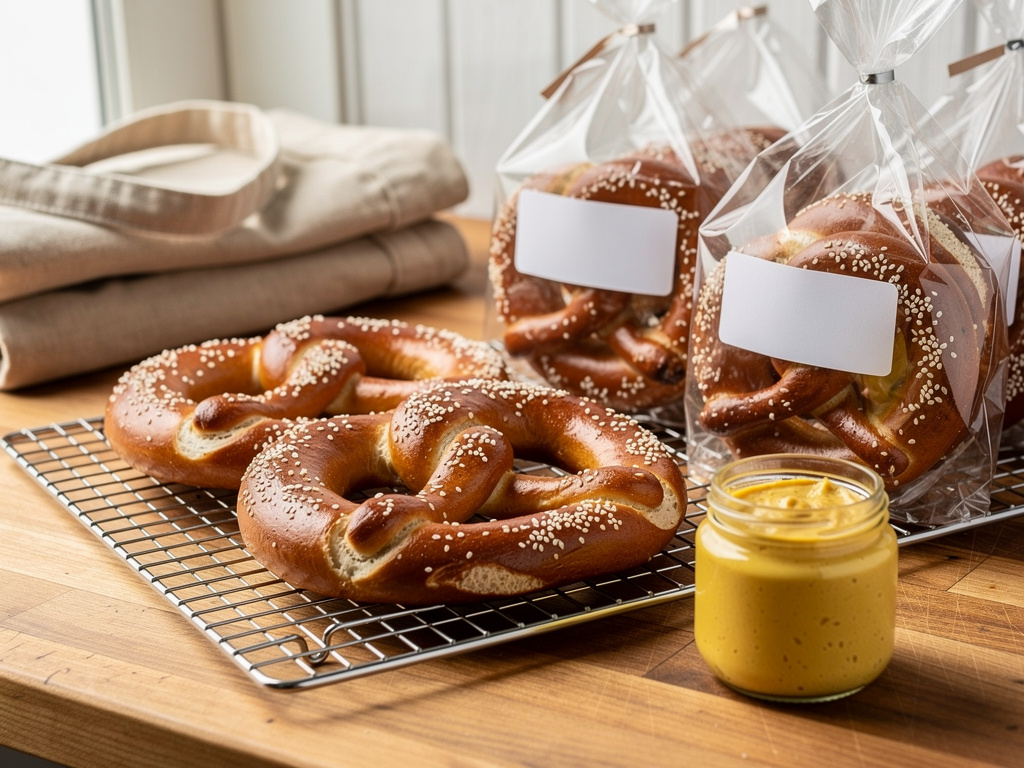


The short version: Yes, in all 9 states we checked you can sell plain homemade soft pretzels and pretzel bites from your home kitchen, because a baked pretzel keeps at room temperature and fits the baked goods category of each state's home food rules (in Wisconsin, a court order rather than a law). California's approved cottage food list names "Pretzels" outright, and so does New York's home processor list. The paperwork runs from nothing at all (Michigan, Ohio, Florida) to a $35 registration with a home kitchen inspection (Pennsylvania), a $100 permit every two years (New Jersey), or a county registration in California, which costs $118 for Class A on Los Angeles County's 2026-2027 fee schedule. The add-ons are where states split: New York bans chocolate on pretzels while Michigan and Ohio name chocolate-covered pretzels as allowed, 5 of the 9 bar cheese-filled pretzels outright (Texas allows them with registration, Ohio with a $10-a-year Home Bakery license and an inspection, Pennsylvania decides case by case, and California's list does not name cheese fillings) and none allows meat-filled ones, homemade mustard is allowed in California and New Jersey but not in Michigan or New York, and a warm pretzel handed over unwrapped at a market usually needs a separate food service permit.
Checked on each state agency's cottage food page, list or rule, September 26, 2026: the rules in this post come from those pages, quoted where it matters, plus the federal rule on lye (21 CFR 184.1763). Laws change, so verify your state's current rules with your state agency or county health department before your first sale. Homegrown takes the orders; it does not make a pretzel legal in your state, customers create a Homegrown account to place their first order, and Homegrown has no drops or countdown release feature.
Your soft pretzels are the thing people ask about. A neighbor wants a dozen for a game day, a coworker wants bites for a birthday party, and the Saturday market manager asked if you would bring some. Before you take the money, settle one question: does your state let you sell pretzels you made in your own kitchen?
For a plain salted pretzel the answer is usually yes. The trouble starts with what goes on or next to it: chocolate, cheese, pepperoni, a homemade mustard, or a warm pretzel pulled from a warmer at your booth. This guide walks through what 9 states actually say, the federal rule on lye, and the pretzel products that cross the line.
Yes, in all 9 states we checked on September 26, 2026, a home baker can sell plain baked soft pretzels in some legal form. The paperwork runs from nothing at all to a registration with a home kitchen inspection. A cottage food law is a state law that lets you make certain low-risk foods at home and sell them without a commercial kitchen, and baked breads are covered by the home food rules of all 9 states we read. In Wisconsin that rule is a court order rather than a law, and DATCP warns that "Ongoing litigation may change the applicability or accuracy" of its guidance.
This page is about the rules. If you want the recipe, the flavors and the booth setup, the companion guide on selling soft pretzels and bites from home covers the business side. What that guide does not do is name states, quote the agencies, or say which add-ons each state allows, and that is what you will find here.
Three things decide your answer:
A baked soft pretzel is flour, water, yeast, sugar, salt and a little fat, baked until the crust is dry, so it does not need a refrigerator to stay safe. That room-temperature test is how 8 states in this guide draw their home food lists; Texas is the exception, since it also allows refrigerated foods once you register, and Ohio offers a separate $10 Home Bakery license for bakery products that need refrigeration. Michigan's agriculture department says cottage foods are those that "can safely be kept at room temperature and do not require refrigeration."
Wisconsin's agriculture department puts it in plain terms for home bakers. Its court-ordered exemption covers baked goods that are "generally exposed to dry heat... at a temperature above 140°F," as in an oven, as long as the finished product is not potentially hazardous. A pretzel baked at 425°F clears that bar easily.
The things that make a pretzel risky are added after or inside the dough:
Keep your pretzel plain or topped with salt, cinnamon sugar or seeds, and it stays inside the bread and baked goods category in every state we checked.
All 9 states in the table below allow plain baked pretzels from a home kitchen, and 2 of them (California and New York) name plain pretzels on their official lists, while the Michigan and Ohio lists name the chocolate-covered kind. The columns that change are the add-ons and the paperwork. Bagels, the other bread that is boiled before it bakes, split the same 9 states on onion, jalapeño and cheese, as our guide to selling homemade bagels lays out.
Swipe the table to see all 9 states and every add-on.
| State | Plain soft pretzels and bites | Chocolate-dipped pretzels | Cheese or meat inside | Homemade mustard | What you file, and the fee |
|---|---|---|---|---|---|
| California | Yes, "Pretzels" is on the CDPH list | Yes, "chocolate-covered nonperishables" are on the candy list | No meat fillings; cheese fillings are not named, and the food must not need refrigeration, so ask your county | Yes, "Mustards (plain, without eggs)" | Registration or permit from your county environmental health office, fee set locally, and a cottage food operator training within three months |
| New York | Yes, "Pretzels" is on the home processor list | No, "No chocolate or candy melts allowed for topping" | No, refrigerated foods are prohibited | No, mustards are prohibited | Home processor registration, no fee |
| Michigan | Yes, under breads and baked goods | Yes, "Chocolate-covered pretzels" is named | Shredded hard cheese in the dough only; no soft cheese, no meat | No, mustard is named as not allowed | Nothing to file, no license |
| Ohio | Yes, under bakery products | Yes, "chocolate covered pretzels" is named | Not as cottage food; a $10-a-year ODA Home Bakery license, with an inspection, covers bakery products that need refrigeration | Not on the list | Nothing to file; label "This Product is Home Produced." |
| New Jersey | Yes, under bread and rolls (submit each product) | Candy is allowed; ask on your product form | No, cheese and meat are prohibited ingredients | Yes, "Vinegar and Mustard" is approved | $100 permit, good for two years |
| Pennsylvania | Yes, as a registered home bakery | Candy making is allowed with registration | Baked goods with meat or cheese may count as hazardous | Ask your inspector | $35 registration plus inspection, $35 a year after |
| Texas | Yes, any food except a short excluded list | Yes | Cheese yes if you register for refrigerated foods; meat no | Not excluded; jarred acidified foods need a batch number and a recipe from an approved source | No filing for plain pretzels, but you must complete an accredited food handler course; DSHS registration for refrigerated foods |
| Florida | Yes, under loaf breads and rolls | "Candies and confections" are on the list | No, low-risk foods only | Not on the list | No state food permit |
| Wisconsin | Yes, oven-baked goods sold direct | Ask DATCP, candy is not covered by the court order | No, potentially hazardous baked goods need a license | Not covered | Nothing to file for baked goods sold direct |
We read each rule on September 26, 2026, on the state agency's own page: CDPH's Approved Cottage Foods list (last reviewed April 2026) and cottage food page, New York Agriculture and Markets' home processing page, MDARD's "What Can I Make?" page, the Ohio Department of Agriculture's cottage food and home bakery pages, the New Jersey Department of Health's approved and prohibited lists and N.J.A.C. 8:24-11, the Pennsylvania Department of Agriculture's Limited Food Establishment page and application packet, Texas DSHS's cottage food page, FDACS's cottage foods page, and Wisconsin DATCP's home bakers page. "Not on the list" means the food is not named on a list that allows only named foods. Confirm with your agency before you sell.
For every other state, the cottage food laws by state guide lists the agency and the sales cap. Look for pretzels under bread or baked goods on your state's list.
In Pennsylvania, a home pretzel baker registers as a Limited Food Establishment, passes a home kitchen inspection, and pays $35, then $35 every year after. Pennsylvania is the state most people link with soft pretzels, so it gets its own section here.
The Pennsylvania Department of Agriculture's Limited Food Establishment page lists both fees, $35 to register and $35 for each annual renewal, and says an inspector visits before the registration is issued.
The department says home kitchens in the program "can only make non-hazardous foods that do not require refrigeration of the finished product," and that you may also need a Retail Food Facility License to sell at an event or a farmers market. We read it on September 26, 2026.
The department's application packet adds the house rules a home pretzel baker lives by:
One break for pretzel bakers: a bakery product you sell directly to the customer, at your home or at your own farmers market stand, does not need a label on the product, as long as the ingredient list is available on request. The department's page asks you to submit everything at least 60 days before you plan to start selling, and its plan review alone takes up to 15 business days before the inspection, so start early. The full walkthrough is in the Pennsylvania cottage food law guide.
New Jersey issues a Cottage Food Operator Permit for $100, good for two years, with sales capped at $50,000 a year under N.J.A.C. 8:24-11. You apply with local zoning approval, a food protection manager certificate, proof of safe water, and a product questionnaire for each product.
The New Jersey Department of Health's approved foods list is short, 18 categories, and pretzels are not one of them by name, so the bread and rolls line is the one that covers you.
The approved list includes bread and rolls under baked goods, and lists "Vinegar and Mustard" as its own approved category. Its "Does NOT Include" list names "Cheese-filled baked goods" and "Baked goods with alcohol." Pretzels are not named, so list them on your product questionnaire. We read it on September 26, 2026.
New Jersey's prohibited ingredients list is the one to read before you plan flavors. It bans cheese, meat, "Fresh Herbs," "Peppers," "Vegetables (fresh, cooked, fried, or dried)" and alcohol as ingredients. That rules out a parmesan-crusted pretzel, any jalapeño pretzel, whether the peppers are fresh or dried, and a beer pretzel. Salt, cinnamon sugar and sesame are the safe toppings; ask on your product questionnaire before using an everything seasoning with dried onion or garlic, since the list bars dried vegetables. More detail sits in the New Jersey cottage food law guide.
Yes, food-grade lye is a legal food ingredient under federal law, and none of the 9 state rules we read treats a lye-dipped pretzel differently from a baking soda one. The FDA's rule at 21 CFR 184.1763 names sodium hydroxide, "also known as... soda lye, caustic soda... and lye," as generally recognized as safe, used "with no limitation other than current good manufacturing practice," with pH control as one of its uses.
The lye bath is what gives a German-style pretzel its deep brown, shiny crust. The baking soda bath most home bakers use does the same job more gently. Either one is a processing step, not a new food category, so it does not move your pretzel off a cottage food list.
What the rule does not cover is your safety in the kitchen:
One Homegrown pretzel roll listing lists "Sodium hydroxide" in its ingredients and describes "a lye bath," which is a clear way to be open about it. If your state requires an ingredient list, ask your agency whether it wants the lye or baking soda named.
In most of the 9 states we checked you can, and Michigan and Ohio name chocolate-covered pretzels outright, but New York does not allow them. Michigan names "Chocolate-covered pretzels" on its allowed list, Ohio names "chocolate covered pretzels" under candy, and California's list allows "chocolate-covered nonperishables." New York's home processor list allows "Pretzels" with the note "No chocolate or candy melts allowed for topping."
A dipped pretzel rod is candy, not bread, in the eyes of several states. Wisconsin's court-ordered home baking rule covers oven-baked goods only, and in November 2024 the state court of appeals reversed the ruling that had extended it to unbaked foods like candy. If you are in Wisconsin, ask DATCP before you sell chocolate-dipped pretzels. In New York, sell them plain. We read both pages on September 26, 2026.
Two practical points once your state says yes:
The rules for candy in general are in can you sell homemade candy, and the pricing for dipped rods is in how much to sell pretzels for.
Usually not under a home food law: of the 9 states in this guide, only Texas allows a cheese-filled pretzel outright under its cottage food law, and Ohio allows one under a separate home bakery license. Pennsylvania decides case by case after a lab test, California's list does not name cheese fillings, and none of the 9 lists meat as allowed. Cheese and meat make a pretzel a food that needs time and temperature control for safety, called a TCS food (older rules say "potentially hazardous"), and most cottage food laws only allow foods that keep at room temperature.
Here is what the states in our table say:
So a cheddar-jalapeño pretzel made with shredded hard cheese in the dough, and jalapeños that are chopped and dried, freeze-dried, or commercially pickled and patted dry (fresh jalapeños are not allowed), may pass in Michigan, while a pretzel stuffed with cheese sauce fails almost everywhere but Texas and a licensed Ohio home bakery. A pretzel dog or pepperoni pretzel fails in every state here that names meat. The guide to TCS foods under cottage food laws lists the states that allow refrigerated foods at all.
Homemade mustard depends on your state, and homemade cheese dip is out almost everywhere. California allows "Mustards (plain, without eggs)" and New Jersey lists "Vinegar and Mustard" as approved, while Michigan names mustard as not allowed and New York prohibits "Sauces, salsas, marinades, mustards, ketchups, vinegars."
Cheese dip is a dairy food that needs refrigeration, which puts it outside every room-temperature cottage food list we read. Texas is the one exception in our table, and only with registration and cold storage.
The easy answer many pretzel vendors use is a sealed, store-bought dip:
The Philly-style pretzel shop on Homegrown with 10 pretzel listings packs brand-name spicy brown mustard packets with its soft pretzels and offers a 3.5 oz brand-name nacho cheese cup as a $3 add-on. A sealed commercial cup is not something you made, so it is not your cottage food. Whether you may resell it next to your pretzels is one question to ask your agency before you add dips.
Usually not under a cottage food law alone: 6 states in this guide set a packaging rule or point hot food and market sales to a separate permit. New York and Michigan require cottage food to be packaged in the home, Texas and Florida require it to be packaged and labeled, New Jersey sends anyone selling hot food to the local health department, and Pennsylvania says a market sale may need a separate retail license. A warm pretzel pulled from a warmer and handed over in a napkin is food service, which needs a permit from your local health department.
Here are those 6 states, in their own words:
If you want to sell hot pretzels from a warmer, look up your county's temporary food establishment permit and ask the market manager what vendors there already hold. That permit usually comes with its own rules on handwashing and hot holding. Selling pretzels baked that morning and bagged at home is the cottage food route; heating and serving them on site is a different permit.
Samples follow the same logic. The farmers market vendor permits by state guide lists who issues market permits in each state.
A pretzel label in the states we read comes down to a few common lines: the product name, your name and address (or a state ID number, or, in New Jersey, your name, business name, permit number and town), the allergens, and in most of them the ingredients from most to least by weight, with California, New York, Ohio, Michigan and Florida also asking for the net quantity. Of the 8 states below, 6 (California, Texas, New Jersey, Ohio, Michigan and Florida) require a home kitchen statement, each in its own words, New York recommends one, and Pennsylvania skips the label for bakery products you sell directly. For pretzels the allergens are almost always wheat, plus milk if you brush on butter and sesame if you top with sesame seeds.
Swipe sideways for each state's label wording.
| State | The home kitchen statement, in the agency's words | Other label rules we read |
|---|---|---|
| California | "Made in a Home Kitchen" in 12-point type on the front panel | Name, city and zip code (a street address too if you are not in a current phone directory), your registration or permit number and the county that issued it, ingredients by weight, net quantity in both English and metric units, allergens |
| Texas | "THIS PRODUCT WAS PRODUCED IN A PRIVATE RESIDENCE THAT IS NOT SUBJECT TO GOVERNMENTAL LICENSING OR INSPECTION." | Your DSHS ID number may replace your home address; add the date made and safe handling text for refrigerated foods |
| New Jersey | "This food is prepared pursuant to N.J.A.C. 8:24-11 in a home kitchen that has not been inspected by the Department of Health." | Your name, business name and permit number, and your town followed by "New Jersey" or "NJ"; the same statement on a placard at your stand |
| Ohio | "This Product is Home Produced." in 10-point type | Ingredients by weight, with sub-ingredients in parentheses |
| Michigan | "Made in a home kitchen that has not been inspected by the Michigan Department of Agriculture & Rural Development" in at least 11-point type | Name and physical address of your home kitchen (or your MSU registration number and phone number), ingredients by weight, net weight or volume with the metric equivalent, allergens |
| Florida | "Made in a cottage food operation that is not subject to Florida's food safety regulations." in at least 10-point type, per Florida Statute 500.80 | Name and address, ingredients by weight, net weight or net volume, allergens |
| New York | A phrase like "Made in a Home Kitchen" is recommended | Name, ingredients, net quantity, processor name and full address |
| Pennsylvania | None required for bakery products you sell directly | Ingredient list available on request; full labels for anything sold through someone else's store |
Statements copied from each agency's page on September 26, 2026. Label rules change more often than the food lists, so check yours before you print a roll of stickers.
The cottage food labeling requirements guide has a full label layout you can copy.
Bag and label at home, before you leave. At 4 pretzels a bag, a market day of 48 pretzels is 12 bags and 12 labels, so print the labels the night before and bag the pretzels as soon as they cool.
You can take orders online in 7 of the 8 states in the table below (Ohio's cottage food page does not address online orders), but shipping is where they differ. New Jersey forbids delivery "by United States postal mail or a common carrier" and any sale outside the state. New York allows internet sales "within New York State only" and says "Shipping products out of state is not permitted."
Slide the table to compare online, mail and out-of-state sales.
| State | Online orders | Mail or shipping | Out of state |
|---|---|---|---|
| New Jersey | Yes, to arrange the sale | No mail or common carrier | No |
| New York | Yes, within New York | Within New York only | No |
| Michigan | Yes, if the buyer can talk with you before the sale | Yes, within Michigan | No |
| Texas | Yes, if you, an employee or a household member deliver it | Not listed as allowed | Not listed as allowed |
| Florida | Yes, on your website | Yes, mail order | The page does not say |
| California | Yes | Yes, "via mail delivery" | Check with your county |
| Pennsylvania | Yes, registration covers "internet sales" from your production site | The page does not say | May also need FDA registration to sell across state lines |
| Ohio | The page does not say | The page does not say | No, cottage foods "may only be sold in Ohio" |
From each agency's page, read September 26, 2026. Where a cell says the page does not say, ask the agency before you ship.
Pretzels also go stale fast, so even where shipping is legal, local pickup is the better fit. A pretzel is at its best within hours of baking, and pre-orders tied to a pickup day let you bake exactly the number you sold.
Usually not under a cottage food law: 4 states in this guide rule it out, and 5 leave a door open. New Jersey bars delivery to "a wholesale establishment" or "a retail food establishment," Florida says "Cottage food products cannot be sold wholesale," Wisconsin says "A business that is wholesaling baked goods must be licensed," and Michigan limits cottage food to "direct sale to customers."
A few states leave the door open:
Breweries are the classic pretzel buyer. If your state allows it, the guide to selling food at brewery taprooms covers how those deals usually work. If not, a licensed commercial kitchen is the legal route.
Soft pretzels, bites and pretzel rolls are a small, real category on Homegrown: 22 listings from 8 vendors in a catalog pull on September 26, 2026. Bites are the biggest group.
In a pull of the Homegrown catalog on September 26, 2026, 22 of the 2,722 products listed by 308 vendors were pretzels, from 8 vendors: 8 soft pretzel listings, 10 pretzel bite listings, and 4 pretzel rolls or loaves. We counted a listing when the thing sold is a pretzel, judged by name and description after reading every listing from each of those vendors; cookies and candy with pretzel pieces, and add-on cheese cups, were not counted. One of the 4 rolls or loaves is a listing titled "Bagels," counted because its description calls it "artisan pretzel bread." One shop accounts for 10 of the 22. No listing sells chocolate-covered pretzels on their own; one treat box offers them as an option.
Pretzel listings on Homegrown by type
Source: Homegrown catalog pull, September 26, 2026, 22 pretzel listings from 8 vendors.
What that tells a new pretzel vendor:
Once your state says yes, the hard part is freshness: a soft pretzel is best the day it is baked, so you want orders in before you mix the dough. Homegrown gives you an ordering page for $10 a month billed annually ($12.50 billed monthly) with no percentage fees beyond standard payment processing. Customers pick their pretzels and a pickup day and pay when they order, so you bake to a real count.
Drag the table sideways to compare the full cost per order and per month.
| Platform | Monthly plan | Trial | Platform fee | Card processing | Customer pays on a $20 order | Vendor pays on a $20 order | Vendor pays in a month of 50 orders at $20 |
|---|---|---|---|---|---|---|---|
| Homegrown | $10 billed annually ($12.50 monthly) | 7 days, no charge until day 8 | None, 0% commission | 2.9% + $0.30, paid by the vendor | $20.00 | $0.88 plus the plan | $54.00 ($56.50 on monthly billing) |
| Hotplate, default | $0 | No plan to try | 5% + $0.55, added to the customer's checkout | 2.9% + $0.30, paid by the vendor | $21.55 | $0.88 | $44.00 |
| Hotplate, vendor covers the fee | $0 | No plan to try | 5% + $0.55, paid by the vendor | 2.9% + $0.30, paid by the vendor | $20.00 | $2.43 | $121.50 |
| Etsy | $0 (one-time set-up fee may apply) | No plan to try | $0.20 listing fee plus 6.5% transaction fee | 3% + $0.25, paid by the vendor | $20.00 plus shipping | $2.35 | $117.50 |
| Shopify Basic | $29 billed yearly ($39 monthly) | 3 days, then $1 a month for 3 months | None with Shopify Payments (2% with another provider) | 2.9% + 30¢ online, paid by the vendor | $20.00 | $0.88 plus the plan | $73.00 ($83.00 on monthly billing) |
| Square Free, online | $0 | No plan to try | None | 3.3% + 30¢ online, paid by the vendor | $20.00 | $0.96 | $48.00 |
We checked every fee on September 26, 2026, on findhomegrown.com/signup, Hotplate's pricing page, Etsy's fees policy and its payment processing help page, Shopify's pricing page and Square's fee help page. Card processing is figured on the $20 price; a platform that charges it on the total with tax, tips or shipping runs a few cents higher. Etsy's month assumes one $0.20 listing per sale and no shipping. Square's in-person rate is 2.6% + 15¢, or $0.67 on $20.
How the alternatives fit a pretzel vendor:
What Homegrown does for a pretzel vendor: pre-orders tied to a pickup day, payment when the order is placed, and one link to share with your market regulars and party customers. The honest bounds: Homegrown does not tell you whether your pretzels are legal in your state, does not print labels, does not ship for you, and has no drops or countdown release feature. Customers create a Homegrown account to place their first order, and while your storefront is listed on the Homegrown marketplace, plan on most orders coming from people you send to your own link.
If your state allows your pretzels and you are tired of counting game-day orders in text threads, set up your Homegrown storefront and list your pretzels with a pickup day.
You can settle your state's pretzel question in one afternoon by reading your state agency's cottage food page for the words pretzel, bread, chocolate, cheese and "packaged." If your state is not one of the 9 states in the table above, this is the order that works.
A written answer from your agency is worth more than any blog post, including this one. Save it with the date and bring a copy to your first market.
It depends on the state. Michigan, Ohio, Florida, Texas and Wisconsin let you sell plain baked pretzels directly to customers with no license (Texas does require an accredited food handler course), New York requires a free home processor registration, New Jersey requires a $100 permit good for two years, Pennsylvania requires a $35 registration and a home kitchen inspection, and California requires a county registration or permit (Los Angeles County charges $118 for Class A) plus a cottage food operator training within three months. Check your own state agency before your first sale, since rules change.
In Michigan and Ohio you do not, because both states name chocolate-covered pretzels as an allowed cottage food. New York's list allows pretzels but says "No chocolate or candy melts allowed for topping," so dipped pretzels need a licensed kitchen there. In Wisconsin, ask DATCP first, because its home exemption covers baked goods, not candy.
Yes, every state in this guide allows it if the pretzels are baked at home, packaged and labeled before you arrive. Serving warm pretzels unwrapped from a warmer usually needs a temporary food permit from your county health department, and Pennsylvania notes a retail license may be needed at a farmers market. Ask the market manager what permits vendors there already hold.
Yes, pretzel bites follow the same rules as full-size pretzels because they are the same baked dough. Keep them plain or topped with salt, cinnamon sugar or dry seasoning, and package them with a label. Cheese-filled bites fall under the stricter rules for cheese in most states.
Yes. The FDA lists food-grade sodium hydroxide, which it also calls lye, as generally recognized as safe under 21 CFR 184.1763. Use food-grade lye, wear gloves and eye protection, and consider naming it on your ingredient list so customers know how the crust was made.
Homemade cheese dip is out under almost every cottage food law, because it is a dairy food that needs refrigeration. Many pretzel vendors offer sealed, shelf-stable cheese cups or mustard packets from a national brand instead. Ask your agency whether you may resell prepackaged items alongside your pretzels.
More on selling pretzels and baked goods legally:
You now know whether your state allows homemade pretzels, which add-ons cross the line, what goes on the label, and why bagged pretzels beat a warmer at a market. The next step is taking orders in a way that fits a product that is best the day it is baked: a set pickup day, payment up front, and a count you can bake to.
A simple way to start: list a 4-pack, a dozen and a bag of bites, open one pickup day a week, and send the link to the people who already ask. Keep your permit or registration number, your label file and your agency's written answer in one folder so a market manager or inspector can see them in 2 minutes.
Start your Homegrown storefront and take pretzel pre-orders by pickup day for $10 a month billed annually ($12.50 billed monthly), with no percentage fees beyond standard payment processing.



