


The short version: A cottage food business is one of the easiest side incomes to start in retirement, because you use your own kitchen, your own recipes and the people you already know. Starting with 3 to 5 shelf-stable products, one pickup day a week and prepaid orders keeps the work to a few days a week and off your feet. If you take Social Security before your full retirement age, your net profit counts toward a 2026 limit of $24,480 ($65,160 in the year you hit that age), so plan your volume around it. Check your state's cottage food rules and your HOA before your first sale.
Checked on October 14, 2026: the earnings limit on the Social Security Administration's working-while-receiving-benefits page, self-employment tax on the IRS page, the Texas and Florida caps on each state's cottage food page, and plan prices and card processing fees on Homegrown's signup page, Hotplate's pricing page and Square's plans page, plus FLIP's cottage food insurance page. Rules differ by state, so verify your state's current rules. On Homegrown, customers create an account to place their first order, and there is no drops (timed release) feature.
You spent forty years being the person who brings the pie. Neighbors ask for your bread recipe. Your church sells out of your fudge at the fall bazaar. Now you have time, a kitchen you know by heart, and a question: could this turn into a little money every month?
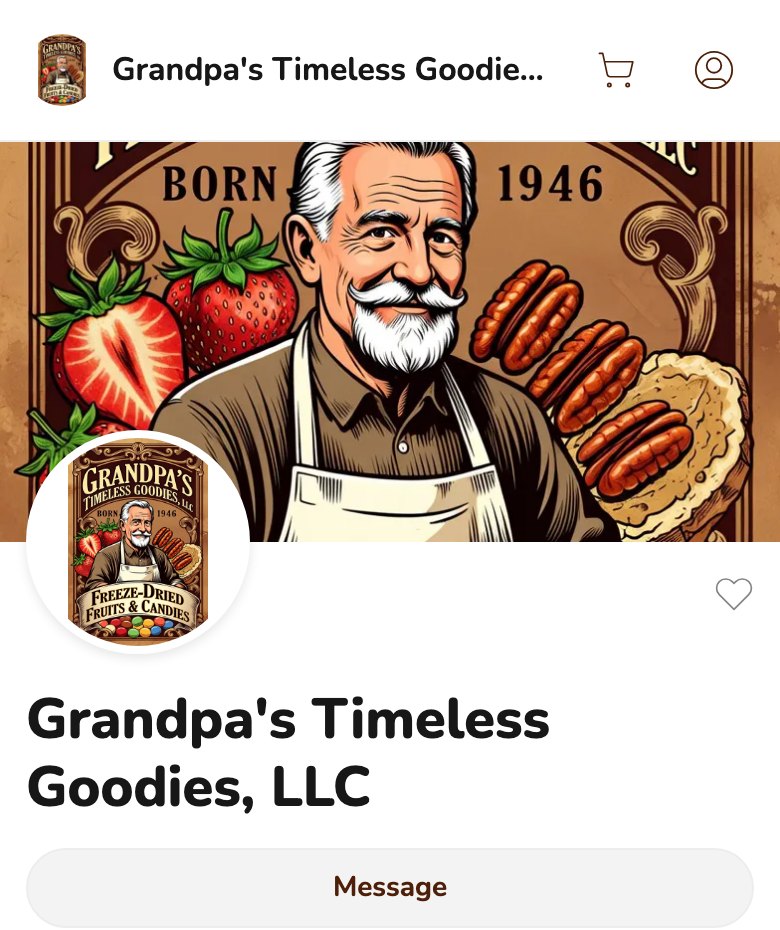
It can. A small food business is one of the few side incomes you can start in retirement with no lease, no staff and no loan. Chris Noble sells as Grandpa's Timeless Goodies in Beaver, Utah. In a review on Homegrown's signup page, he thanked the team for getting his store working online and added: "At 80 years old, I am well beyond my 'best if used by' date!" His store banner says "Born 1946."
This guide is built for that kind of business: sized to your body, your calendar and your Social Security. It covers what you can earn, the two money rules that matter, the state rules, what to sell, where to sell, and a weekly rhythm that still feels like retirement.
A cottage food business is a good fit for a retiree who already cooks or bakes well, because the startup cost can be a few hundred dollars and you control exactly how many hours you work. Cottage food laws let you make lower-risk foods like breads, cookies, jams and candy in your home kitchen and sell them to the public. What counts, where you can sell and how much you can sell all vary by state.
Here is why it fits this stage of life so well:
It is not a fit for everyone. If standing for long stretches is hard, if you dislike handling money or if your HOA bans home businesses, read the sections below before you buy a single bag of flour. For the full step-by-step on permits, labels and your first sale, the complete guide to starting a cottage food business walks through each stage.
If you collect Social Security, read the retiree's guide to cottage food and Social Security too. It goes deeper than this page on how Social Security's yearly earnings limit works.
A retiree selling 8 to 25 orders a week at about $24 an order can keep roughly $500 to $1,570 a month after supplies and fees, in the example below. Your numbers will differ, so treat the table as a way to think, not a promise.
The inputs come from real numbers where we have them. The $24 average order is two products at $12, the median price across the 1,531 baked goods listings on Homegrown in our October 14, 2026 pull. Supplies (ingredients and packaging) are set at 30% of sales as an example; swap in your own. Card processing is Homegrown's 2.9% + $0.30 per order, which is $1.00 on a $24 order, plus the $10 monthly plan.
Scroll sideways to see every column.
| Orders a week | Sales in a 4-week month | Supplies at 30% | Card processing | Homegrown plan | Kept each month | Kept over 12 such months |
|---|---|---|---|---|---|---|
| 8 | $768.00 | $230.40 | $31.87 | $10.00 | $495.73 | $5,948.76 |
| 15 | $1,440.00 | $432.00 | $59.76 | $10.00 | $938.24 | $11,258.88 |
| 25 | $2,400.00 | $720.00 | $99.60 | $10.00 | $1,570.40 | $18,844.80 |
Example inputs, not survey data. Average order $24, supplies 30% of sales, card processing 2.9% + $0.30 per order (about $1.00 on $24), plan $10 a month billed annually. A "month" here is 4 selling weeks, so 12 months is 48 weeks. Insurance, labels, mileage, your time and the self-employment and income tax on this profit are not in this table. Homegrown's fees checked on its signup page and the $12 bakery median from our catalog pull, both on October 14, 2026.
Notice that even the busiest row stays under the 2026 Social Security earnings limit of $24,480. That matters if you claimed benefits early, and the next section explains why.
The bigger lesson in the table is how fast small numbers add up. Moving from 8 to 15 orders a week nearly doubles what you keep, and it is usually just a few more regulars, not more work per order.
Only if you are under your full retirement age and your earnings (any job wages plus your net profit from the business) go over the yearly limit: $24,480 in 2026 if you are under it all year, or $65,160 in the year you reach it. Over the $24,480 limit, Social Security holds back $1 of benefits for every $2 you earn above it. Over the $65,160 limit, it holds back $1 for every $3. The Social Security Administration's page on receiving benefits while working says that for self-employed people it counts "your net profit," not your total sales.
That one word, profit, changes the math in your favor. Flour, butter, jars, labels, your market fee and your card fees come off first. In the table above, $2,400 a month in sales becomes $1,570.40 of profit before any other expenses.
Here is how the rules break down, checked on the SSA site on October 14, 2026:
A worked example: say you are 64, under full retirement age all of 2026, and your food business clears $30,000 in net profit. That is $5,520 over the limit, so $2,760 of benefits would be withheld. SSA also says withheld benefits are not lost; your monthly benefit is raised once you reach full retirement age to account for them.
The limit rises most years. SSA's table of yearly earnings limits already lists 2027 at $25,560, and $67,920 for the year you reach full retirement age. Check the current year's number every January before you plan your volume.
If you are near the line, the Social Security guide for cottage food retirees covers the first-year monthly rule and how to track your income month by month.
Once your net earnings from self-employment reach $400 in a year, you owe self-employment tax of 15.3%, and regular income tax applies on top of it. The IRS self-employment tax page splits that 15.3% into 12.4% for Social Security and 2.9% for Medicare. Being retired does not change it.
The good news is the same as above: it is figured on profit, not sales. So the habits that protect your Social Security also lower your tax bill:
You report the business on Schedule C and figure the self-employment tax on Schedule SE, both filed with your regular Form 1040 return. The Schedule C guide for cottage food vendors walks through which lines your costs go on. If you file with a tax preparer, bring the envelope and the statements; that is most of what they need.
Your state decides which foods you can make at home, where you can sell them and how much you can sell in a year. The rules differ more than most people expect. Two large states show the range.
A 2025 Texas law, SB 541, raised the annual gross income limit to $150,000 from September 1, 2025, according to the Department of State Health Services' cottage food production page. You must complete an accredited food handler training program, and local health departments may not require a permit or charge a fee to produce or sell directly to consumers. Online orders are allowed when you, an employee or a household member delivers the food in person and the label information is posted online before the customer pays.
The Department of Agriculture's cottage foods page caps gross sales at $250,000 a year and requires no state food permit. You can sell in person, on a website or by mail order, but not wholesale to stores.
Both caps are far above anything a retiree side income is likely to reach. Some states set lower caps, require a permit or limit where you can sell, so check before you start. The cottage food laws by state guide is a good first stop, then confirm on your own state agency's page. Verify your state's current rules every year; Texas, for one, rewrote its rules in 2025.
State law is not the only rule. Many HOAs, condo boards and 55-plus communities have rules against home businesses, customer traffic or signs. Read your covenants before you set up porch pickup. The guide to zoning and HOA rules for home stands covers what to look for.
Expect your state to want a label on every package, usually with your name, the product name and the ingredients. Texas, for one, also requires a line saying the food was made in a private home that is not inspected. A food handler course is required in some states, like Texas, and a good idea in all of them. The food handler permit guide explains how to get one.
Pick products that keep for days at room temperature, can be made in batches ahead of time and travel well in a bag. Those three traits cut your standing time, your late nights and your waste.
Good picks for a retiree's first year:
Foods to wait on: anything that needs refrigeration, tall decorated cakes that need delivery, and big-batch bread days that keep you on your feet for ten hours. Some states leave foods that need refrigeration out of their cottage food rules entirely.
In a pull of Homegrown's public catalog on October 14, 2026, baked goods made up 1,531 of 2,914 listings (52.5%), from 193 of 321 vendors, with a median price of $12.00. Pantry goods such as jams, fruit butters, sauces and flour came next at 368 listings from 64 vendors, with a median price of $9.00. We counted by the category each vendor chose for the listing, not by words in the product name.
Homegrown listings by food category
Source: Homegrown public catalog pull, October 14, 2026, 2,914 listings from 321 vendors, counted by the category each vendor chose. Top six food categories shown. Beverages (53), Fruits (35), Seafood (7) and non-food categories are left out of the chart.
Baked goods are the biggest category by a wide margin, about four times the size of the next one. If baking is your strength, you are in good company.
Three to five products is plenty, and plenty of working vendors sell with fewer. In our October 14, 2026 pull of Homegrown's catalog, 127 of the 321 vendors with listings had 5 or fewer, and 83 had 3 or fewer. The median vendor had 7.
Grandpa's Timeless Goodies is one of the small ones. On the day we looked, the store listed three things: freeze-dried strawberries for $8.00, freeze-dried strawberries with bananas for $8.00, and ice cream sandwich bites for $10.00, picked up at the Beaver Farmers Market, with Saturday, October 24 and Saturday, October 31 shown, 9:00 AM to 3:00 PM.
A short menu helps a retiree in three ways:
Add a fourth or fifth item only after the first three sell out on their own for a month. A seasonal item, like pumpkin bread in the fall or fudge in December, is an easy way to test without changing your regular menu.
Most of the cost is your first batch of ingredients and packaging, because you already own the kitchen. The fixed costs are small and you can add them one at a time. Here is what to budget for, with prices where we could check them on October 14, 2026:
The easiest way to keep startup cost low is to start with home pickup and add a market later if you want one. That way the canopy money only gets spent once you know people want your food.
Home pickup with prepaid orders is the easiest place to start, because it needs one 3-hour pickup window a week instead of a full market day, and a farmers market is the best place to meet new customers. You can also do both: a market a few times a month, with orders between markets picked up from your porch.
Swipe left on a phone to see the other columns.
| Where you sell | Time on your feet | Lifting and hauling | Weather | Fees | Waste | Best for |
|---|---|---|---|---|---|---|
| Saturday farmers market | Setup, the full market hours, then teardown | Canopy, tables, weights, coolers and product | You are outside in it | Booth fee set by each market, plus card fees | Higher, since you bake before you know what sells | Meeting new customers |
| Home or porch pickup with prepaid orders | Only while you bake and bag | Bags to the porch | Mostly indoors | Card fees, plus a plan if you use one | Low, since you bake to orders | Regulars, friends, neighbors |
| Both: market twice a month, pickup between | Two long days a month | Two hauls a month | Twice a month | Both of the above | Low on pickup weeks | Growing past your first circle |
A comparison of how each channel works, not survey data. Booth fees vary widely from one market to the next.
If you want the market numbers in detail, the real cost of selling at farmers markets breaks down booth fees, insurance and the hours most vendors forget to count.
Customers can pay you in cash, with a card at your booth, or through an order page that takes cards ahead of time. Each tool charges a different mix of monthly and per-order fees. Here is the full fee stack on a $20 order for five common ways to take payment, checked on October 14, 2026.
Scroll right to see all eight columns.
| Tool | Monthly plan | Trial | Platform fee | Card processing | Customer pays on a $20 order | Vendor pays on a $20 order | Vendor pays in a month of 50 orders at $20 |
|---|---|---|---|---|---|---|---|
| Homegrown | $10 billed annually ($12.50 billed monthly) | 7 days, no charge until day 8 | None (0% commission, no shopper fee) | 2.9% + $0.30, vendor-paid | $20.00 | $0.88 plus the plan | $54.00 ($56.50 billed monthly) |
| Hotplate, default setting | $0 | None (no plan to try) | 5% + $0.55, paid by the customer | 2.9% + $0.30 (vendor pays) | $21.55 | About $0.88 to $0.92 | About $44.00 to $46.25 |
| Hotplate, vendor pays the fee | $0 | None (no plan to try) | 5% + $0.55, paid by the vendor | 2.9% + $0.30, paid by the vendor | $20.00 | $2.43 | $121.50 |
| Square Online, Square Free plan | $0 | None (the plan is $0) | None | 3.3% + 30¢ online, paid by the vendor | $20.00 | $0.96 | $48.00 |
| Square reader at a market booth | $0 (Square Free) | None (the plan is $0) | None, but the market charges a booth fee | 2.6% + 15¢ in person, paid by the vendor | $20.00 | $0.67 plus the booth fee | $33.50 plus booth fees |
Card fees are figured on the $20 price. Hotplate's default row is a range because its post "What Hotplate does" says chefs pay 2.9% of the transaction plus 30 cents, which is about $0.92 if figured on the full $21.55 charge and $0.88 on the $20 order. Hotplate's pricing page says the fee split is "your choice," and the same post says 80% of Hotplate chefs keep the default of passing it to the customer. We checked Homegrown's signup page, Hotplate's pricing page and post, and Square's plans page on October 14, 2026. Sales tax and tips change the exact cents.
Cash still works fine for friends. The problem shows up at 15 orders a week: you are counting change, chasing "I'll pay you Saturday," and baking for people who forget to come. Prepaid orders fix that, which is why the order page matters more than the difference in fees between most of these tools.
If you want prepaid orders on the days you choose, without living on your phone, Homegrown costs $10 per month billed annually ($12.50 billed monthly), with no percentage fees beyond standard payment processing. You share one link with your church group, neighbors and card club. They see your menu, pick a pickup day and pay by card. You get a list of what to bake.
What matters most for a retiree:
Hotplate charges no monthly plan, but by default adds 5% + $0.55 to each customer's order, the vendor still pays 2.9% + $0.30 card processing, and it is built around drops (orders that open for a short window). Square Online's free plan costs $0 a month and charges 3.3% + 30¢ card processing per online order, inside a full store builder. Frontier Farms' Drew Byra wrote on Homegrown's signup page: "Square is like 500 menus."
What Homegrown does not do: customers create a Homegrown account to place their first order, and there is no drops feature. Your storefront is listed on Homegrown's marketplace, but plan on most orders coming from your own link. You pay the card processing, and 20% of each order is held for 30 days before it releases to your bank.
If juggling texts is the part you dread, set up your storefront and send the link to three friends first. The 7-day trial means no charge until day 8, so you see whether your circle orders before you pay.
Pick one pickup day, close orders 2 days before it, and keep the real work to 3 days: one to shop, one to bake and one for pickup. A fixed rhythm is what keeps a side income from spreading into every day. Here is one example week built around Saturday pickup:
Sunday is yours, Tuesday and Wednesday are close to it, and so is any week you want off. If you travel for a month, turn off pickup days or pause the plan, and tell your regulars the date you will be back.
Start with the people who already ask for your food, then let them bring their friends. Twenty regulars ordering every other week is about 10 orders a week, which lands between the first two rows of the income table.
Places retirees find their first customers:
Word of mouth does most of the work after that. The word-of-mouth marketing guide has simple ways to make it easy for happy customers to tell others.
Price each item to cover ingredients, packaging, card fees and an hourly wage you would accept for your time. It is easy to price like a church bake sale and end up working for almost nothing.
Here is a worked example for one dozen cookies, with example inputs you can swap for your own:
For comparison, the middle half of baked goods listings on Homegrown were priced between $6.00 and $16.00 on October 14, 2026. Those listings run from a single cookie to a whole cake, so compare your dozen against other dozens sold near you. The baked goods pricing guide shows how to price by the piece, the dozen and the batch.
The big one is saying yes to everything, until the side income has taken over your week. The rest follow from it:
Most of these come down to one habit: write the rules of your business down before the first order, while you are calm. Decide your menu, your pickup day, your order cutoff and your weekly cap on one sheet of paper and tape it inside a kitchen cabinet. When a neighbor asks for 6 dozen cookies by tomorrow, the answer is already on the sheet, and it is easier to point to a rule than to say no to a friend.
Then check the sheet every 3 months. If you are selling out every week and still feel rested, raise the cap a little. If you dread Fridays, cut a product or move to every other week. A side income that you quit after one tired winter earns less than a smaller one you keep for ten years.
Decide how big the business should be before customers decide for you, and write that number down as a weekly order cap, such as 15 orders. Pair the cap with a short menu and prepaid pickup, set up from the first week.
Set a weekly cap before the first order comes in. If 15 orders a week is your limit, work out what that is in product, such as 15 dozen cookies, and set your quantities so they add up to that across your whole menu. Reset them at the start of each week. When they reach zero, you are done for the week, and the number does the saying no for you. Raise the cap by 5 only after four weeks in a row of selling out without feeling worn out.
Guard the days off too. A pickup window of three hours once a week is a part-time job. Orders any day, at any hour, by text, is a second career. Seen this way, the choice is not how hard to work but which of those two businesses you want to run. When you are ready to set the cap, build your Homegrown storefront and list your first three products with the quantities you want to sell.
Yes. Cottage food laws let people of any age make certain lower-risk foods, like baked goods, jams and candy, in their home kitchen and sell them directly to customers. Each state sets its own list of allowed foods, sales limits and permit rules, so check your state agency's page before your first sale.
It can. While you are under full retirement age for the whole year, Social Security counts your net profit from self-employment toward a yearly limit of $24,480 in 2026, and holds back $1 of benefits for every $2 of profit over it. In the year you turn that age, the limit rises to $65,160 and $1 is held back for every $3 over it. From the month you reach full retirement age, there is no limit.
It depends on how many orders you take. In a worked example at $24 an order with supplies at 30% of sales, 8 orders a week keeps about $496 a month and 25 orders a week keeps about $1,570 a month after card fees and a $10 plan. Where a retiree side income food business lands depends on your prices, your costs and how many regulars order each week.
It depends on your state. Florida requires no state food permit for cottage food, and Texas does not let local health departments require one, though Texas requires a food handler course and state registration for foods that need temperature control. Some other states require a registration, a permit or a kitchen inspection, so look up your own state's rules.
Shelf-stable baked goods like cookies, bars and quick breads are the easiest for most people, because they keep for days and are widely allowed under cottage food laws. On Homegrown, baked goods made up 52.5% of listings in October 2026. Jams, candy and granola are good second choices.
Yes. On Homegrown you can pause your plan, which removes your products and selling but keeps your account and messages, and resume when you are back. That way a retiree side income food business can fit around travel months and family visits. Tell your regulars your return date so they come back with you.
More guides for selling food on your own schedule:
Your recipes are already the hard part. The rest is a short menu, one pickup day and a link your friends can use. Start your Homegrown storefront, add three products, and let your regulars know where to order.



